1. Introduction
Mango (
Mangifera Indica. L) is a green fruit crop inherent to southern Asia
| [1] | W. C. and L. lin Zhang Dong, “Yield gap and production constraints of mango (Mangifera indica) cropping systems in Tianyang County, China,” J. Integr. Agric., vol. 18, no. 8, pp. 1726–1736, 2019. |
[1]
. It belongs to the family
anacardiaceous that is grown in more than 85% with total area coverage and production on 3.7 million hectares and 55 million tons, respectively in the world by the year 2019
| [2] | FAO, Evaluation of the “Food-loss reduction through improved postharvest handling and value-addition of key fruits and vegetables” project in Ethiopia. 2021. |
[2]
. It is among the most frequently grown and productive tropical and subtropical fruit crops.
| [3] | Tewodros, “Mango (Mangifera indica L.) production practices and constraints in major production regions of Ethiopia,” African J. Agric. Res., vol. 14, no. June, pp. 185–196, 2019. |
[3]
.
One of Ethiopia's most popular fruits, the mango is a tropical fruit that is quite seasonal
| [4] | D. Habtamu, “Review on Contribution of fruits and vegetables in security in Ethiopia,” J. Biol. Agric. Healthc., vol. 6, no. 11, pp. 49–58, 2016. |
[4]
. In Ethiopia, it produced mostly in west and east of Oromia, southern nation, nationalities and peoples, Benshangul Gumuz, Harari and Gambella regions
| [5] | Yigzaw, “Mango Production Knowledge and Technological Gaps of Smallholder Farmers in Amhara Region, Ethiopia,” Am. Sci. Res. J. Eng. Technol. Sci., vol. 10, no. 1, pp. 28–39, 2014. |
[5]
. It is the second fruit crop produced in Ethiopia next to banana and it covered about 24,153.66 hectare from 150,959.93-hectare total area covered by fruit crops. A total of 142,630.11 tons of mango fruit was produced with a production level of 5.91 tons per hectare during cropping season
| [6] | C. statistic Agency, “The Federal Democratic Republic of Ethiopia Ethiopian Statistics Service Report On Area and Production of Major Crops,” Ethiopia. |
[6]
. In Oromia, mango is covered about 10,240.90 hectares of land. A total of 61,988.81 tons of mango was produced with a productivity level of 6.05 tons per hectare during Maher cropping season
| [6] | C. statistic Agency, “The Federal Democratic Republic of Ethiopia Ethiopian Statistics Service Report On Area and Production of Major Crops,” Ethiopia. |
[6]
. Among the main mango growing regions in Ethiopia are western and eastern parts, which account for 28 and 23% of Addis Ababa wholesale market share, respectively
| [7] | Mekonnen Tensaw, “Assessment of Postharvest Handling Practices, Loss and Quality of Mango (Mangifera Indica L.) Ecotypes Fruit In Harari Region, Ethiopia,” Haramaya, 2020. |
[7]
.
Minerals, vitamins, carbs, dietary fibre, water, phenol chemicals, and antioxidants can all be found in mango fruit
| [8] | Belsti Lelisa, “Assessment Of Heavy Metal Status In Fresh And Canned Fruits, Vegetable Collected From Supermarket And Irrigation Farms Of Akaki, Awash, Arba Minch Areas, Ethiopia.,” Arba MInch University, 2018. |
[8]
. Crucial for industrial processes for both home and foreign markets
| [9] | Takele Honja, “Review of Mango Value Chain in Ethiopia,” J. Biol. Agric. Healthc., vol. 4, no. 25, pp. 230–240, 2014. |
[9]
. In addition to serving as raw materials for local food processing businesses and the mango fruit industry, it is utilized to address the worldwide problem of food security and to create jobs, especially in rural areas
| [4] | D. Habtamu, “Review on Contribution of fruits and vegetables in security in Ethiopia,” J. Biol. Agric. Healthc., vol. 6, no. 11, pp. 49–58, 2016. |
[4]
.
Grading goods based on their size, shape, color, ripeness, and maturity is called grading
| [10] | S. V. S. Kalpesh M. Deshmukh, Parag D. Varma, Deep V. Varma, Ganesh B. There, “Design and Development of Orange Fruit Grading Machine,” IOSR J. Eng., vol. 10, no. 1, pp. 59–66, 2020. |
[10]
. It was utilized to lower handling losses in packing, shipping, and size reduction. In a number of processing processes, it saves time, energy, and resources while lowering labor costs
| [11] | S. Shahir and V. Thirupathi, “Performance evaluation of a divergent roller grader for selected vegetables,” AMA, Agric. Mech. Asia, Africa Lat. Am., vol. 40, no. 4, pp. 60–62, 2009. |
[11]
.
While this approach is costly, and labor shortages during peak seasons have an impact on size grading operations
| [12] | Alebel, “Assessment and Management of White Mango Scale (Aulacaspise Tubercularis Newstead) On Mango (Mangifera Indica L.) In Bahirdar Zuria District, North Western Ethiopia,” Bahir Dar University, 2022. |
[12]
. Grading by hand can be laborious, unreliable, and ineffective. In order to reduce labor shortages, save time, and enhance the quality of graded goods, farmers are looking for appropriate fruit crop processing technology, such as grading machines. Fruit crop grading is crucial for increasing product value in local markets and boosting national competitiveness through exports to foreign markets
| [13] | Mostafa, “Development of Affordable Machine for Size grading for Egyptian Onion,” Agric. Eng. Int. CIGR Ejournal., vol. 10, no. 10, pp. 1–10, 2009. |
[13]
.
Fruit size uniformity is ensured by size grading machines, which also help growers boost output while reducing expenses and labor needs. Mango exports and commercialization are greatly impacted by the size grading of mangoes after harvest. This is crucial since fruit with higher quality grades sells for more money and is in greater demand. The complete external appeal of a mango fruit influences a customer's decision to buy it. Most of the difference between high-quality and low-quality crops can be attributed to postharvest processing skills and methods
| [14] | Alejadro, “Grading and sorting of Carabao mangoes using probabilistic neural network,” in AIP Electronic and green Materials international Conference proceeding, Manila, Philippines: School of Electrical, Electronics, and Computer Engineering, Mapúa University, 2018, pp. 15–18. |
[14]
.
In Ethiopia, grading crops by hand takes several long days for farmers, agents, wholesalers, merchants, and consumers. Manual grading is time-consuming, labor-intensive, and may be negatively impacted by a labor shortage during busy times
| [15] | M. E. Akram et al., “Development, Fabrication and Performance Evaluation of Mango Pulp Extractor for Cottage Industry,” AgriEngineering, vol. 3, pp. 827–839, 2021. |
[15]
. The machine lowers the hazards connected with the requirement for additional labor and enhances the farmer's capacity to complete tasks quickly
| [16] | Temesgen, “The Newly Emerging Pest White Mango Scale, in Ethiopia,” no. August, 2021. |
[16]
. They used to lower postharvest losses, encourage local production of machinery and equipment, boost rural economic development, and contribute to both national and local food security
| [17] | Khandetod, “Mechanization in Horticulture Crops: Present Status and Future Scope,” Adv. Agric. Res. Technol. J. n, vol. 3, no. 1, pp. 92–103, 2019. |
[17]
. Mango fruit grading machines will benefit farmers, wholesalers, and retailers in the future.
Farmers in Ethiopia use hand grading to sell their mango fruit at market. However, retailers and full sellers use manual grading, which increases their profit margin compared to farmers. Manual grading is challenging, time-consuming, labor-intensive, and not standardized. It also raises concerns about the consistency of graded materials and increases the possibility of combining mango fruits of different sizes. Significant problems in the fruit marketing business included a lack of market data, inadequate institutions, and inadequate marketing infrastructures (bad storage, inadequate packing, inadequate post-harvest handling methods, and nonscientific grading and standards
| [18] | Mengesha, “Marketing System Analysis of Vegetables and Fruits in Amhara Regional State : Survey Evidence from Raya Kobo and Harbu Woredas,” Addis Ababa, 2016. |
[18]
.
A few of the marketing concerns raised by farmers and traders include the absence of a mango fruit size grading machine, competition during the peak of production, which drives down the price of mangoes, quality problems resulting from premature mango harvest, a lack of market connectivity among actors in the value chain, price variation, and transportation issues
| [19] | T. Gutema and A. Tadesse, “Assessment of post-harvest handling of mango and evaluation of mango jam in major mango producing areas of South Omo Zone, SNNPR, Ethiopia,” vol. 12, no. June, pp. 155–160, 2022. |
[19]
. The demand for food, feed, and biological industrial raw materials from domestic supply chains, rural infrastructure, and service providers was increasing due to grading machines
| [17] | Khandetod, “Mechanization in Horticulture Crops: Present Status and Future Scope,” Adv. Agric. Res. Technol. J. n, vol. 3, no. 1, pp. 92–103, 2019. |
[17]
.
Due to intense competition from all over the world, the agricultural sector today needs mechanization in order to meet market demands as demanded by the World Trade Organization. For the design of new machinery and equipment used for mango harvesting, processing, and storage, the lack of engineering attributes, such as the physical and frictional characteristics of mango fruits, was an unidentified challenge
| [20] | S. A. Soomro and Z. A. Khan, “Effect of Grain Moisture Content on Physico-Engineering,” Int. J. Sci. Eng. Res., vol. 8, no. 6, pp. 1796–1805, 2017. |
[20]
.
The current research proposal was undertaken to design, build, and assess the performance of a mango grading machine as well as to ascertain the physical and frictional characteristics of the local mango variety, given the needs of the local market and the lack of affordable mango size grading machines for small-scale farmers. Thus, the goal of this study was to ensure that an alternative, appropriate, reliable, and user-friendly mango fruit grading machine would be designed for farmers, investors, and small businesses.
Objective
To design and evaluate the performance of a mango fruit grading machine which was capable of grading mango fruits into three different sizes in terms of uniformity.
2. Materials and Methods
2.1. Description of Experimental Site
The experiment was conducted at Bako Agricultural Engineering Research Center (BAERC), Oromia Agricultural Research Institute (OARI). BAERC is located in Bako Town of Tibe Woreda, West Shoa Zone Oromia Regional State, Ethiopia.
2.2. Experimental Materials and Instruments
Materials used to construct and evaluate mango fruits size grading machine was obtained from Bako Agricultural Engineering Research Centers. Materials that used for construction of the components of the mango fruits size grading machine were selected based on strength, availability, durability and cost. Sheet metal, angle Iron, shaft, flat bar, UCP bearings, bolts and nuts, water pipe, pulleys, chain, metal wheel, sprockets and belt were used in the construction of the mango fruits size grading machine. The experimental instruments used for the evaluation of mango fruits size grading machine were: digital balance, tachometer, digital Vernier caliper, measuring tape, measuring cylinder, and stop watch and 5hp ACME diesel engine was used as a power source.
2.3. Description the Components of Grading Machine
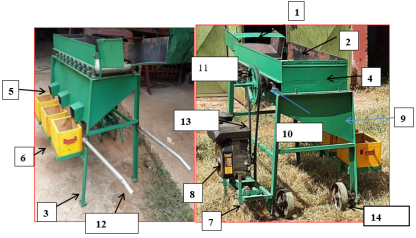
The major component parts of mango fruit size grading machine: - feeding table, grading unit roller, grading cover, sorting table, outlets, collection boxes, power transmission system (pulleys, belts, Engine sit, chain and sprockets), metal wheel and main frame.
Figure 1. Shows the components parts of mango grader Machine.
1. Feeding table, 2. Grading unit, 3. Main frame, 4. Grading unit Cover, 5. Outlets, 6. Collection boxes, 7. Engine sit, 8. Engine, 9. Sorting table, 10. Chain and sprockets, 11. Pulley, 12. Handle, 13. Belt and 14. Metal wheel.
2.4. Working Principles of Mango Fruits Size Grading Machine
With three roller partitions for each size, the mango fruit size grading machine was developed to classify mango fruits into three size ranges: tiny (less than 57 mm), medium (between 57 and 65 mm), and large (more than 65 mm). International criteria for the marketable size of man-go fruits appropriate for commercial purposes served as the basis for the creation of these size categories
| [21] | Ashraf, “Design, Development and Performance Evaluation of Fruit and Vegetable Grader,” J. Agric. Sci., vol. 44, no. 4, pp. 704–713, 2007. |
[21]
.
Mango fruits are manually dumped onto the feeding table, and the machine's feeding rate and rotating roller speed were adjusted. During rotation, fruit with small, medium, and large diameters pass through the appropriate roller and are gathered in boxes. The amount of graded mango fruits was then noted, along with the duration of operation from fruit feeding to the end. Lastly, the mango fruit size machine's fuel and energy consumption, fruit damage percentage (%), grading efficiency (%), and grading capacity (kg/hr) were all calculated.
2.5. Performance Evaluation of Mango Fruits Size Grading Machine
2.5.1. Experimental Design
The experiment was conducted with a 32 full factorial in a completely randomized design (CRD), which has two factors i.e., feed rate and roller speed. The design was 32 factorial combinations with three replication and giving 27 total experimental units (3x3x3=27). The treatments were three levels of roller speeds (120, 150 and 200 rpm), and three levels of feeding rates (10, 15 and 20 kg/min).
Table 1. Experimental design full factorial deign 32.
Factors 2: Feed Rate (F) | Factors 1: Roller Speed (V) |
V1 | V2 | V3 |
F1 | F1V1 | F1V2 | F1V3 |
F2 | F2V1 | F2V2 | F2V3 |
F3 | F3V1 | F3V2 | F3V3 |
Where: - F=Feed rate and V= Speed
Performance Evaluation of Mango Fruit Size Grading Machine
Over the course of the test runs, 405 kilograms of mango fruit samples were employed. Nine groups with little, medium, and large fruits each were created from the samples. Mango fruit was fed to each group at rates of 10, 15, and 20 kg/min. lastly; the size mango grader's performance was assessed in terms of fuel consumption, fixed and variable expenses, damaged mango fruit percentage, grading efficiency, and grading capacity.
2.5.2. Grading Capacity
Grading capacity of a mango fruit size grader was determined on from the amount of fruit graded within a specific period of time.
Grading capacity () =(1)
2.5.3. Grading Efficiency
The grading efficiency of the outlet was calculated according to the following equation. (
2) (Mostafa and Bahnasawy, 2009).
ɳ1=x 100, ɳ2 =x 100, ɳ3=x 100 (2)
Where:
η1, η2, η3 = grading efficiency for small, medium and large size respectively.
N1, N2, N3= the no of correctly graded fruits for small, medium and large respectively n1, n2, n3 = the total no of fruits passed through the rollers for small, medium and large size.
The total size grading efficiency of the machine was calculated from the average of efficiencies of each size by using the following equation:
Where: ηTotal is the total grading efficiency of the machine (%),
η1, η2, η3 are the efficiencies of fruits for small, medium, and large outlet respectively.
2.5.4. Fruit Damage
After grading, mango fruit skin damage was taken into consideration. Visual inspection, hand sorting, and balance was used to weigh damaged fruit. The weight of the actual injured mango fruit to the sample weight was used to calculate the amount of fruits damage using equation (
4)
| [23] | R. Prajwal, V. T. Mujtabha, V. N. Meghana, and E. P. Kumar, “Design and Development of Pedal Operated Maize Sheller for Small and Marginal Farmers,” Int. J. Curr. Microbiol. Appl. Sci., vol. 10, no. 01, pp. 1135–1144, 2021. |
[23]
.
Fruit damage (%) =x100%(4)
Where: FD=Fruit damage (%), Md1, Md2 and Md3 are the mass of damaged fruit collected at small, medium and large size collection unit (kg) respectively and Mt=Total mass of the sample (kg).
2.5.5. Fuel Consumption
The amount of fuel used at a specific feeding rate and the roller speed was measured by using refilling methods. Firstly, machine was kept on a level surface. Then, before the test starts, the fuel tank was filled with fuel up to the top and motor was turned on and start grading operation. After grading the engine was turned off, and the tank was filled back up to its initial level known amount of measured fuel in the measuring cylinder. Finally, the amount of fuel used for size grading machine was assessed by subtracting the amount of fuel in measuring cylinder before and after filling in to the engine tank.
Where: Fc=Fuel consumption (l/hr.), Fr =Refilled quantity of fuel (l) and t = time taken for grading (hr.)
2.6. Cost Analysis of Mango Fruit Size Grading Machine
The initial cost of mango fruit size grading machine was calculated by adding up the cost of each component involved in the prototype. They added to a percentage for prototype fabrication cost and marginal profit of manufacturer. The cost of mango fruit size grading machine was divided into two categories: fixed cost and variable cost. Finally, the grader prototype's operational costs were calculated.
2.7. Methods of Machine Design and Data Analysis
The components of mango fruit size grading machine were designed and assembled by using solid work software version 2018. The data collected in excel and analyzed by analysis of variance (ANOVA) using statistical procedure as described by Gomez and Gomez (1984). The analysis was performed by using statics 8-software (version 8, 2017). The effect of variation between the experimental treatment (main effect) and their interactions effects were analyzed. All values are represented as mean ± standard deviation. Finally, the least significant difference (LSD) between the mean of the treatment test was performed and assessed the difference among the treatments at a 5% level of significance.
3. Results and Discussions
Mango fruit size grading machine based on mango fruits size and entitled” design, construction, and performance evaluation of engine operated mango fruits size grading machine’’ was designed, constructed, and evaluated for its performance.
Performance of Mango Fruits Size Grading Machine
The main and combined effect of rotating roller speed and feed rate on mango fruits size grading machine performance was studied. The grading capacity (GC), grading efficiency (GE), fruit damage (FD), fuel consumption (FC), and consumed energy (CE) were estimated.
Table 2. Interaction effect of the roller speed and feed rate on the performance of mango fruits size grading machine.
Speed (rpm) | Feed rate (Kg/min) | GC (Kg/hr.) | GSE (%) | FD (%) | FC (mL/kg) |
120 | 10 | 1162.42 ± 32.51f | 90.66 ± 0.31a | 0.37 ± 0.02g | 1.23 ± 0.03g |
15 | 1346.48 ± 30.78e | 88.53 ± 0.25b | 0.57 ± 0.06 f | 1.66 ± 0.27f |
20 | 1663.67 ± 22.12d | 87.63 ± 0.25c | 1.86 ± 0.02e | 1.86 ± 0.21ef |
150 | 10 | 1344.70 ± 42.98e | 85.47 ± 0.28 d | 2.14 ± 0.02 d | 2.05 ± 0.17de |
15 | 1677.12 ± 18.55cd | 84.62 ± 0.24 e | 2.35 ± 0.01c | 2.30 ± 0.06cd |
20 | 1920.81 ± 21.51b | 83.36 ± 0.34f | 2.41 ± 0.03c | 2.43 ± 0.04c |
200 | 10 | 1666.35± 215.15d | 82.42 ± 0.23g | 2.53 ± 0.03b | 2.56 ± 0.07bc |
15 | 1844.86 ±199.24bc | 81.39 ± 0.32h | 2.59 ± 0.08b | 2.72 ± 0.12ab |
20 | 2584.86 ± 31.98 a | 79.03 ± 0.36 i | 2.67 ± 0.07a | 2.88 ± 0.24a |
SEM | | 58.43 | 0.17 | 0.02 | 0.09 |
LSD (0.05) | | 173.59 | 0.49 | 0.07 | 0.27 |
CV (%) | | 5.99 | 0.34 | 2.16 | 7.32 |
All values are mean ± standard deviation, and mean values followed by the same letter in a column are not significantly different at 5% level of significance. GC=Grading capacity (kg/hr.), GSE=Grading system efficiency (%), FD=Fruit damage (%), FC= Fuel consumption (mL/kg), CV = coefficient of variation, (%), LSD=List significance difference, SEM=Standard error of means.
Interaction effect of roller speed and feed rate on the performance of mango fruit size grading machine
Effect of rotating roller speed and feed rate on grading capacity
The mean of mango fruit size grading capacity and analysis of variance were presented in
Table 2. The interaction effect of rollers speed and feeding rate were also significant at the same level. The maximum grading capacity of 2584.86 Kg/hr. was recorded when the grading rollers speed was 200 rpm and the feed rate was 20 kg/min and the minimum grading capacity of 1162.42 Kg/hr. was recorded when the grading rollers speed was 120 rpm and the feed rate was 10 kg/min.
Effect of rotating roller speed and feed rate on size grading efficiency
The analysis of the grading efficiency of mango fruits size grader is given in
Table 2. The interaction of rollers speed, and feed rate were significant at 5% level. As can be seen from
Table 2, the maximum grading efficiency of 90.66% was observed at rollers speed of 120 rpm and feeding rate of 10 kg/min. and the minimum grading efficiency of 79.03% was observed at rollers speed of 200 rpm and feeding rate of 20 kg/min. The decrease in the percentage of grading efficiency by increasing the mango fruit feed rate is attributed to the excessive mango fruits in the grading unit.
Effect of rotating roller speed and feed rate on fruits damage
Mean percent of fruit damage of mango fruits at various roller speeds and feed rate was given in
Table 2. The least percent fruit fruits damage of 0.37% was observed at roller speed of 120 rpm, and feed rate of 10 kg/min. Maximum percent fruits damage of 2.67% was occurred when roller speed was operated at speed of 200 rpm and feeding rate of 20 kg/min. It was observed that the damage percentage of mango increased when the rotational speed of the grading unit increased. This increase may have happened due to the increase in the rolling action of mango fruits, which is always associated with the increase in the physical contact between mango fruits and results in abrasion of the fruits cover
| [24] | Dereje Alemu, “Design, Manufacturing and Performance Evaluation of Potato Grading Machine,” Haramaya University, 2019. |
[24]
.
Effect of rotating roller speed and feed rate on fuel consumption
The mean fuel consumption, in milliliters per kilogram (mL/kg), of mango fruits size grading machine which operated at different roller speeds, and feed rates was given in
Table 2. Fuel consumption of the size grading machine increased with increasing roller speeds and feed rates. The least fuel consumption of 1.23 mL/kg was observed at roller speed of 120 rpm and feed rate of 10 kg/min. Maximum fuel consumption of 2.88% was occurred when the grading machine was operated at speed of 200 rpm and feed rate of 20 kg/min. The increase in the amount of fuel requirements by increasing feed rate is attributed to the excessive mango fruits materials in the grading unit, which increases the load on the roller caused more fuel consumed.
Effect of rotating roller speed and feed rate on energy consumption of mango fruits grading machine
The mean energy consumption (w.hr/kg) of mango fruits size grader operated at different roller speeds, and feed rates was given in
Table 2. It increased with increasing roller speeds and feed rates. Energy consumption of the size grading machine decreased with increasing roller speeds and feed rates. The least energy consumption of 1.45 mL/kg was observed at roller speed of 200 rpm and feed rate of 20 kg/min. The maximum energy consumption of 3.23% was obtained when the mango fruit size grading machine was operated at speed of 120 rpm and feed rate of 10 kg/min (
Table 2). This is due to the incensement of the grading capacity of grading machine. The decrease in the amount of energy requirements by increasing feed rate is attributed to the excessive mango fruits materials in the grading unit, which decreases the load on the roller caused less energy consumed.
4. Conclusions and Recommendations
4.1. Conclusions
This study was conducted to design, construct and evaluate the performance of engine operated mango fruits size grading machine. It consists of mainframe, feeding table, grading unit, grading unit cover, outlets, collection boxes, engine sit, and wheel, handle and power transmission system. Grading capacity ranges from 1162.42 to 2584.86 kg/hr., grading efficiency ranges from 90.66 to 79.03%, percentage of fruit damage ranges from 0.37 to 2.67%. Fuel consumption ranges from 1.23 to 2.88 mL/kg, energy consumption ranges from 3.23 to 1.45 w.hr/kg when roller speeds increase from 120 rpm to 200 rpm and feed rate from 10 to 20kg/min. The maximum grading capacity of 2584.86 kg/hr. was obtained at the grading roller speed of 200 rpm and at feed rate of 20 kg/min. The maximum grading efficiency of 90.66% was obtained when the grading unit was operated at speed of 120 rpm and a feed rate of 10 kg/min. It was observed that the lowest percentage of fruit damage (0.37%) was obtained at 120 rpm speed and 10 kg/min feed rate while the highest percent of fruit damage (2.67%) was observed at 20 kg/min and 200 rpm rotational speed.
Accordingly, the following observations were made: Grading capacity, fruits damage and fuel Consumptions were increased with increasing roller speed and feed rate and decreases when the roller speed and feeding rates decreases. Both grading efficiency and energy consumption decreased with increasing roller speed and feed rates.
4.2. Recommendations
From the study the following recommendation was made:
1) Mango fruits size grading machine should be revaluated at more roller speeds, feed rates and inclination angles by using different varieties of mango fruits.
2) This study was determined some engineering properties of mango fruits. Especially physical and frictional properties only. Other engineering properties of mango fruit that used for mango fruit designing machine need further study.
3) The grading roller part of the machine should be made from galvanized hallow pipes so that the frictional damage of mango tuber can be further reduced.
4) The mango fruit size grading machine could be used to grade other crops such as potatoes, orange, avocado and apples based on their engineering properties.





 Share This Article
 Twitter
 Linked In
 Facebook
 Copy
Copy Download