Abstract
This manuscript interrogates how climate stress, household poverty, and the dowry/bride price converge to commodify girls and precipitate girl child marriage in Marsabit County, Kenya. It relies solely on findings from a mixed?methods study’s dataset in 296 household surveys (98.7% response), 16 key informant interviews (80%), 9 focus group discussions (90%), and a transect walk across villages in Buri Aramia, Balla, Korr, Namarei, and Ngurnit Community Health Units. Quantitative analyses (descriptives, chi?square tests, cross?tabs, and hierarchical binary logistic regression) and qualitative themes are integrated to explain mechanisms and pathways. Three results stand out, the first, drought?linked livelihood strain and sparse local markets observed during the transect walk coincide with household narratives of using marriage as a coping strategy to obtain bride wealth, reduce dependents, and manage risk. Second, economic pressure is a strong, independent predictor of earlier marriage: each one?unit increase in the economic composite is associated with more than double the odds of marrying at 18 or older (Odd Ratio (OR)=2.429; 95% Confidence Interval (CI)≈1.363–4.330; p=0.003) that is, stronger economic capacity protects against girl child marriage. Third, commodification of girls is explicit in community accounts and survey frequencies: the practice of exchanging dowry/bride price and the perception that marriage reduces household burden are widely endorsed as “likely” drivers (≥75–90% across related items). Based only on the study’s evidence, climate?exacerbated poverty intensifies a transactional logic around girls’ bodies and futures. Effective measures therefore must be locally grounded to protect schooling continuity during drought months, reduce reliance on dowry through livelihood support, and shift norms via community leadership while enforcing consent and age standards.
Keywords
Climate Stress, Drought, Poverty, Dowry, Child Marriage, Kenya
1. Introduction
Marsabit County in northern Kenya is an arid and semi-arid area which is one of the country’s drought-prone regions, where pastoralist communities depend almost entirely on livestock for their survival and face persistent environmental and economic challenges
| [23] | Kenya National Bureau of Statistics. (2020). 2019 Kenya Population and Housing Census: Volume I-IV. KNBS.
https://www.knbs.or.ke/2019-kenya-population-and-housing-census-reports/ |
| [26] | Kok, M. C., Kakal, T., Kassegne, A. B., Hidayana, I. M., Munthali, A., Menon, J. A., … Van Der Kwaak, A. (2023). Drivers of child marriage in specific settings of Ethiopia, Indonesia, Kenya, Malawi, Mozambique and Zambia—Findings from the Yes I Do! baseline study. BMC Public Health, 23, 794. https://doi.org/10.1186/s12889-023-15697-6 |
[23, 26]
. Recurrent droughts, intensified by climate change, regularly devastate herds of camels, goats, and cattle which are the main source of food, income, and wealth leaving families in deepening poverty with few alternative ways to earn a living. Access to essential services remains severely limited in these remote areas: schools are often far from homes, economic opportunities outside pastoralism are scarce, and girls in particular encounter major obstacles to continuing their education
| [46] | Zaid Obuyi, R. (2024). Effects of Climate Change on Women’s Security Dynamics in Baragoi, Samburu County, Kenya. The Journal of Social Encounters, 8(2), 259-290.
https://doi.org/10.69755/2995-2212.1290 |
[46]
. In this context of chronic vulnerability, girl child marriage has long served as a coping strategy for many households. When economic pressures mount especially during severe droughts, families tend to arrange early marriages for daughters to secure bride price in the form of livestock, providing immediate resources or easing the strain on limited household food supplies. This practice is rooted in cultural norms but amplified by poverty and climate-related shocks that treat girls as economic assets
| [21] | Izugbara, C., Suubi, K., Afifu, C., Salami, T., Opondo, E., & Plan International Team. (2024). The persistence of high rates of child marriage in Sub-Saharan Africa, the Middle East and North Africa, and Asia: A scoping review. Health Care for Women International, 1-24.
https://doi.org/10.1080/07399332.2024.2385328 |
[21]
. This study investigates a central question on how do climate-induced droughts, poverty, and the role of dowry or bride price interact to perpetuate girl child marriages in Marsabit County. Child marriage undermines progress toward the Sustainable Development Goals (SDGs), particularly SDG 5 on Gender Equality and women’s empowerment encompassing SDG 5.3, which aims at ending child, early, and forced marriages by 2030. Child marriage is also linked to SDG 1 on reduction of poverty, SDG 3 on good health and well-being, SDG 4 on education for girls in helping break poverty and inequality, and SDG 10 addressing reduction in inequalities and income disparities regardless of age, sex or ethnicity within and among countries. International organizations such as United Nations Fund for Population Activities and United Nations International Children's Emergency Fund have prioritized elimination of child marriage by 2030, advocating for stronger legal enforcement, education access, and economic empowerment
| [13] | Cordova-Pozo, K. L., Anishettar, S. S., Kumar, M., & Chokhandre, P. K. (2023). Trends in child marriage, sexual violence, early sexual intercourse and the challenges for policy interventions to meet the sustainable development goals. International Journal for Equity in Health, 22(1), 250.
https://doi.org/10.1186/s12939-023-02060-9 |
| [24] | Kenya National Bureau of Statistics (KNBS). (2023). Kenya Demographic and Health Survey 2022. KNBS.
https://www.knbs.or.ke/reports/kdhs-2022/ |
| [40] | United Nations Population Fund and United Nations Children's Fund. (2023). UNFPA-UNICEF Global Programme to End Child Marriage. Retrieved from https://www.unfpa.org/unfpa-unicef-global-programme-end-child-marriage |
[13, 24, 40]
.
This study is relevant to current global, national, and regional priorities such as the Sustainable Development Goals (SDGs), Kenya Vision 2030, and the research gaps in Kenya on child marriage. At a broader level, child marriage hampers the achievement of SDG 5 on gender equality and women’s empowerment encompassing SDG 5.3, which aims at ending child, early, and forced marriages by 2030. This study is linked to SDG 1 on reduction of poverty, SDG 3 on good health and well-being, SDG 4 on education for girls in helping break poverty and inequality, and SDG 10 addressing reduction in inequalities and income disparities regardless of age, sex or ethnicity within and among countries. Likewise, Kenya’s national development framework, Vision 2030, emphasizes equity, gender equality, and education as key aspects of sustainable development. However, child marriage is still persistent in the pastoralist communities, including Marsabit County, subjecting girls to child marriage that only serves to perpetuate poverty, gender subordination, discriminations, and limited educational opportunities for the girls.
2. Statement of the Problem
In Marsabit, girl child marriage practice arises from a complex combination of climate-driven scarcity, economic hardship, and deeply entrenched socio-cultural norms
| [19] | Heise, L., Greene, M. E., Opper, N., Stavropoulou, M., Harper, C., Nascimento, M., … Gupta, G. R. (2019). Gender inequality and restrictive gender norms: Framing the challenges to health. The Lancet, 393(10189), 2440-2454.
https://doi.org/10.1016/S0140-6736(19)30652-X |
| [25] | Kidman, R., Dietrich, J. J., Hornschuh, S., Madi, P., Ramsammy, C. W., Tsotetsi, L., Tshabalala, G., et al. (2024). Drivers of child marriages for girls: A prospective study in a low-income African setting. Global Public Health, 19(1), Article 2335356. https://doi.org/10.1080/17441692.2024.2335356. |
| [37] | Psaki, S. R., Melnikas, A. J., Haque, E., Saul, G., Misunas, C., Patel, S. K., … Amin, S. (2021). What are the drivers of child marriage? A conceptual framework to guide policies and programs. Journal of Adolescent Health, 69(6), S13-S22.
https://doi.org/10.1016/j.jadohealth.2021.09.015 |
[19, 25, 37]
. Pastoralist communities here depend heavily on livestock for survival, but recurrent droughts made worse by climate change cause massive animal losses, plunging families into poverty. With few alternative income sources and schools often requiring long commutes of up to 15 km (one way), education especially for girls frequently gets disrupted
| [24] | Kenya National Bureau of Statistics (KNBS). (2023). Kenya Demographic and Health Survey 2022. KNBS.
https://www.knbs.or.ke/reports/kdhs-2022/ |
| [32] | Neema, S., Muhumuza, C., Nakigudde, R., Uldbjerg, C. S., Tagoola, F. M., & Muhwezi, E. (2021). “Trading daughters for livestock”: Facilitators of child marriage in Lira district, Northern Uganda. African Journal of Reproductive Health, 25(3), 83-93. https://doi.org/10.29063/AJRH2021/V25I3.10 |
[24, 32]
. In times of acute crisis, particularly after droughts, many families turn to girl child marriage as a survival strategy, marrying off young daughters to secure dowry in the form of livestock or cash, build social alliances, or simply reduce the number of dependents at home
. This effectively turns girls into economic assets, a choice reinforced by gender norms, ideas of honor and stigma, and the authority of elders
| [14] | Elnakib, S., Ali, A. K., Mieth, K., & Chandra-Mouli, V. (2024). Mapping the evidence on interventions that mitigate the health, educational, social and economic impacts of child marriage and address the needs of child brides: A systematic scoping review. Sexual and Reproductive Health Matters, 32(1), 2449310. https://doi.org/10.1080/26410397.2024.2449310 |
| [18] | Greene, M. E., & Stiefvater, E. (2019). Social norms and child marriage: The limits of law and policy. Journal of International Development, 31(6), 977-993.
https://doi.org/10.1002/jid.3431 |
[14, 18]
. Although Kenya has strong laws prohibiting girl child marriage, enforcement in remote rural areas like in Marsabit County is weak, leaving girls highly vulnerable
| [9] | Calhoun, M. (2024). Child, early, and forced marriage: An international human rights crisis. Georgetown Journal of International Affairs, 25(1), 151-159.
https://doi.org/10.1353/gia.2024.a934898 |
| [41] | Van der Vyver, J. D. (2021). Child marriage in Africa. In M. C. Green, E. Chitando, & J. Witte Jr. (Eds.), Law, religion and the family in Africa. Lightening Source Inc. |
| [42] | Warria, A. (2019). Child marriages, child protection and sustainable development in Kenya. African Journal of Reproductive Health, 23(2), 121-133.
https://doi.org/10.29063/ajrh2019/v23i2.12 |
[9, 41, 42]
. Much existing research focuses mainly on cultural factors, while paying less attention to the critical role of the link between climate and poverty creating a gap in understanding and in designing effective, locally relevant solutions
| [13] | Cordova-Pozo, K. L., Anishettar, S. S., Kumar, M., & Chokhandre, P. K. (2023). Trends in child marriage, sexual violence, early sexual intercourse and the challenges for policy interventions to meet the sustainable development goals. International Journal for Equity in Health, 22(1), 250.
https://doi.org/10.1186/s12939-023-02060-9 |
| [21] | Izugbara, C., Suubi, K., Afifu, C., Salami, T., Opondo, E., & Plan International Team. (2024). The persistence of high rates of child marriage in Sub-Saharan Africa, the Middle East and North Africa, and Asia: A scoping review. Health Care for Women International, 1-24.
https://doi.org/10.1080/07399332.2024.2385328 |
[13, 21]
. This study sought to address that gap by examining how recurrent droughts linked to climate change, ongoing poverty, and the economic commodification of girls work together to keep girl child marriage prevalent in Marsabit County, Kenya. Through a mixed-methods approach, it aims to:
1) Describe the broader context of scarcity and limited access to services;
2) Measure the connection between economic and material pressures and the age at first marriage for girls; and
3) Investigate how factors like education and timely support such as cash transfers, school feeding programs, and school fees waivers can help break girl child marriage cycle.
3. Research Objective
The specific objectives of this study were to:
1) To explore climate-related hardships and household decisions concerning girls’ marriage in Marsabit County, Kenya.
2) To quantify associations between economic pressures and girl’s age at first marriage in Marsabit County, Kenya.
3) To examine how bride price and ideas of “reducing family burdens” treat girls as economic commodities in Marsabit County, Kenya.
4. Research Question
1) How do climate-related hardships, such as recurrent droughts, influence household decisions regarding the timing and arrangement of girls’ marriages in Marsabit County, Kenya?
2) What are the quantifiable associations between economic pressures and the age at which girls first marry in Marsabit County, Kenya?
3) What ways do practices of bride price and narratives around “reducing family burdens” contribute to the commodification of girls within pastoralist households in Marsabit County, Kenya?
5. Literature Review
Globally, child marriage is widely understood as a multi-causal phenomenon shaped by poverty, gender inequality, weak schooling systems, and restrictive social norms. Recent scholarship has moved away from single-factor explanations and instead emphasizes the interaction between household economics, girls’ limited agency, and institutional weakness
| [4] | Banlanjo, N. M. (2022). Cultural pedogamy: Towards an eco-cultural theory of early (child) marriage. European Journal of Humanities and Social Sciences, 2(6), 98-102.
https://doi.org/10.24018/ejsocial.2022.2.6.334 |
| [34] | Pastén, R., Figueroa, E., & Fuentes, M. (2024). Not a dream wedding: The hidden nexus between gender discrimination, climate change and child marriage. Environment, Development and Sustainability. Advance online publication.
https://doi.org/10.1007/s10668-024-05074-7 |
[4, 34]
. This shift is important because it shows that girl child marriage is not simply a cultural practice, but one embedded in wider structures of inequality. Across Africa, the literature shows that girl child marriage often persists where economic insecurity and normative pressure reinforce one another. Studies have found that poverty, weak legal enforcement, and expectations around girls’ sexuality, obedience, and family honour continue to sustain early marriage even where formal protections exist
| [1] | Adola, S. G., & Wirtu, D. (2024). Effects of early marriage among women married before age 18: A qualitative study in Ethiopia. Frontiers in Sociology, 9, Article 1412133.
https://doi.org/10.3389/fsoc.2024.1412133 |
| [18] | Greene, M. E., & Stiefvater, E. (2019). Social norms and child marriage: The limits of law and policy. Journal of International Development, 31(6), 977-993.
https://doi.org/10.1002/jid.3431 |
[1, 18]
. Research from crisis-affected settings further shows that families may turn to marriage to reduce household burdens or secure material support when livelihoods deteriorate
| [13] | Cordova-Pozo, K. L., Anishettar, S. S., Kumar, M., & Chokhandre, P. K. (2023). Trends in child marriage, sexual violence, early sexual intercourse and the challenges for policy interventions to meet the sustainable development goals. International Journal for Equity in Health, 22(1), 250.
https://doi.org/10.1186/s12939-023-02060-9 |
| [32] | Neema, S., Muhumuza, C., Nakigudde, R., Uldbjerg, C. S., Tagoola, F. M., & Muhwezi, E. (2021). “Trading daughters for livestock”: Facilitators of child marriage in Lira district, Northern Uganda. African Journal of Reproductive Health, 25(3), 83-93. https://doi.org/10.29063/AJRH2021/V25I3.10 |
[13, 32]
. In Kenya, emerging evidence suggests that climate-related stress may intensify these pressures, especially in Arid and Semi-Arid Land (ASAL).
| [43] | Williams, E. M., Tejedor-Garavito, N., Bonnie, A., Dorey, P., Priyatikanto, R., Tatem, A. J.,... & Musyoka, M. (2025). Child Marriage and Climatic Factors: Evidence from Survey Data in Kenya. https://doi.org/10.21203/rs.3.rs-7797744/v1 |
[43]
report an association between climatic stress and higher girl child marriage prevalence, while
| [15] | Esho, T., Komba, E., Richard, F., & Shell-Duncan, B. (2021). Intersections between climate change and female genital mutilation among the Maasai of Kajiado County, Kenya. Journal of Global Health, 11. https://doi.org/10.7189/jogh.11.04060 |
[15]
show that prolonged drought can deepen gender inequality in pastoral communities. Yet national or regional associations do not fully explain the household mechanisms through which environmental stress affects marital decisions. In Marsabit County, this gap is specifically evident. Honor operates as a reputational currency in this moral economy as transferring a “pure” daughter at the right time accrues status and claims on future help, resisting may be read as antisocial, with material consequences
. Simultaneously, household liquidity constraints heighten reliance on coping strategies, while social norms may frame early marriage as both protective and honorable. Although drought, livestock loss, poverty, and weak service access are well documented
| [23] | Kenya National Bureau of Statistics. (2020). 2019 Kenya Population and Housing Census: Volume I-IV. KNBS.
https://www.knbs.or.ke/2019-kenya-population-and-housing-census-reports/ |
| [26] | Kok, M. C., Kakal, T., Kassegne, A. B., Hidayana, I. M., Munthali, A., Menon, J. A., … Van Der Kwaak, A. (2023). Drivers of child marriage in specific settings of Ethiopia, Indonesia, Kenya, Malawi, Mozambique and Zambia—Findings from the Yes I Do! baseline study. BMC Public Health, 23, 794. https://doi.org/10.1186/s12889-023-15697-6 |
[23, 26]
, little research has examined how these conditions interact with bride price and burden-reduction narratives. This study addresses that gap by analysing girl child marriage not as a direct outcome of climate stress alone, but as a product of its interaction with poverty and socially sanctioned marriage practices.
5.1. Theoretical Review/Framework
Bronfenbrenner posits that development unfolds within nested systems micro (household), meso (schools, faith groups), exo (local economy/services), and macro (state policy, culture)
| [7] | Bronfenbrenner, U. (2000). Ecological systems theory. American Psychological Association. |
[7]
. Climate variability and recurrent droughts belong to the macro ecology; their economic aftershocks (livestock loss, price spikes, degraded services) operate at exo/meso levels; and the resulting income compression, food insecurity, and school discontinuity reorganize micro decisions. Heise and colleagues extend ecological thinking to gender and health by foregrounding restrictive gender norms and institutional weaknesses as cross-level mechanisms that channel risk
| [38] | Sadownik, A. R. (2023). Bronfenbrenner: Ecology of human development in ecology of collaboration. In A. R. Sadownik & M. D. Otterstad (Eds.), Re-theorising more-than-parental involvement in early childhood education and care (pp. 57-74). Springer. https://doi.org/10.1007/978-3-031-38762-3_4 |
[38]
. Applied here, climate shocks raise the opportunity cost of keeping girls in school, erode safety nets, and increase the salience of marriage as a coping strategy.
5.1.1. Social Norms Theory
According to
| [36] | Pourtaheri, A., Sany, S. B. T., Aghaee, M. A., Ahangari, H., & Peyman, N. (2023). Prevalence and factors associated with child marriage, a systematic review. BMC women's health, 23(1), 531. https://doi.org/10.1186/s12905-023-02634-3 |
[36]
social norms theory provides a robust framework for understanding how collective behaviors emerge and persist, particularly under conditions of scarcity, where social expectations can transform resource constraints into perceived moral imperatives.
| [2] | Armara, M. G. (2024). Effects of climate variability on livelihood choices and gender roles among pastoral and agro-pastoral communities in Marsabit County, Kenya (Doctoral dissertation, University of Nairobi). University of Nairobi Digital Repository. |
[2]
posits that social norms are sustained by two interlocking types of expectations; empirical expectations (beliefs about what others in a reference group do) and normative expectations (beliefs about what others expect one ought to do, often backed by social approval or disapproval). Compliance with these norms is enforced through social rewards (such as status, inclusion) or punishments (such as stigma, exclusion), with third-party actors such as community leaders or peers playing a critical role in monitoring and sanctioning behavior as argued by
| [31] | Musembi, C. N., Ndong, E., & Nyukuri, C. (2025). After the Law: From Legislative Success to Community-Level Action to End Child Marriage in Kenya. E. Afr. LJ, 30. |
[31]
.
This framework illuminates why certain practices, such as girl child marriage in drought-affected pastoralist communities persist despite legal prohibitions or individual dissent, as social norms convert material scarcity into a socially sanctioned obligation
| [18] | Greene, M. E., & Stiefvater, E. (2019). Social norms and child marriage: The limits of law and policy. Journal of International Development, 31(6), 977-993.
https://doi.org/10.1002/jid.3431 |
| [42] | Warria, A. (2019). Child marriages, child protection and sustainable development in Kenya. African Journal of Reproductive Health, 23(2), 121-133.
https://doi.org/10.29063/ajrh2019/v23i2.12 |
[18, 42]
. In contexts of environmental stress, such as prolonged drought in pastoralist settlements like those in Marsabit county, Kenya, social norms theory elucidates how scarcity recalibrates both empirical and normative expectations, driving behaviors that might otherwise be contested
| [31] | Musembi, C. N., Ndong, E., & Nyukuri, C. (2025). After the Law: From Legislative Success to Community-Level Action to End Child Marriage in Kenya. E. Afr. LJ, 30. |
[31]
. Drought exacerbates resource insecurity, reducing access to livestock, water, and grazing land which are core assets in pastoralist economies
| [26] | Kok, M. C., Kakal, T., Kassegne, A. B., Hidayana, I. M., Munthali, A., Menon, J. A., … Van Der Kwaak, A. (2023). Drivers of child marriage in specific settings of Ethiopia, Indonesia, Kenya, Malawi, Mozambique and Zambia—Findings from the Yes I Do! baseline study. BMC Public Health, 23, 794. https://doi.org/10.1186/s12889-023-15697-6 |
[26]
. This scarcity reshapes empirical expectations, as families observe an uptick in early unions, leading to a shared perception of earlier marriage
| [20] | Ikamari, L. (2023). Regional variation in early marriage in Kenya. Journal of African Population Studies, 36 (1), Article 5283. https://doi.org/10.59147/eA88lpdQ |
| [37] | Psaki, S. R., Melnikas, A. J., Haque, E., Saul, G., Misunas, C., Patel, S. K., … Amin, S. (2021). What are the drivers of child marriage? A conceptual framework to guide policies and programs. Journal of Adolescent Health, 69(6), S13-S22.
https://doi.org/10.1016/j.jadohealth.2021.09.015 |
[20, 37]
. Concurrently, normative expectations are intensified by discourses of virginity, honor, and lineage preservation, which frame early marriage as a moral duty to protect family reputation and secure alliances
| [28] | Male, C., & Wodon, Q. (2018). Girls’ education and child marriage in West and Central Africa: Trends, impacts, costs, and solutions. Forum for Social Economics, 47(2), 262-274. https://doi.org/10.1080/07360932.2018.1451771 |
[28]
. These expectations are not merely internalized but are actively enforced by third-party actors, such as elders, age-set leaders, and religious authorities, who wield significant social capital
. These enforcers translate reputational risks such as stigma or ostracism into material consequences, including restricted access to communal resources like livestock loans, mutual-aid networks, or dispute-resolution mechanisms
| [17] | Gero, C. (2025). The Relationship Between (Rapid) Repeat Adolescent Pregnancy and Early Marriage-Case Study of Kenya. https://hdl.handle.net/10281/542583 |
| [21] | Izugbara, C., Suubi, K., Afifu, C., Salami, T., Opondo, E., & Plan International Team. (2024). The persistence of high rates of child marriage in Sub-Saharan Africa, the Middle East and North Africa, and Asia: A scoping review. Health Care for Women International, 1-24.
https://doi.org/10.1080/07399332.2024.2385328 |
[17, 21]
. The result is a normative trap where families who resist girl child marriage face not only social disapproval but also tangible losses that undermine their survival in a resource-scarce environment
| [14] | Elnakib, S., Ali, A. K., Mieth, K., & Chandra-Mouli, V. (2024). Mapping the evidence on interventions that mitigate the health, educational, social and economic impacts of child marriage and address the needs of child brides: A systematic scoping review. Sexual and Reproductive Health Matters, 32(1), 2449310. https://doi.org/10.1080/26410397.2024.2449310 |
[14]
.
5.1.2. Theory of Gender and Power
Raewyn Connell’s Theory of Gender and Power, as adapted by
, provides a structural lens for understanding how gendered inequalities institutionalize practices like girl child marriage, particularly under conditions of environmental and economic stress. The theory delineates three interlocking structures: the sexual division of labor, which assigns roles based on gender; the sexual division of power, which concentrates authority in male-dominated hierarchies; and cathexis, the cultural and affective norms that shape desire, sexuality, and social bonds
| [11] | Connell, R. (2013). Gender and power: Society, the person and sexual politics. John Wiley & Sons. |
[11]
. In pastoralist communities like those in Marsabit County Kenya, these structures converge to render girls’ bodies exchangeable assets, transforming familial survival strategies into gendered transactions that are socially legitimized and institutionally entrenched.
The sexual division of labor is amplified under climate stress, such as prolonged drought, which intensifies unpaid labor demands on girls and women
| [25] | Kidman, R., Dietrich, J. J., Hornschuh, S., Madi, P., Ramsammy, C. W., Tsotetsi, L., Tshabalala, G., et al. (2024). Drivers of child marriages for girls: A prospective study in a low-income African setting. Global Public Health, 19(1), Article 2335356. https://doi.org/10.1080/17441692.2024.2335356. |
[25]
. Tasks such as water hauling, herding support, and sibling caregiving expand tethering girls to domestic roles that limit their access to education and economic autonomy
. This labor asymmetry reinforces girls’ economic dependency, positioning them as resources within family survival strategies
| [21] | Izugbara, C., Suubi, K., Afifu, C., Salami, T., Opondo, E., & Plan International Team. (2024). The persistence of high rates of child marriage in Sub-Saharan Africa, the Middle East and North Africa, and Asia: A scoping review. Health Care for Women International, 1-24.
https://doi.org/10.1080/07399332.2024.2385328 |
[21]
. Concurrently, the sexual division of power concentrates decision-making authority in male elders and husbands, who control assets such as livestock and social contracts such as marriage agreements
. In Marsabit, this manifests in elder-driven marriage negotiations, where bridewealth often in the form of livestock or cash serves as a mechanism to restock herds, settle debts, or secure alliances
. Cathexis provides the ideological scaffolding for these transactions, embedding them within cultural narratives of purity, obedience, and family honor
. By framing early marriage as a virtuous act that safeguards a girl’s chastity and upholds lineage, cathexis normalizes the commodification of girls as a socially approved response to scarcity.
Overall, ecological theory locates the climate–poverty shock, social norms specify the sanctionable rules families face under that pressure, gender and power theory shows how authority and labor regimes make girls’ “consent” non-decisive, marriage-market logics explain timing and pricing, and eco-cultural political economy situates all of this in pastoral systems where exchange, honor, and insurance are braided. Together, these theories provide a concise but coherent framework that both organizes the constructs used in this study (drought exposure, poverty, elder consent, stigma, polygyny, education) and clarifies their relationships. Climate stress and poverty heighten liquidity needs; gendered power and norms convert those needs into moral obligations; marriage markets and pastoral exchange institutions translate obligations into transactions, producing the observed commodification of girls in Marsabit County.
5.2. Empirical Review
The empirical review in this section synthesizes existing evidence from ethnographic, qualitative, mixed-methods, and broader regional studies on the interplay between climate-related hardships and child/early marriage practices in pastoralist communities. Drawing primarily on recent and foundational works relevant to arid/semi-arid contexts in Kenya and Sub-Saharan Africa.
5.2.1. Climate-Related Hardships and Household Decisions on Girls’ Marriage
Ethnographic and mixed-methods research in East Africa pastoralist communities demonstrates how climate shocks, particularly droughts and erratic rainfall, disrupt pastoral and agro-pastoral livelihoods, prompts most households to advance girls’ marriages as a survival strategy. Multi-country analyses across Ethiopia, Kenya, Malawi, Mozambique, Zambia, and Indonesia show that recurrent climate shocks compress household resources, increase male out-migration, and accelerate girls’ transition from school to marriage
| [27] | Lanyasunya, R., Ngala, F. B. J. A., & Tikoko, B. T. (2023). Relationship between ecological, economic, conflict, socio-cultural factors and enrolment of girls in rural public primary schools in Samburu County, Kenya. Journal of Education and Learning (JEL), 2(1), 154-160.
https://doi.org/10.51317/jel.v2i1.454 |
[27]
. Similar patterns appear in northern Uganda, where crop failures drive elders to exchange daughters for livestock
| [32] | Neema, S., Muhumuza, C., Nakigudde, R., Uldbjerg, C. S., Tagoola, F. M., & Muhwezi, E. (2021). “Trading daughters for livestock”: Facilitators of child marriage in Lira district, Northern Uganda. African Journal of Reproductive Health, 25(3), 83-93. https://doi.org/10.29063/AJRH2021/V25I3.10 |
[32]
. In Maasai and related communities in Kenya, severe droughts lead families to use bridewealth often in the form of livestock to restock herds, repay debts, or secure supports from affine. These findings illustrate how environmental stressors directly shape marital decisions by heightening the perceived economic value of early unions.
5.2.2. Associations Between Economic Pressures and Girls’ Age at First Marriage
Large-scale quantitative studies consistently link economic deprivation and income volatility to earlier marriage ages. Global syntheses quantify the role of marriage as informal insurance against binding poverty, estimating substantial lifetime losses in earnings and health for girls married early
| [6] | Bolarinwa, O. A., Ahinkorah, B. O., Okyere, J., Seidu, A.-A., & Olagunju, O. S. (2022). A multilevel analysis of prevalence and factors associated with female child marriage in Nigeria using the 2018 nigeria demographic and Health Survey Data. BMC Women’s Health, 22(1). https://doi.org/10.1186/s12905-022-01733-x |
[6]
. Household and district-level research in India reveals that higher poverty and limited labor markets reduce age at marriage, even after controlling for education and urban residence
. Comparable multilevel evidence from Nigeria and provincial data from Iran associates low wealth and unstable incomes with increased girl child marriage
| [3] | Asnaashary, M., Farzanegan, M. R., Feizi, M., & Gholipour, H. F. (2024). Economic determinants of child marriage: Evidence from the Iranian provinces. Children and Youth Services Review, 159, 107518.
https://doi.org/10.1016/j.childyouth.2024.107518 |
| [6] | Bolarinwa, O. A., Ahinkorah, B. O., Okyere, J., Seidu, A.-A., & Olagunju, O. S. (2022). A multilevel analysis of prevalence and factors associated with female child marriage in Nigeria using the 2018 nigeria demographic and Health Survey Data. BMC Women’s Health, 22(1). https://doi.org/10.1186/s12905-022-01733-x |
[3, 6]
. Collectively, these studies establish poverty as a key transmission mechanism that lowers the age at first marriage under conditions of material hardship.
Additionally, emerging research in Kenya demonstrates how climatic stressors further intensify economic pressures, accelerating girls' early marriage in climate-vulnerable arid regions. Recent evidence from Kenya highlights how climatic factors compound economic hardship to drive earlier marriage among girls, particularly in Arid and Semi-Arid Lands (ASALs). Williams et al. (2025) used 2014 and 2022 Kenya Demographic and Health Survey data with geospatial analysis to show a significant positive link between high temperatures and higher girl child marriage prevalence, even after controlling for socioeconomic variables. Hotter sub-counties, especially in coastal and north-eastern areas like Mandera and Samburu exhibit elevated rates, indicating that climate change via intensified heat, drought, and resource scarcity exacerbates poverty, displacement, and school dropout, reinforcing early marriage as a survival strategy
| [43] | Williams, E. M., Tejedor-Garavito, N., Bonnie, A., Dorey, P., Priyatikanto, R., Tatem, A. J.,... & Musyoka, M. (2025). Child Marriage and Climatic Factors: Evidence from Survey Data in Kenya. https://doi.org/10.21203/rs.3.rs-7797744/v1 |
[43]
. Similarly,
| [15] | Esho, T., Komba, E., Richard, F., & Shell-Duncan, B. (2021). Intersections between climate change and female genital mutilation among the Maasai of Kajiado County, Kenya. Journal of Global Health, 11. https://doi.org/10.7189/jogh.11.04060 |
[15]
explored intersections in Kajiado County's Maasai communities, finding that prolonged droughts and environmental degradation deepen gender inequalities, erode pastoral livelihoods, and increase both female genital mutilation and girl child marriage risks. Families often marry daughters early to secure bride price or reduce burdens amid livestock losses and food insecurity
| [5] | Biwott, S. K., Otieno, J. A., & Wanjala, M. N. (2024). Determinants of structural, behavioral and cultural practices that perpetuate child marriage in Siaya, Homabay and Kisumu Counties in Kenya. International Journal of Social Science, 9(3), 112-125. |
| [16] | Ganira, L. K., Inda, N. A., Odundo, P. A., Akondo, J. O., & Ngaruiya, B. (2015). Early and forced child marriage on girls’ education in Migori County, Kenya: Constraints, prospects and policy. World Journal of Education, 5(4), 72-80.
https://doi.org/10.5430/wje.v5n4p72 |
[5, 16]
. These studies affirm poverty and material hardship amplified by climate stressors as key mechanisms lowering girls' age at first marriage in Kenya, underscoring the need for climate-integrated interventions in high-risk ASAL counties like Marsabit.
5.2.3. Bride Price and “Reducing Family Burdens” as Mechanisms of Commodification
Qualitative and normative research highlights how bride price and narratives of burden reduction transform girls into economic commodities. In crisis settings, such as among displaced populations or refugees, early marriage surges as families seek to reduce dependents and secure transfers when livelihoods collapse
| [13] | Cordova-Pozo, K. L., Anishettar, S. S., Kumar, M., & Chokhandre, P. K. (2023). Trends in child marriage, sexual violence, early sexual intercourse and the challenges for policy interventions to meet the sustainable development goals. International Journal for Equity in Health, 22(1), 250.
https://doi.org/10.1186/s12939-023-02060-9 |
| [21] | Izugbara, C., Suubi, K., Afifu, C., Salami, T., Opondo, E., & Plan International Team. (2024). The persistence of high rates of child marriage in Sub-Saharan Africa, the Middle East and North Africa, and Asia: A scoping review. Health Care for Women International, 1-24.
https://doi.org/10.1080/07399332.2024.2385328 |
| [40] | United Nations Population Fund and United Nations Children's Fund. (2023). UNFPA-UNICEF Global Programme to End Child Marriage. Retrieved from https://www.unfpa.org/unfpa-unicef-global-programme-end-child-marriage |
[13, 21, 40]
. Religious affiliation and local normative climates in Zimbabwe independently predict adolescent marriage beyond socioeconomic factors, reinforcing expectations that intensify under resource constraints
| [29] | Mobolaji, J. W., Fatusi, A. O., & Adedini, S. A. (2020). Ethnicity, religious affiliation, and girl-child marriage: A cross-sectional study of a nationally representative sample of female adolescents in Nigeria. BMC Public Health, 20, 1-10.
https://doi.org/10.1186/s12889-020-08623-x |
[29]
. In Kenya, elders and faith leaders enforce reputations and “timely” marriages, often justifying higher bridewealth during lean periods
| [10] | Chamisa, M. G., Makururu, S., Nyoni, T., Hapanyengwi, H. O., & Mutongi, C. (2019). Religious affiliation-child marriages nexus in Zimbabwe: A case of Marange. Journal of Economics and Finance (DRJ-JEF), 4(2), 38-44. https://www.dynamicresearchjournals.org |
| [39] | Tsipi, A. (2024). Child Marriage, Gender Inequality, and Young Girls’ Agency in Niger.
https://www.diva-portal.org/smash/get/diva2:1894502/FULLTEXT01.pdf |
[10, 39]
. These accounts reveal bride price and burden-reduction rationales as institutional mechanisms that commodify girls, particularly when other assets become illiquid during shocks.
Overall, the literature underscores that climate-resilient social protection and locally driven norm change are essential to counter the commodification of girls amid intensifying environmental risks.
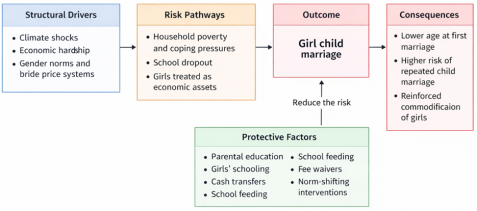
5.3. Conceptual Framework
Figure 1. Conceptual framework on girl child marriage.
6. Research Methodology
This study adopted a convergent parallel mixed-methods design in which quantitative and qualitative data were collected concurrently, analysed separately, triangulated, and integrated during interpretation. This design was appropriate because the study sought both to measure associations between economic pressures and age at first marriage and to understand how drought-related hardship, bride price, and household decision-making were experienced within pastoralist communities in Marsabit County. The quantitative strand provided evidence on patterns and associations, while the qualitative strand offered contextual insight into the meanings, social norms, and survival logics surrounding girl child marriage. The study was conducted in five Community Health Units (CHUs) of Buri Aramia, Balla, Korr, Namarei, and Ngurnit, all in Korr Ngurnit ward. These sites were selected because they are drought-prone pastoralist settings where livelihood insecurity, weak service access, and girl child marriage are locally relevant concerns. The intention was not to produce findings statistically representative of the whole of Marsabit County, but rather to examine the interaction of climate-related hardship, poverty, and marriage practices in analytically relevant locations. This gave the study contextual depth, while also requiring caution in generalizing the findings beyond the selected sites.
6.1. Data Collection
Primary data was collected through household surveys, Focus Group Discussions (FGD), Key Informant Interviews (KIIs), and transect walks. For the quantitative strand, a structured household questionnaire was digitized in Kobo Collect and administered to ever-married women aged 18–49 years. A multistage sampling procedure was used. First, the five CHUs were selected as study sites based on their relevance to the research problem. Households were then sampled proportionate to CHU population size, and within each selected household one eligible respondent was identified using a Kish grid. Of the 300 targeted interviews, 296 were completed and retained after cleaning, yielding a response rate of 98.7 percent. This procedure strengthened consistency in respondent selection at household level, although the sample is best understood as representative of the study settings rather than of the County as a whole. For the qualitative strand, semi-structured guides were used for nine FGDs and sixteen KIIs. Participants were purposively selected to capture a range of perspectives relevant to the study, including married adolescent girls (MAG), unmarried adolescent girls (UAG), mothers, married women, elders, religious leaders, school heads, healthcare workers, administrators, and community health assistants. This approach was appropriate given the sensitivity of the topic and the need to include both those directly affected by girl child marriage and those involved in community decision-making and norm enforcement.
The tools were translated into Rendille, Samburu, and Kiswahili and back-translated to improve accuracy and conceptual equivalence. They were also pilot-tested in a non-sample village to refine wording, sequencing, and locally meaningful expressions. All qualitative sessions were conducted in private settings, audio-recorded with participant consent, and supported by field notes. To better understand the local context, transect walks were carried out in each CHU before formal interviews began. These walks documented schools, health facilities, water points, grazing conditions, settlement patterns, and local market activity. They were not used to generate a formal climatic measure, but rather to contextualize participants’ accounts of drought, mobility, water scarcity, and livestock-related stress. Climate exposure in this study was therefore operationalized through locally experienced and observed livelihood stress rather than meteorological or satellite-based measures. It was captured through respondents’ and participants’ accounts of recurrent drought, livestock loss, reduced pasture, declining milk production, long distances to water points, and weak market activity, alongside transect observations. The study thus examined climate-related hardship as experienced within everyday pastoral livelihoods, rather than estimating the direct causal effect of objective climate variables.
6.2. Data Analysis
6.2.1. Quantitative
Survey data were exported from Kobo Collect into Statistical Package for the Social Sciences (SPSS) version 26 for cleaning and analysis. The cleaning process involved checks for duplicate entries, missing values, range errors, and logical inconsistencies. Descriptive statistics were first generated to summarize respondent characteristics and key marriage-related variables. The dependent variable was age at first marriage, coded dichotomously as 0 for marriage between ages 8 and 17 and 1 for marriage between ages 18 and 23. This coding reflected the study’s interest in distinguishing marriage before age 18 from marriage at or above the legal threshold. Independent variables included a combination of composite indices and categorical controls. Composite measures were constructed from Likert-scale items representing economic pressures, cultural factors, and social factors. To improve transparency in variable construction, internal consistency of the composite measures was assessed using Cronbach’s alpha. The economic pressures scale showed good reliability (α = 0.850) and the cultural factors scale (α = 0.842). The social factors scale had a lower alpha (α = 0.612), indicating moderate internal consistency, but it was retained because of its conceptual relevance and because it captured aspects of community and household influence not represented in the other scales.
Categorical variables, including religion, marriage type, marriage status, consent at marriage, and respondent schooling, were dummy coded using clearly defined reference categories. Bivariate analyses, including chi-square tests and cross-tabulations, were first used to examine the relationship between predictor variables and age at first marriage. Variables that were theoretically important and those showing meaningful association at bivariate level were then included in a hierarchical binary logistic regression model. Binary logistic regression was selected because the dependent variable was dichotomous. Model adequacy was assessed using the Hosmer–Lemeshow goodness-of-fit test and Nagelkerke R². The final model showed acceptable fit, with a non-significant Hosmer–Lemeshow result, χ²(8) = 13.07, p = 0.11, suggesting that the model fit the data reasonably well. The Nagelkerke R² value of 0.599 indicates that the included predictors explained a substantial proportion of the variation in age at first marriage. The results are interpreted as associations rather than causal effects, particularly given the cross-sectional nature of the data and the contextual operationalization of climate-related hardship.
6.2.2. Qualitative
Qualitative data from focus group discussions and key informant interviews were analysed using thematic analysis. Audio recordings were transcribed verbatim, translated into English where necessary, de-identified, and imported into NVivo 12 for coding and analysis. A hybrid coding strategy was used, combining codes derived from the research questions with new codes emerging from the data during analysis. To strengthen analytic reliability, a subset of transcripts was double-coded and discrepancies were resolved through discussion. Analytic memos were used throughout to document coding decisions, emerging interpretations, and points requiring further reflection. The analysis focused particularly on how participants described drought, livestock loss, bride price, schooling disruption, elder authority, household burden, and girls’ consent. This made it possible to trace how climate-related hardship was linked in local narratives to marriage decisions and to the perceived value of daughters within household survival strategies.
6.2.3. Integration
Mixed-methods integration and triangulation occurred at interpretation and analysis through joint displays and narrative weaving. Convergent findings such as poverty/dowry as dominant drivers were triangulated by placing quantitative effect sizes alongside exemplar quotations to explicate mechanisms, while divergences such as stated opposition to girl child marriage versus its persistence were examined against contextual notes from transect walks, FGDs and KIIs to understand normative enforcement and social desirability pressures.
6.3. Ethical Considerations
The protocol received prior approval from the National Commission for Science, Technology, and Innovation (NACOSTI), St Paul’s University Ethics Review Board, and the office of the County secretary for Marsabit. All adult participants gave informed consents whereas emancipated minors provided assent with their guardian’s consent according to local regulation. Informed consent was read aloud where literacy was limited covering study aims, voluntary participation, confidentiality, the right to skip questions or withdraw without penalty, and data handling procedures. Interviews and FGDs were conducted in private, neutral spaces to minimize inadvertent disclosure and community visibility. To safeguard participants discussing sensitive topics (such as coercion, FGM, sexual and partner violence), interviewers were trained in trauma-informed techniques and safe-question sequencing. A referral protocol was operationalized with mapped services such as county child protection officers, nearby health facilities and trusted civil society partners. Audio files and datasets were stored on encrypted, password-protected devices, identifiers were removed at transcription, and role-based access controlled who could view link files. Team briefings included positionality and bias reflection to reduce power asymmetries and normative judgments during fieldwork. Community feedback was planned through CHU-level debriefs and accessible summaries (Kiswahili, English, Samburu or Rendille) to close the loop on results sharing without revealing individual identities.
7. Results and Discussions
This section integrates the quantitative findings from 296 household surveys with qualitative insights from nine focus group discussions, sixteen key informant interviews, and transect observations to examine the pathways from climate-related hardships to girl child marriage in Marsabit County. It highlights key associations, mechanisms of commodification, and protective factors, providing evidence-based interpretations grounded in the pastoralist context.
7.1. Demographic Findings
The household survey achieved 296 analyzable interviews across five CHUs of Buri Aramia, Balla, Korr, Namarei, and Ngurnit. Respondents were predominantly aged between 25–34 (57.4%), with 22.0% aged 18–24 and 20.6% aged 35–49. Half identified as Rendille and half as Samburu, reflecting the study’s purposive ethnic balance. Location shares were broadly even (Buri Aramia 16.9%, Balla 20.6%, Korr 21.6%, Namarei 17.6%, Ngurnit 23.3%). In the qualitative strand, from the nine FGDs conducted there were 81 participants (90% female) and 16 KIIs (75% male) capturing lived experience and decision-making authority. A total of 393 respondents were engaged of whom 95% were female.
Table 1. Participant’s demographics.
Description | Respondents |
Frequency | Percentage |
Sex |
Female | 373 | 95 |
Male | 20 | 5 |
Age group |
Under 18 | 35 | 9 |
18 – 24 | 79 | 20 |
25 – 34 | 193 | 49 |
35 – 49 | 82 | 21 |
50 and above | 4 | 1 |
7.2. Findings
This section presents the core results from the mixed-methods study in Marsabit County, combining descriptive statistics and regression analyses from 296 household surveys with thematic insights from nine focus group discussions, sixteen key informant interviews, and transect walk observations. The findings first outline the prevalence and patterns of girl child marriage in relation to climate-induced hardships and economic pressures, then detail the mechanisms through which bride price practices and burden-reduction narratives contribute to the commodification of girls, and finally highlight the protective role of education amid ongoing drought-related disruptions.
7.2.1. Climate-Related Hardships and Their Impact on Household Decisions Concerning Girl Child Marriage
Transect walks and narratives consistently linked drought cycles, water and pasture failure, and livestock loss to intensified household poverty and debt. Women described long treks for water with 80% stating more than five-kilometer round trip walk to water source, reduced milk yields due to drought and lack of pasture, and distressed sales of animals as shocks that narrowed livelihood options and raised the salience of dowry as a coping strategy.
“According to the society’s cultural norms parents and elders are the sole decision makers hence when a girl is married off, she won’t be able to refuse even if she wanted to refuse more so being married to an old person due to fear of being criticized, she will just have to accept the marriage” (FGD with Samburu Woman Married Before 18 years).
Additionally, respondents described cases where education was deprioritized for daughters during resource scarcity, with families citing inability to afford school-related costs amid livestock decline. FGDs revealed that bride price arrangements often involved negotiations for higher livestock payments from grooms or their families when herds were low, with specific mentions of 3–7 camels or combinations of camels and goats being demanded or accepted. One FGD participant stated: “A girl can be exchanged for seven camels, so when someone marries a girl, they receive seven camels, which helps them restock.” (FGD with Rendille Woman Married Before 18 years). Another respondent noted: “When drought strikes, some parents feel they have no choice but to give away their daughters in exchange for camels, goats, or sheep.” (FGD with Samburu Woman Married Before 18 years). Accounts consistently pointed to these exchanges occurring more frequently in periods of no rainfall for extended months, with livestock used immediately for food or survival needs.
7.2.2. The Associations Between Economic Pressures and Girl’s Age at First Marriage
The age at first marriage ranged from 8 to 23 years with 51.0% of them being married before attaining 18 years. Most unions were polygynous (64.2%), and two-thirds of respondents reported they did not consent to marriage (65.2%). The control variables under household survey religion, marriage type, marriage status, and consent at marriage were categorical and had to be dummy coded.
Table 2 below presents dummy coding, frequency and percentages.
Table 2. Frequency and Percentage Distribution of Marriage-Related Categorical Variables (N=296).
Categorical Variable | Dummy Category | Levels | Frequency | Percentage |
Age at first marriage (dependent variable) | Ages 8 through 17 years | 0 | 151 | 51.0 |
18 through 23 years | 1 | 145 | 49.0 |
Religion (Muslim is the reference category) | Muslim | | 67 | 22.6 |
Christian | | 131 | 44.3 |
Traditionalist | | 98 | 33.1 |
Marriage type (reference is) | Polygamy | 0 | 190 | 64.2 |
Monogamy | 1 | 106 | 35.8 |
Marriage status (reference category is divorced and separated treated as one group) | Separated and divorced | | 44 | 14.9 |
Married | | 219 | 74.0 |
Widowed | | 33 | 11.1 |
Consent at marriage | Yes | 1 | 102 | 34.8 |
No | 0 | 194 | 65.2 |
On age at first marriage, participants across multiple focus group discussions and key informant interviews provided nuanced understandings of what constitutes girl child marriage, frequently grounding their definitions in biological, legal, and socio-cultural terms. Age at first marriage was statistically significant (χ² (9) = 258.44, p<0.001) and predictors added can be distinguished between the outcome categories. The Nagelkerke R² score of 0.599 implies that the model explains 59.9 percent of the variance in the dependent variable. Hosmer–Lemeshow goodness-of-fit test was χ² (8) = 13.07, p =0.11. This test is/should not be significant and is an indicator that the model fits the data very well. One respondent stated, “according to our Samburu society they don’t have indication to differentiate that this child has reached puberty, they assumed that a girl child is always mature despite which age they are, from birth, when they start talking, their role is to get married and start a family.” (FGD with Samburu UAG).
Economic composites were internally reliable (α=0.85) and significantly associated with later marriage: each one-unit increase in the economic score more than doubled the odds of marrying at 18+ (AOR=2.43, p=0.003). Yet descriptive data showed overwhelming pressure in the opposite direction: 87.5–92.5% rated poverty, inability to afford schooling, lack of girls’ economic opportunities, and the perceived relief of household burden as “likely” drivers. Three in four respondents (75.6%) affirmed that dowry payment practices encourage early marriage, and 90.5% cited dowry as a likely reason for marriage under 18 years. Qualitative accounts cast girls as “sources of wealth,” with bride price used to meet basic needs, fund sons’ marriages, or finance rites clear evidence of commodification under economic stress. For instance, a mother explained, “economic hardship, drought and death of our livestock in the recent months are the reasons people lack necessary things, people are being forced to marry their children not because they want but due to circumstances surrounding us” (FGD with Rendille Mother of MAG).
7.2.3. How Dowry/Bride Price and “Burden Reduction” Narratives Commodify Girls
This finding illustrates a key pathway through which climate change exacerbates girl child marriage in arid pastoralist regions like Marsabit County, Kenya. Recurrent and intensified droughts driven by climate change severely disrupt pastoral livelihoods by causing massive livestock losses, water scarcity, and food insecurity. This deepens household poverty and liquidity crises, amplifying economic pressures that make families view daughters as economic assets rather than individuals with independent futures. In response, households increasingly rely on dowry/bride price (typically livestock such as camels, cows, or goats) as a survival strategy: marrying girls early secures immediate resources to restock herds, repay debts, or alleviate the burden of dependents during prolonged crises. The survey data shows strong endorsement (75–90%+) of these transactional logics, where marriage is framed as a means to "reduce family burdens" amid drought-induced hardship explicitly commodifying girls' bodies and futures as exchangeable for economic relief.
This burden reduction plays a significant role in decision-making, where the incentive and promise of dowry becomes a strategy for coping with poverty and instability. As one respondent noted, “some families don’t even manage eating three meals in a day, they are left with few choices, so the only resolution is to marry off their daughters early to have dowry either in form of money or livestock” (KII with a Guidance and Counselling Teacher -GCT). In many narratives, the pursuit of wealth and relief from responsibility is a recurring motivation: “Some families in this community are forced to marry their children off to relieve them from responsibilities, they don’t have what it takes to raise them” (FGD with Samburu MAG).
These norms are reinforced by persistent cultural pressures (>80% agreement on stigma for unmarried girls, value of virginity preservation, and challenges for "older" girls in marriage markets), which sustain bride price as a socially sanctioned coping mechanism. One respondent stated; ‘If a girl stays for a long time at her father’s home and she has already reached maturity age; people will start gossiping. They will say, ah, this one has stayed too long maybe she has no luck with marriage. Even neighbors and relatives will be whispering that something must be wrong with her, that’s why no one has come to ask for her hand. It puts a lot of pressure on the girl and the family.” (FGD with Samburu Woman Married Before 18).
While progressive shifts (e.g., support for girls’ education and autonomy) offer some protection linked to approximately 38% lower odds of girl child marriage climate-exacerbated poverty intensifies the countervailing forces, overriding emerging changes in many cases. Religion also plays a role, with higher odds among Muslim communities in the sample, often tied to elder authority upholding traditional exchange practices.
7.3. Discussion
The findings point to an interaction between climate-related livelihood stress, household poverty, and social norms in shaping girl child marriage in the sampled communities of Marsabit County. Recurrent drought appeared to weaken pastoral livelihoods through livestock loss, reduced milk income, and constrained petty trade, thereby increasing household pressure for short-term liquidity, often through bride price
| [26] | Kok, M. C., Kakal, T., Kassegne, A. B., Hidayana, I. M., Munthali, A., Menon, J. A., … Van Der Kwaak, A. (2023). Drivers of child marriage in specific settings of Ethiopia, Indonesia, Kenya, Malawi, Mozambique and Zambia—Findings from the Yes I Do! baseline study. BMC Public Health, 23, 794. https://doi.org/10.1186/s12889-023-15697-6 |
| [32] | Neema, S., Muhumuza, C., Nakigudde, R., Uldbjerg, C. S., Tagoola, F. M., & Muhwezi, E. (2021). “Trading daughters for livestock”: Facilitators of child marriage in Lira district, Northern Uganda. African Journal of Reproductive Health, 25(3), 83-93. https://doi.org/10.29063/AJRH2021/V25I3.10 |
[26, 32]
. However, the evidence does not suggest a direct causal effect of climate stress on marriage. Rather, drought-related hardship seems to intensify the economic and social conditions under which early marriage becomes more acceptable or difficult to resist. The disjunction between widespread verbal opposition to girl child marriage and its persistence is consistent with social-norms dynamics personal disapproval alongside conformity due to anticipated sanctions and the material calculus of dowry during crisis
| [30] | Msuya, N. H. (2020). Child marriage: An obstacle to socio-economic development in sub-Saharan Africa. Journal for Juridical Science, 45(2), 43-73.
https://doi.org/10.18820/24150517/JJS45.i2.2 |
| [44] | Wilkinson, O., McDonald, K., Trotta, S., Eggert, J. P., & de Wolf, F. (2024). A Social Norms Analysis of Religious Drivers of Child Marriage. Global Health: Science and Practice, 12(2). https://doi.org/10.9745/GHSP-D-23-00339 |
[30, 44]
. The quantitative results support this interpretation indicating that higher economic capacity was associated with later marriage, suggesting that household resources can be protective. Yet the qualitative evidence shows that such protection is fragile where scarcity is prolonged and where social expectations remain strong. This helps explain why stated opposition to girl child marriage may coexist with its persistence. As
| [18] | Greene, M. E., & Stiefvater, E. (2019). Social norms and child marriage: The limits of law and policy. Journal of International Development, 31(6), 977-993.
https://doi.org/10.1002/jid.3431 |
| [19] | Heise, L., Greene, M. E., Opper, N., Stavropoulou, M., Harper, C., Nascimento, M., … Gupta, G. R. (2019). Gender inequality and restrictive gender norms: Framing the challenges to health. The Lancet, 393(10189), 2440-2454.
https://doi.org/10.1016/S0140-6736(19)30652-X |
[18, 19]
suggest, personal disapproval does not necessarily translate into changed practice when families continue to face normative pressure and material insecurity. At the same time, the findings point to openings for change. Participants repeatedly identified girls’ education, women’s leadership, scholarships, and boarding support as possible buffers. In this sense, the study contributes to climate-gender scholarship by showing that climate-related hardship matters chiefly through its interaction with poverty, bride price, and socially enforced expectations.
7.4. Limitations
The study relied on adult recall for age at first marriage and sensitive practices, subject to social desirability and memory bias. Male perspectives were underrepresented in FGDs, despite men’s decisive role in marital arrangements. Climate exposure was captured through self-report and observational transects rather than meteorological or remote-sensing series, constraining causal attribution to specific drought episodes.
8. Conclusions and Recommendations
8.1. Conclusions
In Marsabit County, climate stress amplified poverty, which in concert with entrenched social and cultural rules, intensified the commodification of girls through bride price and coerced girl child marriage. While improved economic conditions markedly delayed marriage, structural pressures drought, livestock loss, elder authority, reputational sanctions kept many households on a pathway where girl child marriage functioned as a coping strategy. The coexistence of progressive attitudes and traditional enforcement suggests a fluid equilibrium that can be tipped with targeted, climate-aware, norm-shifting interventions.
8.2. Recommendations
Climate-smart livelihood protection: Integrate drought-contingent shock-response through NDMA early-warning systems targeted to households with school-age girls, providing unconditional or lightly conditional support (e.g., tied to attendance monitoring) to ease liquidity crises and reduce dowry reliance during prolonged dry spells.
Norms and authority engagement: Train community paralegals and child protection volunteers to enforce Kenya's legal frameworks (Children's Act, Marriage Act) in remote rural areas where elder authority and bridewealth negotiations override individual consent. This targets qualitative findings on reputational pressures/stigma and builds on successful faith/community dialogues in pastoralist hotspots to shift norms framing early marriage as honorable or protective.
Girls’ capability strengthening: Invest in girls’ clubs, peer mentorship, and comprehensive life skills programs (covering SRHR, financial literacy, rights awareness, climate resilience, and negotiation skills) to build agency and delay marriage by enhancing perceived value beyond bride price.
Link to vocational apprenticeships (such as livestock value-add like milk processing, eco-tourism, or off-farm skills) that connect the youth to income pathways, reducing vulnerability to commodification during livelihood shocks and empowering girls to resist family pressures.
Integrated climate-child protection mainstreaming: Advocate for explicit mainstreaming of girl child marriage prevention into county/national drought contingency plans, climate adaptation strategies and disaster risk reduction, with multi-sectoral coordination (education, health, livestock, gender, child protection) and dedicated ASAL funding. This responds to UNICEF 2025 evidence that climate shocks erode family/community protective systems, amplifying girl child marriage in northern Kenya, and calls for child-centered resilience to prevent gender inequities from worsening.
Abbreviations
AOR | Adjusted Odd Ratio |
ASAL | Arid and Semi-Arid Lands |
CHU | Community Health Units |
CI | Confidence Interval |
FGD | Focus Group Discussion |
FGM | Female Genital Mutilation |
GCT | Guiding and Counselling Teacher |
KII | Key Informant Interview |
KNBS | Kenya National Bureau of Statistics |
MAG | Married Adolescent Girl |
NACOSTI | National Commission for Science, Technology, and Innovation |
NDMA | National Drought Management Authority |
OR | Odd Ratio |
SPSS | Statistical Package for the Social Sciences |
UAG | Un-married Adolescent Girl |
UNFPA | United Nations Fund for Population Activities |
UNICEF | United Nations International Children's Emergency Fund |
Author Contributions
Kirleen Carolyne Athiambo: Conceptualization, Formal Analysis, Software, Funding acquisition, Investigation, Methodology, Project administration, Resources, Validation, Visualization, Writing – original draft.
Daniel Muasya: Formal Analysis, Methodology, Project administration, Supervision, Visualization, Writing – review & editing
Alfred Agwanda: Data curation, Formal Analysis, Methodology, Supervision, Visualization, Writing – review & editing
Conflicts of Interest
The authors declare no conflicts of interest.
References
| [1] |
Adola, S. G., & Wirtu, D. (2024). Effects of early marriage among women married before age 18: A qualitative study in Ethiopia. Frontiers in Sociology, 9, Article 1412133.
https://doi.org/10.3389/fsoc.2024.1412133
|
| [2] |
Armara, M. G. (2024). Effects of climate variability on livelihood choices and gender roles among pastoral and agro-pastoral communities in Marsabit County, Kenya (Doctoral dissertation, University of Nairobi). University of Nairobi Digital Repository.
|
| [3] |
Asnaashary, M., Farzanegan, M. R., Feizi, M., & Gholipour, H. F. (2024). Economic determinants of child marriage: Evidence from the Iranian provinces. Children and Youth Services Review, 159, 107518.
https://doi.org/10.1016/j.childyouth.2024.107518
|
| [4] |
Banlanjo, N. M. (2022). Cultural pedogamy: Towards an eco-cultural theory of early (child) marriage. European Journal of Humanities and Social Sciences, 2(6), 98-102.
https://doi.org/10.24018/ejsocial.2022.2.6.334
|
| [5] |
Biwott, S. K., Otieno, J. A., & Wanjala, M. N. (2024). Determinants of structural, behavioral and cultural practices that perpetuate child marriage in Siaya, Homabay and Kisumu Counties in Kenya. International Journal of Social Science, 9(3), 112-125.
|
| [6] |
Bolarinwa, O. A., Ahinkorah, B. O., Okyere, J., Seidu, A.-A., & Olagunju, O. S. (2022). A multilevel analysis of prevalence and factors associated with female child marriage in Nigeria using the 2018 nigeria demographic and Health Survey Data. BMC Women’s Health, 22(1).
https://doi.org/10.1186/s12905-022-01733-x
|
| [7] |
Bronfenbrenner, U. (2000). Ecological systems theory. American Psychological Association.
|
| [8] |
Brubaker, S. J. (2020) Embracing and Expanding Feminist Theory: (Re)Conceptual- izing Gender and Power. Violence Against Women, 27, 717-726.
https://doi.org/10.1177/1077801220958494
|
| [9] |
Calhoun, M. (2024). Child, early, and forced marriage: An international human rights crisis. Georgetown Journal of International Affairs, 25(1), 151-159.
https://doi.org/10.1353/gia.2024.a934898
|
| [10] |
Chamisa, M. G., Makururu, S., Nyoni, T., Hapanyengwi, H. O., & Mutongi, C. (2019). Religious affiliation-child marriages nexus in Zimbabwe: A case of Marange. Journal of Economics and Finance (DRJ-JEF), 4(2), 38-44.
https://www.dynamicresearchjournals.org
|
| [11] |
Connell, R. (2013). Gender and power: Society, the person and sexual politics. John Wiley & Sons.
|
| [12] |
Conrad, N. (2024). Heatwave and Drought Adaptation to Enhance Health and Livelihood Resilience in Kenya-A Policy Review (Master's thesis, ETH Zurich).
https://doi.org/10.3929/ethz-b-000669743
|
| [13] |
Cordova-Pozo, K. L., Anishettar, S. S., Kumar, M., & Chokhandre, P. K. (2023). Trends in child marriage, sexual violence, early sexual intercourse and the challenges for policy interventions to meet the sustainable development goals. International Journal for Equity in Health, 22(1), 250.
https://doi.org/10.1186/s12939-023-02060-9
|
| [14] |
Elnakib, S., Ali, A. K., Mieth, K., & Chandra-Mouli, V. (2024). Mapping the evidence on interventions that mitigate the health, educational, social and economic impacts of child marriage and address the needs of child brides: A systematic scoping review. Sexual and Reproductive Health Matters, 32(1), 2449310.
https://doi.org/10.1080/26410397.2024.2449310
|
| [15] |
Esho, T., Komba, E., Richard, F., & Shell-Duncan, B. (2021). Intersections between climate change and female genital mutilation among the Maasai of Kajiado County, Kenya. Journal of Global Health, 11.
https://doi.org/10.7189/jogh.11.04060
|
| [16] |
Ganira, L. K., Inda, N. A., Odundo, P. A., Akondo, J. O., & Ngaruiya, B. (2015). Early and forced child marriage on girls’ education in Migori County, Kenya: Constraints, prospects and policy. World Journal of Education, 5(4), 72-80.
https://doi.org/10.5430/wje.v5n4p72
|
| [17] |
Gero, C. (2025). The Relationship Between (Rapid) Repeat Adolescent Pregnancy and Early Marriage-Case Study of Kenya.
https://hdl.handle.net/10281/542583
|
| [18] |
Greene, M. E., & Stiefvater, E. (2019). Social norms and child marriage: The limits of law and policy. Journal of International Development, 31(6), 977-993.
https://doi.org/10.1002/jid.3431
|
| [19] |
Heise, L., Greene, M. E., Opper, N., Stavropoulou, M., Harper, C., Nascimento, M., … Gupta, G. R. (2019). Gender inequality and restrictive gender norms: Framing the challenges to health. The Lancet, 393(10189), 2440-2454.
https://doi.org/10.1016/S0140-6736(19)30652-X
|
| [20] |
Ikamari, L. (2023). Regional variation in early marriage in Kenya. Journal of African Population Studies, 36 (1), Article 5283.
https://doi.org/10.59147/eA88lpdQ
|
| [21] |
Izugbara, C., Suubi, K., Afifu, C., Salami, T., Opondo, E., & Plan International Team. (2024). The persistence of high rates of child marriage in Sub-Saharan Africa, the Middle East and North Africa, and Asia: A scoping review. Health Care for Women International, 1-24.
https://doi.org/10.1080/07399332.2024.2385328
|
| [22] |
Joosse, P., & Willey, R. (2020). Gender and charismatic power. Theory and Society, 49(4), 533-561.
https://doi.org/10.1007/s11186-020-09392-3
|
| [23] |
Kenya National Bureau of Statistics. (2020). 2019 Kenya Population and Housing Census: Volume I-IV. KNBS.
https://www.knbs.or.ke/2019-kenya-population-and-housing-census-reports/
|
| [24] |
Kenya National Bureau of Statistics (KNBS). (2023). Kenya Demographic and Health Survey 2022. KNBS.
https://www.knbs.or.ke/reports/kdhs-2022/
|
| [25] |
Kidman, R., Dietrich, J. J., Hornschuh, S., Madi, P., Ramsammy, C. W., Tsotetsi, L., Tshabalala, G., et al. (2024). Drivers of child marriages for girls: A prospective study in a low-income African setting. Global Public Health, 19(1), Article 2335356.
https://doi.org/10.1080/17441692.2024.2335356.
|
| [26] |
Kok, M. C., Kakal, T., Kassegne, A. B., Hidayana, I. M., Munthali, A., Menon, J. A., … Van Der Kwaak, A. (2023). Drivers of child marriage in specific settings of Ethiopia, Indonesia, Kenya, Malawi, Mozambique and Zambia—Findings from the Yes I Do! baseline study. BMC Public Health, 23, 794.
https://doi.org/10.1186/s12889-023-15697-6
|
| [27] |
Lanyasunya, R., Ngala, F. B. J. A., & Tikoko, B. T. (2023). Relationship between ecological, economic, conflict, socio-cultural factors and enrolment of girls in rural public primary schools in Samburu County, Kenya. Journal of Education and Learning (JEL), 2(1), 154-160.
https://doi.org/10.51317/jel.v2i1.454
|
| [28] |
Male, C., & Wodon, Q. (2018). Girls’ education and child marriage in West and Central Africa: Trends, impacts, costs, and solutions. Forum for Social Economics, 47(2), 262-274.
https://doi.org/10.1080/07360932.2018.1451771
|
| [29] |
Mobolaji, J. W., Fatusi, A. O., & Adedini, S. A. (2020). Ethnicity, religious affiliation, and girl-child marriage: A cross-sectional study of a nationally representative sample of female adolescents in Nigeria. BMC Public Health, 20, 1-10.
https://doi.org/10.1186/s12889-020-08623-x
|
| [30] |
Msuya, N. H. (2020). Child marriage: An obstacle to socio-economic development in sub-Saharan Africa. Journal for Juridical Science, 45(2), 43-73.
https://doi.org/10.18820/24150517/JJS45.i2.2
|
| [31] |
Musembi, C. N., Ndong, E., & Nyukuri, C. (2025). After the Law: From Legislative Success to Community-Level Action to End Child Marriage in Kenya. E. Afr. LJ, 30.
|
| [32] |
Neema, S., Muhumuza, C., Nakigudde, R., Uldbjerg, C. S., Tagoola, F. M., & Muhwezi, E. (2021). “Trading daughters for livestock”: Facilitators of child marriage in Lira district, Northern Uganda. African Journal of Reproductive Health, 25(3), 83-93.
https://doi.org/10.29063/AJRH2021/V25I3.10
|
| [33] |
Nganga, D. M. (2023). Exploring the intersections of gender, religion, and, culture when engaging the Pokot-Turkana conflict in Kenya between 1963 and 2015 (Doctoral dissertation).
https://researchspace.ukzn.ac.za/handle/10413/22263
|
| [34] |
Pastén, R., Figueroa, E., & Fuentes, M. (2024). Not a dream wedding: The hidden nexus between gender discrimination, climate change and child marriage. Environment, Development and Sustainability. Advance online publication.
https://doi.org/10.1007/s10668-024-05074-7
|
| [35] |
Paul, P. (2019). Effects of education and poverty on the prevalence of girl child marriage in India: A district-level analysis. Children and Youth Services Review, 100, 16-21.
https://doi.org/10.1016/j.childyouth.2019.02.033
|
| [36] |
Pourtaheri, A., Sany, S. B. T., Aghaee, M. A., Ahangari, H., & Peyman, N. (2023). Prevalence and factors associated with child marriage, a systematic review. BMC women's health, 23(1), 531.
https://doi.org/10.1186/s12905-023-02634-3
|
| [37] |
Psaki, S. R., Melnikas, A. J., Haque, E., Saul, G., Misunas, C., Patel, S. K., … Amin, S. (2021). What are the drivers of child marriage? A conceptual framework to guide policies and programs. Journal of Adolescent Health, 69(6), S13-S22.
https://doi.org/10.1016/j.jadohealth.2021.09.015
|
| [38] |
Sadownik, A. R. (2023). Bronfenbrenner: Ecology of human development in ecology of collaboration. In A. R. Sadownik & M. D. Otterstad (Eds.), Re-theorising more-than-parental involvement in early childhood education and care (pp. 57-74). Springer.
https://doi.org/10.1007/978-3-031-38762-3_4
|
| [39] |
Tsipi, A. (2024). Child Marriage, Gender Inequality, and Young Girls’ Agency in Niger.
https://www.diva-portal.org/smash/get/diva2:1894502/FULLTEXT01.pdf
|
| [40] |
United Nations Population Fund and United Nations Children's Fund. (2023). UNFPA-UNICEF Global Programme to End Child Marriage. Retrieved from
https://www.unfpa.org/unfpa-unicef-global-programme-end-child-marriage
|
| [41] |
Van der Vyver, J. D. (2021). Child marriage in Africa. In M. C. Green, E. Chitando, & J. Witte Jr. (Eds.), Law, religion and the family in Africa. Lightening Source Inc.
|
| [42] |
Warria, A. (2019). Child marriages, child protection and sustainable development in Kenya. African Journal of Reproductive Health, 23(2), 121-133.
https://doi.org/10.29063/ajrh2019/v23i2.12
|
| [43] |
Williams, E. M., Tejedor-Garavito, N., Bonnie, A., Dorey, P., Priyatikanto, R., Tatem, A. J.,... & Musyoka, M. (2025). Child Marriage and Climatic Factors: Evidence from Survey Data in Kenya.
https://doi.org/10.21203/rs.3.rs-7797744/v1
|
| [44] |
Wilkinson, O., McDonald, K., Trotta, S., Eggert, J. P., & de Wolf, F. (2024). A Social Norms Analysis of Religious Drivers of Child Marriage. Global Health: Science and Practice, 12(2).
https://doi.org/10.9745/GHSP-D-23-00339
|
| [45] |
Wingood, G., & DiClemente, R. (2002). The theory of gender and power. In Emerging theories in health promotion practice and research: Strategies for improving public health (pp. 313-345). Jossey-Bass.
https://onlinelibrary.wiley.com/doi/book/10.1002/9780470753552
|
| [46] |
Zaid Obuyi, R. (2024). Effects of Climate Change on Women’s Security Dynamics in Baragoi, Samburu County, Kenya. The Journal of Social Encounters, 8(2), 259-290.
https://doi.org/10.69755/2995-2212.1290
|
Cite This Article
-
APA Style
Athiambo, K. C., Muasya, D., Agwanda, A. (2026). Climate Crisis and the Rise of Girl Child Marriage in Marsabit County, Kenya. International Journal of Science, Technology and Society, 14(2), 57-69. https://doi.org/10.11648/j.ijsts.20261402.12
 Copy
|
Copy
|
 Download
ACS Style
Athiambo, K. C.; Muasya, D.; Agwanda, A. Climate Crisis and the Rise of Girl Child Marriage in Marsabit County, Kenya. Int. J. Sci. Technol. Soc. 2026, 14(2), 57-69. doi: 10.11648/j.ijsts.20261402.12
Copy
|
Download
AMA Style
Athiambo KC, Muasya D, Agwanda A. Climate Crisis and the Rise of Girl Child Marriage in Marsabit County, Kenya. Int J Sci Technol Soc. 2026;14(2):57-69. doi: 10.11648/j.ijsts.20261402.12
Copy
|
Download
-
@article{10.11648/j.ijsts.20261402.12,
  author = {Kirleen Carolyne Athiambo and Daniel Muasya and Alfred Agwanda},
  title = {Climate Crisis and the Rise of Girl Child Marriage in Marsabit County, Kenya},
  journal = {International Journal of Science, Technology and Society},
  volume = {14},
  number = {2},
  pages = {57-69},
  doi = {10.11648/j.ijsts.20261402.12},
  url = {https://doi.org/10.11648/j.ijsts.20261402.12},
  eprint = {https://article.sciencepublishinggroup.com/pdf/10.11648.j.ijsts.20261402.12},
  abstract = {This manuscript interrogates how climate stress, household poverty, and the dowry/bride price converge to commodify girls and precipitate girl child marriage in Marsabit County, Kenya. It relies solely on findings from a mixed?methods study’s dataset in 296 household surveys (98.7% response), 16 key informant interviews (80%), 9 focus group discussions (90%), and a transect walk across villages in Buri Aramia, Balla, Korr, Namarei, and Ngurnit Community Health Units. Quantitative analyses (descriptives, chi?square tests, cross?tabs, and hierarchical binary logistic regression) and qualitative themes are integrated to explain mechanisms and pathways. Three results stand out, the first, drought?linked livelihood strain and sparse local markets observed during the transect walk coincide with household narratives of using marriage as a coping strategy to obtain bride wealth, reduce dependents, and manage risk. Second, economic pressure is a strong, independent predictor of earlier marriage: each one?unit increase in the economic composite is associated with more than double the odds of marrying at 18 or older (Odd Ratio (OR)=2.429; 95% Confidence Interval (CI)≈1.363–4.330; p=0.003) that is, stronger economic capacity protects against girl child marriage. Third, commodification of girls is explicit in community accounts and survey frequencies: the practice of exchanging dowry/bride price and the perception that marriage reduces household burden are widely endorsed as “likely” drivers (≥75–90% across related items). Based only on the study’s evidence, climate?exacerbated poverty intensifies a transactional logic around girls’ bodies and futures. Effective measures therefore must be locally grounded to protect schooling continuity during drought months, reduce reliance on dowry through livelihood support, and shift norms via community leadership while enforcing consent and age standards.},
 year = {2026}
}
Copy
|
Download
-
TY  - JOUR
T1  - Climate Crisis and the Rise of Girl Child Marriage in Marsabit County, Kenya
AU  - Kirleen Carolyne Athiambo
AU  - Daniel Muasya
AU  - Alfred Agwanda
Y1  - 2026/04/07
PY  - 2026
N1  - https://doi.org/10.11648/j.ijsts.20261402.12
DO  - 10.11648/j.ijsts.20261402.12
T2  - International Journal of Science, Technology and Society
JF  - International Journal of Science, Technology and Society
JO  - International Journal of Science, Technology and Society
SP  - 57
EP  - 69
PB  - Science Publishing Group
SN  - 2330-7420
UR  - https://doi.org/10.11648/j.ijsts.20261402.12
AB  - This manuscript interrogates how climate stress, household poverty, and the dowry/bride price converge to commodify girls and precipitate girl child marriage in Marsabit County, Kenya. It relies solely on findings from a mixed?methods study’s dataset in 296 household surveys (98.7% response), 16 key informant interviews (80%), 9 focus group discussions (90%), and a transect walk across villages in Buri Aramia, Balla, Korr, Namarei, and Ngurnit Community Health Units. Quantitative analyses (descriptives, chi?square tests, cross?tabs, and hierarchical binary logistic regression) and qualitative themes are integrated to explain mechanisms and pathways. Three results stand out, the first, drought?linked livelihood strain and sparse local markets observed during the transect walk coincide with household narratives of using marriage as a coping strategy to obtain bride wealth, reduce dependents, and manage risk. Second, economic pressure is a strong, independent predictor of earlier marriage: each one?unit increase in the economic composite is associated with more than double the odds of marrying at 18 or older (Odd Ratio (OR)=2.429; 95% Confidence Interval (CI)≈1.363–4.330; p=0.003) that is, stronger economic capacity protects against girl child marriage. Third, commodification of girls is explicit in community accounts and survey frequencies: the practice of exchanging dowry/bride price and the perception that marriage reduces household burden are widely endorsed as “likely” drivers (≥75–90% across related items). Based only on the study’s evidence, climate?exacerbated poverty intensifies a transactional logic around girls’ bodies and futures. Effective measures therefore must be locally grounded to protect schooling continuity during drought months, reduce reliance on dowry through livelihood support, and shift norms via community leadership while enforcing consent and age standards.
VL  - 14
IS  - 2
ER  -
Copy
|
Download




 Share This Article
 Twitter
 Linked In
 Facebook