Suryanamaskar, is a combination of breathing pattern, mental awareness, variations of Yoga asanas and focus towards specific asanas while performing and physical movement have been suggested to improve cognitive functioning and mental wellbeing. This study assessed the effect of Suryanamaskar intervention on cognitive concentration levels among university students aged between 18-25 years. The study aims to determine whether regular practice of Suryanamaskar can lead to measurable improvement in cognitive concentration ability among the students as assessed by a standard Cognitrone test Vienna Test System. The study incorporated a pre-post-test design with a convenience sample of 20 university students who underwent a structured Suryanamaskar training program for the period six weeks. Cognitive Concentration ability was measured before zero week of Suryanamaskar Intervention and after the Suryanamsakar intervention of Six weeks using the Vienna Test System (VTS)-Cognitrone Test Form S4. This Study revealed a notable Cognitive concentration ability improvement among the university students as it presents the mean score from 56.35 (SD=21.45) to 74.65 (SD=13.72). Therefore, the change in cognitive concentration ability was statistically significant (z=-3.72, p<.001), as it indicates enhanced Cognitive concentration ability among the university students following Suryanamskar intervention for six weeks. The findings suggest that Suryanamaskar practice can significantly improve Cognitive concentration ability among university students. Suggesting its potential as an effective cognitive concentration enhancement in academic settings as it can incorporate with the Suryanamskar intervention with larger sample size and population.
This is an Open Access article, distributed under the terms of the Creative Commons Attribution 4.0 International License (http://creativecommons.org/licenses/by/4.0/), which permits unrestricted use, distribution and reproduction in any medium or format, provided the original work is properly cited.
Suryanamaskar, Cognitive Concentration, University Students, Vienna Test System
1. Introduction
Yoga is an ancient and traditional practice that aligns with Indian philosophy from time immemorial
[1]
U. Mimi, A. Balo, T. Pegu, S. Borah, and S. Rajbongshi, ‘Effect of Yogic Practices on Flexibility Using the Sit and Reach Test’, Med. Health Sci., vol. 1, no. 1, pp. 23–28, Dec. 2025,
. Yoga has evolved from a spiritual discipline to a globally recognised physical and mental practice for health and wellness
[2]
P. A. Gohil, ‘SURYA NAMASKAR: A TRADITIONAL YOGA’, Int. J. Res. Publ. Semin., vol. 1, no. 1, pp. 126–131, Jul. 2012.
[2]
. Traditionally, yoga, associated with meditation, flexibility, and holistic well-being, has also emerged as a competitive sport in recent years
[3]
U. Mimi and A. Balo, ‘Madhya Bharti -Humanities and Social Sciences THE IMPACT OF YOGA ON DAILY LIFE: A COMPREHENSIVE EXPLORATION OF ITS BENEFITS BASED ON RESEARCH FINDINGS’, vol. 84, pp. 63–69, Dec. 2023.
[3]
. As a sport, Yoga is associated with physical power, mental discipline and agility
[4]
A. Balo, U. Mimi, S. Prasad, and R. Sukladas, ‘ENHANCING STATIC BALANCE IN BEGINNER BADMINTON PLAYERS THROUGH YOGIC PRACTICES’, vol. 53, pp. 1–4, Dec. 2023.
[4]
. In any field, there is a need for concentration to execute the determined objectives; therefore, Yoga plays a crucial role in approaching and assessing the directed goals in a rational direction with strategic accomplishment
[3]
U. Mimi and A. Balo, ‘Madhya Bharti -Humanities and Social Sciences THE IMPACT OF YOGA ON DAILY LIFE: A COMPREHENSIVE EXPLORATION OF ITS BENEFITS BASED ON RESEARCH FINDINGS’, vol. 84, pp. 63–69, Dec. 2023.
[3]
. The great Rishi, Maha Rishi Patanjali, systematized the yoga with the principle of Yogic practice into Patanjali Yoga Sutra. The Yoga Sutra has also been divided into four Padas such as Samadhi Pada, Sadhana Pada, Vibhuti Pada and Kaivalya Pada
[5]
K. Stec, M. Kruszewski, and L. Ciechanowski, ‘Effects of Suryanamaskar, an Intensive Yoga Exercise Routine, on the Stress Levels and Emotional Intelligence of Indian Students’, Int. J. Environ. Res. Public. Health, vol. 20, no. 4, p. 2845, Feb. 2023,
The twelve dynamic postures, synchronized breathing, and mindful focus are all part of the ancient and traditional yogic practice known as Suryanamskar
[2]
P. A. Gohil, ‘SURYA NAMASKAR: A TRADITIONAL YOGA’, Int. J. Res. Publ. Semin., vol. 1, no. 1, pp. 126–131, Jul. 2012.
[2]
. Suryanamaskar inculcate numerous advantages which include enhancing flexibility, cardiovascular endurance and physical strength
[6]
A. B. Bhavanani, K. Udupa, null Madanmohan, and P. Ravindra, ‘A comparative study of slow and fast suryanamaskar on physiological function’, Int. J. Yoga, vol. 4, no. 2, pp. 71–76, Jul. 2011,
. SN develop and enhance neuromuscular coordination, muscular strength, stress preventive and reduction, and cognitive abilities and alertness, are well acknowledge in both yoga and scientific literature
[7]
N. Bandyopadhyay, T. Das, and S. Mondal, ‘Practicing Surya Namaskar: A Sequence of Yogic Postures for Overall Health and Wellness among Healthy Adults’, Phys. Educ. Theory Methodol., vol. 25, no. 2, pp. 416–425, Mar. 2025,
. Suryanamsakar’s rhythmic and meditative structure aids in regulating the autonomic nervous system, which enhance physiological efficacy, cognitive and emotional regulation
[8]
M. Phansikar and S. P. Mullen, ‘Cognitive and psychosocial effects of an acute sun salutation intervention among adults with stress’, May 12, 2021, PsyArXiv: 7zu3g_v1.
. In today’s contemporary fast paced academic environment, students often struggle with stress, distraction and reduced attention span, which negatively impact their learning outcomes
[10]
Sheela, H. R. R. Nagendra, and T. S. Ganpat, ‘Efficacy of Yoga for sustained attention in university students’, AYU Int. Q. J. Res. Ayurveda, vol. 34, no. 3, p. 270, Sep. 2013,
. Yoga as an ancient practice that integrates asanas, pranayama, dharna, dhayana, and shatkarma, has been widely emphasizes for its potential to improve concentration, cognitive function including health
[11]
N. Ong, ‘The use of the Vienna Test System in sport psychology research: A review’, Int. Rev. Sport Exerc. Psychol., vol. 8, pp. 1–20, Sep. 2015,
For this scholarly inquiry, the study was conducted based on a quasi-experimental pre-test and post-test design to assess variations in concentration levels before and after Suryanamaskar intervention. A total of 20 University Students from Rajiv Gandhi University, Arunachal Pradesh, aged between 18 to 25 years, participated in the study. Participants were collected through convenience sampling. None of the subjects had prior experience with Suryanamsakar training. Participants underwent a structured six weeks Suryanamsakar training program, consisting of 45-60 minutes session at morning 6: 00 am to 7: 00 am, for 5 days a week.
2.1. Test Procedure
From commencing the measurement, the Vienna Test System (VTS) Cognitrone Test Form S4 was used to measure the Cognitive concentration ability of the university students, and twenty participants were hailing form the different courses run by the Rajiv Gandhi University were tested. The fixed duration for the VTS Cognitrone Test Form S4 is 1.8 sec. for each item, which was incorporated. Participants were instructed to respond and react only when the comparison items or Figures corresponds to one of the four related and reference Figures
[12]
L. E. Teteris, S. Saulite, R. Licis, M. Greve, and B. Boobani, ‘Application of the Vienna Test System to Measure Training-Induced Changes in Choice Reaction Time in U20 Fencers: A 12-Week Training Program Pilot Study’, Sports, vol. 13, no. 11, p. 400, Nov. 2025,
. Participants were also instructed that during the test, one cannot omit an item or go back to the preceding one because once the presentation duration expires, the next Figures or items follow instantly and automatically
[13]
J. N. Zwayen, ‘Some Perceptions of the Ocean Using the Vienna System ((VTS. S (And its relationship to the accuracy of the skill of receiving the transmitter in volleyball.’, Turk. Online J. Qual. Inq., vol. 12, no. 10, p. 320, Dec. 2021.
[13]
.
Individual testing with Cognitrione (cog) Test Form S4 (VTS) was conducted under standardized conditions with participants. Before the actual test, respondents experienced an instruction phase (with animated instruction) and a practice phase to familiarize with the process
[13]
J. N. Zwayen, ‘Some Perceptions of the Ocean Using the Vienna System ((VTS. S (And its relationship to the accuracy of the skill of receiving the transmitter in volleyball.’, Turk. Online J. Qual. Inq., vol. 12, no. 10, p. 320, Dec. 2021.
[13]
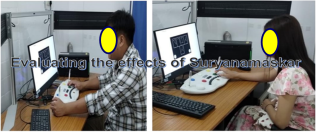
. During the testing, the subject was shown a comparison Figures and four reference Figures on the computer screen. The subject had to select the reference Figure closest to the comparison Figure. Reactions were registered by the computer response panel or keyboard.
Figure 1: VTS Cognitrone Test Form S4 for Data Collection test.
Figure 1. VTS Cognitrone Test Form S4 for Data Collection.
Upon completion of the practice phase, participants conducted the full test independently, and response were automatically recorded for later data analysis. The main variable of the test form is the ability to concentrate. In test form S4, it measures the accuracy during concentrated work. This includes Test Form S4 in which the respondents have an equally long period available for comparing a comparison sample with the reference sample
[14]
‘The new multitasking test in the Vienna Testsystem’. Accessed: May 11, 2026. Available:
. The test duration for Test Form S4 including instruction is approx. 8 minutes
[13]
J. N. Zwayen, ‘Some Perceptions of the Ocean Using the Vienna System ((VTS. S (And its relationship to the accuracy of the skill of receiving the transmitter in volleyball.’, Turk. Online J. Qual. Inq., vol. 12, no. 10, p. 320, Dec. 2021.
[13]
.
2.2. Training Protocol
In the current measure, the training regimen of Suryanamskar was implemented for a period of six weeks. Every training regimen started with following 10 minutes of loosening exercise and a warm-up period of gentle mobilization and breathe awareness practice, advancing to systematic practice of Suryanamsakar
[15]
K. A. Jakhotia et al., ‘Suryanamaskar: An equivalent approach towards management of physical fitness in obese females’, Int. J. Yoga, vol. 8, no. 1, pp. 27–36, Jan. 2015,
. Participants trained five days per week and marched through a progressive training regimen to complete 13 rounds in the first two weeks, 19 rounds in weeks 3 to 4, and 25 rounds in weeks 5 to 6.
Table 1. Six weeks Training Program for Suryanamaskar Practice.
Week
Frequency
Rounds or Session
Targeted structure
Recover protocol
Observation & supervision
Duration or Session
1-2 week
Five session / week
13 rounds
2 set of 7 rounds
4-5 second pause between rounds 1 minute after every round
Instruction (first 4 session) and independent.
45 to 60 minutes (Include warm up, and relaxation followed by opening and closing prayer.
3-4 week
Five session / week
19 rounds
3 set of 9 rounds
4-5 second pause between rounds 1 minute after every round
Instruction (first 4 session) and independent.
45 to 60 minutes (Include warm up, and relaxation followed by opening and closing prayer.
5-6 week
Five session / week
25 rounds
4 set of 6 rounds
4-5 second pause between rounds 1 minute after every round
Instruction (first 4 session) and independent.
45 to 60 minutes (Include warm up, and relaxation followed by opening and closing prayer.
During the training session, participants practiced postures synchronized with breathing, maintained a stable gazed as strategy to build concentration ability, and practiced dynamically with a steady rhythm through transitions of different Suryanamskar asnas. there were five second paused between each round and a one-minute recovery break after every six rounds to aid rest and focus. The first four training were supervised by the instructor and afterwards the participants continued practicing on their own as instructed. Every training period lasted for 60 minutes, including warm up and recovery. The Suryanamaskar Training Session Program for six weeks has been given at Table 1.
2.3. Data Analysis
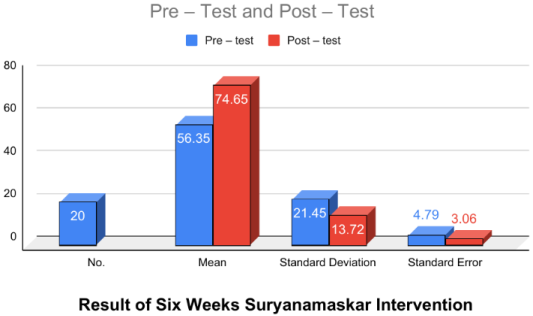
For the data analysis, SPSS, the Wilcoxon Signed Rank Test was used to understand the effect of Suryanamaskar intervention on the subject. The researcher draws attention to Table 1. This may be the effect of the Suryanamaskar intervention for the period of six weeks. The test revealed statistically significant differences in Cognitive concentration of students (z=-3.72, p < .001). This indicates that Suryanamaskar had a positive impact on university students, especially in cognitive ability. Therefore, the mean score of Cognitive Concentration Ability of students ranged from 56.35 (SD=21.45) to 74.65 (SD=13.72).
Figure 2. Result of Six Weeks Suryanamaskar Intervention on Cognitive Concentration Ability of University Students.
3. Result
The results indicate that the main score of the Cognitive concentration before (pre-test) Suryanamskar Training was 56.35 (SD=21.45), whereas after the training (post-test), it significantly increased to 74.64 (SD=13.72). Therefore, Wilcoxon Signed Rank Test revealed that the test has significant improvement in Cognitive Concentration Ability among university Students i.e. (z=-3.75, p<.001). This indicates that the Suryanamaskar training had a positive impact on university students of Arunachal Pradesh, especially in Cognitive Concentration.
Table 2. Descriptive Result of Cognitive Concentration of Pre and Post-test Suryanamaskar intervention among University students.
Table 2. Descriptive Result of Pre and Post Test Suryanamaskar Intervention.
Variable
Training
No.
Mean
Std. Deviation
Std. Error
Concentration Ability
Pre – test
20
56.35
21.45
4.79
Post – test
74.65
13.72
3.06
4. Discussion
The incorporated Practice of Suryanamaskar, likely contributed to the observed improvement in cognitive ability especially the cognitive concentration ability of the students. Practical implications: The positive effect of Suryanamaskar on concentration ability being observed, educational institutions may integrate the Suryanamskar session into their curricula to support and encourage the student’s mental well-being and academic performance to assess the effect of Suryanamaskar on Cognitive ability of university students, the statistical technique Wilcoxon Signed Rank test was utilized as predetermined significant level set at 0.05.
The assessed findings revealed that the statistically significant improvement in Cognitive concentration (z=-3.72, p<.001). This indicates the Suryanamaskar training found enhanced improvement on selected Cognitive Concentration Ability. Limitation and Future Research: 1. small sample size: A large sample size would improve the generalizability of findings. 2. Short Duration: The long-term effect of Suryanamaskar training need further exploration. 3. Control Group: Future study shall include control group for effective and systematic comparison.
5. Conclusion
The Research study finds that Suryanamaskar training significantly improves the concentration ability of university students in Arunachal Pradesh. The study highlights Suryanamaskar as a promising enhancement approach, reinforcing for academic and mental wellbeing, so there should be awareness among the people and institute about the benefits of Suryanamaskar practice in daily life. Educational institutions may suggest Suryanamaskar along with academic curriculum. It is beneficial for all the ages to live better relaxed and quality life.
Future research direction: First. one can explore gender differences in the impact of Suryanamaskar on concentration. 2. One can investigate the long-term cognitive benefits of regular Suryanamaskar practice. 3. Explore the effectiveness of different Suryanamskar Style on Cognitive Concentration.
Abbreviations
SN
Suryanamaskar
VTS
Vienna Test System
COG
Cognitrone
Acknowledgments
We thank and extend our sincere gratitude to all the participants for their valuable contribution during the research study, especially for the data collection.
All the authors declare that they have no known competing financial interest of personal relation that could have appeared to influence the work reported in this research paper.
References
[1]
U. Mimi, A. Balo, T. Pegu, S. Borah, and S. Rajbongshi, ‘Effect of Yogic Practices on Flexibility Using the Sit and Reach Test’, Med. Health Sci., vol. 1, no. 1, pp. 23–28, Dec. 2025,
P. A. Gohil, ‘SURYA NAMASKAR: A TRADITIONAL YOGA’, Int. J. Res. Publ. Semin., vol. 1, no. 1, pp. 126–131, Jul. 2012.
[3]
U. Mimi and A. Balo, ‘Madhya Bharti -Humanities and Social Sciences THE IMPACT OF YOGA ON DAILY LIFE: A COMPREHENSIVE EXPLORATION OF ITS BENEFITS BASED ON RESEARCH FINDINGS’, vol. 84, pp. 63–69, Dec. 2023.
[4]
A. Balo, U. Mimi, S. Prasad, and R. Sukladas, ‘ENHANCING STATIC BALANCE IN BEGINNER BADMINTON PLAYERS THROUGH YOGIC PRACTICES’, vol. 53, pp. 1–4, Dec. 2023.
[5]
K. Stec, M. Kruszewski, and L. Ciechanowski, ‘Effects of Suryanamaskar, an Intensive Yoga Exercise Routine, on the Stress Levels and Emotional Intelligence of Indian Students’, Int. J. Environ. Res. Public. Health, vol. 20, no. 4, p. 2845, Feb. 2023,
A. B. Bhavanani, K. Udupa, null Madanmohan, and P. Ravindra, ‘A comparative study of slow and fast suryanamaskar on physiological function’, Int. J. Yoga, vol. 4, no. 2, pp. 71–76, Jul. 2011,
N. Bandyopadhyay, T. Das, and S. Mondal, ‘Practicing Surya Namaskar: A Sequence of Yogic Postures for Overall Health and Wellness among Healthy Adults’, Phys. Educ. Theory Methodol., vol. 25, no. 2, pp. 416–425, Mar. 2025,
M. Phansikar and S. P. Mullen, ‘Cognitive and psychosocial effects of an acute sun salutation intervention among adults with stress’, May 12, 2021, PsyArXiv: 7zu3g_v1.
Sheela, H. R. R. Nagendra, and T. S. Ganpat, ‘Efficacy of Yoga for sustained attention in university students’, AYU Int. Q. J. Res. Ayurveda, vol. 34, no. 3, p. 270, Sep. 2013,
L. E. Teteris, S. Saulite, R. Licis, M. Greve, and B. Boobani, ‘Application of the Vienna Test System to Measure Training-Induced Changes in Choice Reaction Time in U20 Fencers: A 12-Week Training Program Pilot Study’, Sports, vol. 13, no. 11, p. 400, Nov. 2025,
J. N. Zwayen, ‘Some Perceptions of the Ocean Using the Vienna System ((VTS. S (And its relationship to the accuracy of the skill of receiving the transmitter in volleyball.’, Turk. Online J. Qual. Inq., vol. 12, no. 10, p. 320, Dec. 2021.
[14]
‘The new multitasking test in the Vienna Testsystem’. Accessed: May 11, 2026. Available:
K. A. Jakhotia et al., ‘Suryanamaskar: An equivalent approach towards management of physical fitness in obese females’, Int. J. Yoga, vol. 8, no. 1, pp. 27–36, Jan. 2015,
Mimi, U., Prasad, S., Balo, A., Appralo, T. (2026). Evaluating the Effect of Suryanamaskar Practice on Cognitive Concentration Among University Students. Science Discovery Psychology, 1(2), 69-73. https://doi.org/10.11648/j.sdps.20260102.11
Mimi, U.; Prasad, S.; Balo, A.; Appralo, T. Evaluating the Effect of Suryanamaskar Practice on Cognitive Concentration Among University Students. Sci. Discov. Psychol.2026, 1(2), 69-73. doi: 10.11648/j.sdps.20260102.11
Mimi U, Prasad S, Balo A, Appralo T. Evaluating the Effect of Suryanamaskar Practice on Cognitive Concentration Among University Students. Sci Discov Psychol. 2026;1(2):69-73. doi: 10.11648/j.sdps.20260102.11
@article{10.11648/j.sdps.20260102.11,
  author = {Umesh Mimi and Sambhu Prasad and Abhishek Balo and Tasha Appralo},
  title = {Evaluating the Effect of Suryanamaskar Practice on Cognitive Concentration Among University Students},
  journal = {Science Discovery Psychology},
  volume = {1},
  number = {2},
  pages = {69-73},
  doi = {10.11648/j.sdps.20260102.11},
  url = {https://doi.org/10.11648/j.sdps.20260102.11},
  eprint = {https://article.sciencepublishinggroup.com/pdf/10.11648.j.sdps.20260102.11},
  abstract = {Suryanamaskar, is a combination of breathing pattern, mental awareness, variations of Yoga asanas and focus towards specific asanas while performing and physical movement have been suggested to improve cognitive functioning and mental wellbeing. This study assessed the effect of Suryanamaskar intervention on cognitive concentration levels among university students aged between 18-25 years. The study aims to determine whether regular practice of Suryanamaskar can lead to measurable improvement in cognitive concentration ability among the students as assessed by a standard Cognitrone test Vienna Test System. The study incorporated a pre-post-test design with a convenience sample of 20 university students who underwent a structured Suryanamaskar training program for the period six weeks. Cognitive Concentration ability was measured before zero week of Suryanamaskar Intervention and after the Suryanamsakar intervention of Six weeks using the Vienna Test System (VTS)-Cognitrone Test Form S4. This Study revealed a notable Cognitive concentration ability improvement among the university students as it presents the mean score from 56.35 (SD=21.45) to 74.65 (SD=13.72). Therefore, the change in cognitive concentration ability was statistically significant (z=-3.72, p<.001), as it indicates enhanced Cognitive concentration ability among the university students following Suryanamskar intervention for six weeks. The findings suggest that Suryanamaskar practice can significantly improve Cognitive concentration ability among university students. Suggesting its potential as an effective cognitive concentration enhancement in academic settings as it can incorporate with the Suryanamskar intervention with larger sample size and population.},
 year = {2026}
}
TY  - JOUR
T1  - Evaluating the Effect of Suryanamaskar Practice on Cognitive Concentration Among University Students
AU  - Umesh Mimi
AU  - Sambhu Prasad
AU  - Abhishek Balo
AU  - Tasha Appralo
Y1  - 2026/06/30
PY  - 2026
N1  - https://doi.org/10.11648/j.sdps.20260102.11
DO  - 10.11648/j.sdps.20260102.11
T2  - Science Discovery Psychology
JF  - Science Discovery Psychology
JO  - Science Discovery Psychology
SP  - 69
EP  - 73
PB  - Science Publishing Group
SN  - 3142-9114
UR  - https://doi.org/10.11648/j.sdps.20260102.11
AB  - Suryanamaskar, is a combination of breathing pattern, mental awareness, variations of Yoga asanas and focus towards specific asanas while performing and physical movement have been suggested to improve cognitive functioning and mental wellbeing. This study assessed the effect of Suryanamaskar intervention on cognitive concentration levels among university students aged between 18-25 years. The study aims to determine whether regular practice of Suryanamaskar can lead to measurable improvement in cognitive concentration ability among the students as assessed by a standard Cognitrone test Vienna Test System. The study incorporated a pre-post-test design with a convenience sample of 20 university students who underwent a structured Suryanamaskar training program for the period six weeks. Cognitive Concentration ability was measured before zero week of Suryanamaskar Intervention and after the Suryanamsakar intervention of Six weeks using the Vienna Test System (VTS)-Cognitrone Test Form S4. This Study revealed a notable Cognitive concentration ability improvement among the university students as it presents the mean score from 56.35 (SD=21.45) to 74.65 (SD=13.72). Therefore, the change in cognitive concentration ability was statistically significant (z=-3.72, p<.001), as it indicates enhanced Cognitive concentration ability among the university students following Suryanamskar intervention for six weeks. The findings suggest that Suryanamaskar practice can significantly improve Cognitive concentration ability among university students. Suggesting its potential as an effective cognitive concentration enhancement in academic settings as it can incorporate with the Suryanamskar intervention with larger sample size and population.
VL  - 1
IS  - 2
ER  -
Mimi, U., Prasad, S., Balo, A., Appralo, T. (2026). Evaluating the Effect of Suryanamaskar Practice on Cognitive Concentration Among University Students. Science Discovery Psychology, 1(2), 69-73. https://doi.org/10.11648/j.sdps.20260102.11
Mimi, U.; Prasad, S.; Balo, A.; Appralo, T. Evaluating the Effect of Suryanamaskar Practice on Cognitive Concentration Among University Students. Sci. Discov. Psychol.2026, 1(2), 69-73. doi: 10.11648/j.sdps.20260102.11
Mimi U, Prasad S, Balo A, Appralo T. Evaluating the Effect of Suryanamaskar Practice on Cognitive Concentration Among University Students. Sci Discov Psychol. 2026;1(2):69-73. doi: 10.11648/j.sdps.20260102.11
@article{10.11648/j.sdps.20260102.11,
  author = {Umesh Mimi and Sambhu Prasad and Abhishek Balo and Tasha Appralo},
  title = {Evaluating the Effect of Suryanamaskar Practice on Cognitive Concentration Among University Students},
  journal = {Science Discovery Psychology},
  volume = {1},
  number = {2},
  pages = {69-73},
  doi = {10.11648/j.sdps.20260102.11},
  url = {https://doi.org/10.11648/j.sdps.20260102.11},
  eprint = {https://article.sciencepublishinggroup.com/pdf/10.11648.j.sdps.20260102.11},
  abstract = {Suryanamaskar, is a combination of breathing pattern, mental awareness, variations of Yoga asanas and focus towards specific asanas while performing and physical movement have been suggested to improve cognitive functioning and mental wellbeing. This study assessed the effect of Suryanamaskar intervention on cognitive concentration levels among university students aged between 18-25 years. The study aims to determine whether regular practice of Suryanamaskar can lead to measurable improvement in cognitive concentration ability among the students as assessed by a standard Cognitrone test Vienna Test System. The study incorporated a pre-post-test design with a convenience sample of 20 university students who underwent a structured Suryanamaskar training program for the period six weeks. Cognitive Concentration ability was measured before zero week of Suryanamaskar Intervention and after the Suryanamsakar intervention of Six weeks using the Vienna Test System (VTS)-Cognitrone Test Form S4. This Study revealed a notable Cognitive concentration ability improvement among the university students as it presents the mean score from 56.35 (SD=21.45) to 74.65 (SD=13.72). Therefore, the change in cognitive concentration ability was statistically significant (z=-3.72, p<.001), as it indicates enhanced Cognitive concentration ability among the university students following Suryanamskar intervention for six weeks. The findings suggest that Suryanamaskar practice can significantly improve Cognitive concentration ability among university students. Suggesting its potential as an effective cognitive concentration enhancement in academic settings as it can incorporate with the Suryanamskar intervention with larger sample size and population.},
 year = {2026}
}
TY  - JOUR
T1  - Evaluating the Effect of Suryanamaskar Practice on Cognitive Concentration Among University Students
AU  - Umesh Mimi
AU  - Sambhu Prasad
AU  - Abhishek Balo
AU  - Tasha Appralo
Y1  - 2026/06/30
PY  - 2026
N1  - https://doi.org/10.11648/j.sdps.20260102.11
DO  - 10.11648/j.sdps.20260102.11
T2  - Science Discovery Psychology
JF  - Science Discovery Psychology
JO  - Science Discovery Psychology
SP  - 69
EP  - 73
PB  - Science Publishing Group
SN  - 3142-9114
UR  - https://doi.org/10.11648/j.sdps.20260102.11
AB  - Suryanamaskar, is a combination of breathing pattern, mental awareness, variations of Yoga asanas and focus towards specific asanas while performing and physical movement have been suggested to improve cognitive functioning and mental wellbeing. This study assessed the effect of Suryanamaskar intervention on cognitive concentration levels among university students aged between 18-25 years. The study aims to determine whether regular practice of Suryanamaskar can lead to measurable improvement in cognitive concentration ability among the students as assessed by a standard Cognitrone test Vienna Test System. The study incorporated a pre-post-test design with a convenience sample of 20 university students who underwent a structured Suryanamaskar training program for the period six weeks. Cognitive Concentration ability was measured before zero week of Suryanamaskar Intervention and after the Suryanamsakar intervention of Six weeks using the Vienna Test System (VTS)-Cognitrone Test Form S4. This Study revealed a notable Cognitive concentration ability improvement among the university students as it presents the mean score from 56.35 (SD=21.45) to 74.65 (SD=13.72). Therefore, the change in cognitive concentration ability was statistically significant (z=-3.72, p<.001), as it indicates enhanced Cognitive concentration ability among the university students following Suryanamskar intervention for six weeks. The findings suggest that Suryanamaskar practice can significantly improve Cognitive concentration ability among university students. Suggesting its potential as an effective cognitive concentration enhancement in academic settings as it can incorporate with the Suryanamskar intervention with larger sample size and population.
VL  - 1
IS  - 2
ER  -





 Share This Article
 Twitter
 Linked In
 Facebook
 Copy
Copy Download