1. Business Stories
1.1. The “Crush” Between Steve Jobs and Steve Wosniak
This is a “love story” between a technician, Steve Wosniak, a passionate technician who loved computers and who didn’t really care about making money, and a businessman, Steve Jobs, whose dream was to create a big company that would sell products that would “change the world”, as per Apple's 1997 Think Different marketing campaign. The association of these two complementary personalities was a melting-pot for success. On the one hand, Wozniak made the computer and on the other, Jobs sold it.
1.2. The “Crash” Between Steve Jobs and John Sculley
In 1983, after five months of discussion, John Sculley finally accepted Steve Jobs’ offer to become Apple’s CEO. Before that, Sculley was the CEO of Pepsi. The idea, on the paper, was not bad. On the one hand, Steve Jobs needed an experimented person to help him manage the company, especially the relationships between Apple and its investors, and to help Apple generate cash. One question may easily be raised at this point. As the former CEO of Pepsi, a beverage company, what did Sculley know about computers? The answer is that he knew nothing but he had the experience of managing a big company.
The crash came several years later in 1985. The disagreement came on choosing the price to sell the Apple 2 which wasn’t powerful enough because the microprocessors weren’t powerful enough for the needs of the machine at that time. And, it didn’t sell. So, Steve Jobs wanted to drop the price of the Apple 2 and move on to the advertising of their next product, the Macintosh, but Sculley disagreed
| [1] | Sculley, J. On How Steve Jobs Lost His Job. Speakers. 2013. |
| [2] | Plessis, R. d. The life of Steve Jobs: A psychobiographical study. Diss. University of the Free State, 2016. |
[1, 2]
. He didn’t think that dropping the price would increase the sales. The board teamed with Sculley and Steve Jobs was withdrawn from the responsibility of selling the Macintosh. So, he left the company. He may not have been properly “fired” as we often hear it. But for him, as the founder of the Apple company, taking away from him such responsibility was like being fired.
1.3. The “Crash” Between Ferdinand Piech and Wolfgang Porsche
In the automobile industry, Porsche is a big name - as big as Apple in the electronics industry. The one key manager in Porsche, who “catapulted” the Porsche company to the top, was Ferdinand Piech, the grandson of the founder Ferdinand Porsche. Of course, his mother got married, so he didn’t bear the name “Porsche” as his family name, but he was given “Ferdinand” as his first name.
Ferdinand Piech is remarkable for his “winner” personality and his technical skills. However, most of the other members of the Porsche family disagreeed with him. One key moment of the Porsche history was when Ferdinand Piech decided that Porsche would spend a lot of money to build the Porsche 917 the sports car that would win at the famous “24 hours of Le Mans” in France – a race in which drivers race for 24 hours non-stop through night and day. The driver must be strong, and the car as well. Everybody in Porsche was saying that car racing is not the “real” business of the company, that it was money that production of the other cars could not use. It turns out that Porsche won the 24 hours at Le Mans in 1970 giving the company an “aura”, or what in marketing we call “brand equity”. People now have the strong belief that Porsche cars are strong, powerful and worth their price. Porsche cars are now referred to as “luxury” cars, which they are. The relationships between Ferdinand Piech and the other members of the family often conflicted.
| [3] | Howranek, V. D., The Porsche Story, A Fierce Family Feud. Spiegel. 2009. |
[3]
When trying to build business teams, do we want to favour the emotional well-being of its members? Or do we want to create a winning team? Another question may be: is it necessary to include a conflicting personality for one business to succeed? The case of Porsche shows one example of a winning team - but a winning team filled with emotional issues and conflicts. In the five stages of team development
| [4] | Tuckman, B. Developmental Sequence in Small Groups. Psychological Bulletin, 63(6). 1965. 384-399. |
[4]
, namely Forming, Storming, Norming, Performing, “conflict” is part of the second stage: storming, which is considered a key-stage of team development. Now, in the company Porsche, the “storming” stage may seem to be a prevailing stage.
2. Introduction to the 4-temperament Model
2.1. History of the 4-temperament Model
One common model in personality theory is the 4-temperament model. David Keirsey entitled them the “guardians”, “artisans”, there are come correlations between the Big 5 and the 4-temperament model. However, may psychologists have created their own 4-temperament model. We can see how they correlate in the table below.
Table 1. Possible correlations between David Keirsey, Helen Fisher and Robert Cloninger’s four temperament model.
Author | Book or name of the model and date | Temperament 1 | Temperament 2 | Temperament 3 | Temperament 4 |
Helen Fisher | Why him? Why her? (2009) | Builder | Explorer | Negotiator | Director |
Robert Cloninger | The temperament and character inventory (TCI): A guide to its development and use (1994) | Harm-avoidance | Novelty-Seeking | Reward-Dependance | Persistence |
David Keirsey | 4 temperaments of the MBTi “Please Understand Me” (1984) | Guardian | Artisan | Idealist | Rational |
The Big 5 | McCrae and Costa, 1992 | Conscientiousness | Openness to experience | Agreeableness | No trait correlation |
Table 1 shows the strong similarities between the models. Helen Fisher, in her book, “
Why him? Why her?”, declares: “I was unaware of Keirsey’s types when I outlined my own set of four personality styles while sitting at my desk that New Year’s Day in 2005. Only later did I become aware of the striking similarities”
| [5] | Fisher, H. Why him? Why Her? How to Find and Keep Lasting Love. Henry Holt and Co. 2010. |
[5]
. In other words, she agrees that her Builder-Explorer-Negotiator-Director model is very similar to Keirsey’s Guardian-Artisan-Idealist-Rational model. We may imagine that one key difference is the name given to each of the four temperaments. But their descriptions are striking references to Robert Cloninger’s four Temperament dimensions (1994). For example, one of the four temperament dimensions is
Novelty-Seeking. And, in Helen Fisher’s book,
Why Him? Why Her? (page 47), she writes “Explorers crave novelty”. As for Keirsey’s Artisans, David Keirsey wrote in his book Please Understand Me, that “they need novelty”.
Other correlations are found between three of the “Big 5” Personality Dimensions
| [6] | Costa Jr, P. T. and McCrae, R. R. Four ways five factors are basic. Personality and individual differences. 13.6 1992. 653-665. |
[6]
and the 4 temperaments such as Conscientiousness for the Fisher’s Builders, or Keirsey’s Guardians; Openness to Experience for Fisher’s Explorers, or Keirsey’s Artisans; Agreeableness for Fisher’s Negotiators, or Keirsey’s idealists. As for Fisher’s Directors, or Keirsey’s Rationals, a strong correlation is found with Cloninger’s Persistence temperament trait
| [7] | Cloninger, R., Przybeck, T. R., and Svrakic D. M. The temperament and character inventory (TCI): A guide to its development and use. Center for Psychobiology of Personality, Washington University. 1994. |
[7]
. As written by David Keirsey
| [8] | Keirsey, D. Please Understand Me, 2nd Edition, Prometheus Books. 1998. |
[8]
, “because of their persistence, Rationals tend over their lifetimes to collect a large repertoire of skilled actions.” Thus, we can accept that one key trait of the Rationals is Cloninger’s dimension of Persistence.
2.2. David Keirsey
Besides behavioral and cognitive descriptions, the four temperament, according to David Keirsey, had a specific type of intelligence which he called “logistical intelligence”, “tactical intelligence”, “diplomatic intelligence” and “strategical intelligence”.
Table 2. Keirsey’s correlations between temperaments and intelligence types (Please Understand Me, 1978, David Keirsey, First Edition, Prometheus Nemesis Books).
Temperament | Guardian | Rational | Artisan | Idealist |
Intelligence | Logistical intelligence | Strategical intelligence | Tactical intelligence | Diplomatic intelligence |
Description | Good at organizing (knowing how to put the rights things at the right place and at the right moment) | Focus on long-term goals, sequential way of thinking | Knowing how to make quick and spontaneous last minute decisions | Knowing how to be polite to other people, knowing what to say and do to please them |
2.3. Helen Fisher
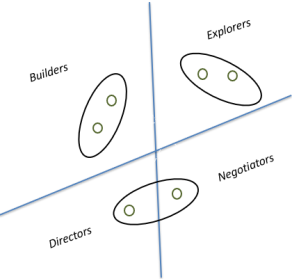
Figure 1. Helen Fisher’s model of the 4 temperaments and their optimal relationships.
Helen Fisher has found from her statistics with the websites chemistry.com and match.com that Builders attract other Builders because they share the lifestyle and values. They want to feel secure and focus on sustaining long-lasting relationships with family and friends. They want a stable life by building for themselves a secure career. Explorers are the opposite from Builders as their key personality characteristics is novelty-seeking. They get bored very easily. So, they are happy with other Explorers. As for Directors and Negotiators, they attract each other because they complement each other. The Directors need the assistance and the sensibility of Negotiators. As for Negotiators who may not be good at decision-making need the decisiveness of Directors.
This finding is presented in
Figure 1 which shows the three “optimal” relationships according to Fisher:
1) A Builder with another Builder
2) An Explorer with another Explorer
3) A Director with a Negotiator
Even if Helen Fisher’s goal was to identify human relationship patterns for people to form couples, and eventually get married. The identified pattern is likely to apply to any other long-lasting human relationships. A married couple may spend a lot of time together, but two collagues who work together every day also spend a lot of time together and would benefit from understand each other. We may then consider this model in the workplace to form pairs.
2.4. Other Psychological and Cultural Dimensions
For the purpose of our study, we will downlist the dimensions we will use to six specific cultural and psychological dimensions which include sociological dimensions from Dutch psychologist Geert Hofstede, American cross-cultural researcher Edward T. Hall and American psychologist David Keirsey as below:
1) uncertainty avoidance (from Hofstede’s 6 dimensions of culture)
2) masculinity (from Hofstede’s 6 dimensions of culture)
3) individualism (from Hofstede’s 6 dimensions of culture)
4) extroversion (from Carl Jung and David Keirsey)
5) chronemics (from sociologist Edward T. Hall)
6) abstract versus concrete (from psychologist David Keirsey)
2.4.1. Uncertainty-avoidance
Uncertainty-avoidance, as defined by Geert Hofstede, is positively corelated with the Big 5 dimension: conscientiousness. Being uncertainty avoidant means not tolerating ambiguity. An uncertainty avoidant person tries not to be in situations where something unexpected, unknown, or away from the usual can happen. It is the preference for situations that are clear, well-defined by codes of behavior, guidelines, laws, and norms. Geert Hofstede’s Uncertainty-Avoidance and Robert Cloninger’s Harm-Avoidance are said to be different by Geert Hofstede; but are positively correlated. Both Uncertainty-Avoidance and Harm-Avoidance are traits of the one of the four temperament, Fisher’s Builder and Keirsey’s Guardian.
2.4.2. Masculinity
Masculinity, as defined by Geert Hofstede, is the desire for achievement. Masucline people are competitive, assertive and confident. There is a possible correlation to be made between Hofstede’s Masculinity and Cloninger’s Persistence. The rationale is to say that people who only think about winning, masculine people, will tend do their best to do it, and so, are inclined to persist in reaching their goals. Both Masculinity and Persistence are traits of the one of the four temperament, Fisher’s Directors and Keirsey’s Rationals.
The opposite is feminity. It is the desire to be helpful. Feminity means a preference for cooperation, modesty, helping other people, caring for the weak and for the quality of life.
2.4.3. Individualism
Individualism, as described by Geert Hofstede, is the desire to “take responsibility for yourself” rather than “responsibility for others”. An individualistic person tends to say "I" more than "we". Collectivism, on the other hand, is the willingness to take responsibility for others whether it be a team, a class, a family, a nation, a country.
| [9] | Hofstede, G. Culture’s consequences: Comparing values, behaviors, institutions, and organizations across nations. Thousand Oaks, CA: Sage Publications. 2001. |
[9]
As defined by Fisher and Keirsey, their personality type, the Builder, or Guardian, is concerned by the well-being of their group. As such, we can consider them to be collectivistic. As for the Directors, or Rationals, they are much more concerned about their goals and, as such, will be considered individualistic.
2.4.4. Extroversion
Extroversion is arguably the most common psychological trait. It is part of the Big 5, as well as the Myers-Briggs Type indicator which originated from the ideas of psychiatrist Carl Jung
| [10] | Jung, C. Psychological Types. Routledge. 1923. |
[10]
.
Extroverted people are curious about other people. They are gregarious and talkative which is the definition that Fisher gave to her Explorers and Keirsey his Artisans. On the other hands, extroverts might be considered to have many “superficial” interactions by introverts who prefer having intimate conversations with only one or a few people like the Idealists and Negotiators do, as described by Keirsey and Fisher.
2.4.5. Concrete and Abstract Cognitive Styles
Being concrete or abstract is a key dimension in David Keirsey’s book Please Understand Me. It is also a reference to Carl Jung’s Sensing and Intuitive types. The intuitive type has an abstract mind. As for the Sensing type, it is more Concrete. Concrete people are in the “here and now” whereas Abstract people are more prone to think about the past, the future or about what’s happening elsewhere. In other words, they are more imaginative. As for the Concrete minded people, they are more practical.
2.4.6. Chronemics
This dimension is taken from Edward T. Hall’s book Beyond Culture
| [11] | Hall, E. T. Beyond Culture. Anchor Books. 1976. |
[11]
. Chronemics opposes polychronism to monochronism. Monochronism means following a sequential plan in which we start the next task only if the previous task is finished. We do one thing at a time. Polychronism means spontaneously starting new things. It is correlated with the trait Openness to Experience, and thus, the description of the Artisan or Explorer. The opposite, the monochronic behavior applies more to the Rational or Director.
2.5. A Novel Way to Analyze Relationships
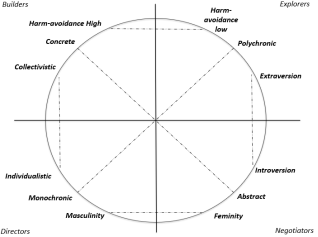
We can now make the table as below. It integrates the six dimensions and finds to which temperament they can be associated with.
Table 3. The six dimensions and their High and Low correspondances with one of the four temperaments.
Psychological traits | Low spectrum | High spectrum |
Harm-Avoidance | Builder | Explorer |
Masculinity | Negotiator | Director |
Individualism | Builder | Director |
Concreteness | Negotiator | Builder |
Chronemics | Director | Explorer |
Extroversion | Negotiator | Explorer |
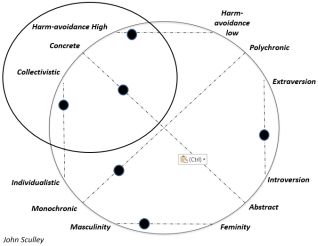
Each end of each dimension corresponds to one of the four temperaments. The Builder scores High in Harm-Avoidance, High in Concreteness and High in Collectivism. The Explorer scores Low in Harm-Avoidance, High in Polychronism and High in Extraversion. The Director corse High in Individualism, Monochronism and Masculinity. The Negotiator scores Low in Masculinity, Low in Concreteness and Low in Extraversion.
2.6. The Integrated Model
Figure 2. The 6 dichotomies applied to the 4-temperament model.
In the next chapter, we will use the model to assess, as observers, the businesspeople and their relationships with their business partners.
3. The Model Applied to Our Business Relationships
In this section, we will use the psychological model we have just defined as observers of business situations. The approach is a qualitative approach as none of the subjects did the psychometric assessment.
3.1. Porsche
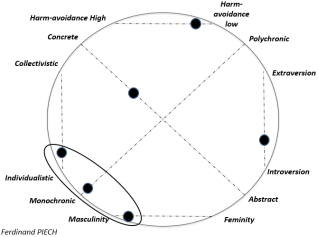
Ferdinand Porsche was extremely competitive. At Le Mans, he did not want the second or third place. He only wanted to be FIRST and WIN the cup. Consequently, we may score his Masculinity trait very high. He kept his focus on his goal and planned the way to reach them. So, his score for Monochronism will be high as well. Was he an extrovert? No, not really. Everything he planned, he planned it alone, not revealing the background of his mind to others. So, we could say he was more Introvert than extrovert. His Harm-Avoidance was low as he kept on taking risks.
The trait concrete-versus-abstract is for us the most difficult to assess as observers as it is the way they think. As an engineer, we may believe that he was more concrete, or practical, than abstract, or imaginative.
We can display his psychological report in this
Figure 3.
Figure 3. Ferdinand Piech’s 6 dimensions applied to the 4-temperament model.
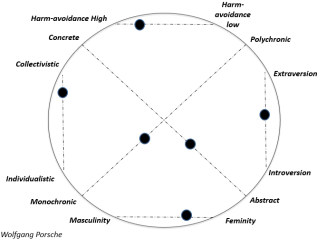
What we see is that all the traits of the Director are full. Piech was a real Director – which we could also call achiever, or winner. Now, if we can his psychography with the one of his cousin, Wolfgang Porsche, we see a much more balanced personality. Someone more careful in his manners, harm-avoidance high. Someone a little bit ore extrovert, but not a very extrovert person either. He was also more “feminine” in the sense that he would go around the factories to see how everybody was feeling. As a shareholer, but not a manager, not a director, he did not need to work. But, occasionally, he would visit the factory workers just to be nice.
Figure 4. Wolfgang Porsche’s 6 dimensions applied to the 4-temperament model.
The temperament score Wolfgang Porsche would have is more difficult to identify than his counterpart, Ferdinand Piech, whom, we can be sure was what Helen Fisher called “Director”.
And if we zoom out from the individual perspective to look at the overall perspective using the 4 wider categories of the 4 temperaments, we will see that, in the Porsche family, Ferdinand was the ony Director which can explained why he may seem to have been isolated.
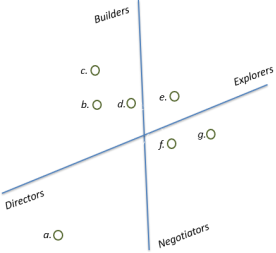
Figure 5. Piech, Porsche and the family in the 4-temperament diagram.
In the diagram in
Figure 5, the individual (a.) refers to Ferdinand Piech, as a Director. His cousin, depending on the perspective we take could be either (b.), a Builder, or (f.), a Negotiator. We may also suggest that the classical approach about psychological traits, as proven in the research to the big 5, (McCrae and Costa, 1997), personality traits are stable and heritable. Other theories, however, from Walter Mischel prefer focusing on the man-situation equation. As such we are more or less introverted, individualistic or harm-avoidant depending on the moment. And even if Wolfgang Porsche did not always agree with Ferdinand, he often assist him in his endeavours. Wolfgang Porsche was Ferdinand Piech’s “first man” when winning the 1971 Le Mans race. As such, Wolfgang Porsche’s personality trait Agreeableness could be considered high, making him, at that precise moment, more of a Negotiator, than a Builder, at that precise moment.
3.2. Apple
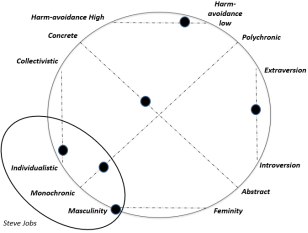
Figure 6. Steve Jobs’ 6 dimensions applied to the 4-temperament model.
Using the model, we see that Steve Jobs was, like Ferdinand Piech, very Individualistic, Monochronic and Masculine. This temperament could also be called the temperament of the Leader. People who are passionate about what they do and who have a strong will to achieve their goals.
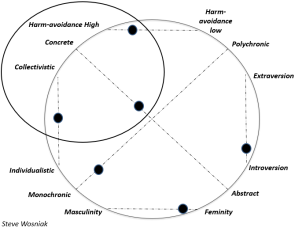
Figure 7. Steve Wosniak’s 6 dimensions applied to the 4-temperament model.
Steve Jobs’ founding partner, Steve Wosniak, would have more of his results in the top left corner of the diagram, being more of a Builder. Indeed, as an engineer, one must be practical, thus scoring high for Concreteness. We often see him depicted as very focused for long hours, by himself, on his work, making him more of an introvert, whereas Steve Jobs was more extrovert, but mostly, Masculine, Monochronic and Individualistic. We can suggest that Wosniak was more collectivistic, thinking as being responsible not only for one’s work but of the entire team’s work. As a consequence, the Builder-Director relationship made of Jobs and Wosniak’s personalities was successful.
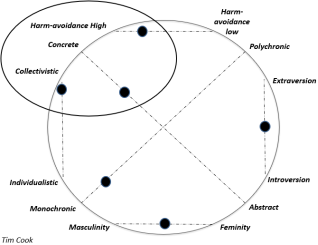
Doing the assesment of Tim Cook, the new CEO of Apple, we see that he stands as a Builder, just like Wosniak. The reasons why he is a Builder – or guardian as Keirsey called them – is that he has a strong logistical intelligence. Amid our Covi-19 global suppy disruption, Tim Cook, who was hired to organized a Just-In-Time method of logistics operation, is someone who knows how to put the right things at the right place and at the right time, the definition of Logistical Intelligence, the intelligence assigned to the Builder temperament.
Figure 8. Tim Cook’s 6 dimensions applied to the 4-temperament model.
For now, we have two Builder-Director successful relationships. Let’s now see where John Sculley is located on our psychological diagram. Sculley was the one who was at the roots of Steve Jobs “being fired from the company he created”.
Sculley scores high on Concreteness, being practical, as someone who was fired to deal with the finances of Apple, High in Harm-Avoidance, as he did not want to change the plan and the price of the Apple 2. People who stick to the plan are “monochronic” and high in “harm-avoidance” – indeed, if the plan was made in such a way, that means, we may believe, that it had a reason. We would want to go further in our analysis by assigning a primary and secondary temperament to each individual. As such, Steve Jobs would be a Director-Explorer, someone whose primary temperament is Director but having a strong tactical intelligence – the ability to change the plan at the last minute, his secondary temperament would be Explorer. As for Scully, his first temperament would be Builder and his second, Director.
Figure 9. John Sculley’s 6 dimensions applied to the 4-temperament model.
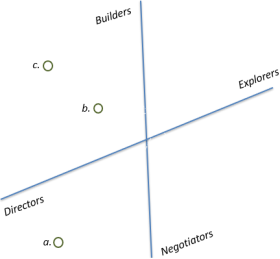
Overviewing the general dispositions of Steve Jobs (a.), John Sculley (b.) and Tim Cook (c.), we see that out of the two Builder-Director relationships, one was successful -Tim Cook and Steve Jobs-, and the other one was a failure -Steve Jobs and John Sculley.
Figure 10. Steve Jobs, John Sculley and Tim Cook placed on the 4-temperament diagram.





 Share This Article
 Twitter
 Linked In
 Facebook
 Copy
Copy Download