
Expanded vermiculite is a natural layered silicate material that, due to its high porosity, low bulk density, and low thermal conductivity, is considered a highly promising filler for the production of lightweight and energy-efficient building materials. These unique physical and structural characteristics make vermiculite particularly suitable for applications where thermal insulation, weight reduction, and energy savings are critical requirements. This paper comprehensively examines the mineralogical composition of expanded vermiculite, its thermomechanical behavior under different temperature conditions, and its functional role when incorporated into construction mixtures. Special attention is given to evaluating the effectiveness of vermiculite as a thermal insulation component and its overall contribution to improving the energy efficiency of modern buildings. At the present stage of development, deepening economic reforms in the construction sector of our Republic is of great importance in order to achieve tangible and sustainable results. This requires the implementation of effective measures aimed at increasing economic efficiency, reducing production costs, and ensuring the wide and productive use of local raw materials in the manufacture of energy-efficient construction materials. In addition, the rational and complete recycling of waste generated by various industrial sectors is becoming an essential component of sustainable development in the construction industry. These priorities highlight the need for innovative material solutions that combine technical performance with economic and environmental benefits. One of the most pressing economic and technological challenges today is the production of high-quality building materials using energy-saving, efficient, and resource-conserving technologies during production, development, and continuous improvement processes. In this context, particular attention is paid to the development of ultra-lightweight, energy-efficient, and durable concrete products. One of the key objectives addressed in this study is the production of high-quality concrete blocks based on expanded vermiculite and low-water cement systems. Such materials have the potential to significantly reduce structural weight, enhance thermal performance, and improve overall energy efficiency, while maintaining the required strength and durability characteristics for modern construction applications.
| Published in | Science Discovery Physics (Volume 1, Issue 1) |
| DOI | 10.11648/j.sdp.20260101.13 |
| Page(s) | 36-42 |
| Creative Commons |
This is an Open Access article, distributed under the terms of the Creative Commons Attribution 4.0 International License (http://creativecommons.org/licenses/by/4.0/), which permits unrestricted use, distribution and reproduction in any medium or format, provided the original work is properly cited. |
| Copyright |
Copyright © The Author(s), 2026. Published by Science Publishing Group |
Expanded Vermiculite, Lightweight Concrete, Thermal Insulation, Energy-efficient Building Materials, Low Water Demand Cement, Porous Fillers, Thermomechanical Properties
Compositions | Raw materials | ||||||
|---|---|---|---|---|---|---|---|
Expanded vermiculite | All vermiculite sand | P.C | Fiber | PEK,% | Water/Cement | Rs, МPа | |
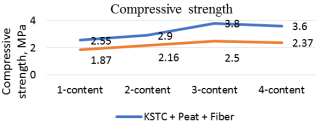
1-comp | 120 | 100 | 400 | 1,0 | 0,5 | 0,54 | 2,55 |
2- comp | 120 | 100 | 400 | 1,0 | 1,0 | 0,54 | 2,90 |
3- comp | 120 | 100 | 400 | 1,0 | 1,2 | 0,54 | 3,80 |
4- comp | 120 | 100 | 400 | 1,0 | 1,5 | 0,54 | 3,60 |
Compositions | Raw materials | ||||||
|---|---|---|---|---|---|---|---|
Expanded vermiculite | All vermiculite sand | LWDC | Fiber | PEK, % | Water/Cement | Rs, МPа | |
1-comp | 120 | 100 | 400 | 1,0 | 0,5 | 0,63 | 1,87 |
2- comp | 120 | 100 | 400 | 1,0 | 1,0 | 0,63 | 2,16 |
3- comp | 120 | 100 | 400 | 1,0 | 1,2 | 0,63 | 2,50 |
4- comp | 120 | 100 | 400 | 1,0 | 1,5 | 0,63 | 2,37 |
TG/DTA | Analyses Confirm Its Resistance to High Temperatures |
TG | Thermogravimetric Analysis |
| [1] | Yusupov, H. V., Karimov, G. U., Saidmurodova, S. M., & Mukhammadiev, I. (2023). Improving the Efficiency of Cement with Low Water Demand. Journal of Engineering, Mechanics and Modern Architecture, (2), 155–160. |
| [2] | Resolution of the President of the Republic of Uzbekistan No. PP-4335 dated May 23, 2019. |
| [3] | GOST 12865-67. Expanded Vermiculite. Approved April 12, 1967. |
| [4] | Baulin, D. K. Interfloor Slabs Made of Lightweight Concrete. |
| [5] | Moscow: Stroyizdat, 1974, 216 p. |
| [6] | Burlakov, G. S. Technology of Products Made of Lightweight Concrete. Moscow, 1986. |
| [7] | Buzhevich, G. A. Lightweight Concretes with Porous Aggregates. Moscow, 1970. |
| [8] | Matyokubov, B. P., & Saidmurodova, S. M. (2022, August). Application of Technology of Vermiculite Lightweight Concretes Based on Low Water Demand Binders. In International Conferences (Vol. 1, No. 15, pp. 103–109). |
| [9] | Matyokubov, B. P., & Saidmurodova, S. M. (2022). Methods for Investigation of Thermophysical Characteristics of Underground External Barrier Structures of Buildings. Research and Education, 1(5), 49–58. |
| [10] | Pulatovich, M. B., & Muzaffarovna, S. S. (2022). Methods for Investigation of Thermophysical Characteristics of Underground External Barrier Structures of Buildings. ISSN 2181-3191, Volume 1, Issue 5, August 2022, Article No. 202259. |
| [11] | Karimov, G. U. (2021). Energy-Efficient Binder of Low Water Demand with Modified Mineral Additives Based on Locally Available Components. In Euro-Asia Conferences (Vol. 4, No. 1, pp. 106–109). |
| [12] | Karimov, G., & Bakhriyev, N. (2018). Research on the Development of Energy-Efficient Binders for Modern Construction. Problems of Architecture and Construction, 1(2), 61–63. |
| [13] | Yusupov, H. V., Karimov, G. U., Saidmurodova, S. M., & Zayniyevich, I. F. (2024). Modern Problems of Low Water Demand Cements. Miasto Przyszłości, 44, 231–234. |
| [14] | Yusupov, H. V., Karimov, G. U., & Saidmurodova, S. M. Increasing the Efficiency of Vermiculite Concrete Based on Low Water Demand Cement. International Scientific and Practical Conference “Architecture Is the Abode of Time”, Samarkand State Architecture and Construction University, May 23–24, 2024. |
| [15] | Saidmurodova, S. M., & Yusupov, H. V. Technology for the Production of Lightweight Concrete Blocks Based on Multi-Tempered Vermiculite and Low-Grade Cement. International Scientific and Technical Conference “Innovative Technologies in Environmental Protection”, May 1–2, 2025. |
| [16] | Saidmurodova, S. M., & Yusupov, H. V. Technology of Vermiculite-Based Lightweight Energy-Efficient Concretes. II Republican Review Competition and Scientific-Practical Conference of Students “New Uzbekistan: Swallows of Science–2023”, Part 1, May 20, 2023, Jizzakh. |
| [17] | Saidmurodova, S. M., & Mukhammadiev, I. Methods for Determining the Properties of Low Water Demand Cements with Microsilica. Proceedings of the XXIII Republican Scientific-Practical Conference “Innovative Ideas of the Youth of New Uzbekistan”, Part I, June 19, 2023. |
| [18] | Lavrin, A. V., Bolyakin, V. B., & Ossialov, V. B. (2018). Experimental Study of Friction Torque in a Rolling Bearing under Shaft Misalignment. Proceedings of the Samara Scientific Center of the Russian Academy of Sciences, Vol. 20, No. 4–1, pp. 37–42. |
APA Style
Vaxobovich, Y. X., Umurkulovich, K. G., Muzaffarovna, S. S. (2026). Lightweight Thermal-protective Materials Based on Foamed Vermiculite: Physical and Chemical Properties, Production Technologies. Science Discovery Physics, 1(1), 36-42. https://doi.org/10.11648/j.sdp.20260101.13
ACS Style
Vaxobovich, Y. X.; Umurkulovich, K. G.; Muzaffarovna, S. S. Lightweight Thermal-protective Materials Based on Foamed Vermiculite: Physical and Chemical Properties, Production Technologies. Sci. Discov. Phys. 2026, 1(1), 36-42. doi: 10.11648/j.sdp.20260101.13
@article{10.11648/j.sdp.20260101.13,
  author = {Yusupov Xamid Vaxobovich and Karimov Gafur Umurkulovich and Saidmurodova Sarvara Muzaffarovna},
  title = {Lightweight Thermal-protective Materials Based on Foamed Vermiculite: Physical and Chemical Properties, Production Technologies},
  journal = {Science Discovery Physics},
  volume = {1},
  number = {1},
  pages = {36-42},
  doi = {10.11648/j.sdp.20260101.13},
  url = {https://doi.org/10.11648/j.sdp.20260101.13},
  eprint = {https://article.sciencepublishinggroup.com/pdf/10.11648.j.sdp.20260101.13},
  abstract = {Expanded vermiculite is a natural layered silicate material that, due to its high porosity, low bulk density, and low thermal conductivity, is considered a highly promising filler for the production of lightweight and energy-efficient building materials. These unique physical and structural characteristics make vermiculite particularly suitable for applications where thermal insulation, weight reduction, and energy savings are critical requirements. This paper comprehensively examines the mineralogical composition of expanded vermiculite, its thermomechanical behavior under different temperature conditions, and its functional role when incorporated into construction mixtures. Special attention is given to evaluating the effectiveness of vermiculite as a thermal insulation component and its overall contribution to improving the energy efficiency of modern buildings. At the present stage of development, deepening economic reforms in the construction sector of our Republic is of great importance in order to achieve tangible and sustainable results. This requires the implementation of effective measures aimed at increasing economic efficiency, reducing production costs, and ensuring the wide and productive use of local raw materials in the manufacture of energy-efficient construction materials. In addition, the rational and complete recycling of waste generated by various industrial sectors is becoming an essential component of sustainable development in the construction industry. These priorities highlight the need for innovative material solutions that combine technical performance with economic and environmental benefits. One of the most pressing economic and technological challenges today is the production of high-quality building materials using energy-saving, efficient, and resource-conserving technologies during production, development, and continuous improvement processes. In this context, particular attention is paid to the development of ultra-lightweight, energy-efficient, and durable concrete products. One of the key objectives addressed in this study is the production of high-quality concrete blocks based on expanded vermiculite and low-water cement systems. Such materials have the potential to significantly reduce structural weight, enhance thermal performance, and improve overall energy efficiency, while maintaining the required strength and durability characteristics for modern construction applications.},
 year = {2026}
}
TY  - JOUR
T1  - Lightweight Thermal-protective Materials Based on Foamed Vermiculite: Physical and Chemical Properties, Production Technologies
AU  - Yusupov Xamid Vaxobovich
AU  - Karimov Gafur Umurkulovich
AU  - Saidmurodova Sarvara Muzaffarovna
Y1  - 2026/02/24
PY  - 2026
N1  - https://doi.org/10.11648/j.sdp.20260101.13
DO  - 10.11648/j.sdp.20260101.13
T2  - Science Discovery Physics
JF  - Science Discovery Physics
JO  - Science Discovery Physics
SP  - 36
EP  - 42
PB  - Science Publishing Group
UR  - https://doi.org/10.11648/j.sdp.20260101.13
AB  - Expanded vermiculite is a natural layered silicate material that, due to its high porosity, low bulk density, and low thermal conductivity, is considered a highly promising filler for the production of lightweight and energy-efficient building materials. These unique physical and structural characteristics make vermiculite particularly suitable for applications where thermal insulation, weight reduction, and energy savings are critical requirements. This paper comprehensively examines the mineralogical composition of expanded vermiculite, its thermomechanical behavior under different temperature conditions, and its functional role when incorporated into construction mixtures. Special attention is given to evaluating the effectiveness of vermiculite as a thermal insulation component and its overall contribution to improving the energy efficiency of modern buildings. At the present stage of development, deepening economic reforms in the construction sector of our Republic is of great importance in order to achieve tangible and sustainable results. This requires the implementation of effective measures aimed at increasing economic efficiency, reducing production costs, and ensuring the wide and productive use of local raw materials in the manufacture of energy-efficient construction materials. In addition, the rational and complete recycling of waste generated by various industrial sectors is becoming an essential component of sustainable development in the construction industry. These priorities highlight the need for innovative material solutions that combine technical performance with economic and environmental benefits. One of the most pressing economic and technological challenges today is the production of high-quality building materials using energy-saving, efficient, and resource-conserving technologies during production, development, and continuous improvement processes. In this context, particular attention is paid to the development of ultra-lightweight, energy-efficient, and durable concrete products. One of the key objectives addressed in this study is the production of high-quality concrete blocks based on expanded vermiculite and low-water cement systems. Such materials have the potential to significantly reduce structural weight, enhance thermal performance, and improve overall energy efficiency, while maintaining the required strength and durability characteristics for modern construction applications.
VL  - 1
IS  - 1
ER  -
Department of Civil Engineering, Samarkand State Architecture and Construction University, Samarkand, Uzbekistan
Biography: Yusupov Xamid Vaxobovich is an Uzbek professional known for his dedication to continuous learning and professional development. He has gained experience in his field through academic training and practical work, demonstrating strong analytical thinking and a responsible approach to his duties.
Research Fields: Engineering and Applied Sciences, Structural Engineering, Construction Materials and Technologies, Analysis and Design of Engineering Structures, Innovative and Sustainable Construction Solutions.

Department of Civil Engineering, Samarkand State Architecture and Construction University, Samarkand, Uzbekistan
Biography: Karimov Gafur Umurkulovich is an Uzbek professional recognized for his commitment to continuous professional development and responsible work ethics. He has gained experience through education and practical activities, demonstrating strong analytical thinking and a disciplined approach to his responsibilities.
Research Fields: Engineering and Applied Sciences, Structural Analysis and Design, Construction Materials and Technologies, Sustainable and Innovative Engineering Solutions, Safety and Reliability of Engineering Structures.
Department of Civil Engineering, Samarkand State Architecture and Construction University, Samarkand, Uzbekistan
Biography: Saidmurodova Sarvara Muzaffarovna is an Uzbek professional known for her dedication to professional development and continuous learning. She has built her experience through education and practical activities, demonstrating responsibility, accuracy, and a strong work ethic.
Research Fields: Engineering and Applied Sciences, Construction Engineering and Management, Building Materials and Technologies, Sustainable Construction and Development, Quality Control and Safety in Construction.


Information



 Share This Article
 Twitter
 Linked In
 Facebook
 Copy
Copy Download