Neoproterozoic mafic-ultramafic layered intrusions within the East African Orogen in Ethiopia host major, yet historically underdeveloped, reserves of igneous phosphate, titanium, and vanadium. Deposits such as the Bikilal Layered Gabbro Complex (BLGC; ~580 Mt @ 3.02% P2O5, 5.4% TiO2, and 17.67% Fe2O3) and the Melka Arba Intrusion (87.5 Mt @ 3.21% P2O5 and 6.66% TiO2) were previously constrained by a single-commodity exploration paradox. Earlier pre-feasibility evaluations focused solely on apatite extraction via dry pneumatic classification, incurring high P2O5 loss (~39%) in fine fractions (<45 µm) and generating a negative Net Present Value (-US$ 142M). This study formulates a unified petrogenetic model linking tholeiitic magma differentiation, immiscible Fe–Ti–P–F oxide-apatite melt segregation, and REE fractionation across Ethiopian complexes. Quantitative EPMA analyses reveal high-purity hydroxyfluorapatite (40.85% P2O5 avg), low-magnesium ilmenite (51.95% TiO2 avg), and vanadiferous titanomagnetite (1.18% V2O5 avg). To address historical process bottlenecks, we present an integrated wet beneficiation circuit (wet ball milling, LIMS, WHIMS, and multi-stage froth flotation). Mass-balance modeling demonstrates that co-recovering apatite (78.5% P2O5 recovery), ilmenite (280 kt/a @ 51.2% TiO2), and V-titanomagnetite (620 kt/a @ 1.2% V2O5) transforms project economics, yielding a positive NPV10% of +US$ 385.4M and an Internal Rate of Return (IRR) of 24.6%.
This is an Open Access article, distributed under the terms of the Creative Commons Attribution 4.0 International License (http://creativecommons.org/licenses/by/4.0/), which permits unrestricted use, distribution and reproduction in any medium or format, provided the original work is properly cited.
Neoproterozoic orogenic belts across the East African Orogen host extensive basic to ultrabasic intrusive complexes whose economic potential remains underutilized
[1]
B. Charlier, O. Namur, and J. Vander Auwera, "Petrology and economic geology of Fe-Ti-V ore-bearing layered intrusions," Elements, vol. 11, no. 5, pp. 333–338, Oct. 2015.
B. R. Frost and D. H. Lindsley, "Occurrence of iron-titanium oxides in igneous rocks," Reviews in Mineralogy and Geochemistry, vol. 25, pp. 433–468, 1991.
. In Ethiopia, igneous apatite-bearing titanomagnetite and ilmenite bodies represent the principal domestic source of agricultural phosphate feedstock and industrial heavy metals
[3]
Consult 4 International, Pre-feasibility Study of the Bikilal Iron-Apatite Deposit, Addis Ababa, Ethiopia: Ministry of Mines, 2002.
[4]
H. Gautneb, T. Gudbrandsen, and S. Tadesse, "The geology, exploration and status of the Epworth and Melka Arba apatite-titanomagnetite deposits, Ethiopia," Journal of African Earth Sciences, vol. 32, no. 4, pp. 741–754, 2001.
T. Wakesa, "Petrology and beneficiation characteristics of the Bikilal Layered Gabbro Complex, Western Ethiopia," M. S. thesis, Dept. Earth Sci., Addis Ababa University, Addis Ababa, Ethiopia, 2010.
[3-5]
. However, historical exploration campaigns suffered from a single-commodity paradigm: evaluating multi-element magmatic systems strictly for a single primary mineral phase while discarding valuable co-products as waste
[5]
T. Wakesa, "Petrology and beneficiation characteristics of the Bikilal Layered Gabbro Complex, Western Ethiopia," M. S. thesis, Dept. Earth Sci., Addis Ababa University, Addis Ababa, Ethiopia, 2010.
[5]
.
In the Bikilal Layered Gabbro Complex (BLGC) of West Wollega, earlier technical studies evaluated the deposit purely as a source of phosphate rock for fertilizer production
[3]
Consult 4 International, Pre-feasibility Study of the Bikilal Iron-Apatite Deposit, Addis Ababa, Ethiopia: Ministry of Mines, 2002.
[3]
. To bypass regional dry-season water constraints near Gimbi, process flowsheets relied on dry pneumatic classification
[6]
Bateman Phosphate Technologies, Testwork Report on Dry Pneumatic Beneficiation of Bikilal Apatite Ore, Johannesburg, South Africa, 2002.
[6]
. This approach rejected all fine particles below 45 µm, causing a 39% loss of total P2O5 to fine tailings and yielding an economically unviable project with an NPV of -US$ 142 million
[3]
Consult 4 International, Pre-feasibility Study of the Bikilal Iron-Apatite Deposit, Addis Ababa, Ethiopia: Ministry of Mines, 2002.
[3]
.
Research Gap & Objective: Published literature treats Ethiopian magmatic P–Fe–Ti–V deposits as isolated regional targets
[4]
H. Gautneb, T. Gudbrandsen, and S. Tadesse, "The geology, exploration and status of the Epworth and Melka Arba apatite-titanomagnetite deposits, Ethiopia," Journal of African Earth Sciences, vol. 32, no. 4, pp. 741–754, 2001.
K. Abera, Geology and Mineral Resources of Western Ethiopia, Addis Ababa: Institute of Geological Survey of Ethiopia, 1975.
[8]
K. Abera, "Magmatic evolution of mafic-ultramafic complexes in the western Ethiopian shield," Ethiopian Journal of Earth Sciences, vol. 15, no. 2, pp. 45–62, 2008.
[4, 7, 8]
without establishing a unified petrogenetic model or an integrated co-product process flowsheet. This paper synthesizes geological, geochemical, micro-probe, and resource block model datasets across the BLGC and Melka Arba deposits.
It establishes the petrogenetic mechanism of silicate-oxide liquid immiscibility and presents an optimized wet beneficiation flowsheet designed to co-recover phosphate, titanium, and vanadium.
2. Geological Setting & Petrogenetic Mechanism
The BLGC (West Wollega) and Melka Arba complex (Bale Zone) intrude Neoproterozoic metamorphic volcano-sedimentary sequences of the Mozambique Belt
[4]
H. Gautneb, T. Gudbrandsen, and S. Tadesse, "The geology, exploration and status of the Epworth and Melka Arba apatite-titanomagnetite deposits, Ethiopia," Journal of African Earth Sciences, vol. 32, no. 4, pp. 741–754, 2001.
T. Wakesa, "Petrology and beneficiation characteristics of the Bikilal Layered Gabbro Complex, Western Ethiopia," M. S. thesis, Dept. Earth Sci., Addis Ababa University, Addis Ababa, Ethiopia, 2010.
[4, 5]
. The BLGC defines an asymmetric, inward-dipping synformal layered structure extending over 30 km along strike
[3]
Consult 4 International, Pre-feasibility Study of the Bikilal Iron-Apatite Deposit, Addis Ababa, Ethiopia: Ministry of Mines, 2002.
[5]
T. Wakesa, "Petrology and beneficiation characteristics of the Bikilal Layered Gabbro Complex, Western Ethiopia," M. S. thesis, Dept. Earth Sci., Addis Ababa University, Addis Ababa, Ethiopia, 2010.
[3, 5]
. Concentric lithological zonation progresses from an unmineralized central olivine gabbro core outward through leucogabbro-anorthosite and hornblende gabbro into mineralized peripheral pyroxenite and hornblendite layers
[3]
Consult 4 International, Pre-feasibility Study of the Bikilal Iron-Apatite Deposit, Addis Ababa, Ethiopia: Ministry of Mines, 2002.
[5]
T. Wakesa, "Petrology and beneficiation characteristics of the Bikilal Layered Gabbro Complex, Western Ethiopia," M. S. thesis, Dept. Earth Sci., Addis Ababa University, Addis Ababa, Ethiopia, 2010.
[3, 5]
.
Magmatic differentiation within these complexes followed a tholeiitic iron-enrichment trend
[9]
T. N. Irvine and W. R. A. Baragar, "A guide to the chemical classification of the common volcanic rocks," Canadian Journal of Earth Sciences, vol. 8, no. 5, pp. 523–548, 1971.
M. J. Toplis and M. R. Carroll, "An experimental study of the influence of oxygen fugacity on Fe-Ti oxide stability, phase relations, and mineral–melt equilibria in ferro-basaltic systems," Journal of Petrology, vol. 36, no. 5, pp. 1137–1170, 1995.
. Fractional crystallization of plagioclase and olivine depleted the residual melt in Al2O3 and SiO2 while driving enrichment in FeOtot, TiO2, P2O5, and F
[1]
B. Charlier, O. Namur, and J. Vander Auwera, "Petrology and economic geology of Fe-Ti-V ore-bearing layered intrusions," Elements, vol. 11, no. 5, pp. 333–338, Oct. 2015.
. Upon reaching critical P-T-X conditions (T ≈ 1020°C–1080°C, fO2 near FMQ), the homogeneous silicate liquid unmixed into two immiscible phases: a silica-rich conjugate melt and a dense, low-viscosity Fe–Ti–P–F oxide-apatite liquid that gravitated into intercumulus spaces, crystallizing net-textured to massive titanomagnetite, ilmenite, and fluorapatite horizons
[1]
B. Charlier, O. Namur, and J. Vander Auwera, "Petrology and economic geology of Fe-Ti-V ore-bearing layered intrusions," Elements, vol. 11, no. 5, pp. 333–338, Oct. 2015.
B. R. Frost and D. H. Lindsley, "Occurrence of iron-titanium oxides in igneous rocks," Reviews in Mineralogy and Geochemistry, vol. 25, pp. 433–468, 1991.
A. Kolker, "Mineralogy and geochemistry of Fe-Ti oxide and apatite (nelsonite) deposits and evaluation of the liquid immiscibility hypothesis," Economic Geology, vol. 77, no. 5, pp. 1146–1163, 1982.
Quantitative mineral chemistry was determined via electron microprobe analysis (EPMA) across representative mineralized core samples from BLGC and Melka Arba
[4]
H. Gautneb, T. Gudbrandsen, and S. Tadesse, "The geology, exploration and status of the Epworth and Melka Arba apatite-titanomagnetite deposits, Ethiopia," Journal of African Earth Sciences, vol. 32, no. 4, pp. 741–754, 2001.
T. Wakesa, "Petrology and beneficiation characteristics of the Bikilal Layered Gabbro Complex, Western Ethiopia," M. S. thesis, Dept. Earth Sci., Addis Ababa University, Addis Ababa, Ethiopia, 2010.
[4, 5]
(Table 1). Apatite across both intrusions is stoichiometric fluorapatite with low heavy metal impurities (Cd, Pb < 10 ppm)
[4]
H. Gautneb, T. Gudbrandsen, and S. Tadesse, "The geology, exploration and status of the Epworth and Melka Arba apatite-titanomagnetite deposits, Ethiopia," Journal of African Earth Sciences, vol. 32, no. 4, pp. 741–754, 2001.
T. Wakesa, "Petrology and beneficiation characteristics of the Bikilal Layered Gabbro Complex, Western Ethiopia," M. S. thesis, Dept. Earth Sci., Addis Ababa University, Addis Ababa, Ethiopia, 2010.
[4, 5]
. Ilmenite occurs as discrete homogeneous grains with low MgO (<1.5%), suitable for pigment production, while titanomagnetite contains elevated vanadium (0.82–1.62% V2O5)
[4]
H. Gautneb, T. Gudbrandsen, and S. Tadesse, "The geology, exploration and status of the Epworth and Melka Arba apatite-titanomagnetite deposits, Ethiopia," Journal of African Earth Sciences, vol. 32, no. 4, pp. 741–754, 2001.
T. Wakesa, "Petrology and beneficiation characteristics of the Bikilal Layered Gabbro Complex, Western Ethiopia," M. S. thesis, Dept. Earth Sci., Addis Ababa University, Addis Ababa, Ethiopia, 2010.
[14]
USGS, Mineral Commodity Summaries: Titanium and Vanadium, Reston, VA: U. S. Geological Survey, 2021.
[4, 5, 14]
.
Table 1. Summary of geochemical characteristics, concentration ranges, mean values, and petrological-industrial significance of key mineral phases (apatite, ilmenite, and vanadiferous titanomagnetite).
Mineral Phase
Key Oxide / Element
Concentration Range (%)
Mean (%)
Petrological & Industrial Significance
Apatite (BLGC & Melka Arba)
P2O5
40.05% – 41.52%
40.85%
Stoichiometric fluorapatite
[5]
T. Wakesa, "Petrology and beneficiation characteristics of the Bikilal Layered Gabbro Complex, Western Ethiopia," M. S. thesis, Dept. Earth Sci., Addis Ababa University, Addis Ababa, Ethiopia, 2010.
[5]
.
CaO
53.80% – 55.20%
54.45%
High Ca/P ratio suitable for wet-process H3PO4
[13]
IFDC, The Fertilization Process and Technical Specifications, Muscle Shoals, AL: International Fertilizer Development Center, 2019.
[13]
.
Cadmium (Cd)
< 5 ppm – 12 ppm
< 8 ppm
Environmentally clean fertilizer feedstock
[14]
USGS, Mineral Commodity Summaries: Titanium and Vanadium, Reston, VA: U. S. Geological Survey, 2021.
[14]
.
Ilmenite (Discrete Grains)
TiO2
50.49% – 53.82%
51.95%
High-grade feedstock for TiO2 pigment production
[4]
H. Gautneb, T. Gudbrandsen, and S. Tadesse, "The geology, exploration and status of the Epworth and Melka Arba apatite-titanomagnetite deposits, Ethiopia," Journal of African Earth Sciences, vol. 32, no. 4, pp. 741–754, 2001.
H. Gautneb, T. Gudbrandsen, and S. Tadesse, "The geology, exploration and status of the Epworth and Melka Arba apatite-titanomagnetite deposits, Ethiopia," Journal of African Earth Sciences, vol. 32, no. 4, pp. 741–754, 2001.
B. R. Frost and D. H. Lindsley, "Occurrence of iron-titanium oxides in igneous rocks," Reviews in Mineralogy and Geochemistry, vol. 25, pp. 433–468, 1991.
USGS, Mineral Commodity Summaries: Titanium and Vanadium, Reston, VA: U. S. Geological Survey, 2021.
[14]
.
Geostatistical block modeling using Ordinary Kriging (OK) on a 25 m × 25 m × 25 m grid defined global resources for BLGC
[3]
Consult 4 International, Pre-feasibility Study of the Bikilal Iron-Apatite Deposit, Addis Ababa, Ethiopia: Ministry of Mines, 2002.
[15]
JORC, Australasian Code for Reporting of Exploration Results, Mineral Resources and Ore Reserves (The JORC Code), Joint Ore Reserves Committee, 2012.
[3, 15]
. Melka Arba resources were calculated via volumetric domain modeling
[4]
H. Gautneb, T. Gudbrandsen, and S. Tadesse, "The geology, exploration and status of the Epworth and Melka Arba apatite-titanomagnetite deposits, Ethiopia," Journal of African Earth Sciences, vol. 32, no. 4, pp. 741–754, 2001.
(Table 2). In addition, trace element ICP-MS analyses at Melka Arba reveal Total Rare Earth Element (TREE) concentrations in apatite ranging from 2,453 ppm in pyroxenites up to 4,144 ppm in pegmatitic facies, dominated by LREEs (La, Ce, Nd)
[4]
H. Gautneb, T. Gudbrandsen, and S. Tadesse, "The geology, exploration and status of the Epworth and Melka Arba apatite-titanomagnetite deposits, Ethiopia," Journal of African Earth Sciences, vol. 32, no. 4, pp. 741–754, 2001.
Table 2. Summary of JORC-compliant mineral resource estimates, grade distributions (P₂O₅, TiO₂, Fe₂O₃, and V₂O₅), and supporting references for the Bikilal–Ghimbi Complex (BLGC) and Melka Arba deposits.
Deposit / Domain
JORC Category
Tonnage (Mt)
P2O5 (%)
TiO2 (%)
Fe2O3 (%)
V2O5 (%)
Source Citation
BLGC Soji-Bikilal (Indicated)
Indicated
435.0
3.00%
5.00%
16.40%
0.04%
[3]
Consult 4 International, Pre-feasibility Study of the Bikilal Iron-Apatite Deposit, Addis Ababa, Ethiopia: Ministry of Mines, 2002.
[3]
BLGC Deep Extensions (Inferred)
Inferred
145.0
3.10%
6.60%
21.50%
0.04%
[3]
Consult 4 International, Pre-feasibility Study of the Bikilal Iron-Apatite Deposit, Addis Ababa, Ethiopia: Ministry of Mines, 2002.
[3]
BLGC Global Resource Total
Global
580.0
3.02%
5.40%
17.67%
0.04%
[3]
Consult 4 International, Pre-feasibility Study of the Bikilal Iron-Apatite Deposit, Addis Ababa, Ethiopia: Ministry of Mines, 2002.
[3]
Melka Arba Main Indicated
Indicated
87.5
3.21%
6.66%
-
-
[4]
H. Gautneb, T. Gudbrandsen, and S. Tadesse, "The geology, exploration and status of the Epworth and Melka Arba apatite-titanomagnetite deposits, Ethiopia," Journal of African Earth Sciences, vol. 32, no. 4, pp. 741–754, 2001.
H. Gautneb, T. Gudbrandsen, and S. Tadesse, "The geology, exploration and status of the Epworth and Melka Arba apatite-titanomagnetite deposits, Ethiopia," Journal of African Earth Sciences, vol. 32, no. 4, pp. 741–754, 2001.
Micro-structural liberation analysis indicates that 42% of apatite crystals are fine-grained (20–75 µm) and closely intergrown with amphibole
[5]
T. Wakesa, "Petrology and beneficiation characteristics of the Bikilal Layered Gabbro Complex, Western Ethiopia," M. S. thesis, Dept. Earth Sci., Addis Ababa University, Addis Ababa, Ethiopia, 2010.
[5]
. The historical dry pneumatic flowsheet rejected all material finer than 45 µm to prevent separator blinding, leading to a catastrophic 39% P2O5 loss to tailings
[3]
Consult 4 International, Pre-feasibility Study of the Bikilal Iron-Apatite Deposit, Addis Ababa, Ethiopia: Ministry of Mines, 2002.
[6]
Bateman Phosphate Technologies, Testwork Report on Dry Pneumatic Beneficiation of Bikilal Apatite Ore, Johannesburg, South Africa, 2002.
[3, 6]
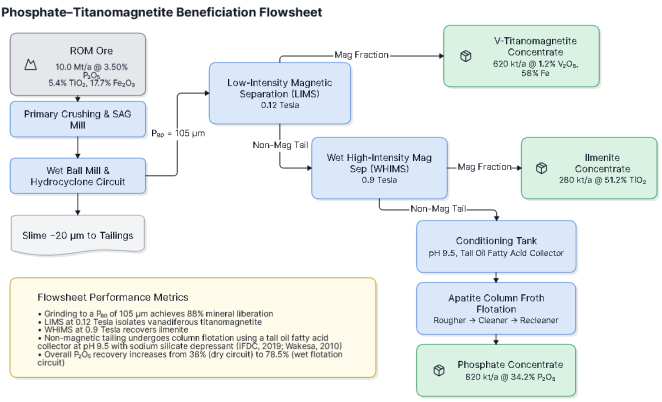
. To resolve this metallurgical bottleneck, an integrated wet beneficiation circuit was designed and modeled (Figure 1).
Figure 1. Re-engineered wet beneficiation flowsheet for Ethiopian Fe–Ti–P–V ore, combining wet ball milling, low-intensity magnetic separation (LIMS), wet high-intensity magnetic separation (WHIMS), and multi-stage froth flotation (IFDC, 2019; Wakesa, 2010).
The proposed circuit processes 10.0 Mt/a of run-of-mine (ROM) ore through wet SAG and ball milling, grinding to a P80 of 105 µm to achieve 88% mineral liberation. Low-Intensity Magnetic Separation (LIMS at 0.12 T) first isolates vanadiferous titanomagnetite (620 kt/a @ 1.2% V2O5, 58% Fe). The non-magnetic tailings pass to Wet High-Intensity Magnetic Separation (WHIMS at 0.9 T) to recover ilmenite (280 kt/a @ 51.2% TiO2). Finally, the WHIMS non-magnetic tail is conditioned at pH 9.5 using tall oil fatty acid collectors and sodium silicate depressants, undergoing rougher-cleaner-recleaner froth flotation (IFDC, 2019; Wakesa, 2010). This increases overall P2O5 recovery from 38% (dry circuit) to 78.5%, producing 820 kt/a of premium phosphate concentrate @ 34.2% P2O5.
5. Economic & Comparative Evaluation
A comparative financial analysis demonstrates the economic transformation achieved by transitioning from single-commodity dry processing to the multi-commodity wet circuit
[3]
Consult 4 International, Pre-feasibility Study of the Bikilal Iron-Apatite Deposit, Addis Ababa, Ethiopia: Ministry of Mines, 2002.
[13]
IFDC, The Fertilization Process and Technical Specifications, Muscle Shoals, AL: International Fertilizer Development Center, 2019.
[3, 13]
(Table 3). Igneous phosphate deposits globally (e.g., Siilinjärvi, Palabora) rely on co-product credit revenues to ensure commercial viability
[1]
B. Charlier, O. Namur, and J. Vander Auwera, "Petrology and economic geology of Fe-Ti-V ore-bearing layered intrusions," Elements, vol. 11, no. 5, pp. 333–338, Oct. 2015.
Neoproterozoic magmatic Fe–Ti–P–V intrusions in Ethiopia represent major multi-commodity mineral deposits when evaluated within an integrated petrogenetic and metallurgical framework. Replacing historic dry pneumatic classification with a wet ball-milling, magnetic separation, and froth flotation flowsheet recovers fine-grained apatite (78.5% recovery) and unlocks high-value ilmenite and vanadiferous titanomagnetite co-products. This shifts project economics from a negative NPV (-US$ 142M) to a highly profitable asset (+US$ 385.4M NPV10%), establishing a robust domestic foundation for agricultural fertilizer production and industrial metallurgy in East Africa.
Abbreviations
BLGC
Bikilal Layered Gabbro Complex
CAPEX
Capital Expenditure
Cd
Cadmium
EPMA
Electron Microprobe Analysis
Fe2O3tot
Total Ferric Oxide
ICP-MS
Inductively Coupled Plasma Mass Spectrometry
IRR
Internal Rate of Return
JORC
Joint Ore Reserves Committee
LIMS
Low-Intensity Magnetic Separation
LREEs
Light Rare Earth Elements
Mt
Million Tonnes
NPV
Net Present Value
OK
Ordinary Kriging
P₈₀
80% Passing Particle Size (Grind Size)
pH
Potential of Hydrogen (Measure of Acidity/Alkalinity)
REE
Rare Earth Elements
ROM
Run-Of-Mine (Raw Extracted Ore)
SAG
Semi-Autogenous Grinding (Milling Process)
T
Tesla (Unit of Magnetic Flux Density)
TREE
Total Rare Earth Element
US$
United States Dollar
WHIMS
Wet High-Intensity Magnetic Separation
µm
Micrometers (Microns)
Acknowledgments
The authors gratefully acknowledge the foundational geological surveys and historical exploration datasets provided by the Geological Survey of Ethiopia (GSE), Consult 4 International, and associated researchers whose previous mapping and resource estimates, including those for the Bikilal Layered Gabbro Complex and the Melka Arba Intrusion, enabled this re-evaluation. Special thanks are extended to academic and industrial collaborators in petrology and process metallurgy whose insights on tholeiitic magma differentiation, liquid immiscibility, and wet beneficiation circuits were instrumental in developing the integrated recovery model presented in this study.
Author Contributions
Gutema Mekonen: Conceptualization, Data curation, Formal Analysis, Investigation, Methodology, Software, Writing – original draft
Data Availability Statement
The datasets used and/or analyzed during the current study are available from the corresponding author upon reasonable request.
Conflicts of Interest
The author declare no conflicts of interest.
References
[1]
B. Charlier, O. Namur, and J. Vander Auwera, "Petrology and economic geology of Fe-Ti-V ore-bearing layered intrusions," Elements, vol. 11, no. 5, pp. 333–338, Oct. 2015.
B. R. Frost and D. H. Lindsley, "Occurrence of iron-titanium oxides in igneous rocks," Reviews in Mineralogy and Geochemistry, vol. 25, pp. 433–468, 1991.
Consult 4 International, Pre-feasibility Study of the Bikilal Iron-Apatite Deposit, Addis Ababa, Ethiopia: Ministry of Mines, 2002.
[4]
H. Gautneb, T. Gudbrandsen, and S. Tadesse, "The geology, exploration and status of the Epworth and Melka Arba apatite-titanomagnetite deposits, Ethiopia," Journal of African Earth Sciences, vol. 32, no. 4, pp. 741–754, 2001.
T. Wakesa, "Petrology and beneficiation characteristics of the Bikilal Layered Gabbro Complex, Western Ethiopia," M. S. thesis, Dept. Earth Sci., Addis Ababa University, Addis Ababa, Ethiopia, 2010.
[6]
Bateman Phosphate Technologies, Testwork Report on Dry Pneumatic Beneficiation of Bikilal Apatite Ore, Johannesburg, South Africa, 2002.
[7]
K. Abera, Geology and Mineral Resources of Western Ethiopia, Addis Ababa: Institute of Geological Survey of Ethiopia, 1975.
[8]
K. Abera, "Magmatic evolution of mafic-ultramafic complexes in the western Ethiopian shield," Ethiopian Journal of Earth Sciences, vol. 15, no. 2, pp. 45–62, 2008.
[9]
T. N. Irvine and W. R. A. Baragar, "A guide to the chemical classification of the common volcanic rocks," Canadian Journal of Earth Sciences, vol. 8, no. 5, pp. 523–548, 1971.
M. J. Toplis and M. R. Carroll, "An experimental study of the influence of oxygen fugacity on Fe-Ti oxide stability, phase relations, and mineral–melt equilibria in ferro-basaltic systems," Journal of Petrology, vol. 36, no. 5, pp. 1137–1170, 1995.
A. Kolker, "Mineralogy and geochemistry of Fe-Ti oxide and apatite (nelsonite) deposits and evaluation of the liquid immiscibility hypothesis," Economic Geology, vol. 77, no. 5, pp. 1146–1163, 1982.
Mekonen, G. (2026). Petrogenesis and Co-Product Beneficiation of Neoproterozoic Fe–Ti–P–V Magmatic Systems in Ethiopia. Science Discovery Energy, 1(2), 65-69. https://doi.org/10.11648/j.sdenergy.20260102.12
Mekonen, G. Petrogenesis and Co-Product Beneficiation of Neoproterozoic Fe–Ti–P–V Magmatic Systems in Ethiopia. Sci. Discov. Energy2026, 1(2), 65-69. doi: 10.11648/j.sdenergy.20260102.12
Mekonen G. Petrogenesis and Co-Product Beneficiation of Neoproterozoic Fe–Ti–P–V Magmatic Systems in Ethiopia. Sci Discov Energy. 2026;1(2):65-69. doi: 10.11648/j.sdenergy.20260102.12
@article{10.11648/j.sdenergy.20260102.12,
  author = {Gutema Mekonen},
  title = {Petrogenesis and Co-Product Beneficiation of Neoproterozoic Fe–Ti–P–V Magmatic Systems in Ethiopia},
  journal = {Science Discovery Energy},
  volume = {1},
  number = {2},
  pages = {65-69},
  doi = {10.11648/j.sdenergy.20260102.12},
  url = {https://doi.org/10.11648/j.sdenergy.20260102.12},
  eprint = {https://article.sciencepublishinggroup.com/pdf/10.11648.j.sdenergy.20260102.12},
  abstract = {Neoproterozoic mafic-ultramafic layered intrusions within the East African Orogen in Ethiopia host major, yet historically underdeveloped, reserves of igneous phosphate, titanium, and vanadium. Deposits such as the Bikilal Layered Gabbro Complex (BLGC; ~580 Mt @ 3.02% P2O5, 5.4% TiO2, and 17.67% Fe2O3) and the Melka Arba Intrusion (87.5 Mt @ 3.21% P2O5 and 6.66% TiO2) were previously constrained by a single-commodity exploration paradox. Earlier pre-feasibility evaluations focused solely on apatite extraction via dry pneumatic classification, incurring high P2O5 loss (~39%) in fine fractions (2O5 avg), low-magnesium ilmenite (51.95% TiO2 avg), and vanadiferous titanomagnetite (1.18% V2O5 avg). To address historical process bottlenecks, we present an integrated wet beneficiation circuit (wet ball milling, LIMS, WHIMS, and multi-stage froth flotation). Mass-balance modeling demonstrates that co-recovering apatite (78.5% P2O5 recovery), ilmenite (280 kt/a @ 51.2% TiO2), and V-titanomagnetite (620 kt/a @ 1.2% V2O5) transforms project economics, yielding a positive NPV10% of +US$ 385.4M and an Internal Rate of Return (IRR) of 24.6%.},
 year = {2026}
}
TY  - JOUR
T1  - Petrogenesis and Co-Product Beneficiation of Neoproterozoic Fe–Ti–P–V Magmatic Systems in Ethiopia
AU  - Gutema Mekonen
Y1  - 2026/11/25
PY  - 2026
N1  - https://doi.org/10.11648/j.sdenergy.20260102.12
DO  - 10.11648/j.sdenergy.20260102.12
T2  - Science Discovery Energy
JF  - Science Discovery Energy
JO  - Science Discovery Energy
SP  - 65
EP  - 69
PB  - Science Publishing Group
SN  - 3142-8509
UR  - https://doi.org/10.11648/j.sdenergy.20260102.12
AB  - Neoproterozoic mafic-ultramafic layered intrusions within the East African Orogen in Ethiopia host major, yet historically underdeveloped, reserves of igneous phosphate, titanium, and vanadium. Deposits such as the Bikilal Layered Gabbro Complex (BLGC; ~580 Mt @ 3.02% P2O5, 5.4% TiO2, and 17.67% Fe2O3) and the Melka Arba Intrusion (87.5 Mt @ 3.21% P2O5 and 6.66% TiO2) were previously constrained by a single-commodity exploration paradox. Earlier pre-feasibility evaluations focused solely on apatite extraction via dry pneumatic classification, incurring high P2O5 loss (~39%) in fine fractions (2O5 avg), low-magnesium ilmenite (51.95% TiO2 avg), and vanadiferous titanomagnetite (1.18% V2O5 avg). To address historical process bottlenecks, we present an integrated wet beneficiation circuit (wet ball milling, LIMS, WHIMS, and multi-stage froth flotation). Mass-balance modeling demonstrates that co-recovering apatite (78.5% P2O5 recovery), ilmenite (280 kt/a @ 51.2% TiO2), and V-titanomagnetite (620 kt/a @ 1.2% V2O5) transforms project economics, yielding a positive NPV10% of +US$ 385.4M and an Internal Rate of Return (IRR) of 24.6%.
VL  - 1
IS  - 2
ER  -





 Share This Article
 Twitter
 Linked In
 Facebook

 Copy
 Download