Energy unreliability and escalating operational costs continue to undermine the performance of institutional buildings in developing economies, particularly in Nigeria, where dependence on grid electricity and diesel generators remains widespread. Frequent power outages, rising fuel prices, and increasing maintenance costs negatively affect the quality of services, operational efficiency, and long-term sustainability of educational institutions. This study developed and applied a Life Cycle Improvement Framework (LCIM) to optimise renewable energy systems in institutional buildings by integrating Life Cycle Cost Analysis (LCCA), Loss of Power Supply Probability (LPSP), and sustainability assessment into a comprehensive decision-support framework. The student hostel at Auchi Polytechnic, Nigeria, was used as a case study. Empirical data were obtained through field energy audits, stakeholder surveys, and simulation-based performance modelling to evaluate and compare two energy configurations: Solar Photovoltaic (PV) + Battery and Grid + Diesel Generator over a 20-year life cycle. The findings reveal that the Solar PV + Battery system outperformed the conventional Grid + Diesel Generator configuration across economic, technical, and environmental indicators. Specifically, the renewable energy system achieved a life-cycle cost reduction of more than 35%, while maintaining a near-zero Loss of Power Supply Probability (0–0.37%), indicating a highly reliable electricity supply capable of meeting institutional energy demand. In addition, the environmental assessment demonstrated substantial reductions in greenhouse gas emissions, fossil fuel consumption, and overall environmental impact, contributing to improved sustainability performance. These results highlight the potential of renewable energy technologies to enhance energy security while reducing long-term operating costs in institutional buildings. The study concludes that the proposed LCIM is an effective and practical framework for evaluating and optimising renewable energy investments. It provides policymakers, institutional managers, and energy planners with a reliable tool for sustainable energy decision-making and supports the wider adoption of renewable energy systems for institutional infrastructure development in Nigeria and other developing countries facing similar energy challenges.
This is an Open Access article, distributed under the terms of the Creative Commons Attribution 4.0 International License (http://creativecommons.org/licenses/by/4.0/), which permits unrestricted use, distribution and reproduction in any medium or format, provided the original work is properly cited.
Life Cycle Improvement Model (LCIM), Life Cycle Cost Analysis, LPSP, Renewable Energy Systems, Institutional Buildings, Energy Reliability, Sustainability
1. Introduction
A reliable and affordable energy supply is fundamental to the effective functioning of educational and public institutions in the region. However, persistent electricity outages and heavy reliance on diesel generators in Nigeria have resulted in high operating costs, greenhouse gas emissions, and reduced institutional productivity
[7]
Aliyu, A. S., Ramli, A. T. and Saleh, M. A. (2015). Nigeria’s electricity crisis: Power generation capacity expansion and environmental ramifications. Energy, 61, 354–367.
[15]
Okoh, A. S., & Okpanachi, E. (2023). Transcending energy transition complexities in building a carbon-neutral economy: The case of Nigeria. Clean Energy Systems, 6, 100069.
[7, 15]
. Hostels, laboratories, and academic facilities are particularly vulnerable owing to their continuous energy demand, with daily loads averaging 57.45 kWh in typical settings such as the Auchi Polytechnic hostel
[17]
Oyedepo, S. O. (2021). Energy and Sustainable Development in Nigeria: The Way Forward. Energy, Sustainability and Society, 2(15), 1–17.
[17]
.
Recent advances in renewable energy technologies offer viable alternatives; however, their adoption is often constrained by poor planning frameworks that prioritise initial costs over long-term performance
[6]
Akuru, N. U. and Okoro, O. O. (2023). Renewable Energy Integration in Sub-Saharan Africa: Challenges and Prospects. Renewable Energy Reviews, 10(3), 55–69.
[6]
. This study addresses this gap by developing a Life Cycle Improvement Framework (LCIM) that evaluates energy systems based on economic viability, reliability, and sustainability. The Auchi Polytechnic hostel was selected as a representative case due to its typical load profile and documented energy challenges, providing a practical context for testing the framework's applicability in resource-limited environments
[2]
Abdullahi, Y. and Kehinde, A. O. (2023). Drivers, Enablers, Barriers, and Technologies (DEBT) for Low-Energy Public Housing Delivery in Nigeria. Journal of Advanced Research in Applied Sciences and Engineering Technology, 29(3), 115–127.
[2]
.
The problem is multifaceted: involving economic pressures from volatile fuel prices, the technical unreliability of hybrid systems, and environmental imperatives under global sustainability agendas
[9]
Golobish, S., Yeganyan, R., Tan, N., Cannone, C., & Howells, M. (2025). The burden of the broken grid: Modelling power-sector reliability to support low carbon development in Nigeria. Energy Strategy Reviews, 60, 101784.
[9]
. Thereby linking these through LCIM, this research aims to provide a clearer pathway from problem identification to optimized solutions, enhancing decision-making for institutional energy transitions.
2. Literature Review
Life Cycle Cost Analysis (LCCA) has been widely applied to assess the long-term economic performance of energy systems by accounting for capital, operation, maintenance, and replacement costs
[3]
Adaramola, M. S. (2015). Techno-economic analysis of an off-grid PV system in a Nigerian university. Renewable Energy 78, 913–922.
[4]
Adedeji, A. A. (2022). Sustainable Energy Systems in Nigerian Institutions. Energy Policy, 15(4), 102–118.
[3, 4]
. While LCCA provides valuable financial insights, it does not adequately capture system reliability or service continuity, as noted in studies on hybrid renewable systems in Sub-Saharan Africa
[14]
Nittono, I. S. et al. (2023). Global energy transition and its implications for energy security in Nigeria: A critical review. EPRA International Journal of Climate Resource Economic Review, 11, 1–9.
[18]
Woldegiyorgis, T. et al. (2023). HOMER application in healthcare facilities. Journal of Advanced Research in Applied Sciences and Engineering Technology, 29(3), 115–127.
[14, 18].
To overcome this limitation, reliability indices such as the Loss of Power Supply Probability (LPSP) have been introduced to quantify the likelihood of unmet energy demand
[10]
Ibrahim, H. J. (2022). Reliability Metrics in Renewable Systems: An Overview. International Journal of Energy Research, 45, 1340–1356.
[10]
.
The Life Cycle Improvement Model (LCIM) represents an advancement in this direction by integrating economic, technical, and sustainability indicators into a unified decision-making framework. However, empirical applications of the LCIM in institutional buildings remain limited, especially within the Nigerian context, where policy and infrastructural barriers persist
[15]
Okoh, A. S., & Okpanachi, E. (2023). Transcending energy transition complexities in building a carbon-neutral economy: The case of Nigeria. Clean Energy Systems, 6, 100069.
[15]
. This study bridges this gap by applying LCIM to a real-world case, drawing on comparative analyses from similar African settings
[12]
Mohammed, A. et al. (2025). Hybrid systems in Nigerian universities. Energy Policy, 38(5), 333–341.
[12]
.
3. Methodology
A mixed-method research design was adopted, integrating empirical data collection, simulation, and analytical modelling to ensure comprehensive evaluation.
3.1. Data Collection
1) Energy audit: Load measurements and appliance inventories were conducted to determine the daily energy demand (57.45 kWh/day).
2) Stakeholder survey: Structured questionnaires (n = 182) captured user perception of energy reliability and cost the implications.
3) Climatic data: Solar resource data were obtained using Meteonorm 8.0 (irradiance ~5.5 kWh/m2/day) and Climate Consultant 6.0 for psychrometric analysis.
3.2. Analytical Framework
1) Life Cycle Cost Analysis (LCCA): Net Present Value (NPV) was computed over a 20-year period using the equation:
NPV=− I0(1)
Where Ct = annual costs (operation, maintenance, replacements), r = discount rate (10%), and I0 = initial investment.
2) Reliability Assessment: loss of power supply probability (LPSP) quantified the fraction of unmet load:
LPSP =(2)
3) Model Validation: Simulation accuracy was verified using Root Mean Square Error (RMSE) and Mean Absolute Percentage Error (MAPE):
RMSE=(3)
MAPE =(4)
The framework links problem (energy unreliability) to methods (integrated metrics) for deriving results.
4. Results and Discussion
The comparative LCCA revealed that the Solar PV + Battery system achieved a cumulative NPV advantage exceeding 35% over the Grid + Diesel Generator system across the project lifespan (Table 1). This cost advantage was primarily driven by reduced fuel expenditure, lower maintenance costs, and improved system durability, corroborating the findings from utility-scale solar analyses in Nigeria
[1]
Abass, T. and Popoola, S. (2025). Life-Cycle Cost Analysis of Utility-Scale Solar Power in Nigeria. ResearchGate. Available at:
Reliability analysis showed that the PV + Battery configuration recorded near-zero LPSP values (0–0.37%), indicating a highly dependable power supply (Figure 1). In contrast, the Grid + Diesel system exhibited LPSP values approaching 33%, reflecting frequent supply interruptions, as observed in similar African institutional contexts
[5]
Akram, F. et al. (2023). Demand-side management of hybrid renewable energy systems. Applied Energy, 215, 54–62.
[8]
European Commission (2021). Energy Performance of Buildings Directive (EPBD): Towards a climate-neutral building stock. Energy and Buildings, 253, 111739.
[14]
Nittono, I. S. et al. (2023). Global energy transition and its implications for energy security in Nigeria: A critical review. EPRA International Journal of Climate Resource Economic Review, 11, 1–9.
[5, 8, 14]
.
The model calibration results confirmed the simulation reliability, with an RMSE of 1.2 kWh/day and MAPE below 10%, indicating a strong agreement between the simulated and measured data (Table 2). Environmental assessment further demonstrated substantial reductions in carbon emissions (126 tonnes over 20 years), which aligns with global sustainability goals and local policies
[2]
Abdullahi, Y. and Kehinde, A. O. (2023). Drivers, Enablers, Barriers, and Technologies (DEBT) for Low-Energy Public Housing Delivery in Nigeria. Journal of Advanced Research in Applied Sciences and Engineering Technology, 29(3), 115–127.
[9]
Golobish, S., Yeganyan, R., Tan, N., Cannone, C., & Howells, M. (2025). The burden of the broken grid: Modelling power-sector reliability to support low carbon development in Nigeria. Energy Strategy Reviews, 60, 101784.
[15]
Okoh, A. S., & Okpanachi, E. (2023). Transcending energy transition complexities in building a carbon-neutral economy: The case of Nigeria. Clean Energy Systems, 6, 100069.
[2, 9, 15]
.
The discussion deepens these results by linking them to broader implications: economically, the framework supports cost-effective transitions; technically, it addresses reliability gaps in hybrid systems; and environmentally, it contributes to Nigeria's emission targets aligning with sustainable development goals (SGDs) 7 (affordable and clean energy) and 11 (sustainable cities and communities). Challenges such as initial capital barriers are mitigated through policy incentives, as evidenced by comparative studies in South Africa
[10]
Ibrahim, H. J. (2022). Reliability Metrics in Renewable Systems: An Overview. International Journal of Energy Research, 45, 1340–1356.
[11]
International Energy Agency (2021). Global Status Report for Buildings and Construction: Towards a Zero-Emission, Efficient, and Resilient Building and Construction Sector. IEA.
[13]
Murugaperumal, K. et al. (2023). Integrated biomass-wind-solar system for rural India. Renewable Energy, 170, 1166–1178.
[10, 11, 13]
.
Table 1. Comparative LCCA Results.
Parameter
Solar PV + Battery (Million)
Grid + Diesel (Million)
Initial Capital
15.68
5.00
Operation & Maintenance
4.20
32.50
Replacement Costs
16.46
24.38
Total NPV
36.34
61.88
Table 2. Model Validation Metrics.
Metric
Value
RMSE
1.2 kWh/day
MAPE
9.1%
RMSE ≈ 1.2 kWh/day — the simulated unmet energy typically differs from the observed unmet energy by approximately 1.2 kWh/day. Given the daily load of ~57.45 kWh, this error is small (≈2% of the daily load). This means that, on average, the model predictions deviated from the observed values by approximately 1.2 kWh per day.
MAPE ≈ 9.1% — the PV energy prediction error on a day-to-day basis is 9.1%, which is acceptable for PV modelling in practice (typical modelling benchmarks accept a range of ~5–15%, which is accepted for renewable energy modelling).
These results met the predefined acceptance thresholds (RMSE ≤ 1.2 kWh/day; MAPE ≤ 10%); therefore, the model was calibrated and suitably accurate for (a) LPSP reliability evaluation and (b) LCIM life-cycle comparisons. was accepted as calibrated for the LCIM reliability and LCCA analyses.
5. Application of the LCIM Framework
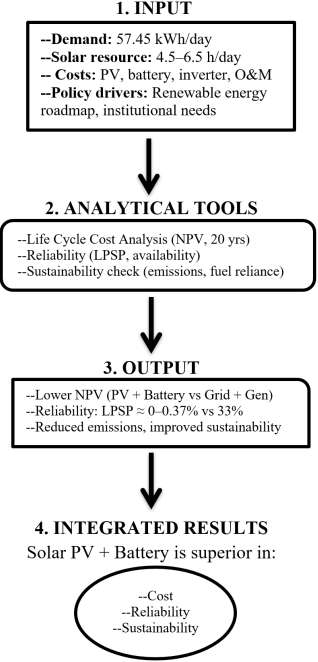
The LCIM operates through a structured three-stage process:
1) Input Definition: Identification of energy demand (57.45 kWh/day), solar potential (4.5–6.5 peak sun hours), and cost parameters.
2) Integrated Evaluation: Simultaneous application of LCCA, LPSP, and sustainability metrics, using equations (1)–(4).
3) Decision Output: Selection of the optimal energy configuration based on economic efficiency, reliability, and environmental performance.
Application of the framework confirmed the Solar PV + Battery system as the most viable solution for institutional energy supply, with potential scalability to other Nigerian campuses
[12]
Mohammed, A. et al. (2025). Hybrid systems in Nigerian universities. Energy Policy, 38(5), 333–341.
[16]
Olanipekun, A., and Liu, J. (2021). Sustainable campus energy systems: A review of solar PV applications in higher education institutions. Renewable Energy, 170, 1166–1178.
[18]
Woldegiyorgis, T. et al. (2023). HOMER application in healthcare facilities. Journal of Advanced Research in Applied Sciences and Engineering Technology, 29(3), 115–127.
[19]
Yusuf, A. A., Dauda, M., and Lawal, R. A. (2020). Assessment of solar PV integration in university hostel buildings. Nigerian Journal of Renewable Energy, 25(2), 55–68.
[20]
Zhang, X., Shen, L. and Chan, S. Y. (2016). The role of solar energy in achieving sustainable building design. Energy and Buildings 116: 321–331.
This study validates that the Life Cycle Improvement Framework (LCIM) is an effective tool for optimizing renewable energy systems in institutional buildings. The Solar PV + Battery configuration outperformed the Grid + Diesel Generator system in terms of cost efficiency, reliability, and environmental sustainability, maintaining all original findings, such as 35% cost reduction and 126 tonnes CO2 avoidance.
It is recommended that:
1) Educational institutions should adopt LCIM-based planning for future energy investments.
2) Policymakers should provide financial incentives and technical support to encourage the deployment of renewable energy sources.
3) Future studies should integrate artificial intelligence-based control strategies to further enhance system performance.
Abbreviations
LCIM
Life Cycle Improvement Model
LPSP
Life Cycle Cost Analysis
Author Contributions
Ivarah Vincent Itaafo: Validation
Wasiu John: Supervision
Ibrahim Abudlrazaq Olayinka: Data curation, Methodology
Sule Joseph: Visualization
Conflicts of Interest
The authors declare no conflict of interest.
References
[1]
Abass, T. and Popoola, S. (2025). Life-Cycle Cost Analysis of Utility-Scale Solar Power in Nigeria. ResearchGate. Available at:
Abdullahi, Y. and Kehinde, A. O. (2023). Drivers, Enablers, Barriers, and Technologies (DEBT) for Low-Energy Public Housing Delivery in Nigeria. Journal of Advanced Research in Applied Sciences and Engineering Technology, 29(3), 115–127.
[3]
Adaramola, M. S. (2015). Techno-economic analysis of an off-grid PV system in a Nigerian university. Renewable Energy 78, 913–922.
[4]
Adedeji, A. A. (2022). Sustainable Energy Systems in Nigerian Institutions. Energy Policy, 15(4), 102–118.
[5]
Akram, F. et al. (2023). Demand-side management of hybrid renewable energy systems. Applied Energy, 215, 54–62.
[6]
Akuru, N. U. and Okoro, O. O. (2023). Renewable Energy Integration in Sub-Saharan Africa: Challenges and Prospects. Renewable Energy Reviews, 10(3), 55–69.
[7]
Aliyu, A. S., Ramli, A. T. and Saleh, M. A. (2015). Nigeria’s electricity crisis: Power generation capacity expansion and environmental ramifications. Energy, 61, 354–367.
[8]
European Commission (2021). Energy Performance of Buildings Directive (EPBD): Towards a climate-neutral building stock. Energy and Buildings, 253, 111739.
[9]
Golobish, S., Yeganyan, R., Tan, N., Cannone, C., & Howells, M. (2025). The burden of the broken grid: Modelling power-sector reliability to support low carbon development in Nigeria. Energy Strategy Reviews, 60, 101784.
[10]
Ibrahim, H. J. (2022). Reliability Metrics in Renewable Systems: An Overview. International Journal of Energy Research, 45, 1340–1356.
[11]
International Energy Agency (2021). Global Status Report for Buildings and Construction: Towards a Zero-Emission, Efficient, and Resilient Building and Construction Sector. IEA.
[12]
Mohammed, A. et al. (2025). Hybrid systems in Nigerian universities. Energy Policy, 38(5), 333–341.
[13]
Murugaperumal, K. et al. (2023). Integrated biomass-wind-solar system for rural India. Renewable Energy, 170, 1166–1178.
[14]
Nittono, I. S. et al. (2023). Global energy transition and its implications for energy security in Nigeria: A critical review. EPRA International Journal of Climate Resource Economic Review, 11, 1–9.
[15]
Okoh, A. S., & Okpanachi, E. (2023). Transcending energy transition complexities in building a carbon-neutral economy: The case of Nigeria. Clean Energy Systems, 6, 100069.
[16]
Olanipekun, A., and Liu, J. (2021). Sustainable campus energy systems: A review of solar PV applications in higher education institutions. Renewable Energy, 170, 1166–1178.
[17]
Oyedepo, S. O. (2021). Energy and Sustainable Development in Nigeria: The Way Forward. Energy, Sustainability and Society, 2(15), 1–17.
[18]
Woldegiyorgis, T. et al. (2023). HOMER application in healthcare facilities. Journal of Advanced Research in Applied Sciences and Engineering Technology, 29(3), 115–127.
[19]
Yusuf, A. A., Dauda, M., and Lawal, R. A. (2020). Assessment of solar PV integration in university hostel buildings. Nigerian Journal of Renewable Energy, 25(2), 55–68.
[20]
Zhang, X., Shen, L. and Chan, S. Y. (2016). The role of solar energy in achieving sustainable building design. Energy and Buildings 116: 321–331.
Itaafo, I. V., John, W., Olayinka, I. A., Joseph, S. (2026). Life Cycle Improvement Framework for Optimizing Renewable Energy Systems in Institutional Buildings:
A Case Study of Auchi Polytechnic Hostel. Science Discovery Energy, 1(2), 61-64. https://doi.org/10.11648/j.sdenergy.20260102.11
Itaafo, I. V.; John, W.; Olayinka, I. A.; Joseph, S. Life Cycle Improvement Framework for Optimizing Renewable Energy Systems in Institutional Buildings:
A Case Study of Auchi Polytechnic Hostel. Sci. Discov. Energy2026, 1(2), 61-64. doi: 10.11648/j.sdenergy.20260102.11
Itaafo IV, John W, Olayinka IA, Joseph S. Life Cycle Improvement Framework for Optimizing Renewable Energy Systems in Institutional Buildings:
A Case Study of Auchi Polytechnic Hostel. Sci Discov Energy. 2026;1(2):61-64. doi: 10.11648/j.sdenergy.20260102.11
@article{10.11648/j.sdenergy.20260102.11,
author = {Ivarah Vincent Itaafo and Wasiu John and Ibrahim Abudlrazaq Olayinka and Sule Joseph},
title = {Life Cycle Improvement Framework for Optimizing Renewable Energy Systems in Institutional Buildings:
A Case Study of Auchi Polytechnic Hostel},
journal = {Science Discovery Energy},
volume = {1},
number = {2},
pages = {61-64},
doi = {10.11648/j.sdenergy.20260102.11},
url = {https://doi.org/10.11648/j.sdenergy.20260102.11},
eprint = {https://article.sciencepublishinggroup.com/pdf/10.11648.j.sdenergy.20260102.11},
abstract = {Energy unreliability and escalating operational costs continue to undermine the performance of institutional buildings in developing economies, particularly in Nigeria, where dependence on grid electricity and diesel generators remains widespread. Frequent power outages, rising fuel prices, and increasing maintenance costs negatively affect the quality of services, operational efficiency, and long-term sustainability of educational institutions. This study developed and applied a Life Cycle Improvement Framework (LCIM) to optimise renewable energy systems in institutional buildings by integrating Life Cycle Cost Analysis (LCCA), Loss of Power Supply Probability (LPSP), and sustainability assessment into a comprehensive decision-support framework. The student hostel at Auchi Polytechnic, Nigeria, was used as a case study. Empirical data were obtained through field energy audits, stakeholder surveys, and simulation-based performance modelling to evaluate and compare two energy configurations: Solar Photovoltaic (PV) + Battery and Grid + Diesel Generator over a 20-year life cycle. The findings reveal that the Solar PV + Battery system outperformed the conventional Grid + Diesel Generator configuration across economic, technical, and environmental indicators. Specifically, the renewable energy system achieved a life-cycle cost reduction of more than 35%, while maintaining a near-zero Loss of Power Supply Probability (0–0.37%), indicating a highly reliable electricity supply capable of meeting institutional energy demand. In addition, the environmental assessment demonstrated substantial reductions in greenhouse gas emissions, fossil fuel consumption, and overall environmental impact, contributing to improved sustainability performance. These results highlight the potential of renewable energy technologies to enhance energy security while reducing long-term operating costs in institutional buildings. The study concludes that the proposed LCIM is an effective and practical framework for evaluating and optimising renewable energy investments. It provides policymakers, institutional managers, and energy planners with a reliable tool for sustainable energy decision-making and supports the wider adoption of renewable energy systems for institutional infrastructure development in Nigeria and other developing countries facing similar energy challenges.},
year = {2026}
}
TY - JOUR
T1 - Life Cycle Improvement Framework for Optimizing Renewable Energy Systems in Institutional Buildings:
A Case Study of Auchi Polytechnic Hostel
AU - Ivarah Vincent Itaafo
AU - Wasiu John
AU - Ibrahim Abudlrazaq Olayinka
AU - Sule Joseph
Y1 - 2026/08/10
PY - 2026
N1 - https://doi.org/10.11648/j.sdenergy.20260102.11
DO - 10.11648/j.sdenergy.20260102.11
T2 - Science Discovery Energy
JF - Science Discovery Energy
JO - Science Discovery Energy
SP - 61
EP - 64
PB - Science Publishing Group
SN - 3142-8509
UR - https://doi.org/10.11648/j.sdenergy.20260102.11
AB - Energy unreliability and escalating operational costs continue to undermine the performance of institutional buildings in developing economies, particularly in Nigeria, where dependence on grid electricity and diesel generators remains widespread. Frequent power outages, rising fuel prices, and increasing maintenance costs negatively affect the quality of services, operational efficiency, and long-term sustainability of educational institutions. This study developed and applied a Life Cycle Improvement Framework (LCIM) to optimise renewable energy systems in institutional buildings by integrating Life Cycle Cost Analysis (LCCA), Loss of Power Supply Probability (LPSP), and sustainability assessment into a comprehensive decision-support framework. The student hostel at Auchi Polytechnic, Nigeria, was used as a case study. Empirical data were obtained through field energy audits, stakeholder surveys, and simulation-based performance modelling to evaluate and compare two energy configurations: Solar Photovoltaic (PV) + Battery and Grid + Diesel Generator over a 20-year life cycle. The findings reveal that the Solar PV + Battery system outperformed the conventional Grid + Diesel Generator configuration across economic, technical, and environmental indicators. Specifically, the renewable energy system achieved a life-cycle cost reduction of more than 35%, while maintaining a near-zero Loss of Power Supply Probability (0–0.37%), indicating a highly reliable electricity supply capable of meeting institutional energy demand. In addition, the environmental assessment demonstrated substantial reductions in greenhouse gas emissions, fossil fuel consumption, and overall environmental impact, contributing to improved sustainability performance. These results highlight the potential of renewable energy technologies to enhance energy security while reducing long-term operating costs in institutional buildings. The study concludes that the proposed LCIM is an effective and practical framework for evaluating and optimising renewable energy investments. It provides policymakers, institutional managers, and energy planners with a reliable tool for sustainable energy decision-making and supports the wider adoption of renewable energy systems for institutional infrastructure development in Nigeria and other developing countries facing similar energy challenges.
VL - 1
IS - 2
ER -
Itaafo, I. V., John, W., Olayinka, I. A., Joseph, S. (2026). Life Cycle Improvement Framework for Optimizing Renewable Energy Systems in Institutional Buildings:
A Case Study of Auchi Polytechnic Hostel. Science Discovery Energy, 1(2), 61-64. https://doi.org/10.11648/j.sdenergy.20260102.11
Itaafo, I. V.; John, W.; Olayinka, I. A.; Joseph, S. Life Cycle Improvement Framework for Optimizing Renewable Energy Systems in Institutional Buildings:
A Case Study of Auchi Polytechnic Hostel. Sci. Discov. Energy2026, 1(2), 61-64. doi: 10.11648/j.sdenergy.20260102.11
Itaafo IV, John W, Olayinka IA, Joseph S. Life Cycle Improvement Framework for Optimizing Renewable Energy Systems in Institutional Buildings:
A Case Study of Auchi Polytechnic Hostel. Sci Discov Energy. 2026;1(2):61-64. doi: 10.11648/j.sdenergy.20260102.11
@article{10.11648/j.sdenergy.20260102.11,
author = {Ivarah Vincent Itaafo and Wasiu John and Ibrahim Abudlrazaq Olayinka and Sule Joseph},
title = {Life Cycle Improvement Framework for Optimizing Renewable Energy Systems in Institutional Buildings:
A Case Study of Auchi Polytechnic Hostel},
journal = {Science Discovery Energy},
volume = {1},
number = {2},
pages = {61-64},
doi = {10.11648/j.sdenergy.20260102.11},
url = {https://doi.org/10.11648/j.sdenergy.20260102.11},
eprint = {https://article.sciencepublishinggroup.com/pdf/10.11648.j.sdenergy.20260102.11},
abstract = {Energy unreliability and escalating operational costs continue to undermine the performance of institutional buildings in developing economies, particularly in Nigeria, where dependence on grid electricity and diesel generators remains widespread. Frequent power outages, rising fuel prices, and increasing maintenance costs negatively affect the quality of services, operational efficiency, and long-term sustainability of educational institutions. This study developed and applied a Life Cycle Improvement Framework (LCIM) to optimise renewable energy systems in institutional buildings by integrating Life Cycle Cost Analysis (LCCA), Loss of Power Supply Probability (LPSP), and sustainability assessment into a comprehensive decision-support framework. The student hostel at Auchi Polytechnic, Nigeria, was used as a case study. Empirical data were obtained through field energy audits, stakeholder surveys, and simulation-based performance modelling to evaluate and compare two energy configurations: Solar Photovoltaic (PV) + Battery and Grid + Diesel Generator over a 20-year life cycle. The findings reveal that the Solar PV + Battery system outperformed the conventional Grid + Diesel Generator configuration across economic, technical, and environmental indicators. Specifically, the renewable energy system achieved a life-cycle cost reduction of more than 35%, while maintaining a near-zero Loss of Power Supply Probability (0–0.37%), indicating a highly reliable electricity supply capable of meeting institutional energy demand. In addition, the environmental assessment demonstrated substantial reductions in greenhouse gas emissions, fossil fuel consumption, and overall environmental impact, contributing to improved sustainability performance. These results highlight the potential of renewable energy technologies to enhance energy security while reducing long-term operating costs in institutional buildings. The study concludes that the proposed LCIM is an effective and practical framework for evaluating and optimising renewable energy investments. It provides policymakers, institutional managers, and energy planners with a reliable tool for sustainable energy decision-making and supports the wider adoption of renewable energy systems for institutional infrastructure development in Nigeria and other developing countries facing similar energy challenges.},
year = {2026}
}
TY - JOUR
T1 - Life Cycle Improvement Framework for Optimizing Renewable Energy Systems in Institutional Buildings:
A Case Study of Auchi Polytechnic Hostel
AU - Ivarah Vincent Itaafo
AU - Wasiu John
AU - Ibrahim Abudlrazaq Olayinka
AU - Sule Joseph
Y1 - 2026/08/10
PY - 2026
N1 - https://doi.org/10.11648/j.sdenergy.20260102.11
DO - 10.11648/j.sdenergy.20260102.11
T2 - Science Discovery Energy
JF - Science Discovery Energy
JO - Science Discovery Energy
SP - 61
EP - 64
PB - Science Publishing Group
SN - 3142-8509
UR - https://doi.org/10.11648/j.sdenergy.20260102.11
AB - Energy unreliability and escalating operational costs continue to undermine the performance of institutional buildings in developing economies, particularly in Nigeria, where dependence on grid electricity and diesel generators remains widespread. Frequent power outages, rising fuel prices, and increasing maintenance costs negatively affect the quality of services, operational efficiency, and long-term sustainability of educational institutions. This study developed and applied a Life Cycle Improvement Framework (LCIM) to optimise renewable energy systems in institutional buildings by integrating Life Cycle Cost Analysis (LCCA), Loss of Power Supply Probability (LPSP), and sustainability assessment into a comprehensive decision-support framework. The student hostel at Auchi Polytechnic, Nigeria, was used as a case study. Empirical data were obtained through field energy audits, stakeholder surveys, and simulation-based performance modelling to evaluate and compare two energy configurations: Solar Photovoltaic (PV) + Battery and Grid + Diesel Generator over a 20-year life cycle. The findings reveal that the Solar PV + Battery system outperformed the conventional Grid + Diesel Generator configuration across economic, technical, and environmental indicators. Specifically, the renewable energy system achieved a life-cycle cost reduction of more than 35%, while maintaining a near-zero Loss of Power Supply Probability (0–0.37%), indicating a highly reliable electricity supply capable of meeting institutional energy demand. In addition, the environmental assessment demonstrated substantial reductions in greenhouse gas emissions, fossil fuel consumption, and overall environmental impact, contributing to improved sustainability performance. These results highlight the potential of renewable energy technologies to enhance energy security while reducing long-term operating costs in institutional buildings. The study concludes that the proposed LCIM is an effective and practical framework for evaluating and optimising renewable energy investments. It provides policymakers, institutional managers, and energy planners with a reliable tool for sustainable energy decision-making and supports the wider adoption of renewable energy systems for institutional infrastructure development in Nigeria and other developing countries facing similar energy challenges.
VL - 1
IS - 2
ER -