
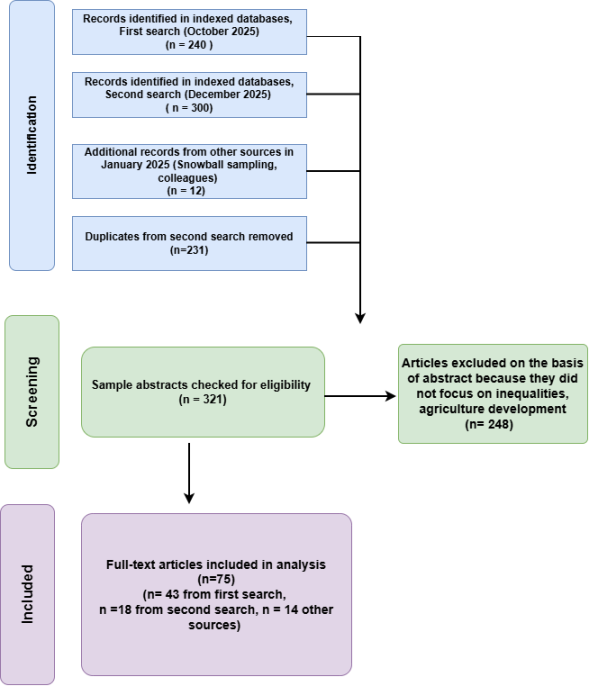
Agricultural inequality remains a major challenge to inclusive rural development in India, affecting access to land, irrigation, institutional credit, technology, and markets, thereby influencing agricultural productivity and farmers' livelihoods. Despite extensive research at the national and state levels, district-level evidence remains limited, particularly for agriculturally vulnerable regions such as Bhind district in Madhya Pradesh. This study systematically reviews the literature to identify the key dimensions, determinants, and research gaps related to agricultural inequality in Madhya Pradesh, with a particular focus on Bhind district. Following the PRISMA 2020 guidelines, 552 records were identified through Scopus, Google Scholar, and institutional sources. After duplicate removal and eligibility screening, 75 studies published up to 2024 were included. Thematic analysis identified unequal land distribution, fragmented landholdings, inadequate irrigation, limited access to institutional credit, uneven technology adoption, weak market integration, and socio-economic disparities linked to caste and gender as the principal drivers of agricultural inequality. The review also highlights that existing research is largely concentrated at the national and state levels, with limited evidence on district-level disparities. Based on the synthesized findings, this study proposes a conceptual framework integrating the structural, institutional, and socio-economic dimensions of agricultural inequality in Bhind district. The findings emphasize the need for place-based policies that improve equitable access to productive resources, strengthen rural institutions, expand irrigation and market infrastructure, and support small and marginal farmers. The study provides a foundation for future empirical research and evidence-based agricultural policymaking in Madhya Pradesh and comparable agrarian regions.
| Published in | Science Discovery Agriculture (Volume 1, Issue 4) |
| DOI | 10.11648/j.sda.20260104.16 |
| Page(s) | 197-208 |
| Creative Commons |
This is an Open Access article, distributed under the terms of the Creative Commons Attribution 4.0 International License (http://creativecommons.org/licenses/by/4.0/), which permits unrestricted use, distribution and reproduction in any medium or format, provided the original work is properly cited. |
| Copyright |
Copyright © The Author(s), 2026. Published by Science Publishing Group |
Agricultural Inequality, Systematic Literature Review, PRISMA, Land Ownership, Agricultural Productivity, Rural Development, Madhya Pradesh, Bhind District
Article Title | Authors | Findings |
|---|---|---|
Land Distribution and Inequality in Rural India | Rawal V. (2013) | Unequal land ownership remains the primary source of agricultural inequality, with marginal farmers controlling a disproportionately small share of agricultural land. |
Farm Size Impacts on Efficiency, Productivity and Returns to Scale in Indian Agriculture | Birthal P. S., Jha A. K., Tiongco M., Narrod C. (2015) | Larger farms achieve higher productivity due to better access to irrigation, technology, and institutional support, while smallholders face structural disadvantages. |
Credit Access, Rural Institutions and Agricultural Inequality in India | Jha S., Nagarajan H. K., Prasanna K. R. (2017) | Limited access to institutional credit forces small and marginal farmers to rely on informal lenders, reinforcing agricultural inequality. |
Technology Adoption, Farm Size and Income Inequality in Indian Agriculture | Shankar B., Poole N., Rao E. J. O. (2019) | Adoption of modern agricultural technologies is positively associated with farm size, contributing to productivity and income disparities. |
Regional Disparities in Agricultural Productivity in India | Pradhan K. C., Sahoo P., Nair R. (2020) | Significant differences in irrigation, infrastructure, and institutional support create wide regional disparities in agricultural productivity across Indian states. |
Agricultural Regional Disparities: A Case of Madhya Pradesh | Dutta T., Rawat A., Singh J. (2020) | Madhya Pradesh exhibits considerable inter-district disparities in agricultural development, with districts such as Bhind facing low irrigation coverage and fragmented landholdings. |
Understanding the Sources of Agricultural Growth in India | Birthal P. S., Negi D. S., Roy D. (2019) | Agricultural growth is driven by irrigation, technology adoption, and investment, but unequal access to these resources widens inequality among farmers. |
Farm Size and Productivity: Understanding the Strengths of Smallholders and Improving Their Livelihoods | Chand R., Lakshmi Prasanna P. A., Singh A. (2011) | Smallholders can achieve high productivity but require improved access to markets, credit, technology, and institutional support. |
Investment, Subsidies and Pro-Poor Growth in Rural India | Fan S., Gulati A., Thorat S. (2008) | Agricultural subsidies and public investments often benefit larger farmers disproportionately, limiting their effectiveness in reducing inequality. |
Gender Inequality in Agriculture and Food Systems in India: Emerging Evidence | Mohanty S., Kumari V., Singh R. (2024) | Gender-based disparities in land ownership, credit access, and extension services continue to constrain women's agricultural productivity and income. |
FAO | Food and Agriculture Organization |
GOI | Government of India |
HYV | High-Yielding Varieties |
MGNREGA | Mahatma Gandhi National Rural Employment Guarantee Act |
MSP | Minimum Support Price |
NSS | National Sample Survey |
PRISMA | Preferred Reporting Items for Systematic Reviews and Meta-Analyses |
RBI | Reserve Bank of India |
UNDP | United Nations Development Programme |
| [1] | Akber, N., & Paltasingh, K. R. (2019). Investment, subsidy and productivity in Indian agriculture: An empirical analysis. Agricultural Economics Research Review, 32(Conference Issue), 13-25. |
| [2] | Aliber, M., & Cousins, B. (2013). Livelihoods after land reform: Trajectories of change in South Africa’s former homelands. Journal of Agrarian Change, 13(1), 140-165. |
| [3] | Appu, P. S. (1996). Land reforms in India. New Delhi: Vikas Publishing House. |
| [4] | Banerjee, A., & Iyer, L. (2005). History, institutions, and economic performance: The legacy of colonial land tenure systems in India. American Economic Review, 95(4), 1190-1213. |
| [5] | Bardhan, P. (2016). State and development: The need for a reappraisal of the current literature. Journal of Economic Literature, 54(3), 862-892. |
| [6] | Besley, T., & Burgess, R. (2000). Land reform, poverty reduction, and growth: Evidence from India. Quarterly Journal of Economics, 115(2), 389-430. |
| [7] | Bhalla, G. S., & Chadha, G. K. (2019). Rural employment, agricultural growth and structural transformation in India. Indian Journal of Labour Economics, 62(1), 1-22. |
| [8] | Bhalla, G. S., & Singh, G. (2009). Economic liberalisation and Indian agriculture. Sage Publications. |
| [9] | Bhalla, G. S., & Singh, G. (2010). Economic liberalisation and Indian agriculture: A statewise analysis. New Delhi: Academic Foundation. |
| [10] | Binswanger-Mkhize, H. P., Bourguignon, C., & van den Brink, R. (2009). Agricultural land redistribution: Toward greater consensus. World Bank. |
| [11] | Birthal, P. S., Jha, A. K., Tiongco, M., & Narrod, C. (2015). Farm-size impacts on efficiency, productivity and returns to scale in Indian agriculture. Agricultural Economics, 46(3), 441-454. |
| [12] | Birthal, P. S., Joshi, P. K., & Gulati, A. (2011). Vertical coordination in high-value food commodities: Implications for smallholders. Indian Journal of Agricultural Economics, 66(3), 1-19. |
| [13] | Birthal, P. S., Joshi, P. K., Roy, D., & Thorat, A. (2014). Diversification in Indian agriculture towards high-value crops: The role of smallholders. Canadian Journal of Agricultural Economics, 62(1), 61-91. |
| [14] | Birthal, P. S., Negi, D. S., & Roy, D. (2019). Understanding the sources of agricultural growth in India. Agricultural Economics Research Review, 32(2), 161-174. |
| [15] | Bustos, P., Caprettini, B., & Ponticelli, J. (2016). Agricultural productivity and structural transformation: Evidence from Brazil. American Economic Review, 106(6), 1320-1365. |
| [16] | Byres, T. J. (1991). The Green Revolution as a bourgeois revolution: Implications of India's rural political economy. Journal of Peasant Studies, 18(3-4), 164-181. |
| [17] | Byres, T. J. (2018). Capitalism from above and capitalism from below. Palgrave Macmillan. |
| [18] | Chand, R. (2017). Doubling farmers’ income: Rationale, strategy, prospects and action plan. NITI Aayog Discussion Paper. |
| [19] | Chand, R., Lakshmi Prasanna, P. A., & Singh, A. (2011). Farm Size and Productivity: Understanding the Strengths of Smallholders and Improving Their Livelihoods. Economic and Political Weekly, 46(26-27), 5-11. |
| [20] | Chand, R., Raju, S. S., & Pandey, L. M. (2011). Growth crisis in agriculture: Severity and options at national and state levels. Economic and Political Weekly, 46(26-27), 37-45. |
| [21] | Das, R., & Srivastava, R. (2021). Income inequality among agricultural households in India: A regression-based decomposition analysis. Review of Development Economics, 25(3), 1128-1149. |
| [22] | Deaton, A. (2013). The great escape: Health, wealth, and the origins of inequality. Princeton University Press. |
| [23] | Deininger, K., & Jin, S., & Nagarajan, H. K. (2009). Land reforms, poverty reduction, and economic growth: Evidence from India. Journal of Development Studies, 45(4), 496-521. |
| [24] | Deininger, K., & Squire, L. (1998). New ways of looking at old issues: Inequality and growth. Journal of Development Economics, 57(2), 259-287. |
| [25] | Deshpande, A. (2003). Contemporary India: A Sociological View. New Delhi: Penguin Books. |
| [26] | Deshpande, A. (2014). The grammar of caste: Economic discrimination in contemporary India. Oxford University Press. |
| [27] | Deshpande, A. (2017). The grammar of caste: Economic discrimination in contemporary India. Oxford University Press. |
| [28] | Dev, S. M. (2018). Agricultural development and rural livelihoods in India. Journal of Rural Development, 37(1), 1-22. |
| [29] | Dev, S. M. (2018). Agricultural policies for inclusive growth. New Delhi: Oxford University Press. |
| [30] | Doss, C., Kovarik, C., Peterman, A., Quisumbing, A., & van den Bold, M. (2018). Gender inequalities in ownership and control of land in Africa: Myth and reality. Agricultural Economics, 46(3), 403-434. |
| [31] | Dutta, T., Rawat, A., & Singh, J. (2020). Agricultural Regional Disparities: A Case of Madhya Pradesh. Journal of Madhya Pradesh Economic Association, Vol. XXX, pp. 19-31. |
| [32] | Ellis, F. (1993). Peasant economics: Farm households and agrarian development. Cambridge: Cambridge University Press. |
| [33] | Ellis, F. (2000). Rural livelihoods and diversity in developing countries. Oxford University Press. |
| [34] | Fan, S., Gulati, A., & Thorat, S. (2008). Investment, subsidies, and pro-poor growth in rural India. Agricultural Economics, 39(2), 163-170. |
| [35] | Fan, S., Hazell, P., & Thorat, S. (2018). Government spending, growth and poverty in rural India. American Journal of Agricultural Economics, 100(2), 593-612. |
| [36] | Food and Agriculture Organization of the United Nations. (2017). The future of food and agriculture: Trends and challenges. FAO. |
| [37] | Frankel, F. R. (1971). India’s Green Revolution: Economic gains and political costs. Princeton: Princeton University Press. |
| [38] | Ghosh, J. (2010). Agrarian change and rural poverty in India. Journal of Agrarian Change, 10(1), 121-141. |
| [39] | Government of India. (2018). Agricultural statistics at a glance. New Delhi: Ministry of Agriculture and Farmers’ Welfare. |
| [40] | Government of India. (2022). Agricultural Statistics at a Glance 2022. Department of Agriculture & Farmers Welfare, Ministry of Agriculture & Farmers Welfare, New Delhi. |
| [41] | Government of India. (2022). Agricultural census of India. Ministry of Agriculture and Farmers’ Welfare. |
| [42] | Griffin, K. (1974). The political economy of agrarian change: An essay on the Green Revolution. London: Macmillan. |
| [43] | Gulati, A., & Narayanan, S. (2003). The subsidy syndrome in Indian agriculture. New Delhi: Oxford University Press. |
| [44] | Gulati, A., Kapur, D., & Bouton, M. (2021). India’s agriculture towards 2030. Oxford University Press. |
| [45] | Hayami, Y., & Ruttan, V. W. (1985). Agricultural development: An international perspective. Johns Hopkins University Press. |
| [46] | Himanshu. (2019). Inequality in India: A review of levels and trends. WIDER Working Paper. |
| [47] | Jha, S., Nagarajan, H. K., & Prasanna, K. R. (2017). Credit access, rural institutions and agricultural inequality in India. Economic and Political Weekly, 52(24), 45-53. |
| [48] | Jodhka, S. S., & Kumar, A. (2012). Caste, landlessness and agrarian change in India. Economic and Political Weekly, 47(26-27), 55-63. |
| [49] | Kumar, A., Singh, R., & Sharma, P. (2020). Irrigation development and regional disparities in agricultural productivity in Madhya Pradesh. Agricultural Economics Research Review, 33(1), 45-58. |
| [50] | Kumar, A., Singh, R., & Sinha, S. (2014). Smallholder agriculture in India: Constraints and opportunities. Agricultural Economics Research Review, 27(2), 173-186. |
| [51] | Mohanty, S., Kumari, V., & Singh, R. (2024). Gender inequality in agriculture and food systems in India: Emerging evidence. Journal of Agricultural Extension Management, 25(1), 135-152. |
| [52] | Moher, D., Liberati, A., Tetzlaff, J., Altman, D. G. and PRISMA Group*, T., 2009. Preferred reporting items for systematic reviews and meta-analyses: the PRISMA statement. Annals of internal medicine, 151(4), pp. 264-269. |
| [53] | Nagaraj, R. (2015). Land distribution, inequality, and agricultural growth in India. Economic and Political Weekly, 50(41), 53-60. |
| [54] | North, D. C. (1990). Institutions, institutional change and economic performance. Cambridge University Press. |
| [55] | Page, M. J., McKenzie, J. E., Bossuyt, P. M., Boutron, I., Hoffmann, T. C., Mulrow, C. D., Shamseer, L., Tetzlaff, J. M., Akl, E. A., Brennan, S. E. and Chou, R., 2021. The PRISMA 2020 statement: an updated guideline for reporting systematic reviews. bmj, 372. |
| [56] | Patnaik, U. (2016). Agrarian relations and accumulation. Social Scientist, 44(1-2), 3-27. |
| [57] | Pradhan, K. C., Sahoo, P., & Nair, R. (2020). Regional disparities in agricultural productivity in India. Journal of Rural Development, 39(2), 181-198. |
| [58] | Rawal, V. (2013). Land distribution and inequality in rural India. Economic and Political Weekly, 48(36), 85-92. |
| [59] | Rawal, V., & Swaminathan, M. (2018). Changing trajectories: Agrarian transformation in India. Tulika Books. |
| [60] | Reddy, A. A., & Jha, S. (2012). Institutional credit to agriculture in India: Status, issues, and reforms. Agricultural Economics Research Review, 25(2), 229-238. |
| [61] | Reddy, D. N., & Mishra, S. (2018). Agrarian distress and rural inequality in India. Oxford University Press. |
| [62] | Reserve Bank of India. (2023). Annual Report 2022-23. Mumbai: RBI. |
| [63] | Saha, P., & Hazra, S. (2021). MGNREGA and rural income inequality: Evidence from Indian states. Social Change, 51(3), 421-438. |
| [64] | Sen, A. (1992). Inequality reexamined. Oxford University Press. |
| [65] | Sen, A. K. (1966). Peasants and dualism with or without surplus labour. Journal of Political Economy, 74(5), 425-450. |
| [66] | Shankar, B., Poole, N., & Rao, E. J. O. (2019). Technology adoption, farm size and income inequality in Indian agriculture. Food Policy, 84, 21-32. |
| [67] | Sharma, V. P., & Singh, R. (2017). Agricultural marketing reforms and price realization in India. Indian Journal of Agricultural Marketing, 31(1), 1-16. |
| [68] | Shivaswamy, G. P., Raghavendra, K. J., Anuja, A. R., Singh, K. N., Rajesh, T., & Harish Kumar, H. V. (2020). Impact of institutional credit on agricultural productivity in India: A time series analysis. The Indian Journal of Agricultural Sciences, 90(2), 412-417. |
| [69] | Singh, S., Bhogal, S., & Kaur, G. (2022). Technology adoption and farm size in Indian agriculture. Journal of Rural Studies, 91, 12-24. |
| [70] | Swaminathan, M. S., & Bhavani, R. V. (2013). Food production and availability: Essential prerequisites for sustainable food security. Indian Journal of Medical Research, 138(3), 383-391. |
| [71] | Swaminathan, M. S., & Misra, R. (2020). Agricultural policy and farmer welfare in India. Indian Journal of Human Development, 14(2), 175-190. |
| [72] | Thorat, S. K. and Newman, K. S. (eds) (2010) Blocked by Caste: Economic Discrimination in Modern India, USA: Oxford University Press. |
| [73] | UNDP. (2019). Human development report. United Nations Development Programme. |
| [74] | Vaidyanathan, A. (2010). Agricultural growth in India: Role of technology, incentives and institutions. New Delhi: Oxford University Press. |
| [75] | World Bank. (2020). World development report 2020: Trading for development in the age of global value chains. World Bank. |
APA Style
Singh, A., Acharya, R., Sudele, S. (2026). Agricultural Inequality in Bhind District, Madhya Pradesh: Evidence from a Systematic Literature Review. Science Discovery Agriculture, 1(4), 197-208. https://doi.org/10.11648/j.sda.20260104.16
ACS Style
Singh, A.; Acharya, R.; Sudele, S. Agricultural Inequality in Bhind District, Madhya Pradesh: Evidence from a Systematic Literature Review. Sci. Discov. Agric. 2026, 1(4), 197-208. doi: 10.11648/j.sda.20260104.16
@article{10.11648/j.sda.20260104.16,
  author = {Ankit Singh and Rekha Acharya and Shweta Sudele},
  title = {Agricultural Inequality in Bhind District, Madhya Pradesh: Evidence from a Systematic Literature Review},
  journal = {Science Discovery Agriculture},
  volume = {1},
  number = {4},
  pages = {197-208},
  doi = {10.11648/j.sda.20260104.16},
  url = {https://doi.org/10.11648/j.sda.20260104.16},
  eprint = {https://article.sciencepublishinggroup.com/pdf/10.11648.j.sda.20260104.16},
  abstract = {Agricultural inequality remains a major challenge to inclusive rural development in India, affecting access to land, irrigation, institutional credit, technology, and markets, thereby influencing agricultural productivity and farmers' livelihoods. Despite extensive research at the national and state levels, district-level evidence remains limited, particularly for agriculturally vulnerable regions such as Bhind district in Madhya Pradesh. This study systematically reviews the literature to identify the key dimensions, determinants, and research gaps related to agricultural inequality in Madhya Pradesh, with a particular focus on Bhind district. Following the PRISMA 2020 guidelines, 552 records were identified through Scopus, Google Scholar, and institutional sources. After duplicate removal and eligibility screening, 75 studies published up to 2024 were included. Thematic analysis identified unequal land distribution, fragmented landholdings, inadequate irrigation, limited access to institutional credit, uneven technology adoption, weak market integration, and socio-economic disparities linked to caste and gender as the principal drivers of agricultural inequality. The review also highlights that existing research is largely concentrated at the national and state levels, with limited evidence on district-level disparities. Based on the synthesized findings, this study proposes a conceptual framework integrating the structural, institutional, and socio-economic dimensions of agricultural inequality in Bhind district. The findings emphasize the need for place-based policies that improve equitable access to productive resources, strengthen rural institutions, expand irrigation and market infrastructure, and support small and marginal farmers. The study provides a foundation for future empirical research and evidence-based agricultural policymaking in Madhya Pradesh and comparable agrarian regions.},
 year = {2026}
}
TY  - JOUR
T1  - Agricultural Inequality in Bhind District, Madhya Pradesh: Evidence from a Systematic Literature Review
AU  - Ankit Singh
AU  - Rekha Acharya
AU  - Shweta Sudele
Y1  - 2026/11/24
PY  - 2026
N1  - https://doi.org/10.11648/j.sda.20260104.16
DO  - 10.11648/j.sda.20260104.16
T2  - Science Discovery Agriculture
JF  - Science Discovery Agriculture
JO  - Science Discovery Agriculture
SP  - 197
EP  - 208
PB  - Science Publishing Group
SN  - 3142-8495
UR  - https://doi.org/10.11648/j.sda.20260104.16
AB  - Agricultural inequality remains a major challenge to inclusive rural development in India, affecting access to land, irrigation, institutional credit, technology, and markets, thereby influencing agricultural productivity and farmers' livelihoods. Despite extensive research at the national and state levels, district-level evidence remains limited, particularly for agriculturally vulnerable regions such as Bhind district in Madhya Pradesh. This study systematically reviews the literature to identify the key dimensions, determinants, and research gaps related to agricultural inequality in Madhya Pradesh, with a particular focus on Bhind district. Following the PRISMA 2020 guidelines, 552 records were identified through Scopus, Google Scholar, and institutional sources. After duplicate removal and eligibility screening, 75 studies published up to 2024 were included. Thematic analysis identified unequal land distribution, fragmented landholdings, inadequate irrigation, limited access to institutional credit, uneven technology adoption, weak market integration, and socio-economic disparities linked to caste and gender as the principal drivers of agricultural inequality. The review also highlights that existing research is largely concentrated at the national and state levels, with limited evidence on district-level disparities. Based on the synthesized findings, this study proposes a conceptual framework integrating the structural, institutional, and socio-economic dimensions of agricultural inequality in Bhind district. The findings emphasize the need for place-based policies that improve equitable access to productive resources, strengthen rural institutions, expand irrigation and market infrastructure, and support small and marginal farmers. The study provides a foundation for future empirical research and evidence-based agricultural policymaking in Madhya Pradesh and comparable agrarian regions.
VL  - 1
IS  - 4
ER  -
School of Economics, Devi Ahilya Vishwavidyalaya, Indore, India
School of Economics, Devi Ahilya Vishwavidyalaya, Indore, India

Information



 Share This Article
 Twitter
 Linked In
 Facebook

 Copy
 Download