2. Literature Review
2.1. The Emergence of the Concept "Competitiveness" and Company’s Competitiveness
The concept of competitiveness gained importance in the 1960s, particularly in France with indicative plans that emphasized the necessity of having competitive prices to support exports. This concept has evolved significantly, becoming a crucial area of interest for researchers focused on growth and stimulation of economic performance.
Competitiveness broadly refers to a country's ability to create and maintain an economic environment that promotes rapid production and added value. Such as Walsh et al.
and Porter
| [41] | Porter, M. E. (1979). The structure within industries and companies' performance. The review of economics and statistics, 214-227. |
| [42] | Porter, M. E. (1980). Competitive strategy: Techniques for analyzing industries and companies. New York: Free Press. |
| [43] | Porter, M. E. (1985). Competitive advantage: Creating and sustaining superior performance. New York: Free Press. |
| [44] | Porter M. E. (1986). Changing Patterns of International Competition. California Management Review, 28(2), 9-40. |
| [45] | Porter M. E. (March–April 1990). The Competitive Advantage of Nations. Harvard Business Review, 68(2), 73-93. |
[41-45]
defined it as the capacity to produce, distribute, and sell goods and services profitably on the global stage, enhancing the standard of living. Krugman
| [29] | Krugman P., (Mars - April 1994). Competitiveness: A Dangerous Obsession. Foreign Affairs, 73(2), 28-44. |
[29]
initially viewed competitiveness as a "dangerous obsession," but after evolved by the World Economic Forum
| [62] | World Economic Forum, The Global Competitiveness Report 2001-2011, Directorate – General Regional Policy, Oxford, University Press, Oxford. |
[62]
to signify a nation's performance in providing high living standards. For Porter
| [42] | Porter, M. E. (1980). Competitive strategy: Techniques for analyzing industries and companies. New York: Free Press. |
[42]
in his book “the competitive advantage of nations”, emphasized national productivity as a key indicator of competitiveness, depending on quality product, perceived value and efficiency for determine its order price.
The European commission
| [20] | European Commission: Directorate-General for Enterprise and Industry, European competitiveness report 2000., Publications Office, (2006). |
[20]
described competitiveness as an economy's ability to sustain high living standards and employment without compromising future generations' well-being, also consider it as “a sustained rise in the standards of living of a nation or region and a level of involuntary unemployment as low as possible” (European competitiveness report,
| [20] | European Commission: Directorate-General for Enterprise and Industry, European competitiveness report 2000., Publications Office, (2006). |
[20]
, p. 9); for Aiginger
| [1] | Aiginger, K. (5 October 2006). Competitiveness: From a Dangerous Obsession to a Welfare Creating Ability with Positive Externalities. Journal of Industry, Competition and Trade, Vol 6, 161–177. |
[1]
, simplified it to mean creating well-being, and the WEF
| [62] | World Economic Forum, The Global Competitiveness Report 2001-2011, Directorate – General Regional Policy, Oxford, University Press, Oxford. |
[62]
defined it as the set of institutions, policies, and factors determining a country's productivity and sustainable prosperity.
Company's competitiveness is a concept that expresses its long-term performance, primarily its growth. It is often related to elements such as its products, prices, and positioning, and is characterized by the triptych of price/quality/cost. This notion of competitiveness originates from the company itself and is used to compare its performance with that of other firms in the same sector.
Muchielli
| [37] | Muchielli, J. L. (2002). La competitivite: definitions, indicateurs et determinants. Accomex, numero special" La France est-elle competitive, (44), 9-19. |
[37]
had defined a company’s competitiveness in two terms, in relative term, by its ability to exceed the average performance of the sector, in the short term, it is often measured by market share and growth. For example, Dell experienced a sales growth of 15% in 2001, while the global PC market declined by 5%, increasing its market share in the United States and worldwide. Another example is PSA, which, in a market growing by 5.7% in France, saw its market share increase by 16%, surpassing Renault. According to Elkhorchi H., Elkhourchi B. and Boujdid
| [19] | Elkhorchi, H., elkhourchi, B., & boujdid, L. (2023). La RSE et La competitivite: Une revue de litterature. Revue Internationale des Sciences de Gestion, 6(2), 180-202. |
[19]
, competitiveness defined as the ability to face competition and to develop in a competitive environment, for Kowalska
| [28] | Kowalska, K. (December 2014). Non-market factors of competitiveness of transport, freight forwarding and logistics companies. Forum Scientiae Oeconomia, 4(2), 5-17. |
[28]
, relates to competitive factors that provide company an advantage to maintain its competitive position and develop its potential in a competitive environment, and according to European commission
| [20] | European Commission: Directorate-General for Enterprise and Industry, European competitiveness report 2000., Publications Office, (2006). |
[20]
, in the context of the industrial sector, competitiveness for a company means improving and maintaining its position in the global market.
Therefor various approaches exist for measurement the competitive advantage of company, it encompasses economic sustainability, short and long-term performance, value creation, and adaptation to national and international markets. The same for strategic analysis, can be at different levels within the company, particularly for specific products, product ranges, or market segments, based on many tools, such as the Boston Consulting Group matrices (BCG,
| [5] | Boston Consulting Group. (1970). Perspectives on experience. Boston Consulting Group. |
[5]
), focusing on cost reduction to define a company's competitiveness, Porter’s Five Forces Model
| [41] | Porter, M. E. (1979). The structure within industries and companies' performance. The review of economics and statistics, 214-227. |
[41]
which set forth trends by which firms position themselves among different industries, or others…etc.
2.2. Types of Competitiveness
A company can gain its competitive advantage over its competitors by focusing on one or both types of competitiveness; price or hors-price competitiveness.
2.2.1. Price Competitiveness
The price competitiveness of a company as defined by Yesfi
| [63] | Yesfi, K. (2001). La competitivite du Commerce exterieur marocain: situation et perspectives: cas du secteur textile-habillement. DESA en economie internationale. |
[63]
is its ability to maintain sustainable competition with its counterparts while achieving high profit margins, without compromising the competitiveness of its selling prices and by controlling its production costs compared to foreign competitors. This competitiveness, based on reducing production costs and product prices, is supported by economies of scale policies and experience effects. It primarily concerns interchangeable products.
The price competitiveness of a company is assessed according to two distinct approaches, as highlighted by Bienayme
| [4] | Bienayme, A. (1997). Entreprise competitive. Encyclopedie de Gestion. Ed Economica, tome 1, 2ème edition, p 1101-1114. |
[4]
, through prices and costs, depending on the competitive factors involved. Price competitiveness is primarily achieved through productivity gains, often obtained through economies of scale or the development of technical advancements aimed at increasing efficiency. In contrast, cost competitiveness involves reducing production costs, including lowering labor costs and those of raw materials.
Example of Cost Competitiveness
Distribution costs represent a major challenge for firms, affecting both their price competitiveness and non-price competitiveness. High costs often translate into higher selling prices for consumers, making products less competitive compared to those from other countries where distribution costs are lower. Consequently, even if the quality and productivity of the products are comparable, higher prices can lead to a loss of market share. In addition to the impacts on prices, distribution costs can also influence the perception of product quality. For example, if a product is difficult to find due to distribution issues, it can harm its reputation, even if its quality is high, which can affect consumers' purchasing decisions.
The distribution costs can vary significantly from one market to another depending on various factors, such as distance, available infrastructure, and local regulations. This variability can make planning and distribution strategy difficult for firms seeking to internationalize.
Therefore, effective cost management is essential to maintain a firm's competitive position in the market, which can adopt various strategies to mitigate the impact of its labor, production, and distribution costs, either through the automation of processes, optimization of the supply chain and logistics, establishing partnerships with local distributors, and investing in inventory management technologies; all these strategies can help reduce overall costs and improve its micro-economic competitiveness.
However, according to Storper and Walker
| [58] | Walker, R., and Storper, M. (1989). The capitalist imperative: territory, technology and industrial growth (Vol. 2). Oxford: Basil Blackwell. |
[58]
and Hudson
| [24] | Hudson, R. (1999). The Learning Economy, the Learning Firm and the Learning Region’ A Sympathetic Critique of the Limits to Learning. European Urban and Regional Studies, 6(1), 59-72. |
[24]
, price competitiveness is often regarded as a form of weak competition, as it can be easily replicated by competitors and does not guarantee a sustainable advantage in the market.
2.2.2. Hors-Price Competitiveness
Competitiveness beyond price based on differentiation values quality, innovation, brand image, and the satisfaction of specific customer needs. More sustainable, it includes product competitiveness (technology, reliability) and structural competitiveness (size, industrial, organizational and marketing strategy).
Competitiveness beyond price results from specific characteristics of a product that make it distinguishable from similar products offered by competitors. This differentiation makes the product less substitutable, and producers benefiting from these characteristics can exert a certain degree of monopoly power. The degree of differentiation is related to the low substitutability of products.
Example of Structural Competitiveness (firm scale)
The size of the firm is a central concept in strategic management, often associated with cost competitiveness. According to Josef Schumpeter
| [49] | Schumpeter J., (1942), Capitalism, Socialism, and Democracy, Harper & Brothers, United States. First edition. |
[49]
, in his book “Capitalism, Socialism, and Democracy “(p 82): “big business may have had more to do with creating that standard of life than with keeping it down”, to him, an increase in size would allow firms to better control their costs and thus improve their competitive position, however, this idea is only valid under certain conditions, as cost dominance is not the only path to competitiveness. Also, many firms of different sizes coexist and manage to be competitive by relying on distinct strategies. Indeed, the link between competitiveness and size remains debated, and two opposing schools of thought exist: “big is better” vs “small is beautiful”
The "big is better" approach argues that large firms have a competitive advantage over smaller ones, benefiting from economies of scale; according to Simon
| [51] | Simon, H. (1945). Administrative Behaviour. New York, The Free Press. |
[51]
and Chandler
| [10] | Chandler, A. D. (1962). Strategy and structure: Chapters in the history of the industrial empire. Cambridge Mass, 5(1), 12-48. |
[10]
, this approach stemming from industrial economics and based on several arguments, such as economies of scale and better coordination of actions, for Williamson
| [60] | Williamson O. E. (1975), « Markets and Hierarchies », New York, The Free Press. |
| [61] | Williamson O. E. (1985), « The Economic Institutions of Capitalism », New York, The Free Press. |
[60, 61]
its ability to absorb market losses due to the size of firms, while (Pfeffer and Salancick, Mintz and Schwartz
| [38] | Pfeffer J. and Salancik G. R. (1978). The external of organizations: A resource–dependence perspective. New York: Harper & Row. |
| [35] | Mintz B. A. and Schwartz M. (1987). The power structure of American business. University of Chicago Press. |
[38, 35]
saw it in centralization of structures and connections with social elites, conferring strong market influence, and according to neo-institutionalist theorists, like (DiMaggio and Powell, Meyer and Scott
| [14] | DiMaggio P. J. and Powell W. (1983). The Iron Cage Revisited: Institutional Isomorphism and Collective Rationality in Organizational Fields. American Sociological Review, 48(2), 147-160. |
| [34] | Meyer, J., Scott, W. R., & Strang, D. (1987). Centralization, fragmentation, and school district complexity. Administrative science quarterly, 186-201. |
[14, 34]
, they maintain their dominant position by imposing common practices and reinforcing justified structures. Although the explanations vary, all these theories agree on the fact that large firms are formidable competitors.
The "small is beautiful" approach challenges the notion that large size is essential for competitiveness, positing that small businesses rely on agility and innovation to maintain their competitive edge. Dodgson and Rothwell
| [15] | Dodgson M. and Rothwell R. (1991). Technology strategies in small firms. Journal of General Management, 17(1), 45-55. |
[15]
emphasized this perspective by highlighting several advantages of small and medium-sized enterprises (SMEs). These enterprises are generally more flexible and capable of quickly adapting to market fluctuations, and they incur lower costs than larger firms. The specialization and bureaucracy inherent in large organizations often lead to diminished employee motivation, as well as additional costs associated with coordination and management. Picard
| [39] | Picard, P. (1990). Elements de microeconomie: theorie et applica tions. Montchrestien. |
[39]
identified two theoretical streams that support this approach: the specificity stream, which emphasizes the unique characteristics of SMEs compared to large firms, indicating that behaviors and performance vary according to size, and the diversity stream, which considers the impact of size as contingent and context-dependent, with distinct types of businesses.
But, recent research by (Messeghem, Torrès and Julien
| [33] | Messeghem K., (1998), La PME face à l’assurance qualite. Dans Actes des XIVèmes journees nationales des IAE, Nantes, 1998. Tome 3. Marketing, strategie et organisation. Coord Brechet JP, Mevellec P., Presses Academiques de l’Ouest, Nantes, 695p. |
| [54] | Torrès O. and Julien P. A. (2005). Specificity and denaturing of small business. International small business journal, 23(4), 355-377. |
[33, 54]
indicated that, in certain contexts, small enterprises can function similarly to large enterprises, thereby challenging the notion that small and medium-sized enterprises (SMEs) require fundamentally different management for SMEs.
In summary, price competitiveness and hors-price competitiveness both influence a company’s performance in the short and long term. While price competitiveness primarily influences short-term market shares, hors-price competitiveness is an advantage related to long-term structural performance, which is often explained by investments in research and development, as well as in physical and human capital, which enable the maintenance and improvement of product differentiation over the long term.
2.3. Competitiveness Approaches
Research on competitiveness is divided into two approaches; there are researchers who support the idea that a company's competitive advantage results from a single factor, as well as others who see multiple factors contributing to a company's performance relative to its competitors.
2.3.1. One-dimensional Approach
The one-dimensional approach to competitiveness primarily focuses on a single measurable factor, often related to costs, prices, or market share. According to this perspective, a company's competitiveness is determined by its ability to maintain low costs, offer competitive prices, or increase its market share.
This approach inspired by the BCG matrix focuses on cost reduction and efficiency gains through accumulated experience. According to Bouri
| [7] | Bouri, N. (2022). Competitivite et performance des PME: Essai d’analyses des interactions theoriques. Le Manager, 9(1), 278-307. |
[7]
, a competitive company is one that utilizes its production factors in the most efficient manner possible to minimize its costs, Authors such as the BCG
| [5] | Boston Consulting Group. (1970). Perspectives on experience. Boston Consulting Group. |
[5]
, the unit labor cost of (Hickman, Turner and Golub, Siggel and Cockburn
| [23] | Hickman, B. G. (Ed.). (1992). International productivity and competitiveness. Oxford University Press on Demand.
https://doi.org/10.1007/s10842-006-8430-x |
| [55] | Turner A. G. (1997). Towards a system of multilateral unit labour cost-based competitiveness indicators for advanced, developing, and transition countries. Internat. Monetary Fund, Research Department. |
| [50] | Siggel E. and Cockburn J. (1995). International competitiveness and its sources: a method of development policy analysis. Concordia University, Department of Economics, Discussion Paper, 9517. |
[23, 55, 50]
consider the total unit cost of the product as a key indicator, as well as (Jorgenson and Kuroda, Durand and Giorno
| [18] | Durand M. and Giorno C. (1987). Indicators of international competitiveness: conceptual aspects and evaluation. OECD economic studies, 9(3), 147-182. |
| [26] | Jorgenson D. W. and Kuroda M. (1992). Productivity and international competitiveness in Japan and the United States, (1960-1985). The Economic Studies Quarterly, 43(4), 313-325. |
[18, 26]
stress that to the price of products and services are crucial for outpacing competition, for Dollar and Wolff
| [16] | Dollar, D. and Wolff E. N. (1993). Competitiveness, convergence, and international specialization. Mit Press. |
[16]
, productivity remains the fundamental indicator of industrial competitiveness, while (Hatsopoulos and Krugman, Mandang
| [22] | Hatsopoulos, G. N., Krugman, P. R., and Summers, L. H. (1988). US competitiveness: Beyond the trade deficit. Science. 241(4863), 299-307. |
| [32] | Mandeng, O. J. (1991). International competitiveness and specialization. CEPAL review. (45), 25-40. |
[22, 32]
underline the evolution of market shares as a sign of competitive progress in a given market, studies like those support this approach by noting these specific indicators as essential for measuring competitiveness.
Although this approach provides clear and measurable indicators of competitiveness, it is limited in its ability to capture the full complexity of modern competition, which requires a broader consideration of qualitative and contextual factors, such as quality or product differentiation. Below you will find a summary table (
Table 1) of these theories:
Table 1. Summary table of theories.
Economist | Theory |
Boston Consulting Group 5] | Cost reduction and efficiency |
Durand and Giorno, Jorgenson and Kuroda 18, 26] | Price of products/services |
Hatsopoulos and Krugman, Mandang 22, 32] | Market share evolution |
Hickman 23] | Unit labor cost |
Dollar and Wolff 16] | Productivity |
Siggel and Cockburn, Turner and Golub 50, 55] | Total Unit Cost of the Product |
Source: Author own work
2.3.2. Pluri-Dimensional Approach
The pluri-dimensional approach is more comprehensive and realistic, considering competitiveness as a multidimensional phenomenon that integrates not only costs but also non-price elements (e.g., innovation, quality, flexibility). As noted by Bouri
| [7] | Bouri, N. (2022). Competitivite et performance des PME: Essai d’analyses des interactions theoriques. Le Manager, 9(1), 278-307. |
[7]
, it focuses, in particular, on the five competitive forces to analyze the industry structure, the value chain to understand how each activity contributes to competitive advantage and Porter's diamond to assess competitiveness at the national and regional levels. Furthermore, research on the determinants of company competitiveness is often multidimensional; according to Covin J. G., and Covin T. J.
| [13] | Covin J. G., and Covin T. J. (1990). Competitive aggressiveness, environmental context, and small firm performance. Entrepreneurship theory and practice, 14(4), 35-50. |
[13]
, there are 12 determinants that measure overall competitiveness: price, quality, marketing, product design, structure, culture, human resources, product/service innovation, etc.
This approach encompasses several internal and external factors influencing competitiveness. However, the theories and theoretical models within this approach emphasize that achieving competitiveness necessitates a comprehensive strategy that integrates price, quality, innovation, and organizational strategy.
Among these theoretical models, we find Porter's generic competitive strategy model
| [42] | Porter, M. E. (1980). Competitive strategy: Techniques for analyzing industries and companies. New York: Free Press. |
[42]
, which discusses a company's competitive advantage through its focus on differentiation or cost reduction. The single diamond model of Porter
| [43] | Porter, M. E. (1985). Competitive advantage: Creating and sustaining superior performance. New York: Free Press. |
[43]
, known as the “value chain,” is a model for analyzing the company's activities, divided into primary activities and support activities, to identify areas where it can create value and gain a competitive edge. The double diamond model extends Porter's model by considering competitiveness in both domestic and international markets by Rugman and D'Cruz
| [47] | Rugman, A. M., & D'Cruz, J. R. (1993). The "Double diamond" model of international competitiveness: the Canadian experience. Management International Review, 33(2), 17–39. |
[47]
, emphasizing that firms must excel in both areas, while Moon, Rugman and Verbeke
| [36] | Moon H. C., Rugman A. M. and Verbeke A. (1995). The generalized double diamond approach to international competitiveness. In Beyond the diamond, Research in Global Strategic Management, Vol 5, 97-114. |
[36]
stress the central role of government—especially in small economies—in guiding investments and public policies in favor of national competitiveness. The nine-factor model of Cho
| [12] | Cho, D. S. (1994). A dynamic approach to international competitiveness: The case of Korea. Asia pacific business review, 1(1), 17-36. |
[12]
states that competitiveness is influenced by physical, human, and external factors such as chance. The approach based on tangible and intangible resources (skills, innovation) determines competitiveness. The inverse model of competitiveness, as identified by Van Berkum
| [57] | Van Berkum, S., and Van Meijl, H. (2000). The application of trade and growth theories to agriculture: a survey. Australian Journal of Agricultural and Resource Economics, 44(4), 505-542. |
[57]
, focuses on the causes of lack of competitiveness rather than competitiveness itself, concentrating on three inefficiencies: technical (quality, management, investments), marketing (business strategies, expertise), and market (perception of competition, role of the state). Performed, potential, and procedural competitiveness, the model “potential – performance - process” (PPP) by Buckley, Pass and Prescott
| [8] | Buckley, P. J., Pass C. L., And Prescott K. (1988). Measures of international competitiveness: A critical survey. Journal of Marketing Management, 4(2), 175-200. |
[8]
distinguished three dimensions: potential competitiveness (resources and capabilities), performed competitiveness (measurable results and performances), and procedural competitiveness (management and internal processes); this integrated approach is necessary for sustainable advantage. The asset, process and performance Model (APP) by Ajitabh and Momaya
| [2] | Ajitabh A. and Momaya K. (2004). Competitiveness of Firms: Review of Theory, Frameworks and Models. Singapore Management Review, 26(1), 45-61. |
[2]
considers competitiveness to rest on three pillars: assets (material and immaterial resources), processes (operations management and strategies), and performance (quality, productivity, costs, international expansion). The model for SMEs focuses on entrepreneurial competencies such as innovation and cost management. Additionally, there is the Pitelis model
| [40] | Pitelis, C. (2003). Supply-side Strategy for Productivity, Competitiveness and Convergence for the EU and the CEECs. Foreign Direct Investment in Central and Eastern Europe, Aldershot: Ashgate. |
[40]
on competitiveness, which is related to productivity, economies of scale, and the impact of macroeconomic policies. Below you will find a summary table (
Table 2) of these models:
Table 2. Summary table of theoretical model.
Economist | Model | Theory |
Porter 42] | Generic strategy | Differentiation or Cost Leadership |
Porter 43] | Value-chain | Primarily Activities & Supports Activities |
Buckley et al. 8] | PPP Model | Three dimensions of competitiveness: Potential, Performance and Process. |
Rugman & D'Cruz 47] | Double diamond model | Competitive advantage in domestic and international markets. |
Cho 2] | Nine-factor model | Physical, Human and External Factors of Competitiveness |
Moon and Choo 36] | Government role model | Government has a central role in guiding national competitiveness. |
Pitelis 40] | Competitiveness Model | Focusing on productivity, economies of scale and macroeconomic policies. |
Van Berkum 57] | Inverse Model of Competitiveness | Inefficiencies Factors |
Ajitabh & Momaya 2] | APP Model | Three pillars of competitiveness: Assets, Processes and Performance. |
Source: Author own work
In this article, we will focus solely on the qualitative indicators of competitiveness, as our objective of study is qualitative. To this end, the second part of this article is an empirical study aimed to explore the key determinants concerning the two types and approaches of competitiveness.
4. Result
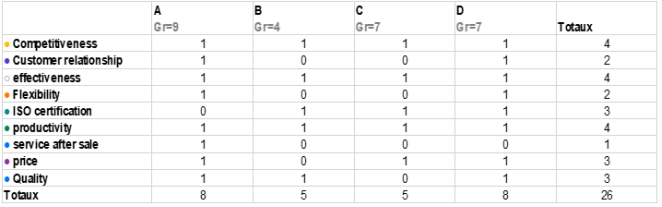
After calculating the key concepts, we created codes for each document used, to link these codes to the concerned company, in order to see how compagnies respond to competitiveness and its factors. Using a binary matrix (
Figure 1), we obtained the following results:
Figure 1. Code-document of codes in a binary matrix.
All firms scored 1 according to the price and/or quality factors, which indicated competitiveness in pricing strategy and quality standards; meaning rather low prices, economic prices or suitable prices combined with high quality or medium for the customer. Also, B, C, and D firms score 1 in ISO certification factor, which is important for meeting quality standards. But firms A and D were rated 1 in flexibility and customer relationship, implying that they are very adaptive, able to change with pressure or external situations, and they well address their customer needs and satisfaction. While B and C score 0 in both factors, possibly seeming to have a more rigid process or less ability to adapt.
The Micro-enterprise A and the big enterprise D stand out as they have a high performance in all elements of competitiveness, while big enterprise C scores well on most elements, particularly in price, and productivity; however, she can still better incorporate flexibility and heightened attention to customer. In contrast, the small-sized company “B” is strong only in quality and certified by ISO; thus, it must improve its productivity, customer relationship management and flexibility.
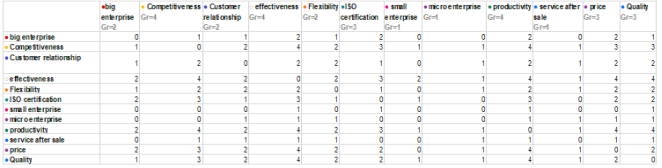
Although, we cannot judge between the competitors according to them size, if we focus only on code-document table. So, in parallel with the code-document, we have to organize these codes into a co-occurrence table of codes (as shown in
Figure 2), to establish the links between them, and the influence of each on the other and on competitiveness as well.
Figure 2. COOC table of codes.
In order to properly analyze this COOC table, we prefer to calculate the correlation matrix, using “Pearson correlation coefficient”, which is a method for measuring the linear relationship between two variables. This coefficient denoted as r ranges from -1 to +1, where +1 indicates a perfect positive correlation (both variables increase or decrease together), -1 indicates a perfect negative correlation (as one variable increases, the other decreases) and 0 indicates no linear relationship.
The equation of “Pearson correlation coefficient” is:
r=
Where:
The point i variate from 1 to 12.
Xi and Yi are the individual data points in two datasets, X and Y.
and are the mean values of datasets X and Y, respectively.
Ʃ: sum of all data points of a dataset.
The calculation of correlation of codes, using the coefficient r, yields the following results in
Figure 3:
Figure 3. Correlation matrix of codes.
1) Competitiveness and effectiveness: a presumably strong correlation due to value (0.74) suggests that more competitive firms should be more effective in undertaking their operations. This might represent how competitiveness aligns with better organizational practices and outcomes.
2) Productivity and competitiveness: the correlation (0.01) is positive but too weak, explaining that high productivity does not necessarily translate into high competitiveness.
3) Customer relationship and competitiveness: correlation coefficient here is moderate (0.32), which indicates that strong customer relationships tend to be more competitive than average, which indicates that there could be importance regarding customer satisfaction in better overall performance.
4) Flexibility and competitiveness: A weak to a negligible negative correlation was found (-0.057) between competitiveness and flexibility, showing that flexibility does not have a strong relationship with competitiveness for this dataset. However, because of the correlation with Customer Relationship (0.31), some link exists between a company's flexibility and its ability to maintain good customer relations.
5) ISO Certification: the correlations between ISO certification and various elements in this context, such as Competitiveness and Productivity, are consistently weak. It indicates that certification may not be a major determinant of competitiveness in this case.
6) Small enterprise: exist a weak negative association (-0.13) between the medium enterprise and competitive performance, recommending that the medium company under study may not perform as competitively as the larger ones.
7) Big enterprises: a moderate positive correlation (0.63), indicating that bigger enterprises are likely to have higher competitiveness. This suggests that bigger firms probably gain economies of scale or certain advantages that ensure a better competitive standing.
8) Micro-enterprise: a negative correlation value indicates weakness of competitiveness, although she is strong in majority of factors and achieve high effectiveness. Probably, this influence comes from the branding, as well as from the environmental factors of industrial region.
9) Price & competitiveness: a negative correlation (-0.35) shows that a lower price can improve competitiveness or vice versa; however, this may lead compagnies to fail in maintaining a good level of competitiveness, and it is more relevant within a less competitive market.
10) Quality & competitiveness: very high positive correlation (0.75) demonstrates that quality product is one of the most important factors firms can use to enhance competence.
5. Discussion
Our findings coincide with those of Azriyah, Sofiah and Rozita
| [3] | Azriyah A., Sofiah M. d. A. And Rozita A. (Mai 2016). Cost Management, Entrepreneurship and Competitiveness of Strategic Priorities for Small and Medium Enterprises. Procedia - Social and Behavioral Sciences, Vol 219, 84-90. |
[3]
, who connected cost management practices to competitiveness as a strategic priority in entrepreneurship. They pointed out that continuous adoption and refinement of cost management practices provide the entrepreneurial competencies to survive and succeed in the future. Firms proficient in these fields are more likely to retain a formidable position in the competitive market. In a saturated market, price competition leads to a downward spiral, hurting profit margins. On the other hand, several factors are at play, such as innovation, new product development, and customer services; a firm investing in product quality and in others factors differentiates itself and can attract those customers who are willing to pay more for better quality products.
Particularly in the agri-food industry, competitiveness does not rely solely on price, but also on the ability of firms to offer quality products, meet consumer expectations, and differentiate themselves in the market. Non-price factors encompass all elements other than price that can influence demand for a product, either through the perceived quality of the product, through its attributes – the characteristics that firms must be able to communicate credibly to attract foreign consumers – or through differentiation; this allows firms to justify higher prices, enabling them to maintain competitiveness even without being the cheapest.
Gaigne, Latouche and Turolla
| [21] | Gaigné C., Latouche K. and Turolla S. (2020). Competitivite internationale du secteur agroalimentaire français: c’est quoi le problème?. In Annales des Mines-Realites industrielles, 2020 (2), 21-29. Institut Mines-Telecom. |
[21]
confirmed these results in their study on a saturated market; firms that focus solely on price competitiveness may find themselves in a race to the bottom, which can harm their profit margins. As Rust, Kannan and Peng
| [48] | Rust R. T., Kannan P. K. and Peng N. (2002). The customer economics of internet privacy. Journal of the Academy of Marketing Science, 30(4), 455-464. |
[48]
identified three approaches, as three different kinds of quality (customer-oriented, cost optimization-oriented and mixed approaches), where customer-oriented to quality will thus have a performance advantage over those with a cost-oriented or can damage their financial performance through an excessively cost-oriented.
Our results are conflated with the "bigger is better" approach for large firms that have a competitive advantage over smaller ones. This idea, stems from industrial economics and based on several arguments, including economies of scale and better coordination of actions by Simon
| [51] | Simon, H. (1945). Administrative Behaviour. New York, The Free Press. |
[51]
and Chandler
| [10] | Chandler, A. D. (1962). Strategy and structure: Chapters in the history of the industrial empire. Cambridge Mass, 5(1), 12-48. |
[10]
, the ability to absorb market losses due to their size according to Williamson
| [60] | Williamson O. E. (1975), « Markets and Hierarchies », New York, The Free Press. |
| [61] | Williamson O. E. (1985), « The Economic Institutions of Capitalism », New York, The Free Press. |
[60-61]
, the centralization of structures and connections with social elites, conferring strong market influence noted by Pfeffer and Salancik [
38] as well as Mintz and Schwartz
| [35] | Mintz B. A. and Schwartz M. (1987). The power structure of American business. University of Chicago Press. |
[35]
; and according to neo-institutionalist theorists like (DiMaggio and Powell, Meyer and Scott
| [14] | DiMaggio P. J. and Powell W. (1983). The Iron Cage Revisited: Institutional Isomorphism and Collective Rationality in Organizational Fields. American Sociological Review, 48(2), 147-160. |
| [34] | Meyer, J., Scott, W. R., & Strang, D. (1987). Centralization, fragmentation, and school district complexity. Administrative science quarterly, 186-201. |
[14, 34]
have imposed common practices, allowing large firms to maintain their dominant position and structures. All these theories agree on the idea that large firms are competitive. Also, for Schumpeter
| [49] | Schumpeter J., (1942), Capitalism, Socialism, and Democracy, Harper & Brothers, United States. First edition. |
[49]
, large firms, due to their size benefit from economies of scale and can make costly investments in R&D, which promotes innovation and would be profitable in the long term, a strategy that is challenging for smaller entities.
Based on the analysis of both tables and the correlation matrix, effectiveness and productivity tend to arise as central factors for competitiveness. The high co-occurrence of these two factors presented in the second table is interpreted to mean that firms view them as interlinked and essentially important for their success, as stated by Chevassus-Lozza and Gallezot
| [11] | Chevassus E., and Gallezot J. (1995). La competitivite hors-prix dans les echanges de produits agricoles et agro-alimentaires français sur le marche communautaire. Economie & prevision, 117(1), 143-154. |
[11]
, competitiveness of intra-community markets rests upon the right mix of price and non-price factors; these authors emphasize that mere low-pricing of products is not enough; differentiation of products with respect to quality and specialization is warranted to retain one's market position.
For flexibility factor in relation to competitiveness, it may not be as vital as effectiveness. Because firms in the agri-food industry emphasize operational efficiency and cost competitiveness more than adaptability to change. So, flexibility is important, but might play a secondary role in securing efficiency of the operations and cost competitiveness. Flexibility becomes particularly critical when responding to changes in the global and local markets, often, in circumstances like market shifts or crises, flexibility gives a competitive edge. On the other hand, firms that lack of inflexibility could be risk to adapt with changes in consumer demands or internal pressures.
And ISO 9001 certification is increasingly becoming an important factor for competitiveness in the agri-food industry. Certification can help firms meet industry standards, thereby boosting their credibility in the marketplace. Firms like “A”; have not been granted ISO certification are still fighting to remain nimble by pursuing a high-quality philosophy, with professional services before and after sales. According to Rolland and Tran
| [46] | Rolland S. and Tran S. (2006, November). La certification qualite est-elle un facteur de competitivite pour les entreprises? Le cas de la norme ISO 9001. In 5ème edition du colloque metamorphose des Organisations «Nouvelles regulations, Normalisation et Dynamique des organisations» (p. 20). INCONNU. |
[46]
the decision to seek ISO certification leads to better performance behind an internal motivation than for those firms forced into it; as Jones, Arndt and Kustin
| [25] | Jones, R., Arndt, G., & Kustin, R. (1997). ISO 9000 among Australian companies: impact of time and reasons for seeking certification on perceptions of benefits received. International journal of quality & reliability management, 14(7), 650-660. |
[25]
showed that firms seeking certification voluntarily or those with varying mixed motivations (including outside pressures) receive much better returns than those that are obliged, also (Terziovski, Power and Sohal, & Singels, Ruël and Van De Water
| [53] | Terziovski M. Power D., and Sohal A. S. (2003). The longitudinal effects of the ISO 9000 certification process on business performance. European Journal of operational research, 146(3), 580-595. |
| [52] | Singels J., Ruël G., and Van De Water H. (2001). ISO 9000 series‐Certification and performance. International Journal of Quality & Reliability Management, 18(1), 62-75. |
[53, 52]
showed that firms having an inner quality culture gained the most advantage from certification.
On the contrary results of Rolland and Tran’s
| [46] | Rolland S. and Tran S. (2006, November). La certification qualite est-elle un facteur de competitivite pour les entreprises? Le cas de la norme ISO 9001. In 5ème edition du colloque metamorphose des Organisations «Nouvelles regulations, Normalisation et Dynamique des organisations» (p. 20). INCONNU. |
[46]
on certification costs, ISO 9001 certification generates the biggest benefits when the certification is outsourced for external objectives-the main imperatives in this case being customer satisfaction and market differentiation, rather than internal purposes such as process optimization and cost/time performance. And the evaluations of numerous studies remain to be explored; the company may already possess a competitive advantage that could hinder the commercial effect of certification, as in the case of company A, the promotion of certification may be insufficient, as in the case of company B, or the company may not prioritize commercial aspects in its certification process, as in the case of company C.
At this end, enterprise C and enterprise D appear to be the best performers, strong in price strategy, productivity, quality, customer relationship and effectiveness service process. They have great adaptability, efficiency, and retain high standing with respect to pricing and quality, which posits them strategically in the market. Oppositely, Company A and B, exhibit weaknesses, respectively, akin in brand notoriety/relationship marketing and flexibility, thus reactive for market competitiveness in a constantly dynamic environment. As well as Chevassus-Lozza and Galliano
| [11] | Chevassus E., and Gallezot J. (1995). La competitivite hors-prix dans les echanges de produits agricoles et agro-alimentaires français sur le marche communautaire. Economie & prevision, 117(1), 143-154. |
[11]
argue this situation to the national specialization of a sector, which exerts a favorable impact on the competitiveness of firms within that sector. Favorable comparative advantages are accorded to a sector under national specialization, thus improving the visibility of the firms that operate therein.
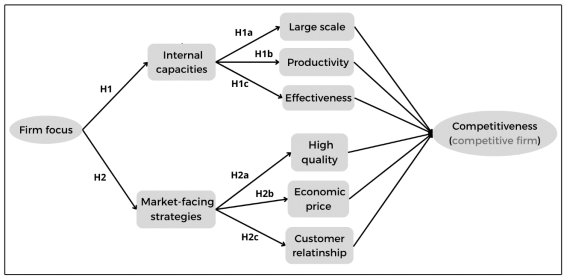
Above is a logical relationship diagram for evaluating the elements that affect competitiveness; within the structure of those mentioned above, one can locate customer relationship, quality, price, productivity, and effectiveness as contributing factors to competitiveness bearing the resulted outcome as demonstrated in a literature review. The main hypothesis we concluded from this primary study are:
H1: Internal capabilities positively influences firm competitiveness.
H1a: Productivity positively influences firm competitiveness.
H1b: Organizational effectiveness positively influences firm competitiveness.
H1c: Large scale positively influences firm competitiveness.
H2: Marketing strategies positively influences firm competitiveness.
H2a: High product quality positively influences firm competitiveness.
H2b: Economic pricing positively influences firm competitiveness.
H2c: Customer relationship quality positively influences firm competitiveness.
Meanwhile, flexibility in relation with environment is less correlated with competitiveness while not as critical in that regard. However, it plays a role in responding to the market-development changes in production processes and customers' satisfaction. Additionally, ISO certification is less emphasized comparatively in the analysis, but could be branched further down with quality since it enables affirmation of a high standing rate in the industrial field. Below (
Figure 4) is the model:
Figure 4. Conceptual model of competitiveness factors of industrial firm.
Theoretical Implication
Our results confirm previous conclusions regarding large enterprises that benefit from economies of scale and possess more substantial financial resources compared to businesses of different sizes, which provides them with a competitive advantage in the industrial sector, exemplified by the agri-food industry in this study. Thanks to their large size, they can focus on efficiency production process, big productivity, economic price, high quality product, and customer service relationship, rather than limiting themselves solely to price, which does not guarantee them lasting success. Concerning flexibility, although it is less critical than efficiency, it allows firms to adjust in response to market changes and unforeseen crises.
On the other hand, ISO certification, which enhances a company's credibility, is not a central element; it reveals its full potential when integrated into a comprehensive strategy that emphasizes quality.
Practical Implication
As findings, firm C and firm D outperform their competitors A and B due to their strengths in pricing, productivity, and customer relationships. The conceptual model of the logical relationships between these various factors accentuates these interconnections. On this basis, large firms are known for their significant production capacity, which is related both to their industrial burdens and their workforce. Therefore, we recommend Micro and VSEs in industrial sector to increase their productive capacity through the experience effect to reduce the unit prices of products via economies of scale, while also optimizing customer services through flexible relationships in transportation, installation and maintenance of machines, and the provision of spare parts, in order to retain potential customers and attract new ones for a high-quality product in a competitive market.
Limit and perspective
However, the term "competitiveness" remains complex and does not reach a consensus among researchers, it is what the theorists (Kotler and Dubois & Lesca
| [27] | Kotler P. (1989). Marketing Management. Paris: Publi-Union. |
| [31] | Lesca H. (1986). Structure et systeme d'information facteurs de competitivite de l'entreprise. Masson 2e edition. |
[27, 31]
attributed to the absence of unanimous definition of the indicators and factors that determine competitiveness, making this concept ambiguous and difficult to grasp.
For this reason, the qualitative approach and the sample deployed in this article are insufficient to yield universally acceptable results across all sectors.
Therefore, we look to a quantitative study that analyzes the relationships between these factors and the competitiveness of the conceptual model, based on hypotheses and tests on a larger sample than this one.





 Share This Article
 Twitter
 Linked In
 Facebook

 Copy
Copy Download