Abstract
This article investigates the determination and evaluation of the aerodynamic parameters of a mine ventilation network when fan-ejector units are used for the ventilation of underground mine workings. Dead-end workings of the Zarmitan and Gujumsay mines of JSC “NMMC”, characterized by complex ventilation conditions, were selected as the research objects. The mining and technical conditions of the mines, the total power of self-propelled mining equipment, the required standard airflow rate, and the air capacity of the installed VM-6 auxiliary ventilation fan were comparatively analyzed. The calculations showed that the required airflow exceeds the fan capacity by a factor of 1.72 times at the Zarmitan mine and 1.06 times at the Gujumsay mine. The aerodynamic resistance of the ventilation network was evaluated on the basis of airflow rate and pressure loss, and the quadratic relationship between mine depression and airflow rate was analyzed. When the fan-ejector unit was incorporated into the ventilation network, airflow distribution was investigated using Kirchhoff’s first and second laws, taking into account the airflow balance at network junctions and the pressure balance within closed ventilation circuits. For the iterative ventilation-network calculations, a numerical tolerance of ΔQ/Q₀ ≤ 5% was adopted in this study as the convergence criterion for the airflow balance. In addition, the pressure characteristic of the fan-ejector unit was evaluated from the difference between the total pressures at its inlet and outlet, while its relative efficiency was analyzed as a function of the mixed airflow rate. The obtained results demonstrate that the operating mode of a fan-ejector unit should be determined through an integrated consideration of airflow rate, aerodynamic resistance, mine depression, airflow distribution within the ventilation network, and the pressure characteristics of the unit. The results can be used to substantiate the operating parameters of fan-ejector units and to evaluate the aerodynamic performance of auxiliary ventilation systems in underground mine workings with complex ventilation conditions.
Keywords
Underground Mine Working, Mine Ventilation, Fan-Ejector Unit, Ejection, Airflow Rate, Aerodynamic Resistance,
Ventilation Network, Ventilation Efficiency
1. Introduction
In recent years, the topological structure of underground mine ventilation networks has become increasingly complex. This is primarily attributed to the increasing total length of mine workings, the progressive deepening of mining operations, the development of numerous diagonal and auxiliary connections between mining horizons, and the growing number of intake-air and return-air shafts. Modern studies have investigated auxiliary mine ventilation, airflow distribution, and ventilation conditions in underground mine workings using experimental and numerical approaches
| [1] | Vives, J., Bascompta Massanés, M., De Felipe, J. J., and Sanmiquel, L. Computational Fluid Dynamics (CFD) study to optimize the auxiliary ventilation system in an underground mine. DYNA, 2022, vol. 89, no. 221, pp. 84–91.
https://doi.org/10.15446/dyna.v89n221.100297 |
| [2] | Torno, S.; Toraño, J. On the prediction of toxic fumes from underground blasting operations and dilution ventilation: Conventional and numerical models. Tunnelling and Underground Space Technology. 2020, 96, 103194.
https://doi.org/10.1016/j.tust.2019.103194 |
| [3] | Kim, M.; Park, J.; Jo, Y.; Lee, D.; Yi, H. Numerical Investigation of Characteristics of Mine Ventilation Using One or Two Ducts in Underground Mining Faces. In: Bui, X. N.; Lee, C.; Drebenstedt, C., eds. Proceedings of the International Conference on Innovations for Sustainable and Responsible Mining. Lecture Notes in Civil Engineering, vol. 109. Springer, Cham, 2021, pp. 245–262.
https://doi.org/10.1007/978-3-030-60839-2_13 |
| [4] | Yi, H.; Park, J.; Kim, M. Characteristics of mine ventilation air flow using both blowing and exhaust ducts at the mining face. Journal of Mechanical Science and Technology. 2020, 34, 1167–1174.
https://doi.org/10.1007/s12206-020-0218-0 |
[1-4]
. In particular, V.G. Andreyev, L.D. Dyakonov, and R.A. Kolomiyets investigated the improvement of high-capacity ejector technology for underground mines. V.V. Bondarenko, V.G. Lisiyenko, and B.I. Kitayev studied the ejection performance of ejectors equipped with short mixing chambers, while M.M. Gervasyeva addressed theoretical and computational aspects of low-pressure ejector design and calculation. N.N. Mokhirev conducted extensive research on fan-ejector modelling, calculation methods for ejectors used in the ventilation of short dead-end mine workings, as well as the determination of rational operating modes and installation locations of fan-ejector units
| [6] | Mokhirev N. N. Determination of operating modes and installation locations for ejector fans. Ventilation of Mines and Shafts. - 1980. - №7. - P. 50-55. |
[6]
. I.M. Pechuk investigated the application of compressed-air ejectors for the ventilation of dead-end mine workings, whereas A.V. Shalimov focused on the theoretical modelling of ejector units for underground mine ventilation
| [7] | Shalimov A. V. Theoretical modeling of ejector installations for underground mine ventilation. In: Proceedings of the Scientific Session of the Mining Institute of the Ural Branch of the Russian Academy of Sciences based on research results in 2001. Perm; 2002. |
| [9] | Kazakov B. P., Shalimov A. V. Mathematical modeling of ejector units during underground ventilation. Izvestiya Vysshikh Uchebnykh Zavedenii. Gornyi Zhurnal. 2004; 2: 39–44. |
[7, 9]
. Collectively, these studies have established important theoretical and methodological foundations for the application, aerodynamic calculation, and optimization of ejector-assisted ventilation systems in underground mining operations.
Recent studies have also demonstrated the effectiveness of analytical and Computational Fluid Dynamics (CFD)-based approaches for optimizing auxiliary mine ventilation systems, assessing airflow and pressure losses, and improving the aerodynamic and energy performance of mine ventilation fans
| [10] | Menéndez, J.; Fernández-Oro, J. M.; Merlé, N.; Galdo, M.; Álvarez, L.; López, C.; Bernardo-Sánchez, A. Auxiliary ventilation systems in mining and tunnelling: Air leakage prediction and system design to optimize the energy efficiency and operation costs. Tunnelling and Underground Space Technology. 2023, 140, 105298.
https://doi.org/10.1016/j.tust.2023.105298 |
| [11] | Zhang, H.; Li, M.; Xiao, Y.; Han, X.; Liu, B.; Yang, W. Numerical study on interactions between climate conditions and diesel exhaust and optimization of auxiliary ventilation in underground mines. Thermal Science and Engineering Progress. 2023, 37, 101594.
https://doi.org/10.1016/j.tsep.2022.101594 |
| [12] | Fakhari, S. M.; Mrad, H. Optimization of an axial-flow mine ventilation fan based on effects of design parameters. Results in Engineering. 2024, 21, 101662.
https://doi.org/10.1016/j.rineng.2023.101662 |
[10-12]
.
2. Methodology
Experimental and industrial investigations were conducted at two mines operated by JSC “NMMC” (Navoi Mining and Metallurgical Company), selected as research sites due to the presence of underground mine workings characterized by complex ventilation conditions.
Table 1. Mining and Technical Characteristics of the Mines Investigated.
Parameter | Zarmitan Mine (JSC NMMC) | Gujumsay Mine (JSC NMMC) |
Ore type | Gold-sulfide ore | Gold-sulfide ore |
Mining horizon depth, m | 420–900 | 200–650 |
Cross-sectional area of dead-end workings, S, m² | 8.5–10.2 | 7.0–9.5 |
Length of dead-end workings, L, m | 140–220 | 80–160 |
Self-propelled mining equipment fleet | Drilling rig (97 kW), LHD (130 kW), PSM (80 kW) | Drilling rig (80 kW), LHD (110 kW) |
Total rated power of internal combustion engines, kW | 307 | 190 |
Required airflow rate, Qₙₒᵣₘ, m3/min | 30.7 | 19.0 |
Installed auxiliary ventilation fan (AVF) | VM-6 (Qmax = 4.24 m3/s) | VM-6 (Qmax = 4.24 m3/s) |
Airflow deficit ratio, Qₙₒᵣₘ/QAVF | 7.3/4.24 = 1.72 times | 4.5/4.24 = 1.06 times |
Application of an ejector unit | Required | Recommended |
At the Zarmitan Mine (JSC “NMMC”), the total rated power of the three self-propelled mining machines amounts to 307 kW, resulting in a deficit in the calculated airflow required to ensure adequate ventilation of the working area. This operating condition is representative of an underground mine section characterized by complex ventilation conditions and insufficient airflow supply. Therefore, the Zarmitan Mine was selected as the primary research site for conducting experimental and industrial trials of the proposed ventilation system.
The pressure measurements used in the aerodynamic analysis were obtained using a TESTO 521-3 differential pressure instrument. The static and dynamic pressure components at the inlet and outlet sections were used to determine the corresponding total pressures.
3. Results and Discussion
The aerodynamic resistance of each branch of the ventilation network is determined using the following equation:
where: Δhi is the pressure loss (depression) in the i-th section, Pa; Qi is the airflow rate in the i-th section, m3/s. According to Equation (
1), the relationship between aerodynamic resistance, pressure loss, and airflow rate is illustrated in
Figure 1.
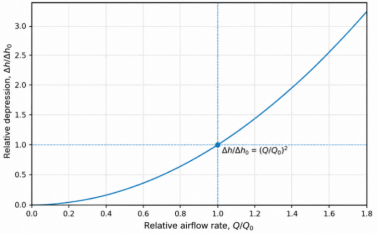
Figure 1. Relationship between mine ventilation network depression and airflow rate.
As can be seen from the graph, the pressure drop (depression) in the mine ventilation network is related to the airflow rate according to a nonlinear quadratic relationship. At relatively low airflow rates, an increase in airflow causes only a moderate increase in pressure loss. However, as the relative airflow rate Q/Q0 increases, the slope of the characteristic curve becomes progressively steeper. This indicates that increasing the airflow rate through underground mine workings requires a progressively higher ventilation pressure (depression) to overcome the aerodynamic resistance of the ventilation network.
Section pressure drop (Based on TESTO 521-3 Measurement Data):
(2)
where pst1 and pst2 are the static pressures at the inlet and outlet sections, respectively; pdyn1 and pdyn2 are the corresponding dynamic pressures; and p₁ = pst1 + pdyn1 and p₂ = pst2 + pdyn2 represent the total pressures at the inlet and outlet sections, respectively.
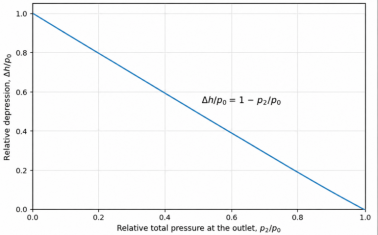
Figure 2. Relationship between the Pressure Drop in a Mine Working Section and the Total Pressure Difference.
The graph illustrates that the pressure drop (depression) within a section of the mine ventilation network is determined by the difference in total pressure between the inlet and outlet points. As the relative total pressure at the outlet increases, the relative pressure drop across the section decreases linearly. This relationship indicates that the pressure loss required to overcome the aerodynamic resistance during airflow movement through the mine working is directly associated with the difference in the energy state of the airflow between the inlet and outlet sections.
As the outlet pressure approaches the inlet pressure, the value of Δh tends toward zero. Conversely, an increase in the pressure difference between the inlet and outlet results in a corresponding increase in the pressure drop (depression) across the section. Therefore, this relationship can be used to assess the aerodynamic state of the mine ventilation network, identify sections characterized by high aerodynamic resistance, and substantiate the required pressure parameters of the fan-ejector unit.
When a fan-ejector unit is incorporated into the mine ventilation system, the airflow distribution within the ventilation network can be analyzed using Kirchhoff’s laws. According to Kirchhoff’s First Law, the airflow balance must be satisfied at each junction of the ventilation network:
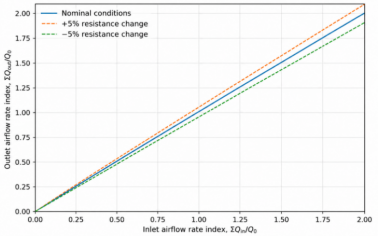
Figure 3. Airflow Balance at a Mine Ventilation Network Junction According to Kirchhoff’s First Law.
The graph illustrates the application of Kirchhoff’s First Law at a junction of the mine ventilation network, according to which the sum of the airflow rates entering a junction must be equal to the sum of the airflow rates leaving it. Under ideal airflow balance conditions, this relationship is represented by the straight line y=x. Therefore, an increase in the total incoming airflow rate requires a proportional increase in the total outgoing airflow rate. In addition to the principal airflow balance line, the graph shows the ±5% numerical convergence limits adopted in this study. The convergence criterion for the iterative ventilation-network calculation was set at ΔQ/Qo ≤ 5%. This value was adopted as a numerical tolerance for evaluating the convergence of the calculated airflow balance and should not be interpreted as an allowable physical air-leakage threshold. Values within these limits indicate that the numerical airflow-balance calculation has reached the adopted convergence criterion, whereas values outside the limits indicate that further iteration or refinement of the network calculation is required..
When a fan-ejector unit is employed, maintaining this airflow balance becomes particularly important because the ejection process entrains an additional mass of air into the primary airflow, resulting in the redistribution of airflow rates throughout the mine ventilation network.
Kirchhoff’s Second Law describes the balance of pressure drops (depressions) within a closed circuit of the mine ventilation network:
The permissible deviation for airflow balance convergence is defined as: ΔQ/Qo ≤ 5%.
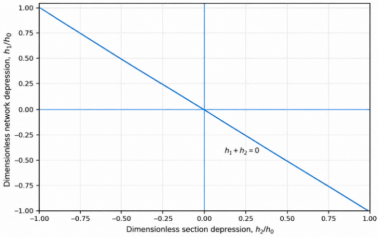
Figure 4. Balance of Pressure Drops in a Closed Ventilation Circuit According to Kirchhoff’s Second Law.
The graph characterizes the balance of aerodynamic pressure losses within a closed circuit of the mine ventilation network. According to Kirchhoff’s Second Law, the algebraic sum of the pressure drops (depressions) along a closed ventilation circuit must be equal to zero. The negative slope of the graph indicates that an increase in the pressure drop in one section requires a corresponding change in the balancing pressure drop in the opposite direction
| [5] | Kobylkin S. S., Sologub O. V. Review of existing software tools for modeling ventilation in underground structures and mines. Mining Informational and Analytical Bulletin (Scientific and Technical Journal). 2009; S13: 115–132. (In Russian). |
[5]
.
The fact that the graph passes through the origin of the coordinate system indicates that the condition ∑Δh=0 is satisfied. In this case, the positive and negative pressure drops (depressions) algebraically compensate for each other. This law represents one of the fundamental conditions for calculating the airflow direction and its distribution among individual branches of mine ventilation networks with complex topology. When a fan-ejector unit is incorporated into the ventilation network, the additional pressure generated by the unit affects the existing balance of pressure drops. Therefore, when selecting the installation location and operating mode of the fan-ejector unit, it is necessary to consider not only the airflow rate but also the balance of pressure drops within the closed ventilation circuits.
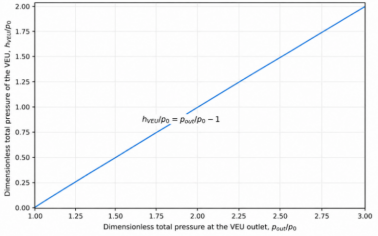
The total pressure generated by the fan-ejector unit is determined as the difference between the total pressures at its outlet and inlet:
(5)
Figure 5. Relationship between the total pressure of the fan-ejector unit and the difference between the inlet and outlet total pressures.
The graph demonstrates that the total pressure generated by the fan-ejector unit is determined by the difference between the total pressures at its outlet and inlet. An increase in the total pressure at the outlet of the fan-ejector unit promotes a more effective conversion of the kinetic energy of the mixed airflow into static pressure, which is required to overcome the aerodynamic resistance of the mine ventilation network. Therefore, this parameter is considered one of the key aerodynamic characteristics of the fan-ejector system, as it reflects the system’s capability to provide the required air exchange within an underground mine working. From a practical perspective, the graph demonstrates the necessity of matching the operating mode of the fan-ejector unit with the aerodynamic resistance of the mine ventilation network. The required airflow rate can be maintained at a stable level only when the total pressure generated by the fan-ejector unit is within the ventilation network
| [7] | Shalimov A. V. Theoretical modeling of ejector installations for underground mine ventilation. In: Proceedings of the Scientific Session of the Mining Institute of the Ural Branch of the Russian Academy of Sciences based on research results in 2001. Perm; 2002. |
| [8] | Alymenko D. N. Operation of a Combined-Type Ventilation Unit in a Mine Ventilation Network [Candidate of Technical Sciences Dissertation]. Perm, 1999. 159 p. |
[7, 8]
.
The efficiency (coefficient of performance) of the fan-ejector unit is determined as follows:
(6)
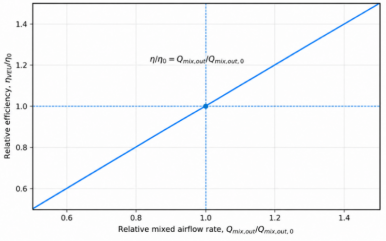
Figure 6. Relative relationship between the efficiency of the fan-ejector unit and the mixed airflow rate.

The graph characterizes the functional relationship between the efficiency of the fan-ejector unit and the parameters of the mixed airflow in dimensionless form. Equation (
6) is used in the article to determine the efficiency of the fan-ejector unit. The point corresponding to Q
mix, out/Q
mix, out, 0=1 and η/η
0=1represents the reference operating condition of the fan-ejector unit. Assuming that the remaining parameters are constant, an increase in the mixed airflow rate is accompanied by an increase in the relative efficiency of the fan-ejector unit. This behavior can be explained by the entrainment of an additional air mass from the surrounding mine atmosphere into the ejector zone, which results in an increase in the total airflow capacity of the ventilation system. Therefore, this relationship can be used for a qualitative assessment of the energy efficiency of the fan-ejector unit and for comparing its performance under different operating conditions. When sufficient experimental data are available, the presented relative relationship can be transformed into an actual efficiency characteristic, η=f(Q), enabling a more accurate quantitative evaluation of the aerodynamic and energy performance of the fan-ejector unit
| [9] | Kazakov B. P., Shalimov A. V. Mathematical modeling of ejector units during underground ventilation. Izvestiya Vysshikh Uchebnykh Zavedenii. Gornyi Zhurnal. 2004; 2: 39–44. |
[9]
.
The air quality at workplaces where self-propelled mining equipment is operated is assessed based on the concentrations of harmful substances in the mine atmosphere. In accordance with the applicable standards and industrial safety regulations for underground ore mining, the standardized maximum allowable concentration (MAC) values for harmful substances are presented in
Table 2.
Table 2. Standardized Maximum Allowable Concentration (MAC) values for harmful substances.
No. | Substance | Maximum allowable concentration (MAC), mg/m3 | MAC, ppm | Hazard class | Notes/Requirement |
1 | Carbon monoxide (CO) | 20 | 17.4 | IV | |
2 | Nitric oxide (NO) | 5 | 4.0 | III | |
3 | Nitrogen dioxide (NO₂) | 2 | 1.06 | III | |
4 | Acrolein | 0.2 | — | II | |
5 | Carbon dioxide (CO₂) | 9000 | — | — | General monitoring |
6 | Oxygen (O₂) concentration | — | — | — | Standard ≥20vol.% |
7 | DPM (Diesel Particulate Matter) | 0.1 | — | I | Carcinogenic |
4. Conclusions
1) The analysis of the mining, technical, and ventilation conditions of the Zarmitan and Gujumsay mines demonstrated that the airflow required for the operation of self-propelled mining equipment exceeds the capacity of the existing auxiliary ventilation systems. The calculated airflow deficit ratio was 1.72 at the Zarmitan Mine and 1.06 at the Gujumsay Mine
2) At the Zarmitan Mine, the total rated power of the internal combustion engines of three self-propelled mining machines is 307 kW, resulting in a calculated airflow deficit under the existing ventilation conditions. Therefore, mine sections characterized by complex ventilation conditions at the Zarmitan Mine were selected as the primary research site for experimental and industrial investigations of the proposed fan-ejector ventilation system.
3) The analysis of the relationship between aerodynamic resistance, pressure drop (depression), and airflow rate showed that the pressure drop in the mine ventilation network varies according to a nonlinear quadratic relationship with airflow rate. As the airflow rate increases, a progressively higher ventilation pressure is required to overcome the aerodynamic resistance of underground mine workings.
4) The evaluation of the pressure drop in a mine working section based on the difference in total pressure between the inlet and outlet sections provides a means of assessing the aerodynamic condition of the ventilation network, identifying sections with high aerodynamic resistance, and substantiating the required pressure parameters of the fan-ejector unit.
5) When a fan-ejector unit is incorporated into the ventilation network, the redistribution of airflow should satisfy Kirchhoff’s First Law, according to which the total airflow entering each network junction must equal the total airflow leaving it. In this study, ΔQ/Q₀ ≤ 5% was adopted solely as a numerical convergence criterion for the iterative airflow-balance calculation and not as a physical air-leakage threshold.
6) Based on Kirchhoff’s Second Law, the algebraic sum of pressure drops within a closed ventilation circuit must satisfy the condition ∑Δh=0. Since the additional pressure generated by the fan-ejector unit affects the existing pressure balance, both the installation location and operating mode of the unit should be selected with consideration of the pressure-drop balance within closed ventilation circuits.
7) The total pressure generated by the fan-ejector unit is determined by the difference between the total pressures at its outlet and inlet. Stable delivery of the required airflow rate can be achieved only when the total pressure generated by the unit is sufficient to compensate for the overall aerodynamic pressure losses within the mine ventilation network.
8) The analysis of the functional relationship between the relative efficiency of the fan-ejector unit and the mixed airflow rate
9) The obtained aerodynamic relationships demonstrate that the operating mode of the fan-ejector unit should be selected through an integrated assessment of airflow rate, aerodynamic resistance, pressure drop, airflow balance at network junctions, pressure balance in closed circuits, and the total pressure generated by the unit. Such an integrated approach enables the operating characteristics of the fan-ejector unit to be matched with those of the mine ventilation network.
10) In addition to aerodynamic performance, the application of a fan-ejector ventilation system requires systematic assessment of mine air quality. In the present study, the air quality at workplaces of self-propelled mining equipment is evaluated according to the concentrations of CO, NO, NO₂, acrolein, CO₂, oxygen content, and diesel particulate matter (DPM).
11) Overall, the results provide a methodological basis for substantiating the aerodynamic parameters of fan-ejector units used in dead-end underground mine workings with complex ventilation conditions. The proposed approach can be applied to evaluate airflow distribution and pressure losses, match the operating mode of a fan-ejector unit with the aerodynamic resistance of the ventilation network, and assess the aerodynamic performance of auxiliary mine ventilation systems.
Abbreviations
NMMC | Navoi Mining and Metallurgical Company |
AVF | Auxiliary Ventilation Fan |
MAC | Maximum Allowable Concentration |
DPM | Diesel Particulate Matter |
CFD | Computational Fluid Dynamics |
Author Contributions
Ravshanov Avaz Ali Ugli: Data Curation, Investigation, Resources, Validation
Nurkhonov Khusan Almirza Ugli: Conceptualization, Formal Analysis, Methodology, Visualization, Writing – original draft, Writing – review & editing
Conflicts of Interest
The authors declare no conflicts of interest.
References
| [1] |
Vives, J., Bascompta Massanés, M., De Felipe, J. J., and Sanmiquel, L. Computational Fluid Dynamics (CFD) study to optimize the auxiliary ventilation system in an underground mine. DYNA, 2022, vol. 89, no. 221, pp. 84–91.
https://doi.org/10.15446/dyna.v89n221.100297
|
| [2] |
Torno, S.; Toraño, J. On the prediction of toxic fumes from underground blasting operations and dilution ventilation: Conventional and numerical models. Tunnelling and Underground Space Technology. 2020, 96, 103194.
https://doi.org/10.1016/j.tust.2019.103194
|
| [3] |
Kim, M.; Park, J.; Jo, Y.; Lee, D.; Yi, H. Numerical Investigation of Characteristics of Mine Ventilation Using One or Two Ducts in Underground Mining Faces. In: Bui, X. N.; Lee, C.; Drebenstedt, C., eds. Proceedings of the International Conference on Innovations for Sustainable and Responsible Mining. Lecture Notes in Civil Engineering, vol. 109. Springer, Cham, 2021, pp. 245–262.
https://doi.org/10.1007/978-3-030-60839-2_13
|
| [4] |
Yi, H.; Park, J.; Kim, M. Characteristics of mine ventilation air flow using both blowing and exhaust ducts at the mining face. Journal of Mechanical Science and Technology. 2020, 34, 1167–1174.
https://doi.org/10.1007/s12206-020-0218-0
|
| [5] |
Kobylkin S. S., Sologub O. V. Review of existing software tools for modeling ventilation in underground structures and mines. Mining Informational and Analytical Bulletin (Scientific and Technical Journal). 2009; S13: 115–132. (In Russian).
|
| [6] |
Mokhirev N. N. Determination of operating modes and installation locations for ejector fans. Ventilation of Mines and Shafts. - 1980. - №7. - P. 50-55.
|
| [7] |
Shalimov A. V. Theoretical modeling of ejector installations for underground mine ventilation. In: Proceedings of the Scientific Session of the Mining Institute of the Ural Branch of the Russian Academy of Sciences based on research results in 2001. Perm; 2002.
|
| [8] |
Alymenko D. N. Operation of a Combined-Type Ventilation Unit in a Mine Ventilation Network [Candidate of Technical Sciences Dissertation]. Perm, 1999. 159 p.
|
| [9] |
Kazakov B. P., Shalimov A. V. Mathematical modeling of ejector units during underground ventilation. Izvestiya Vysshikh Uchebnykh Zavedenii. Gornyi Zhurnal. 2004; 2: 39–44.
|
| [10] |
Menéndez, J.; Fernández-Oro, J. M.; Merlé, N.; Galdo, M.; Álvarez, L.; López, C.; Bernardo-Sánchez, A. Auxiliary ventilation systems in mining and tunnelling: Air leakage prediction and system design to optimize the energy efficiency and operation costs. Tunnelling and Underground Space Technology. 2023, 140, 105298.
https://doi.org/10.1016/j.tust.2023.105298
|
| [11] |
Zhang, H.; Li, M.; Xiao, Y.; Han, X.; Liu, B.; Yang, W. Numerical study on interactions between climate conditions and diesel exhaust and optimization of auxiliary ventilation in underground mines. Thermal Science and Engineering Progress. 2023, 37, 101594.
https://doi.org/10.1016/j.tsep.2022.101594
|
| [12] |
Fakhari, S. M.; Mrad, H. Optimization of an axial-flow mine ventilation fan based on effects of design parameters. Results in Engineering. 2024, 21, 101662.
https://doi.org/10.1016/j.rineng.2023.101662
|
Cite This Article
-
APA Style
Ugli, R. A. A., Ugli, N. K. A. (2026). Investigation of Aerodynamic Parameters of Underground Mine Ventilation Using Fan-ejector Units. International Journal of Mechanical Engineering and Applications, 14(4), 80-87. https://doi.org/10.11648/j.ijmea.20261404.12
Copy
|
Download
ACS Style
Ugli, R. A. A.; Ugli, N. K. A. Investigation of Aerodynamic Parameters of Underground Mine Ventilation Using Fan-ejector Units. Int. J. Mech. Eng. Appl. 2026, 14(4), 80-87. doi: 10.11648/j.ijmea.20261404.12
Copy
|
Download
-
@article{10.11648/j.ijmea.20261404.12,
author = {Ravshanov Avaz Ali Ugli and Nurkhonov Khusan Almirza Ugli},
title = {Investigation of Aerodynamic Parameters of Underground Mine Ventilation Using Fan-ejector Units},
journal = {International Journal of Mechanical Engineering and Applications},
volume = {14},
number = {4},
pages = {80-87},
doi = {10.11648/j.ijmea.20261404.12},
url = {https://doi.org/10.11648/j.ijmea.20261404.12},
eprint = {https://article.sciencepublishinggroup.com/pdf/10.11648.j.ijmea.20261404.12},
abstract = {This article investigates the determination and evaluation of the aerodynamic parameters of a mine ventilation network when fan-ejector units are used for the ventilation of underground mine workings. Dead-end workings of the Zarmitan and Gujumsay mines of JSC “NMMC”, characterized by complex ventilation conditions, were selected as the research objects. The mining and technical conditions of the mines, the total power of self-propelled mining equipment, the required standard airflow rate, and the air capacity of the installed VM-6 auxiliary ventilation fan were comparatively analyzed. The calculations showed that the required airflow exceeds the fan capacity by a factor of 1.72 times at the Zarmitan mine and 1.06 times at the Gujumsay mine. The aerodynamic resistance of the ventilation network was evaluated on the basis of airflow rate and pressure loss, and the quadratic relationship between mine depression and airflow rate was analyzed. When the fan-ejector unit was incorporated into the ventilation network, airflow distribution was investigated using Kirchhoff’s first and second laws, taking into account the airflow balance at network junctions and the pressure balance within closed ventilation circuits. For the iterative ventilation-network calculations, a numerical tolerance of ΔQ/Q₀ ≤ 5% was adopted in this study as the convergence criterion for the airflow balance. In addition, the pressure characteristic of the fan-ejector unit was evaluated from the difference between the total pressures at its inlet and outlet, while its relative efficiency was analyzed as a function of the mixed airflow rate. The obtained results demonstrate that the operating mode of a fan-ejector unit should be determined through an integrated consideration of airflow rate, aerodynamic resistance, mine depression, airflow distribution within the ventilation network, and the pressure characteristics of the unit. The results can be used to substantiate the operating parameters of fan-ejector units and to evaluate the aerodynamic performance of auxiliary ventilation systems in underground mine workings with complex ventilation conditions.},
year = {2026}
}
Copy
|
Download
-
TY - JOUR
T1 - Investigation of Aerodynamic Parameters of Underground Mine Ventilation Using Fan-ejector Units
AU - Ravshanov Avaz Ali Ugli
AU - Nurkhonov Khusan Almirza Ugli
Y1 - 2026/09/30
PY - 2026
N1 - https://doi.org/10.11648/j.ijmea.20261404.12
DO - 10.11648/j.ijmea.20261404.12
T2 - International Journal of Mechanical Engineering and Applications
JF - International Journal of Mechanical Engineering and Applications
JO - International Journal of Mechanical Engineering and Applications
SP - 80
EP - 87
PB - Science Publishing Group
SN - 2330-0248
UR - https://doi.org/10.11648/j.ijmea.20261404.12
AB - This article investigates the determination and evaluation of the aerodynamic parameters of a mine ventilation network when fan-ejector units are used for the ventilation of underground mine workings. Dead-end workings of the Zarmitan and Gujumsay mines of JSC “NMMC”, characterized by complex ventilation conditions, were selected as the research objects. The mining and technical conditions of the mines, the total power of self-propelled mining equipment, the required standard airflow rate, and the air capacity of the installed VM-6 auxiliary ventilation fan were comparatively analyzed. The calculations showed that the required airflow exceeds the fan capacity by a factor of 1.72 times at the Zarmitan mine and 1.06 times at the Gujumsay mine. The aerodynamic resistance of the ventilation network was evaluated on the basis of airflow rate and pressure loss, and the quadratic relationship between mine depression and airflow rate was analyzed. When the fan-ejector unit was incorporated into the ventilation network, airflow distribution was investigated using Kirchhoff’s first and second laws, taking into account the airflow balance at network junctions and the pressure balance within closed ventilation circuits. For the iterative ventilation-network calculations, a numerical tolerance of ΔQ/Q₀ ≤ 5% was adopted in this study as the convergence criterion for the airflow balance. In addition, the pressure characteristic of the fan-ejector unit was evaluated from the difference between the total pressures at its inlet and outlet, while its relative efficiency was analyzed as a function of the mixed airflow rate. The obtained results demonstrate that the operating mode of a fan-ejector unit should be determined through an integrated consideration of airflow rate, aerodynamic resistance, mine depression, airflow distribution within the ventilation network, and the pressure characteristics of the unit. The results can be used to substantiate the operating parameters of fan-ejector units and to evaluate the aerodynamic performance of auxiliary ventilation systems in underground mine workings with complex ventilation conditions.
VL - 14
IS - 4
ER -
Copy
|
Download