Research Article | | Peer-Reviewed

Influence of Course-Related Factors on Hospitality TVET Enrolment and the Moderating Role of Gender in Selected Ghanaian Colleges of Education

Received: 29 July 2026     Accepted: 8 August 2026     Published: 24 August 2026
Views:       Downloads:
Abstract

Despite the strategic importance of Technical and Vocational Education and Training (TVET) for skills development and youth employability in Ghana, hospitality programmes in Colleges of Education continue to face low and gender-imbalanced enrolment, raising critical questions about how programme design shapes students' decisions to enrol and persist. This study examined whether course-related drivers (programme attributes) predict hospitality TVET enrolment in selected Ghanaian Colleges of Education and whether gender conditions this relationship. An explanatory cross-sectional research design was employed. Quantitative data were collected from hospitality students using a structured questionnaire (n = 336; response rate = 95.5%). Exploratory factor analysis (EFA) validated the course-related factors scale; hierarchical multiple regression tested direct and interaction effects. The course-related factors scale yielded four dimensions (i.e., practical and industry-relevant curriculum; mentorship, collaboration and community engagement; ethical and communication skills development; and entrepreneurial and career advancement support. Regression results indicated that only two aspects of course-related factors significantly predicted enrolment, with ethical and communication skills development exerting the strongest effect, followed by practical and industry-relevant curriculum. Moderation analysis confirmed that gender significantly conditioned the relationship between course-related factors and enrolment, with a stronger association among female students. The study extends hospitality TVET enrolment research by isolating course-related drivers and evidencing gender-contingent effects in a Colleges of Education context.

Published in International Journal of Hospitality & Tourism Management (Volume 10, Issue 2)
DOI 10.11648/j.ijhtm.20261002.14
Page(s) 221-230
Creative Commons

This is an Open Access article, distributed under the terms of the Creative Commons Attribution 4.0 International License (http://creativecommons.org/licenses/by/4.0/), which permits unrestricted use, distribution and reproduction in any medium or format, provided the original work is properly cited.

Copyright

Copyright © The Author(s), 2026. Published by Science Publishing Group

Keywords

Hospitality TVET, Student Enrolment, Course-related Factors, Gender Moderation, Colleges of Education, Ghana

1. Introduction
Hospitality programmes in Technical and Vocational Education and Training (TVET) are designed to equip learners with practical skills that align with employer needs . After World War II, UNESCO and the International Labour Organisation (ILO) promoted TVET as a way to grow economies and reduce poverty. As education shifted toward lifelong learning, TVET became more closely linked to national skills development and employability . In Africa, TVET is widely seen as a pathway that can reduce youth unemployment and support economic empowerment . Yet, many countries, including Ghana, continue to face low TVET enrolment, which limits these benefits .
In hospitality TVET, students' decisions to enrol are closely tied to what the programme promises for their future careers. Career decisions shape learners' life paths . These decisions are influenced by personal interests, family and community influence, and the wider context around the learner . Research in hospitality and tourism education shows that students often look at job chances and expected income , family influence and location , and broader pressures such as social expectations, programme reputation, and perceived career prospects . Within this mix, course-related factors matter because they provide the "real evidence" students look for when judging whether hospitality TVET is worth it, such as whether the curriculum is practical, current, and aligned with what the industry actually demands . Recent work from Ghana also continues to highlight that students' TVET choices are shaped by their perceptions of the pathway's value and outcomes .
However, Ghana's hospitality TVET enrolment remains a concern. TVET is recognised for its role in skills development, employability, and income generation . However, enrolment in Ghanaian colleges of education has been reported to be declining, influenced by negative public attitudes and the belief that TVET is less respected than academic routes . This matters beyond education because low enrolment can contribute to shortages of skilled labour needed for national development . While teaching resources and infrastructure constraints are part of this problem , course design also plays a direct role: students may avoid enrolling when curricula are outdated, overly theoretical, or disconnected from workplace needs . Evidence from hospitality education also shows that practical training and internship experiences build key workplace skills such as communication and teamwork, which can shape how students judge the value of a programme . In Ghana, concerns about gaps between what is taught and what the industry expects continue to be raised in hospitality training discussions .
Gender adds another layer to the enrolment problem. Students' education choices are often shaped by cultural beliefs about "male" and "female" fields . In Ghana and other settings, social and cultural biases, unequal access to support, and weaknesses in career guidance can discourage girls from some technical areas , while social norms may also limit boys' participation in fields seen as feminine . Across African contexts, girls may face family and community resistance when choosing vocational routes, reinforcing gender imbalance , and even when equity efforts exist, changing deeply held attitudes remains difficult . Gender-related differences can also appear during practical training and placements, where students' experiences and perceived safety or support may shape how attractive the programme feels .
Despite the importance of course design and gender, gaps remain in the literature. Many earlier studies pay limited attention to how tools shape data quality, and include too few stakeholders in explaining enrolment decisions . There is also limited Ghana-specific evidence that tests how course features such as industry relevance, practical training, mentorship, ethics and communication development, and career or entrepreneurship support shape enrolment outcomes, and whether these relationships differ for male and female students . This gap is important because course improvements may not influence all students in the same way, especially where gendered expectations shape perceptions of programme fit and future opportunities.
Against this background, the present manuscript examines how course-related factors influence students' decisions to enrol and remain committed to hospitality TVET programmes in Ghana, and whether these effects differ by gender. By focusing on course design and delivery (including practical, industry-linked learning and skills development) alongside gender differences in enrolment responses, the study aims to generate evidence that can guide programme improvement and more inclusive recruitment strategies in hospitality TVET.
2. Literature Review
2.1. Hospitality TVET Enrolment in Vocational Choice Research
Enrolment into hospitality TVET programmes can be conceptualised as an education choice shaped by perceived programme value, expected career outcomes, and enabling constraints. In this study, student enrolment goes beyond simply joining a hospitality programme. It also includes a student's satisfaction with the programme, commitment to continue, intention to complete, and willingness to recommend the course to others. This view is supported by well-known explanations of why students join, stay, or drop out of higher education programmes.
Bean's model suggests that students are more likely to continue when they are satisfied with their studies, feel supported by the institution, and can manage outside pressures such as finances and family demands. Astin also argues that students stay longer when they take part actively in learning through class engagement, campus activities, and interaction with lecturers. Spady explains dropout as a social process, where students are more likely to leave if they fail to feel connected to the institution's community and peer networks.
Tinto's model brings these ideas together by showing that students enter with different backgrounds and goals. However, their decision to stay depends on how well they adjust academically and socially once they join the institution . When students perform well in coursework and also feel a sense of belonging through supportive peer and lecturer relationships, they are more likely to remain and complete their studies . Because hospitality education includes both classroom learning and hands-on training, this model fits the programme well. Guided by Tinto's model, the present study treats enrolment as a continuing process shaped by learner attitudes, teaching and learning resources, and course-related factors, all of which influence satisfaction, commitment, persistence, and programme advocacy .
2.2. Course-Related Factors and Enrolment Outcomes
Course-related factors are the parts of a programme that can attract students, influence their choice to join, and encourage them to stay and finish . In hospitality TVET, these factors often include practical learning linked to the workplace (such as internships, field projects, and simulations), mentorship and teamwork support (from lecturers, alumni, and industry professionals), training in ethics and communication (professional behaviour, teamwork, and customer handling), and support for careers and self-employment (career guidance, job connections, and business start-up skills).
Extant research shows that students are more likely to choose programmes that clearly build job-ready skills and improve their chances of employment . In hospitality education, hands-on training and strong links with industry are key reasons why students enrol . Technology-based learning, including simulations, can also improve student confidence and interest, which strengthens the programme's appeal .
Mentorship and supportive relationships also matter. Teaching that is friendly, supportive, and trust-building helps students feel that they belong, which can increase their willingness to join and remain in a programme . Guidance from mentors, alumni, and peers also shapes students' views of the programme and can influence enrolment decisions . In addition, programmes that develop ethics and communication skills tend to be seen as higher quality because these skills are important for hospitality work and improve graduates' readiness to serve clients professionally . Students are also attracted to programmes that support career growth and self-employment. Entrepreneurship and innovation training can build confidence and resilience , while career guidance, placement support, and visible alumni success can strengthen students' belief that the programme leads to real opportunities .
Overall, studies agree that practical learning, mentorship, and career preparation make programmes more attractive to students, mainly because they improve confidence and satisfaction. However, most studies focus on satisfaction rather than real enrolment decisions, and many are based on single institutions or non-TVET settings . There is also limited evidence from Ghana on how these course features shape enrolment in hospitality-TVET colleges. Few studies test, using strong quantitative methods, how course design affects behaviours like applying, accepting admission, and staying in the programme. In addition, gender differences are rarely examined, even though hospitality education often shows uneven participation patterns. For these reasons, this study examines how course-related factors influence student enrolment in hospitality programmes in Ghana's Colleges of Education and tests whether gender changes these relationships.
2.3. Moderating Role of Gender in the Link Between Course Factors and Enrolment
Course features such as practical learning, strong links with industry, flexible study options, recognised certificates, and support for self-employment can make a programme look more valuable to students. However, male and female students may not react to these course features in the same way, so gender can shape how course design influences enrolment.
Studies show that women are more likely to join and stay in programmes when the course provides clear career paths, well-organised practical training, and placements that feel safe and supportive. When what is taught does not match what happens in real workplaces, women's interest and participation often reduce . This suggests that women's enrolment decisions are strongly influenced by whether the programme feels job-focused and whether practical training is well managed. Research also shows mixed results on how gender affects responses to entrepreneurship training and related support. For example, one study found that among young people in Bangladesh, women were less likely than men to turn social support into an intention to start a business . In China, another study found that links between readiness for career change and confidence in starting a business were stronger for men . However, a study of engineering students in India found no clear gender differences in how entrepreneurship education shaped intentions . These mixed findings suggest that gender effects depend on the setting and how the course is designed, and that gender may strengthen or weaken how entrepreneurship support influences enrolment and continuation. Some course requirements can also affect women more than men. Programmes that require travel for internships or off-campus training may discourage women because of family responsibilities or restrictions on movement . Designing practical training with local placements, flexible schedules, or online options can reduce these barriers and make programmes easier for women to access.
Even though these studies offer useful insights, there is still limited evidence on how gender changes the link between course features and enrolment, especially in hospitality programmes in Sub-Saharan Africa, such as Ghana. In addition, many studies focus on students' intentions rather than what students actually do. This study goes further by examining enrolment orientation, which includes students' commitment, satisfaction, and willingness to recommend the programme, as close indicators of whether students will stay and succeed in hospitality education.
3. Methodology
3.1. Research Design
An explanatory cross-sectional research design was employed in this study. It is a study approach used when a researcher wants to explain why something happens by testing whether one factor is linked to another. Instead of stopping at "what is happening," it focuses on "what is driving it" by examining relationships between variables using organised data collection and statistical testing . For this study on course-related drivers of hospitality TVET enrolment, an explanatory design fits because the key interest is not only describing enrolment patterns, but testing whether course factors such as teaching approach, course content, learning resources, practical exposure, assessment style, career guidance, and perceived course value are connected to students' willingness or decision to enrol. This aligns with the idea that quantitative research can test relationships among variables using measured data. It is also especially useful for a gender-moderated analysis because explanatory studies can go one step further and test whether the strength of a relationship changes across groups . In this case, the study can test whether course-related drivers influence enrolment in the same way for male and female students, or whether the influence is stronger for one group than the other.
3.2. Population and Sampling
The quantitative population comprised hospitality students in selected Ghanaian Colleges of Education. Stratified procedures supported representation by college and year of study. A total of 352 questionnaires were distributed, and 336 valid questionnaires were analysed (response rate = 95.5%).
3.3. Measures
Course-related factors were measured using multi-item 5-point Likert scales capturing practical exposure, curriculum relevance, ethics/communication development, and entrepreneurship/career support. Hospitality TVET enrolment was operationalised as an enrolment orientation/enrolment-related outcome scale. Gender was coded as a binary moderator (female vs male).
3.4. Validity and Reliability
EFA (principal component extraction with varimax rotation) assessed construct validity. Sampling adequacy was confirmed using KMO and Bartlett's test. Internal consistency reliability was assessed using Cronbach's alpha with the 0.70 threshold .
3.5. Data Analysis
Descriptive statistics summarised respondent characteristics. Multiple regression tested the direct effects of the four course-related dimensions on enrolment. Moderation was tested using hierarchical regression with an interaction term (course-related factors × gender), consistent with standard interaction testing procedures .
4. Results
4.1. Demographic Characteristics
Gender distribution showed that 80.4% of respondents were female and 19.6% were male (Table 1). Most respondents were aged under 25 years, with 50.9% aged 20–24 and 35.4% below 20. The majority were in their second year (37.8%) or third year (31.8%).
Table 1. Demographic Profiles of Respondents.

Demographic variable

Category

N

%

Gender

Female

270

80.4

Male

66

19.6

Age group

Below 20 years

119

35.4

20–24 years

171

50.9

25–29 years

38

11.3

30 years and above

8

2.4

Year of study

First year

52

15.5

Second year

127

37.8

Third year

107

31.8

Fourth year

50

14.9

Note. N = 336
4.2. Measurement Model Validation: Course-related Factors Scale
EFA results supported factorability (KMO = 0.804; Bartlett’s test p < 0.001) (Table 2).
Table 2. Rotated Factor Structure of Items Measuring Course-Related Factors.

Extracted Factor

Component

1

2

3

4

Factor 1: Practical and Industry-Relevant Curriculum

The courses include modules focused on sustainable practices and environmental impact.

0.753

The courses provide exposure to real-world projects and industry partnerships.

0.680

The institution offers support for students to engage in research and innovation activities.

0.614

The institution offers opportunities for interdisciplinary learning and collaboration.

0.585

The institution provides access to career counselling and guidance services.

0.516

The courses include practical simulations and real-life case studies for a hands-on learning experience.

0.500

Factor 2: Mentorship, Collaboration and Community Engagement

The institution encourages participation in community service and outreach programs related to the field of study.

0.659

The institution provides access to relevant certifications and professional development.

0.659

The institution offers mentorship programs connecting students with industry professionals.

0.658

The courses provide opportunities for collaborative projects with peers.

0.531

The courses integrate emerging technologies and industry-relevant innovations.

0.526

Factor 3: Ethical and Communication Skills Development

The institution offers language courses or communication skills training alongside technical subjects.

0.668

The courses include modules on ethical practices and social responsibility in the chosen field.

0.657

The courses offered provide opportunities for the practical application of knowledge.

0.635

The institution provides access to research opportunities and academic conferences.

0.522

Factor 4: Entrepreneurial and Career Advancement Support

The institution offers support for students interested in entrepreneurial ventures.

0.720

The courses are regularly updated to align with industry trends and advancements.

0.710

The institution facilitates networking events with alumni and industry experts.

0.572

The institution provides support for students interested in pursuing further education in the same field.

0.556

Note. Extraction Method: Principal Component Analysis. Rotation Method: Varimax with Kaiser Normalisation. KMO measure of sampling adequacy = 0.804. Bartlett’s test of sphericity (p-value) = p < 0.001
The four extracted dimensions were labelled: (i) Practical and Experiential Learning Opportunities; (ii) Industry-Relevant Curriculum Content; (iii) Ethical and Communication Skills Development; and (iv) Entrepreneurial and Career Advancement Support. They had eigenvalues > 1 and collectively explained 54.79% of total variance (Table 3).
Table 3. Total variance explained (course-related factors).

Component

% Variance

Cumulative %

1

25.50

25.50

2

11.66

37.16

3

9.27

46.43

4

8.36

54.79

4.3. Regression Results: Direct Effects of Course-related Factors on Enrolment
Results in Table 4 show that the model explained 38.7% of the variance in hospitality TVET enrolment (R² = 0.387). The overall model was statistically significant (F = 52.290, p < 0.001). The practical and industry-relevant curriculum had a significant positive effect (β = 0.257, t = 4.483, p < .001). This finding showed that courses emphasising sustainability, industry partnerships, and practical case studies strongly encourage enrolment. In addition, mentorship, collaboration, and community engagement were positive but not statistically significant (β = 0.115, t = 1.911, p = .057). While students value mentorship and collaboration, their influence on enrolment decisions was weaker and fell just short of statistical significance. Ethical and communication skills development emerged as the strongest predictor (β = 0.315, t = 5.643, p < .001). This finding underscored the importance of modules on ethics, language, and communication in motivating students to enrol. Moreover, support for entrepreneurial and career advancement did not have a significant effect (β = 0.061, t = 1.116, p = .265). Although entrepreneurial training and networking are valued, they may not directly drive students’ initial decision to enrol.
Table 4. Regression coefficients (course-related factors → enrolment).

Predictor

B

SE

Beta

T

P

(Constant)

1.020

0.194

5.247

<.001

Practical and Industry-Relevant Curriculum

0.267

0.060

0.257***

4.483

<.001

Mentorship, Collaboration and Community Engagement

0.106

0.056

0.115 Ns

1.911

.057

Ethical and Communication Skills Development

0.305

0.054

0.315***

5.643

<.001

Entrepreneurial and Career Advancement Support

0.055

0.049

0.061N. s

1.116

.265

Note. Dependent Variable: Student Enrolment. R = .62, R² = .39, Adj. R² = .38. F = 52.3, p < .001. Levels of Significance: *p < .05. **p < .01. ***p < .001. N.s-Not Significant
4.4. Moderation Results: Gender as a Moderator
The interaction term was statistically significant (B = 0.380, p < 0.001), confirming that gender moderates the influence of course-related factors on enrolment (Table 5).
Table 5. Moderation model (course-related factors × gender → enrolment).

Predictor

B

SE

T

p

Constant

3.57

0.95

3.76

.00

Course-Related Factors (CRFs)

0.02N. s

0.25

0.08

.93

Gender (Gr)

-1.35*

0.51

-2.66

.01

CRFs × Gender (Interaction)

0.38***

0.13

2.88

<.001

Note. Model Summary: R = .62, R² = .38, F (3, 332) = 68.94, p < .001. Interaction Test: ΔR² = .02, F (1,332) = 8.29, p < .001. Levels of Significance: *p < .05. **p < .01. ***p < .001. N.s-Not Significant
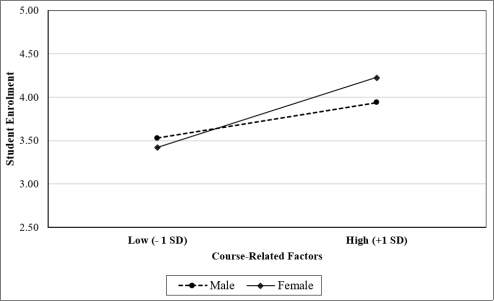
The conditional plot indicates a steeper positive slope for female students, suggesting a stronger translation of programme attributes into enrolment among females (Figure 1).
Figure 1. Conditional Plot Showing the Moderating Effect of Gender on the Link Between Course-Related Factors and Student Enrolment.
5. Discussion and Conclusions
5.1. Influence of Course-related Factors on Student Enrolment
The results show that course-related factors play an important role in attracting students to hospitality programmes. Overall, these factors explained 38.7% of the differences in student enrolment (R² = 0.387, p < .001). The strongest course features were training that builds ethical behaviour and communication skills (β = 0.315, p < .001) and a practical curriculum that matches industry needs (β = 0.257, p < .001). Mentorship, collaboration, and support for entrepreneurship also had positive links with enrolment, but they influenced enrolment less strongly. This pattern supports earlier work showing that good course design, strong communication training, and relevant content increase students' satisfaction and commitment . It also matches evidence that programme relevance, mentoring, and institutional reputation shape students' programme choices in hospitality and higher education .
The findings suggest that students are especially drawn to hospitality programmes that clearly build work readiness. Students appear to value courses that help them develop professional behaviour, communicate well with clients, and act responsibly in work settings. This aligns with research showing that skills development is a major reason why students find a programme attractive . It also reflects hospitality studies reporting that practical and technology-supported learning experiences that build confidence can increase satisfaction and intention to enrol . In other words, when students believe a programme will equip them with real skills that employers want, they are more likely to choose it.
The weaker influence of entrepreneurship and career advancement support may be because these areas are not always clear or visible to students at the point of enrolment. Some programmes introduce mentorship and entrepreneurship training later, so students may not see them as decisive when applying. This fits research suggesting that entrepreneurship education is valuable for building creativity and resilience, but it may not be the main reason students enrol . Other studies also show that course quality and career fit tend to shape enrolment decisions more strongly than broader social influences . In the Ghanaian context, where hospitality education can be costly, and students may worry about job security, many learners may prefer programmes that promise clearer employment outcomes rather than taking on the risks associated with entrepreneurship.
These results also fit well with the study's guiding ideas. Social Cognitive Career Theory explains that learners choose programmes when they believe they can succeed and when they expect good outcomes such as employability and confidence . The strong effect of ethical and communication training suggests that students expect these skills to improve their chances of getting jobs and performing well. Resource Dependency Theory also helps explain the results by showing that a strong curriculum and good delivery are valuable institutional assets that make programmes more attractive to students . The Theory of Planned Behaviour further supports these results because students are more likely to enrol when they hold positive views about the programme, believe it will help them gain strong skills, and feel supported by the institution and their environment . In this case, mentorship may contribute by offering encouragement, but its influence on the enrolment decision appears smaller than the influence of curriculum quality and practical skill development.
Overall, this study adds evidence that course content and how it is delivered matter greatly for hospitality TVET enrolment. It shows that course-related factors such as ethics, communication, and industry relevance do not just influence satisfaction; they directly shape enrolment decisions, with ethical communication training and practical curriculum design having the strongest effects. This extends earlier work that often relied mainly on qualitative accounts by showing, with numbers, which course features matter most for enrolment in hospitality TVET settings . The results highlight the importance of designing hospitality programmes that are practical, industry-focused, and clearly build professionalism, ethics, and employability.
5.2. Moderating Role of Gender in the Effect of Course-related Factors on Enrolment
The results show that gender changes how strongly course-related factors influence enrolment in hospitality programmes. For male students, course-related factors had a clear positive effect on enrolment (B = 0.40, SE = 0.12, t = 3.35, p < .001). For female students, the effect was much stronger—almost double (B = 0.78, SE = 0.06, t = 13.98, p < .001). This means that although both groups respond positively to course features, female students are more likely than males to base their enrolment decisions on what the course offers, especially practical and industry-relevant content, mentorship opportunities, communication skills training, and clear career or entrepreneurship support.
These findings suggest that strengthening course quality and making programmes clearly linked to work opportunities can be an effective way to improve female enrolment and also help female students remain in the programme. In practice, colleges can place more emphasis on industry connections, structured mentorship, and clear career pathways to support women's participation and reduce gender gaps in hospitality TVET.
The results are consistent with studies showing that women's participation in hospitality and technical programmes increases when courses are practical, well supported, and delivered within safe and encouraging learning environments . They also reflect concerns that mismatches between curriculum and industry, especially around placements and internships, can discourage women, particularly when these experiences seem unsafe or socially restrictive . Evidence on gender differences in entrepreneurship-related support is mixed across countries. For example, some studies found weaker links between support and entrepreneurial intention for women , while others reported stronger entrepreneurship-confidence effects for men , and some found no clear gender differences . This suggests that gender differences often depend on context and how programmes are designed.
In the Ghanaian hospitality context, where practical placements are central, the stronger response among female students implies that mentorship, supportive course structures, and well-managed placements can reduce common barriers to women's participation. Overall, these results add evidence that in hospitality TVET settings, improving course relevance, mentorship, and professionalism-focused training is particularly important for motivating and sustaining female enrolment.
6. Managerial Implications
Colleges can improve hospitality TVET enrolment and retention by strengthening how programmes prepare students for real work. First, they should provide well-planned, practical learning through regular skills sessions, internships, and attachments, and build steady partnerships with hotels, restaurants, and other hospitality organisations so that every student gets meaningful workplace exposure. Second, curriculum teams should work closely with industry when reviewing or updating courses, so that what is taught matches the skills employers expect and the roles graduates are likely to enter. Third, programmes should treat ethics, communication, and professional behaviour as core parts of training, teaching them clearly and assessing them the same way other key skills are assessed. Fourth, colleges should improve support for career growth by offering mentorship, linking students to alumni, and creating connections to business support centres or organisations that help students who want to start hospitality-related businesses. Finally, recruitment should speak to both men and women by showing a wide range of hospitality career paths and directly addressing stereotypes that may discourage male students from enrolling.
7. Limitations and Further Research
First, self-reported measures may introduce common-method bias; future studies could integrate administrative enrolment records and longitudinal designs. Second, the gender imbalance in the sample suggests the need for more gender-balanced samples or multi-group models with measurement invariance testing. Third, the context was limited to selected Colleges of Education; comparative research across TVET institutions and regions would improve generalisation. Future studies could also examine additional moderators such as socio-economic background, prior hospitality exposure, and institutional resource differences.
Abbreviations

EFA

Exploratory Factor Analysis

ILO

International Labour Organisation

KMO

Kaiser-Meyer-Olkin

TVET

Technical and Vocational Education and Training

UNESCO

United Nations Educational, Scientific and Cultural Organisation

Author Contributions
Nanice Fosu: Conceptualization, Data curation, Formal Analysis, Investigation, Methodology, Project administration, Resources, Software, Supervision, Validation, Visualization, Writing – original draft, Writing – review & editing
Duncan Shirandula: Methodology, Project administration, Resources, Software, Supervision, Validation, Visualization, Writing – original draft, Writing – review & editing
Vincent Maranga: Methodology, Project administration, Resources, Software, Supervision, Validation, Visualization, Writing – original draft, Writing – review & editing
Patrick Akwasi Anamuah Mensah: Methodology, Investigation, Supervision, Validation, Visualization, Writing – original draft, Writing – review & editing
Data Availability Statement
The datasets generated and/or analyzed during this study can be obtained from the corresponding author upon reasonable request.
Conflicts of Interest
The authors declare no conflict of interest.
References
[1] A. A. Essuman and F. B. Fraikue, "Assessing TVET graduates in hospitality management: Balancing theoretical knowledge and practical skills for industry success," Universal Journal of Educational Research, vol. 3, no. 4, 2024.
[2] UNESCO, Transforming Technical and Vocational Education and Training for successful and just transitions: UNESCO strategy 2022-2029. Paris, France: UNESCO, 2022.
[3] I. Magadza and J. Mampane, "The role of TVET colleges in addressing the needs of NEET youth in a South African province," Community College Journal of Research and Practice, pp. 1–17, 2024.
[4] F. Kokutse, "Countries can benefit more from TVET if they invest in the sector," 2025. Available:
[5] O. Koçak et al., "The role of family influence and academic satisfaction on career decision-making self-efficacy and happiness," International Journal of Environmental Research and Public Health, vol. 18, no. 11, p. 5919, 2021.
[6] N. Panakaje et al., "Decoding destinations: Unravelling the factors that shape career choices in commerce and management," Cogent Education, vol. 11, no. 1, p. 2356395, 2024.
[7] F. Liu, Q. He, and N. Wu, "Factors influencing students' career intentions in the hospitality and tourism industries: A meta-analysis," Behavioural Sciences, vol. 12, no. 12, p. 517, 2022.
[8] P. T. de Carvalho and R. J. Raimundo, "Ikigai and career choices in hospitality and tourism: A study of student motivations amidst industry disruptions," Tourism and Hospitality, vol. 6, no. 2, 2025.
[9] World Bank Group, "Skills training is opening opportunities for millions of young people in Africa," 2025.
[10] G. Mwinkume et al., "Enhanced multinomial logistic regression analysis of determinants influencing technical and vocational education and training (TVET) choices among Ghanaian youth: Implications for policy development," JIPD, vol. 8, no. 11, p. 8642, 2024.
[11] A. Shore and T. Dinning, "Developing students' skills and work readiness: An experiential learning framework," Journal of Work-Applied Management, vol. 15, no. 2, pp. 188–199, 2023.
[12] W. Rahmaningtyas et al., "Graduate satisfaction: How experiential learning supercharges employability skills," Asian Journal of University Education, vol. 21, no. 1, pp. 160–176, 2025.
[13] N. A. Sarkodie, "Assessing hospitality training and practices in Ghana," African Journal of Hospitality, Tourism and Leisure, vol. 7, no. 1, 2018.
[14] C. Boateng, F. Ackon, and I. Nyarko, "Factors influencing students' choice of technical and vocational education and training (TVET) pathway in the Central Region of Ghana," African Journal of Empirical Research, vol. 5, no. 4, 2024.
[15] J. P. Bean, "Interaction effects based on class level in an explanatory model of college student dropout syndrome," American Educational Research Journal, vol. 22, no. 1, pp. 35–64, 1985.
[16] A. W. Astin, "Student involvement: A developmental theory for higher education," Journal of College Student Personnel, vol. 25, no. 4, pp. 297–308, 1984.
[17] W. G. Spady, "Dropouts from higher education: An interdisciplinary review and synthesis," Interchange, vol. 1, no. 1, pp. 64–85, 1970.
[18] V. Tinto, "Dropout from higher education: A theoretical synthesis of recent research," Review of Educational Research, vol. 45, no. 1, pp. 89–125, 1975.
[19] V. Tinto, Leaving College: Rethinking the Causes and Cures of Student Attrition, 2nd ed. Chicago, IL, USA: University of Chicago Press, 1993.
[20] V. Tinto, "Research and practice of student retention: What next?," Journal of College Student Retention: Research, Theory & Practice, vol. 8, no. 1, pp. 1–19, 2006.
[21] S. W. Draper, "Tinto's model of student retention," University of Glasgow, Glasgow, U.K., 2004. Available:
[22] C. Chhor et al., "Factors influencing students' enrollment decisions in higher education institutions: A case study of the National University of Battambang," European Journal of Contemporary Education and E-Learning, vol. 2, no. 6, pp. 169–186, 2024.
[23] R. Poole, D. Thompson, and D. Galloway, "Decisions, decisions, decisions: An exploration of factors affecting the decision-making of 'Uni Connect' students, when choosing higher education study," Journal of Marketing for Higher Education, pp. 1–22, 2023.
[24] F. Zyberaj et al., "Factors influencing university students' academic program preferences: An analysis of Albanian data," Acta Psychologica, 2025.
[25] J. Mendoza-Villafaina and N. López-Mosquera, "Educational experience, university satisfaction and institutional reputation: Implications for university sustainability," The International Journal of Management Education, vol. 22, no. 3, p. 101013, 2024.
[26] T. Jitpratum and W. Weerasophon, "Factors affecting the decision to study at College of Hospitality Industry Management, Suan Sunandha Rajabhat University, in the academic year 2023," in Proc. Int. Conf. Actual Economy: Local Solutions for Global Challenges, vol. 15, no. 1, 2025, p. 285.
[27] A. M. da C. e S. Gaspar and J. M. A. C. Soares, "Factors influencing the choice of higher education institutions in Angola," International Journal of Educational Administration and Policy Studies, vol. 13, no. 1, pp. 23–39, 2021.
[28] K. M. Selem et al., "How does tech-driven hospitality curriculum drive student satisfaction? Lessons from technical universities," The TQM Journal, 2025.
[29] K. Bell, "Increasing undergraduate student satisfaction in higher education: The importance of relational pedagogy," Journal of Further and Higher Education, vol. 46, no. 4, pp. 490–503, 2022.
[30] G. Connie et al., "Factors influencing students' choice of an institution of higher education," Journal of Positive School Psychology, vol. 6, no. 4, pp. 10015–10043, 2022.
[31] M. Sakalasooriya, "Exploring university choice factors among school leavers in selected Sri Lankan districts: A second-order confirmatory factor analysis," Human Behaviour, Development and Society, vol. 26, no. 1, pp. 156–171, 2025.
[32] W. N. B. Wan Kamarudin et al., "Inspirational hospitality entrepreneurship model in cultivating the entrepreneurship education among Malaysian higher institutions hospitality students," Asian Journal of University Education, vol. 19, no. 1, pp. 53–71, 2023.
[33] M. De Senta, S. Redondo, and R. Enciso, "Factors influencing senior high school students' decisions in college enrollment at Columban College Olangapo City," Institutional Multidisciplinary Research and Development Journal, vol. 5, pp. 1–15, 2024.
[34] A. Melak and S. Singh, "Women's participation and factors affecting their academic performance in engineering and technology education: A study of Ethiopia," Sustainability, vol. 13, no. 4, p. 2246, 2021.
[35] M. Sayed and F. Abdelaal, "Exploring the factors affecting low female students' enrollment in the hotel management department at governmental universities," Journal of Association of Arab Universities for Tourism and Hospitality, vol. 21, no. 1, pp. 91–102, 2021.
[36] Md. U. Hossain, Md. S. Arefin, and V. Yukongdi, "Personality traits, social self-efficacy, social support, and social entrepreneurial intention: The moderating role of gender," Journal of Social Entrepreneurship, vol. 15, no. 1, pp. 119–139, 2024.
[37] J. Zhang, J. Huang, and S. Ye, "The impact of career adaptability on college students' entrepreneurial intentions: A moderated mediation effect of entrepreneurial self-efficacy and gender," Current Psychology, vol. 43, no. 5, pp. 4638–4653, 2024.
[38] M. Kaur and S. Chawla, "Understanding the relationship between entrepreneurship education, entrepreneurial attitudes, and entrepreneurial intentions among engineering graduates: The moderating role of gender," Journal of Work-Applied Management, vol. 15, no. 2, pp. 200–215, 2023.
[39] L. Farré and F. Ortega, "Family ties, geographic mobility and the gender gap in academic aspirations," IZA – Institute of Labour Economics, Bonn, Germany, 2021. Available:
[40] J. W. Creswell, Designing and Conducting Mixed Methods Research. Thousand Oaks, CA, USA: SAGE, 2009.
[41] A. F. Hayes, Introduction to Mediation, Moderation, and Conditional Process Analysis: A Regression-Based Approach, 3rd ed. New York, NY, USA: Guilford Publications, 2022.
[42] L. S. Aiken, S. G. West, and R. R. Reno, Multiple Regression: Testing and Interpreting Interactions. Newbury Park, CA, USA: SAGE, 1991.
[43] A. Field, Discovering Statistics Using IBM SPSS Statistics, 5th ed. London, U.K.: SAGE Publications, 2018.
[44] H. Kaiser, "An index of factorial simplicity," Psychometrika, vol. 39, no. 1, pp. 31–36, 1974.
[45] S. Kvale and S. Brinkmann, InterViews: Learning the Craft of Qualitative Research Interviewing, 2nd ed. Los Angeles, CA, USA: SAGE, 2009.
[46] R. W. Lent, S. D. Brown, and G. Hackett, "Toward a unifying social cognitive theory of career and academic interest, choice, and performance," Journal of Vocational Behavior, vol. 45, no. 1, pp. 79–122, 1994.
[47] J. Pfeffer and G. R. Salancik, The External Control of Organizations: A Resource Dependence Perspective. New York, NY, USA: Harper & Row, 1978.
[48] I. Ajzen, "The theory of planned behavior," Organizational Behavior and Human Decision Processes, vol. 50, no. 2, pp. 179–211, 1991.
Cite This Article
  • APA Style

    Fosu, N., Shirandula, D., Maranga, V., Mensah, P. A. A. (2026). Influence of Course-Related Factors on Hospitality TVET Enrolment and the Moderating Role of Gender in Selected Ghanaian Colleges of Education. International Journal of Hospitality & Tourism Management, 10(2), 221-230. https://doi.org/10.11648/j.ijhtm.20261002.14

    Copy | Download

    ACS Style

    Fosu, N.; Shirandula, D.; Maranga, V.; Mensah, P. A. A. Influence of Course-Related Factors on Hospitality TVET Enrolment and the Moderating Role of Gender in Selected Ghanaian Colleges of Education. Int. J. Hosp. Tour. Manag. 2026, 10(2), 221-230. doi: 10.11648/j.ijhtm.20261002.14

    Copy | Download

    AMA Style

    Fosu N, Shirandula D, Maranga V, Mensah PAA. Influence of Course-Related Factors on Hospitality TVET Enrolment and the Moderating Role of Gender in Selected Ghanaian Colleges of Education. Int J Hosp Tour Manag. 2026;10(2):221-230. doi: 10.11648/j.ijhtm.20261002.14

    Copy | Download

  • @article{10.11648/j.ijhtm.20261002.14,
      author = {Nanice Fosu and Duncan Shirandula and Vincent Maranga and Patrick Akwasi Anamuah Mensah},
      title = {Influence of Course-Related Factors on Hospitality TVET Enrolment and the Moderating Role of Gender in Selected Ghanaian Colleges of Education},
      journal = {International Journal of Hospitality & Tourism Management},
      volume = {10},
      number = {2},
      pages = {221-230},
      doi = {10.11648/j.ijhtm.20261002.14},
      url = {https://doi.org/10.11648/j.ijhtm.20261002.14},
      eprint = {https://article.sciencepublishinggroup.com/pdf/10.11648.j.ijhtm.20261002.14},
      abstract = {Despite the strategic importance of Technical and Vocational Education and Training (TVET) for skills development and youth employability in Ghana, hospitality programmes in Colleges of Education continue to face low and gender-imbalanced enrolment, raising critical questions about how programme design shapes students' decisions to enrol and persist. This study examined whether course-related drivers (programme attributes) predict hospitality TVET enrolment in selected Ghanaian Colleges of Education and whether gender conditions this relationship. An explanatory cross-sectional research design was employed. Quantitative data were collected from hospitality students using a structured questionnaire (n = 336; response rate = 95.5%). Exploratory factor analysis (EFA) validated the course-related factors scale; hierarchical multiple regression tested direct and interaction effects. The course-related factors scale yielded four dimensions (i.e., practical and industry-relevant curriculum; mentorship, collaboration and community engagement; ethical and communication skills development; and entrepreneurial and career advancement support. Regression results indicated that only two aspects of course-related factors significantly predicted enrolment, with ethical and communication skills development exerting the strongest effect, followed by practical and industry-relevant curriculum. Moderation analysis confirmed that gender significantly conditioned the relationship between course-related factors and enrolment, with a stronger association among female students. The study extends hospitality TVET enrolment research by isolating course-related drivers and evidencing gender-contingent effects in a Colleges of Education context.},
     year = {2026}
    }
    

    Copy | Download

  • TY  - JOUR
    T1  - Influence of Course-Related Factors on Hospitality TVET Enrolment and the Moderating Role of Gender in Selected Ghanaian Colleges of Education
    AU  - Nanice Fosu
    AU  - Duncan Shirandula
    AU  - Vincent Maranga
    AU  - Patrick Akwasi Anamuah Mensah
    Y1  - 2026/08/24
    PY  - 2026
    N1  - https://doi.org/10.11648/j.ijhtm.20261002.14
    DO  - 10.11648/j.ijhtm.20261002.14
    T2  - International Journal of Hospitality & Tourism Management
    JF  - International Journal of Hospitality & Tourism Management
    JO  - International Journal of Hospitality & Tourism Management
    SP  - 221
    EP  - 230
    PB  - Science Publishing Group
    SN  - 2640-1800
    UR  - https://doi.org/10.11648/j.ijhtm.20261002.14
    AB  - Despite the strategic importance of Technical and Vocational Education and Training (TVET) for skills development and youth employability in Ghana, hospitality programmes in Colleges of Education continue to face low and gender-imbalanced enrolment, raising critical questions about how programme design shapes students' decisions to enrol and persist. This study examined whether course-related drivers (programme attributes) predict hospitality TVET enrolment in selected Ghanaian Colleges of Education and whether gender conditions this relationship. An explanatory cross-sectional research design was employed. Quantitative data were collected from hospitality students using a structured questionnaire (n = 336; response rate = 95.5%). Exploratory factor analysis (EFA) validated the course-related factors scale; hierarchical multiple regression tested direct and interaction effects. The course-related factors scale yielded four dimensions (i.e., practical and industry-relevant curriculum; mentorship, collaboration and community engagement; ethical and communication skills development; and entrepreneurial and career advancement support. Regression results indicated that only two aspects of course-related factors significantly predicted enrolment, with ethical and communication skills development exerting the strongest effect, followed by practical and industry-relevant curriculum. Moderation analysis confirmed that gender significantly conditioned the relationship between course-related factors and enrolment, with a stronger association among female students. The study extends hospitality TVET enrolment research by isolating course-related drivers and evidencing gender-contingent effects in a Colleges of Education context.
    VL  - 10
    IS  - 2
    ER  - 

    Copy | Download

Author Information
  • Abstract
  • Keywords
  • Document Sections

    1. 1. Introduction
    2. 2. Literature Review
    3. 3. Methodology
    4. 4. Results
    5. 5. Discussion and Conclusions
    6. 6. Managerial Implications
    7. 7. Limitations and Further Research
    Show Full Outline
  • Abbreviations
  • Author Contributions
  • Data Availability Statement
  • Conflicts of Interest
  • References
  • Cite This Article
  • Author Information