Abstract
This study examines the role and effectiveness of Academic Quality Assurance (AQA) mechanisms in three private higher education institutions in Sierra Leone: the University of Management and Technology (UMT), the University of Lunsar (UoL), and Central University (CU). Adopting a mixed-methods comparative case study design, the research draws on Total Quality Management, Stakeholder Theory, and Institutional Theory to analyze how quality assurance is structured, implemented, and experienced within these institutions. Quantitative data were collected through structured questionnaires administered to students and academic staff, while qualitative insights were obtained from semi-structured interviews with administrators, quality assurance officers, and regulatory stakeholders, complemented by institutional document analysis. The findings indicate that although all three universities have established formal AQA frameworks in line with national accreditation requirements, their effectiveness varies considerably. Common challenges include limited financial and human resources, weak data-driven monitoring systems, inadequate faculty development mechanisms, and low levels of stakeholder participation. Comparative results show that Central University demonstrates relatively stronger implementation of quality assurance practices, particularly in stakeholder engagement and faculty support, whereas UMT and UoL exhibit more compliance-oriented approaches. The study contributes empirical evidence to the limited literature on academic quality assurance in private higher education within post-conflict contexts and provides practical insights for strengthening institutional quality assurance systems in Sierra Leone.
|
Published in
|
Innovation Education (Volume 1, Issue 1)
|
|
DOI
|
10.11648/j.iedu.20260101.12
|
|
Page(s)
|
8-15 |
|
Creative Commons
|

This is an Open Access article, distributed under the terms of the Creative Commons Attribution 4.0 International License (http://creativecommons.org/licenses/by/4.0/), which permits unrestricted use, distribution and reproduction in any medium or format, provided the original work is properly cited.
|
|
Copyright
|
Copyright © The Author(s), 2026. Published by Science Publishing Group
|
Keywords
Academic Quality Assurance, Private Higher Education, Sierra Leone, Institutional Performance, Faculty Development,
Stakeholder Perception
1. Introduction
The role of higher education institutions (HEIs) in fostering national development, promoting human capital, and driving innovation has been widely acknowledged in academic and policy discourse
| [1] | Altbach, P. G., Reisberg, L., & Rumbley, L. E. (2009). Trends in global higher education: Tracking an academic revolution. UNESCO. |
[1]
. In low-income and post-conflict countries such as Sierra Leone, higher education is particularly critical to rebuilding socio-economic infrastructure, creating employment, and nurturing civic engagement. However, the rapid expansion of HEIs in Sierra Leone, especially private universities, has raised pressing concerns regarding the maintenance and enhancement of academic quality. To address these concerns, Academic Quality Assurance (AQA) frameworks have emerged as central tools for ensuring institutional accountability, educational excellence, and stakeholder satisfaction.
AQA refers to the systematic processes institutions use to monitor, assess, and enhance the quality of academic programs, teaching practices, research outputs, and support services
| [10] | Harvey, L., & Green, D. (1993). Defining quality. Assessment & Evaluation in Higher Education, 18(1), 9–34.
https://doi.org/10.1080/0260293930180102 |
| [13] | Materu, P. (2007). Higher education quality assurance in Sub-Saharan Africa: Status, challenges, opportunities, and promising practices (World Bank Working Paper No. 124). The World Bank. |
[10, 13]
. These processes are essential for safeguarding academic integrity, meeting accreditation requirements, and aligning education delivery with labour market expectations. Globally, higher education systems have adopted structured quality assurance frameworks, such as the European Standards and Guidelines (ESG) and the U.S. accreditation system, which emphasise internal self-evaluation, external reviews, and stakeholder feedback
| [7] | ENQA – European Association for Quality Assurance in Higher Education. (2015). Standards and guidelines for quality assurance in the European Higher Education Area (ESG).
https://enqa.eu/wp-content/uploads/2015/11/ESG_2015.pdf |
| [22] | Westerheijden, D. F., Stensaker, B., & Rosa, M. J. (2010). The first decade of working on the European Higher Education Area. EUA Publications. |
[7, 22]
.
In Africa, the need for strong quality assurance mechanisms has been amplified by massification, limited resources, and wide disparities in institutional performance. Several countries, including Nigeria, Kenya, and Ghana have established national quality assurance bodies to accredit programs and institutions, albeit with varying success
| [16] | Saint, W. (2004). Higher education in Ethiopia: The vision and its challenges. JHEA/RESA, 2(3), 83–113. |
| [20] | Tamrat, W. (2017). Quality assurance in Ethiopian private higher education: The interplay of policy, capacity and practice. Quality in Higher Education, 23(3), 212–226.
https://doi.org/10.1080/13538322.2017.1407403 |
[16, 20]
. The African Union's Continental Education Strategy (2016–2025) further recognises quality assurance as central to achieving Africa’s development goals. However, challenges remain, particularly for newly established private institutions that often operate with constrained budgets, limited faculty capacity, and weak governance structures
| [6] | Deming, W. E. (1986). Out of the crisis. MIT Press. |
| [13] | Materu, P. (2007). Higher education quality assurance in Sub-Saharan Africa: Status, challenges, opportunities, and promising practices (World Bank Working Paper No. 124). The World Bank. |
[6, 13]
.
In Sierra Leone, the Tertiary Education Commission (TEC) serves as the national regulatory body for higher education, tasked with accrediting institutions and programs, promoting academic standards, and encouraging institutional development. Yet, the country's post-conflict realities, including economic hardship, infrastructure deficits, and faculty shortages, have constrained the effective implementation of robust quality assurance frameworks
| [12] | Kamara, A. (2016). Higher education governance and quality assurance in Sierra Leone. West African Journal of Education, 9(2), 91–108. |
[12,
. Compounding these challenges is the emergence of private universities such as the University of Management and Technology (UMT), the University of Lunsar (UoL), and Central University (CU). While these institutions are playing a vital role in increasing access to higher education, questions remain about the adequacy and effectiveness of their AQA systems.
The proliferation of private HEIs in Sierra Leone is largely driven by the limited absorptive capacity of public universities and growing societal demand for tertiary education
. Private institutions are expected to deliver comparable educational quality while competing for resources, faculty, and students. Yet, the absence of empirical research on their quality assurance practices leaves a significant gap in understanding whether these institutions meet academic and professional benchmarks. Moreover, the unique contextual challenges faced by these universities, such as lack of institutional maturity, inadequate quality assurance culture, and weak internal monitoring systems, necessitate targeted scholarly inquiry.
This study responds to these knowledge gaps by conducting a comparative case study of three private universities, UMT, UoL, and CU to assess the structure, effectiveness, and impact of their academic quality assurance mechanisms. Specifically, the research investigates how these institutions develop, implement, and sustain AQA practices and the extent to which these practices influence key dimensions such as student outcomes, faculty development, and institutional reputation. The study is framed by Total Quality Management (TQM), Stakeholder Theory, and Institutional Theory, which together offer a comprehensive lens for understanding the dynamics of quality assurance in resource-constrained academic environments
| [6] | Deming, W. E. (1986). Out of the crisis. MIT Press. |
| [9] | Freeman, R. E. (1984). Strategic management: A stakeholder approach. Pitman. |
| [17] | Scott, W. R. (2001). Institutions and organizations (2nd ed.). Sage Publications. |
[6, 9, 17]
.
The significance of this research lies not only in its potential to inform institutional reforms at UMT, UoL, and CU but also in its broader relevance to tertiary education policy in Sierra Leone and other post-conflict contexts. By documenting the practices and challenges of AQA in these institutions, the study contributes to the emerging literature on higher education quality in the Global South and provides actionable recommendations for policymakers, institutional leaders, and international development partners.
2. Literature Review
2.1. Conceptualising Academic Quality Assurance
Academic Quality Assurance (AQA) has evolved into a core mechanism for ensuring credibility, transparency, and improvement in higher education institutions (HEIs) worldwide. Broadly defined, AQA refers to the structured processes through which institutions monitor, evaluate, and enhance the quality of academic offerings, including teaching, research, curriculum, assessment, and student services
. The concept of “quality” in higher education is multifaceted, ranging from excellence and value-for-money to transformation and fitness-for-purpose, which influences how quality assurance is designed and implemented in different contexts.
Harvey and Green’s (1993) five conceptualizations of quality, exceptionality, perfection, fitness for purpose, value for money, and transformation serve as a theoretical basis for quality assurance discourses. These dimensions underscore that academic quality cannot be reduced to a singular metric but must consider institutional mission, stakeholder expectations, and continuous improvement, moving quality assurance beyond compliance toward continuous improvement
| [11] | Harvey, L., & Newton, J. (2004). Transforming quality evaluation: Moving on. In D. Westerheijden, B. Stensaker, & M. Rosa (Eds.), Quality assurance in higher education: Trends in regulation, translation and transformation (pp. 225–245). Springer. |
[11]
. In practical terms, AQA includes internal mechanisms such as course evaluations, peer reviews, and academic audits, as well as external processes like accreditation and benchmarking
| [21] | Van Vught, F. A., & Westerheijden, D. F. (1994). Towards a general model of quality assessment in higher education. Higher Education, 28(3), 355–371. https://doi.org/10.1007/BF01383763 |
[21]
.
2.2. Theoretical Framework
This study is grounded in three interrelated theoretical perspectives: Total Quality Management (TQM), Stakeholder Theory, and Institutional Theory.
TQM promotes continuous improvement through stakeholder involvement and process optimization. Applied to HEIs, it emphasizes internal feedback loops, faculty development, and student-centered services
| [6] | Deming, W. E. (1986). Out of the crisis. MIT Press. |
| [19] | Srikanthan, G., & Dalrymple, J. F. (2003). Developing a holistic model for quality in higher education. Quality in Higher Education, 9(3), 215–224.
https://doi.org/10.1080/1353832032000151071 |
[6, 19]
.
Stakeholder Theory posits that organizations must address the expectations of all groups impacted by their operations, including students, faculty, employers, and regulatory agencies
| [9] | Freeman, R. E. (1984). Strategic management: A stakeholder approach. Pitman. |
[9]
. In AQA, this theory is relevant for evaluating how well institutional practices reflect stakeholder engagement.
Institutional Theory addresses how HEIs conform to external norms and regulations to gain legitimacy
| [17] | Scott, W. R. (2001). Institutions and organizations (2nd ed.). Sage Publications. |
[17]
. Compliance with national accreditation standards and alignment with regional education strategies are central to this theory’s application.
The integration of these perspectives provides a multidimensional understanding of quality assurance dynamics within Sierra Leonean universities, where external pressures, internal resources, and stakeholder expectations intersect.
2.3. Global Quality Assurance Practices
Globally, structured AQA frameworks have become standard practice, particularly in the Global North. In Europe, the
European Standards and Guidelines (ESG) promote institutional autonomy, stakeholder involvement, and transparency in quality assurance
. Similarly, in North America, accreditation bodies such as the
Middle States Commission on Higher Education (MSCHE) and the
Western Association of Schools and Colleges (WASC) use peer-review processes to evaluate institutional effectiveness
| [22] | Westerheijden, D. F., Stensaker, B., & Rosa, M. J. (2010). The first decade of working on the European Higher Education Area. EUA Publications. |
[22]
. These systems are grounded in continuous improvement and informed by robust data collection, performance indicators, and stakeholder feedback.
The global shift toward formalized quality assurance reflects a growing demand for accountability in higher education. African HEIs face persistent challenges including funding shortfalls, faculty shortages, and infrastructural decay
| [5] | Dembélé, M., & Miaro-II, B. N. (2015). Improving quality assurance in African higher education. Association of African Universities (AAU). |
[5]
. As student populations become more mobile and education markets more competitive, institutions are expected to demonstrate the value and credibility of their offerings
| [1] | Altbach, P. G., Reisberg, L., & Rumbley, L. E. (2009). Trends in global higher education: Tracking an academic revolution. UNESCO. |
[1]
. Moreover, transparency in accreditation processes enhances institutional reputation, drives funding opportunities, and facilitates international recognition of qualifications.
2.4. Quality Assurance in African Higher Education
In Africa, the quality assurance movement has gained traction over the past two decades. The
African Union’s Continental Education Strategy for Africa (CESA 2016–2025) explicitly prioritizes quality assurance as a driver of higher education transformation. Countries such as Nigeria (via the NUC) and Kenya (through the CUE) have developed national QA frameworks with mixed results
| [13] | Materu, P. (2007). Higher education quality assurance in Sub-Saharan Africa: Status, challenges, opportunities, and promising practices (World Bank Working Paper No. 124). The World Bank. |
| [20] | Tamrat, W. (2017). Quality assurance in Ethiopian private higher education: The interplay of policy, capacity and practice. Quality in Higher Education, 23(3), 212–226.
https://doi.org/10.1080/13538322.2017.1407403 |
[13, 20]
.
Despite progress, African HEIs face persistent challenges including funding shortfalls, faculty shortages, and infrastructural decay
| [6] | Deming, W. E. (1986). Out of the crisis. MIT Press. |
[6]
. Many institutions lack the internal capacity to sustain robust QA mechanisms, and national QA agencies are often under-resourced and inconsistently supported. Resistance to change, particularly from faculty perceiving QA as bureaucratic or punitive, also hinders progress
| [14] | Mishra, S. (2006). Quality assurance in higher education: An introduction. National Assessment and Accreditation Council (NAAC), Bangalore. |
[14]
. Moreover, the rapid expansion of private universities across the continent has outpaced the development of regulatory oversight, creating disparities in quality.
Nonetheless, success stories exist. South Africa’s
Council on Higher Education (CHE) and Ghana’s
National Accreditation Board (NAB) have introduced performance-based reviews and institutional audits that have led to notable improvements in educational quality
. These examples suggest that with sufficient political will and strategic investment, African countries can build quality assurance systems aligned with global standards.
2.5. Quality Assurance in Sierra Leone: Current Landscape
Sierra Leone’s higher education system, disrupted by a decade-long civil war, is still in a process of reconstruction. The
Tertiary Education Commission (TEC), established in the post-war period, is tasked with regulating HEIs, accrediting programs, and enforcing quality standards. While the TEC has made notable strides, including the development of national QA guidelines, its implementation capacity is constrained by inadequate funding and staff shortages
| [12] | Kamara, A. (2016). Higher education governance and quality assurance in Sierra Leone. West African Journal of Education, 9(2), 91–108. |
[12]
.
The country’s emerging private university sector, represented by institutions such as UMT, UoL, and CU, has introduced fresh opportunities for expanding access but also new risks to educational quality. These institutions often operate with limited infrastructure, skeletal faculty, and modest financial bases. They face unique challenges in building internal QA units, aligning curricula with TEC standards, and securing stakeholder trust.
Research by Sesay (2015) reveals that many private universities in Sierra Leone adopt quality assurance as a compliance requirement rather than a strategic improvement tool. This reactive approach limits innovation and stakeholder engagement, resulting in fragmented QA practices. Moreover, there is minimal documentation of how QA impacts student learning outcomes, faculty performance, or employer satisfaction, making evidence-based reform difficult to pursue.
2.6. Literature Gaps and Rationale for the Study
A review of existing literature reveals several key gaps. First, most studies on AQA in Sierra Leone focus on public institutions, with limited empirical data on private HEIs. Second, few studies use a comparative framework to analyze institutional variation in QA implementation. Third, there is insufficient exploration of how QA intersects with faculty development, stakeholder perceptions, and institutional reputation. Lastly, there is little integration of local contexts, such as post-conflict recovery and economic fragility, into theoretical discussions on QA.
This study was conducted to fill these gaps by providing a comparative, theory-driven, and context-sensitive analysis of AQA practices at three private Sierra Leonean universities. By doing so, it contributes not only to the national policy discourse but also to broader debates on higher education quality in the Global South.
3. Methodology
This study adopted a mixed-methods comparative case study design to investigate the implementation and impact of Academic Quality Assurance (AQA) practices at three private higher education institutions (HEIs) in Sierra Leone: the University of Management and Technology (UMT), University of Lunsar (UoL), and Central University (CU). A mixed-methods approach was selected to integrate the breadth of quantitative survey findings with the depth of qualitative insights, thereby enriching the understanding of institutional variations in AQA practices
| [4] | Creswell, J. W., & Plano Clark, V. L. (2018). Designing and conducting mixed methods research (3rd ed.). Sage. |
[4]
. The three universities were purposively selected due to their institutional diversity, regional relevance, and emerging role in Sierra Leone’s higher education landscape. The study population included students, faculty members, and administrative staff, with a stratified random sample of 366 respondents drawn across the three institutions. Data were collected through structured questionnaires, semi-structured interviews, and document analysis.
The quantitative component involved Likert-scale questionnaires administered to students and academic staff to gauge perceptions of AQA effectiveness, student support systems, and faculty development practices. The instruments were adapted from existing validated studies
| [8] | Ewell, P. T. (2010). Twenty years of quality assurance in higher education: What’s happened and what’s next? Quality in Higher Education, 16(2), 135–145.
https://doi.org/10.1080/13538322.2010.485719 |
| [14] | Mishra, S. (2006). Quality assurance in higher education: An introduction. National Assessment and Accreditation Council (NAAC), Bangalore. |
[8, 14]
and pilot-tested for reliability, yielding Cronbach’s alpha scores of 0.84 and 0.88 for students and faculty respectively, yielding acceptable Cronbach’s alpha coefficients above 0.80, consistent with established reliability thresholds
| [15] | Nunnally, J. C., & Bernstein, I. H. (1994). Psychometric theory (3rd ed.). McGraw-Hill. |
[15]
. Qualitative data were gathered through 15 key informant interviews with Quality Assurance Officers, Deans, and representatives from the Tertiary Education Commission (TEC), complemented by a review of internal policy documents, curriculum review reports, and TEC quality assurance guidelines. Thematic analysis was employed for qualitative data following Braun and Clarke’s (2006) framework, while quantitative data were analyzed using SPSS version 25, applying descriptive statistics, ANOVA, and Pearson correlation where appropriate.
All research procedures were conducted in accordance with ethical guidelines. Approval was obtained from the Njala University Ethics Review Committee (Ref: NJU/SSSL/24/005). Informed consent was secured from all participants, and confidentiality was maintained throughout the research process. The triangulation of multiple data sources, surveys, interviews, and institutional documents ensured robustness and credibility of findings. This methodological approach enabled the study to explore not only the effectiveness of existing AQA frameworks but also how these practices are experienced and perceived by stakeholders in the unique context of Sierra Leone’s post-conflict private university sector.
4. Results and Discussion
This section presents the empirical findings from the quantitative surveys and qualitative interviews conducted across the University of Management and Technology (UMT), University of Lunsar (UoL), and Central University (CU). The results are organized under three thematic areas: (1) awareness and engagement with quality assurance frameworks, (2) the effectiveness of QA practices on faculty and teaching quality, and (3) institutional outcomes and stakeholder satisfaction. These findings are discussed in relation to relevant literature and theoretical frameworks, including Total Quality Management (TQM), Stakeholder Theory, and the Resource-Based View (RBV).
4.1. Awareness and Stakeholder Engagement in Quality Assurance
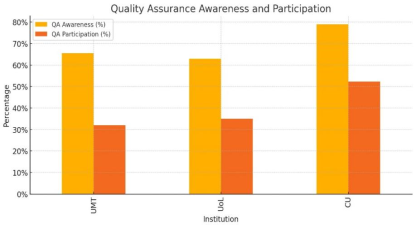
Survey responses revealed that a moderate proportion of stakeholders are aware of existing QA frameworks at their respective institutions. Specifically, 72.1% of students and 65.5% of faculty reported general awareness of institutional QA policies. However, only 38.6% had actively participated in QA-related activities such as course evaluations, curriculum reviews, or internal audits. This pattern was particularly evident at UoL and UMT, where quality assurance mechanisms existed but were underutilized by faculty and students. In contrast, CU demonstrated comparatively higher levels of stakeholder engagement, with 52.3% of its respondents’ indicating participation in QA meetings or feedback forums.
Figure 1. Quality Assurance & Participation.
Qualitative interview data supported these findings. Respondents from UoL noted that QA activities were “formalized on paper but lacked regular implementation.” A QA Officer at UMT remarked,
“We are trying to embed QA into the academic culture, but uptake is still low.” These findings align with Stakeholder Theory
| [9] | Freeman, R. E. (1984). Strategic management: A stakeholder approach. Pitman. |
[9]
, which suggests that institutional performance improves when multiple stakeholders are included in strategic processes. The limited involvement of students and lecturers in QA initiatives may indicate a lack of stakeholder ownership, which undermines the goals of continuous quality improvement
| [13] | Materu, P. (2007). Higher education quality assurance in Sub-Saharan Africa: Status, challenges, opportunities, and promising practices (World Bank Working Paper No. 124). The World Bank. |
| [20] | Tamrat, W. (2017). Quality assurance in Ethiopian private higher education: The interplay of policy, capacity and practice. Quality in Higher Education, 23(3), 212–226.
https://doi.org/10.1080/13538322.2017.1407403 |
[13, 20]
.
4.2. Faculty Development and Instructional Quality
Results on faculty development revealed significant institutional gaps. While 81.9% of academic staff acknowledged the existence of peer review or evaluation procedures, only 31.6% had received written feedback on their teaching performance within the past academic year. Furthermore, 69.4% of faculty surveyed reported they had not participated in any formal Continuous Professional Development (CPD) training on pedagogical methods, research skills, or digital learning tools during the same period. This suggests a disconnect between policy and practice in relation to faculty development.
Thematic analysis from interviews revealed that resource limitations, high teaching loads, and limited institutional funding contributed to weak faculty development structures. At UoL, a faculty member commented:
“You are expected to teach, advise students, and write research papers, but there’s no support or time allocated for development.” These findings support the Resource-Based View
, which posits that internal capabilities, including human capital, determine the competitive advantage of academic institutions. The lack of investment in faculty undermines not only teaching effectiveness but also long-term institutional credibility.
Despite these challenges, Central University exhibited comparatively stronger faculty development initiatives. The institution had initiated quarterly teaching clinics and annual curriculum review workshops. Faculty members at CU noted access to small research grants and conference sponsorships, which were largely absent at UMT and UoL. These institutional differences reinforce the principle of Total Quality Management
| [6] | Deming, W. E. (1986). Out of the crisis. MIT Press. |
[6]
, where continuous improvement is dependent on empowering and training employees, in this case, academic staff.
4.3. Institutional Outcomes and Perceived Impact
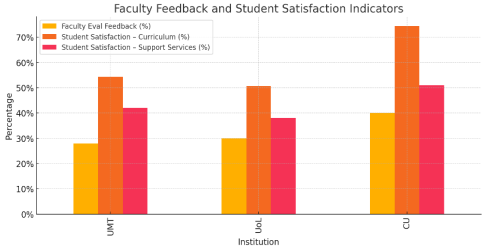
When examining outcomes, 68.2% of student respondents across all institutions expressed satisfaction with curriculum content, while only 43.7% reported satisfaction with academic support services such as advising, tutoring, and library access. Notably, CU again led in performance, with 74.5% of its students affirming that their academic programmes were “relevant to the job market.” In contrast, only 54.3% and 50.7% of students at UMT and UoL respectively reported similar perceptions.
These findings point to variable implementation of QA frameworks and unequal outcomes across institutions. Institutions with structured QA processes, such as CU, demonstrated stronger stakeholder satisfaction and alignment with employer needs. As such, these results affirm the findings of Ewell (2010), who argues that robust QA systems contribute to both institutional reputation and graduate employability. However, across all institutions, systematic tracking of graduate performance, employer feedback, and longitudinal learning outcomes was largely absent. This gap impairs the ability of QA units to assess the real-world impact of academic programmes and limits feedback loops that could drive curricular reform.
In terms of institutional credibility, interviewees indicated that QA is not yet fully integrated into strategic planning. A TEC official noted:
“Most private institutions treat QA as a requirement for licensing, not as a mechanism for quality enhancement.” This compliance-oriented culture contradicts global best practices, which emphasize proactive quality assurance rooted in institutional vision and mission alignment
| [7] | ENQA – European Association for Quality Assurance in Higher Education. (2015). Standards and guidelines for quality assurance in the European Higher Education Area (ESG).
https://enqa.eu/wp-content/uploads/2015/11/ESG_2015.pdf |
| [16] | Saint, W. (2004). Higher education in Ethiopia: The vision and its challenges. JHEA/RESA, 2(3), 83–113. |
[7, 16]
.
Figure 2. Faculty Feedback & Students Satification.
5. Conclusion and Recommendations
5.1. Conclusion
This study has examined the implementation and effectiveness of Academic Quality Assurance (AQA) practices across three private higher education institutions (HEIs) in Sierra Leone, University of Management and Technology (UMT), University of Lunsar (UoL), and Central University (CU). Using a mixed-methods comparative case study approach, the research revealed that while all three institutions have made strides in developing formal QA structures, significant disparities exist in stakeholder engagement, faculty development, and outcome tracking.
CU demonstrated comparatively higher institutional performance, driven by a more structured quality assurance unit, stakeholder participation, and investment in faculty support mechanisms. Conversely, UMT and UoL exhibited limited operationalization of QA frameworks, with minimal stakeholder involvement and inconsistent faculty evaluation processes. Across all institutions, there was limited evidence of systematic monitoring, longitudinal data use, or mechanisms to track graduate performance and employer satisfaction. These findings suggest that while private HEIs in Sierra Leone are aware of quality assurance imperatives, their current approaches are largely compliance-oriented rather than strategically embedded within institutional cultures.
This research reinforces theoretical insights from Total Quality Management (TQM), Stakeholder Theory, and the Resource-Based View (RBV), illustrating that quality assurance effectiveness depends not only on policy frameworks but also on internal resource mobilization, leadership commitment, and inclusive governance. Strengthening AQA across Sierra Leone’s growing private university sector requires a shift from policy compliance to evidence-based, participatory, and improvement-driven practices.
5.2. Recommendations
1) Strengthen Internal QA Units
Each institution should prioritize the operational capacity of its Quality Assurance Unit by recruiting trained staff, allocating dedicated budgets, and institutionalizing continuous self-assessment processes. Periodic internal audits, supported by peer reviews and student feedback loops, should inform strategic decisions.
2) Promote Stakeholder Involvement
HEIs must broaden stakeholder participation in QA processes. Students, faculty, alumni, and employers should be systematically involved in curriculum reviews, programme evaluations, and feedback mechanisms. Creating formal platforms, such as QA forums and student-led panels, can foster a culture of transparency and inclusiveness.
3) Invest in Faculty Development
Institutions should embed structured faculty development programmes, including regular pedagogical training, research mentorship, and performance-based incentives. Opportunities for continuous professional development (CPD) and participation in academic conferences must be expanded to improve instructional quality and retention.
4) Adopt Data-Driven QA Models
QA processes should be supported by robust data collection and analytics systems. Institutions need to implement learning management systems (LMS), alumni tracking tools, and employer surveys to monitor graduate outcomes, course effectiveness, and skill-market alignment. This will help in aligning academic offerings with national development goals.
5) Enhance TEC’s Oversight and Support Role
The Tertiary Education Commission (TEC) should provide additional capacity-building support to private institutions through technical training, shared QA tools, and performance benchmarks. Regulatory oversight must shift from one-time accreditation to ongoing institutional mentoring, quality audits, and public reporting of QA performance indicators.
6) Encourage South–South Collaboration
Finally, Sierra Leonean private universities could benefit from regional partnerships with peer institutions across West Africa. Joint research projects, benchmarking exchanges, and inter-university QA capacity-building initiatives can accelerate the development of a quality-driven academic culture in the subregion.
Abbreviations
AQA | Academic Quality Assurance |
CHE | Council on Higher Education |
CPD | Continuous Professional Development |
CU | Central University |
ENQA | European Association for Quality Assurance in Higher Education |
ESG | European Standards and Guidelines |
HEI(s) | Higher Education Institution(s) |
LMS | Learning Management System |
QA | Quality Assurance |
RBV | Resource-Based View |
TEC | Tertiary Education Commission (Sierra Leone) |
TQM | Total Quality Management |
UoL | University of Lunsar |
UMT | University of Management and Technology |
WASC | Western Association of Schools and Colleges |
Author Contributions
Gibrill Amid Sesay is the sole author. The author read and approved the final manuscript.
Conflicts of Interest
The author declares that there is no conflicts of interest in this work.
References
| [1] |
Altbach, P. G., Reisberg, L., & Rumbley, L. E. (2009). Trends in global higher education: Tracking an academic revolution. UNESCO.
|
| [2] |
Barney, J. B. (1991). Firm resources and sustained competitive advantage. Journal of Management, 17(1), 99–120.
https://doi.org/10.1177/014920639101700108
|
| [3] |
Braun, V., & Clarke, V. (2006). Using thematic analysis in psychology. Qualitative Research in Psychology, 3(2), 77–101.
https://doi.org/10.1191/1478088706qp063oa
|
| [4] |
Creswell, J. W., & Plano Clark, V. L. (2018). Designing and conducting mixed methods research (3rd ed.). Sage.
|
| [5] |
Dembélé, M., & Miaro-II, B. N. (2015). Improving quality assurance in African higher education. Association of African Universities (AAU).
|
| [6] |
Deming, W. E. (1986). Out of the crisis. MIT Press.
|
| [7] |
ENQA – European Association for Quality Assurance in Higher Education. (2015). Standards and guidelines for quality assurance in the European Higher Education Area (ESG).
https://enqa.eu/wp-content/uploads/2015/11/ESG_2015.pdf
|
| [8] |
Ewell, P. T. (2010). Twenty years of quality assurance in higher education: What’s happened and what’s next? Quality in Higher Education, 16(2), 135–145.
https://doi.org/10.1080/13538322.2010.485719
|
| [9] |
Freeman, R. E. (1984). Strategic management: A stakeholder approach. Pitman.
|
| [10] |
Harvey, L., & Green, D. (1993). Defining quality. Assessment & Evaluation in Higher Education, 18(1), 9–34.
https://doi.org/10.1080/0260293930180102
|
| [11] |
Harvey, L., & Newton, J. (2004). Transforming quality evaluation: Moving on. In D. Westerheijden, B. Stensaker, & M. Rosa (Eds.), Quality assurance in higher education: Trends in regulation, translation and transformation (pp. 225–245). Springer.
|
| [12] |
Kamara, A. (2016). Higher education governance and quality assurance in Sierra Leone. West African Journal of Education, 9(2), 91–108.
|
| [13] |
Materu, P. (2007). Higher education quality assurance in Sub-Saharan Africa: Status, challenges, opportunities, and promising practices (World Bank Working Paper No. 124). The World Bank.
|
| [14] |
Mishra, S. (2006). Quality assurance in higher education: An introduction. National Assessment and Accreditation Council (NAAC), Bangalore.
|
| [15] |
Nunnally, J. C., & Bernstein, I. H. (1994). Psychometric theory (3rd ed.). McGraw-Hill.
|
| [16] |
Saint, W. (2004). Higher education in Ethiopia: The vision and its challenges. JHEA/RESA, 2(3), 83–113.
|
| [17] |
Scott, W. R. (2001). Institutions and organizations (2nd ed.). Sage Publications.
|
| [18] |
Sesay, G. A. (2015). Faculty perceptions of quality assurance practices in private universities in Sierra Leone. Sierra Leone Education Review, 3(1), 67–82.
|
| [19] |
Srikanthan, G., & Dalrymple, J. F. (2003). Developing a holistic model for quality in higher education. Quality in Higher Education, 9(3), 215–224.
https://doi.org/10.1080/1353832032000151071
|
| [20] |
Tamrat, W. (2017). Quality assurance in Ethiopian private higher education: The interplay of policy, capacity and practice. Quality in Higher Education, 23(3), 212–226.
https://doi.org/10.1080/13538322.2017.1407403
|
| [21] |
Van Vught, F. A., & Westerheijden, D. F. (1994). Towards a general model of quality assessment in higher education. Higher Education, 28(3), 355–371.
https://doi.org/10.1007/BF01383763
|
| [22] |
Westerheijden, D. F., Stensaker, B., & Rosa, M. J. (2010). The first decade of working on the European Higher Education Area. EUA Publications.
|
Cite This Article
-
APA Style
Sesay, G. A. (2026). Evaluating Academic Quality Assurance in Private Higher Education Institutions in Sierra Leone: A Comparative Study of UMT, UoL, and CU. Innovation Education, 1(1), 8-15. https://doi.org/10.11648/j.iedu.20260101.12
 Copy
|
Copy
|
 Download
ACS Style
Sesay, G. A. Evaluating Academic Quality Assurance in Private Higher Education Institutions in Sierra Leone: A Comparative Study of UMT, UoL, and CU. Innov. Educ. 2026, 1(1), 8-15. doi: 10.11648/j.iedu.20260101.12
Copy
|
Download
AMA Style
Sesay GA. Evaluating Academic Quality Assurance in Private Higher Education Institutions in Sierra Leone: A Comparative Study of UMT, UoL, and CU. Innov Educ. 2026;1(1):8-15. doi: 10.11648/j.iedu.20260101.12
Copy
|
Download
-
@article{10.11648/j.iedu.20260101.12,
  author = {Gibrill Amid Sesay},
  title = {Evaluating Academic Quality Assurance in Private Higher Education Institutions in Sierra Leone: A Comparative Study of UMT, UoL, and CU},
  journal = {Innovation Education},
  volume = {1},
  number = {1},
  pages = {8-15},
  doi = {10.11648/j.iedu.20260101.12},
  url = {https://doi.org/10.11648/j.iedu.20260101.12},
  eprint = {https://article.sciencepublishinggroup.com/pdf/10.11648.j.iedu.20260101.12},
  abstract = {This study examines the role and effectiveness of Academic Quality Assurance (AQA) mechanisms in three private higher education institutions in Sierra Leone: the University of Management and Technology (UMT), the University of Lunsar (UoL), and Central University (CU). Adopting a mixed-methods comparative case study design, the research draws on Total Quality Management, Stakeholder Theory, and Institutional Theory to analyze how quality assurance is structured, implemented, and experienced within these institutions. Quantitative data were collected through structured questionnaires administered to students and academic staff, while qualitative insights were obtained from semi-structured interviews with administrators, quality assurance officers, and regulatory stakeholders, complemented by institutional document analysis. The findings indicate that although all three universities have established formal AQA frameworks in line with national accreditation requirements, their effectiveness varies considerably. Common challenges include limited financial and human resources, weak data-driven monitoring systems, inadequate faculty development mechanisms, and low levels of stakeholder participation. Comparative results show that Central University demonstrates relatively stronger implementation of quality assurance practices, particularly in stakeholder engagement and faculty support, whereas UMT and UoL exhibit more compliance-oriented approaches. The study contributes empirical evidence to the limited literature on academic quality assurance in private higher education within post-conflict contexts and provides practical insights for strengthening institutional quality assurance systems in Sierra Leone.},
 year = {2026}
}
Copy
|
Download
-
TY  - JOUR
T1  - Evaluating Academic Quality Assurance in Private Higher Education Institutions in Sierra Leone: A Comparative Study of UMT, UoL, and CU
AU  - Gibrill Amid Sesay
Y1  - 2026/02/06
PY  - 2026
N1  - https://doi.org/10.11648/j.iedu.20260101.12
DO  - 10.11648/j.iedu.20260101.12
T2  - Innovation Education
JF  - Innovation Education
JO  - Innovation Education
SP  - 8
EP  - 15
PB  - Science Publishing Group
UR  - https://doi.org/10.11648/j.iedu.20260101.12
AB  - This study examines the role and effectiveness of Academic Quality Assurance (AQA) mechanisms in three private higher education institutions in Sierra Leone: the University of Management and Technology (UMT), the University of Lunsar (UoL), and Central University (CU). Adopting a mixed-methods comparative case study design, the research draws on Total Quality Management, Stakeholder Theory, and Institutional Theory to analyze how quality assurance is structured, implemented, and experienced within these institutions. Quantitative data were collected through structured questionnaires administered to students and academic staff, while qualitative insights were obtained from semi-structured interviews with administrators, quality assurance officers, and regulatory stakeholders, complemented by institutional document analysis. The findings indicate that although all three universities have established formal AQA frameworks in line with national accreditation requirements, their effectiveness varies considerably. Common challenges include limited financial and human resources, weak data-driven monitoring systems, inadequate faculty development mechanisms, and low levels of stakeholder participation. Comparative results show that Central University demonstrates relatively stronger implementation of quality assurance practices, particularly in stakeholder engagement and faculty support, whereas UMT and UoL exhibit more compliance-oriented approaches. The study contributes empirical evidence to the limited literature on academic quality assurance in private higher education within post-conflict contexts and provides practical insights for strengthening institutional quality assurance systems in Sierra Leone.
VL  - 1
IS  - 1
ER  -
Copy
|
Download





 Share This Article
 Twitter
 Linked In
 Facebook