Abstract
The continuously increasing demand for higher data transmission rates in modern telecommunication systems is pushing existing optical filtering and dispersion management technologies to their fundamental limits. Among these technologies, fiber Bragg gratings (FBGs) have emerged as key components due to their compact size, wavelength selectivity, and compatibility with optical fiber infrastructures. However, the performance of conventional FBGs is often constrained by intrinsic limitations such as group delay ripples, limited bandwidth control, and non-ideal spectral responses, which become increasingly critical at high data rates. The present work focuses on the mathematical modeling and optimization of phase masks to improve the performance of fiber Bragg gratings. The first stage of this study is devoted to enhancing the planar Bragg grating configuration. Subsequently, a comprehensive analysis is carried out to identify and evaluate the parameters that govern the optical behavior of phase masks and, by extension, the resulting fiber Bragg gratings. Four key parameters are systematically investigated in this study. The first parameter is the grating length L, which plays a crucial role in determining the reflectivity, bandwidth, and spectral selectivity of the grating. The second parameter is the refractive index modulation Δn between the exposed and unexposed regions of the fiber core, which directly influences the coupling strength and overall efficiency of the grating. The third set of parameters concerns the group delay and bandwidth characteristics of chirped fiber Bragg gratings, which are particularly important for dispersion compensation and signal integrity in high-speed optical communication systems. Finally, the effect of various apodization functions is examined, as apodization is known to significantly reduce sidelobes and improve spectral smoothness. A detailed and systematic investigation of these parameters demonstrates that appropriate optimization can lead to a substantial reduction, and in some cases complete suppression, of group delay ripples. The elimination of these oscillations is a critical requirement for achieving high-fidelity signal transmission and minimizing distortion in optical communication links. The results show that the performance of phase masks and the resulting fiber gratings depends on the combined effects of structural and optical parameters. Optimizing these parameters together is essential to obtain high diffraction efficiency, good spectral quality, and stable grating inscription. The proposed approach provides practical design guidelines for developing high-performance grating-based components for next-generation optical communication systems.
Keywords
Optical Fiber, Chromatic Dispersion, Fiber Bragg Grating, Transfer, Apodization
1. Introduction
Distributed optical gratings in fibers are key elements for wavelength selection in telecommunication networks.
| [1] | Kashyap, R. Fiber Bragg Gratings, 2nd Ed.; Academic Press: London, 2010. Comprehensive treatise on FBG fundamentals, fabrication, theory, and applications. |
| [2] | Daud, S.; Ali, J. Fibre Bragg Grating and No Core Fibre Sensors; SpringerBriefs in Physics; Springer: Singapore, 2018. Introduction to FBG design and sensor applications. https://doi.org/10.1007/978-981-10-8598-9 |
[1, 2]
. They enable multiple wavelengths to propagate simultaneously within a single optical fiber, a key feature for wavelength-division multiplexing (WDM) systems, where different channels travel together before being separated to recover the original signals.
| [3] | Cusano, A.; Cutolo, A.; Albert, J. (Eds.). Fiber Bragg Grating Sensors: Recent Advancements, Industrial Applications and Market Exploitation; Bentham Science Publishers: Sharjah, 2011. Overview of fabrication methods and commercial advances. https://doi.org/10.2174/97816080534331110101 |
| [4] | Ghatak, A. K.; Thyagarajan, K. An Introduction to Fiber Optics; Cambridge University Press: Cambridge, 1998. Fundamental textbook covering optical fiber theory and gratings. |
[3, 4]
The performance of FBGs strongly depends on the quality and precision of the grating structure, which is directly influenced by the phase mask fabrication process used to inscribe the grating into the fiber core.
| [5] | Bures, J. Optique guidée. Fibres optiques et composants passifs tout fibre; Presses Internationales Polytechnique: Montréal, 2009. Detailed coverage of guided optics including Bragg structures. |
[5]
The main goal of this study is to improve the optical behavior of phase masks and to identify the parameters that control grating performance through a systematic modeling and optimization approach. By jointly analyzing grating length, refractive index modulation, chirp, and apodization, this work provides quantitative design guidelines to reduce spectral ripples and improve bandwidth and group delay performance.
| [6] | Meltz, G.; Ouellette, F. (Eds.). Optical Fiber Sensors: Advanced Techniques and Applications; SPIE Press: Bellingham, WA, 2003. In-depth treatments of FBG sensor technology. https://doi.org/10.1117/3.521867 |
| [7] | Senior, J. M.; Jamro, M. Y. Optical Fiber Communications: Principles and Practice, 3rd Ed.; Pearson: Harlow, 2009. Classic optical fiber communications textbook with FBG context. |
[6, 7]
A systematic analysis of these factors allows for the improvement of phase mask performance and the definition of precise fabrication requirements.
| [8] | Agrawal, G. P. Fiber-Optic Communication Systems, 4th Ed.; Wiley: Hoboken, NJ, 2010. Authoritative resource on fiber communications including filters and gratings.
https://doi.org/10.1002/9780470918524 |
[8]
This work thus bridges the gap between theoretical design and practical implementation, providing guidelines for the development of high-performance and reliable fiber Bragg gratings. The insights gained contribute to advancing optical technologies for next-generation high-speed telecommunication systems.
| [9] | Snyder, A. W.; Love, J. Optical Waveguide Theory; Chapman and Hall: London, 1983. Fundamental theory of guided waves relevant to FBG modal analysis. |
| [10] | Ghatak, A. K.; Thyagarajan, K. Introduction to Fiber Optics; Cambridge University Press: Cambridge, 1998. Foundational theory on fiber modes and gratings. |
[9, 10]
Although fiber Bragg gratings and Fourier optics have been extensively investigated in the literature, most previous works focus either on grating performance inside the fiber or on qualitative descriptions of phase mask behavior. In contrast, the novelty of this work lies in a systematic and quantitative optimization of phase mask parameters using a Fourier optics framework, with the explicit objective of minimizing zeroth-order diffraction and defining fabrication tolerances suitable for telecommunication-grade FBGs.
This study establishes explicit relationships between grating depth, duty cycle, and diffraction efficiency, and provides quantitative tolerance limits required to achieve less than 2% zeroth-order power while maintaining high first-order diffraction efficiency. These results offer practical design guidelines that directly link theoretical modeling to phase mask fabrication constraints.
2. Mathematical Modeling Phase masks
The aim of this work is to determine the optimal parameter values needed to produce efficient phase masks.
| [11] | Marcuse, D. Theory of Dielectric Optical Waveguides, 2nd Ed.; Academic Press: San Diego, 1991. Mathematical foundations for waveguide and grating design. |
[11]
. These parameters are crucial for determining the final performance of fiber Bragg gratings, particularly in terms of reflectivity, bandwidth, and suppression of spectral ripples. The parameters considered in this study include the groove depth
, the grating period
, and the duty cycle
, defined as the ratio of line width to grating period
. These characteristics directly influence the mask’s ability to produce precise and stable Bragg gratings. Since this work is focused on telecommunication applications, the target wavelength for the Bragg grating inscription is set at
, corresponding to the optimal transmission window of standard optical fibers.
| [13] | Senior, J. M. Optical Fiber Communications: Principles and Practice, 3rd Ed.; Pearson: Harlow, 2009. Detailed system-level view of fiber components including filters. |
[13]
The Bragg condition provides a fundamental relationship between the wavelength to be reflected and the grating period. This relationship serves as the theoretical foundation for designing phase masks, allowing precise calculation of the grating dimensions required to achieve the desired optical performance.
Where:
: the effective refractive index of the optical fiber. It represents the average refractive index “seen” by the fundamental mode propagating in the fiber. This parameter directly determines the Bragg wavelength and the propagation characteristics of optical signals.
: the Bragg grating period. It is the distance between two successive identical structures in the grating or phase mask pattern. The period is directly related to the reflection wavelength through the Bragg condition.
3. Materials and Methods
Designing a Phase masks requires selecting materials with a controlled refractive index between the core and cladding regions.
| [15] | Kashyap, R. Photonic Devices; Applied Optics and Optical Engineering Series; Academic Press: London, 2012. Broader context of photonic devices including grating fabrication. |
[15]
To achieve this, we will implement the mathematical modeling of the fiber and then simulate the results in MATLAB.
3.1. Modeling the Phase Masks
If the wavelength λ is about four times the thickness of a single grating layer, the reflections from each layer add together. This constructive interference makes the grating act like a mirror, reflecting light efficiently at that wavelength.
This condition for constructive interference can therefore be expressed as:
Where:
: the effective refractive index of the two media forming the layer. It represents the average refractive index experienced by light propagating through the combination of the two materials. This parameter is crucial for determining the optical thickness and the conditions for constructive interference in the grating.
: the physical thickness of each layer. It corresponds to the actual distance traveled by light within each material and directly contributes to the optical thickness
These two parameters are essential for correctly designing a Bragg grating and ensuring that light is reflected constructively at the desired wavelength.
So,
with
we thus obtain the Bragg wavelength.
An ideal binary phase mask model is adopted in this work as a first-order theoretical approximation. This choice allows the fundamental influence of grating depth and duty cycle on diffraction efficiency to be isolated without the additional complexity introduced by fabrication imperfections.
Effects such as non-vertical etching, edge roughness, depth non-uniformity, and engraving errors are therefore not included in the present model. The objective of this study is to establish baseline design rules and quantitative tolerance limits, which constitute a necessary preliminary step before incorporating real fabrication effects. These non-ideal effects will be addressed in future work.
3.2. Condition of Modeling the Phase Masks
An equivalent derivation of this condition can be obtained by considering a grating with period , illuminated by light of vacuum wavelength , propagating in a medium of refractive index , and diffracted at the Bragg order . In optical fibers, light propagation is essentially collinear with the grating axis, which results in backward diffraction corresponding to reflected waves.
We then have:
and
By substituting these values into the general equation:
we obtain:
This also gives the Bragg condition for .
For a target Bragg wavelength of propagating in an optical fiber with an effective refractive index of , the corresponding grating period in the fiber is calculated to be . Consequently, the phase mask must be designed with a period of to satisfy the Bragg condition.
To analyze the optical behavior of the phase mask, a Fourier optics approach is employed to model the interaction of the mask with normally incident ultraviolet radiation at a wavelength of (). Within this framework, the amplitude transmission function of an ideal binary phase grating, denoted by , is defined as follows:
(9)
With:
(11)
The light intensity for each diffraction order can then be obtained by computing the squared magnitude of and
The application of the Fourier transform:
(12)
(13)
This framework makes it possible to quantify how light is distributed among different diffraction orders, explicitly accounting for the effects of grating depth and the proportion of line width to the grating period.
The numerical simulations were performed using a Fourier optics approach implemented in MATLAB. All relevant simulation parameters are summarized in
Table 1 to ensure reproducibility of the results.
Table 1.
Simulation parameters used in this study. Simulation parameters used in this study. Simulation parameters used in this study. Parameter | Symbol | Value |
UV laser wavelength | | |
Target Bragg wavelength | | |
Effective refractive index | | 1.46 |
Fiber grating period | | |
Phase mask period | | |
Grating depth range | | |
Duty cycle range | | |
Number of sampling points | | |
Spatial resolution | | |
Diffraction orders considered | | |
4. Results
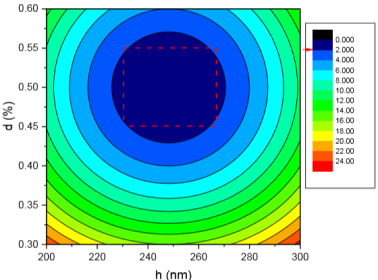
Figure 1 shows that the zeroth-order light power is lowest when the grating depth
is
. This corresponds to the wavelength of the laser used. For a different wavelength, the minimum zeroth-order power would occur at a different grating depth.
The figure further demonstrates the influence of the duty cycle on zeroth-order diffraction. The minimum zeroth-order power occurs at , indicating that the grating line widths are equal to the spacing between adjacent lines. Deviations from the optimal grating depth or duty cycle result in a marked increase in zeroth-order light intensity.
Figure 1. Zeroth-order diffraction efficiency (%) as a function of the grating depth h (nm) and the duty cycle d. The minimum zeroth-order power is obtained for h = 248 nm and d = 0.5.Zeroth-order diffraction efficiency (%) as a function of the grating depth h (nm) and the duty cycle d. The minimum zeroth-order power is obtained for h = 248 nm and d = 0.5.
The grating depth was set at and the line-width-to-period ratio at , with vertical etch profiles. These conditions reduce the zeroth-order power to below 2%.
Ray-tracing simulations were performed for single-core and dual-core fibers. The guided power fraction and ray trajectories were analyzed as a function of launch angle.
5. Discussion
The results demonstrate that grating depth and duty cycle are the dominant parameters governing diffraction efficiency in binary phase masks.
| [1] | Kashyap, R. Fiber Bragg Gratings, 2nd Ed.; Academic Press: London, 2010. Comprehensive treatise on FBG fundamentals, fabrication, theory, and applications. |
| [2] | Daud, S.; Ali, J. Fibre Bragg Grating and No Core Fibre Sensors; SpringerBriefs in Physics; Springer: Singapore, 2018. Introduction to FBG design and sensor applications. https://doi.org/10.1007/978-981-10-8598-9 |
[1, 2]
. The minimum in zeroth-order diffraction observed at h = 248 nm corresponds to a π phase shift between the exposed and unexposed regions, leading to destructive interference in the zeroth order.
| [5] | Bures, J. Optique guidée. Fibres optiques et composants passifs tout fibre; Presses Internationales Polytechnique: Montréal, 2009. Detailed coverage of guided optics including Bragg structures. |
| [6] | Meltz, G.; Ouellette, F. (Eds.). Optical Fiber Sensors: Advanced Techniques and Applications; SPIE Press: Bellingham, WA, 2003. In-depth treatments of FBG sensor technology. https://doi.org/10.1117/3.521867 |
[5, 6]
The optimal duty cycle d = 0.5 ensures symmetry between the grating lines and spaces, maximizing constructive interference in the first diffraction orders.
| [7] | Senior, J. M.; Jamro, M. Y. Optical Fiber Communications: Principles and Practice, 3rd Ed.; Pearson: Harlow, 2009. Classic optical fiber communications textbook with FBG context. |
| [8] | Agrawal, G. P. Fiber-Optic Communication Systems, 4th Ed.; Wiley: Hoboken, NJ, 2010. Authoritative resource on fiber communications including filters and gratings.
https://doi.org/10.1002/9780470918524 |
[7, 8]
The impossibility of simultaneously suppressing the zeroth order and higher diffraction orders reflects a fundamental trade-off inherent to binary phase masks. These findings highlight the importance of precise fabrication tolerances to achieve high-performance FBG inscription.
| [11] | Marcuse, D. Theory of Dielectric Optical Waveguides, 2nd Ed.; Academic Press: San Diego, 1991. Mathematical foundations for waveguide and grating design. |
[11]
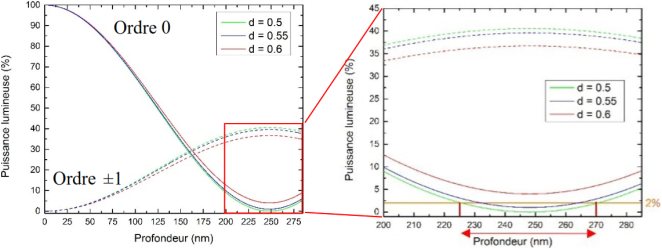
Figure 2 illustrates the distribution of light power in the zeroth order as a function of
and
.
This demonstrates that precise control of these parameters is essential to achieve minimal power in the zeroth order, which is critical for high-efficiency diffraction into the
orders.
| [13] | Senior, J. M. Optical Fiber Communications: Principles and Practice, 3rd Ed.; Pearson: Harlow, 2009. Detailed system-level view of fiber components including filters. |
[13]
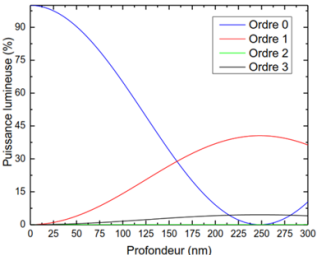
further confirms that under optimal conditions, nearly 80% of the incident light is transferred into the first-order diffractions, while the remaining energy is distributed among higher orders. This indicates that it is impossible to simultaneously suppress both the zeroth order and higher-order diffractions, emphasizing the need for precise grating design.
The Fourier optics analysis and calculations of
and
(Equations (
12) and (
13)) provide quantitative insight into how grating depth and duty cycle influence light redistribution. To maintain the zeroth-order power below 2%, fabrication tolerances should be
and
, corresponding to a
variation in line widths. Maintaining vertical etch profiles is also crucial to achieve these performance targets.
In addition to mask design, light propagation in optical fibers plays a significant role in FBG performance. Single-core fibers provide straightforward guiding, while dual-core fibers can expand the guiding region and enable core-to-core interactions.
| [10] | Ghatak, A. K.; Thyagarajan, K. Introduction to Fiber Optics; Cambridge University Press: Cambridge, 1998. Foundational theory on fiber modes and gratings. |
| [11] | Marcuse, D. Theory of Dielectric Optical Waveguides, 2nd Ed.; Academic Press: San Diego, 1991. Mathematical foundations for waveguide and grating design. |
[10, 11]
Using simplified ray-tracing simulations, the guided power fraction and ray trajectories were analyzed as a function of launch angle, providing insight into the efficiency and modal distribution of light within different fiber geometries.
Finally, the Bragg condition analysis demonstrates that for a target wavelength of 1550 nm in a fiber with an effective refractive index
, the grating period in the fiber should be
, corresponding to a phase mask period of
. These calculations link theoretical design to practical implementation, ensuring that fabricated FBGs achieve the desired reflection wavelength, bandwidth, and suppression of spectral ripples.
| [15] | Kashyap, R. Photonic Devices; Applied Optics and Optical Engineering Series; Academic Press: London, 2012. Broader context of photonic devices including grating fabrication. |
[15]
Figure 3 shows how optical power is distributed across different diffraction orders as the grating depth
changes. When
, about
of the incident light is directed into the ±1 diffraction orders, achieving maximum first-order efficiency. The remaining 20% spreads into higher orders, while the zeroth-order power is minimized.
| [8] | Agrawal, G. P. Fiber-Optic Communication Systems, 4th Ed.; Wiley: Hoboken, NJ, 2010. Authoritative resource on fiber communications including filters and gratings.
https://doi.org/10.1002/9780470918524 |
[8]
This figure emphasizes two critical observations:
1) Trade-off between zeroth-order suppression and higher-order diffraction: It is impossible to simultaneously minimize the zeroth order and completely suppress higher orders. This underscores the importance of precise control over grating depth and duty cycle during phase mask fabrication.
2) Sensitivity to fabrication tolerances: Small deviations from the optimal grating depth cause a rapid increase in zeroth-order power and a redistribution of light into higher orders, demonstrating the strict tolerances required to achieve high-performance FBGs.
| [11] | Marcuse, D. Theory of Dielectric Optical Waveguides, 2nd Ed.; Academic Press: San Diego, 1991. Mathematical foundations for waveguide and grating design. |
| [12] | Okamoto, K. Fundamentals of Optical Waveguides, 2nd Ed.; Academic Press: Burlington, MA, 2006. Widely used graduate-level text on fiber and waveguide optics.
https://doi.org/10.1016/B978-0-12-525096-2.X5000-1 |
[11, 12]
Together with
Figures 1 and 2,
Figure 3 provides a comprehensive understanding of how phase mask parameters affect light propagation and diffraction efficiency, offering quantitative guidance for designing masks that yield high-quality fiber Bragg gratings for telecommunication applications.
| [13] | Senior, J. M. Optical Fiber Communications: Principles and Practice, 3rd Ed.; Pearson: Harlow, 2009. Detailed system-level view of fiber components including filters. |
| [14] | Hecht, J. Understanding Fiber Optics, 5th Ed.; Pearson: Boston, 2015. Accessible introduction with practical insights on fiber components. |
| [15] | Kashyap, R. Photonic Devices; Applied Optics and Optical Engineering Series; Academic Press: London, 2012. Broader context of photonic devices including grating fabrication. |
[13-15]
Overall, the study highlights the importance of optimizing both phase mask parameters and fiber launch conditions to achieve high-performance FBGs. The results provide clear guidelines for precise mask fabrication, effective diffraction management, and improved light guidance, enabling reliable implementation in next-generation high-speed optical communication systems.
| [1] | Kashyap, R. Fiber Bragg Gratings, 2nd Ed.; Academic Press: London, 2010. Comprehensive treatise on FBG fundamentals, fabrication, theory, and applications. |
| [2] | Daud, S.; Ali, J. Fibre Bragg Grating and No Core Fibre Sensors; SpringerBriefs in Physics; Springer: Singapore, 2018. Introduction to FBG design and sensor applications. https://doi.org/10.1007/978-981-10-8598-9 |
| [3] | Cusano, A.; Cutolo, A.; Albert, J. (Eds.). Fiber Bragg Grating Sensors: Recent Advancements, Industrial Applications and Market Exploitation; Bentham Science Publishers: Sharjah, 2011. Overview of fabrication methods and commercial advances. https://doi.org/10.2174/97816080534331110101 |
[1-3]
6. Conclusion
This study presents a comprehensive analysis of phase mask design and its impact on the performance of fiber Bragg gratings (FBGs) for telecommunication applications. By combining theoretical modeling, Fourier optics simulations, and parameter optimization, the work demonstrates the critical role of grating depth and line-width-to-period ratio in controlling diffraction efficiency and light distribution among diffraction orders.
The results indicate that the zeroth-order power reaches a minimum at and , conditions under which nearly of the incident light is efficiently transferred to the diffraction orders. Deviations from these optimal values lead to significant increases in zeroth-order power and redistribution of energy to higher orders, highlighting the strict fabrication tolerances required for high-performance FBGs. For practical implementation, the study identifies tolerances of to ensure efficient diffraction, combined with vertical etch profiles for reliable mask fabrication.
The Bragg condition calculation shows that a phase mask period of produces a fiber grating with a period for a reflection wavelength of 1550 nm, assuming an effective refractive index of. This directly links theoretical design to practical mask production, ensuring the grating achieves the desired wavelength, bandwidth, and spectral smoothness.
Overall, this work bridges the gap between phase mask design and FBG performance, providing clear guidelines for optimizing grating parameters and fabrication tolerances. The insights gained are directly applicable to the development of high-performance, reliable FBGs for next-generation high-speed optical communication systems and advanced photonic devices.
Abbreviations
FBG | Fiber Bragg Grating |
WDM | Wavelength-Division Multiplexing |
| Zeroth-order Light Intensity |
| Nth-order Light Intensity |
| Grating Period |
| Bragg Wavelength |
| Effective Refractive Index |
Conflicts of Interest
The authors state that they have no financial or personal connections that could have affected this work. The study received no funding or support from any commercial or external organization and was carried out independently. There are no competing interests related to the methods, results, or conclusions of this study.
References
| [1] |
Kashyap, R. Fiber Bragg Gratings, 2nd Ed.; Academic Press: London, 2010. Comprehensive treatise on FBG fundamentals, fabrication, theory, and applications.
|
| [2] |
Daud, S.; Ali, J. Fibre Bragg Grating and No Core Fibre Sensors; SpringerBriefs in Physics; Springer: Singapore, 2018. Introduction to FBG design and sensor applications.
https://doi.org/10.1007/978-981-10-8598-9
|
| [3] |
Cusano, A.; Cutolo, A.; Albert, J. (Eds.). Fiber Bragg Grating Sensors: Recent Advancements, Industrial Applications and Market Exploitation; Bentham Science Publishers: Sharjah, 2011. Overview of fabrication methods and commercial advances.
https://doi.org/10.2174/97816080534331110101
|
| [4] |
Ghatak, A. K.; Thyagarajan, K. An Introduction to Fiber Optics; Cambridge University Press: Cambridge, 1998. Fundamental textbook covering optical fiber theory and gratings.
|
| [5] |
Bures, J. Optique guidée. Fibres optiques et composants passifs tout fibre; Presses Internationales Polytechnique: Montréal, 2009. Detailed coverage of guided optics including Bragg structures.
|
| [6] |
Meltz, G.; Ouellette, F. (Eds.). Optical Fiber Sensors: Advanced Techniques and Applications; SPIE Press: Bellingham, WA, 2003. In-depth treatments of FBG sensor technology.
https://doi.org/10.1117/3.521867
|
| [7] |
Senior, J. M.; Jamro, M. Y. Optical Fiber Communications: Principles and Practice, 3rd Ed.; Pearson: Harlow, 2009. Classic optical fiber communications textbook with FBG context.
|
| [8] |
Agrawal, G. P. Fiber-Optic Communication Systems, 4th Ed.; Wiley: Hoboken, NJ, 2010. Authoritative resource on fiber communications including filters and gratings.
https://doi.org/10.1002/9780470918524
|
| [9] |
Snyder, A. W.; Love, J. Optical Waveguide Theory; Chapman and Hall: London, 1983. Fundamental theory of guided waves relevant to FBG modal analysis.
|
| [10] |
Ghatak, A. K.; Thyagarajan, K. Introduction to Fiber Optics; Cambridge University Press: Cambridge, 1998. Foundational theory on fiber modes and gratings.
|
| [11] |
Marcuse, D. Theory of Dielectric Optical Waveguides, 2nd Ed.; Academic Press: San Diego, 1991. Mathematical foundations for waveguide and grating design.
|
| [12] |
Okamoto, K. Fundamentals of Optical Waveguides, 2nd Ed.; Academic Press: Burlington, MA, 2006. Widely used graduate-level text on fiber and waveguide optics.
https://doi.org/10.1016/B978-0-12-525096-2.X5000-1
|
| [13] |
Senior, J. M. Optical Fiber Communications: Principles and Practice, 3rd Ed.; Pearson: Harlow, 2009. Detailed system-level view of fiber components including filters.
|
| [14] |
Hecht, J. Understanding Fiber Optics, 5th Ed.; Pearson: Boston, 2015. Accessible introduction with practical insights on fiber components.
|
| [15] |
Kashyap, R. Photonic Devices; Applied Optics and Optical Engineering Series; Academic Press: London, 2012. Broader context of photonic devices including grating fabrication.
|
Cite This Article
-
ACS Style
Erica, R. H. N.; Andriamanalina, A. N. Phase Mask Modeling for Improved Fiber Bragg Grating Efficiency in Optical Fibers. Am. J. Inf. Sci. Technol. 2026, 10(1), 8-14. doi: 10.11648/j.ajist.20261001.12
 Copy
|
Copy
|
 Download
-
@article{10.11648/j.ajist.20261001.12,
  author = {Randriana Heritiana Nambinina Erica and Ando Nirina Andriamanalina},
  title = {Phase Mask Modeling for Improved Fiber Bragg Grating Efficiency in Optical Fibers},
  journal = {American Journal of Information Science and Technology},
  volume = {10},
  number = {1},
  pages = {8-14},
  doi = {10.11648/j.ajist.20261001.12},
  url = {https://doi.org/10.11648/j.ajist.20261001.12},
  eprint = {https://article.sciencepublishinggroup.com/pdf/10.11648.j.ajist.20261001.12},
  abstract = {The continuously increasing demand for higher data transmission rates in modern telecommunication systems is pushing existing optical filtering and dispersion management technologies to their fundamental limits. Among these technologies, fiber Bragg gratings (FBGs) have emerged as key components due to their compact size, wavelength selectivity, and compatibility with optical fiber infrastructures. However, the performance of conventional FBGs is often constrained by intrinsic limitations such as group delay ripples, limited bandwidth control, and non-ideal spectral responses, which become increasingly critical at high data rates. The present work focuses on the mathematical modeling and optimization of phase masks to improve the performance of fiber Bragg gratings. The first stage of this study is devoted to enhancing the planar Bragg grating configuration. Subsequently, a comprehensive analysis is carried out to identify and evaluate the parameters that govern the optical behavior of phase masks and, by extension, the resulting fiber Bragg gratings. Four key parameters are systematically investigated in this study. The first parameter is the grating length L, which plays a crucial role in determining the reflectivity, bandwidth, and spectral selectivity of the grating. The second parameter is the refractive index modulation Δn between the exposed and unexposed regions of the fiber core, which directly influences the coupling strength and overall efficiency of the grating. The third set of parameters concerns the group delay and bandwidth characteristics of chirped fiber Bragg gratings, which are particularly important for dispersion compensation and signal integrity in high-speed optical communication systems. Finally, the effect of various apodization functions is examined, as apodization is known to significantly reduce sidelobes and improve spectral smoothness. A detailed and systematic investigation of these parameters demonstrates that appropriate optimization can lead to a substantial reduction, and in some cases complete suppression, of group delay ripples. The elimination of these oscillations is a critical requirement for achieving high-fidelity signal transmission and minimizing distortion in optical communication links. The results show that the performance of phase masks and the resulting fiber gratings depends on the combined effects of structural and optical parameters. Optimizing these parameters together is essential to obtain high diffraction efficiency, good spectral quality, and stable grating inscription. The proposed approach provides practical design guidelines for developing high-performance grating-based components for next-generation optical communication systems.},
 year = {2026}
}
Copy
|
Download
-
TY  - JOUR
T1  - Phase Mask Modeling for Improved Fiber Bragg Grating Efficiency in Optical Fibers
AU  - Randriana Heritiana Nambinina Erica
AU  - Ando Nirina Andriamanalina
Y1  - 2026/01/19
PY  - 2026
N1  - https://doi.org/10.11648/j.ajist.20261001.12
DO  - 10.11648/j.ajist.20261001.12
T2  - American Journal of Information Science and Technology
JF  - American Journal of Information Science and Technology
JO  - American Journal of Information Science and Technology
SP  - 8
EP  - 14
PB  - Science Publishing Group
SN  - 2640-0588
UR  - https://doi.org/10.11648/j.ajist.20261001.12
AB  - The continuously increasing demand for higher data transmission rates in modern telecommunication systems is pushing existing optical filtering and dispersion management technologies to their fundamental limits. Among these technologies, fiber Bragg gratings (FBGs) have emerged as key components due to their compact size, wavelength selectivity, and compatibility with optical fiber infrastructures. However, the performance of conventional FBGs is often constrained by intrinsic limitations such as group delay ripples, limited bandwidth control, and non-ideal spectral responses, which become increasingly critical at high data rates. The present work focuses on the mathematical modeling and optimization of phase masks to improve the performance of fiber Bragg gratings. The first stage of this study is devoted to enhancing the planar Bragg grating configuration. Subsequently, a comprehensive analysis is carried out to identify and evaluate the parameters that govern the optical behavior of phase masks and, by extension, the resulting fiber Bragg gratings. Four key parameters are systematically investigated in this study. The first parameter is the grating length L, which plays a crucial role in determining the reflectivity, bandwidth, and spectral selectivity of the grating. The second parameter is the refractive index modulation Δn between the exposed and unexposed regions of the fiber core, which directly influences the coupling strength and overall efficiency of the grating. The third set of parameters concerns the group delay and bandwidth characteristics of chirped fiber Bragg gratings, which are particularly important for dispersion compensation and signal integrity in high-speed optical communication systems. Finally, the effect of various apodization functions is examined, as apodization is known to significantly reduce sidelobes and improve spectral smoothness. A detailed and systematic investigation of these parameters demonstrates that appropriate optimization can lead to a substantial reduction, and in some cases complete suppression, of group delay ripples. The elimination of these oscillations is a critical requirement for achieving high-fidelity signal transmission and minimizing distortion in optical communication links. The results show that the performance of phase masks and the resulting fiber gratings depends on the combined effects of structural and optical parameters. Optimizing these parameters together is essential to obtain high diffraction efficiency, good spectral quality, and stable grating inscription. The proposed approach provides practical design guidelines for developing high-performance grating-based components for next-generation optical communication systems.
VL  - 10
IS  - 1
ER  -
Copy
|
Download






 Share This Article
 Twitter
 Linked In
 Facebook