
This research presents a comprehensive mineralogical characterization of the Ashashire gold deposit in western Ethiopia to inform processing strategies. We analyzed six representative core samples using fire assay with atomic absorption spectroscopy (AAS), inductively coupled plasma (ICP), and quantitative evaluation of minerals by scanning electron microscopy (QEMSCAN). The gold content varied from 1.47 g/t to 5.27 g/t, with a mean value of 2.54 g/t. The results indicate that gold primarily occurs as native gold and gold-telluride, closely associated with tellurium, and is predominantly occurs as free particles or in association with gangue minerals such as quartz and pyrite. Pyrite (2.1-6.73 wt%) is the dominant sulfide mineral, with only trace chalcopyrite detected. The gangue assemblage is dominated by quartz (10.3-42.3 wt%), ankerite-dolomite (9.1-27.6 wt.%), muscovite (8.0-22.6 wt%), chlorite (0.2-17.4 wt%), and albite (5.6-33.7 wt%). Gold grain size distribution reveals 19.2% coarse particles (>60 µm), 27.6% in the 20-40 µm range, and 3.8% very fine particles (<2 µm). The presence of tellurium and gold-tellurides indicates a refractory gold component requiring specialized processing. We recommend an integrated flowsheet that combines gravity separation, flotation, pressure oxidation, and cyanidation (CIL/CIP) to optimize gold recovery. These findings provide a foundation for developing efficient and sustainable processing strategies tailored to the deposit's unique characteristics.
| Published in | American Journal of Chemical Engineering (Volume 14, Issue 4) |
| DOI | 10.11648/j.ajche.20261404.15 |
| Page(s) | 127-137 |
| Creative Commons |
This is an Open Access article, distributed under the terms of the Creative Commons Attribution 4.0 International License (http://creativecommons.org/licenses/by/4.0/), which permits unrestricted use, distribution and reproduction in any medium or format, provided the original work is properly cited. |
| Copyright |
Copyright © The Author(s), 2026. Published by Science Publishing Group |
Gold, Mineralogy, Ashashire, Gangue, Processing, Tellurium
Sample ID | Lithology | Au Assay 1 (g/t) | Au Assay 2 (g/t) | Au Assay 3 (g/t) | Average (Au g/t) |
|---|---|---|---|---|---|
AS1 | Granite | 2.25 | 2.26 | 2.24 | 2.25 |
AS2 | Granite | 1.62 | 1.92 | 1.84 | 1.79 |
AS3 | Pelite | 1.47 | 1.92 | 1.75 | 1.71 |
AS4 | Pelite | 2.33 | 2.03 | 2.22 | 2.19 |
AS5 | Mafic | 4.07 | 3.64 | 3.53 | 3.75 |
AS6 | Mafic | 2.65 | 2.82 | 5.27 | 3.58 |
Average | 2.54 |
Element | Unit | AS1 | AS2 | AS3 | AS4 | AS5 | AS6 |
|---|---|---|---|---|---|---|---|
Ag | ppm | 0.3 | 0.3 | 0.6 | 0.6 | 2.1 | 0.6 |
Te | ppm | 2.4 | 2.4 | 1.2 | 1.8 | 3.4 | 1.6 |
C Organic | % | 0.03 | <0.03 | <0.03 | <0.03 | <0.03 | <0.03 |
S sulphide | % | 1.02 | 0.52 | 0.98 | 2.28 | 2.1 | 3.02 |
Cu | ppm | 74 | 52 | 260 | 214 | 258 | 120 |
Zn | ppm | 62 | 34 | 108 | 118 | 104 | 92 |
Hg | ppm | 0 | 0 | 0 | 0.5 | 0.5 | 0.5 |
Ni | ppm | 20 | 20 | 50 | 45 | 45 | 45 |
Pb | ppm | 3 | 5 | 10 | 15 | 20 | 2.5 |
As | ppm | <10 | <10 | <10 | <10 | <10 | <10 |
Element | Unit | Au | Ag | Te | C Organic | S sulphide | Cu | Zn | Hg | Ni | Pb | As |
|---|---|---|---|---|---|---|---|---|---|---|---|---|
Au | ppm | 1.00 | 0.54 | 0.59 | -0.03 | 0.39 | 0.72 | 0.40 | 0.18 | 0.55 | 0.19 | 0.38 |
Ag | ppm | 0.54 | 1.00 | 0.53 | -0.06 | 0.01 | 0.15 | 0.36 | 0.12 | 0.31 | 0.13 | 0.11 |
Te | ppm | 0.59 | 0.53 | 1.00 | -0.07 | 0.14 | 0.51 | 0.26 | 0.11 | 0.44 | 0.17 | 0.09 |
C Organic | % | -0.03 | -0.06 | -0.07 | 1.00 | 0.01 | -0.07 | -0.08 | -0.01 | -0.10 | -0.09 | -0.05 |
S sulphide | % | 0.39 | 0.01 | 0.14 | 0.01 | 1.00 | 0.14 | 0.32 | 0.08 | 0.13 | 0.23 | 0.07 |
Cu | ppm | 0.72 | 0.15 | 0.51 | -0.07 | 0.14 | 1.00 | 0.64 | 0.31 | 0.57 | 0.33 | 0.25 |
Zn | ppm | 0.40 | 0.36 | 0.26 | -0.08 | 0.32 | 0.64 | 1.00 | 0.16 | 0.46 | 0.26 | 0.17 |
Hg | ppm | 0.18 | 0.12 | 0.11 | -0.01 | 0.08 | 0.31 | 0.16 | 1.00 | 0.28 | -0.04 | 0.11 |
Ni | ppm | 0.55 | 0.31 | 0.44 | -0.10 | 0.13 | 0.57 | 0.46 | 0.28 | 1.00 | 0.39 | 0.23 |
Pb | ppm | 0.19 | 0.13 | 0.17 | -0.09 | 0.23 | 0.33 | 0.26 | -0.04 | 0.39 | 1.00 | 0.15 |
As | ppm | 0.38 | 0.11 | 0.09 | -0.05 | 0.07 | 0.25 | 0.17 | 0.11 | 0.23 | 0.15 | 1.00 |
Mineral | AS1 | AS2 | AS3 | AS4 | AS5 | AS6 |
|---|---|---|---|---|---|---|
Pyrite | 3.5 | 2.1 | 3 | 5.9 | 5.1 | 6.73 |
Quartz | 42.3 | 36.7 | 24.5 | 23.2 | 37.3 | 10.3 |
Ankerite-dolomite | 11.7 | 9.1 | 21.7 | 27.6 | 15.4 | 24.9 |
Muscovite | 22.6 | 15.8 | 8 | 9.4 | 11.6 | 8 |
Chlorite | 4.1 | 0.2 | 17.4 | 13.9 | 15.2 | 15 |
Albite | 8.6 | 33.7 | 11 | 6.2 | 5.6 | 23 |
Paragonite | trace | 0.8 | 2.7 | 4.7 | 0.35 | 1.8 |
Rutile | 0.9 | 0.5 | 2.6 | 3.4 | 2.6 | 3.9 |
Magnetite | 0.7 | trace | 2.8 | 1.8 | 1.5 | 3.1 |
Chalcopyrite | trace | trace | trace | trace | Trace | trace |
Calcite | 0.3 | trace | 5 | 2.1 | 3.9 | 3.9 |
Others | <5 | <1 | <2 | <2 | <2 | <1 |
Grain size range (µm) | Proportion (%) |
|---|---|
< 2 | 3.8 |
2 -20 | 23.4 |
20 -40 | 27.6 |
40 -60 | 26 |
> 60 | 19.2 |
Total | 100 |
AAS | Atomic Absorption Spectroscopy |
ALS | Australia Laboratories Service |
ICP | Inductively Coupled Plasma |
ppm | Parts Per Million |
QEMSCAN | Quantitative Evaluation of Minerals by Scanning Electron Microscopy |
SEM | Scanning Electron Microscope |
wt% | Weight Percent |
| [1] | Goldfarb, R. J., Groves, D. I. Orogenic Gold Deposits: A Proposed Classification in the Context of Their Crustal Distribution and Relationship to Other Gold Deposit Types. Ore Geology Reviews. 2018, 95, 330-356. |
| [2] | Ogden, J. Ancient Jewellery. Vol. 4. Berkeley, CA: University of California Press; 1992, pp. 1-200. |
| [3] | Kesler, S. E., Laznicka, P. Mineral Resources, Economics, and the Environment. Ore Geology Reviews. 1994, 9(6), 511-512. |
| [4] | Yannopoulos, J. C. The Extractive Metallurgy of Gold. New York, NY: Van Nostrand Reinhold; 1991, pp. 1-300. |
| [5] | Marsden, J., House, I. The Chemistry of Gold Extraction. 2nd ed. Littleton, CO: Society for Mining, Metallurgy, and Exploration; 2006, pp. 1-651. |
| [6] | Zhou, J., Jago, B., Martin, C. Establishing the Process Mineralogy of Gold Ores. Technical Bulletin. 2004, 03, 1-18. |
| [7] | Xiao, Y., Li, J., Liu, Y., Chen, Y., Wang, H. A Systematic Review of Gold Extraction: Fundamentals, Advancements, and Challenges Toward Alternative Lixiviants. Hydrometallurgy. 2022, 215, 105-120. |
| [8] | Vaughan, J. P. The Process Mineralogy of Gold: The Classification of Ore Types. JOM. 2004, 56(7), 46-48. |
| [9] | Henley, K. J. Gold-Ore Mineralogy and Its Relation to Metallurgical Treatment. Mineral Science and Engineering. 1975, 7(4), 289-312. |
| [10] | Boyle, R. W. Geochemistry of Gold and Its Deposits. Geological Survey of Canada Bulletin. 1979, 280, 1-589. |
| [11] | Healy, R. E., Petruk, W. Petrology of Au-Ag-Hg Alloy and "Invisible" Gold in the Trout Lake Massive Sulfide Deposit, Flin Flon, Manitoba. The Canadian Mineralogist. 1990, 28(2), 189-206. |
| [12] | Radtke, A. S. Geology of the Carlin Gold Deposit, Nevada. Washington, DC: US Government Printing Office; 1985, pp. 1-126. |
| [13] | Zhou, J. Y., Cabri, L. J. Gold Process Mineralogy: Objectives, Techniques, and Applications. JOM. 2004, 56(7), 49-54. |
| [14] | Zhang, H., Wang, Z., Qian, G., Chen, Y., Gao, J., Yuan, Y., Xu, J., Fang, Z., Gan, R., Yan, S., Zhang, X., Lu, J., Ding, Y. Pyrite's Hidden Treasure: Arsenic-Induced Structural Transformation Promotes Gold Enrichment. Geochimica et Cosmochimica Acta. 2026, 1-15. |
| [15] | Golden Star Resources Limited Ethiopia. Dul Gold Exploration Annual Report. Unpublished technical report; 1997. |
| [16] | Metal Mining Agency of Japan. Report on Geological Survey of Wollega Area, Western Ethiopia. Unpublished technical report; 1974. |
| [17] | Ethiopian Institute of Geological Survey. Geology of the Kurmuk and Asosa Area. Unpublished technical report; 1991. |
| [18] | Benzu Gold Mining Ethiopia PLC. Independent Technical Report of Dul-Menghe and Agusha License, Benshangul Gumuz Region, Ethiopia. Unpublished technical report; 2013. |
| [19] | Chryssoulis, S. L., McMullen, J. Mineralogical Investigation of Gold Ores. In: Adams, M. D., Ed. Gold Ore Processing. 2nd ed. Amsterdam: Elsevier; 2016, pp. 57-93. |
| [20] | Adams, M. D. (Ed.). Gold Ore Processing: Project Development and Operations. Vol. 15. Amsterdam: Elsevier; 2016, pp. 1-1000. |
| [21] | Lottermoser, B. Sulfidic Mine Wastes. In: Mine Wastes: Characterization, Treatment and Environmental Impacts. Berlin: Springer; 2010, pp. 43-117. |
| [22] | Wills, B. A., Finch, J. Wills' Mineral Processing Technology: An Introduction to the Practical Aspects of Ore Treatment and Mineral Recovery. Oxford: Butterworth-Heinemann; 2015, pp. 1-512. |
| [23] | Barbouchi, A., Louarrat, M., Mikali, M., Barfoud, L., El Alaoui-Chrifi, M. A., Faqir, H., Benzakour, J. Advancements in Improving Gold Recovery from Refractory Gold Ores/Concentrates: A Review. Canadian Metallurgical Quarterly. 2025, 64(4), 2370-2387. |
| [24] | Fuerstenau, M. C., Han, K. N. Principles of Mineral Processing. Littleton, CO: Society for Mining, Metallurgy, and Exploration; 2003, pp. 1-584. |
| [25] | Evans, C. L., Wightman, E. M., Manlapig, E. V., Coulter, B. L. Application of Process Mineralogy as a Tool in Sustainable Processing. Minerals Engineering. 2011, 24(12), 1242-1248. |
| [26] | Hausen, D. M. Characterizing the Textural Features of Gold Ores for Optimizing Gold Extraction. JOM. 2000, 52(4), 14-16. |
APA Style
Belachew, G., Belachew, Y., Tamene, M. (2026). Characterization of Ore and Gangue Mineralogy at the Ashashire Gold Deposit, Benishangul-Gumuz Region, Western Ethiopia. American Journal of Chemical Engineering, 14(4), 127-137. https://doi.org/10.11648/j.ajche.20261404.15
ACS Style
Belachew, G.; Belachew, Y.; Tamene, M. Characterization of Ore and Gangue Mineralogy at the Ashashire Gold Deposit, Benishangul-Gumuz Region, Western Ethiopia. Am. J. Chem. Eng. 2026, 14(4), 127-137. doi: 10.11648/j.ajche.20261404.15
@article{10.11648/j.ajche.20261404.15,
  author = {Getnet Belachew and Yohannes Belachew and Mastewal Tamene},
  title = {Characterization of Ore and Gangue Mineralogy at the Ashashire Gold Deposit, Benishangul-Gumuz Region, Western Ethiopia},
  journal = {American Journal of Chemical Engineering},
  volume = {14},
  number = {4},
  pages = {127-137},
  doi = {10.11648/j.ajche.20261404.15},
  url = {https://doi.org/10.11648/j.ajche.20261404.15},
  eprint = {https://article.sciencepublishinggroup.com/pdf/10.11648.j.ajche.20261404.15},
  abstract = {This research presents a comprehensive mineralogical characterization of the Ashashire gold deposit in western Ethiopia to inform processing strategies. We analyzed six representative core samples using fire assay with atomic absorption spectroscopy (AAS), inductively coupled plasma (ICP), and quantitative evaluation of minerals by scanning electron microscopy (QEMSCAN). The gold content varied from 1.47 g/t to 5.27 g/t, with a mean value of 2.54 g/t. The results indicate that gold primarily occurs as native gold and gold-telluride, closely associated with tellurium, and is predominantly occurs as free particles or in association with gangue minerals such as quartz and pyrite. Pyrite (2.1-6.73 wt%) is the dominant sulfide mineral, with only trace chalcopyrite detected. The gangue assemblage is dominated by quartz (10.3-42.3 wt%), ankerite-dolomite (9.1-27.6 wt.%), muscovite (8.0-22.6 wt%), chlorite (0.2-17.4 wt%), and albite (5.6-33.7 wt%). Gold grain size distribution reveals 19.2% coarse particles (>60 µm), 27.6% in the 20-40 µm range, and 3.8% very fine particles (<2 µm). The presence of tellurium and gold-tellurides indicates a refractory gold component requiring specialized processing. We recommend an integrated flowsheet that combines gravity separation, flotation, pressure oxidation, and cyanidation (CIL/CIP) to optimize gold recovery. These findings provide a foundation for developing efficient and sustainable processing strategies tailored to the deposit's unique characteristics.},
 year = {2026}
}
TY  - JOUR
T1  - Characterization of Ore and Gangue Mineralogy at the Ashashire Gold Deposit, Benishangul-Gumuz Region, Western Ethiopia
AU  - Getnet Belachew
AU  - Yohannes Belachew
AU  - Mastewal Tamene
Y1  - 2026/08/22
PY  - 2026
N1  - https://doi.org/10.11648/j.ajche.20261404.15
DO  - 10.11648/j.ajche.20261404.15
T2  - American Journal of Chemical Engineering
JF  - American Journal of Chemical Engineering
JO  - American Journal of Chemical Engineering
SP  - 127
EP  - 137
PB  - Science Publishing Group
SN  - 2330-8613
UR  - https://doi.org/10.11648/j.ajche.20261404.15
AB  - This research presents a comprehensive mineralogical characterization of the Ashashire gold deposit in western Ethiopia to inform processing strategies. We analyzed six representative core samples using fire assay with atomic absorption spectroscopy (AAS), inductively coupled plasma (ICP), and quantitative evaluation of minerals by scanning electron microscopy (QEMSCAN). The gold content varied from 1.47 g/t to 5.27 g/t, with a mean value of 2.54 g/t. The results indicate that gold primarily occurs as native gold and gold-telluride, closely associated with tellurium, and is predominantly occurs as free particles or in association with gangue minerals such as quartz and pyrite. Pyrite (2.1-6.73 wt%) is the dominant sulfide mineral, with only trace chalcopyrite detected. The gangue assemblage is dominated by quartz (10.3-42.3 wt%), ankerite-dolomite (9.1-27.6 wt.%), muscovite (8.0-22.6 wt%), chlorite (0.2-17.4 wt%), and albite (5.6-33.7 wt%). Gold grain size distribution reveals 19.2% coarse particles (>60 µm), 27.6% in the 20-40 µm range, and 3.8% very fine particles (<2 µm). The presence of tellurium and gold-tellurides indicates a refractory gold component requiring specialized processing. We recommend an integrated flowsheet that combines gravity separation, flotation, pressure oxidation, and cyanidation (CIL/CIP) to optimize gold recovery. These findings provide a foundation for developing efficient and sustainable processing strategies tailored to the deposit's unique characteristics.
VL  - 14
IS  - 4
ER  -
Center for Ethio-Mines Development, Addis Ababa Institute of Technology, Addis Ababa, Ethiopia;Geological Institute of Ethiopia, Ministry of Mines, Addis Ababa, Ethiopia
Geological Institute of Ethiopia, Ministry of Mines, Addis Ababa, Ethiopia
Geological Institute of Ethiopia, Ministry of Mines, Addis Ababa, Ethiopia
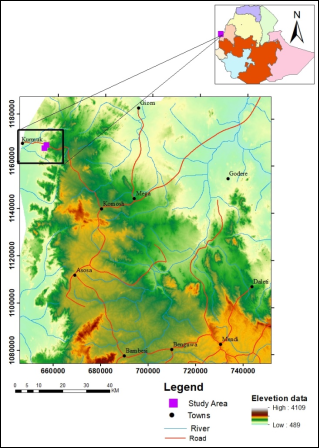
Figure 1. Location map of the study area.
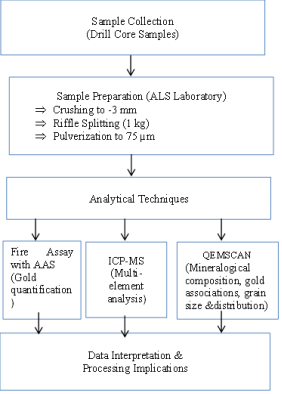
Figure 2. Flow diagram for the mineralogical characterization of the Ashashire deposit.
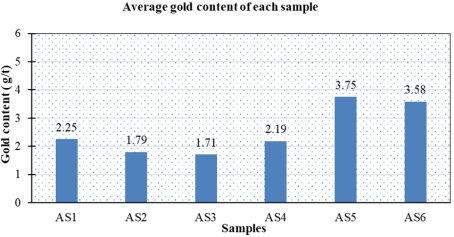
Figure 3. Average gold concentration for representative core samples.
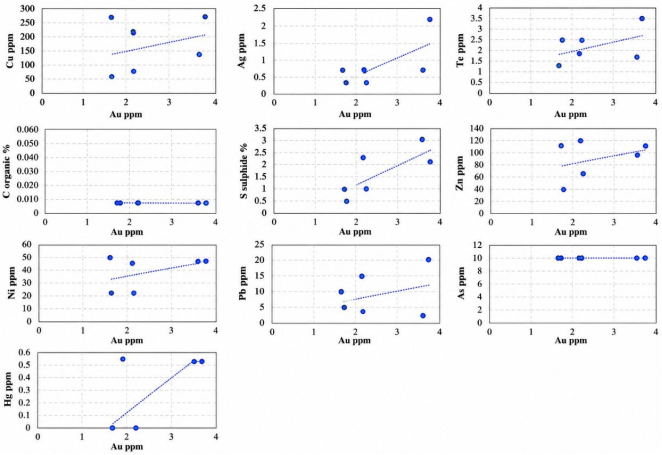
Figure 4. Scatter plots of gold versus associated elements.
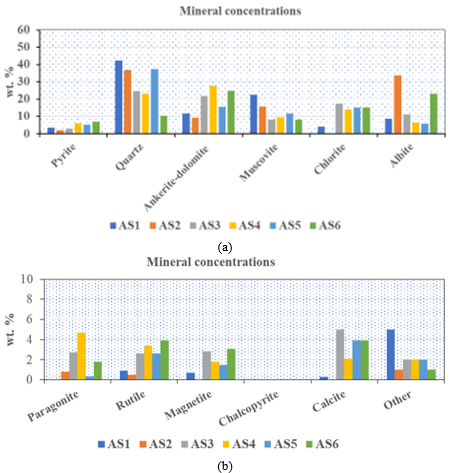
Figure 5. (a) Principal mineral abundances, and (b) secondary mineral abundances in all samples.
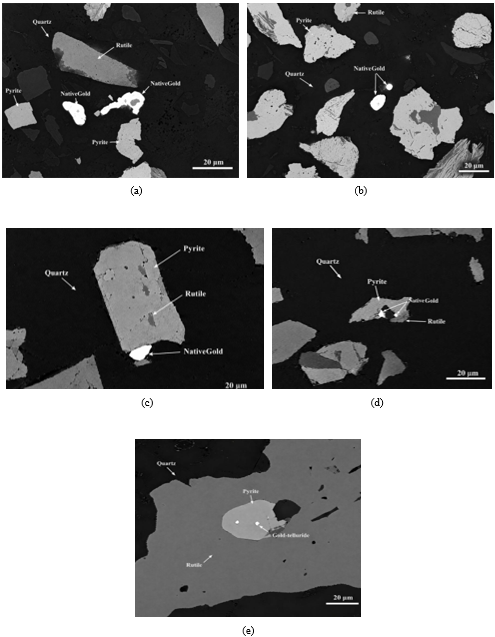
Figure 6. Backscattered electron (BSE) images of representative gold grains: (a, b) Liberated native gold; (c) Native gold with pyrite along grain boundaries; (d) Native gold associated with pyrite and quartz; (e) Pyrite with gold-telluride inclusions (possibly calaverite, AuTe2).

Information



 Share This Article
 Twitter
 Linked In
 Facebook
 Copy
Copy Download