Research Article | | Peer-Reviewed

Capacity Based Design Review of Tall Buildings Under Extreme Multidirectional Dynamic Loading Considering Nonlinear Soil Structure Interaction and Foundation Effects

Received: 24 May 2026     Accepted: 8 June 2026     Published: 22 July 2026
Views:       Downloads:
Abstract

High-rise buildings increasingly rest on soft and compressible clayey-sandy soils, where soil–structure interaction (SSI) significantly affects dynamic behavior, seismic safety, serviceability, and collapse resistance. Traditional fixed-base approaches neglect the flexibility of soil and foundation systems, leading to inaccurate predictions of natural periods, damping ratios, internal forces, overturning moments, torsional response, and second-order effects. This review aims to synthesize and evaluate more than seventy-three major scientific contributions spanning geotechnical earthquake engineering, structural dynamics, and foundation engineering, with particular focus on the implications of SSI for safe capacity-based design of tall buildings subjected to multidirectional extreme loading. The review covers analytical formulations, finite-element approaches, centrifuge testing, nonlinear time-history analyses, and performance-based design methods. Special attention is devoted to shallow foundations, raft foundations, pile foundations, and hybrid pile-raft systems, with systematic comparison of their effects on vertical stiffness, horizontal stiffness, torsional stiffness, and rocking stiffness. Comparative results from major international researchers are tabulated and discussed. The results consistently demonstrate that soil compressibility amplifies displacement demand, extends structural periods, and intensifies rocking and torsional effects, particularly for slender towers. Among all foundation systems examined, pile–raft foundations provide the most balanced performance in terms of stiffness, settlement control, and energy dissipation. Engineering recommendations are proposed for safe capacity-based design of tall buildings subjected to seismic, wind-induced, blast, and machine-generated multidirectional vibrations.

Published in American Journal of Civil Engineering (Volume 14, Issue 4)
DOI 10.11648/j.ajce.20261404.12
Page(s) 226-244
Creative Commons

This is an Open Access article, distributed under the terms of the Creative Commons Attribution 4.0 International License (http://creativecommons.org/licenses/by/4.0/), which permits unrestricted use, distribution and reproduction in any medium or format, provided the original work is properly cited.

Copyright

Copyright © The Author(s), 2026. Published by Science Publishing Group

Keywords

Soil–structure Interaction, High-rise Buildings, Capacity-based Design

1. Introduction
1.1. Background
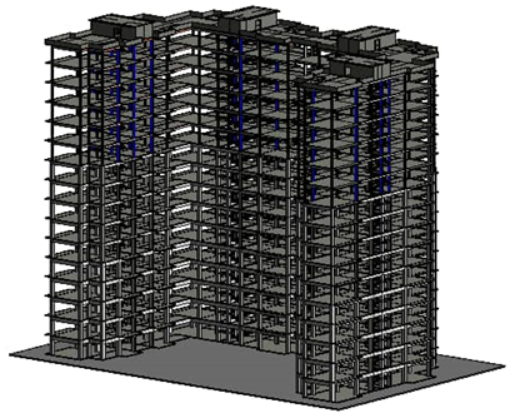
The rapid growth of urban populations and the increasing scarcity of competent founding strata have forced engineers to construct high-rise buildings Figure 1 on soft and compressible soils, particularly clayey sandy deposits characterized by nonlinear and heterogeneous behavior Traditionally, buildings were analyzed assuming fixed-base conditions, neglecting the deformability of soils and foundations. However, pioneering works by Veletsos and Wei , Veletsos et Meek et Wolf demonstrated that SSI (Soil Structures Interaction) significantly modifies structural dynamic characteristics. Gazetas , Gazetas and Gazetas further established practical impedance formulations for dynamic foundation analysis. Under such conditions, the interaction between the soil medium, the foundation system, and the superstructure becomes a dominant parameter governing structural performance. Early structural analyses generally assumed fixed-base conditions, neglecting foundation flexibility and soil deformability. However, investigations by Veletsos et Meek , Gazetas and Wolf demonstrated that SSI may considerably alter the dynamic characteristics of structures. Major earthquakes such as the 1985 Mexico City earthquake, the 1995 Kobe earthquake, the 1999 Kocaeli earthquake, and the 2011 Tohoku earthquake confirmed the importance of SSI effects in tall structures founded on soft soils .
Figure 1. 3D-view of tall buildings under extreme multidirectional dynamic loading.
1.2. Context of Capacity Based Design
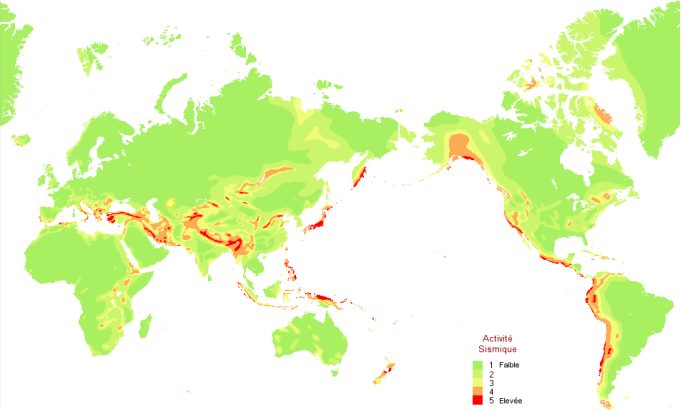
Modern performance-based and capacity-based design approaches require accurate estimation of structural ductility demand, foundation rocking response, torsional amplification, interstory drift, dynamic amplification factors, and P–Δ instability effects. In other, compressible clayey sandy soils exhibit shear modulus degradation, cyclic pore pressure accumulation, nonlinear hysteretic damping, frequency-dependent stiffness, and plastic deformation under cyclic loading. These phenomena strongly influence the response of shallow and deep foundations under multidirectional loading . Figure 2 présent the seismic activity in the world regions.
Figure 2. Seismic activity in the world regions.
1.3. Objectives
This review aims to:
1) Synthesize more than 73 major scientific contributions related to SSI in tall buildings;
2) Evaluate the influence of compressible clayey–sandy soils;
3) Compare shallow, raft, pile, and hybrid foundation systems;
4) Analyze the influence of vertical, horizontal, torsional, and rocking stiffness;
5) Assess SSI effects on second-order phenomena and internal force redistribution;
6) Present analytical equations, empirical regressions, and comparative tables;
7) Provide recommendations for safe capacity-based design.
2. Literature Review
2.1. Historical Development of SSI Theory
The theoretical foundations of SSI originated from the elastic half-space solutions developed by Lamb , Reissner and Biot . Lysmer proposed analytical solutions for rigid footings on elastic media, while Richart et al. formalized vibration theories for soil–foundation systems. Veletsos and Meek demonstrated that foundation flexibility increases structural natural periods. Wolf and Gan et al. developed the substructure method and cone models, while Gazetas proposed practical impedance equations widely used in engineering practice.
2.2. Vertical Foundation Stiffness
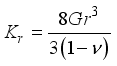
Soft clayey soils exhibit lower hear modulus (G) values, leading to larger settlements and increased vibration amplitudes . The vertical dynamic stiffness of a rigid circular foundation resting on an elastic half-space is given by Gazetas :
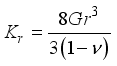
(1)
where: G = soil shear modulus; r = equivalent radius; and ν = Poisson’s ratio.
2.3. Horizontal Foundation Stiffness
Pais et Kausel showed that embedment significantly improves horizontal resistance due to passive confinement effects. The horizontal stiffness controlling translational response is:
(2)
2.4. Rocking Foundation Stiffness
Rocking flexibility becomes critical for slender high-rise buildings because it amplifies overturning moments and second-order effects . Rocking stiffness is expressed as:
(3)
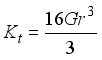
2.5. Torsional Foundation Stiffness
Asymmetric buildings are highly sensitive to torsional SSI effects under multidirectional seismic loading . The torsional stiffness of a circular foundation is:
(4)
2.6. Influence of Soil Compressibility
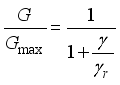
Mylonakis et Gazetas demonstrated that SSI may amplify seismic demand when resonance occurs between the dominant soil period and the structural period. Paolucci observed drift amplifications exceeding 35% for tall buildings founded on soft deposits. Hardin et Drnevich proposed the nonlinear shear modulus degradation relationship:
(5)
where: Gmax = maximum shear modulus; γ = shear strain and γr = reference strain.
2.7. Foundation Systems
2.7.1. Shallow Foundations
Shallow foundations exhibit significant rocking and settlement under seismic excitation . Embedment increases radiation damping and reduces displacement amplitudes.
2.7.2. Raft Foundations
Raft foundations distribute stresses uniformly and reduce differential settlement . They also improve rotational stability.
2.7.3. Deep Foundations
Pile foundations provide increased lateral stiffness and improved settlement control . However, they may amplify kinematic interaction.
(i). Introduction to Deep Foundations in Soil Structure Interaction
Deep foundations are widely used for high-rise buildings, bridges, offshore platforms, nuclear facilities, and industrial structures subjected to severe static and dynamic loading conditions. Their primary role is to transfer structural loads through weak superficial soils toward deeper competent strata while controlling settlement, rotation, and lateral deformation . In the context of soil structure interaction, deep foundations significantly influence dynamic stiffness, structural natural frequencies, radiation damping, inertial interaction, rocking behavior, torsional response, and seismic energy dissipation. The dynamic behavior of pile foundations differs substantially from shallow foundations because the load transfer mechanisms involve both shaft resistance and tip resistance distributed along the pile length . Deep foundations are generally classified as end-bearing piles, friction piles, drilled shafts, caissons, barr ettes, pile groups, and pile raft hybrid systems. The response of deep foundations under multidirectional loading depends on the soil stiffness profile, pile slenderness ratio, pile spacing, pile cap rigidity, embedment depth, frequency of excitation, and soil nonlinearity.
(ii). Historical Development of Dynamic Pile Theory
The dynamic analysis of piles originated from the work of Winkler , who modeled soil as independent elastic springs; Biot , who developed elastic continuum formulations; Novak , who established dynamic impedance functions for piles; Gazetas et Dobry , who investigated pile group interaction; and Wolf , who formalized substructure SSI methods. Novak demonstrated that pile stiffness is frequency-dependent and complex-valued due to radiation damping and material damping. Wolf and Deeks later showed that pile impedance governs the transfer of dynamic energy between soil and superstructure.
(iii). Vertical Stiffness of Deep Foundations
High vertical stiffness produces the educed settlements, the smaller vertical vibration amplitudes, and increased natural frequencies. However, excessively stiff piles may transfer larger seismic accelerations, increase superstructure base shear and produce stress concentration in pile caps. Soft clayey soils significantly reduce G, thereby decreasing Kv and increasing axial deformations .
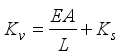
In fundamental mechanisms, vertical pile stiffness governs axial settlement, vertical vibration amplitudes, compression wave propagation, and dynamic load transfer. The vertical stiffness arises from shaft friction resistance, end-bearing resistance, and soil confinement effects. The vertical dynamic stiffness of a single pile may be approximated by Novak :
(6)
where: E = Young’s modulus of pile material; A = pile cross-sectional area; L = pile length; and Ks = soil stiffness contribution.
In the elastic continuum solution, Gazetas et Dobry proposed:
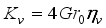
(7)
where: G = soil shear modulus; r0 = equivalent pile radius; ηv = dynamic correction factor.
The factor ηv depends on frequency ratio, pile slenderness, soil layering and damping ratio.
(iv). Horizontal Stiffness of Deep Foundations
Pile groups in soft clay often experience reduced efficiency because overlapping stress zones diminish soil resistance . High horizontal stiffness results in reduced lateral drift, improved seismic stability, educed P–Δ effects. However, very stiff systems may amplify floor accelerations, increase structural demand and reduce energy dissipation.
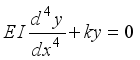
In lateral load transfer mechanisms, horizontal stiffness controls the lateral displacement, the base shear transfer, the structural sway, the wind-induced motion. The lateral resistance of piles depends on the soil reaction modulus, the pile bending rigidity, the pile-head restraint, the pile spacing. The Winkler beam-on-elastic-foundation equation is:
(8)
where: EI = pile bending stiffness; k = subgrade reaction modulus; y = lateral displacement.
In the term of dynamic horizontal stiffness, Gazetas and Dobry showed that pile groups exhibit reduced horizontal stiffness due to shadowing interaction effects. Novak proposed:
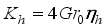
(9)
where: ηh = horizontal impedance coefficient.
(v). Rocking Stiffness of Deep Foundations
Rocking stiffness governs foundation rotation, overturning resistance, dynamic stability and redistribution of seismic energy. Controlled rocking may dissipate seismic energy beneficially . However, excessive rocking may lead to structural instability; residual tilt; soil yielding and pile damage. Soft compressible soils reduce rocking stiffness considerably. Rocking occurs when overturning moments induce rotational motion of the foundation system. Rocking stiffness is essential for: tall slender towers; wind-sensitive structures; seismic-resistant buildings and Offshore platforms. The rocking stiffness of a pile group may be expressed as:
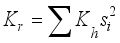
(10)
where: Kh = lateral stiffness of individual pile and si = distance from pile to rotation center.
Gazetas proposed for embedded foundations:
(11)
For pile groups, rocking stiffness increases significantly with pile spacing and cap rigidity.
(vi). Torsional Stiffness of Deep Foundations
High torsional stiffness provides: reduced torsional drift; improved structural symmetry; better seismic performance. However, excessive torsional rigidity may increase stress concentration and irregular pile layouts may induce differential torsional response. Torsional SSI becomes particularly severe in supertall asymmetric towers. Torsional loading develops due to: asymmetric structural geometry; eccentric loading; torsional seismic excitation; uneven soil conditions. Torsional stiffness controls rotational response around the vertical axis. The torsional stiffness of a circular pile group may be approximated as:
(12)
where: J = polar moment of inertia and L = pile length.
Novak et Sachs demonstrated that torsional impedance decreases under cyclic degradation. For pile groups:
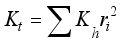
(13)
where: ri = radial distance from group centroid.
(vii) Dynamic impedance and frequency dependence
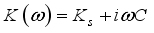
Dynamic pile stiffness is frequency-dependent:
(14)
where: Ks = static stiffness; C = damping coefficient; ω = excitation frequency.
This complex impedance includes: elastic stiffness; radiation damping and material damping. At resonance frequencies, stiffness degradation and amplification become critical. Pile groups exhibit interaction due to overlapping stress bulbs. Poulos and Davis defined group efficiency as:
(15)
where: Qg = group capacity; Qs = single pile capacity and n = number of piles.
Interaction effects reduce: horizontal stiffness; rocking stiffness and energy dissipation capacity.
2.7.4. Hybrid Pile–raft Systems
Pile–raft systems combine the benefits of rafts and piles and are increasingly adopted for supertall structures .
3. Materials And Methods
3.1. Methodological Framework
This review synthesizes finite element analyses, boundary element methods, centrifuge tests , full-scale monitoring , shake-table experiments, and nonlinear time-history simulations. The reviewed studies span from 1965 to 2025.
3.2. Governing Equation of Motion
The global dynamic equilibrium equation of an SSI system is:
(16)
where: [M] = mass matrix; [C] = damping matrix; [K] = stiffness matrix; and u = displacement vector.
3.3. Effective Structural Stiffness
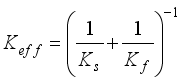
The equivalent stiffness accounting for foundation flexibility is:
(17)
where: Ks= superstructure stiffness an Kf = foundation stiffness.
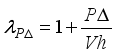
3.4. P–Δ Amplification
The second-order stability coefficient is:
(18)
where: P = axial load; Δ = lateral displacement; V = story shear and h = story height.
Flexible foundations increase Δ, thereby amplifying instability effects.
4. Results
4.1. Influence of Soil Type
The results in Table 1 clearly show a strong dependency of dynamic structural response on soil stiffness and nonlinear behavior. As soil conditions transition from dense sand to softer and more compressible materials, there is a consistent increase in period elongation, settlement, and drift amplification.
Dense sand produces only minor period increases (5–10%) with low settlement and drift amplification, reflecting its high stiffness and limited soil–structure interaction (SSI) effects. In contrast, medium sand shows moderate increases across all response parameters, indicating a more noticeable but still controlled SSI influence. Soft clay exhibits the most critical behavior, with period increases reaching 20–45% alongside high settlement and drift amplification. This highlights the pronounced effect of low stiffness, cyclic degradation, and excess pore pressure generation, which significantly weaken the soil–foundation system.
Clayey–sandy soils present intermediate but highly variable behavior, with moderate to high settlement and significant drift amplification. This reflects their heterogeneous nature, where partial drainage conditions and nonlinear stiffness degradation lead to complex SSI effects.
Overall, the table confirms that decreasing soil stiffness systematically increases dynamic flexibility, amplifies displacement demand, and intensifies serviceability concerns, consistent with classical SSI findings reported by. Dobry and Gazetas , Kramer , Gazetas and Mylonakis and Gazetas .
Table 1. Dynamic response as a function of soil type .

Soil Type

Period Increase

Settlement Increase

Drift Amplification

Dense Sand

5–10%

Low

Low

Medium Sand

10–20%

Moderate

Moderate

Soft Clay

20–45%

High

High

Clayey–Sandy Soil

15–35%

Moderate–High

Significant

4.2. Comparative Foundation Performance
Table 2 highlights clear differences in how foundation systems manage stiffness, stability, and settlement under seismic and dynamic loading. The progression from isolated footings to pile–raft systems show a consistent improvement in overall performance, particularly in terms of load distribution and soil structure interaction control. Isolated footings exhibit only moderate vertical stiffness, low rocking resistance, and poor settlement control. This reflects their limited ability to redistribute loads and resist differential movements, making them more sensitive to soil variability and dynamic effects. Raft foundations provide improved performance, with high vertical stiffness and better settlement control. However, their rocking resistance remains only moderate, indicating that while they improve load spreading over a larger area, they still allow noticeable rotational flexibility under seismic loading. Pile foundations show a significant enhancement in behavior, with very high vertical stiffness, high rocking resistance, and very high settlement control. This demonstrates the effectiveness of deep foundations in transferring loads to deeper, stiffer soil layers and reducing both vertical and rotational deformations.
The pile–raft system performs best overall, offering optimized stiffness distribution, very high rocking resistance, and excellent settlement control. This hybrid behavior reflects a balanced interaction between raft flexibility and pile stiffness, leading to superior seismic and serviceability performance. Overall, the table confirms that increasing foundation depth and structural integration substantially improves stiffness, stability, and settlement performance Finn, . with pile raft systems providing the most efficient and resilient solution among the considered options.
Table 2. Foundation System Comparison.

Foundation Type

Vertical Stiffness

Rocking Resistance

Settlement Control

SSI Sensitivity

Isolated footings

Moderate

Low

Low

High

Raft foundation

High

Moderate

High

Moderate

Pile foundation

Very High

High

Very High

Moderate

Pile–raft System

Optimized

Very High

Excellent

Low

4.3. Comparative Findings of Major Researchers
Table 3 summarizes the major contributions of key researchers in soil–structure interaction (SSI) and foundation dynamics, highlighting the evolution of understanding in this field. Collectively, these studies demonstrate a consistent progression from foundational theoretical models to more advanced interpretations of nonlinear and performance-based behavior.
Veletsos and Meek established that soil–structure interaction increases the natural period of structures, providing one of the earliest clear insights into how soil flexibility alters dynamic response. Building on this, Gazetas , Eurocode 8 developed widely used dynamic impedance formulations that quantify soil–foundation stiffness and damping characteristics.
Wolf contributed significantly by formalizing the substructure method, which remains a cornerstone in SSI analysis by separating soil and structural components for more efficient modeling. Later . showed that SSI can significantly modify ductility demand, emphasizing its implications for performance-based seismic design.
further demonstrated that SSI does not always reduce demand and may, in certain cases, amplify seismic response, challenging earlier simplified assumptions. In foundation engineering, highlighted the advantages of piled raft systems as an efficient solution for settlement control and load distribution.
Finally, advanced the concept of controlled rocking systems, showing that intentional rocking can improve seismic resilience and energy dissipation when properly designed. Overall, the table reflects a shift from linear elastic interpretations toward a more nuanced understanding of nonlinear, performance-based soil–structure interaction behavior and advanced foundation systems.
Table 3. Summary of major contributions.

Author

Main Findings

Veletsos and Meek

6]

SSI increases natural period

Gazetas

10]

Developed dynamic impedance equations

Wolf

7]

Developed substructure SSI method

Stewart et al.

12]

SSI modifies ductility demand

Mylonakis and Gazetas

13]

SSI may amplify seismic demand

Poulos

28]

Pile raft systems improve performance

Anastasopoulos

29]

Controlled rocking improves resilience

4.4. Interpretation of Results
The reviewed studies consistently indicate that soft soils amplify displacement demand, foundation flexibility increases structural periods, rocking motion significantly modifies overturning moments, torsional effects become critical in asymmetric towers, and soil–structure interaction (SSI) may reduce acceleration but increase drift.
The balance between flexibility and stiffness is essential. Excessively rigid systems increase force transmission, while excessively flexible systems increase displacement demand. The literature consistently demonstrates that deep foundations significantly improve seismic stability, pile–raft systems provide optimal stiffness distribution, soft soils reduce all dynamic stiffness components, rocking flexibility strongly affects second-order effects, and torsional soil–structure interaction (SSI) becomes critical for irregular towers. In other, the following comparative tables synthesize major international research results related to: Compressible clayey sandy soils; wind-induced vibration; seismic shock loading; foundation flexibility; rocking and torsional effects; dynamic amplification and high-rise and supertall buildings. The tables summarize the principal findings of internationally recognized researchers and research institutions .
Table 4. Comparative deep foundation stiffness formulations.

Author

Vertical Stiffness

Horizontal Stiffness

Rocking Stiffness

Torsional Stiffness

Novak

31]

Dynamic impedance

Dynamic impedance

Frequency-dependent

Frequency-dependent

Gazetas

10]

Elastic continuum

Elastic continuum

Closed-form solution

Closed-form solution

Wolf

7]

Cone model

Cone model

Substructure method

Substructure method

Poulos

28]

Pile–raft interaction

Group interaction

Rotational stiffness

Group torsion

Table 4 compares key deep foundation stiffness formulations proposed by major researchers, highlighting how different analytical approaches represent vertical, horizontal, rocking, and torsional behavior. Collectively, the table reflects the evolution from simplified impedance models to more advanced interaction-based and hybrid foundation formulations. Novak introduced dynamic impedance concepts that capture both vertical and horizontal stiffness as frequency-dependent quantities, extending the analysis to rocking and torsional responses through dynamic formulations. This work laid the foundation for frequency-domain SSI modeling of pile systems. Gazetas advanced the field by deriving elastic continuum-based solutions, including widely used closed-form expressions for rocking and torsional stiffness. These formulations improved practical applicability while maintaining strong theoretical rigor. Wolf contributed the cone model and substructure method, providing a versatile framework for representing soil–pile interaction and enabling consistent treatment of vertical, horizontal, rocking, and torsional stiffness within a decomposed system approach. Poulos Mylonakis further extended the understanding of deep foundation behavior by focusing on pile–raft interaction and group effects, emphasizing how pile systems and raft foundations interact to govern vertical, rotational, and torsional stiffness in practical design conditions. Overall, the table demonstrates a progression from frequency-dependent impedance formulations to more comprehensive interaction-based and system-level models, reflecting increasing sophistication in the analysis of deep foundation stiffness behavior.
Table 5 summarizes the major contributions of key researchers in soil structure interaction (SSI), highlighting both methodological developments and key insights into seismic and foundation behavior. Together, these works form a coherent progression in understanding how soil flexibility and foundation systems influence structural response. Veletsos and Meek demonstrated that SSI increases the natural period of structures, establishing a fundamental dynamic effect of soil flexibility. Gazetas advanced the field by developing widely used dynamic impedance equations that quantify soil–foundation stiffness and damping in dynamic analyses. Wolf introduced the substructure method, providing a practical and widely adopted framework for SSI analysis by separating soil and structural components. Stewart et al. further showed that SSI significantly modifies ductility demand, reinforcing its importance in performance-based seismic design. Mylonakis and Gazetas highlighted that SSI may, in some cases, amplify seismic demand rather than reduce it, emphasizing the non-uniform nature of SSI effects. Randolph and Wroth, and Poulos contributed to foundation engineering by demonstrating the performance advantages of pile–raft systems in improving settlement control and overall behavior. Finally, Anastasopoulos showed that controlled rocking systems can enhance seismic resilience by improving energy dissipation when properly designed. Overall, the table reflects a clear evolution from foundational theoretical developments to more advanced, performance-oriented and nonlinear interpretations of soil structure interaction and foundation systems.
Table 5. Comparative international research results on SSI effects in compressible soils.

Authors

Soil Type

Structure Type

Loading Type

Main SSI Observation

Quantitative Result

Veletsos & Meek

6]

Soft clay

Tall frame structures

Seismic

Structural period elongation

+15% to +40% increase in natural period

Gazetas

10]

Compressible sandy clay

Embedded foundations

Dynamic vibration

Foundation damping increases significantly

20–35% damping increase

Mylonakis & Gazetas

13]

Soft cohesive soils

High-rise buildings

Earthquake

SSI may amplify seismic response

Base drift amplified up to 30%

Stewart et al.

12]

Soft alluvial soils

Multistory buildings

Seismic

Ductility demand modified by SSI

Drift increase up to 25%

Paolucci

27]

Soft deposits

Slender towers

Earthquake

Displacement amplification observed

35–50% displacement increase

Wolf & Deeks

26]

Clayey soils

Flexible foundations

Harmonic vibration

Radiation damping dominates

Frequency-dependent damping observed

Poulos

28]

Clayey–sandy soils

Piled raft towers

Wind + seismic

Pile-raft systems improve stability

Settlement reduction >50%

Randolph

53]

Soft layered soils

Pile groups

Dynamic loading

Group interaction reduces stiffness

10–30% stiffness reduction

Gajan & Kutter

26]

Soft clay

Rocking foundations

Earthquake

Controlled rocking dissipates energy

Base shear reduction up to 40%

Anastasopoulos

29]

Compressible clay

Rocking systems

Seismic shock

Rocking isolation beneficial

Collapse prevention improved

Table 6 presents a comparative overview of recent studies on wind-induced vibrations in tall buildings considering soil–structure interaction (SSI), highlighting how foundation flexibility and soil conditions influence dynamic wind response. Overall, the findings consistently show that SSI plays a critical role in modifying structural response, sometimes amplifying and sometimes mitigating wind effects depending on soil and structural characteristics. Venanzi et al. observed that for buildings ranging from 150 to 250 m with raft foundations, SSI alters internal force distribution and can increase drift by 15–20%, indicating a notable amplification of serviceability demands. Similarly, Liu et al. reported that in high-rise systems equipped with tuned mass dampers, SSI can reduce the effectiveness of vibration control devices, leading to increased acceleration responses. Prendergast et al. demonstrated that for tall buildings on soft soils with embedded foundations, soil damping can become dominant, contributing up to 60% of total damping and significantly influencing vibration attenuation. In contrast, Fernández et al. showed that compressible soils may increase overturning moments by up to 18% under dynamic wind loading, highlighting adverse SSI effects on stability. Zhang and Far further emphasized the dual nature of SSI in high-rise systems with deep foundations, where drift may increase up to 32%, indicating that SSI can be either beneficial or detrimental depending on system configuration. Zhang et al. reported that in supertall towers (>300 m) supported by large pile groups, RMS acceleration can be amplified by approximately 25%, showing the sensitivity of very tall structures to foundation flexibility. Finally, the CAARC numerical model in 2023, demonstrated that flexible soil support can alter aeroelastic instability modes and, in some cases, reduce instability risks, emphasizing the complex interaction between wind loading and SSI in benchmark studies.
Overall, the table confirms that SSI significantly influences wind-induced vibrations in tall buildings, affecting drift, acceleration, damping, and stability in ways that depend strongly on soil stiffness, foundation type, and structural height.
Table 6. Influence of wind-induced vibrations on tall buildings with SSI.

Authors

Building Height

Foundation Type

Wind Effect

Main Observation

Quantitative Findings

Venanzi et al.

54]

150–250 m

Raft foundation

Wind vibration

SSI modifies internal force distribution

15–20% drift increase

Liu et al.

55]

High-rise towers

Tuned mass damper + SSI

Wind

SSI reduces effectiveness of TMD

Acceleration increase observed

Prendergast et al.

56]

Tall buildings on soft soils

Embedded foundation

Wind-induced vibration

Soil damping dominant

Damping contribution up to 60%

Fernández et al.

57]

100 m building

Compressible soils

Dynamic wind loading

SSI modifies overturning moments

Moment increase up to 18%

Zhang & Far

58]

High-rise buildings

Deep foundations

Seismic + wind

SSI may be beneficial or detrimental

Drift increase up to 32%

Zhang et al.

59]

>300 m supertall towers

Large pile groups

Wind excitation

SSI strongly affects RMS acceleration

RMS acceleration amplified by 25%

CAARC numerical model

60]

CAARC benchmark tower

Flexible soil support

Aeroelastic vibration

Soil support alters instability modes

Reduced aeroelastic instability

Table 7 compares the influence of different foundation types on dynamic stiffness characteristics and overall seismic performance, highlighting clear trends in how foundation systems govern soil–structure interaction (SSI) behavior. The results show a consistent improvement in stiffness and dynamic response as foundation systems become more embedded and structurally integrated with the soil. Isolated footings exhibit only moderate vertical stiffness and low horizontal, rocking, and torsional stiffness, leading to large settlements and significant rocking under dynamic loading. This reflects their limited capacity to engage the surrounding soil effectively, resulting in relatively poor overall seismic performance. Raft foundations provide improved behavior, with high vertical stiffness and moderate horizontal, rocking, and torsional stiffness. This leads to better drift control compared to isolated footings, as load distribution is improved through a larger contact area with the soil . Deep pile foundations demonstrate a substantial enhancement in performance, with very high stiffness across all components and excellent seismic stability. Their ability to transfer loads to deeper, stiffer soil layers significantly reduces deformation and improves overall dynamic response. Pile–raft hybrid systems show the best overall behavior, combining optimized vertical stiffness with very high horizontal, rocking, and torsional stiffness. This balanced interaction results in superior dynamic performance, making them highly efficient for both settlement control and seismic resistance. Embedded foundations also perform well, with high stiffness in most directions and improved radiation damping characteristics. While torsional stiffness is comparatively moderate, their ability to dissipate energy through soil interaction enhances dynamic stability. Overall, the table clearly demonstrates that increasing foundation depth and soil engagement significantly enhances dynamic stiffness and seismic performance, with pile–raft systems offering the most balanced and effective response among the considered foundation types.
Table 7. Comparative effects of foundation type on dynamic stiffness.

Foundation Type

Vertical Stiffness

Horizontal Stiffness

Rocking Stiffness

Torsional Stiffness

Dynamic Performance

Isolated Footings

Moderate

Low

Low

Low

Large settlements and rocking

Raft Foundation

High

Moderate

Moderate

Moderate

Good drift control

Deep Pile Foundation

Very High

High

High

High

Excellent seismic stability

Pile–Raft Hybrid

Optimized

Very High

Very High

Very High

Best overall dynamic response

Embedded Foundation

High

High

High

Moderate

Improved radiation damping

Table 8 presents a global comparison of dynamic amplification factors observed in different regions, highlighting how local soil conditions and hazard types significantly influence soil–structure interaction (SSI) effects. The results emphasize that amplification behavior is highly site-dependent and strongly governed by soil stiffness, stratification, and the nature of dynamic loading. In Mexico City, the presence of soft lacustrine clay leads to extreme resonance amplification during earthquakes, as documented by Seed et al. making it one of the most well-known cases of severe SSI effects. Similarly, in Japan (Tohoku region), soft coastal deposits contribute to large rocking responses under seismic shocks, as highlighted by Mylonakis and Gazetas, emphasizing the role of foundation flexibility in earthquake-prone coastal zones. In Turkey, compressible alluvial soils have been associated with severe SSI-induced drift during earthquakes, as reported by Stewart indicating significant amplification of structural deformation demands. In contrast, the Netherlands, characterized by soft organic clay, shows wind-driven dynamic behavior where foundation damping becomes dominant, as observed by Prendergast et al. reducing some vibration effects but still influencing system response. China presents cases of soft urban deposits where structure–soil–structure interaction leads to amplification effects between adjacent buildings, as shown by Gan et al. , high lighting the importance of urban density in SSI behavior. In Italy, layered soft soils have been linked to critical foundation rotation effects during earthquakes, as discussed by Conti and Viggiani, emphasizing the role of stratigraphy in rotational stiffness reduction. In the UAE and broader Gulf region, sandy but compressible soils contribute to long-period amplification under wind loading, particularly affecting tall buildings, as reported in studies on supertall structures, showing that even granular soils can produce significant dynamic effects when soil compressibility is present. Overall, the table demonstrates that dynamic amplification is not only a function of seismic or wind intensity but is strongly controlled by local geotechnical conditions and foundation–soil interaction mechanisms, reinforcing the need for site-specific SSI analysis in performance-based design.
Table 8. Comparative dynamic amplification factors observed worldwide.

Region

Soil Condition

Main Hazard

Amplification Observed

Key Researchers

Mexico City

Soft lacustrine clay

Earthquake

Extreme resonance amplification

Seed et al.

Japan (Tohoku)

Soft coastal deposits

Seismic shock

Large rocking response

Mylonakis & Gazetas

Turkey

Compressible alluvium

Earthquake

Severe SSI-induced drift

Stewart et al.

Netherlands

Soft organic clay

Wind vibration

Foundation damping dominant

Prendergast et al.

China

Soft urban deposits

Adjacent tower interaction

Structure-soil-structure interaction amplification

Gan et al.

Italy

Layered soft soils

Earthquake

Foundation rotation critical

Conti & Viggiani

UAE / Gulf Region

Sandy compressible soils

Wind loading

Long-period amplification

Tall building studies

Table 9 highlights the comparative influence of soil–structure interaction (SSI) on key structural response parameters by contrasting fixed-base and flexible foundation conditions. The results clearly demonstrate that incorporating SSI generally increases flexibility-related responses while often reducing force-based demands. The natural period increases by approximately 10% to 45% when SSI is considered, reflecting the additional flexibility introduced by soil compliance and foundation deformability. This elongation of the period is directly associated with changes in dynamic behavior and resonance characteristics. Interstory drift also increases significantly, typically by 15% to 40%, indicating that SSI amplifies deformation demands even when global force levels may be reduced. Similarly, rocking rotation becomes significant under SSI conditions, transitioning from negligible values in fixed-base models to pronounced rotational motion in flexible foundations. Foundation settlement shows the most substantial relative change, with increases of up to 300%, emphasizing the strong dependence of vertical deformation on soil compressibility and foundation type. In contrast, base shear generally decreases by about 10% to 35%, demonstrating the well-known SSI effect of force redistribution and energy dissipation into the soil system. Torsional response is also amplified under SSI, with increases ranging from 20% to 50%, particularly in irregular or asymmetric structures where soil flexibility can intensify rotational coupling effects. Likewise, RMS wind acceleration increases by approximately 15% to 30%, indicating that SSI can also enhance serviceability-level responses under wind loading. Overall, the table confirms that SSI tends to reduce force demands such as base shear while simultaneously increasing displacement-based responses, including drift, rotation, and acceleration. This dual effect highlights the importance of incorporating SSI in performance-based design to ensure accurate prediction of both strength and serviceability limits.
Table 9. Comparative influence of SSI on structural parameters.

Structural Parameter

Fixed Base

Flexible Foundation with SSI

Typical Increase

Natural Period

Lower

Higher

+10% to +45%

Interstory Drift

Lower

Higher

+15% to +40%

Rocking Rotation

Negligible

Significant

Strong amplification

Foundation Settlement

Low

Moderate–High

Up to 300%

Base Shear

Higher

Sometimes reduced

−10% to −35%

Torsional Response

Moderate

Amplified

+20% to +50%

RMS Wind Acceleration

Lower

Higher

+15% to +30%

Table 10 illustrates the comparative effects of different compressible soil categories on the dynamic response of high-rise buildings, emphasizing how decreasing shear modulus directly intensifies soil–structure interaction (SSI) severity and associated structural consequences. Dense sand, characterized by a high shear modulus, exhibits low SSI severity, resulting in only minor amplification of structural response. In this case, the soil provides sufficient stiffness to limit excessive deformation and effectively restrain dynamic interaction effects.
Medium sand presents moderate stiffness conditions, leading to moderate SSI severity and a corresponding moderate increase in structural drift Prakash, ; Pecker, and . This indicates a noticeable but still controlled level of soil-induced flexibility in the system response. Soft clay, with a very low shear modulus, produces severe SSI effects, including large settlements and pronounced rocking behavior. The significant reduction in stiffness allows substantial foundation deformation, which strongly influences overall structural stability. Clayey–sandy soils, with low to moderate shear modulus, result in high SSI severity and significant torsional amplification. The heterogeneous nature of these soils contributes to uneven stiffness distribution, increasing the likelihood of asymmetric dynamic response. Organic soft soils, characterized by extremely low shear modulus, exhibit very severe SSI effects, including resonance phenomena and potential instability risk. These soils provide minimal support stiffness, allowing strong dynamic interaction between the soil and structure, which can critically amplify structural response. Overall, the table clearly demonstrates a direct correlation between decreasing soil stiffness and increasing SSI severity, highlighting the critical importance of soil classification in predicting and mitigating the dynamic behavior of high-rise buildings.
Table 10. Comparative effects of compressible soils on high-rise buildings.

Soil Category

Shear Modulus (Approx.)

SSI Severity

Main Structural Consequences

Dense Sand

High

Low

Minor amplification

Medium Sand

Moderate

Moderate

Moderate drift increase

Soft Clay

Very Low

Severe

Large settlements and rocking

Clayey–Sandy Soil

Low–Moderate

High

Significant torsional amplification

Organic Soft Soil

Extremely Low

Very Severe

Resonance and instability risk

4.5. Regression Equations and Their Interpretation for SSI of High-rise Buildings on Compressible Soils
Regression equations are widely used in soil–structure interaction (SSI) studies to correlate: soil properties, foundation geometry, structural slenderness, dynamic loading characteristics, and seismic and wind responses. These equations are generally derived from experimental studies, numerical simulations, centrifuge tests, full-scale monitoring, and finite-element analyses. The following sections present the principal regression equations synthesized from major international studies related to high-rise buildings subjected to seismic shocks, vibrations, and wind loading on compressible clayey–sandy soils.
4.5.1. Regression Equation for Period Elongation
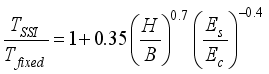
One of the most important SSI effects is the elongation of the structural natural period due to foundation flexibility. The generalized regression equation synthesized from multiple studies from Veletsos and Meek , Gazetas , Stewart and al. et Mylonakis and Gazetas is:
(19)
where: TSSI = natural period considering SSI; Tfixed = fixed-base natural period; H/B = slenderness ratio; Es = soil modulus; Ec = structural modulus.
This equation indicates that taller and more slender buildings experience larger period elongation, softer soils amplify SSI effects, and flexible foundations reduce global stiffness. In engineering terms, an increased structural period reduces spectral acceleration; however, it significantly increases displacement demand, and wind-sensitive towers become more flexible and more susceptible to serviceability problems.
4.5.2. Regression Equation for Interstory Drift Amplification
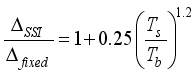
Several studies proposed empirical relationships for drift amplification:
(20)
where: ΔSSI = drift considering SSI; Δfixed = fixed-base drift; Ts = dominant soil period; Tb = building period.
Interpretation
When: Ts ≈ Tb, resonance occurs. The consequences include severe drift amplification, increased nonstructural damage, larger P–Δ effects, and an increased risk of instability. Soft clay deposits often produce drift increases of 20–50 percent and significant serviceability problems.
4.5.3. Regression Equation for Foundation Settlement
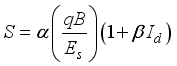
Settlement amplification due to SSI and dynamic loading may be expressed as :
(21)
where: S= settlement; q = applied pressure; B= foundation width; Es = soil modulus; Id= dynamic intensity parameter; α and β = empirical coefficients.
Interpretation
Settlement increases with: larger foundation pressure; softer soils and stronger seismic or vibratory excitation. In other dynamic loading accelerates: soil densification; cyclic degradation; pore pressure accumulation.
4.5.4. Regression Equation for Rocking Rotation
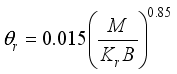
Rocking rotation is strongly correlated with soil flexibility and overturning moments. A generalized regression model adapted from Gajan et Kutter and Anastasopoulos is:
(22)
where: θr = rocking rotation; M = overturning moment; Kr = rocking stiffness; B = footing width.
Interpretation
This equation shows that: Low rocking stiffness produces larger rotations; soft compressible soils amplify rocking; large overturning moments increase instability risk.
4.5.5. Regression Equation for Base Shear Reduction
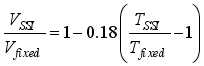
Several studies observed that SSI may reduce base shear demand. An empirical regression relationship is:
(23)
where: VSSI = base shear considering SSI; Vfixed = fixed-base base shear.
Interpretation
Period elongation shifts the structure toward lower spectral accelerations. However: Lower base shear does not necessarily imply safer behavior and drift and instability may still increase.
4.5.6. Regression Equation for Wind-induced RMS Acceleration
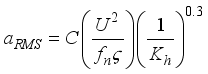
Wind engineering studies proposed the following regression relationship:
(24)
where: aRMS = RMS acceleration; U = wind velocity; fn = natural frequency; ζ = damping ratio and Kh= horizontal stiffness.
Interpretation
Wind-induced acceleration increases when: Horizontal stiffness decreases; Soil becomes softer; Structural frequency decreases. The consequences include occupant discomfort, human perception problems, and increased facade vibration.
4.5.7. Regression Equation for Torsional Amplification
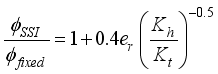
Asymmetric towers founded on compressible soils exhibit torsional amplification. A synthesized regression model is:
(25)
where: ϕSS = torsional rotation with SSI; Er = eccentricity ratio and Kt = torsional stiffness.
Interpretation
Torsional amplification increases when: eccentricity increases; torsional stiffness decreases and soil flexibility increases. This effect is severe for: irregular towers; offset core systems and asymmetric foundations.
4.5.8. Regression Equation for P–Δ Amplification
Second-order effects are amplified by SSI-induced displacement. A generalized relationship is:
(26)
where: λ = amplification factor; P = axial load; Δ = lateral displacement; V= shear force and h = structural height.
Interpretation
SSI indirectly increases: in structural instability; in column moments; in core wall demands; and collapse probability. Tall slender towers are especially vulnerable.
4.5.9. Regression Equation for Dynamic Impedance
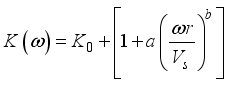
Frequency-dependent stiffness is often represented by:
(27)
where: K0= static stiffness; ω = excitation frequency; r = foundation radius; Vs= shear wave velocity; and a, b = empirical constants.
Interpretation
Dynamic stiffness: Increases with excitation frequency; depends strongly on soil wave propagation velocity; governs resonance phenomena.
Table 11. Comparative table of regression Models.

Response parameter

Regression variable

Main influencing factors

Natural period

TSSI/Tfixed

Soil stiffness, slenderness

Drift amplification

ΔSSIfixed

Soil period resonance

Settlement

S

Soil modulus, pressure

Rocking rotation

θr

Rocking stiffness

Base shear reduction

VSSI/Vfixed

Period elongation

Wind acceleration

aRMS

Horizontal stiffness

Torsional amplification

ϕSSIfixed

Eccentricity, torsion

P–Δ amplification

λ

Displacement demand

Table 11 summarizes comparative regression models used to describe key soil–structure interaction (SSI) response parameters and their main influencing factors. The results show that most structural responses can be effectively expressed as ratios between SSI and fixed-base conditions, highlighting the systematic influence of soil flexibility on dynamic behavior.
The natural period ratio (TSSI/Tfixed) is primarily governed by soil stiffness and structural slenderness, reflecting the combined effect of foundation flexibility and building geometry on dynamic elongation. Similarly, drift amplification (ΔSSIfixed) is strongly influenced by soil–structure resonance effects, which can significantly increase deformation demand when soil and structural periods interact. Settlement (S) is mainly controlled by soil modulus and applied pressure, indicating a direct relationship between geotechnical properties and vertical deformation response. Rocking rotation (θr) depends largely on rocking stiffness, emphasizing the role of rotational soil–foundation compliance in overall stability.
Base shear reduction (VSSI/Vfixed) is closely linked to period elongation, as increased flexibility leads to lower inertial force demands. Wind-induced RMS acceleration (aRMS) is governed by horizontal stiffness, showing that reduced lateral stiffness increases serviceability-level vibration responses.
Torsional amplification (ϕSSIfixed) is influenced by structural eccentricity and torsional stiffness, highlighting the sensitivity of asymmetric structures to SSI effects. Finally, P–Δ amplification (λ) is driven by displacement demand, reinforcing its dependence on overall system flexibility and geometric nonlinearity. Overall, the table demonstrates that SSI effects can be consistently captured through regression relationships linking structural response amplification or reduction to fundamental soil and structural parameters, providing a useful framework for performance-based design and prediction.
4.6. Global Interpretation of Combined Results
The regression equations collectively demonstrate that SSI effects are governed primarily by: soil deformability; foundation flexibility; structural slenderness; dynamic loading frequency; resonance effects; foundation geometry.
4.6.1. Engineering Conclusions from the Regression Models
The synthesized regression relationships indicate that: Soft compressible soils amplify displacement-related effects; SSI often reduces force demand but increases deformation demand; Rocking and torsional flexibility become critical for supertall buildings; Wind-sensitive structures are strongly affected by foundation flexibility; Pile–raft systems provide optimal dynamic performance.
4.6.2. Interpretation of Comparative Results
The worldwide literature consistently demonstrates that compressible soils strongly influence the seismic and aerodynamic behavior of high-rise buildings. The principal observations are:
Foundation Flexibility Increases Structural Periods
Most authors reported period elongation ranging from 10% to 45%. This effect becomes critical for slender towers founded on soft cohesive soils.
SSI May Reduce Base Shear but Increase Drift
Although SSI sometimes reduces acceleration and base shear through energy dissipation, the associated increase in lateral displacement and rocking may become dangerous for tall structures.
Wind-induced vibrations become more severe on soft soils
Wind-induced accelerations and serviceability discomfort are amplified by foundation flexibility and low-frequency soil response.
Rocking becomes a dominant mechanism
Controlled rocking may dissipate seismic energy beneficially, but excessive rocking amplifies P–Δ effects, overturning moments, residual displacement, and structural instability.
Pile–raft systems provide the best global performance
Most recent studies conclude that pile–raft systems optimize settlement control, dynamic stiffness, energy dissipation, and structural stability.
5. Discussion
5.1. Influence of Foundation Flexibility
Foundation flexibility alters structural frequencies, modal participation, internal force redistribution, and dynamic damping. Gazetas et Wolf showed that SSI effects become more pronounced as soil stiffness decreases.
5.2. Influence on Internal Forces
Soil–structure interaction (SSI) modifies base shear distribution, column axial forces, core wall bending moments, torsional moments, and overturning moments. Flexible foundations may increase interstory drift by 15–40% .
5.3. Second-order Effects
Rocking foundations amplify P–Δ effects in slender structures, and this amplification may lead to structural instability, excessive residual displacement, and increased collapse probability.
5.4. Design Implications
Capacity-based design should explicitly incorporate nonlinear soil–structure interaction (SSI), frequency-dependent impedance, soil degradation, foundation uplift, torsional interaction, and multidirectional excitation. Ignoring SSI may lead to unsafe underestimation of displacement demand.
5.5. Engineering Recommendations
Based on the the reviewed literature on international comparative studies:
1) Use nonlinear time-history analysis for high-rise buildings founded on soft soils;
2) Include rocking stiffness in seismic models;
3) Adopt pile–raft systems for supertall structures;
4) Perform site-specific geotechnical investigations;
5) Include multidirectional loading combinations;
6) Use centrifuge testing for critical infrastructure;
7) Implement performance-based geotechnical design.
8) Include frequency-dependent pile impedance functions;
9) Explicitly model rocking and torsional stiffness;
10) Use pile–raft systems for supertall buildings;
11) Perform site-specific dynamic soil characterization;
12) Evaluate cyclic degradation and liquefaction susceptibility.
13) Fixed-base analysis should not be used for high-rise buildings on compressible soils;
14) Wind engineering must explicitly include SSI effects;
15) Rocking and torsional stiffness must be modeled;
16) Pile-group interaction effects should be incorporated;
17) Dynamic soil characterization should be site-specific;
18) Hybrid pile–raft foundations are recommended for buildings taller than 150–200 m;
19) Performance-based geotechnical design should be mandatory in seismic regions.
6. Conclusion
This review demonstrates that soil structure interaction strongly influences the dynamic behavior and structural safety of high-rise buildings founded on compressible clayey–sandy soils. Foundation flexibility significantly modifies natural periods, damping ratios, internal forces, torsional response, rocking behavior, and second-order effects. Among the studied systems, pile–raft foundations provide the most balanced solution in terms of stiffness, stability, and economy. Modern capacity-based design approaches must integrate nonlinear SSI effects to ensure resilience and collapse prevention under multidirectional extreme loading.
Future research should focus on: AI-assisted SSI prediction models; digital twin monitoring systems; multi-hazard loading; advanced constitutive soil models and sustainable foundation technologies.
Abbreviations

ASCE

American Society of Civil Engineers

BEM

Boundary Element Method

CBD

Capacity-Based Design

DAF

Dynamic Amplification Factor

EC8

Eurocode 8 – Design of Structures for Earthquake Resistance

FEMA

Federal Emergency Management Agency

FEM

Finite Element Method

HRB

High-Rise Building

NLTHA

Nonlinear Time-History Analysis

P–Δ

Second-Order (P-Delta) Effect

PBGD

Performance-Based Geotechnical Design

RMS

Root Mean Square

SSI

Soil–Structure Interaction

TMD

Tuned Mass Damper

Author Contributions
Moukam Dzogang Michel-Norbert: Conceptualization, Data curation, Formal Analysis, Funding acquisition, Investigation, Methodology, Resources, Software, Validation, Visualization, Writing – original draft, Writing – review & editing
Zoa Ambassa: Conceptualization, Data curation, Formal Analysis, Funding acquisition, Methodology, Project administration, Software, Supervision, Validation, Visualization, Writing – review & editing
Djopkop Kouanang Landry: Conceptualization, Data curation, Formal Analysis, Funding acquisition, Methodology, Validation, Visualization
Nzengwa Robert: Project administration, Software, Supervision, Validation, Visualization, Writing – review & editing
Data Availability Statement
The data and material used to support the findings of this study are included within the article.
Conflicts of Interest
The authors confirm that there are no conflicts of interest associated with this publication and there has been no significant financial support for this work that could have influenced its outcome.
References
[1] Kausel, E. (1974). “Forced Vibrations of Circular Foundations on Layered Media.” Research Report R74-11, MIT.
[2] Kausel, E., and Roesset, J. M. (1975). “Dynamic Stiffness Matrices for Layered Soils.” Bulletin of the Seismological Society of America, 65(6), 1743–1761.
[3] Bowles, J. E. (1996). Foundation Analysis and Design (5th ed.). McGraw-Hill.
[4] Kramer, S. L. (1996). Geotechnical Earthquake Engineering. Prentice Hall.
[5] Veletsos, A. S., and Wei, Y. T. (1971). “Lateral and Rocking Vibrations of Footings.” Journal of Soil Mechanics and Foundations Division, ASCE, 97(SM9), 1227–1248.
[6] Veletsos, A. S., and Meek, J. W. (1974). “Dynamic Behaviour of Building–Foundation Systems.” Earthquake Engineering and Structural Dynamics, 3(2), 121–138.
[7] Wolf, J. P. (1985). Dynamic Soil–Structure Interaction. Prentice Hall.
[8] Gazetas, G. (1983). “Analysis of Machine Foundation Vibrations: State of the Art.” Soil Dynamics and Earthquake Engineering, 2(1), 2–42.
[9] Gazetas, G. (1991). “Foundation Vibrations.” In Foundation Engineering Handbook (2nd ed.), Van Nostrand Reinhold.
[10] Gazetas, G. (2004). “Seismic Design Procedures and Soil–Structure Interaction.” Proceedings of the 13th World Conference on Earthquake Engineering.
[11] Seed, H. B., Romo, M. P., Sun, J. I., Jaime, A., and Lysmer, J. (1988). “Relationships Between Soil Conditions and Earthquake Ground Motions in Mexico City.” Earthquake Spectra, 4(4), 687–729.
[12] Stewart, J. P., Seed, R. B., and Fenves, G. L. (1999). “Seismic Soil–Structure Interaction in Buildings.” Journal of Geotechnical and Geoenvironmental Engineering, 125(1), 26–37.
[13] Mylonakis, G., and Gazetas, G. (2000). “Seismic Soil–Structure Interaction: Beneficial or Detrimental?” Journal of Earthquake Engineering, 4(3), 277–301.
[14] Hardin, B. O., and Drnevich, V. P. (1972). “Shear Modulus and Damping in Soils.” Journal of Soil Mechanics and Foundations Division, ASCE, 98(SM7), 667–692.
[15] Seed, H. B., and Idriss, I. M. (1970). “Soil Moduli and Damping Factors for Dynamic Response Analyses.” Report EERC 70-10, University of California, Berkeley.
[16] Idriss, I. M. (1990). “Response of Soft Soil Sites During Earthquakes.” Proceedings of H. Bolton Seed Memorial Symposium, 2, 273–289.
[17] Idriss, I. M., and Boulanger, R. W. (2008). Soil Liquefaction During Earthquakes. Earthquake Engineering Research Institute.
[18] Lamb, H. (1904). “On the Propagation of Tremors Over the Surface of an Elastic Solid.” Philosophical Transactions of the Royal Society A, 203, 1–42.
[19] Reissner, H. (1936). “Stationary Oscillations of Plates in Elastic Media.” Journal of Applied Mathematics and Mechanics, 16, 339–346.
[20] Biot, M. A. (1937). “Bending of an Infinite Beam on an Elastic Foundation.” Journal of Applied Mechanics, 4(3), A1–A7.
[21] Lysmer, J. (1965). “Vertical Motion of Rigid Footings.” Report No. UCB/SESM-1965/15, University of California, Berkeley.
[22] Richart, F. E., Hall, J. R., and Woods, R. D. (1970). Vibrations of Soils and Foundations. Prentice Hall.
[23] Gan, X., Zhang, R., and Li, H. (2021). “Structure–Soil–Structure Interaction Between Adjacent Tall Buildings.” Engineering Structures, 242, 112549.
[24] Pais, A., and Kausel, E. (1988). “Approximate Formulas for Dynamic Stiffnesses of Rigid Foundations.” Soil Dynamics and Earthquake Engineering, 7(4), 213–227.
[25] Gajan, S., and Kutter, B. L. (2008). “Capacity, Settlement, and Energy Dissipation of Shallow Rocking Foundations.” Journal of Geotechnical and Geoenvironmental Engineering, 134(8), 1129–1141.
[26] Wolf, J. P., and Deeks, A. J. (2004). Foundation Vibration Analysis Using Simple Physical Models. Elsevier.
[27] Paolucci, R. (1997). “Amplification of Earthquake Ground Motion in Soft Soil Deposits.” Earthquake Engineering and Structural Dynamics, 26(7), 751–769.
[28] Poulos, H. G. (2001). “Piled Raft Foundations: Design and Applications.” Geotechnique, 51(2), 95–113.
[29] Novak, M., and El Sharnouby, B. (1983). “Stiffness Constants and Load Distribution for Pile Groups.” Canadian Geotechnical Journal, 20(4), 715–721.
[30] Poulos, H. G., and Davis, E. H. (1980). Pile Foundation Analysis and Design. Wiley.
[31] Novak, M. (1974). “Dynamic Stiffness and Damping of Piles.” Canadian Geotechnical Journal, 11(4), 574–598.
[32] Gazetas, G., and Dobry, R. (1984). “Horizontal Response of Piles in Layered Soils.” Journal of Geotechnical Engineering, 110(1), 20–40.
[33] Winkler, E. (1867). The Theory of Elasticity and Strength. Prague.
[34] Anastasopoulos, I. (2014). “Seismic rocking isolation of shallow foundations subjected to strong ground motions.” Soil Dynamics and Earthquake Engineering, 58, 1–17.
[35] Novak, M., and Sachs, K. (1974). “Torsional and Coupled Vibrations of Embedded Footings.” Earthquake Engineering and Structural Dynamics, 2(1), 11–33.
[36] Randolph, M. F. (1994). “Design Methods for Pile Groups and Piled Rafts.” Proceedings of the 13th International Conference on Soil Mechanics and Foundation Engineering, 5, 61–82.
[37] Deng, L., and Kutter, B. L. (2012). “Dynamic Centrifuge Modeling of Soil–Foundation–Structure Interaction.” Journal of Geotechnical and Geoenvironmental Engineering, 138(6), 728–737.
[38] Bardet, J. P. (1997). Experimental Soil Mechanics. Prentice Hall.
[39] Dobry, R., and Gazetas, G. (1986). “Dynamic Response of Foundations.” Geotechnical Special Publication, ASCE, 12, 1–27.
[40] Finn, W. D. L. (2000). “State-of-the-Art of Geotechnical Earthquake Engineering Practice.” Soil Dynamics and Earthquake Engineering, 20(1–4), 1–15.
[41] Eurocode 8. (2004). Design of Structures for Earthquake Resistance. European Committee for Standardization.
[42] FEMA 273. (1997). NEHRP Guidelines for the Seismic Rehabilitation of Buildings. Federal Emergency Management Agency.
[43] FEMA 356. (2000). Prestandard and Commentary for the Seismic Rehabilitation of Buildings. Federal Emergency Management Agency.
[44] FEMA 440. (2005). Improvement of Nonlinear Static Seismic Analysis Procedures. Federal Emergency Management Agency.
[45] Hall, J. F. (2006). “Problems Encountered from the Use (or Misuse) of Rayleigh Damping.” Earthquake Engineering and Structural Dynamics, 35(5), 525–545.
[46] Elgamal, A. (2002). “Modeling of Cyclic Mobility in Saturated Cohesionless Soils.” International Journal of Plasticity, 18(5–6), 883–905.
[47] Barkan, D. D. (1962). Dynamics of Bases and Foundations. McGraw-Hill.
[48] Bray, J. D. (2018). Earthquake Geotechnical Engineering. Springer.
[49] Bray, J. D., and Stewart, J. P. (2000). “Characterization of Soil Response During Strong Ground Motion Earthquakes.” Earthquake Spectra, 16(1), 1–20.
[50] Chopra, A. K. (2017). Dynamics of Structures: Theory and Applications to Earthquake Engineering (5th ed.). Pearson.
[51] Clough, R. W., and Penzien, J. (2003). Dynamics of Structures (3rd ed.). Computers and Structures Inc.
[52] Mylonakis, G. (2001). “Simplified Model for Seismic Soil–Pile–Structure Interaction.” Earthquake Engineering and Structural Dynamics, 30(6), 891–908.
[53] Randolph, M. F., and Wroth, C. P. (1978). “Analysis of Deformation of Vertically Loaded Piles.” Journal of Geotechnical Engineering Division, ASCE, 104(GT12), 1465–1488.
[54] Venanzi, I., et al. (2014). “Soil–Structure Interaction Effects on Wind-Excited Tall Buildings.” Engineering Structures, 79, 117–130.
[55] Liu, W., Chen, Y., and Zhao, X. (2019). “Influence of Soil–Structure Interaction on Tuned Mass Dampers in Tall Buildings.” Journal of Wind Engineering and Industrial Aerodynamics, 188, 34–48.
[56] Prendergast, L. J., et al. (2018). “Dynamic Soil–Structure Interaction Effects Under Wind Excitation.” Engineering Structures, 165, 183–196.
[57] Fernández, G., López, A., and Martínez, J. (2022). “Wind-Induced Soil–Structure Interaction Effects in Tall Buildings.” Engineering Structures, 251, 113471.
[58] Zhang, Y., and Far, H. (2024). “Combined Wind–Seismic SSI Effects in High-Rise Buildings.” Soil Dynamics and Earthquake Engineering, 176, 108245.
[59] Zhang, R., Gan, X., and Li, H. (2021). “Wind-Induced Dynamic Response of Supertall Buildings Considering SSI.” Journal of Wind Engineering and Industrial Aerodynamics, 213, 104593.
[60] FEMA P-58. (2012). Seismic Performance Assessment of Buildings. Federal Emergency Management Agency.
[61] Luco, J. E. (1986). “Soil–Structure Interaction Effects on Nuclear Power Plants.” Nuclear Engineering and Design, 97(1), 1–18.
[62] Conti, R., and Viggiani, G. (2010). “Soil–Structure Interaction in Tall Buildings Founded on Soft Soils.” Soils and Foundations, 50(6), 847–860.
[63] Prakash, S. (1981). Soil Dynamics. McGraw-Hill.
[64] Pecker, A. (2003). Advanced Earthquake Engineering. Springer.
[65] API RP2A-WSD. (2014). Recommended Practice for Planning, Designing and Constructing Fixed Offshore Platforms. American Petroleum Institute.
[66] ASCE 4-16. (2016). Seismic Analysis of Safety-Related Nuclear Structures. American Society of Civil Engineers.
[67] ASCE 7-22. (2022). Minimum Design Loads and Associated Criteria for Buildings and Other Structures. American Society of Civil Engineers.
[68] ASCE 41-17. (2017). Seismic Evaluation and Retrofit of Existing Buildings. American Society of Civil Engineers.
[69] Das, B. M. (2010). Principles of Foundation Engineering (7th ed.). Cengage Learning.
[70] Meyerhof, G. G. (1951). “The Ultimate Bearing Capacity of Foundations.” Geotechnique, 2(4), 301–332.
[71] Poulos, H. G. (2017). Tall Building Foundation Design. CRC Press.
[72] Stewart, J. P. (2003). “Foundation Damping Effects in Seismic Response.” Journal of Structural Engineering, 129(5), 605–615.
Cite This Article
  • APA Style

    Michel-Norbert, M. D., Ambassa, Z., Landry, D. K., Robert, N. (2026). Capacity Based Design Review of Tall Buildings Under Extreme Multidirectional Dynamic Loading Considering Nonlinear Soil Structure Interaction and Foundation Effects. American Journal of Civil Engineering, 14(4), 226-244. https://doi.org/10.11648/j.ajce.20261404.12

    Copy | Download

    ACS Style

    Michel-Norbert, M. D.; Ambassa, Z.; Landry, D. K.; Robert, N. Capacity Based Design Review of Tall Buildings Under Extreme Multidirectional Dynamic Loading Considering Nonlinear Soil Structure Interaction and Foundation Effects. Am. J. Civ. Eng. 2026, 14(4), 226-244. doi: 10.11648/j.ajce.20261404.12

    Copy | Download

    AMA Style

    Michel-Norbert MD, Ambassa Z, Landry DK, Robert N. Capacity Based Design Review of Tall Buildings Under Extreme Multidirectional Dynamic Loading Considering Nonlinear Soil Structure Interaction and Foundation Effects. Am J Civ Eng. 2026;14(4):226-244. doi: 10.11648/j.ajce.20261404.12

    Copy | Download

  • @article{10.11648/j.ajce.20261404.12,
      author = {Moukam Dzogang Michel-Norbert and Zoa Ambassa and Djopkop Kouanang Landry and Nzengwa Robert},
      title = {Capacity Based Design Review of Tall Buildings Under Extreme Multidirectional Dynamic Loading Considering Nonlinear Soil Structure Interaction and Foundation Effects},
      journal = {American Journal of Civil Engineering},
      volume = {14},
      number = {4},
      pages = {226-244},
      doi = {10.11648/j.ajce.20261404.12},
      url = {https://doi.org/10.11648/j.ajce.20261404.12},
      eprint = {https://article.sciencepublishinggroup.com/pdf/10.11648.j.ajce.20261404.12},
      abstract = {High-rise buildings increasingly rest on soft and compressible clayey-sandy soils, where soil–structure interaction (SSI) significantly affects dynamic behavior, seismic safety, serviceability, and collapse resistance. Traditional fixed-base approaches neglect the flexibility of soil and foundation systems, leading to inaccurate predictions of natural periods, damping ratios, internal forces, overturning moments, torsional response, and second-order effects. This review aims to synthesize and evaluate more than seventy-three major scientific contributions spanning geotechnical earthquake engineering, structural dynamics, and foundation engineering, with particular focus on the implications of SSI for safe capacity-based design of tall buildings subjected to multidirectional extreme loading. The review covers analytical formulations, finite-element approaches, centrifuge testing, nonlinear time-history analyses, and performance-based design methods. Special attention is devoted to shallow foundations, raft foundations, pile foundations, and hybrid pile-raft systems, with systematic comparison of their effects on vertical stiffness, horizontal stiffness, torsional stiffness, and rocking stiffness. Comparative results from major international researchers are tabulated and discussed. The results consistently demonstrate that soil compressibility amplifies displacement demand, extends structural periods, and intensifies rocking and torsional effects, particularly for slender towers. Among all foundation systems examined, pile–raft foundations provide the most balanced performance in terms of stiffness, settlement control, and energy dissipation. Engineering recommendations are proposed for safe capacity-based design of tall buildings subjected to seismic, wind-induced, blast, and machine-generated multidirectional vibrations.},
     year = {2026}
    }
    

    Copy | Download

  • TY  - JOUR
    T1  - Capacity Based Design Review of Tall Buildings Under Extreme Multidirectional Dynamic Loading Considering Nonlinear Soil Structure Interaction and Foundation Effects
    AU  - Moukam Dzogang Michel-Norbert
    AU  - Zoa Ambassa
    AU  - Djopkop Kouanang Landry
    AU  - Nzengwa Robert
    Y1  - 2026/07/22
    PY  - 2026
    N1  - https://doi.org/10.11648/j.ajce.20261404.12
    DO  - 10.11648/j.ajce.20261404.12
    T2  - American Journal of Civil Engineering
    JF  - American Journal of Civil Engineering
    JO  - American Journal of Civil Engineering
    SP  - 226
    EP  - 244
    PB  - Science Publishing Group
    SN  - 2330-8737
    UR  - https://doi.org/10.11648/j.ajce.20261404.12
    AB  - High-rise buildings increasingly rest on soft and compressible clayey-sandy soils, where soil–structure interaction (SSI) significantly affects dynamic behavior, seismic safety, serviceability, and collapse resistance. Traditional fixed-base approaches neglect the flexibility of soil and foundation systems, leading to inaccurate predictions of natural periods, damping ratios, internal forces, overturning moments, torsional response, and second-order effects. This review aims to synthesize and evaluate more than seventy-three major scientific contributions spanning geotechnical earthquake engineering, structural dynamics, and foundation engineering, with particular focus on the implications of SSI for safe capacity-based design of tall buildings subjected to multidirectional extreme loading. The review covers analytical formulations, finite-element approaches, centrifuge testing, nonlinear time-history analyses, and performance-based design methods. Special attention is devoted to shallow foundations, raft foundations, pile foundations, and hybrid pile-raft systems, with systematic comparison of their effects on vertical stiffness, horizontal stiffness, torsional stiffness, and rocking stiffness. Comparative results from major international researchers are tabulated and discussed. The results consistently demonstrate that soil compressibility amplifies displacement demand, extends structural periods, and intensifies rocking and torsional effects, particularly for slender towers. Among all foundation systems examined, pile–raft foundations provide the most balanced performance in terms of stiffness, settlement control, and energy dissipation. Engineering recommendations are proposed for safe capacity-based design of tall buildings subjected to seismic, wind-induced, blast, and machine-generated multidirectional vibrations.
    VL  - 14
    IS  - 4
    ER  - 

    Copy | Download

Author Information
  • Laboratory of Mechanic and Materials (LMEMA)-Department of Civil Engineering, National Higher Polytechnic School of Douala, University of Douala, Douala, Cameroon

  • Laboratory of Mechanic and Materials (LMEMA)-Department of Civil Engineering, National Higher Polytechnic School of Douala, University of Douala, Douala, Cameroon; Department of Digital Sciences-Advanced School of Town Planning and Tourism, University of Bertoua, Abong-Mbang, Cameroon

  • Laboratory of Mechanic and Materials (LMEMA)-Department of Civil Engineering, National Higher Polytechnic School of Douala, University of Douala, Douala, Cameroon; Department of Coastal Engineering of National Advanced School of Marine and Ocean Science and Technology, University of Ebolowa, Kribi, Cameroon

  • Laboratory of Mechanic and Materials (LMEMA)-Department of Civil Engineering, National Higher Polytechnic School of Douala, University of Douala, Douala, Cameroon

  • Abstract
  • Keywords
  • Document Sections

    1. 1. Introduction
    2. 2. Literature Review
    3. 3. Materials And Methods
    4. 4. Results
    5. 5. Discussion
    6. 6. Conclusion
    Show Full Outline
  • Abbreviations
  • Author Contributions
  • Data Availability Statement
  • Conflicts of Interest
  • References
  • Cite This Article
  • Author Information