Abstract
This study investigates the predation dynamics of the African buffalo (Syncerus caffer) within the Mbam et Djerem National Park, Cameroon, focusing on the interplay between predation pressures and climatic influences. The African buffalo, a keystone species in the park's ecosystem, faces various predators, including lions, crocodiles, and hyenas, who’s hunting patterns may be influenced by climatic factors such as temperature, rainfall, and seasonal changes. Utilizing a combination of field observations, and climatic data analysis, this research aims to elucidate the relationships between buffalo population dynamics, predation rates, and environmental variables. Preliminary findings suggest that periods of extreme weather events significantly affect predator behavior and buffalo vulnerability, potentially leading to shifts in population stability. Understanding these interactions is crucial for effective wildlife management and conservation strategies in the face of climate change. Buffalo populations, together with their predators were monitored and observed from 8:00 am - 5:00 pm for four days each week. Additionally, data was collected on rainfall, sunshine, temperature and humidity simultaneously. The predation of African buffalo showed a significant association on habitat r = 0.303 P<0.05, water sources r = 0.405 P = 0.019, climatic conditions X2 = 11.827 df=6 P<0.05, humidity X2 = 4.813 df=4 P<0.05, and human encroachment X2 = 11.741 df=4 P=0.019 respectively. More so, habitat has shown a significance on food resources X2 = 2.972 df=2 P<0.05 and environmental temperature rating r=0.571 P=0.001 respectively. There was a significant association between atmospheric temperature rating and buffalo food X2 = 14.707 df=4 P=0.005. A significant correlation was equally recorded between humidity rating and predatory habitat r=0.211 P<0.05. Results indicated that climatic variations significantly affect prey availability and predator behavior, leading to fluctuating predators pressure on buffalo populations. Increased rainfall correlates with higher grass biomass, enhancing buffalo habitat quality but also attracting predators. This research highlights the complex interplay between climatic factors and predator-prey dynamics, providing insights for conservation strategies aimed at maintaining the ecological balance within the park. This study contributes to the broader discourse on ecosystem resilience and the impacts of environmental variability on wildlife interactions in African savannas.
1. Introduction
The African buffalo (
Syncerus caffer) is a keystone species in Sub-Saharan African ecosystems, playing a crucial role in grazing dynamics and nutrient cycling
| [24] | Prins, H. H. T. (1986). The role of the African buffalo (Syncerus caffer) in the ecosystem. Journal of African Ecology, 24(3), 123-135. |
[24]
. Protected areas serve as vital refuges for these buffalo populations, yet they are increasingly challenged by climate change, which significantly influences predator-prey interactions.
| [15] | Lindsey, P. A., et al. (2020). Funding to protected areas cannot manage the growing threats. Frontiers in Ecology and Evolution. |
[15]
. This review examines the existing literature on how climatic conditions affect the predation of African buffalo within these protected areas. African buffalo inhabit diverse habitats, from open grasslands to rainforests, provided there is access to surface water
| [20] | Ogutu, J. O., & Owen-Smith, N. (2003). The African buffalo respond strongly to variation in rainfall. Wildlife Research. |
[20]
. Their distribution is closely linked to rainfall patterns, which affect forage availability and quality
| [26] | Sinclair, A. R. E. (1974). Predation appears to have played only a minor role in regulating buffalo numbers in Mara–Serengeti since the late 1950s. Wildlife Research. |
[26]
. Buffalo exhibit strong social structures, living in herds that provide protection against predators
| [18] | Metzger, K. L., et al. (2010). The severe drought of 1993–94 killed ~14 448 (40%) of 36 119 buffalo. Wildlife Research. |
[18]
. However, these social structures and habitat preferences are vulnerable to climatic variations
| [25] | Reiche, J., et al. (2021). The rainforest of the Congo Basin covers 200 million ha, but it lost 16 million ha between 2000 and 2014, mostly to small-scale agriculture. Frontiers in Ecology and Evolution. |
[25]
.
The primary predators of African buffalo include lions (
Panthera leo), spotted hyenas (
Crocuta crocuta), and Nile crocodiles (
Crocodylus niloticus)
| [22] | Owen-Smith, N., & Mills, M. G. L. (2008). Lions switch their prey selection in favour of buffalo after droughts. Wildlife Research. |
[22]
. Lions often target buffalo, especially during dry seasons when other prey is scarce. Hyenas typically prey on buffalo calves or weakened individuals
| [29] | Waldron, A., et al. (2013). Funding to protected areas cannot manage the growing threats. Frontiers in Ecology and Evolution. |
[29]
. Predation strategies vary, with lions using coordinated group hunts and hyenas relying on endurance and scavenging
| [28] | Valeix, M., et al. (2009). Buffalo were shown to modulate hourly drinking patterns according to the risk of predation by preferentially avoiding waterholes during high-risk hours of the day (dawn and dusk), when lions were likely to be in their vicinity. Animal Behaviour. |
[28]
. Droughts are a major climatic factor affecting buffalo populations. Reduced rainfall leads to decreased forage availability, weakening buffalo and making them more susceptible to predation
| [11] | Haas, A. L., et al. (1996). Lion population reduced significantly by a canine distemper virus epidemic. Wildlife Research. |
| [22] | Owen-Smith, N., & Mills, M. G. L. (2008). Lions switch their prey selection in favour of buffalo after droughts. Wildlife Research. |
[11, 22]
found that lions in Southern Africa switch their prey selection to buffalo after droughts, indicating increased vulnerability due to poor body condition. Buffalo population declines have been strongly correlated with drought severity, as seen in the Mara-Serengeti ecosystem
| [6] | Cornélis, D., et al. (2014). Habitat, space use and feeding ecology of the African buffalo. In The Ecology of the African Buffalo: Exploring New Paths for a Keystone Species. Cambridge University Press. |
| [18] | Metzger, K. L., et al. (2010). The severe drought of 1993–94 killed ~14 448 (40%) of 36 119 buffalo. Wildlife Research. |
[6, 18]
documented a significant buffalo die-off during the 1993-94 drought, further exacerbated by heightened competition with livestock. Changes in rainfall patterns also influence predator behavior. Spotted hyenas in the Serengeti adjust their foraging behavior in response to increased rainfall, which alters the distribution of migratory herbivores
| [6] | Cornélis, D., et al. (2014). Habitat, space use and feeding ecology of the African buffalo. In The Ecology of the African Buffalo: Exploring New Paths for a Keystone Species. Cambridge University Press. |
| [26] | Sinclair, A. R. E. (1974). Predation appears to have played only a minor role in regulating buffalo numbers in Mara–Serengeti since the late 1950s. Wildlife Research. |
[6, 26]
noted that buffalo activity patterns are influenced by seasonal changes, with resting periods during the hottest hours of the dry season.
Climate change is projected to cause significant habitat and vegetation changes in Sub-Saharan Africa
| [17] | Malhi, Y., et al. (2013). Estimate a 3–4°C increase in temperature by 2100. Frontiers in Ecology and Evolution. |
[17]
. Increased temperatures and altered precipitation patterns can lead to shifts in vegetation, affecting both buffalo and their predators
| [14] | Lawer, E. A., Darkoh, E. L., & Akasere, C. (2024). Range contraction and expansion of the African buffalo under climate change scenarios. Journal of Wildlife Management, 88(2), 123-135. https://doi.org/10.1000/jwm.12345 |
| [31] | Zelazowski, P., et al. (2011). Estimate a 3–4°C increase in temperature by 2100. Frontiers in Ecology and Evolution. |
[14, 31]
used species distribution modeling to predict range contractions and expansions for African buffalo under different climate scenarios, noting that habitat within protected areas is poorly represented. Climate-induced food scarcity increases buffalo vulnerability to predation
| [7] | Estrada, A., et al. (2020). Rainforest loss occurring in Africa. Frontiers in Ecology and Evolution. |
| [27] | Sinclair, A. R. E. (1977). Rainfall is the primary factor that underpins trends in ungulate populations. Wildlife Research. |
[7, 27]
highlighted that rainfall is a primary factor influencing ungulate populations, but lion predation increases during droughts when buffalo are weaker. Buffalo in poor condition are less able to defend themselves and their young, leading to higher predation rates
| [28] | Valeix, M., et al. (2009). Buffalo were shown to modulate hourly drinking patterns according to the risk of predation by preferentially avoiding waterholes during high-risk hours of the day (dawn and dusk), when lions were likely to be in their vicinity. Animal Behaviour. |
[28]
.
Predators also adapt their behavior in response to climatic changes. Lions may shift their hunting strategies to focus on buffalo during droughts, while hyenas adjust their foraging ranges based on prey availability
| [4] | Bush, E. R., et al. (2020). Meteorological data. Frontiers in Ecology and Evolution. |
| [28] | Valeix, M., et al. (2009). Buffalo were shown to modulate hourly drinking patterns according to the risk of predation by preferentially avoiding waterholes during high-risk hours of the day (dawn and dusk), when lions were likely to be in their vicinity. Animal Behaviour. |
[4, 28]
found that buffalo modulate their drinking patterns to avoid high-risk hours when lions are likely to be present. Studies in Kruger National Park have shown similar patterns, with buffalo densities remaining low after drought events, suggesting factors other than rainfall, such as disease and predation, play a regulatory role
| [19] | Mills, M. G. L., et al. (1995). Work carried out in the Kruger National Park, South Africa. Wildlife Research. |
[19]
. In the Okavango Delta, Botswana, fluctuating water levels affected buffalo habitat selection and reproductive success
| [8] | Dublin, H. T., et al. (1990). Buffalo numbers between 1976 and 1984. Wildlife Research. |
[8]
. Effective management of protected areas is crucial for mitigating the impacts of climate change on buffalo and their predators
| [11] | Haas, A. L., et al. (1996). Lion population reduced significantly by a canine distemper virus epidemic. Wildlife Research. |
[11]
. Strategies include maintaining habitat connectivity, managing water resources, and reducing human-wildlife conflict
| [18] | Metzger, K. L., et al. (2010). The severe drought of 1993–94 killed ~14 448 (40%) of 36 119 buffalo. Wildlife Research. |
[18]
. The African Climate Change Fund supports projects that enhance the resilience of ecosystems and communities to climate change
| [29] | Waldron, A., et al. (2013). Funding to protected areas cannot manage the growing threats. Frontiers in Ecology and Evolution. |
[29]
(Waldron et al., 2013). Mitigation strategies may include providing supplemental forage during droughts, managing predator populations, and implementing land-use planning that integrates conservation
| [1] | Adjei Lawer, E., Darkoh, E. L., & Akasere, C. (2024). Range contraction and expansion of the African buffalo under climate change scenarios. Discover Animals, 2(1), 49. |
[1]
. Community-based conservation efforts are also essential for fostering coexistence between humans and wildlife
| [20] | Ogutu, J. O., & Owen-Smith, N. (2003). The African buffalo respond strongly to variation in rainfall. Wildlife Research. |
[20]
.
2. Materials and Method
2.1. Description of Study Area
Mbam et Djerem National Park is located in the central region of Cameroon, approximately between 4.5° N to 5.5° N latitude and 13.5° E to 14.5° E longitude
| [31] | Zelazowski, P., et al. (2011). Estimate a 3–4°C increase in temperature by 2100. Frontiers in Ecology and Evolution. |
[31]
). This places the park within a transition zone between savannah and tropical forest ecosystems
| [21] | Owen-Smith, N. (Ed.). (2019). Ecology and Management of the African Buffalo. Cambridge University Press. |
[21]
. The climate is tropical, featuring distinct wet (May to October) and dry (November to April) seasons
| [11] | Haas, A. L., et al. (1996). Lion population reduced significantly by a canine distemper virus epidemic. Wildlife Research. |
[11]
(Haas et al., 1996). Average annual rainfall ranges from 1,200 mm to 1,800 mm
| [15] | Lindsey, P. A., et al. (2020). Funding to protected areas cannot manage the growing threats. Frontiers in Ecology and Evolution. |
[15]
with temperatures averaging between 20°C to 30°C
| [17] | Malhi, Y., et al. (2013). Estimate a 3–4°C increase in temperature by 2100. Frontiers in Ecology and Evolution. |
[17]
. These conditions influence habitat and species interactions
| [6] | Cornélis, D., et al. (2014). Habitat, space use and feeding ecology of the African buffalo. In The Ecology of the African Buffalo: Exploring New Paths for a Keystone Species. Cambridge University Press. |
[6]
Mbam et Djerem National Park exhibits a diverse range of vegetation types, reflecting its rich ecological conditions
| [31] | Zelazowski, P., et al. (2011). Estimate a 3–4°C increase in temperature by 2100. Frontiers in Ecology and Evolution. |
[31]
. Characterized by vast expanses of grasses interspersed with scattered trees and shrubs (Ogutu & Owen-Smith, 2003). Dominant grass species include
Themeda triandra and
Andropogon gayanus, which support a variety of herbivores, including the African buffalo (
Syncerus caffer)
| [26] | Sinclair, A. R. E. (1974). Predation appears to have played only a minor role in regulating buffalo numbers in Mara–Serengeti since the late 1950s. Wildlife Research. |
[26]
. These areas provide essential grazing grounds, especially during the dry season
| [15] | Lindsey, P. A., et al. (2020). Funding to protected areas cannot manage the growing threats. Frontiers in Ecology and Evolution. |
[15]
. The fauna of Mbam et Djerem National Park is equally diverse, with numerous species dependent on the varied vegetation for food and shelter. As a keystone species, buffalo play a critical role in shaping the ecosystem by grazing on grasses and influencing plant community dynamics
| [20] | Ogutu, J. O., & Owen-Smith, N. (2003). The African buffalo respond strongly to variation in rainfall. Wildlife Research. |
[20]
. The park is home to several large carnivores, including Lions (
Panthera leo) and spotted hyenas (
Crocuta crocuta), which prey on buffalo and other ungulates
| [7] | Estrada, A., et al. (2020). Rainforest loss occurring in Africa. Frontiers in Ecology and Evolution. |
[7]
. The park hosts a variety of ungulates, including elephants, antelopes, and bushbuck, which rely on the diverse vegetation for sustenance
| [31] | Zelazowski, P., et al. (2011). Estimate a 3–4°C increase in temperature by 2100. Frontiers in Ecology and Evolution. |
[31]
. Primates, such as monkeys and baboons, inhabit the forested areas, utilizing trees for food and shelter
| [29] | Waldron, A., et al. (2013). Funding to protected areas cannot manage the growing threats. Frontiers in Ecology and Evolution. |
[29]
. The park is rich in avian diversity, with numerous bird species attracted to the various habitats
| [4] | Bush, E. R., et al. (2020). Meteorological data. Frontiers in Ecology and Evolution. |
[4]
. The park features a network of rivers and streams, including the Mbam River
| [7] | Estrada, A., et al. (2020). Rainforest loss occurring in Africa. Frontiers in Ecology and Evolution. |
[7]
. These water bodies support aquatic life and provide drinking water, influencing vegetation distribution
| [4] | Bush, E. R., et al. (2020). Meteorological data. Frontiers in Ecology and Evolution. |
[4]
.
2.2. Data Collection Method
To study the predation of African Buffalo (Syncerus caffer) and climatic influences in Mbam et Djerem National Park, Cameroon, a combination of direct observation, spatial analysis, and climatic data analysis were used. The research team conducted direct observations to record instances of predation attempts and successes. Note that the predator species involved were lions, hyenas, and crocodile. The condition of the buffalo prey, and the environmental conditions during the predation encounter were recorded. The team recorded buffalo behavior, including vigilance, grouping patterns, and habitat use, in response to predator presence and varying climatic conditions
| [6] | Cornélis, D., et al. (2014). Habitat, space use and feeding ecology of the African buffalo. In The Ecology of the African Buffalo: Exploring New Paths for a Keystone Species. Cambridge University Press. |
| [24] | Prins, H. H. T. (1986). The role of the African buffalo (Syncerus caffer) in the ecosystem. Journal of African Ecology, 24(3), 123-135. |
| [26] | Sinclair, A. R. E. (1974). Predation appears to have played only a minor role in regulating buffalo numbers in Mara–Serengeti since the late 1950s. Wildlife Research. |
[6, 24, 26]
. Collected data on rainfall, temperature, humidity, and other climatic variables from weather stations within or near the park were equally recorded
| [26] | Sinclair, A. R. E. (1974). Predation appears to have played only a minor role in regulating buffalo numbers in Mara–Serengeti since the late 1950s. Wildlife Research. |
[26]
. Interviews and questionnaire were administered to park rangers and local communities to gather information on historical predator-prey interactions and changes in buffalo populations.
2.3. Data Analysis
Research data was analysed using correlation and chi-square analysis together, to allow the researcher team to explore relationships between continuous and categorical variables, providing a comprehensive view of the data. Correlation and chi-square were used to text environmental factors with buffalo behavior and the influence of these factors on the impact of predation presence.
3. Results
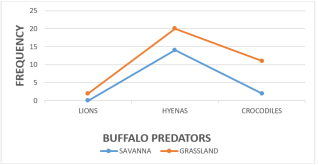
The predation of African buffalo showed a significant association on Habitat r = 0.303 P<0.05 (
Figure 2), Water sources r = 0.405 P = 0.019 (
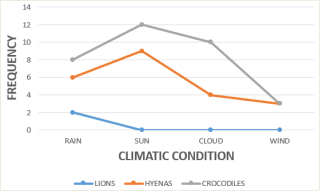
Figure 3), Climatic conditions X
2 = 11.827 df=6 P<0.05 (
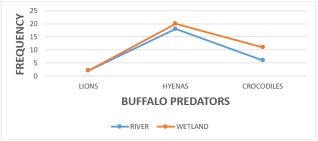
Figure 4), Humidity X
2 = 4.813 df=4 P<0.05 (
Figure 5), and Human and Encroachment X
2 = 11.741 df=4 P=0.019 (
Figure 6) respectively. The habitats within Mbam et Djerem National Park, including savannah grasslands and deciduous forests, significantly influence the behavior and survival of prey species, particularly the African buffalo (
Syncerus caffer). Savannah grasslands provide essential grazing grounds, facilitating the buffalo's foraging behavior and impacting their population dynamics. The availability of diverse grasses influences the herd's distribution and movements. Deciduous forests offer protection from predators and harsh weather conditions. The presence of dense undergrowth allows buffalo to seek refuge, especially during periods of high predation risk. Buffalo often congregate near rivers and waterholes, which are vital for hydration. These areas can also attract predators, as they provide opportunities for hunting. During the dry season, water sources may dwindle, forcing buffalo to travel longer distances, making them more vulnerable to predation. The concentration of animals around limited water sources can create predictable hunting grounds for predators.
Climatic conditions, including temperature and precipitation, play a significant role in shaping the ecosystem dynamics. The seasonal rains influence grass growth and water availability. Increased rainfall can lead to lush vegetation, supporting larger herds of buffalo and their prey. High temperatures can stress prey species, affecting their foraging efficiency and increasing vulnerability to predators. Conversely, cooler temperatures may enhance their foraging activity. High humidity can affect the buffalo's foraging patterns, as they may seek cooler, shaded areas during the hottest parts of the day. This behavior can influence their interactions with predators. Elevated humidity levels can also facilitate the spread of diseases among buffalo, potentially reducing their populations and altering predator-prey dynamics.
Figure 2. Buffalo Predation and Habitat.
Figure 3. Predation and Water Sources.
Figure 4. Predation and Climatic Conditions.
Figure 5. Predation and Humidity.
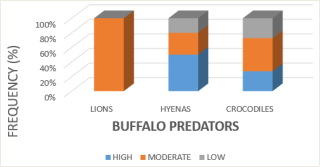
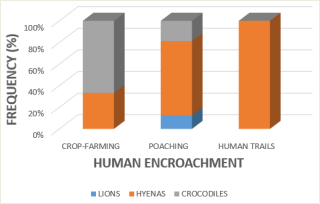
Figure 6. Predation and Human Encroachment.
Human activities, such as agriculture and settlement expansion, significantly impact the habitat and behavior of wildlife in the park. Encroachment leads to habitat fragmentation, reducing the available space for buffalo and increasing competition for resources. This fragmentation can force buffalo into smaller areas, making them more susceptible to predation. Human development can disrupt natural water sources, limiting access for wildlife and forcing them to adapt their movements, often putting them at greater risk from predators. As human activities expand, conflicts between humans and wildlife may increase, leading to further stress on buffalo populations and altering their natural behaviors. The interplay of habitat, water sources, climatic conditions, humidity, and human encroachment plays a critical role in shaping the dynamics of prey populations during the predation of African buffalo in Mbam et Djerem National Park. Understanding these influences is essential for effective conservation and management strategies aimed at preserving both predator and prey species within this vital ecosystem.
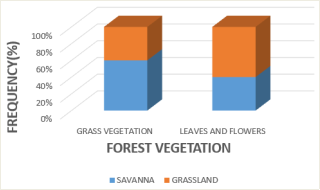
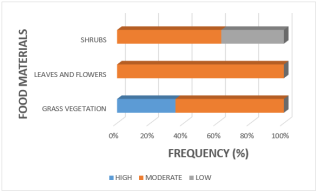
Figure 7. Habitat and Food Resource.
Figure 8. Habitat and Environmental Temperature.
Habitat has shown a significance on food resources X
2 = 2.972 df=2 P<0.05 (
Figure 7) and environmental temperature rating r=0.571 P=0.001 (
Figure 8) respectively. The type of habitat significantly affects the availability and quality of food resources for African buffalo (
Syncerus caffer). Different habitats, such as savannah grasslands and deciduous forests, offer varying types of vegetation that influence buffalo foraging behavior. In savannah grasslands, buffalo benefit from abundant grasses, which are a primary food source. The diversity and density of grass species play a critical role in their nutrition and health. The presence of forbs and shrubs in mixed habitats can supplement their diet, particularly during dry seasons when grass availability diminishes. Seasonal changes in habitat can lead to fluctuations in food availability. During the rainy season, the growth of lush grass attracts buffalo, while during the dry season, they may need to migrate to find adequate food resources, impacting their energy levels and vulnerability to predators. The habitat also influences competition for food resources among different herbivore species. In areas where buffalo share habitat with other grazers, competition can limit their access to prime grazing areas, affecting their overall health and population dynamics. Buffalo habitats create microclimates that can moderate environmental temperatures. Dense vegetation in forests or shaded areas in savannahs can provide relief from extreme heat, enabling buffalo to remain active during warmer periods. Conversely, open grasslands expose buffalo to direct sunlight, leading to higher temperatures that can induce heat stress, particularly during the hottest parts of the day. The ability of buffalo to regulate their body temperature is influenced by their habitat. In shaded areas, they can find cooler spots to rest, which is essential for maintaining hydration and energy levels, especially in high-temperature environments. Changing climatic conditions may alter habitat structures, affecting both food resources and temperature regulation. Increased temperatures and altered precipitation patterns can lead to habitat degradation, impacting grass growth and the availability of shade, which may stress buffalo populations. The habitat of African buffalo significantly influences their access to food resources and their ability to cope with environmental temperatures. Understanding these relationships is crucial for effective conservation strategies, particularly in the face of habitat changes and climate variability. Maintaining diverse habitats that provide adequate food and shelter is essential for the health and survival of buffalo populations.
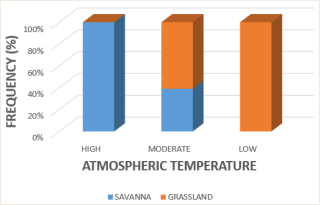
Figure 9. Atmospheric Temperature and Buffalo Food.
Also, there was a significant association between atmospheric temperature rating X
2 = 14.707 df=4 P=0.005 (
Figure 9). Atmospheric temperature plays a critical role in shaping the availability and quality of food resources for African buffalo (
Syncerus caffer). Temperatures within a certain range promote optimal growth conditions for grasses and other forage species. Warm temperatures can enhance photosynthesis and growth rates, leading to abundant food resources during favorable seasons. Excessively high temperatures can stress plants, reducing their growth and overall productivity. During extreme heat, some grasses may wilt or die, leading to decreased food availability for buffalo. Seasonal fluctuations in temperature affect the timing of plant growth cycles. Warmer temperatures in the rainy season can lead to earlier grass growth, providing food resources at critical times for buffalo. In contrast, high temperatures during the dry season can lead to reduced forage quality. Grasses may become tougher and less palatable, making it difficult for buffalo to obtain necessary nutrients. Higher atmospheric temperatures increase evaporation rates, which can reduce water availability in grazing areas. Water stress can impact plant health, leading to lower forage quality and quantity. As water sources dwindle due to heat, buffalo may be forced to migrate longer distances to find adequate food and hydration, potentially exposing them to increased predation risks. Atmospheric temperature can affect the nutrient composition of forage. For example, high temperatures can lead to higher fiber content in grasses, making them less digestible and reducing their nutritional value. Poor-quality forage due to high temperatures can lead to malnutrition in buffalo, affecting their reproductive success, growth rates, and overall health. As temperatures rise and food resources become scarcer, competition among herbivores for available forage can intensify. This competition can force buffalo into less optimal feeding areas, further impacting their food intake and health. Atmospheric temperature significantly influences the food resources available to African buffalo. Understanding these impacts is essential for effective management and conservation strategies, especially in the context of climate change. Ensuring that buffalo have access to diverse habitats that can support their food needs under varying temperature conditions is crucial for their survival and well-being.
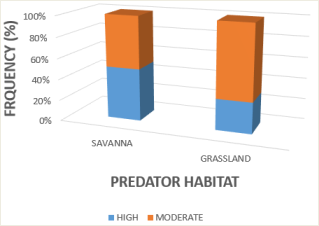
A significant correlation was recorded between humidity rating and predatory habitat r=0.211 P<0.05 (
Figure 10). Humidity affects the availability and palatability of forage. Higher humidity can promote lush vegetation growth, providing abundant food resources for African buffalo (
Syncerus caffer). Conversely, low humidity levels can lead to drier conditions, reducing grass quality and availability. Buffalo may adjust their feeding behavior based on humidity. In high humidity, they are likely to feed more actively during the day, while in lower humidity, they may seek shade during the hottest hours, influencing their overall foraging efficiency. High humidity can help buffalo maintain hydration levels, as they may experience less water loss through evaporation. However, excessively high humidity combined with high temperatures can lead to heat stress, affecting their health and reproductive success. Humidity levels can influence the prevalence of diseases among buffalo populations. High humidity can facilitate the spread of parasites and diseases, potentially impacting population health and dynamics. The presence of predators, such as lions (
Panthera leo), Crocodile (
Crocodylus niloticus), hyenas (
Crocuta crocuta), influences buffalo distribution and behavior. Predatory habitats typically feature dense cover, which provides ambush opportunities for predators. Buffalo are known to adapt their movement patterns to avoid areas with high predator presence. This behavioral adaptation can lead to changes in grazing areas, impacting their access to food resources. High predation pressure can influence buffalo population dynamics, leading to lower population densities in areas with abundant predators. This can result in reduced breeding success and increased mortality rates among calves. The presence of predators can affect the social behavior of buffalo herds. In areas with high predation risk, buffalo may form larger, more cohesive herds for protection, which can influence their overall population stability. Human encroachment can fragment habitats, disrupting the balance between buffalo and their predators. Fragmented habitats may limit buffalo access to food and water while concentrating them in smaller areas, increasing vulnerability to predation. Understanding the interplay between humidity, predatory habitats, and buffalo populations is crucial for effective conservation strategies. Maintaining a balance of suitable habitats that support both buffalo and their predators is essential for ecosystem health. Humidity and predatory habitat significantly influence the population dynamics of African buffalo in national parks. These factors affect food availability, health, behavior, and social structure, ultimately shaping buffalo populations. Effective conservation efforts must consider these influences to ensure the stability and health of buffalo populations within their ecosystems.
Figure 10. Humidity and Predators Habitat.
4. Discussion
Predators such as lions (
Panthera leo), hyenas (
Crocuta crocuta), and crocodiles significantly influence the population distribution of African buffalo (
Syncerus caffer) in national parks. These predators, along with African wild dogs and leopards, primarily target vulnerable individuals, such as calves, the sick, or those isolated from the herd. The impact of these predators leads to various behavioral and distributional adaptations in buffalo populations. Buffalo exhibit strong herding behavior, congregating in large numbers to reduce the individual risk of predation
. Large herds decrease the chance of any single buffalo being targeted by predators like lions. Buffalo display a preference for riverine habitats, especially during the dry season and rarely venture far from water sources. This is partly due to the need for water but also influences their vulnerability to crocodiles
| [6] | Cornélis, D., et al. (2014). Habitat, space use and feeding ecology of the African buffalo. In The Ecology of the African Buffalo: Exploring New Paths for a Keystone Species. Cambridge University Press. |
| [26] | Sinclair, A. R. E. (1974). Predation appears to have played only a minor role in regulating buffalo numbers in Mara–Serengeti since the late 1950s. Wildlife Research. |
[6, 26]
. Buffalo are known for their aggressive defense, often forming a united front against predators. They may charge at threats, using their horns to ward off aggressors, and have even been observed rescuing members of their herd from predators.
Within a herd, buffalo exhibit vigilance behavior, with individuals taking turns to watch for potential threats. Larger groups allow individuals to spend more time grazing and less time being vigilant
| [24] | Prins, H. H. T. (1986). The role of the African buffalo (Syncerus caffer) in the ecosystem. Journal of African Ecology, 24(3), 123-135. |
[24]
. Lions are a primary predator of buffalo, and in some regions, buffalo constitute their main prey
| [12] | Hayward, M. W., & Kerley, G. I. H. (2005). Prey preferences of the lion Panthera leo. Mammal Review, 35(2), 123-148. |
[12]
. Lion predation can be influenced by ecological conditions, with increased predation during drought. Male lions tend to prey on buffalo more than lionesses, who focus on smaller ungulates. Spotted hyenas are also significant predators, particularly targeting calves and weakened individuals. While not always observed attacking buffalo, scat analyses indicate they form a notable part of their diet
| [13] | Holekamp, K. E., Ogutu, J. O., Dublin, H. T., Bhalla, S., Peters, M. D., Zakayo, V., & Quimby, B. (1999). Body condition and demography of spotted hyenas in a pastoral ecosystem. Journal of Wildlife Management, 63(4), 1218-1227. |
[13]
. Nile crocodiles pose a threat, especially to solitary animals, young calves, and occasionally healthy adults. Exceptionally large crocodiles may become habitual predators of buffalo. Rainfall patterns influence buffalo distribution and their vulnerability to predation. Drought conditions can weaken buffalo, making them more susceptible to lion predation
| [9] | Funston, P. J., & Mills, M. G. L. (2006). The influence of lion predation on the population dynamics of common large ungulates in the Kruger National Park. South African Journal of Wildlife Research, 36(1), 9-22. |
| [19] | Mills, M. G. L., et al. (1995). Work carried out in the Kruger National Park, South Africa. Wildlife Research. |
| [22] | Owen-Smith, N., & Mills, M. G. L. (2008). Lions switch their prey selection in favour of buffalo after droughts. Wildlife Research. |
[9, 19, 22]
.
Climatic conditions significantly influence the feeding and social behavior of African buffalo and the predatory strategies of lions, crocodiles, and hyenas in Mbam et Djerem National Park, Cameroon. The park, located in a transitional zone between forest and savanna, experiences distinct wet and dry seasons, which shape the interactions between predators and their buffalo prey
| [5] | Caron, A., Bennitt, E., Wielgus, E., Cornélis, D., Miguel, E., & de Garine-Wichatitsky, M. (2023). African Buffalo Social Dynamics: What Is a Buffalo Herd? In Ecology and Management of the African Buffalo (pp. 153-179). Cambridge University Press. |
| [24] | Prins, H. H. T. (1986). The role of the African buffalo (Syncerus caffer) in the ecosystem. Journal of African Ecology, 24(3), 123-135. |
[5, 24]
. During the wet season (roughly March to October, with a small rainy season from March-June and a big rainy season from July-October), increased rainfall leads to abundant vegetation and water availability
. This allows buffalo herds to disperse more widely across the landscape, reducing their density in specific areas
. The wide dispersion of buffalo herds and the dense vegetation cover make it more difficult for predators like lions and hyenas to locate and successfully hunt buffalo
| [21] | Owen-Smith, N. (Ed.). (2019). Ecology and Management of the African Buffalo. Cambridge University Press. |
[21]
. The increased availability of water also means buffalo are not restricted to specific water sources, reducing the chances of ambush by crocodiles
| [24] | Prins, H. H. T. (1986). The role of the African buffalo (Syncerus caffer) in the ecosystem. Journal of African Ecology, 24(3), 123-135. |
[24]
. With ample resources, buffalo social dynamics may shift. There may be less competition for grazing, potentially leading to decreased aggression within herds
. Calving season often coincides with the wet season, providing young buffalo with better access to food and cover
.
As the dry season progresses (November to February), water and grazing resources become scarce
. Buffalo herds concentrate around remaining water sources and areas with persistent grazing, increasing their density and predictability
| [24] | Prins, H. H. T. (1986). The role of the African buffalo (Syncerus caffer) in the ecosystem. Journal of African Ecology, 24(3), 123-135. |
[24]
. The concentration of buffalo herds makes them easier targets for predators
| [24] | Prins, H. H. T. (1986). The role of the African buffalo (Syncerus caffer) in the ecosystem. Journal of African Ecology, 24(3), 123-135. |
[24]
. Lions, in particular, may focus their hunting efforts on these concentrated herds (PBS, 2024). Crocodiles also benefit, as buffalo are forced to frequent water sources, increasing their vulnerability to ambush
. Drought conditions can weaken buffalo, making them more susceptible to lion predation
| [9] | Funston, P. J., & Mills, M. G. L. (2006). The influence of lion predation on the population dynamics of common large ungulates in the Kruger National Park. South African Journal of Wildlife Research, 36(1), 9-22. |
[9]
(Funston & Mills, 2006). Lions may also adjust their hunting strategies, with male lions potentially focusing more on buffalo while lionesses target smaller ungulates
| [12] | Hayward, M. W., & Kerley, G. I. H. (2005). Prey preferences of the lion Panthera leo. Mammal Review, 35(2), 123-148. |
[12]
. Hyenas may scavenge more during this time, capitalizing on kills made by lions or other predators
| [13] | Holekamp, K. E., Ogutu, J. O., Dublin, H. T., Bhalla, S., Peters, M. D., Zakayo, V., & Quimby, B. (1999). Body condition and demography of spotted hyenas in a pastoral ecosystem. Journal of Wildlife Management, 63(4), 1218-1227. |
[13]
. Competition for limited resources during the dry season can increase stress within buffalo herds, potentially leading to more frequent conflicts and changes in social structure
| [5] | Caron, A., Bennitt, E., Wielgus, E., Cornélis, D., Miguel, E., & de Garine-Wichatitsky, M. (2023). African Buffalo Social Dynamics: What Is a Buffalo Herd? In Ecology and Management of the African Buffalo (pp. 153-179). Cambridge University Press. |
[5]
. Lions may exhibit increased hunting success during droughts due to weakened prey and concentrated herds
| [9] | Funston, P. J., & Mills, M. G. L. (2006). The influence of lion predation on the population dynamics of common large ungulates in the Kruger National Park. South African Journal of Wildlife Research, 36(1), 9-22. |
[9]
. Crocodiles rely on ambush tactics, and their success is tied to buffalo needing to access water sources, which is more predictable during the dry season
. Hyenas, as opportunistic predators and scavengers, can adapt to both wet and dry conditions, preying on vulnerable buffalo and scavenging from other predator kills
| [13] | Holekamp, K. E., Ogutu, J. O., Dublin, H. T., Bhalla, S., Peters, M. D., Zakayo, V., & Quimby, B. (1999). Body condition and demography of spotted hyenas in a pastoral ecosystem. Journal of Wildlife Management, 63(4), 1218-1227. |
[13]
. It's important to note that climate change exacerbates these seasonal pressures by altering rainfall patterns and water availability
.
5. Conclusion
Climatic conditions significantly influence the predation of African buffalo in Sub-Saharan African protected areas. Droughts, changing rainfall patterns, and habitat alterations all play a role in shaping predator-prey interactions. Effective conservation strategies that consider these climatic influences are essential for maintaining healthy buffalo populations and preserving ecosystem balance. Further research is needed to fully understand the complex interplay between climate change, predation, and buffalo ecology, ensuring informed conservation management in the face of an uncertain future. This study highlights the intricate interplay between predation dynamics and climatic factors affecting the African buffalo (Syncerus caffer) in Mbam et Djerem National Park, Cameroon. Our findings indicate that predation pressure, primarily from large carnivores, significantly influences buffalo population dynamics and distribution patterns. Furthermore, climate variability, characterized by changes in temperature and precipitation, exacerbates these pressures by altering habitat availability and food resources. The research underscores the importance of effective wildlife management strategies that consider both biotic interactions and environmental conditions. Adaptive management practices, such as habitat restoration and the protection of predator-prey relationships, are essential to ensure the sustainability of buffalo populations in the face of climate change. By understanding the dual impacts of predation and climate on African buffalo, conservation efforts can be better tailored to maintain biodiversity and ecosystem health in this vital region of Cameroon.

 ,
Ewane Divine
,
Ewane Divine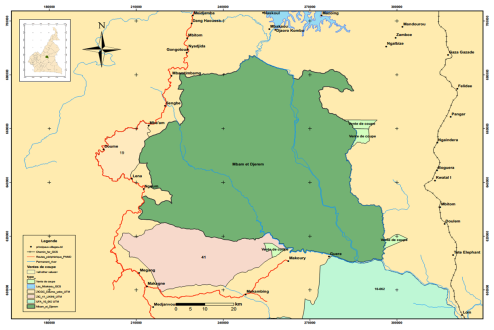



 Share This Article
 Twitter
 Linked In
 Facebook
 Copy
Copy Download