Research Article | | Peer-Reviewed

Estimating the Amount Litterfall and the Rate of Decomposition: The Case of Two Selected Agroforestry Species in the Aba Gerima Watershed, Northwest Ethiopia

Received: 27 August 2026     Accepted: 8 September 2026     Published: 24 September 2026
Views:       Downloads:
Abstract

Litter decomposition is influenced by litter quality, decomposer activity, macro- and microclimatic conditions, and soil nutrient status, while mixing leaves of species with different resource qualities and structural characteristics can further modify the physical and chemical environment in which decomposition occurs. The selection and use of appropriate agroforestry tree species that maintain soil nutrients thereby improving productivity remains to challenge in low-input agricultural systems. Therefore, this research focuses on two agroforestry tree species, C.macrostachyus and C.africana. This study evaluated the litterfall and decomposition rates of two agroforestry tree species, C. macrostachyus, and C. africana, in the Aba Gerima watershed to improve soil nutrient management in low-input agricultural systems. Using litter-bag techniques and RCBD design, estimating the amount of litterfall was collected every 15 days from February to May 2023, and decomposition rates were monitored over 30, 60, 90, and 120 days during both dry and wet seasons for February to May 2023 and June to September 2023, respectively. Soil samples were analyzed for physicochemical properties of the under-canopy and outside-canopy. Results indicated that C. africana produced more litterfall (5.89 t/ha) compared to C. macrostachyus (5.19 t/ha). However, C. macrostachyus decomposed faster, with higher mass loss (94% in the dry season) and a greater impact on soil nutrient input. Both species showed no significant difference in decomposition during the wet season. The study concludes that litterfall and organic matter from C. macrostachyus and C. africana can be used as mulch or compost to enhance soil fertility. Raising community awareness about conserving these trees in cropland and homegarden agroforestry practices can improve soil fertility and crop productivity.

Published in World Journal of Health Services Research (Volume 1, Issue 1)
DOI 10.11648/j.wjhsr.20260101.16
Page(s) 54-62
Creative Commons

This is an Open Access article, distributed under the terms of the Creative Commons Attribution 4.0 International License (http://creativecommons.org/licenses/by/4.0/), which permits unrestricted use, distribution and reproduction in any medium or format, provided the original work is properly cited.

Copyright

Copyright © The Author(s), 2026. Published by Science Publishing Group

Keywords

Litterfall, Decomposition Rate, Agroforestry System, C. Macrostachyus, C. Africana

1. Introduction
Agroforestry (AF) is a dynamic, ecologically oriented plan for managing natural resources that diversifies and sustains smallholder production on farm and range land for greater social, economic, and environmental advantages . Litterfall is considered to be one of the most critical ecological processes in agroforestry systems and is a key component of the system's biogeochemical cycle of matter . Dead animal matter is primarily decomposed by bacteria, while fungi are the main decomposers of dead plant material. The main process, known as lighting decomposition, is highly complex and can be further divided into many sub-processes . In agricultural environments, a more diversified soil fauna community causes faster decomposition but has minimal effect on the overall rate of decomposition . In the study area, farmers maintain or plant valuable tree species such as Croton macrostachyus, Cordia africana, Milletia ferruginea, Albizia gummifera, Mangifera indica, and Persea American in their agroforestry practice. The relative abundance of trees in residential areas compared to croplands indicates improvement of soil organisms, soil enhancement, maintaining soil fertility, and sustainable productivity. The plants in the highlands of north-western Ethiopia have not been sufficient for the amount of litterfall and subsequent decomposition rates. Litterfall is often used for firewood. Farmers would have benefited more by incorporating tree litter into the soil, which can enhance the overall productivity and sustainability of their agricultural land . Therefore, the goal of this study is to determine the amount of litter released and the rate of decomposition and incorporation into the soil nutrient content of input for Croton macrostachyus and Cordia africana species. It is also to find out which species of tree decomposes faster. i) To quantify and compare the amount of leaf litterfall from Croton macrostachyus and Cordia africana from the watershed of the study area. ii) To measure and compare the rate of decomposition of litterfall for Croton macrostachyus and Cordia africana in the watershed.
2. Methodogy
2.1. Study Site Description
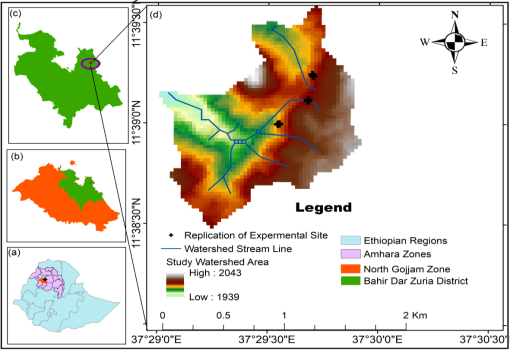
Aba Gerima watershed is bounded by two Kebeles namely, Gonibat Aba Gerima to the north and North West and Laguna Abune Hana to the south and South West, but the majority of the watershed is found in Gonibat Aba Gerima Kebele. Aba Gerima watershed covers an area of 900 ha. The watershed is part of Tana Sub-basin located nearby Lake Tana. The study watershed is located between 11o38'30" and 11o41'30"N latitude and 37o29'0" and 37o31'0"E longitude (Figure 1). The location of the watershed is between 1600 and 2200 m.a.s.l. The elevation in the study watersheds ranges from 1880 m to 2078m, which is typical for a tropical highland environment.
Figure 1. Study area location.
Figure 1 indicates (a) a Map of Ethiopia and Amhara region, (b) the North Gojjam Zone, (c) Indicates Bahir Dar Zuria District, and (d) Indicate Aba Gerima watershed area, watershed streams feature, and experimental site.
2.2. Sampling Technique
2.2.1. Selection of the Specific Tree Species
The dominant tree species in the Aba Gerima watershed were Croton macrostachyus and Cordia africana. Therefore, these two agroforestry species were found to be appropriate for this study. The selected watershed with these tree species is characterized by approximately similar slopes where under the shade of these tree species Rhamnus prinoides and Coffea arabica were grown as the main socioeconomic cash crop of the area. The sampled trees taken also have a more or less similar management history. On the selected field, individual trees of Croton macrostachyus and Cordia africana having approximately similar height, diameter at breast height (DBH), crown diameter, and uniform site conditions were taken to factors nearly constant. The potential candidate trees identified, three individual Croton macrostachyus and Cordia africana trees were selected purposively for this study.
2.2.2. The Estimating of Leaf Litter Collection
For this study, litterfall samples were collected from isolated trees of the species Croton macrostachyus and Cordia africana growing in the same soil type, landscape location, and roughly comparable age of the tree species. Leaf litter from the selected tree species was collected every 15 days using litter bags from February 2023 to May 2023 to estimate litterfall. In the four sides of the tree canopy 1.5×1.5 meter plots were laid for each tree species beneath the canopy. The three replicate plots each containing four composite litter bags contain the 24 bag samples of each species. After the bags had been used for approximately four months, one sample bag of each species was taken from each plot every two weeks. A total of 24 sample bags were installed, i.e. 2×3×4 each (tree species, replication, and sample bags). The sample bags in the four directions were mixed and six composite samples were taken for analysis from each sample tree.
Calculate the crown area; (assuming an elliptical crown shape) using the formula .
ca = π(d/2) × (w/2)(1)
Where d is the crown diameter at its widest point and w is the perpendicular crown extent at the same height.
The amount of litterfall: The litter trap samples were estimated from the litterfall plot established beneath the tree and litterfall samples were collected every two weeks the amount of litter was determined using the plot area (m2), the canopy or crown area (m2), and the amount of litterfall (g) collected (2):
Amount oflitterfall (g)= Tree crown area m2×litterfall collected (g)Plot area (m2)(2)
2.2.3. Rate of Decomposition
Leaf litter decomposition was studied using the standard litter bag method defined by (Swift & Anderson, 1989). The 10 × 10 cm nylon mesh bags with a mesh size of 2 mm are used to hold batches of 5g of leaf litter oven-dried at 65oand 24 hours. Litter bags were placed and buried into the soil layer about 2cm deep in the ground where they were exposed to weathering and soil-borne decomposers. The data collection continued from February 2023 to September 2023, covering both the dry and wet seasons. Nylon meshes were installed in the dry and wet seasons, from February 2023 to September 2023. For each dry and wet season, species there were 24 bag samples; the three replication plots, each with four assembled litter bags. After using the litter bag technique in nylon mesh bags for approximately eight consecutive months, one sample bag of each species was removed from each plot every month . During the dry season, 24 samples were collected using the nylon mesh bag technique, i.e. 2×3×4 (tree species, replication, and sample bag). Similarly, 24 sample bags were used for the wet season. A total of 48 sample bags were installed, i.e. 2×3×4×2 (tree species, replication, sample bag, and seasonal variation).
Decomposition rate (k): The litter decomposition rate was calculated using the formula procedures.
Kt= - ln (Xt/Xo) andk= -ln(Wt/ Wo)t Or (3)
(R) = Wo-Wtt(4)
where: (R/k) is the decomposition rate (g/months), t is the time of observation (months), Wo, Xo is the initial dry weight of litter (gr), and Wt, Xt is the final dry weight of litter (g) time, and Half-life periods t (0.5) of decomposing litter samples were estimated from k values using
Mass loss (%): The estimated oven-dry weight of the litter samples that are collected each month was used to calculate the decrease in weight [mass loss (%) and remaining mass (g)] of all the leaf litter collected for four months of each season .
Mass loss%=Initial weight -Final weightInitial weight×100 (5)
Mass remaining in the litter bag = 100 -% Mass Loss(6)
2.3. Data Analysis
Descriptive statistics was used to determine leaf litter, decomposition rate, and soil nutrient status under Croton macrostachyus and Cordia africana tree species. A one-way analysis of variance (ANOVA) was used to compare the amount of litterfall and rate of the decomposition between, and Croton macrostachyus and Cordia africana tree species. The LSD (Least Significant Difference) test was used to compare means at significance levels of 0.05. All statistical analysis was performed using Microsoft Office Excel and SAS 9.4 software.
3. Results and Discussion
3.1. The Amount of Litterfall for Croton macrostachyus and Cordia africana
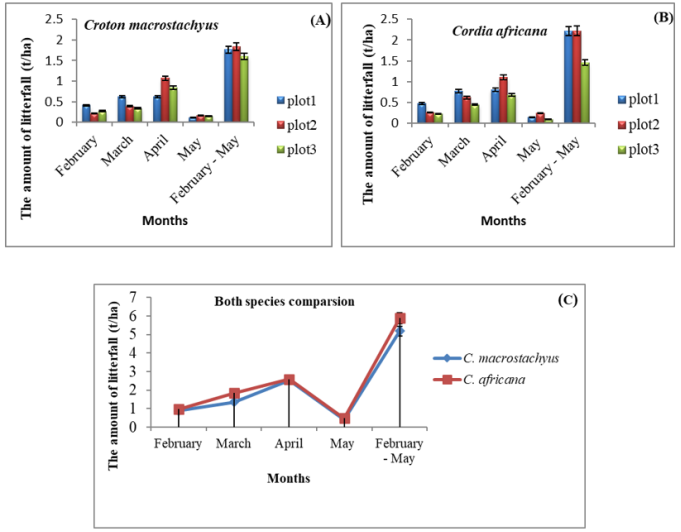
The litterfall collected from Croton macrostachyus and Cordia africana, in four months the two tree species of the crown litterfall were 1.76 t/ha, 1.83 t/ha, and 1.6 t/ha at plot1, plot2, and plot3 sites, respectively. At plot1, plot2, and plot3 sites, it was 2.21 t/ha, 2.2 t/ha, and 1.46 t/ha of the equivalent per the canopy of litterfall. From the amount of litter collected, it is evident that the mean difference between the Croton macrostachyus and Cordia africana species was significant (Figure 2. A, B, C). The variation in litterfall between the two species suggests that the disturbance has a substantial impact on the soil physicochemical properties, as can be illustrated later. Croton macrostachyus and Cordia africana species have a total amount of form four-month litterfall of 5.19 t/ha and 5.89 t/ha respectively, (which is equivalent to the crown area of both tree species), respectively, in four months. The amount of litterfall for the Cordia africana is greater than Croton macrostachyus. The trend of amount of monthly litterfall in February, March, April, and May were 0.89 t/ha, 1.35 t/ha, 2.53 t/ha, and 0.42 t/ha for Croton macrostachyus and 0.97 t/ha, 1.84 t/ha, 2.54 t/ha, and 0.49 t/ha for Cordia africana respectively; indicating that litterfall peaks in April and radically decline in May for both species (Figure 2. a, b, c). In the agroforestry system of the Aba Gerima watershed, the fractions and the total litterfall between Croton macrostachyus and Cordia africana revealed substantial differences in the total amount of litterfall.
Figure 2. A) The amount of litterfall Croton macrostachyus, B) the amount of Cordia africana litterfall, and C) the total amount of litterfall for both species throughout four months in Aba Gerima watershed.
This finding is supported by studies carried out in the tropics by many different researchers who reported comparable results . According to , they reported 3.6 to 12.4 t/ha/year litterfall in the tropical moist forest. In addition reported by , the mean annual dry masses of litterfall were 10.76 t/ha/yr and 6.64 t/ha/yr in lower-distributed and high-distributed sites, respectively. The high value of reproductive parts as a fraction of litterfall was recorded in March, April, December, January, and February in both lower-distributed and high-distributed sites of the forest, which might indicate the flowering and fruiting seasons of some of the forest species. Moreover, a significant difference in the mean dry weight of litterfall was observed between lower-distributed and high-distributed sites of the forest . In Southern Ethiopia, , found that among deciduous plantation species and natural forests, litter production rates ranging from 9.7 to 12.6 t/ha/year occurred. In the Ethiopian Highlands, , reported the annual fine litter production ranging from 5.0 to 6.5 t/ha in tree plantations and 10.9 Mg/ha in a natural forest relatively higher than the present value.
3.2. The Rate of Decomposition of the Litterfall for Croton macrostachyus and Cordia africana
3.2.1. The Effect of Tree Species on Mass Loss for 120 Days of the Dry and Wet Season
The result showed that the dry and wet season maximum mass remaining for Cordia africana was lower than Croton macrostachyus over the entire experimental period (Figure 2). In the dry season, the mass loss in the first 30 days was 3.9% for Cordia africana and 10.3% for Croton macrostachyus. On the 60th and 90th days, the leaf litter mass loss for Cordia africana was 15.3% and 30.4%, respectively, compared to 44.3% and 72.5%, respectively for Croton macrostachyus. During the wet season, the percentage of remaining mass loss after the initial 30 days showed variations from 55% for Cordia africana and 76.3% for Croton macrostachyus. Subsequently, on the 60th and 90th days, the mass loss of leaf litter still present was recorded at 80.3% and 97.7% for Cordia africana, respectively. In contrast, for Croton macrostachyus, these values were 85.3% and 99.7% for the 60th and 90th days incubation periods, respectively. The mass losses of the rate of decomposition after 120 days of the dry season were 47% and 94% for Cordia africana and Croton macrostachyus, respectively. However, during the 120-day incubation period of the wet season, there was a constant mass loss due to the decomposition of both tree species. Additionally, Croton macrostachyus experienced greater mass loss throughout the sampling days than Cordia africana (Table 1). The decomposition rates of the two species were higher significantly different except for 120 days of the wet season. Besides, the litter mass loss during the dry season was lower than that of the wet season.
Table 1. The effect of species on litter mass loss at different stages of decomposition for 120 days in the dry and wet seasons.

Incubation period (day) KD (gday-1)

Species ±

30D

60D

90D

120D

The dry season mass loss% of mean value and std dev. Respectively

C. Macrostachyus

10.33 ± 3.44867

44.33 ± 4.22532

72.53 ± 2.90057

94.00 ± 3.34066

Cordia Africana

3.87 ± 1.50111

15.33 ± 1.94251

30.40 ± 4.27551

47.93 ± 8.01332

R-Square

0.956

0.995

0.992

0.991

CV

19.952

5.825

6.207

5.259

LSD (0.05)

4.977*

6.105**

11.244**

13.11**

The wet season mass loss% mean value and std dev. Respectively

C. Macrostachyus

76.33 ±.90185

85.93 ±.50332

99.70 ±.08718

100.00 ±.00000

Cordia Africana

55.00 ±1.24900

80.33 ±1.10151

97.66 ±.30551

100.00 ±.00000

R-Square

0.994

0.949

0.987

0

CV

2.179

1.361

0.209

0

LSD (0.05)

5.026**

3.975**

0724*

Ns

According to a research finding on the pattern of leaf litter decomposition (weight loss) of tree species , weight loss in alder was initially slower than in leaves of Khasi pine needles and Khasi mandarin for about a month. Comparisons of the potential nutrient content (N, P, and K) in the leaf litter of each tree species revealed that the leaf litter of Croton macrostachyus exhibited a significantly higher K value (P < 0.05) in comparison to the leaf litter of Cordia africana and Hygenia abyssinica. Moreover, both Croton macrostachyus and Hygenia abyssinica demonstrated a higher concentration of N and P than Cordia africana . Soil organic matter content was determined from the mass loss process and decomposition rate to show a positive correlation of p=0.631 and an effect of 32.3% and 32.8%, respectively, on the CO2 flux emitted from the soil . The maximum weight loss percentage was for Acacia nilotica at week seven (55.36%), followed by Prosopis juliflora (55.04%), and the differences in percentage mass loss of leaf litter from the first to the seventh week of decomposition decreased by 10.64, 7.69, 4.62, 4.5, and 3.95 percent, respectively due to winter conditions . This is substantiated, by , who reported the components and the total litterfall also showed a significant difference between wet and dry seasons in the forest. This result was in line with , who reported a significant difference in litter production among studied species (P < 0.05). Also, there was a significant difference in decay constant among studied species (P < 0.05) and indigenous species such as Coffea arabica, Cordia africana, and Millettia ferruginea showed a greater value of the decay constant as compared to exotic species such as Eucalyptus camaldulensis, Persea Americana, and Mangifera indica. Coffea arabica showed the fastest decomposition with a decay constant of 2.4 while it was 1.1 for Eucalyptus camaldulensis. In addition reported by , the reduction of residual litter mass in the bags at each sampling time (measured in months) showed an exponential decline across all plantation species and in the natural forest.
3.2.2. The Effect of Tree Species on Decomposition Rate Constant (K) for 120 Days in the Dry and Wet Season
The dry and wet season decomposition rate (g/day) of the studied foliage litter materials has shown a different pattern. In this study, the rate of decomposition constant (K) levels was significantly high (P < 0.05) for Croton macrostachyus and Cordia africana during the 120 days of incubation periods. In the dry season, the rate of decomposition during the first 30 days varied from 0.0172 g/day for Croton macrostachyus and 0.0064 g/day for Cordia africana. On the 60th day incubation period, the remaining leaf litterfall mass was 0.0369 g/day, and 0.0128 g/day, for Croton macrostachyus and Cordia africana, respectively. For the 90th and 120th days, the decomposition rate of leaf litter was 0.0169 g/day, and 0.0200 g/day in Cordia africana, respectively, compared to that of Croton macrostachyus, which was about 0.0403 g/day and 0.0392 g/day, respectively. The decomposition rates of Croton macrostachyus were recorded as the highest, ranging from 0.0172 to 0.0392 g/day for each 30-120 days sampling period. In contrast, Cordia africana displayed decomposition rates of 0.0064 to 0.0200 g/day for the same sampling period. During the wet season, the rate of decomposition for the 30-day incubation period varied from 0.1272 g/day and 0.0916 g/day for Croton macrostachyus and Cordia africana respectively. At the 60th day incubation period, the remaining leaf litter mass was 0.0716 g/day and 0.0669 g/day for Croton macrostachyus and Cordia africana, respectively. The decomposition rates of Croton macrostachyus were found to be the fastest with the range from 0.1272 to 0.0554 g/day for each 30-90 days sampling period, respectively. Cordia africana has decomposition rates in the range from 0.0916 to 0.0542 g/day for each 30-90 days incubation period respectively. Significant variation was not observed after the 90th and 120th days of the incubation period (P<0.05) for both tree species of Croton macrostachyus and Cordia africana with the range from 0.0554 to 0.0416 g/day and 0.0542 to 0.0416g/day, respectively (Table 2). Croton macrostachyus has a more rapid decomposition in the dry and wet seasons, than Cordia africana, because of the slow decomposition rate of Cordia africana despite the profuse leaf fall observed under its crowns. The rate of decomposition exhibited a significantly reduced pace during the dry season in comparison to the wet season in the case of these specific tree species. The shedding of reproductive components, namely fruits and flowers, displayed a pronounced seasonality, characterized by elevated quantities observed during the wet season.
Table 2. The effect of species on decomposition rates at different stages of decomposition for 120 days in the dry and wet seasons.

Incubation period (day)

KD (gday-1)

Species

30D

60D

90D

120D

The dry season decomposition rate of mean value and std dev. Respectively

C. macrostachyus

.0172a ±.00575

.0369a ±.00352

.0403a ±.00161

.0392a ±.00139

C. africana

.0064b ±.00250

.0128b ±.00162

.0169b ±.00238

.0200b ±.00334

R-Square

0.95788

0.9954

0.991917

0.989874

CV

19.48312

5.887841

6.477498

5.786078

LSD (0.05)

0.041*

0.000**

0.000**

0.001**

The Wet season decomposition rate of mean value and std dev. Respectively

C. macrostachyus

.1272a ±.00150

.0716a ±.00042

.0554a ±.00005

.0416 ±.000

Cordia africana

.0916b ±.00208

.0669b ±.00092

.0542b ±.00017

.0416 ±.000

R-Square

0.994045

0.948773

0.986737

0

CV

2.178605

1.360911

0.208824

0

LSD (0.05)

0.0084*

0.0033**

0.0004**

Ns

Levels of significance: p<0.05 (*), p< 0.001 (**) and NS is not significant.
Whereas: D is the interval dates, and CV is the coefficient of variation.
The mean daily decomposition rate constant of these two species in the dry season leaf litter ranged from 0.0064 to 0.0200 g/day, corresponding to 0.0172 to 0.0392 g/day of the present finding for Cordia africana and Croton macrostachyus. In addition, the wet season litterfall decomposition ranged from 0.0916 to 0.0416 g/day for Cordia africana and 0.1272 to 0.0416 g/day for Croton macrostachyus, respectively. Given that the experiment was conducted at three sites under the same climatic conditions, the difference that was found in the rate of decomposition values between the species can be a result of the different qualities of their litter. The result is supported by studies conducted in the tropics by many authors . There were highly significant (P < 0.05) variations between the species in the mass loss from the leaves of Cordia africana and Croton macrostachyus (Table 2). According to , the mass loss in Croton macrostachyus was greater than that of Cordia africana. Decomposition processes in ecosystems presumably contribute to the enhancement of soil fertility and the sustainability of agricultural productivity. In leaf litter decomposition, there is a loss of carbon as the litter decomposes. The increase in CO2 resulted from the activity of soil microorganisms and fauna. CO2, produced by the decomposition of organic matter, is affected by temperature changes . According to , the decomposition rate of conifer species such as Pinus patula exhibited a relatively lower value compared to that of broadleaved ones. Conversely, the production of litter under broad-leaved Eucalyptus was notably higher in comparison to coniferous species. In general, the process of litter decomposition was observed to be rapid across all species .
4. Conclusion
The study showed that the amount of litterfall and rate of decomposition were varies significantly between Cordia africana and Croton macrostachyus. The total amount of litterfall was greater for Croton macrostachyus than for Cordia africana. Besides, Croton macrostachyus was found to have a more rapid decomposition rate of litterfall than Cordia africana. This is due to the addition of nutrients through litterfall, root turnover, and microbial activities. In addition to social and economic benefits, Cordia africana and Croton macrostachyus based homegarden agroforestry contribute to improving soil fertility thereby enhancing productivity. Farmers maintained Cordia africana and Croton macrostachyus as agroforestry trees because of their economic, ecologic, and social importance. The recommendation are Croton macrostachyus is a fast-decomposing litterfall that is useful for compost preparation to supplement soil fertilizers than Cordia africana, therefore good decomposition and soil nutrient content and further research are required on the nutrient release aspect of other indigenous species. Cordia africana and Croton macrostachyus are important agroforestry tree species that contribute to enhanced decomposition rates and improved soil nutrient content and hence should be promoted for further development.
Abbreviations

AF

Agroforestry

ANOVA

A One-Way Analysis of Variance

BDUSL

Bahir Dar University Soil Laboratory

CBD

Complete Block Design

CO2

Carbon Dioxide

D

Date

DSRD

Dry Season Rate of Decomposition

Ha

Hectare

HFA,

Home Field Advantage

HGA

Homegarden Agroforestry

WSRD

Wet Season Rate of Decomposition

Author Contributions
Kerebih Aragaw Fentie: Conceptualization, Data curation, Formal Analysis, Investigation, Methodology, Resources, Software, Writing – original draft, Writing – review & editing
Habtamu Assaye Deffersha: Conceptualization, Supervision, Validation, Visualization, Writing – review & editing
Asmamaw Ketema Gizaw: Conceptualization, Data curation, Validation, Visualization, Writing – review & editing
Conflicts of Interest
The authors declare no conflicts of interest.
References
[1] Abraham Mahari. (2014). Leaf litter decomposition and nutrient release from Cordia africana Lam. and Croton macrostachyus Del. tree Species. Journal of Environment and Earth Science, 4(15), 1-8.
[2] Ambachew Demessie, Singh, B. R., Lal, R., & Strand, L. T. (2012). Leaf litterfall and litter decomposition under Eucalyptus and coniferous plantations in Gambo District, southern Ethiopia. Acta Agriculturae Scandinavica Section B: Soil and Plant Science, 62(5), 467-476.
[3] Bekele, W., Nigatu, L., & Wogi, L. (2021). Foliage Litter Decomposition of Agroforestry Shrub Species in Dello-Menna District of Bale Zone, Southeast Ethiopia. Journal of Environment and Earth Science, 8(May), 411–417.
[4] Chave, J., Navarrete, D., Almeida, S., Álvarez, E., Aragão, L. E. O. C., Bonal, D., Châtelet, P., Silva-Espejo, J. E., Goret, J. Y., Von Hildebrand, P., Jiménez, E., Patiño, S., Peñuela, M. C., Phillips, O. L., Stevenson, P., & Malhi, Y. (2010). Regional and seasonal patterns of litterfall in tropical South America. Biogeosciences, 7(1), 43-55.
[5] Darmawan, A. A., Ariyanto, D. P., Basuki, T. M., & Syamsiyah, J. (2021). Measuring of leaf litter decomposition rate and flux of carbon dioxide in various land cover in Gunung Bromo Education Forest, Karanganyar. IOP Conference Series: Earth and Environmental Science, 824(1), 1-9.
[6] Getachew, K., Itanna, F., & Mahari, A. (2015). Evaluation of locally available fertilizer tree/shrub species in Gozamin Woreda, North Central Ethiopia. Agriculture and Environmental Management, 4(3), 164-168.
[7] Hailie Shiferaw Wolle, Barberi, P., & Carlesi, S. (2021). Effect Of Homegarden And Parkland Agroforestry Practices In Ethiopia On Selected Soil Properties. African Journal of Food, Agriculture, Nutrition and Development, 21(5), 18115-18130.
[8] Kuyah, S., & Muthuri, C. (2012). Crown area allometries for estimation of aboveground tree biomass in agricultural landscapes of western Kenya. 267–277.
[9] Leakey, R. R. B. (2017). Definition of Agroforestry Revisited. Multifunctional Agriculture, February, 5-6.
[10] Lisanework, N., & Michelsen, A. (1994). Litterfall and nutrient release by decomposition in three plantations compared with a natural forest in the Ethiopian highland. Forest Ecology and Management, 65(2-3), 149-164.
[11] Liu, C., Westman, C. J., Berg, B., Kutsch, W., Wang, G. Z., Man, R., & Ilvesniemi, H. (2004). Variation in litterfall‐climate relationships between coniferous and broadleaf forests in Eurasia. Global Ecology and Biogeography, 13(2), 105-114.
[12] Makkonen, M., Berg, M. P., Handa, I. T., Hättenschwiler, S., van Ruijven, J., van Bodegom, P. M., & Aerts, R. (2012). Highly consistent effects of plant litter identity and functional traits on decomposition across a latitudinal gradient. Ecology Letters, 15(9), 1033–1041.
[13] Nivethadevi, P., Swaminathan, C., Sangeetha, K., Kannan, P., & Sivasankari, B. (2022). Evaluating Litter Decomposition Rate of Five Tropical Trees using Litter Bag Technique. Ecology, Environment and Conservation, 28, 191-197.
[14] Olsen, S. R. (1954). Estimation of available phosphorus in soils by extraction with sodium bicarbonate. US Department of Agriculture.
[15] Petit-aldana, J., Rahman, M. M., Parraguirre-lezama, C., Infante-cruz, A., & Romero-arenas, O. (2019). Litter Decomposition Process in Coffee Agroforestry Systems. Forest and Environmental Science, 35(2), 121-139.
[16] Staelens, J., Nachtergale, L., De Schrijver, A., Vanhellemont, M., Wuyts, K., & Verheyen, K. (2011). Spatio-temporal litterfall dynamics in a 60-year-old mixed deciduous forest. Annals of Forest Science, 68(1), 89-98.
[17] Talemos Seta, Demissew, S., & Woldu, Z. (2018). Litterfall dynamics in Boter-Becho Forest: Moist evergreen montane forest of Southwestern Ethiopia. Journal of Ecology and The Natural Environment, 10(1), 13-21.
[18] Tripathi, O. P., Pandey, H. N., & Tripathi, R. S. (2009). Litter production, decomposition, and physico-chemical properties of soil in 3 developed agroforestry systems of Meghalaya, Northeast India. African Journal of Plant Science, 3(8), 160-167.
[19] Vitoussek, P. M., & Sanford, R. L. (1986). Nutrient cycling in moist tropical forest. Annu Rev Ecol Syst, 17, 137-167.
[20] Zenebe Argado, Ambachew Wele, T. A. (2024). Litter Production and Decomposition in Agro-ecosystems of Aleta Chuko District of Sidama Region, Ethiopia. Research Square, 1-15.
[21] Zhou, G., Guan, Æ. L., Wei, Æ. X., Zhang, Æ. D., & Zhang, Æ. Q. (2007). Litterfall production along successional and altitudinal gradients of subtropical monsoon evergreen broadleaved forests in Guangdong, China. Plant Ecol, 188, 77-89.
Cite This Article
  • APA Style

    Fentie, K. A., Deffersha, H. A., Gizaw, A. K. (2026). Estimating the Amount Litterfall and the Rate of Decomposition: The Case of Two Selected Agroforestry Species in the Aba Gerima Watershed, Northwest Ethiopia. World Journal of Health Services Research, 1(1), 54-62. https://doi.org/10.11648/j.wjhsr.20260101.16

    Copy | Download

    ACS Style

    Fentie, K. A.; Deffersha, H. A.; Gizaw, A. K. Estimating the Amount Litterfall and the Rate of Decomposition: The Case of Two Selected Agroforestry Species in the Aba Gerima Watershed, Northwest Ethiopia. World J. Health Serv. Res. 2026, 1(1), 54-62. doi: 10.11648/j.wjhsr.20260101.16

    Copy | Download

    AMA Style

    Fentie KA, Deffersha HA, Gizaw AK. Estimating the Amount Litterfall and the Rate of Decomposition: The Case of Two Selected Agroforestry Species in the Aba Gerima Watershed, Northwest Ethiopia. World J Health Serv Res. 2026;1(1):54-62. doi: 10.11648/j.wjhsr.20260101.16

    Copy | Download

  • @article{10.11648/j.wjhsr.20260101.16,
      author = {Kerebih Aragaw Fentie and Habtamu Assaye Deffersha and Asmamaw Ketema Gizaw},
      title = {Estimating the Amount Litterfall and the Rate of Decomposition: The Case of Two Selected Agroforestry Species in the Aba Gerima Watershed, Northwest Ethiopia},
      journal = {World Journal of Health Services Research},
      volume = {1},
      number = {1},
      pages = {54-62},
      doi = {10.11648/j.wjhsr.20260101.16},
      url = {https://doi.org/10.11648/j.wjhsr.20260101.16},
      eprint = {https://article.sciencepublishinggroup.com/pdf/10.11648.j.wjhsr.20260101.16},
      abstract = {Litter decomposition is influenced by litter quality, decomposer activity, macro- and microclimatic conditions, and soil nutrient status, while mixing leaves of species with different resource qualities and structural characteristics can further modify the physical and chemical environment in which decomposition occurs. The selection and use of appropriate agroforestry tree species that maintain soil nutrients thereby improving productivity remains to challenge in low-input agricultural systems. Therefore, this research focuses on two agroforestry tree species, C.macrostachyus and C.africana. This study evaluated the litterfall and decomposition rates of two agroforestry tree species, C. macrostachyus, and C. africana, in the Aba Gerima watershed to improve soil nutrient management in low-input agricultural systems. Using litter-bag techniques and RCBD design, estimating the amount of litterfall was collected every 15 days from February to May 2023, and decomposition rates were monitored over 30, 60, 90, and 120 days during both dry and wet seasons for February to May 2023 and June to September 2023, respectively. Soil samples were analyzed for physicochemical properties of the under-canopy and outside-canopy. Results indicated that C. africana produced more litterfall (5.89 t/ha) compared to C. macrostachyus (5.19 t/ha). However, C. macrostachyus decomposed faster, with higher mass loss (94% in the dry season) and a greater impact on soil nutrient input. Both species showed no significant difference in decomposition during the wet season. The study concludes that litterfall and organic matter from C. macrostachyus and C. africana can be used as mulch or compost to enhance soil fertility. Raising community awareness about conserving these trees in cropland and homegarden agroforestry practices can improve soil fertility and crop productivity.},
     year = {2026}
    }
    

    Copy | Download

  • TY  - JOUR
    T1  - Estimating the Amount Litterfall and the Rate of Decomposition: The Case of Two Selected Agroforestry Species in the Aba Gerima Watershed, Northwest Ethiopia
    AU  - Kerebih Aragaw Fentie
    AU  - Habtamu Assaye Deffersha
    AU  - Asmamaw Ketema Gizaw
    Y1  - 2026/09/24
    PY  - 2026
    N1  - https://doi.org/10.11648/j.wjhsr.20260101.16
    DO  - 10.11648/j.wjhsr.20260101.16
    T2  - World Journal of Health Services Research
    JF  - World Journal of Health Services Research
    JO  - World Journal of Health Services Research
    SP  - 54
    EP  - 62
    PB  - Science Publishing Group
    UR  - https://doi.org/10.11648/j.wjhsr.20260101.16
    AB  - Litter decomposition is influenced by litter quality, decomposer activity, macro- and microclimatic conditions, and soil nutrient status, while mixing leaves of species with different resource qualities and structural characteristics can further modify the physical and chemical environment in which decomposition occurs. The selection and use of appropriate agroforestry tree species that maintain soil nutrients thereby improving productivity remains to challenge in low-input agricultural systems. Therefore, this research focuses on two agroforestry tree species, C.macrostachyus and C.africana. This study evaluated the litterfall and decomposition rates of two agroforestry tree species, C. macrostachyus, and C. africana, in the Aba Gerima watershed to improve soil nutrient management in low-input agricultural systems. Using litter-bag techniques and RCBD design, estimating the amount of litterfall was collected every 15 days from February to May 2023, and decomposition rates were monitored over 30, 60, 90, and 120 days during both dry and wet seasons for February to May 2023 and June to September 2023, respectively. Soil samples were analyzed for physicochemical properties of the under-canopy and outside-canopy. Results indicated that C. africana produced more litterfall (5.89 t/ha) compared to C. macrostachyus (5.19 t/ha). However, C. macrostachyus decomposed faster, with higher mass loss (94% in the dry season) and a greater impact on soil nutrient input. Both species showed no significant difference in decomposition during the wet season. The study concludes that litterfall and organic matter from C. macrostachyus and C. africana can be used as mulch or compost to enhance soil fertility. Raising community awareness about conserving these trees in cropland and homegarden agroforestry practices can improve soil fertility and crop productivity.
    VL  - 1
    IS  - 1
    ER  - 

    Copy | Download

Author Information