Review Article | | Peer-Reviewed

Downturns of Tertiary Healthcare Infrastructure and Services in Nigeria: Context, Dimensions, Consequences, Past Policy Interventions, and Roadmap for Reform

Received: 18 August 2026     Accepted: 27 August 2026     Published: 18 September 2026
Views:       Downloads:
Abstract

Nigerian tertiary healthcare centers are legally mandated to provide specialized clinical care, advance research, and deliver undergraduate and postgraduate medical education. Decades of systemic, structural, and institutional dwindling infrastructure and medical services, however, have profoundly compromised this national mandate. This narrative review analyzes current evidence from public health, health economics, public policy, and clinical practice reports to examine the multidimensional crises plaguing these apex tertiary healthcare centers. Five primary drivers of the declining infrastructure and services of Nigeria's tertiary healthcare centers emerge from the search data: chronic underfunding coupled with misaligned budgets, severe infrastructure and technological deficits, widespread procurement corruption, weak regulatory oversight, and an unprecedented human resource crisis fueled by medical emigration ("brain drain"). By tracing the historical evolution of these challenges, we outline their direct consequences (degradation of patient outcomes and escalating mortality rates, the erosion of medical education and research output, and economic devaluation and the outflow of medical tourism) for patient outcomes and medical education, and detail critical lessons from past policy failures, including the multi-million United States dollar Vamed Engineering Project to equip apex tertiary medical centers during the 2000s, the 2014 National Health Act, and the Public-Private Partnerships. To reverse this infrastructure and medical services decline and advance toward universal health coverage, we propose a targeted framework centered on alternative health financing, public-private partnerships, institutional autonomy, clinical technology integration, and robust and aggressive workforce retention strategies.

Published in World Journal of Health Services Research (Volume 1, Issue 1)
DOI 10.11648/j.wjhsr.20260101.14
Page(s) 35-44
Creative Commons

This is an Open Access article, distributed under the terms of the Creative Commons Attribution 4.0 International License (http://creativecommons.org/licenses/by/4.0/), which permits unrestricted use, distribution and reproduction in any medium or format, provided the original work is properly cited.

Copyright

Copyright © The Author(s), 2026. Published by Science Publishing Group

Keywords

Nigeria, Tertiary Healthcare, Health Services Administration, Institutional Failures, Quality of Healthcare, Health Policy

1. Introduction
Tertiary healthcare centers (THCs) remain the cornerstone of a functional national healthcare system . In Nigeria, these centers comprise federal university teaching hospitals, federal medical centers, and specialized research institutes . Statutorily, these institutions provide specialized curative, rehabilitative, and preventive care . They also drive undergraduate and postgraduate medical training and clinical research tailored to regional health priorities . Ideally, these centers serve as definitive referral hubs, managing complex cases referred from other primary and secondary healthcare facilities . Yet Nigerian tertiary healthcare faces severe systemic dysfunction . Far from being centers of clinical excellence, many teaching hospitals struggle with dilapidated infrastructure, frequent strikes, acute shortages of essential supplies, obsolete or nonfunctional equipment, and high rates of preventable medical errors .
Patients must navigate a chaotic environment where basic diagnostics are unavailable, emergency care is routinely delayed, and out- of- pocket expenses plunge families into catastrophic poverty . These dwindling fortunes stem from deep-seated historical, political, and economic crises . Decades of political instability, systemic corruption, and negligible political will—compounded by the structural adjustment programs of the late 20th century—have systematically eroded Nigeria's public healthcare infrastructure . Although successive administrations have introduced multiple health sector reforms, these policies rarely translate into tangible institutional improvements .
Understanding the dwindling fortunes of Nigerian THCs is not merely an academic exercise; it is an urgent public health priority . As Nigeria grapples with a dual burden of infectious and non- communicable diseases, the collapse of its highest level of healthcare threatens national health security, dampens human capital development, and exacerbates social inequalities .
This narrative review synthesizes empirical evidence, policy documents, and historical analyses to critically evaluate the systemic decline of Nigerian THCs infrastructure and services, analyze lessons learned from decades of stagnation, and articulate a pragmatic roadmap for systemic reform.
2. Methodology
2.1. Search Strategy and Information Sources
We searched PubMed, MEDLINE, African Journals OnLine, Embase, Scopus, Cochrane Database of Systematic Reviews, and Google Scholar to evaluate institutional failures in Nigerian tertiary healthcare centers. The search strategy combined Medical Subject Headings terms and free-text keywords capturing three primary domains: facility type ("tertiary healthcare", "teaching hospitals", "federal medical centers"), location ("Nigeria", "Nigerian"), and systemic challenges ("institutional failure", "infrastructure decay", "brain drain", "medical negligence", "funding deficits", "governance"). The search was limited to peer-reviewed articles, gray literature, and government reports published between January 1980 and December 2025 to track the crisis's contemporary trajectory. We manually reviewed reference lists of included studies, national health policies, and official reports from the Nigerian Federal Ministry of Health and the World Health Organization (WHO) to identify additional relevant literature. Table 1 below summarizes the systematic outline used as a literature search strategy for all the relevant studies for this narrative review.
Table 1. Outline of Literature Search Strategy for Reviewed Studies.

COMPONENT

STRATEGY DETAILS

Databases/Engines

PubMed, MEDLINE, African Journals OnLine, Embase, Scopus, Cochrane Database of Systematic Reviews, Google Scholar

Domain 1: Facility Type

"tertiary healthcare", "teaching hospitals", "federal medical centers"

Domain 2: Location

"Nigeria", "Nigerian"

Domain 3: Systemic Challenges

"institutional failure", "infrastructure decay", "brain drain", "medical negligence", "funding deficits", "governance"

Search Logic

MeSH terms and free-text keywords combined within and across the three primary domains

Publication Types

Peer-reviewed articles, gray literature, government reports

Timeframe

January 1980 - December 2025

Manual Searching

Reference lists of included studies, national health policies, official reports from the Nigerian Federal Ministry of Health and the World Health Organization

2.2. Eligibility Criteria
To align precisely with the primary research objectives, literature screening followed a structured protocol based on predetermined eligibility criteria (inclusion and exclusion parameters), as shown in Table 2 below.
Table 2. Presentation of the Inclusion and Exclusion Criteria of Selected Relevant Studies.

PARAMETER/ CATEGORY

INCLUSION CRITERIA

EXCLUSION CRITERIA

Setting/Facility Level

Nigerian tertiary healthcare institutions (teaching hospitals and federal medical centers)

Primary or secondary healthcare tiers with no tertiary nexus.

Scope/Focus

Systemic, structural, financial, or administrative frameworks.

Purely clinical case reports or drug efficacy trials without systemic analysis.

Design/Publication Type

Peer-reviewed empirical research or systematic and narrative reviews.

Editorials, commentaries, or opinion pieces lacking empirical data.

Gray Literature

Official white papers, national policies, and institutional reports.

Unofficial blogs, self-published reports, or gray literature from unaccredited or non-public health bodies.

Language

Documents published exclusively in English.

Documents published in languages other than English.

2.3. Study Selection and Data Extraction
The selection process followed a multi-stage screening protocol. First, duplicates across the databases were identified and removed. Second, titles and abstracts were independently screened for relevance based on the pre-established eligibility criteria. Third, full-text articles of the shortlisted studies were retrieved and thoroughly reviewed for final inclusion. Data extraction was structured using a standardized matrix. The extracted data points included: primary author, year of publication, geographic location/zone of the study facility, specific institutional failures evaluated, lessons learned, and proposed strategic recommendations.
2.4. Data Synthesis and Characterization of Homogeneity
We synthesized the findings using a qualitative narrative approach, as the high degree of thematic uniformity across the literature precluded the need for a statistical meta-analysis. During data extraction and screening, we observed a striking convergence among the selected studies that spanned across diverse geopolitical zones and more than two decades of publication. Remarkably, the institutional deficiencies documented in the early 1980s closely mirrored the systemic failures reported in the mid-2020s. Furthermore, the underlying structural drivers of these failures remained identical, whether the healthcare facility was situated in a northern or southern region. This persistent lack of variance in both systemic pathology and reform trajectory justifies a unified narrative framework, confirming that these breakdowns represent deeply entrenched, systemic patterns rather than isolated institutional anomalies.
3. Context and Evolution of Tertiary Healthcare in Nigeria
The evolution of THCs in Nigeria began during the colonial era, heavily shaped by British administrative models . The establishment of University College Hospital (UCH), Ibadan, in 1948 introduced formal tertiary medical education and specialized clinical care to the country . Modeled after elite British teaching institutions, UCH—and later the Lagos University Teaching Hospital in 1962—initially featured world-class infrastructure and international faculty, attracting patients from across West Africa . Following independence, booming oil revenues in the 1960s and early 1970s enabled the federal government to prioritize healthcare expansion . This economic surge funded subsequent waves of teaching hospitals across diverse geopolitical zones to decentralize specialized medicine . During this peak period, these institutions were well-equipped with contemporary technology and staffed by highly motivated, globally trained specialists . However, the economic volatility of the late 1970s and 1980s triggered a severe institutional decline in Nigeria . Falling global oil prices and political instability under successive military regimes drastically reduced national revenues . To secure international financial assistance, Nigeria implemented Structural Adjustment Programs mandated by the International Monetary Fund and the World Bank . These programs forced deep cuts in public spending, leading to currency devaluation and reduced funding for health and education . The impact on tertiary healthcare was immediate . Equipment maintenance budgets disappeared, capital projects ceased, and hyperinflation eroded medical salaries .
This economic crisis triggered the first major wave of medical "brain drain," driving mass migration of elite Nigerian physicians to the United Kingdom, United States, and Gulf States . Nigeria’s 1999 transition to democracy raised hopes for healthcare revitalization . While the democratic era boosted absolute budgetary allocations and birthed ambitious blueprints—such as updated National Health Policies, the Vamed Engineering modernization project, and the National Health Act of 2014—structural deficiencies remained . Political interference, bureaucratic inertia, and rigid civil service frameworks stalled progress . Consequently, these legislative and financial milestones failed to yield functional tertiary health centers. Instead, decades of underfunding and structural neglect institutionalized a legacy of systemic decay that persists today .
4. Core Dimensions of Decline of Nigeria’s THCs
4.1. Chronic Underfunding and Budgetary Misalignment
Nigeria’s tertiary healthcare crisis stems from a fundamental lack of funding . In 2001, African Union leaders met in Abuja and pledged to allocate at least 15% of their annual national budgets to health. More than twenty years later, Nigeria has never met this goal . Instead, federal health funding bounces between 4% and 6.5%—nowhere near enough to run a complex national healthcare system . The money that does get allocated is poorly distributed. Roughly 75% to 80% of what tertiary hospitals receive goes entirely to running costs, mainly staff salaries and administrative expenses. This leaves less than 25% for capital upgrades. Hospitals are forced to use this tiny remaining fraction to maintain crumbling buildings, buy advanced diagnostic equipment, upgrade IT systems, and fund medical research . As a result, these major teaching hospitals face constant financial strain. Since government funds cannot cover daily operational costs, hospital managers have no choice but to charge high fees for medical services. This shifts the entire financial burden onto patients, making out-of-pocket payments account for more than 70% of all health spending in Nigeria . For the average family, a referral to a specialist hospital is financially devastating . It regularly forces patients to discharge themselves early against medical advice, or turn to cheaper, unsafe alternatives .
4.2. Infrastructural Decay and Technological Deficits
The infrastructure of many Nigerian tertiary hospitals suffers from systemic neglect . Dilapidated buildings, peeling paint, broken plumbing, and unhygienic wards characterize numerous federally owned institutions . Furthermore, basic utilities remain chronically unreliable. Because the national electricity grid is unstable, these centers rely on heavy-duty diesel generators . However, soaring diesel costs drain institutional budgets and force power rationing. This causes periodic blackouts in critical areas like intensive care units, neonatal wards, and operating theaters, occasionally forcing surgical teams to use smartphone torches . Regular water supply is similarly compromised. Many THCs lack regular municipal water, relying instead on boreholes. When treatment infrastructure fails, hospital-acquired infection rates escalate, undermining standard infection control protocols. The technological deficit is equally severe. Advanced diagnostic tools like Magnetic Resonance Imaging, Computed Tomography scanners, and linear accelerators are scarce in public centers . Where available, they are frequently non-functional due to poor maintenance, missing spare parts, or a lack of local technical expertise . Consequently, THCs paradoxically rely on external private centers for routine patient diagnostics.
4.3. Human Resource Crisis and the "Brain Drain" (Japa Syndrome)
Nigeria's THCs face an unprecedented human resource collapse driven by the "Japa" syndrome (a Yoruba word meaning to flee or escape) . Severe inflation, low wages, hazardous working conditions, institutional politics, and stagnant career progression drive this mass migration . Consequently, thousands of physicians, nurses, laboratory scientists, and pharmacists relocate annually to high-income nations . Data from the Medical and Dental Council of Nigeria (MDCN) alongside international regulatory bodies indicate that Nigeria has lost more than half of its skilled medical workforce over the past decade, primarily to the United Kingdom, Canada, the United States, and Australia . This systemic migration severely compromises tertiary healthcare institutions by depleting the cadres of senior consultants and specialized nursing personnel—particularly in perioperative, intensive care, and nephrology units . These professionals are indispensable for directing postgraduate residency programs and supervising complex clinical interventions . Consequently, the retained workforce is subjected to excessive clinical volumes, extended shifts, and profound occupational burnout . Currently, Nigeria's physician-to-patient ratio is approximately 1:5,000, vastly exceeding the WHO-recommended benchmark of 1:600 .
This workforce depletion establishes a self-perpetuating cycle: escalating clinical burdens on remaining staff accelerate burnout, thereby driving subsequent waves of institutional resignation and migration .
4.4. Governance, Administrative Inefficiencies, and Institutional Politics
The leadership framework governing Nigerian THCs is characterized by structural rigidity and intense politicization . By statutory mandate and institutional precedent, the role of Chief Medical Director within teaching hospitals remains almost exclusively restricted to medical physicians holding postgraduate clinical fellowships . While these executives possess advanced clinical competencies, they frequently lack formal, comprehensive training in health economics, modern healthcare administration, human resource management, or corporate governance . As a result, tertiary centers are often administered through outdated bureaucratic mechanisms modeled after the core civil service. This structural deficiency manifests as protracted decision-making processes, suboptimal asset management, fiscal opacity, and an institutional inability to adapt to evolving healthcare demands . Furthermore, the exclusive reservation of executive leadership for physicians has exacerbated interprofessional rivalries . Non-physician labor unions—most notably the Joint Health Sector Unions, representing nursing, pharmacy, and medical laboratory sciences—frequently clash with physician bodies, including the National Association of Resident Doctors and the Nigerian Medical Association . These systemic frictions routinely culminate in protracted, recurrent industrial actions that paralyze tertiary facilities, compromise patient care, and severely disrupt clinical education .
4.5. Procurement Malpractice and Corruption
Procurement corruption severely damages the financial and structural integrity of THCs in Nigeria . Capital funds meant for facility upgrades are frequently lost to inflated contracts, kickbacks, and patronage networks . A major issue is the purchase of refurbished, sub-standard, or obsolete medical equipment disguised as brand-new. Furthermore, institutions often procure complex machinery without service-level agreements or technical training packages . Consequently, expensive machinery breaks down within weeks of installation and sits idle, effectively becoming high-priced furniture . This subversion of competitive bidding drains public funds while depriving hospitals of lifesaving tools .
4.6. Weak Regulatory Oversight and Accountability
The regulatory framework overseeing Nigerian THCs remains fragmented and lacks enforcement capacity. Although the Federal Ministry of Health maintains theoretical oversight, rigorous and independent quality assurance audits are absent. Existing accreditation bodies—including the National Universities Commission and postgraduate medical colleges—primarily evaluate educational curricula and baseline staffing quotas. They rarely monitor continuous clinical outcomes, patient safety metrics, or operational efficiency . Consequently, institutions face few structural repercussions for administrative negligence or substandard care . Furthermore, patient grievance mechanisms are either non-existent or structurally biased toward hospitals. Medical errors are frequently dismissed as unavoidable complications rather than systemic failures, fostering an environment of limited accountability . This lack of transparency ultimately erodes public trust, driving patients away from public tertiary centers toward costly private facilities or unregulated traditional alternatives .
5. Consequences of Decline of Nigeria’s THCs
5.1. Degradation of Patient Outcomes and Escalating Mortality Rates
The institutional decline in THCs directly causes preventable deaths . As the final referral tier for complex cases, THCs with operational deficiencies drive up mortality rates, particularly among vulnerable populations.
Nigeria’s maternal mortality ratio remains among the highest globally, exceeding 500 deaths per 100,000 live births . At the tertiary level, these deaths often stem from delayed emergency obstetric care, blood bank shortages, and missing surgical consumables. Emergency medicine is similarly compromised. Without standardized triage and due to rigid "pay-before-treatment" policies, critically ill patients suffer. Those with acute myocardial infarction, cerebrovascular accidents, or severe polytrauma frequently die in waiting areas while relatives scramble to purchase basic supplies such as intravenous fluids and syringes . Additionally, degraded infection control infrastructure has turned many THCs’ wards into reservoirs for multidrug-resistant bacterial pathogens . The resulting high rates of postoperative infections and neonatal sepsis prolong hospitalizations, escalate catastrophic health expenditures, and increase overall mortality among the populace .
5.2. The Erosion of Medical Education and Research Output
The decay of THCs directly compromises medical education and clinical research . These institutions serve as vital classrooms for medical students and residents . When facilities lack basic diagnostics, modern surgical suites, or electronic records, training reverts to obsolete paradigms . Consequently, trainees increasingly learn medicine in theory rather than through practice . For instance, a neurosurgery or cardiology resident might graduate having seen only a fraction of standard global procedures. Frequent equipment failures and missing consumables restrict hands-on experience, ultimately undermining the clinical competence and global competitiveness of Nigerian-trained specialists . Concurrently, clinical research has stagnated . Without research grants, state-of-the-art laboratories, and robust data infrastructure, clinicians cannot execute high-impact, translational studies . Institutional output remains confined to retrospective case series and descriptive cross-sectional designs. These methodologies carry minimal weight in global scientific discourse and fail to effectively inform national health policy .
5.3. Economic Devaluation and the Outflow of Medical Tourism
The systematic outbound of Nigeria's political and economic elite to foreign medical destinations has fundamentally crippled the nation’s domestic healthcare landscape . This outbound medical tourism drains hundreds of millions of dollars from the domestic economy annually . More critically, it creates a starkly bifurcated system: high-quality foreign care for the wealthy, and underfunded, failing public tertiary centers for the impoverished majority . Because policymakers and their families bypass local institutions, there is no personal stake or political will to fund, reform, or sustain the domestic healthcare infrastructure .
6. Retrospective Insights from Past Policy Interventions
For thirty years, Nigerian governments and international partners have launched initiatives to fix Nigeria’s THCs. Evaluating why these interventions failed offers essential guidance for building a sustainable future .
6.1. The Vamed Engineering Project: The Limits of Equipment-Centric Fixes
In the early 2000s, Nigeria launched the multi-billion Naira Vamed Engineering Project to equip apex THCs with advanced diagnostic and therapeutic technologies . While the initiative initially modernized select centers, its long-term clinical impact stalled . The Vamed project underscores a critical lesson in global health procurement: high-tech hardware acquisition fails without systemic institutional reform . The initiative neglected to establish preventative maintenance frameworks, secure spare-part supply lines, or build local biomedical engineering capacity . Consequently, much of the sophisticated machinery was abandoned within years of installation.
This failure highlights that technological interventions in low- and middle-income country health systems require parallel investments in management structures and technical support ecosystems .
6.2. The National Health Act 2014: Legislative Implementation Gaps
The 2014 National Health Act promised to revolutionize Nigerian healthcare . By establishing a legal framework for system regulation and creating the Basic Health Care Provision Fund, the legislation aimed to secure dedicated funding for primary and secondary care . Yet, bureaucratic inertia and weak political commitment have stalled meaningful progress. Critical components remain unenforced, particularly Section 11 financing mechanisms, quality standards, and emergency care mandates. This stagnation underscores a vital lesson: statutory frameworks achieve nothing without clear operational guidelines, fiscal transparency, and sustained political will across all levels of government .
6.3. Public-Private Partnerships (PPPs): The Risk of Fragmented Modernization
To bypass public funding constraints, several THCs outsourced clinical and ancillary services—including radiology, laboratory diagnostics, and pharmacy supply chains—to private entities via public-private partnerships (PPPs) . The outcomes remain mixed. While privatization improved equipment availability and service reliability, it sharply increased out-of-pocket costs, pricing out low-income patients. Furthermore, vague contract terms triggered legal disputes between some hospital administrations and some private vendors over profit-sharing and operational boundaries . These experiences demonstrate that PPPs cannot serve as stopgap measures for public sector failures. Instead, they require robust national regulatory frameworks that balance private returns with health equity and the desired social safety nets .
7. Strategic Roadmap for Reform
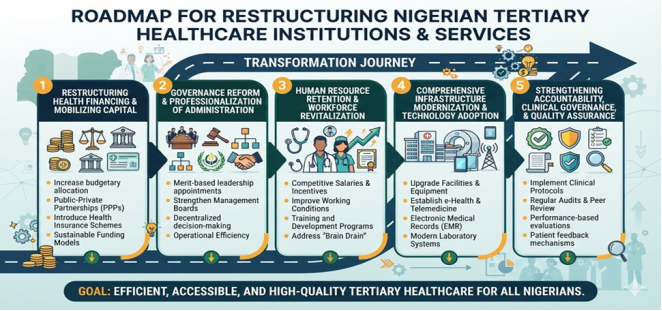
Addressing the decline in Nigeria's THCs demands a departure from transient, reactionary policies . Long-term viability depends on a structurally integrated roadmap targeting core vulnerabilities in healthcare financing, institutional governance, infrastructure decay, and human resource management .
Figure 1. Proposed transformational roadmap for tertiary healthcare restructuring in Nigeria.
7.1. Restructuring Health Financing and Mobilizing Capital
Nigeria must aggressively reform funding for its THCs . Relying on erratic federal budgetary subventions is structurally unsustainable. Fully operationalizing and enforcing the National Health Insurance Authority Act will make coverage mandatory. This shifts the population from out-of-pocket spending to a pre-paid, pooled-risk framework . Consequently, capitation and fee-for-service reimbursements will provide teaching hospitals with predictable revenue. To complement this, Nigeria should establish a Tertiary Healthcare Trust Fund, modeled after the Tertiary Education Trust Fund. Financing could come from an earmarked 1-2% levy on corporate profits within the telecommunications, oil and gas, and financial sectors . These revenues must be strictly ring-fenced for capital expenditure, biomedical research, and infrastructural upgrades. Concurrently, the Nigeria Sovereign Investment Authority should scale up its co-investments in oncology, cardiology, and diagnostic centers, expanding on successful institutional pilots .
7.2. Governance Reform and Professionalization of Administration
Tertiary hospital governance requires modernization to eliminate administrative inefficiencies and professional rivalries . Teaching hospital leadership must be decoupled . While a Director of Clinical Services manages clinical care, a professional Chief Executive Officer should lead overall administration. This executive must hold a master of Business Administration, Master of Health Administration, or specialized training in hospital management and corporate governance, regardless of their undergraduate discipline . Furthermore, hospital management boards require insulation from partisan political interference. These boards should comprise technocrats, health economists, legal experts, and community representatives.
Empowered with institutional autonomy, boards must independently set competitive internal salary structures, negotiate localized procurement, and recruit staff to fill specific institutional deficits. Consequently, they must remain strictly accountable to performance targets established by the Ministry of Health .
7.3. Human Resource Retention and Workforce Revitalization
Stemming the medical brain drain in Nigeria requires competitive compensation structures and workplace improvements . While matching Western salaries is fiscally impossible, governments can narrow the gap . Key steps include adjusting salary scales for inflation, offering non-taxable clinical allowances, increasing hazard pay, and introducing performance bonuses . Senior clinicians should also receive duty-free vehicle import waivers and subsidized housing loans . At the facility level, investing in core infrastructure—uninterrupted power, running water, and digital health tools—mitigates operational burnout and improves patient safety . Furthermore, professionals who have emigrated remain valuable assets . Tertiary institutions can capture their expertise through structured "brain-gain" initiatives . These include joint clinical appointments, virtual telemedicine consults, and short-term visiting fellowships for block-teaching . Such frameworks allow diaspora experts to support local medical training without permanent relocation .
7.4. Comprehensive Infrastructure Modernization and Technology Adoption
Modernizing healthcare infrastructure is essential to support contemporary clinical workflows . Tertiary hospitals should transition away from inefficient paper documentation in favor of unified, open-source Electronic Health Record platforms . These systems optimize patient tracking, minimize administrative delays, prevent revenue loss, and compile standardized clinical data for public health planning and research . Furthermore, teaching hospitals must reform their procurement strategies by avoiding unsupported hardware acquisitions. Future diagnostic equipment should be secured through Managed Service Contracts. Under this framework, vendors retain hardware ownership and receive payment tied to equipment uptime and operational metrics . This model transfers the responsibilities of maintenance, calibration, and parts supply directly to the manufacturer. Finally, establishing high-speed digital communication networks will position tertiary centers as central hubs for tele-consultation . This infrastructure allows specialists to review complex cases and deliver clinical oversight to primary and secondary facilities in rural areas, expanding the reach of specialized healthcare .
7.5. Strengthening Accountability, Clinical Governance, and Quality Assurance
Federal healthcare facilities require a structural shift toward transparency, continuous audit, and clinical accountability . The Federal Ministry of Health, partnering with professional regulatory bodies, should establish an independent Healthcare Quality Assurance Commission. This agency will conduct unannounced clinical audits of tertiary centers to track metrics like surgical site infections, 30-day readmissions, neonatal mortality, and patient satisfaction . Publishing these results annually will allow data to link directly to budgetary funding incentives. Furthermore, teaching hospitals must mandate confidential morbidity and mortality review panels, utilizing Root Cause Analysis for every unexpected clinical death or severe adverse event . This framework shifts the institutional response to medical errors from blame and concealment to objective, continuous learning and patient safety improvement .
8. Conclusion
The systemic decline of institutional structures and services of Nigeria’s THCs stems from decades of underfunding, fragmented governance, and severe medical brain drain. The institutional decline has compromised patient care, undermined medical residency training, and fueled a costly outbound medical tourism market. Historically, isolated equipment procurement and unenforced legislative mandates have failed to address the root causes of this crisis. Reversing this trajectory requires systemic structural reform rather than superficial interventions. Nigeria can rebuild its premier hospitals into centers of clinical excellence by implementing strategic health financing, professionalizing hospital administration, creating competitive staff retention packages, and institutionalizing strict clinical accountability. Ultimately, revitalizing the tertiary healthcare tier is a prerequisite for national health security and equity. Achieving this requires sustained political commitment and a transition from policy formulation to rigorous execution.
Abbreviations

FMoH

Federal Ministry of Health

MDCN

Medical and Dental Council of Nigeria

PPPs

Public-Private Partnerships

THCs

Tertiary Healthcare Centers

UCH

University College Hospital

WHO

World Health Organization

Author Contributions
Collins Amadi: Conceptualization, Data curation, Formal Analysis, Funding acquisition, Investigation, Methodology, Project administration, Resources, Software, Supervision, Validation, Visualization, Writing – original draft, Writing – review & editing
Roy Chidi Amadi: Conceptualization, Data curation, Formal Analysis, Funding acquisition, Investigation, Methodology, Project administration, Resources, Software, Supervision, Validation, Writing – original draft, Writing – review & editing
Sasha Chidera Amadi: Conceptualization, Data curation, Formal Analysis, Funding acquisition, Investigation, Methodology, Project administration, Resources, Supervision, Validation, Visualization, Writing – original draft, Writing – review & editing
Elena Chile Amadi: Conceptualization, Data curation, Formal Analysis, Funding acquisition, Investigation, Methodology, Project administration, Resources, Software, Validation, Visualization, Writing – original draft, Writing – review & editing
Comfort John: Conceptualization, Data curation, Formal Analysis, Funding acquisition, Investigation, Methodology, Project administration, Resources, Software, Supervision, Validation, Visualization, Writing – original draft, Writing – review & editing
Conflicts of Interest
The authors declare no conflicts of interest.
References
[1] Abubakar I, Dalglish SL, Angell B, Sanuade O, Abimbola S, Adamu AL, et al. The Lancet Nigeria Commission: investing in health and the future of the nation. The Lancet. 2022; 399(10330): 1155-200.
[2] Josiah BO, Enebeli EC, Duncan BA, Anukam LU, Akingbade O, Ncube F, et al. Correction: Perceptions of healthcare finance and system quality among Nigerian healthcare workers. PLOS Global Public Health. 2025; 5(8): e0005068.
[3] Obi C, Arize I, Nwokolo C, Okechi B, Ebenso B, Onwujekwe O. Referral experiences of healthcare consumers: results from a cross-sectional study in urban slums in southeast Nigeria. Front Public Health. 2025; 13: 1561158.
[4] Koce F, Randhawa G, Ochieng B. Understanding healthcare self-referral in Nigeria from the service users' perspective: a qualitative study of Niger state. BMC Health Serv Res. 2019; 19(1): 209.
[5] Adewale OS. An internet-based telemedicine system in Nigeria. Int J Inf Manag. 2004; 24(3): 221-34.
[6] Ukpe E. Transforming healthcare: Telemedicine's role and impact in Nigeria. IOSR J Hum Soc Sci. 2025; 30(2): 20-6.
[7] Aregbeshola BS, Khan SM. Out-of-Pocket Payments, Catastrophic Health Expenditure and Poverty Among Households in Nigeria 2010. Int J Health Policy Manag. 2018 Sep 1; 7(9): 798-806.
[8] Croke K, Ogbuoji O. Health reform in Nigeria: the politics of primary health care and universal health coverage. Health Policy Plan. 2024; 39(1): 22-31.
[9] Ilesanmi OS, Afolabi AA, Adeoya CT. Driving the implementation of the National Health Act of Nigeria to improve the health of her population. Pan Afr Med J. 2023; 45: 157.
[10] Adeniji T, Oyeyemi AY. A Review-Based Comparative Analysis of Health Care Delivery System in Nigeria and the United Kingdom. West Afr J Med. 2020; 37(6): 597-605.
[11] Ityavyar DA. Background to the development of health services in Nigeria. Soc Sci Med. 1987; 24(6): 487-99.
[12] Ibrahim M. Medical education in Nigeria. Med Teach. 2007; 29(9): 901-5.
[13] Osoba M, Usman S, Oyadiran O, Odeyemi J, Abode M, Usman O, et al. O. Undergraduate medical education in Nigeria: current standard and the need for advancement. Pan Afr Med J. 2021; 40: 40.
[14] Bolt J, Cilliers J. The expansion of colonial state healthcare in twentieth-century British Africa. Med Hist. 2025; 69(1): 119-165.
[15] Ekanade OV. The dynamics of forced neoliberalism in Nigeria since the 1980s. J Ret Afr. 2014; 1(1): 1-24.
[16] Ajoseh S, Langer A, Amoniyan O, Uyah UA. Navigating brain drain: understanding public discourse on legislation to retain medical professionals in Nigeria. Global Health. 2024; 20(1): 80.
[17] Umar AA, Salihu HM, Azuine RE. Crisis of Brain Drain in Nigeria's Health Sector: Challenges, Opportunities, and the Path Forward. Int J MCH AIDS. 2025; 14: e011.
[18] Chukwuma JN, Obi FA. A political economy analysis of health policymaking in Nigeria: the genesis of the 2014 National Health Act. Health Policy Plan. 2025; 40(4): 459-470.
[19] Enabulele O, Enabulele JE. Nigeria's National Health Act: An assessment of health professionals' knowledge and perception. Niger Med J. 2016; 57(5): 260-265.
[20] Yisa SS, Ogunniyi TJ, Dine RD. Strengthening primary health care in Nigeria: a means to achieve universal health coverage. BMJ Glob Health. 2025; 10(10): e018486.
[21] Madu AC, Osborne K. Healthcare Financing in Nigeria: A Policy Review. Int J Soc Determinants Health Health Serv. 2023; 53(4): 434-443.
[22] Edeh HC. Exploring dynamics in catastrophic health care expenditure in Nigeria. Health Econ Rev. 2022; 12(1): 22.
[23] Ilegogie OC. Energizing Health: Electricity Access and the Right to Health in Nigeria. Health Hum Rights. 2025 Dec; 27(2): 409-418.
[24] Zakir B. Nigeria's Medical Exodus: Urgent Reforms to Retain Doctors. Cureus. 2025; 17(11): e96421.
[25] Uneke CJ, Ezeoha AE, Ndukwe CD, Oyibo PG, Onwe FD. Enhancing leadership and governance competencies to strengthen health systems in Nigeria: assessment of organizational human resources development. Healthc Policy. 2012; 7(3): 73-84.
[26] Adeloye D, David RA, Olaogun AA, Auta A, Adesokan A, Gadanya M, Opele JK, Owagbemi O, Iseolorunkanmi A. Health workforce and governance: the crisis in Nigeria. Hum Resour Health. 2017; 15(1): 32.
[27] Onwujekwe O, Orjiakor CT, Hutchinson E, McKee M, Agwu P, Mbachu C, et al. Where Do We Start? Building Consensus on Drivers of Health Sector Corruption in Nigeria and Ways to Address It. Int J Health Policy Manag. 2020; 9(7): 286-296.
[28] Diaconu K, Chen YF, Cummins C, Jimenez Moyao G, Manaseki-Holland S, Lilford R. Methods for medical device and equipment procurement and prioritization within low- and middle-income countries: findings of a systematic literature review. Global Health. 2017; 13(1): 59.
[29] Umeano-Enemuoh JC, Onwujekwe OE, Uzochukwu BS, Ezeoke OP. Patients’ satisfaction and quality of care in a tertiary institution in Southeast Nigeria. Int Res J Basic Clin Stud. 2014; 2(2): 14-9.
[30] Afolalu OO, Jordan S, Kyriacos U. Medical error reporting among doctors and nurses in a Nigerian hospital: A cross-sectional survey. J Nurs Manag. 2021; 29(5): 1007-1015.
[31] Mbachu II, Ezeama C, Osuagwu K, Umeononihu OS, Obiannika C, Ezeama N. A cross-sectional study of maternal near miss and mortality at a rural tertiary centre in southern Nigeria. BMC Pregnancy Childbirth. 2017; 17(1): 251.
[32] Makanjuola OB, Fayemiwo SA, Okesola AO, Gbaja A, Ogunleye VA, Kehinde AO, et al. Pattern of multidrug-resistant bacteria associated with intensive care unit infections in Ibadan, Nigeria. Ann Ibadan Postgrad Med. 2018; 16(2): 162-169.
[33] Tolani MA, Ahmed M, Ojewola RW, Abdulwahab-Ahmed A, Abdulkadir A, Mbaeri TU, et al. Assessment of Health-care Research and Its Challenges among Medical Doctors in Nigeria. Niger Med J. 2020; 61(4): 218-222.
[34] Adeoye AO. Assessing the associated medical, legal, and social issues in medical tourism and its implications for Nigeria. Pan Afr Med J. 2023; 45: 145.
[35] Makinde OA. Physicians as medical tourism facilitators in Nigeria: ethical issues of the practice. Croat Med J. 2016 Dec 31; 57(6): 601-604.
[36] Kalu Q, Edentekhe TA, Eguma S. Anesthesia equipment and their chain of survival. Calabar J Health Sci. 2020; 4(1): 13-9. Doi. 10.25259/CJHS_16_2020
[37] Egwudo AE, Jegede AO, Oyeniyi TA, Ezekwelu NJ, Abdu-Aguye SN, Okwuraiwe AP, et al. Integrating digital health technologies into the healthcare system: Challenges and opportunities in Nigeria. PLOS Digit Health. 2025; 4(7): e0000928.
[38] Uzochukwu B, Onwujekwe E, Mbachu C, Okeke C, Molyneux S, Gilson L. Accountability mechanisms for implementing a health financing option: the case of the basic health care provision fund (BHCPF) in Nigeria. Int J Equity Health. 2018; 17(1): 100.
[39] Jinadu FO, Agunloye AM, Adeyomoye AA, Adekoya AO, Obajimi GO. Public-private partnerships in Nigerian teaching hospitals: Potential and challenges. West Afr J Rad. 2020 Jul 1; 27(2): 143-9.
[40] Josiah BO, Enebeli EC, Duncan BA, Adejumo PO, Josiah CC, Anukam L. et al. Critical review of healthcare financing and a survey of system quality perception among healthcare users in Nigeria (2010-2023). PLOS Glob Public Health. 2025; 5(5): e0004615.
[41] Ipinnimo TM, Durowade KA, Afolayan CA, Ajayi PO, Akande TM. The Nigeria national health insurance authority act and its implications towards achieving universal health coverage. Niger Postgrad Med J. 2022; 29(4): 281-287.
[42] Mohammed ENA. Knowledge, causes, and experience of inter-professional conflict and rivalry among healthcare professionals in Nigeria. BMC Health Serv Res. 2022; 22(1): 320.
[43] Adigwe OP, Mohammed ENA, Onavbavba G. Preventing and Mitigating Inter-Professional Conflict Among Healthcare Professionals in Nigeria. J Healthc Leadersh. 2023; 15: 1-9.
[44] Otolorin EO. Mitigating the healthcare exodus: pathways to retention and brain gain in Nigeria. J Global Med [Internet]. 2026 Mar. 30 [cited 2026 Aug. 11]; 6(1): e345. Available from:
[45] Alobo IG, Soyannwo T, Ukponwan G, Akogu S, Akpa AM, Ayankola K. Implementing electronic health system in Nigeria: perspective assessment in a specialist hospital. Afr Health Sci. 2020; 20(2): 948-954.
[46] Onyeabor US, Onwuasoigwe O, Okenwa WO, Schaaf T, Pinkwart N, Balzer F. Exploring user experiences of clinicians engaged with the digital healthcare interventions across the referral and university teaching hospitals in Nigeria: a qualitative study. Front Digit Health. 2025; 7: 1488880.
[47] Olufunlayo TF, Ojo OO, Ozoh OB, Agabi OP, Opara CR, Taiwo FT, et al. Telemedicine ready or not? A cross-sectional assessment of telemedicine maturity of federally funded tertiary health institutions in Nigeria. Digit Health. 2023; 9: 20552076221150072.
[48] Alinnor EA, Ogaji DS. Physicians' knowledge, attitude and practice of clinical audit in a tertiary health facility in a developing country: a cross-sectional study. Pan Afr Med J. 2022; 43: 22.
[49] Ogbuanya AU, Enemuo VC, Eni UE, Nwigwe CG, Otu O. Mortality audit in general surgery unit and lessons learned at a Nigerian tertiary hospital: a single centre observational study. Pan Afr Med J. 2022; 41: 228.
Cite This Article
  • APA Style

    Amadi, C., Amadi, R. C., Amadi, S. C., Amadi, E. C., John, C. (2026). Downturns of Tertiary Healthcare Infrastructure and Services in Nigeria: Context, Dimensions, Consequences, Past Policy Interventions, and Roadmap for Reform. World Journal of Health Services Research, 1(1), 35-44. https://doi.org/10.11648/j.wjhsr.20260101.14

    Copy | Download

    ACS Style

    Amadi, C.; Amadi, R. C.; Amadi, S. C.; Amadi, E. C.; John, C. Downturns of Tertiary Healthcare Infrastructure and Services in Nigeria: Context, Dimensions, Consequences, Past Policy Interventions, and Roadmap for Reform. World J. Health Serv. Res. 2026, 1(1), 35-44. doi: 10.11648/j.wjhsr.20260101.14

    Copy | Download

    AMA Style

    Amadi C, Amadi RC, Amadi SC, Amadi EC, John C. Downturns of Tertiary Healthcare Infrastructure and Services in Nigeria: Context, Dimensions, Consequences, Past Policy Interventions, and Roadmap for Reform. World J Health Serv Res. 2026;1(1):35-44. doi: 10.11648/j.wjhsr.20260101.14

    Copy | Download

  • @article{10.11648/j.wjhsr.20260101.14,
      author = {Collins Amadi and Roy Chidi Amadi and Sasha Chidera Amadi and Elena Chile Amadi and Comfort John},
      title = {Downturns of Tertiary Healthcare Infrastructure and Services in Nigeria: Context, Dimensions, Consequences, Past Policy Interventions, and Roadmap for Reform},
      journal = {World Journal of Health Services Research},
      volume = {1},
      number = {1},
      pages = {35-44},
      doi = {10.11648/j.wjhsr.20260101.14},
      url = {https://doi.org/10.11648/j.wjhsr.20260101.14},
      eprint = {https://article.sciencepublishinggroup.com/pdf/10.11648.j.wjhsr.20260101.14},
      abstract = {Nigerian tertiary healthcare centers are legally mandated to provide specialized clinical care, advance research, and deliver undergraduate and postgraduate medical education. Decades of systemic, structural, and institutional dwindling infrastructure and medical services, however, have profoundly compromised this national mandate. This narrative review analyzes current evidence from public health, health economics, public policy, and clinical practice reports to examine the multidimensional crises plaguing these apex tertiary healthcare centers. Five primary drivers of the declining infrastructure and services of Nigeria's tertiary healthcare centers emerge from the search data: chronic underfunding coupled with misaligned budgets, severe infrastructure and technological deficits, widespread procurement corruption, weak regulatory oversight, and an unprecedented human resource crisis fueled by medical emigration ("brain drain"). By tracing the historical evolution of these challenges, we outline their direct consequences (degradation of patient outcomes and escalating mortality rates, the erosion of medical education and research output, and economic devaluation and the outflow of medical tourism) for patient outcomes and medical education, and detail critical lessons from past policy failures, including the multi-million United States dollar Vamed Engineering Project to equip apex tertiary medical centers during the 2000s, the 2014 National Health Act, and the Public-Private Partnerships. To reverse this infrastructure and medical services decline and advance toward universal health coverage, we propose a targeted framework centered on alternative health financing, public-private partnerships, institutional autonomy, clinical technology integration, and robust and aggressive workforce retention strategies.},
     year = {2026}
    }
    

    Copy | Download

  • TY  - JOUR
    T1  - Downturns of Tertiary Healthcare Infrastructure and Services in Nigeria: Context, Dimensions, Consequences, Past Policy Interventions, and Roadmap for Reform
    AU  - Collins Amadi
    AU  - Roy Chidi Amadi
    AU  - Sasha Chidera Amadi
    AU  - Elena Chile Amadi
    AU  - Comfort John
    Y1  - 2026/09/18
    PY  - 2026
    N1  - https://doi.org/10.11648/j.wjhsr.20260101.14
    DO  - 10.11648/j.wjhsr.20260101.14
    T2  - World Journal of Health Services Research
    JF  - World Journal of Health Services Research
    JO  - World Journal of Health Services Research
    SP  - 35
    EP  - 44
    PB  - Science Publishing Group
    UR  - https://doi.org/10.11648/j.wjhsr.20260101.14
    AB  - Nigerian tertiary healthcare centers are legally mandated to provide specialized clinical care, advance research, and deliver undergraduate and postgraduate medical education. Decades of systemic, structural, and institutional dwindling infrastructure and medical services, however, have profoundly compromised this national mandate. This narrative review analyzes current evidence from public health, health economics, public policy, and clinical practice reports to examine the multidimensional crises plaguing these apex tertiary healthcare centers. Five primary drivers of the declining infrastructure and services of Nigeria's tertiary healthcare centers emerge from the search data: chronic underfunding coupled with misaligned budgets, severe infrastructure and technological deficits, widespread procurement corruption, weak regulatory oversight, and an unprecedented human resource crisis fueled by medical emigration ("brain drain"). By tracing the historical evolution of these challenges, we outline their direct consequences (degradation of patient outcomes and escalating mortality rates, the erosion of medical education and research output, and economic devaluation and the outflow of medical tourism) for patient outcomes and medical education, and detail critical lessons from past policy failures, including the multi-million United States dollar Vamed Engineering Project to equip apex tertiary medical centers during the 2000s, the 2014 National Health Act, and the Public-Private Partnerships. To reverse this infrastructure and medical services decline and advance toward universal health coverage, we propose a targeted framework centered on alternative health financing, public-private partnerships, institutional autonomy, clinical technology integration, and robust and aggressive workforce retention strategies.
    VL  - 1
    IS  - 1
    ER  - 

    Copy | Download

Author Information
  • Department of Chemical Pathology, Rivers State University, Port Harcourt, Nigeria; Department of Chemical Pathology, PAMO University of Medical Sciences, Port Harcourt, Nigeria; Department of Chemical Pathology, University of Uyo, Uyo, Nigeria; Department of Laboratory Services, MEDCOL Nigeria Limited, Port Harcourt, Nigeria

  • Department of Laboratory Services, MEDCOL Nigeria Limited, Port Harcourt, Nigeria; Basic Health Studies, Captain Elechi Amadi, Port Harcourt, Nigeria; Basic Health Studies, Excellent Montessori College, Port Harcourt, Nigeria

  • Department of Laboratory Services, MEDCOL Nigeria Limited, Port Harcourt, Nigeria; Basic Health Studies, Captain Elechi Amadi, Port Harcourt, Nigeria; Basic Health Studies, Excellent Montessori College, Port Harcourt, Nigeria

  • Department of Laboratory Services, MEDCOL Nigeria Limited, Port Harcourt, Nigeria; Basic Health Studies, Captain Elechi Amadi, Port Harcourt, Nigeria; Basic Health Studies, Excellent Montessori College, Port Harcourt, Nigeria

  • Department of Laboratory Services, MEDCOL Nigeria Limited, Port Harcourt, Nigeria; Department of Management, Ignatius Ajuru University of Education, Port Harcourt, Nigeria

  • Abstract
  • Keywords
  • Document Sections

    1. 1. Introduction
    2. 2. Methodology
    3. 3. Context and Evolution of Tertiary Healthcare in Nigeria
    4. 4. Core Dimensions of Decline of Nigeria’s THCs
    5. 5. Consequences of Decline of Nigeria’s THCs
    6. 6. Retrospective Insights from Past Policy Interventions
    7. 7. Strategic Roadmap for Reform
    8. 8. Conclusion
    Show Full Outline
  • Abbreviations
  • Author Contributions
  • Conflicts of Interest
  • References
  • Cite This Article
  • Author Information