
Repaglinide is a short-acting insulin secretagogue whose short half-life necessitates frequent dosing, compromising adherence. Controlled-release (CR) matrix tablets combining hydrophobic and hydrophilic polymers can sustain drug release and reduce dosing frequency. To formulate and evaluate CR repaglinide tablets using Eudragit RS100 and Carbopol P974 NF at varying drug: polymer ratios, with and without natural co-excipients, and to characterise their physicochemical properties, in vitro release, and release kinetics. Nine formulations (CR-R1–CR-R9) were prepared by direct compression and wet granulation at drug: polymer ratios of 10:1, 10:2 and 10:3, with gum acacia and guar gum as co-excipients in selected batches. Pre-compression (Carr's index, Hausner's ratio, angle of repose) and post-compression (weight variation, thickness, hardness, friability, drug content) parameters were assessed per pharmacopeial standards. In vitro release was studied by USP Method I and modelled with the Power Law equation; similarity (f2) and difference (f1) factors were calculated against a reference product. Data were analysed by one-way ANOVA with Tukey's post hoc test. All blends showed excellent-to-very-good flow (Carr's index 9.22–11.88%; Hausner's ratio 1.06–1.16; angle of repose 29.99–31.94°). All tablets met pharmacopeial limits for weight variation, hardness (6.5–7.2 kg/cm2), friability (<0.5%) and drug content (97.1–99.7%). Drug release at 2 hours ranged from 77.0% to 92.0%. Power Law fitting (r² = 0.988–0.997) indicated anomalous non-Fickian diffusion (n = 0.608–0.790) for all formulations. Eudragit RS100–Carbopol P974 NF matrices produced robust, pharmacopeia-compliant repaglinide CR tablets with diffusion/erosion-controlled release, supporting this polymer combination for sustained oral repaglinide delivery.
| Published in | World Journal of Health Services Research (Volume 1, Issue 1) |
| DOI | 10.11648/j.wjhsr.20260101.12 |
| Page(s) | 14-24 |
| Creative Commons |
This is an Open Access article, distributed under the terms of the Creative Commons Attribution 4.0 International License (http://creativecommons.org/licenses/by/4.0/), which permits unrestricted use, distribution and reproduction in any medium or format, provided the original work is properly cited. |
| Copyright |
Copyright © The Author(s), 2026. Published by Science Publishing Group |
Repaglinide, Controlled-release Matrix Tablets, Eudragit RS100, Carbopol P974 NF, Drug Release Kinetics
S. No. | Chemicals Used |
|---|---|
1 | Methocel |
2 | Ethocel |
3 | Magnesium stearate |
4 | HPMC |
5 | Evocil |
6 | Distilled water |
7 | Phosphate buffer (pH 6.8 and 7.4) |
S. No. | Equipment Used |
|---|---|
1 | Weighing balance |
2 | pH meter |
3 | Friabilator |
4 | Hardness tester |
5 | Volumetric flasks |
6 | UV spectrophotometer |
7 | Petri dish |
8 | Magnetic stirrer |
9 | Filter paper |
10 | Stainless steel spatulas, etc. |
D:P Ratio | Repaglinide (mg) | Eudragit RS100 + Carbopol P974 NF (mg) | Spray-dried Lactose (mg) | Mg Stearate (mg) | Total (mg) |
|---|---|---|---|---|---|
10:1 | 10 | 3 | 77.85 | 0.5 | 100 |
10:2 | 10 | 6 | 75.15 | 0.5 | 100 |
10:3 | 10 | 9 | 72.45 | 0.5 | 100 |
D:P Ratio | Repaglinide (mg) | Eudragit RS100 + Carbopol P974 NF (mg) | Spray-dried Lactose (mg) | Mg Stearate (mg) | Total (mg) |
|---|---|---|---|---|---|
10:1 | 10 | 3 | 86.5 | 0.5 | 100 |
10:2 | 10 | 6 | 83.5 | 0.5 | 100 |
10:3 | 10 | 9 | 80.5 | 0.5 | 100 |
Formulation | Compressibility Index (%) (USP <15%) | Hausner's Ratio (USP 1.00–1.25) | Angle of Repose (°) (USP 25–35°) | Interpretation |
|---|---|---|---|---|
CR-R1 | 9.85 ± 0.89 | 1.06 ± 0.41 | 30.03 ± 0.25 | Excellent |
CR-R2 | 10.02 ± 0.43 | 1.15 ± 0.45 | 31.67 ± 0.33 | Excellent |
CR-R3 | 11.46 ± 0.76 | 1.16 ± 0.16 | 31.87 ± 0.45 | Very good |
CR-R4 | 9.22 ± 0.45 | 1.10 ± 0.44 | 29.99 ± 0.32 | Excellent |
CR-R5 | 11.88 ± 0.56 | 1.16 ± 0.59 | 31.94 ± 1.14 | Very good |
CR-R6 | 10.65 ± 0.71 | 1.15 ± 0.30 | 30.76 ± 1.34 | Excellent |
CR-R7 | 11.77 ± 0.44 | 1.16 ± 0.37 | 31.66 ± 1.15 | Very good |
CR-R8 | 10.43 ± 1.52 | 1.14 ± 0.22 | 30.38 ± 0.18 | Excellent |
CR-R9 | 11.39 ± 2.14 | 1.15 ± 0.34 | 31.23 ± 0.22 | Very good |
Formulation | Weight Variation (mg) ±5% | Thickness (mm) | Hardness (kg/cm2) 5–8 | Friability (%) <1% | Drug Content (%) 95–105% |
|---|---|---|---|---|---|
CR-R1 | 251.3 ± 1.7 | 4.31 ± 0.04 | 6.5 ± 0.3 | 0.49 ± 0.02 | 99.5 ± 0.5 |
CR-R2 | 247.5 ± 2.2 | 4.25 ± 0.03 | 6.8 ± 0.2 | 0.48 ± 0.03 | 97.2 ± 0.7 |
CR-R3 | 251.4 ± 1.5 | 4.24 ± 0.06 | 6.7 ± 0.1 | 0.41 ± 0.01 | 99.2 ± 0.4 |
CR-R4 | 248.7 ± 1.9 | 4.29 ± 0.05 | 6.8 ± 0.3 | 0.38 ± 0.01 | 98.3 ± 0.5 |
CR-R5 | 252.1 ± 2.1 | 4.28 ± 0.02 | 7.1 ± 0.2 | 0.37 ± 0.01 | 99.7 ± 0.5 |
CR-R6 | 250.1 ± 0.9 | 4.31 ± 0.02 | 7.2 ± 0.2 | 0.37 ± 0.03 | 97.1 ± 0.5 |
CR-R7 | 248.5 ± 2.1 | 4.29 ± 0.03 | 7.1 ± 0.2 | 0.39 ± 0.01 | 99.3 ± 0.4 |
CR-R8 | 253.1 ± 2.0 | 4.28 ± 0.02 | 7.05 ± 0.1 | 0.35 ± 0.03 | 98.6 ± 0.5 |
CR-R9 | 250.1 ± 1.0 | 4.30 ± 0.03 | 7.1 ± 0.1 | 0.37 ± 0.03 | 99.4 ± 0.7 |
Formulation | Time 1 h (%) | Time 1.5 h (%) | Time 2 h (%) |
|---|---|---|---|
CR-R1 | 38.50 | 52.07 | 87.02 |
CR-R2 | 31.01 | 43.01 | 83.03 |
CR-R3 | 28.03 | 39.03 | 87.03 |
CR-R4 | 31.03 | 37.07 | 92.02 |
CR-R5 | 33.05 | 45.03 | 77.04 |
CR-R6 | 32.01 | 47.03 | 82.03 |
CR-R7 | 36.05 | 59.03 | 86.03 |
CR-R8 | 29.04 | 56.05 | 92.03 |
CR-R9 | 31.03 | 47.01 | 90.03 |
Formulation | Power Law Model (r²) | N | Mechanism |
|---|---|---|---|
CR-R1 | 0.995 | 0.678 | ANFD |
CR-R2 | 0.997 | 0.790 | ANFD |
CR-R3 | 0.993 | 0.704 | ANFD |
CR-R4 | 0.992 | 0.608 | ANFD |
CR-R5 | 0.989 | 0.652 | ANFD |
CR-R6 | 0.995 | 0.655 | ANFD |
CR-R7 | 0.988 | 0.746 | ANFD |
CR-R8 | 0.994 | 0.631 | ANFD |
CR-R9 | 0.990 | 0.652 | ANFD |
Test Formulation vs Reference | f1 value | f2 value |
|---|---|---|
CR-R1 vs Reference | 85.10 | 10.65 |
CR-R2 vs Reference | 88.56 | 9.33 |
CR-R3 vs Reference | 79.45 | 11.57 |
CR-R4 vs Reference | 76.65 | 9.36 |
CR-R5 vs Reference | 71.67 | 7.87 |
CR-R6 vs Reference | 78.78 | 12.43 |
CR-R7 vs Reference | 82.34 | 9.56 |
CR-R8 vs Reference | 54.76 | 6.23 |
CR-R9 vs Reference | 56.87 | 7.98 |
CR | Sustained Release |
USP | United States Pharmacopeia |
PVP | Polyvinylpyrrolidone |
HPMC | Hydroxypropyl Methylcellulose |
CR-R | Control Release Repaglinide |
| [1] | Adepu, S., & Ramakrishna, S. (2021). Controlled drug delivery systems: current status and future directions. Molecules, 26(19), 5905. |
| [2] | Alhakamy, N. A., Naveen, N. R., Gorityala, S., Kurakula, M., Hosny, K. M., Safhi, A. Y., Mushtaq, R. Y. (2022). Development of novel S-protective thiolated-based mucoadhesive tablets for repaglinide: pharmacokinetic study. Polymers, 14(17), 3529. |
| [3] | Almajidi, Y. Q., Al-Hakeem, M. A., Maashi, M. S., Kareem, A. K., Kadhim, M., Waad, I., ... Fereydouni, N. (2026). Chitosan-based hydrogels loaded with repaglinide and difluorinated curcumin: impact on structural integrity, drug release, and antibacterial activity. Naunyn-Schmiedeberg's Archives of Pharmacology, 399(4), 5499–5514. |
| [4] | Amadi, R. B., & Vugigi, S. (2024). Content Uniformity and In-vitro Dissolution of Amlodipine Half Tablets. Kabarak Journal of Research & Innovation, 14(02), 212–219. |
| [5] | Askarizadeh, M., Esfandiari, N., Honarvar, B., Sajadian, S. A., & Azdarpour, A. (2023). Kinetic modeling to explain the release of medicine from drug delivery systems. ChemBioEng Reviews, 10(6), 1006–1049. |
| [6] | Barnwal, K. K., & Kumar, R. (2026). Floating Drug Delivery Systems of Repaglinide for Gastro-Retentive Controlled Release: A Comprehensive Review. IASR Journal of Medical and Pharmaceutical Science, 6, 65–70. |
| [7] | Berardi, A., Abdel Rahim, S., Bisharat, L., & Cespi, M. (2019). Swelling of zein matrix tablets benchmarked against HPMC and ethylcellulose: Challenging the matrix performance by the addition of co-excipients. Pharmaceutics, 11(10), 513. |
| [8] | Bhadane, S. P., Surawase, R. K., Jadhav, O. A., Purkar, Y. S., & Shelar, S. S. (2024). Review on recent advances of sustained release matrix tablet. Research Journal of Pharmaceutical Dosage Forms and Technology, 16(2), 189–193. |
| [9] | Bramhe, P., Waghmare, S., Rarokar, N., Sabale, P., Khedekar, P., Sabale, V., & Potey, L. (2025). Polymer blends innovation: Advancement in novel drug delivery. International Journal of Polymeric Materials and Polymeric Biomaterials, 74(10), 957–974. |
| [10] | Danish, Z., Hussain, R. M. A., Ijaz, H., Mughal, S., Saeed, H., Aslam, I., ... Khan, A. (2023). Formulation, optimization and in vitro evaluation of sustained release oral hydrogels of diacerein to treat arthritis. Pakistan Journal of Pharmaceutical Sciences, 36(1), 39. |
| [11] | Ellakwa, T. E., Abu-Khadra, A. S., & Ellakwa, D. E.-S. (2024). Influence of physico-chemical properties of hydroxypropyl methylcellulose on quetiapine fumarate release from sustained release matrix tablets. BMC Chemistry, 18(1), 219. |
| [12] | Ghadhan, H. Y., & Ahmed, K. K. (2025). Factors Affecting Preparation of Repaglinide Nanosuspension. Indonesian Journal of Pharmacy/Majalah Farmasi Indonesia, 36(4), 788. |
| [13] | Hirun, N., & Kraisit, P. (2022). Drug-polymers composite matrix tablets: Effect of hydroxypropyl methylcellulose (hpmc) k-series on porosity, compatibility, and release behavior of the tablet containing a bcs class i drug. Polymers, 14(16), 3406. |
| [14] | Gupta, S. K., & Patra, S. (2023). Preparation, characterization and optimization of sustained release matrix tablets of repaglinide using box-behnken design. Research Journal of Pharmacy and Technology, 16(5), 2403–2410. |
| [15] | Huynh-Ba, K., & Moreton, R. C. (2025). Development of United States Pharmacopeia-National Formulary (USP–NF) Monographs and General Chapters. In Specification of Drug Substances and Products (pp. 185–204). Elsevier. |
| [16] | Khan, K. A., Zizzadoro, C., Di Cerbo, A., Pugliese, N., Khan, G. M., Ghazanfar, S., ... Farid, A. (2022). Preparation and in vitro evaluation of controlled-release matrices of losartan potassium using ethocel grade 10 and carbopol 934P NF as rate-controlling polymers. Polymers, 14(15), 2993. |
| [17] | Kumar, A., Jain, S. K., Mishra, D. K., & Gautam, R. (2024). Influence of drug properties and routes of drug administration on design of sustained and controlled release systems. In Novel Carrier Systems for Targeted and Controlled Drug Delivery (pp. 1–46): Springer. |
| [18] | Pardo, H., Peña, M. Á., Martínez-Alonso, B., Torrado-Salmerón, C., & Guarnizo-Herrero, V. (2026). Polymeric Matrix Mini-Tablets Based on Eudragit® S 100 and HPMC for Controlled Release of Pantoprazole. Pharmaceutics, 18(3), 327. |
| [19] | Patel, J., Maiti, S., & Moorthy, N. H. N. (2022). Repaglinide-laden hydrogel particles of xanthan gum derivatives for the management of diabetes. Carbohydrate Polymers, 287, 119354. |
| [20] | Wilkins, C. A., Hamman, H., Hamman, J. H., & Steenekamp, J. H. (2024). Fixed-dose combination formulations in solid oral drug therapy: advantages, limitations, and design features. Pharmaceutics, 16(2), 178. |
| [21] | Rabani, T., Jan, S. U., Razaque, G., Gul, R., Khan, K. A., Rashid, F., & Tufail, M. (2022). Formulation and assessment of controlled release tablets of famotidine by using eudragit RL 100 polymer. Pakistan Journal of Pharmaceutical Sciences, 35, 1779. |
| [22] | Razaque, G., HAQ, N. U., Khan, H., Khan, K. A., Shawani, N. A., Danish, M. Z., & Ahmad, A. (2017). In Vitro Evaluation of Controlled Release Matrix Tablets of Glipizide and Effect of Different Parameters. Latin American Journal of Pharmacy, 36(12), 2501–2508. |
| [23] | Shahazad, K., Jan, S. U., Gul, R., Tafazzul, M., Mengal, S., Jamal, F., & Iqbal, N. (2025). Formulation development and pharmacokinetic evaluation of celecoxib loaded hydroxyl propyl methyl cellulose (HPMC) microparticles in in-vivo model. Pakistan Journal of Pharmaceutical Sciences, 38(4), 1470. |
| [24] | Shahwani, G. M., Jan, S. U., Akhtar, M., Razzaque, G., Gul, R., Ul Haq, N., ... Qadir, A. (2022). Formulation and evaluation of an ointment from Pinus gerardiana extracts indigenous to Balochistan. Pakistan Journal of Pharmaceutical Sciences, 35, 1819. |
| [25] | Thakare Eknath, B., Malpure Prashant, S., Maru Avish, D., & More Yashpal, M. (2019). Formulation and evaluation of mucoadhesive buccal tablet of repaglinide. Journal of Drug Delivery & Therapeutics, 9(4-A), 415–424. |
| [26] | Thejovathi, B. (2022). Formulation And Evaluation of Mucoadhesive Buccal Tablets (Repaglinide) For Management of Diabetes. International Journal of Pharmacy Research & Technology (IJPRT), 12(1), 75–92. |
| [27] | Verma, V. S., Pandey, A., Jha, A. K., Badwaik, H. K. R., Alexander, A., & Ajazuddin. (2024). Polyethylene glycol–based polymer-drug conjugates: novel design and synthesis strategies for enhanced therapeutic efficacy and targeted drug delivery. Applied Biochemistry and Biotechnology, 196(10), 7325–7361. |
| [28] | Vlad, R.-A., Pintea, A., Pintea, C., Rédai, E.-M., Antonoaea, P., Bîrsan, M., & Ciurba, A. (2025). Hydroxypropyl methylcellulose—a key excipient in pharmaceutical drug delivery systems. Pharmaceutics, 17(6), 784. |
| [29] | Waqar, M. A., Mubarak, N., Khan, A. M., Khan, R., Shaheen, F., & Shabbir, A. (2024). Advanced polymers and recent advancements on gastroretentive drug delivery system; a comprehensive review. Journal of Drug Targeting, 32(6), 655–671. |
| [30] | Zhou, X., Hao, Y., Zhang, X., He, X., & Zhang, C. (2023). Cellulose-based polymers. Physical Sciences Reviews, 8(9), 2001–2048. |
APA Style
Ghaffar, H., Shahwani, G. M., Ghaffar, A., Shahwani, G. R., Ahmed, R., et al. (2026). Formulation and Evaluation of Controlled-Release Repaglinide Tablets Using Eudragit RS100 and Carbopol P974 NF Polymer Combinations. World Journal of Health Services Research, 1(1), 14-24. https://doi.org/10.11648/j.wjhsr.20260101.12
ACS Style
Ghaffar, H.; Shahwani, G. M.; Ghaffar, A.; Shahwani, G. R.; Ahmed, R., et al. Formulation and Evaluation of Controlled-Release Repaglinide Tablets Using Eudragit RS100 and Carbopol P974 NF Polymer Combinations. World J. Health Serv. Res. 2026, 1(1), 14-24. doi: 10.11648/j.wjhsr.20260101.12
AMA Style
Ghaffar H, Shahwani GM, Ghaffar A, Shahwani GR, Ahmed R, et al. Formulation and Evaluation of Controlled-Release Repaglinide Tablets Using Eudragit RS100 and Carbopol P974 NF Polymer Combinations. World J Health Serv Res. 2026;1(1):14-24. doi: 10.11648/j.wjhsr.20260101.12
@article{10.11648/j.wjhsr.20260101.12,
  author = {Haseena Ghaffar and Ghulam Mustafa Shahwani and Abdul Ghaffar and Ghulam Razzaq Shahwani and Rasheed Ahmed and Marvi},
  title = {Formulation and Evaluation of Controlled-Release Repaglinide Tablets Using Eudragit RS100 and Carbopol P974 NF Polymer Combinations},
  journal = {World Journal of Health Services Research},
  volume = {1},
  number = {1},
  pages = {14-24},
  doi = {10.11648/j.wjhsr.20260101.12},
  url = {https://doi.org/10.11648/j.wjhsr.20260101.12},
  eprint = {https://article.sciencepublishinggroup.com/pdf/10.11648.j.wjhsr.20260101.12},
  abstract = {Repaglinide is a short-acting insulin secretagogue whose short half-life necessitates frequent dosing, compromising adherence. Controlled-release (CR) matrix tablets combining hydrophobic and hydrophilic polymers can sustain drug release and reduce dosing frequency. To formulate and evaluate CR repaglinide tablets using Eudragit RS100 and Carbopol P974 NF at varying drug: polymer ratios, with and without natural co-excipients, and to characterise their physicochemical properties, in vitro release, and release kinetics. Nine formulations (CR-R1–CR-R9) were prepared by direct compression and wet granulation at drug: polymer ratios of 10:1, 10:2 and 10:3, with gum acacia and guar gum as co-excipients in selected batches. Pre-compression (Carr's index, Hausner's ratio, angle of repose) and post-compression (weight variation, thickness, hardness, friability, drug content) parameters were assessed per pharmacopeial standards. In vitro release was studied by USP Method I and modelled with the Power Law equation; similarity (f2) and difference (f1) factors were calculated against a reference product. Data were analysed by one-way ANOVA with Tukey's post hoc test. All blends showed excellent-to-very-good flow (Carr's index 9.22–11.88%; Hausner's ratio 1.06–1.16; angle of repose 29.99–31.94°). All tablets met pharmacopeial limits for weight variation, hardness (6.5–7.2 kg/cm2), friability (<0.5%) and drug content (97.1–99.7%). Drug release at 2 hours ranged from 77.0% to 92.0%. Power Law fitting (r² = 0.988–0.997) indicated anomalous non-Fickian diffusion (n = 0.608–0.790) for all formulations. Eudragit RS100–Carbopol P974 NF matrices produced robust, pharmacopeia-compliant repaglinide CR tablets with diffusion/erosion-controlled release, supporting this polymer combination for sustained oral repaglinide delivery.},
 year = {2026}
}
TY  - JOUR
T1  - Formulation and Evaluation of Controlled-Release Repaglinide Tablets Using Eudragit RS100 and Carbopol P974 NF Polymer Combinations
AU  - Haseena Ghaffar
AU  - Ghulam Mustafa Shahwani
AU  - Abdul Ghaffar
AU  - Ghulam Razzaq Shahwani
AU  - Rasheed Ahmed
AU  - Marvi
Y1  - 2026/09/15
PY  - 2026
N1  - https://doi.org/10.11648/j.wjhsr.20260101.12
DO  - 10.11648/j.wjhsr.20260101.12
T2  - World Journal of Health Services Research
JF  - World Journal of Health Services Research
JO  - World Journal of Health Services Research
SP  - 14
EP  - 24
PB  - Science Publishing Group
UR  - https://doi.org/10.11648/j.wjhsr.20260101.12
AB  - Repaglinide is a short-acting insulin secretagogue whose short half-life necessitates frequent dosing, compromising adherence. Controlled-release (CR) matrix tablets combining hydrophobic and hydrophilic polymers can sustain drug release and reduce dosing frequency. To formulate and evaluate CR repaglinide tablets using Eudragit RS100 and Carbopol P974 NF at varying drug: polymer ratios, with and without natural co-excipients, and to characterise their physicochemical properties, in vitro release, and release kinetics. Nine formulations (CR-R1–CR-R9) were prepared by direct compression and wet granulation at drug: polymer ratios of 10:1, 10:2 and 10:3, with gum acacia and guar gum as co-excipients in selected batches. Pre-compression (Carr's index, Hausner's ratio, angle of repose) and post-compression (weight variation, thickness, hardness, friability, drug content) parameters were assessed per pharmacopeial standards. In vitro release was studied by USP Method I and modelled with the Power Law equation; similarity (f2) and difference (f1) factors were calculated against a reference product. Data were analysed by one-way ANOVA with Tukey's post hoc test. All blends showed excellent-to-very-good flow (Carr's index 9.22–11.88%; Hausner's ratio 1.06–1.16; angle of repose 29.99–31.94°). All tablets met pharmacopeial limits for weight variation, hardness (6.5–7.2 kg/cm2), friability (<0.5%) and drug content (97.1–99.7%). Drug release at 2 hours ranged from 77.0% to 92.0%. Power Law fitting (r² = 0.988–0.997) indicated anomalous non-Fickian diffusion (n = 0.608–0.790) for all formulations. Eudragit RS100–Carbopol P974 NF matrices produced robust, pharmacopeia-compliant repaglinide CR tablets with diffusion/erosion-controlled release, supporting this polymer combination for sustained oral repaglinide delivery.
VL  - 1
IS  - 1
ER  -
Department of Pharmacology, University of Balochistan, Quetta, Pakistan
Department of Pharmaceutics, University of Balochistan, Quetta, Pakistan
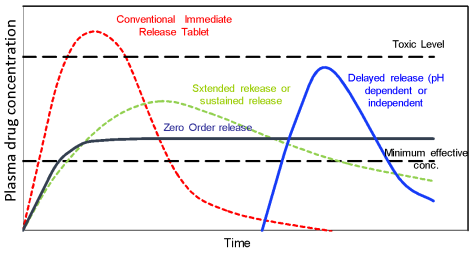
Figure 1. Schematic plasma drug-concentration profiles for conventional immediate-release, extended/sustained-release, zero-order, and delayed-release dosing.
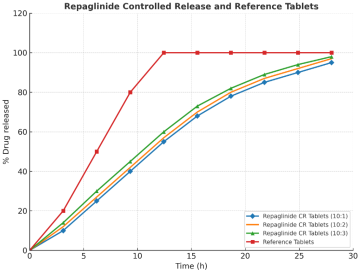
Figure 2. In vitro drug-release profiles of controlled-release repaglinide tablet formulations (CR-R1–CR-R9) versus the reference product.
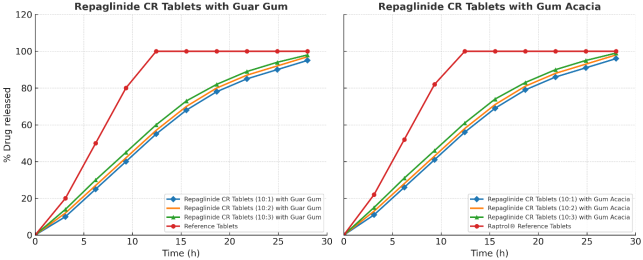
Figure 3. Drug-release characteristics of repaglinide CR tablets formulated with guar gum and gum acacia co-excipients.
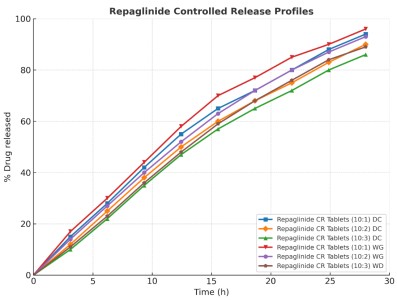
Figure 4. Drug-release characteristics of repaglinide from all controlled-release tablet formulations.

Information



 Share This Article
 Twitter
 Linked In
 Facebook
 Copy
Copy Download