Abstract
This study aims to leverage current AI image generation technology to evaluate the potential of human-machine collaboration in mascot symbol design and explore potential strategies to address the crisis of homogenization in visual design. Based on a theoretical framework of semiotics and destination branding, this study combines cultural coding, AI prompt engineering, and expert calibration to transform local agricultural specialty products (ASP) into a mascot visual system. The MidJourney platform, which is relatively easy to use, was selected as the primary AI generation tool for this project. Following necessary manual optimization, three industrial design experts evaluated the generated AI visual codes via a structured questionnaire to measure their acceptability across five design dimensions. The results indicated that AI-assisted generation could rapidly produce diverse mascot concepts that embody distinct regional characteristics, though only a few met expectations. This may be attributed to the author’s limited proficiency in crafting prompts for this platform; performance was expected to improve significantly with further training. The experts’ evaluation of the AI-generated mascot designs revealed that overall acceptance was satisfactory, though the male protagonist scored slightly higher in terms of visual appeal and functional suitability. In conclusion, the authors argued that AI-generated image technology, when embedded within a human-machine cooperation loop, offers an effective and viable mechanism for mascot symbol design of agriculture-specific products in travel destinations.
|
Published in
|
Social Sciences (Volume 15, Issue 3)
|
|
DOI
|
10.11648/j.ss.20261503.13
|
|
Page(s)
|
124-130 |
|
Creative Commons
|

This is an Open Access article, distributed under the terms of the Creative Commons Attribution 4.0 International License (http://creativecommons.org/licenses/by/4.0/), which permits unrestricted use, distribution and reproduction in any medium or format, provided the original work is properly cited.
|
|
Copyright
|
Copyright © The Author(s), 2026. Published by Science Publishing Group
|
Keywords
AI-generated Image Technology (AIGIT), Agricultural Specialty Products, Mascot, Tourism Destination
1. Introduction
In modern regional tourism promotion, mascots have become a key tool linking local culture, brand identity, and consumer behavior. Through visual design and storytelling, mascots transform abstract regional characteristics into emotionally appealing symbols, enhancing tourists' memorability and affinity for destinations, thereby increasing travel motivation and length of stay. Reports indicate that local governments in Japan and Taiwan extensively employ mascots as part of their regional marketing strategies. Through sophisticated visual design and diverse applications such as events, souvenirs, and social media engagement, they extend brand lifecycles and generate economic benefits
| [1] | LEE M M. The Research into the Visual Property of Characters for Place Marketing in Japan [D]. Taoyuan City, Taiwan; Chung Yuan Christian University, 2011.
https://hdl.handle.net/11296/8btj9n |
[1]
.
For local industries, mascots can drive the development of cultural and creative products, extend tourism services (guided tours, themed events), and facilitate channel integration for local small-scale farmers and artisans, forming an industrial chain of “mascot → brand recognition → consumer conversion.” Practical experience and academic research both emphasize that the success of mascots hinges on three key factors: local relevance (cultural roots), visual distinctiveness, and sustainable management with cross-sector collaboration. Without these elements, mascots risk becoming short-lived gimmicks incapable of driving long-term industrial advancement.
In other words, mascot symbol design forms the foundation for successful local branding: it conveys local culture and values through color, form, and symbolic language, establishing emotional connections and high recognizability. Effective codes possess scalability, facilitating application across merchandise, events, and digital media while fostering cross-sector industrial collaboration. Design must balance visual language, narrative depth, and interactivity, while properly addressing intellectual property and cultural respect. Avoid stereotyping or excessive commercialization to sustain long-term trust and ensure sustainable operations.
However, the current market environment exhibits a trend of visual homogenization. Therefore, this study aims to utilize currently popular AI-generated image technologies to evaluate the potential of human-machine collaboration in mascot symbol design of agricultural specialty products in travel destinations and explore how to address the crisis of visual design homogenization.
2. Literature Review
To gain a thorough understanding of artificial intelligence's role in design aesthetics, an interdisciplinary approach is essential. By building foundational bridges between semiotics, marketing, computer science, and other disciplines, we can begin to grasp its true significance.
2.1. Tourism Destination Image (TDI) & Saussure Codes
Tourism Destination Image (TDI) is composed of Cognitive Images (knowledge-based attributes) and Affective Images (evaluative emotional responses), both of which dictate traveler choice
| [2] | CROMPTON J L. An assessment of the image of Mexico as a vacation destination and the influence of geographical location upon that image [J]. Journal of travel research, 1979, 17(4): 18-23. https://doi.org/10.1177/004728757901700404 |
| [3] | HONG S-K, KIM J-H, JANG H, et al. The roles of categorization, affective image and constraints on destination choice: An application of the NMNL model [J]. Tourism management, 2006, 27(5): 750-61.
https://doi.org/10.1016/j.tourman.2005.11.001 |
| [4] | PIKE S, RYAN C. Destination positioning analysis through a comparison of cognitive, affective, and conative perceptions [J]. Journal of travel research, 2004, 42(4): 333-42.
https://doi.org/10.1177/004728750426302 |
[2-4]
. The cognitive aspect includes describable attributes such as resources, facilities, and transportation; the affective aspect is tourists' liking, surprise, or sense of belonging to the location.
From a semiotic perspective, a mascot is a symbolic system composed of a signifier (physical form) and a signified (potential meaning). Simply, design is the translation of the core image (signified) of a destination into a recognizable visual or behavioral signifier. For dissemination across multiple platforms, the signifier must possess visual recognizability, performance feasibility, and emotional evocative power
. For example, the distinctive white V-shaped stripe and "T" on the chest of the mascot "Oh! Bear" (
Figure 1) serve as specific signifiers, distinguishing it from ordinary bear images and ensuring effective concept communication
.
2.2. Mascots and Local Agricultural Promotion
Mascots, typically anthropomorphized animals or costumed characters, have evolved from static, cartoonish logos into dynamic intellectual properties engineered for cross‑platform performance and audience interaction. This evolution requires designers to balance visual distinctiveness, performer ergonomics, and multimedia adaptability so that a character can appear credibly in live events, short animations, social media, and merchandise. Integrating this contemporary understanding of mascot design with the promotion of local agricultural products creates a potent marketing synergy: mascots embody regional narratives, simplify complex product attributes (e.g., organic, heirloom, terroir), and provide a memorable cue that links consumers’ affective responses to specific crops or farming practices
.
From an academic perspective, mascots operate as symbolic intermediaries that translate place identity and cultural heritage into consumable brand meaning. When a mascot is crafted with local motifs—traditional dress, endemic fauna, or references to regional festivals—it performs two functions simultaneously: it signals provenance (thereby enhancing perceived authenticity) and it reduces cognitive friction in consumer decision‑making by offering a single, salient heuristic for product quality. Empirical work on character‑led campaigns in sustainable food contexts suggests that mascots can positively influence attitudes and purchase intentions, particularly when they are congruent with product values such as healthfulness or environmental stewardship
| [8] | TAKáCS D, KOŠIČIAROVá I, KáDEKOVá Z, et al. Cartooning Consumption: The Power of Mascots in the Plant-Based Consumer Sustainable Behavior [J]. Sustainability, 2025, 17(13): 5865. https://doi.org/10.3390/su17135865 |
[8]
.
Designing mascots for agricultural promotion also entails logistical and ethical considerations. Performer safety, cultural sensitivity, and supply‑chain transparency must be embedded in early design stages so that the mascot’s public appearances—at farmers’ markets, school outreach programs, or export packaging—do not inadvertently mislead consumers about production methods or origin. Moreover, coupling mascot campaigns with educational content (short animations about cultivation, QR codes linking to farm stories) amplifies their persuasive power while supporting traceability and consumer trust
| [9] | KAMCHOMPOO S, KAEWKANTA C. Local Mascot Design by Using Universal Design for Sustainable Community Development: A Case Study of PAA YAO CRAFT MARKET; proceedings of the 2024 Joint International Conference on Digital Arts, Media and Technology with ECTI Northern Section Conference on Electrical, Electronics, Computer and Telecommunications Engineering (ECTI DAMT & NCON), F, 2024 [C]. IEEE.
https://doi.org/10.1109/ECTIDAMTNCON60518.2024.10480094 |
[9]
.
2.3. Artificial Intelligence-Generated Image Technology (AIGIT)
Currently, the field of graphic design is undergoing a disruptive transformation driven by artificial intelligence technology (AIGIT), and its development may be based on three core architectures:
| [10] | CHEN M. Talking about the Generative Adversarial Network (GAN) for elementary school students [J/OL] 2018,
https://ithelp.ithome.com.tw/articles/10196257 |
| [11] | ZOU Z, SHI T, QIU S, et al. Stylized neural painting; proceedings of the Proceedings of the IEEE/CVF Conference on Computer Vision and Pattern Recognition, F, 2021 [C].
https://openaccess.thecvf.com/content/CVPR2021/papers/Zou_Stylized_Neural_Painting_CVPR_2021_paper.pdf |
| [12] | GATYS L A, ECKER A S, BETHGE M. A neural algorithm of artistic style [J]. arXiv preprint arXiv: 150806576, 2015. https://doi.org/10.48550/arXiv.1508.06576 |
| [13] | LIANG D, KRISHNAN R G, HOFFMAN M D, et al. Variational autoencoders for collaborative filtering; proceedings of the Proceedings of the 2018 world wide web conference, F, 2018 [C]. https://doi.org/10.1145/3178876.3186150 |
[10-13]
1) Neural Style Transfer (NST): Merging artistic styles with image data.
2) Generative Adversarial Networks (GANs): Creating novel content through competing neural architectures.
3) Variational Auto-encoders (VAEs): Refining and optimizing visual detail.
These technologies will catalyze applications across at least five major directions: automated design (sketch generation), format conversion, content generation, image restoration (automatic defect enhancement), and market response prediction/ optimization.
3. Practical Operation
Currently, numerous AI platforms exist online to assist designers in creating artwork. Among the more prominent ones are MidJourney (https://www.midjourney.com/), Leonardo (https://leonardo.ai/), dreamlike.art (https://dreamlike.art/), Adobe Firefly beta, and Stable Diffusion. The author has previously attempted to set up the Stable Diffusion platform multiple times to leverage artificial intelligence (AI) technology for rapid painting creation. However, the quality of AI-generated images depends not only on the user's familiarity with the platform but also on the underlying large model employed. Therefore, this study selected the MidJourney platform (https://www.midjourney.com/) to create a mascot symbol for the Imperial Pomelo fruit, a specialty agricultural product of Shetou Township, Changhua County, Taiwan. The detailed operational steps were as follows. Briefly, we defined this collaborative workflow as a “human-machine collaborative operating system.” The AI entity generated visual symbols, while human insight guided the presentation of cultural attributes for regional tourism destinations through AI prompting.
3.1. Process for Extracting Mascot Symbols Using AI Collaboration
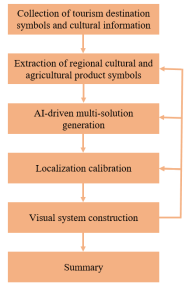
This research framework integrated the design process of tourism destination symbol into five steps as shown in
Figure 2.
Then, the five steps were further outlined below.
A. Collection of tourism destination symbols and cultural information: Gathered characteristic data on regional folk customs and specialty agricultural products.
B. Extraction of regional cultural and agricultural product symbols: Identifying the referents (core meanings) of symbols and converting them into AI prompts to empower artificial intelligence.
C. AI-driven multi-solution generation: Produced diverse visual symbols and image concepts.
D. Localization calibration: Experts and industry professionals discussed and screened for cultural authenticity and consumer resonance.
E. Visual system construction: Integrated mascot character imagery into brand and digital media.
Figure 2. Process for Extracting Mascot Symbols Using AI Collaboration.
3.2. Simple Steps for AI-Generated Images of Mascot
MidJourney is a text-to-image AI tool built on the Discord platform that generates visually stunning images based on your text prompts. Due to its user-friendly interface and fast image generation capabilities, it has become increasingly popular among users in recent years. MidJourney prompts typically consist of three main parts: A) subject, B) style, and C) parameters. Simply, A) subject refers to the specific content of the AI-generated images; B) style refers to the visual style, environmental elements, and lighting of the AI-generated images; and C) parameters refer to the image dimensions and other settings.
The following outlined the operational steps for generating AI-generated images in this study. First, we derived a prompt based on Saussure’s sign theory to encode the anthropomorphic pomelo fruit, and then used AI to generate an image featuring the characteristics of a travel destination mascot. The prompt texts were as follows: “A cheerful and brave anthropomorphic pomelo mascot with a round, compact body, a large head, wide-open eyes, and a smile; 3D render, the main color is a soft golden yellow, accented with light green leaf decorations; the skin has a delicate texture with soft highlights; A small green leaf sits atop its head like a hat; its cheeks are flushed with a soft pink blush; it strikes a friendly pose, either waving or cradling the fruit”. With its cute cartoon style, soft natural lighting, light-colored background, and rich details, it exudes warmth and freshness, making it ideal as a brand mascot.” The prompt texts “A cheerful and brave anthropomorphic pomelo mascot, Round, compact body, Large head, wide-open eyes, and a smile” described the subject, while “3D render, Cute cartoon style, Soft natural lighting” described the style. Therefore, if the designer understands these key elements, simply changing the text descriptions can alter the presentation style of the AI-generated images.
3.3. Design Quality Assessment for ASP Mascot Character
To evaluate the aesthetic quality of the final mascot character designs, this study once again employed the structured evaluation framework for graphic design previously published by the authors
| [14] | YAO Y C, WU S H. Application of artificial intelligence (ai) in symbol design of specialty products in tourism destinations: a case study of the guava mascot designed for shetou's specialty agricultural product; proceedings of the 2024 Symposium on Thinking and Management of Tourism and Hospitality Industry hold on, F, 2024 [C]. https://ssrn.com/abstract=4825398 |
[14]
. The survey was conducted using a 5-point Likert scale. The study invited three industry experts to complete a questionnaire evaluating the designs across five dimensions (e.g., visual appeal, character traits, emotional expressiveness, consistency and coherence, and functional role). These dimensions were selected to comprehensively cover both the perceptual and functional aspects of character design, as these elements may collectively influence viewers’ acceptance and the design’s usability in practical applications.
4. Results and Discussion
4.1. Extraction of Mascot Image for Agricultural and Specialty Products at Tourist Destinations
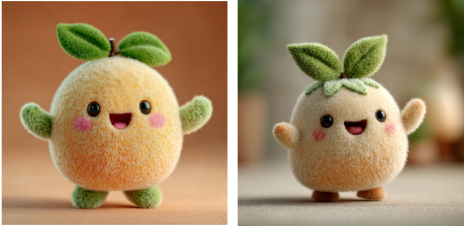
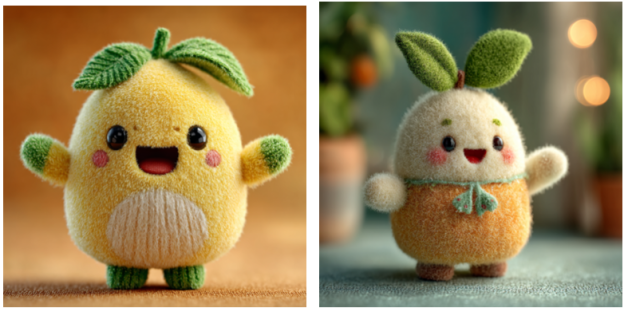
Based on Saussure’s theory of signs, the overall design of this mascot, representing local agricultural specialties of travel destinations, derived from the original codes of the fruit’s shape and color. Briefly, it featured a short, rounded body (with a relatively large head-to-body ratio) and short, smooth limbs, creating a cute and approachable impression. The primary visual color was a warm yellow, highlighting its warm, curious, and lively personality. After confirming the visual design codes, they were converted into prompts. By entering prompts, MidJourney was able to generate quickly initial drafts of anthropomorphic Emperor Pomelo mascots including protagonists and supporting characters (
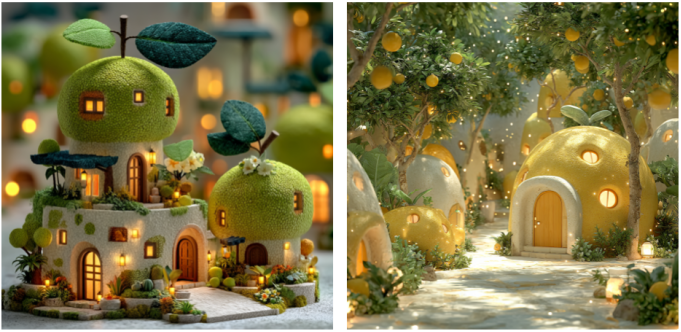
Figures 3, 4). The results demonstrated that this AI platform successfully translates descriptions of a “lively” and “stylized” protagonist into distinct visual representations. Furthermore, by making minor adjustments to the input prompts, scene images could be generated quickly, further refining the mascot character design for agricultural specialty products (
Figure 5). However, the level of detail in the images may be influenced by the specificity of the prompts. If the author determined after review that the images lack sufficient saturation or brightness, manual adjustments were made using graphic design software (such as Photoshop program) to ensure the output quality of the mascot images.
Figure 3. AI-generated image of a pomelo-like mascot. Left panel: male protagonist, Right panel: Female protagonist.
Figure 4. AI-generated image of a pomelo-like mascot: male supporting role. Left panel: male supporting role, Right panel: female supporting role.
Generally, after entering a prompt, MidJourney can generate four images at a time. The duration of image generation is primarily dependent on computer hardware specifications and internet speed. For example, using a Windows 11 operating system, an Intel Core i7 processor, and 24 GB of RAM, the average time to generate four images was approximately 29.1 seconds. The results also showed that only about 1 in 100 AI-generated mascot images met the author’s expectations. However, after continuous practice and refinement, that ratio was further improved to 1 in 40.
Figure 5. Conceptual design of a scene featuring the mascot character for agricultural products at a tourist destination. The images on the left and right panels depicted different scenes, enriching the mascot’s character story.
4.2. Expert Evaluation of Design Quality
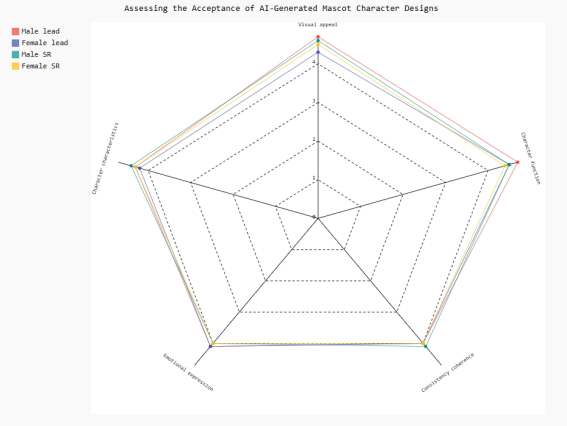
Three industrial design experts (including two men and one woman, with an average of approximately 22.7 years of professional experience) evaluated the characteristics of these mascot designs across five key dimensions through questionnaire analysis. The analysis was based on the assumption that each dimension was equally important and suitable for small sample sizes. A comparative overview using a radar chart generated by Python program revealed that the anthropomorphic pomelo-themed characters were generally well-received with no significant differences among them (
Figure 6). However, the male protagonist scored slightly higher in terms of “visual appeal” and “character function,” suggesting that, in the agriculture-tourism sector, AI-generated male characters may currently hold greater commercial marketing value.
Figure 6. Assessing the Acceptance of AI-Generated Mascot Character Designs. This questionnaire used a Likert scale, where 5 indicated “strongly agree” and 1 indicated “strongly disagree.” The values shown on the radar chart represented the average scores from the questionnaires completed by three experts.
5. Conclusion
In this case study, we designed a mascot themed around pomelos—a specialty of the e area in Changhua County, Taiwan. By first using AI to generate images and then refining them manually, we not only significantly shortened the design cycle for the final piece but also highlighted the unique characteristics of AI-generated content in character design. Furthermore, AIGIT has the potential to serve as a design mechanism for small-scale farmers in the future, enabling them to create professional-grade brand identities at a fraction of the traditional cost.
Abbreviations
AI | Artificial Intelligence |
AIGIT | AI-Generated Image Technology |
ASP | Agricultural Specialty Products |
GANs | Generative Adversarial Networks |
NST | Neural Style Transfer |
TDI | Tourism Destination Image |
VAEs | Variational Auto-encoders |
Acknowledgments
The authors would like to express sincere gratitude to three design experts in the industry, Mr. Gao, Mr. Zhong, and Ms. Chen, for taking the time to assist with the questionnaire survey conducted as part of this study on AI-generated mascot designs.
Author Contributions
Kuo Shan Yao: Writing – original draft, Project administration, Formal Analysis, Validation
Yu Yu Yao: Data curation, Investigation, Software
Shiu Hua Wu: Conceptualization, Funding acquisition, Formal Analysis, Supervision, Writing – review & editing
Funding
This work is supported by Li-Yi Enterprise Company Limited of Funder (Grant No. 11116049).
Data Availability Statement
The data supporting the outcome of this research work has been reported in the Figure 6 of this manuscript.
Conflicts of Interest
The authors declare no conflicts of interest.
References
| [1] |
LEE M M. The Research into the Visual Property of Characters for Place Marketing in Japan [D]. Taoyuan City, Taiwan; Chung Yuan Christian University, 2011.
https://hdl.handle.net/11296/8btj9n
|
| [2] |
CROMPTON J L. An assessment of the image of Mexico as a vacation destination and the influence of geographical location upon that image [J]. Journal of travel research, 1979, 17(4): 18-23.
https://doi.org/10.1177/004728757901700404
|
| [3] |
HONG S-K, KIM J-H, JANG H, et al. The roles of categorization, affective image and constraints on destination choice: An application of the NMNL model [J]. Tourism management, 2006, 27(5): 750-61.
https://doi.org/10.1016/j.tourman.2005.11.001
|
| [4] |
PIKE S, RYAN C. Destination positioning analysis through a comparison of cognitive, affective, and conative perceptions [J]. Journal of travel research, 2004, 42(4): 333-42.
https://doi.org/10.1177/004728750426302
|
| [5] |
CHANDLER D. Semiotics: the basics [M]. Routledge, 2022.
https://analepsis.org/wp-content/uploads/2011/08/69249454-chandler-semiotics.pdf
|
| [6] |
MOTC. About Oh Bear [Z]. 2013.
https://www.taiwan.net.tw/m1.aspx?sno=0040078
|
| [7] |
ZHOU C. When regional traditional culture meets agricultural product brand packaging design [J]. Highlights in Art and Design, 2023, 2(2): 14-6.
https://doi.org/10.54097/hiaad.v2i2.6150
|
| [8] |
TAKáCS D, KOŠIČIAROVá I, KáDEKOVá Z, et al. Cartooning Consumption: The Power of Mascots in the Plant-Based Consumer Sustainable Behavior [J]. Sustainability, 2025, 17(13): 5865.
https://doi.org/10.3390/su17135865
|
| [9] |
KAMCHOMPOO S, KAEWKANTA C. Local Mascot Design by Using Universal Design for Sustainable Community Development: A Case Study of PAA YAO CRAFT MARKET; proceedings of the 2024 Joint International Conference on Digital Arts, Media and Technology with ECTI Northern Section Conference on Electrical, Electronics, Computer and Telecommunications Engineering (ECTI DAMT & NCON), F, 2024 [C]. IEEE.
https://doi.org/10.1109/ECTIDAMTNCON60518.2024.10480094
|
| [10] |
CHEN M. Talking about the Generative Adversarial Network (GAN) for elementary school students [J/OL] 2018,
https://ithelp.ithome.com.tw/articles/10196257
|
| [11] |
ZOU Z, SHI T, QIU S, et al. Stylized neural painting; proceedings of the Proceedings of the IEEE/CVF Conference on Computer Vision and Pattern Recognition, F, 2021 [C].
https://openaccess.thecvf.com/content/CVPR2021/papers/Zou_Stylized_Neural_Painting_CVPR_2021_paper.pdf
|
| [12] |
GATYS L A, ECKER A S, BETHGE M. A neural algorithm of artistic style [J]. arXiv preprint arXiv: 150806576, 2015.
https://doi.org/10.48550/arXiv.1508.06576
|
| [13] |
LIANG D, KRISHNAN R G, HOFFMAN M D, et al. Variational autoencoders for collaborative filtering; proceedings of the Proceedings of the 2018 world wide web conference, F, 2018 [C].
https://doi.org/10.1145/3178876.3186150
|
| [14] |
YAO Y C, WU S H. Application of artificial intelligence (ai) in symbol design of specialty products in tourism destinations: a case study of the guava mascot designed for shetou's specialty agricultural product; proceedings of the 2024 Symposium on Thinking and Management of Tourism and Hospitality Industry hold on, F, 2024 [C].
https://ssrn.com/abstract=4825398
|
Cite This Article
-
APA Style
Yao, K. S., Yao, Y. Y., Wu, S. H. (2026). Exploring the Application of AI-Generated Image Technology in the Design of Agricultural Product Mascots for Tourist Destinations. Social Sciences, 15(3), 124-130. https://doi.org/10.11648/j.ss.20261503.13
 Copy
|
Copy
|
 Download
ACS Style
Yao, K. S.; Yao, Y. Y.; Wu, S. H. Exploring the Application of AI-Generated Image Technology in the Design of Agricultural Product Mascots for Tourist Destinations. Soc. Sci. 2026, 15(3), 124-130. doi: 10.11648/j.ss.20261503.13
Copy
|
Download
AMA Style
Yao KS, Yao YY, Wu SH. Exploring the Application of AI-Generated Image Technology in the Design of Agricultural Product Mascots for Tourist Destinations. Soc Sci. 2026;15(3):124-130. doi: 10.11648/j.ss.20261503.13
Copy
|
Download
-
@article{10.11648/j.ss.20261503.13,
  author = {Kuo Shan Yao and Yu Yu Yao and Shiu Hua Wu},
  title = {Exploring the Application of AI-Generated Image Technology in the Design of Agricultural Product Mascots for Tourist Destinations},
  journal = {Social Sciences},
  volume = {15},
  number = {3},
  pages = {124-130},
  doi = {10.11648/j.ss.20261503.13},
  url = {https://doi.org/10.11648/j.ss.20261503.13},
  eprint = {https://article.sciencepublishinggroup.com/pdf/10.11648.j.ss.20261503.13},
  abstract = {This study aims to leverage current AI image generation technology to evaluate the potential of human-machine collaboration in mascot symbol design and explore potential strategies to address the crisis of homogenization in visual design. Based on a theoretical framework of semiotics and destination branding, this study combines cultural coding, AI prompt engineering, and expert calibration to transform local agricultural specialty products (ASP) into a mascot visual system. The MidJourney platform, which is relatively easy to use, was selected as the primary AI generation tool for this project. Following necessary manual optimization, three industrial design experts evaluated the generated AI visual codes via a structured questionnaire to measure their acceptability across five design dimensions. The results indicated that AI-assisted generation could rapidly produce diverse mascot concepts that embody distinct regional characteristics, though only a few met expectations. This may be attributed to the author’s limited proficiency in crafting prompts for this platform; performance was expected to improve significantly with further training. The experts’ evaluation of the AI-generated mascot designs revealed that overall acceptance was satisfactory, though the male protagonist scored slightly higher in terms of visual appeal and functional suitability. In conclusion, the authors argued that AI-generated image technology, when embedded within a human-machine cooperation loop, offers an effective and viable mechanism for mascot symbol design of agriculture-specific products in travel destinations.},
 year = {2026}
}
Copy
|
Download
-
TY  - JOUR
T1  - Exploring the Application of AI-Generated Image Technology in the Design of Agricultural Product Mascots for Tourist Destinations
AU  - Kuo Shan Yao
AU  - Yu Yu Yao
AU  - Shiu Hua Wu
Y1  - 2026/06/09
PY  - 2026
N1  - https://doi.org/10.11648/j.ss.20261503.13
DO  - 10.11648/j.ss.20261503.13
T2  - Social Sciences
JF  - Social Sciences
JO  - Social Sciences
SP  - 124
EP  - 130
PB  - Science Publishing Group
SN  - 2326-988X
UR  - https://doi.org/10.11648/j.ss.20261503.13
AB  - This study aims to leverage current AI image generation technology to evaluate the potential of human-machine collaboration in mascot symbol design and explore potential strategies to address the crisis of homogenization in visual design. Based on a theoretical framework of semiotics and destination branding, this study combines cultural coding, AI prompt engineering, and expert calibration to transform local agricultural specialty products (ASP) into a mascot visual system. The MidJourney platform, which is relatively easy to use, was selected as the primary AI generation tool for this project. Following necessary manual optimization, three industrial design experts evaluated the generated AI visual codes via a structured questionnaire to measure their acceptability across five design dimensions. The results indicated that AI-assisted generation could rapidly produce diverse mascot concepts that embody distinct regional characteristics, though only a few met expectations. This may be attributed to the author’s limited proficiency in crafting prompts for this platform; performance was expected to improve significantly with further training. The experts’ evaluation of the AI-generated mascot designs revealed that overall acceptance was satisfactory, though the male protagonist scored slightly higher in terms of visual appeal and functional suitability. In conclusion, the authors argued that AI-generated image technology, when embedded within a human-machine cooperation loop, offers an effective and viable mechanism for mascot symbol design of agriculture-specific products in travel destinations.
VL  - 15
IS  - 3
ER  -
Copy
|
Download





 Share This Article
 Twitter
 Linked In
 Facebook