Abstract
Social media has emerged as a powerful tool for promoting sustainable development initiatives on platforms like Instagram, Twitter, You Tube, Facebook, Twitter, etc. due to its wide reach and engagement potential. This paper examines the effectiveness of utilizing social media platforms for sustainable development campaigns. The objective of this research is to assess how social media can be leveraged to raise awareness, mobilize support, and drive action towards sustainable development goals. Problem Statement: Despite the increasing use of social media for advocacy purposes, there is a need to understand its impact on sustainable development campaigns comprehensively. This research aims to address this gap by exploring the role of social media in fostering sustainable behavior change and community engagement. Research Questions & Hypotheses: 1. How does social media influence public perceptions and attitudes towards sustainable development? Hypothesis: Social media engagement positively correlates with increased awareness and support for sustainable development initiatives. 2. What strategies are most effective in leveraging social media for sustainable development campaigns? Hypothesis: Interactive and visually compelling content generates higher levels of engagement and participation in sustainable development campaigns on social media platforms. Research Methodology: This study employs a mixed-methods approach of primary and secondary data sources, combining quantitative analysis of social media data with qualitative interviews and surveys to gather insights into user perceptions and behaviours. Key Findings & Conclusions: Preliminary findings suggest that social media plays a crucial role in spreading a word and driving support for sustainable development campaigns. Interactive content, influencer partnerships, and targeted messaging emerge as key success factors in driving engagement and action. Discussions & Recommendations: The findings highlight the importance of strategic communication and community engagement strategies in maximizing the impact of sustainable development campaigns on social media. Recommendations include the development of tailored content, fostering partnerships with influencers and organizations, and leveraging data analytics to measure and optimize campaign effectiveness.
Keywords
Social Media, Sustainable Development, Advocacy, Engagement, Communication, Campaigns, Behaviour Change, Community Mobilization
1. Introduction
Social media platforms have become incredibly effective instruments for promoting sustainable development efforts in the current era of fast digital transformation. Platforms like Instagram, YouTube, Facebook, and Twitter have transformed the way environmental, social, and economic sustainability principles are communicated because of their worldwide reach and interactive possibilities. In the past, traditional environmental advocacy relied on gatekeeping print or electronic media and slow, labour-intensive physical efforts to spread information
| [7] | Sobhani Fard, Y., & Hatami, M. (2026). Sustainable development in the digital age: Leveraging social networks for viral green product messages (Version 1) [Preprint]. Research Square. https://doi.org/10.21203/rs.3.rs-3423200/v1 |
[7]
. On the other hand, direct, two-way communication is made possible by the modern digital environment, which enables groups and independent activists to overcome temporal and geographic boundaries. By transforming passive audiences into active content co-creators who can spread messages across horizontal networks in a matter of seconds, this change has democratized environmental discourse. Addressing the behavioral and social factors that underlie global difficulties is crucial to achieving the 2030 Agenda and its 17 Sustainable Development Goals (SDGs). In this regard, social media is essential for increasing public knowledge, influencing attitudes, and inspiring group action in favor of sustainable practices and green consumption
| [6] | De Luca, F., Iaia, L., Mehmood, A., & Vrontis, D. (2022). Can social media improve stakeholder engagement and communication of Sustainable Development Goals? A cross-country analysis. Technological Forecasting and Social Change, 177, 121525. https://doi.org/10.1016/j.techfore.2022.121525 |
| [11] | Nathaly Aya Pastrana & Rafael Obregón (2023) Harnessing the power of social marketing for sustainable development 20: 661–692 https://doi.org/10.1007/s12208-023-00382-6 |
[6, 11]
. According to empirical study, social media information serves as an external trigger that greatly influences green buying intentions, especially among young "digital natives" and Generation Z. Campaigns can successfully foster strong subjective standards and good perceived green values by employing interactive and visually appealing content, such as short-form video reels, focused messaging, and strategic influencer alliances
| [9] | Si Xie and Ghulam Rasool Madni, Sustainability (2023), Impact of Social Media on Young Generation’s Green Consumption Behavior through Subjective Norms and Perceived Green Value. 15(4), 3739; https://doi.org/10.3390/su15043739 |
[9]
. Modern campaigns are increasingly using strategic social marketing frameworks that combine innovative communication strategies with interactive experiences in order to optimize impact. For instance, applying surprise and innovation in green product messages—such as exhibiting sophisticated technologies or the exceptional power of nature—has been found to boost message virality and consumer engagement. Additionally, users may directly visualize their ecological footprint and experiment with sustainable decision-making in real-time thanks to the integration of gamified simulations, virtual or augmented reality (VR/AR) tools, and mobile apps
. These interactive technologies effectively link macro-level sustainable development goals to micro-level everyday practices like recycling, cutting back on water and power use, or switching to sustainable modes of transportation. However, using social media for sustainable development comes with intricate, systemic issues that might reduce the effectiveness of campaigns. The hazards of "slacktivism" (also known as "clicktivism"), which occurs when low-effort digital acts like "liking" or sharing content fail to transition into substantial, demanding offline commitments like volunteering or money donation, must be managed by activists and groups. Additionally, "echo chambers" are often created by algorithmic curation on digital platforms, limiting the impact of environmental efforts to audiences that are already environmentally sensitive and impeding widespread public conversion
| [7] | Sobhani Fard, Y., & Hatami, M. (2026). Sustainable development in the digital age: Leveraging social networks for viral green product messages (Version 1) [Preprint]. Research Square. https://doi.org/10.21203/rs.3.rs-3423200/v1 |
[7]
. However, there are complex, systemic problems with using social media for sustainable development, which could make campaigns less successful. Activists and organizations must manage the risks of "slacktivism" (sometimes called "clicktivism"), which happens when low-effort digital actions like "liking" or sharing content fail to evolve into significant, demanding offline commitments like volunteering or financial donation. Furthermore, automated curation on digital platforms frequently creates "echo chambers," which restrict the influence of environmental initiatives to audiences who are already environmentally conscious and hinder broad public conversion.
2. Literature Review
Social networking websites have emerged as powerful platforms for facilitating large-scale group action and driving societal change. This literature review explores the potential role of social networking websites in supporting individual reduction in personal energy consumption. We summarize existing applications of social networking in various contexts and propose an innovative approach that integrates feedback on ecological footprint data into popular social networking sites and internet portal sites.
Numerous studies have highlighted the effectiveness of social networking platforms in mobilizing communities and catalyzing collective action. From political movements to environmental campaigns, social networking websites have demonstrated their capacity to amplify voices and foster collaboration among diverse groups. These platforms have been utilized for raising awareness, organizing events, and facilitating discussions on pressing issues.
Thus paper’s proposed approach seeks to leverage the widespread usage of existing social networking sites by integrating feedback mechanisms related to ecological footprint data. By providing users with regular feedback on their energy consumption behaviours, these platforms can serve as catalysts for behavioural change. Moreover, integrating such feedback into commonly used sites enables the exploration of motivational schemes that leverage group dynamics to encourage sustained engagement.
To assess the effectiveness of different motivational schemes, we propose a threefold evaluation focusing on reduction in CO2 emissions, lifestyle changes, and user retention. By comparing various approaches, including gamification, social incentives, and peer-to-peer engagement, we aim to identify strategies that are most conducive to fostering sustainable behaviours.
Social networking websites hold immense potential as tools for promoting individual reduction in energy consumption. By integrating feedback mechanisms into popular online platforms, we can harness the power of social networks to drive positive environmental change. Through rigorous evaluation of motivational schemes, we can optimize strategies for maximizing impact and fostering long-term behavioural shifts towards sustainability.
| [1] | Mankoff, J., Matthews, D., Fussell, S. R., & Johnson, M. (2007). Leveraging social networks to motivate individuals to reduce their ecological footprints. In 40th Annual Hawaii International Conference on System Sciences (HICSS 2007) (p. 87). IEEE. https://doi.org/10.1109/HICSS.2007.325 |
[1]
The dissemination of green product messages via social networks has emerged as a pivotal strategy for promoting sustainability. This review examines the role of surprising messages in enhancing the viralization of green product messages on social media platforms. Drawing from literature, interviews, and exploratory factor analysis, this study categorizes and prioritizes factors conducive to message virality.
The study identifies 16 factors crucial for the viralization of green product messages, focusing on seduction, innovation, and the unknown. Notably, advanced and novel technologies rank highest, emphasizing their ability to intrigue audiences and evoke surprise. These findings echo prior research, particularly emphasizing the significance of surprise in green product message virality.
Technological advancements significantly influence consumer acceptance, with products boasting cutting-edge technology being more likely to capture attention and be shared across social networks. This underscores the correlation between innovation and product promotion, highlighting the pivotal role of innovation in fostering market acceptance.
Emphasizing innovation and surprise in green product messaging holds profound implications for sustainable development. By leveraging social networks to disseminate surprising messages, green producers and marketers can efficiently promote their products at minimal cost. This approach not only enhances consumer engagement but also contributes to environmental health by encouraging the adoption of green products, thereby fostering sustainable development.
Governments can harness these insights to promote a culture of green consumption through targeted policy interventions. By incorporating organized solutions based on identified factors, policymakers can steer societies towards sustainable development while improving economic conditions without compromising environmental integrity.
This literature review underscores the efficacy of surprising messages in promoting green products through social networks. Prioritizing factors related to innovation and leveraging technological advancements can enhance the viralization of green product messages, contributing to sustainable development and environmental well-being. Moreover, policymakers can utilize these insights to formulate effective strategies for promoting green consumption and fostering sustainable growth.
| [2] | Sobhanifard, Y., & Hatami, M. (2026). Sustainable development in the digital age: Leveraging social networks for viral green product messages (Version 1) [Preprint]. Research Square. https://doi.org/10.21203/rs.3.rs-3423200/v1 |
[2]
Social media has become integral to modern communication, offering unparalleled opportunities to raise awareness and address environmental issues. This paper explores the role of social media in fostering environmental awareness and solutions, highlighting its potential to connect individuals globally and drive positive change.
Various strategies have been identified for utilizing social media effectively in promoting environmental awareness. These include creating engaging content, utilizing hashtags and campaigns, partnering with influencers, and real-time monitoring and response. These strategies facilitate broader audience reach and foster dialogue around environmental issues.
Despite its potential, leveraging social media for environmental awareness comes with challenges. Misinformation and limited attention spans among users pose significant obstacles. Additionally, the echo chamber phenomenon limits diverse perspectives and broad-based engagement on environmental issues.
Despite challenges, social media presents opportunities for environmental awareness. It enables crowdsourcing of solutions, mobilization of public support, and facilitates cross-sector collaboration. These opportunities enhance the effectiveness of environmental initiatives and foster collaborative problem-solving.
To maximize the impact of environmental campaigns on social media, it is essential to develop clear strategies, employ a multichannel approach, and promote transparency and fact-checking. These practices ensure credibility, reach, and engagement, thus enhancing the effectiveness of environmental communication efforts.
| [3] | John, J., & Puthenthara, M. (2023). Leveraging social media for environmental awareness and solutions: Strategies, challenges, and opportunities. International Journal on Emerging Research Areas, 3(1), 11–24.
https://doi.org/10.5281/zenodo.8013217 |
[3]
The surge in social media usage, particularly platforms like Facebook, among higher education students is seen as a promising avenue for spreading awareness about environmental sustainability. This paper sets out to review, summarize, and analyze the impact of social media on engaging students and staff in environmental sustainability issues.
In employing a systematic literature review, the researchers scoured three online databases to gather relevant papers. Data from each paper were extracted, and the ensuing discussion was structured around the formulated research questions.
The findings underscore the need for higher education institutions to capitalize on the widespread use of social media to broaden students' and staff's perspectives on environmental sustainability. Practices like recycling, reducing electricity and water consumption, and minimizing paper usage in classrooms serve as tangible ways to involve students in environmental initiatives. Social media can also aid staff in disseminating university policies and fostering a culture of environmental consciousness.
However, the research has its limitations, including a lack of keyword search using synonyms, no forward or backward searches, and a cutoff point of 2013 for paper searches. Future studies should address these limitations by employing diverse research methodologies and exploring the topic with updated data. Developing frameworks to optimize social media's role in promoting environmental sustainability in higher education is also recommended.
Practically, leveraging social media can significantly enhance the propagation of environmental awareness in higher education settings. Moreover, increasing environmental awareness levels among students can potentially lead to improved behavioral practices regarding sustainability.
The originality of this research lies in its focus on the role of social media in shaping environmental sustainability awareness in higher education. While environmental sustainability is a well-discussed topic in academia, the specific impact of social media remains underexplored. This knowledge gap presents a valuable opportunity for sustainability researchers to delve into the effective utilization of social media for environmental awareness campaigns in higher education.
| [4] | Hamid, S., Ijab, M. T., Sulaiman, H., Anwar, R. M., & Norman, A. A. (2017). Social media for environmental sustainability awareness in higher education. International Journal of Sustainability in Higher Education, 18(4), 474–491.
https://doi.org/10.1108/IJSHE-01-2015-0010 |
[4]
In today's tech-driven era, digitalization permeates every aspect of life, marking a significant shift towards the "e" world. Our reliance on digital devices underscores its indispensability, highlighting its potential to reshape socio-economic growth paradigms. This symbiotic relationship between digitalization and inclusive growth fosters sustainable development, simplifying processes across various domains such as administration, regulation, and planning, thereby enhancing overall quality of life.
The advent of the digital age facilitates sustainable development by empowering societies to become Conscious, Connected, Compliant, Collaborative, and Content. Empowered digitally, societies become responsible stakeholders in the nation's future, contributing towards inclusive growth. This paper seeks to explore the scope of digitalization in the contemporary landscape and its pivotal role in realizing inclusive growth objectives through sustainable means.
The globalization of digitalization has propelled corporate, financial, and administrative sectors, broadening service offerings to society. From streamlined access to technology to enhanced healthcare and educational opportunities, digitalization bridges gaps for the underprivileged, fostering social integration and economic empowerment. By creating a common platform, digitalization aims to uplift millions from poverty, illiteracy, and unemployment, fostering inclusive sustainable growth.
By integrating urban and rural realms, digital platforms enable holistic sustainable development, promoting socio-economic inclusion. This approach fosters dynamic urban frameworks, transparent governance, and active public participation, fostering a prosperous nation. Through this holistic approach, nations not only facilitate inclusive growth but also cultivate digitally savvy, empowered citizens, poised to drive change and progress towards sustainable development.
| [5] | Bhutani, S., & Paliwal, Y. (2015). Digitalization: A step towards sustainable development. OIDA International Journal of Sustainable Development, 8(12), 11–24.
https://ssrn.com/abstract=2713132 |
[5]
Social media, based on information and communication technologies (ICTs), work as new channels to exchange information among stakeholders and play role in improving stakeholder engagement. Considering this aspect, we investigated the characteristics of social media posts that result in higher stakeholder engagement in the European context, and we determined which of the 17 United Nations (UN) Sustainable Development Goals (SDGs) result in greater stakeholder engagement. We apply chi-square automatic interaction detection (CHAID) method to categorize social media posts based on their engagement levels. We analyzed tweets that companies published in 2019 on Twitter that also publish sustainability reports on Global Reporting Initiative. The final sample is based on 3,045 tweets from 173 firms of different industries and countries. We found that tweet characteristics such as content type (SDGs), use of hashtags, existence of link, number of characters, industry type and country of a firm significantly influence stakeholder engagement rates. The most significant SGDs are partnerships for the goals, climate action, reduced inequalities, life below water, life on land, and gender equality. This is the first study which considers the communication of SDGs by firms through social media to determine which SDGs are considered most relevant and promote higher stakeholder engagement.
| [6] | De Luca, F., Iaia, L., Mehmood, A., & Vrontis, D. (2022). Can social media improve stakeholder engagement and communication of Sustainable Development Goals? A cross-country analysis. Technological Forecasting and Social Change, 177, 121525. https://doi.org/10.1016/j.techfore.2022.121525 |
[6]
3. Research Methodology
The research paper focuses on leveraging social media platforms for sustainable development campaigns. It explores how these platforms can be utilized effectively to promote environmental, social, and economic sustainability.
For this study, a mixed-method approach is employed consisting of Primary methods & Secondary methods. Primary methods include surveys conducted to gather firsthand insights from individuals and organizations involved in sustainable development initiatives. These surveys aim to understand the usage patterns, preferences, and challenges faced in leveraging social media for sustainability campaigns.
| [7] | Sobhani Fard, Y., & Hatami, M. (2026). Sustainable development in the digital age: Leveraging social networks for viral green product messages (Version 1) [Preprint]. Research Square. https://doi.org/10.21203/rs.3.rs-3423200/v1 |
[7]
Secondary methods involve the analysis of existing literature of already published.
| [6] | De Luca, F., Iaia, L., Mehmood, A., & Vrontis, D. (2022). Can social media improve stakeholder engagement and communication of Sustainable Development Goals? A cross-country analysis. Technological Forecasting and Social Change, 177, 121525. https://doi.org/10.1016/j.techfore.2022.121525 |
[6]
1) Papers
2) Reports
3) Online portals.
These sources provide valuable background information and insights into the current landscape of social media usage for sustainable development.
Additionally, social media platforms themselves are studied through algorithms and analytics tools to analyze trends, engagement levels, and the effectiveness of different campaign strategies. This approach helps in understanding user behaviour and optimizing campaign outreach and impact.
By combining both primary and secondary research methods, this study aims to provide comprehensive insights into the potential of social media for driving sustainable development initiatives and informing future strategies in this domain.
3.1. Data Analysis
The data provided offers valuable insights into the demographics, behaviors, and perceptions related to leveraging social media for sustainable development campaigns. Here's a comprehensive analysis:
3.1.1. Demographic Analysis
1) Age: The majority of respondents (96%) are between 18-24 years old, indicating a young demographic engaged in the study.
2) Gender: There is a slightly higher representation of females (60%) compared to males (40%), suggesting a balanced gender distribution.
3.1.2. Educational Background
The educational background of respondents varies, with 48% holding a Bachelor's degree and 36% having some college education without a degree.
3.1.3. Social Media Usage
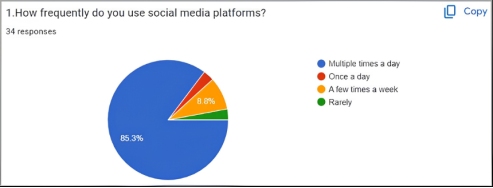
1) A vast majority (85%) of respondents use social media multiple times a day, emphasizing its frequent usage among the demographic.
2) Instagram emerges as the most used platform (88%), followed by YouTube (36%) and Snapchat (33%).
3.1.4. Participation in Sustainable Development Campaigns
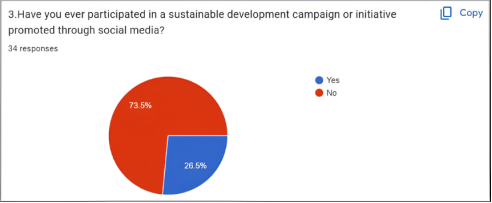
Over two-thirds (73.5%) of respondents have participated in sustainable development campaigns on social media, indicating active engagement in such initiatives.
Figure 1. Respondents' participation in a sustainable development campaign or initiative promoted through social media.
3.1.5. Influence & Motivation
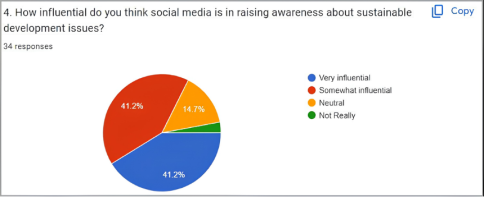
The majority of respondents find social media very influential (57%) in raising awareness about sustainable development issues.
Motivation to engage in sustainable development campaigns is primarily driven by a desire to make a positive impact (64%) and concern for the environment (64%).
Figure 2. Respondents' perceived influence of social media in raising awareness about sustainable development issues.
3.1.6. Engagement Practices
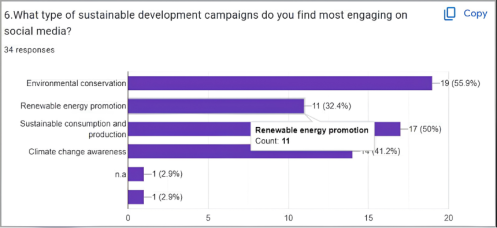
Environmental conservation campaigns are found to be the most engaging (58%) on social media, followed by sustainable consumption and production (48%).
Figure 3. Frequency of social media platform usage among respondents.
3.1.7. Likelihood of Sharing Content
A significant portion of respondents (60%) are somewhat likely or neutral about sharing content related to sustainable development on their social media profiles.
3.1.8. Beliefs Regarding Influence of Social Media
The majority (76%) of respondents agree that social media can effectively influence behavior change towards sustainable practices.
3.1.9. Factors for Campaign Success
Engaging content through reels (85%) and influencer endorsements (85%) are perceived as key factors contributing to the success of sustainable development campaigns on social media.
3.1.10. Action Taking Behaviour
Nearly half of the respondents (46%) have taken action (such as signing a petition, donating, or volunteering) as a result of encountering sustainable development campaigns on social media.
3.2. Suggestions for Improvement
Suggestions for improving support for sustainable development campaigns on social media include focusing on engaging content, influencer endorsements, and clear call-to-action.
Figure 4. Types of sustainable development campaigns respondents find most engaging on social media.
Social media has revolutionized communication and engagement, offering infinite opportunities for promoting sustainable development campaigns. This analysis delves into the potential and challenges of leveraging social media platforms to drive awareness and action towards sustainable development initiatives. Building upon the literature review conducted earlier, this analysis explores key themes such as the effectiveness of social media in raising awareness, the role of content creation and engagement strategies, challenges associated with misinformation, and opportunities for fostering cross-sector collaboration.
The literature review highlighted the transformative potential of social media in amplifying environmental awareness. With billions of active users across various platforms, social media serves as a powerful tool for reaching diverse audiences and sparking meaningful conversations. However, while social media offers extensive reach, its effectiveness in driving tangible behavior change remains debated. Despite this, research suggests that social media can play a crucial role in initiating conversations and catalyzing grassroots movements, ultimately contributing to long-term societal change.
Despite its potential, leveraging social media for sustainable development campaigns comes with its unique set of challenges. One of the most prominent challenges is the prevalence of misinformation and disinformation on social media platforms. False or misleading information can undermine the credibility of campaigns and erode public trust in environmental issues. Addressing this challenge requires proactive measures such as promoting transparency, fact-checking, and fostering critical media literacy skills among users. Additionally, collaboration with reputable sources and leveraging algorithms to prioritize credible content can help mitigate the spread of misinformation.
Social media platforms present unparalleled opportunities for fostering cross-sector collaboration and mobilizing collective action towards sustainable development goals. By facilitating connections between individuals, organizations, and governments, social media can serve as a catalyst for innovation and knowledge-sharing. Moreover, social media enables organizations to reach beyond traditional boundaries and engage with diverse stakeholders, thereby amplifying the impact of sustainable development initiatives.
4. Conclusion
In harnessing social media for sustainable development campaigns, it is evident that these platforms offer immense opportunities for raising awareness, fostering engagement, and driving collective action. Through innovative and engaging content creation, strategic engagement strategies, and cross-sector collaboration, organizations can amplify the reach and impact of their initiatives. However, as with any communication medium, there are both strengths and areas for improvement that warrant attention.
One of the key strengths of leveraging social media for sustainable development lies in its unparalleled reach and accessibility to the youth as billions of active users worldwide, social media platforms provide a powerful means of connecting with diverse audiences and initiating conversations on pressing environmental issues. Additionally, the dynamic nature of social media facilitates real-time engagement, enabling organizations to adapt their messaging and respond to evolving challenges swiftly.
However, despite its potential, leveraging social media for sustainable development campaigns also presents challenges that must be addressed. One notable challenge is the availability of misinformation on these platforms. False or misleading information can undermine the credibility of campaigns and erode public trust in environmental issues. To solve this, organizations must prioritize transparency, fact-checking, and critical media literacy education to empower users to discern credible sources from misinformation.
Additionally, limited attention spans and information overload pose barriers to effectively engaging audiences on social media. In a sea of competing content, sustainable development campaigns must employ strategies to capture and retain audience attention. This may include leveraging visual content, storytelling, and interactive features to create immersive experiences that resonate with users on an emotional level.
In conclusion, while social media presents powerful opportunities for advancing sustainable development goals, it is not without its challenges. By addressing issues such as misinformation, attention spans, and inclusivity, and adopting best practices for content creation and engagement, organizations can maximize the impact of their social media campaigns. By making concerted efforts and strategic utilization of these platforms, we can harness the transformative potential of social media to create a more sustainable and equitable future for all.
Abbreviations
SDGs | Sustainable Development Goals |
ICT | Information and Communication Technology |
CHAID | Chi-square Automatic Interaction Detection |
UN | United Nations |
Conflicts of Interest
The authors declare no conflicts of interest.
References
| [1] |
Mankoff, J., Matthews, D., Fussell, S. R., & Johnson, M. (2007). Leveraging social networks to motivate individuals to reduce their ecological footprints. In 40th Annual Hawaii International Conference on System Sciences (HICSS 2007) (p. 87). IEEE.
https://doi.org/10.1109/HICSS.2007.325
|
| [2] |
Sobhanifard, Y., & Hatami, M. (2026). Sustainable development in the digital age: Leveraging social networks for viral green product messages (Version 1) [Preprint]. Research Square.
https://doi.org/10.21203/rs.3.rs-3423200/v1
|
| [3] |
John, J., & Puthenthara, M. (2023). Leveraging social media for environmental awareness and solutions: Strategies, challenges, and opportunities. International Journal on Emerging Research Areas, 3(1), 11–24.
https://doi.org/10.5281/zenodo.8013217
|
| [4] |
Hamid, S., Ijab, M. T., Sulaiman, H., Anwar, R. M., & Norman, A. A. (2017). Social media for environmental sustainability awareness in higher education. International Journal of Sustainability in Higher Education, 18(4), 474–491.
https://doi.org/10.1108/IJSHE-01-2015-0010
|
| [5] |
Bhutani, S., & Paliwal, Y. (2015). Digitalization: A step towards sustainable development. OIDA International Journal of Sustainable Development, 8(12), 11–24.
https://ssrn.com/abstract=2713132
|
| [6] |
De Luca, F., Iaia, L., Mehmood, A., & Vrontis, D. (2022). Can social media improve stakeholder engagement and communication of Sustainable Development Goals? A cross-country analysis. Technological Forecasting and Social Change, 177, 121525.
https://doi.org/10.1016/j.techfore.2022.121525
|
| [7] |
Sobhani Fard, Y., & Hatami, M. (2026). Sustainable development in the digital age: Leveraging social networks for viral green product messages (Version 1) [Preprint]. Research Square.
https://doi.org/10.21203/rs.3.rs-3423200/v1
|
| [8] |
Bedard, S. A. N., & Tolmie, C. R. (2020). Online sustainable consumption: The role of social media in purchasing green products. Information, 11(9), 447.
https://doi.org/10.1002/csr.1654
|
| [9] |
Si Xie and Ghulam Rasool Madni, Sustainability (2023), Impact of Social Media on Young Generation’s Green Consumption Behavior through Subjective Norms and Perceived Green Value. 15(4), 3739;
https://doi.org/10.3390/su15043739
|
| [10] |
Avery Franken and Chanel MacDiarmid Published (2021) Environmental Activism in the Digital Age
https://doi.org/10.26443/firr.v11i1.52
|
| [11] |
Nathaly Aya Pastrana & Rafael Obregón (2023) Harnessing the power of social marketing for sustainable development 20: 661–692
https://doi.org/10.1007/s12208-023-00382-6
|
| [12] |
M. Mercedes Galan, Maria Sarmento & Susana Marques (2023) Social Marketing to achieve the Sustainable Development Goals (SDGs) in 2030 Agenda by the United Nations 20: 521–527.
https://doi.org/10.1007/s12208-023-00381-7
|
Cite This Article
-
-
@article{10.11648/j.sjbm.20261403.17,
  author = {Sheetal Badesra and Durga Aryal and Hansika Jain and Parth Goyal},
  title = {Leveraging Social Media for Sustainable Development Campaigns},
  journal = {Science Journal of Business and Management},
  volume = {14},
  number = {3},
  pages = {106-113},
  doi = {10.11648/j.sjbm.20261403.17},
  url = {https://doi.org/10.11648/j.sjbm.20261403.17},
  eprint = {https://article.sciencepublishinggroup.com/pdf/10.11648.j.sjbm.20261403.17},
  abstract = {Social media has emerged as a powerful tool for promoting sustainable development initiatives on platforms like Instagram, Twitter, You Tube, Facebook, Twitter, etc. due to its wide reach and engagement potential. This paper examines the effectiveness of utilizing social media platforms for sustainable development campaigns. The objective of this research is to assess how social media can be leveraged to raise awareness, mobilize support, and drive action towards sustainable development goals. Problem Statement: Despite the increasing use of social media for advocacy purposes, there is a need to understand its impact on sustainable development campaigns comprehensively. This research aims to address this gap by exploring the role of social media in fostering sustainable behavior change and community engagement. Research Questions & Hypotheses: 1. How does social media influence public perceptions and attitudes towards sustainable development? Hypothesis: Social media engagement positively correlates with increased awareness and support for sustainable development initiatives. 2. What strategies are most effective in leveraging social media for sustainable development campaigns? Hypothesis: Interactive and visually compelling content generates higher levels of engagement and participation in sustainable development campaigns on social media platforms. Research Methodology: This study employs a mixed-methods approach of primary and secondary data sources, combining quantitative analysis of social media data with qualitative interviews and surveys to gather insights into user perceptions and behaviours. Key Findings & Conclusions: Preliminary findings suggest that social media plays a crucial role in spreading a word and driving support for sustainable development campaigns. Interactive content, influencer partnerships, and targeted messaging emerge as key success factors in driving engagement and action. Discussions & Recommendations: The findings highlight the importance of strategic communication and community engagement strategies in maximizing the impact of sustainable development campaigns on social media. Recommendations include the development of tailored content, fostering partnerships with influencers and organizations, and leveraging data analytics to measure and optimize campaign effectiveness.},
 year = {2026}
}
 Copy
|
Copy
|
 Download
-
TY  - JOUR
T1  - Leveraging Social Media for Sustainable Development Campaigns
AU  - Sheetal Badesra
AU  - Durga Aryal
AU  - Hansika Jain
AU  - Parth Goyal
Y1  - 2026/09/08
PY  - 2026
N1  - https://doi.org/10.11648/j.sjbm.20261403.17
DO  - 10.11648/j.sjbm.20261403.17
T2  - Science Journal of Business and Management
JF  - Science Journal of Business and Management
JO  - Science Journal of Business and Management
SP  - 106
EP  - 113
PB  - Science Publishing Group
SN  - 2331-0634
UR  - https://doi.org/10.11648/j.sjbm.20261403.17
AB  - Social media has emerged as a powerful tool for promoting sustainable development initiatives on platforms like Instagram, Twitter, You Tube, Facebook, Twitter, etc. due to its wide reach and engagement potential. This paper examines the effectiveness of utilizing social media platforms for sustainable development campaigns. The objective of this research is to assess how social media can be leveraged to raise awareness, mobilize support, and drive action towards sustainable development goals. Problem Statement: Despite the increasing use of social media for advocacy purposes, there is a need to understand its impact on sustainable development campaigns comprehensively. This research aims to address this gap by exploring the role of social media in fostering sustainable behavior change and community engagement. Research Questions & Hypotheses: 1. How does social media influence public perceptions and attitudes towards sustainable development? Hypothesis: Social media engagement positively correlates with increased awareness and support for sustainable development initiatives. 2. What strategies are most effective in leveraging social media for sustainable development campaigns? Hypothesis: Interactive and visually compelling content generates higher levels of engagement and participation in sustainable development campaigns on social media platforms. Research Methodology: This study employs a mixed-methods approach of primary and secondary data sources, combining quantitative analysis of social media data with qualitative interviews and surveys to gather insights into user perceptions and behaviours. Key Findings & Conclusions: Preliminary findings suggest that social media plays a crucial role in spreading a word and driving support for sustainable development campaigns. Interactive content, influencer partnerships, and targeted messaging emerge as key success factors in driving engagement and action. Discussions & Recommendations: The findings highlight the importance of strategic communication and community engagement strategies in maximizing the impact of sustainable development campaigns on social media. Recommendations include the development of tailored content, fostering partnerships with influencers and organizations, and leveraging data analytics to measure and optimize campaign effectiveness.
VL  - 14
IS  - 3
ER  -
Copy
|
Download




 Share This Article
 Twitter
 Linked In
 Facebook
 Email: