
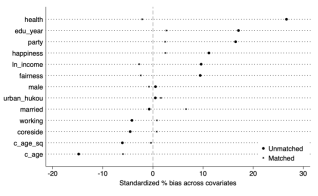
Against the backdrop of global population aging, social participation has been widely regarded as a key pathway to promote the mental health of older adults. However, existing studies often overlook the self-selection bias rooted in cumulative advantage, which may lead to an overestimation of participation effects. Based on the 2023 Chinese General Social Survey (CGSS), this study examines the real effect of social participation on mental health among older Chinese adults using Propensity Score Matching (PSM) to strip out the interference of institutional capital and psychological baselines. The matching covariate set innovatively incorporates Communist Party membership as institutional capital, alongside life satisfaction and perceived social fairness as psychological baseline variables, to more thoroughly identify the sources of selection effects. Ordered logistic regression shows that the composite social participation index is significantly positively associated with mental health, but heterogeneity analysis reveals that this effect is almost entirely driven by formal participation (voting), while informal participation is not statistically significant. After PSM removes cumulative advantage effects, the average treatment effect (ATT) of the composite index decreases by roughly one-third but remains significant, whereas sub-dimensional ATTs become non-significant. The findings confirm a dual structure of “selection gateway plus participation effect” and suggest that active aging policy in China should shift from mobilizing participation to empowering participation, lowering thresholds for disadvantaged older adults so that participation dividends extend from advantaged groups to all older adults.
| Published in | Science Innovation (Volume 14, Issue 3) |
| DOI | 10.11648/j.si.20261403.17 |
| Page(s) | 103-108 |
| Creative Commons |
This is an Open Access article, distributed under the terms of the Creative Commons Attribution 4.0 International License (http://creativecommons.org/licenses/by/4.0/), which permits unrestricted use, distribution and reproduction in any medium or format, provided the original work is properly cited. |
| Copyright |
Copyright © The Author(s), 2026. Published by Science Publishing Group |
Social Participation, Mental Health, Older Adults, Cumulative Advantage, Institutional Capital
类型 | 变量 | 均值(SD) |
|---|---|---|
因变量 | 心理健康 | 3.77 (0.98) |
自变量 | 综合参与指数 | 0.00 (1.00) |
非正式参与 | 0.00 (1.00) | |
正式参与(投票) | 0.37 (0.48) | |
匹配变量 | 政治身份 | 0.15(0.35) |
生活满意度 | 3.91 (0.86) | |
社会公平感 | 3.37 (0.99) | |
控制变量 | 人口学/SES变量 | 略 |
变量 | M1 (控制) | M2 (主效应) |
|---|---|---|
社会参与综合指数 | — | 0.08* |
自评健康 | 0.74*** | 0.79*** |
受教育年限 | 0.03*** | 0.06*** |
个人收入(ln) | 0.04*** | 0.05*** |
代际同住 | 0.24*** | 0.24*** |
其他控制变量 | 已控制 | 已控制 |
Pseudo R² | 0.08 | 0.10 |
变量 | M_Inf (非正式) | M_For (正式) |
|---|---|---|
非正式参与(社交) | 0.03 | — |
正式参与(投票) | — | 0.24*** |
控制变量 | 已控制 | 已控制 |
Pseudo R² | 0.10 | 0.10 |
变量 | 匹配前差异 | ATT (T值) | 结果 |
|---|---|---|---|
综合指数 | 0.21 (4.21) | 0.14 (=2.1) | 显著(p<0.05) |
非正式参与 | 0.14 (=2.84) | 0.04 (=0.52) | 不显著 |
正式参与 | 0.10 (=1.97) | 0.11 (=1.56) | 不显著 |
| [1] |
UN DESA. World Population Prospects 2024: Summary of Results [R]. New York: United Nations, 2024.
https://desapublications.un.org/publications/world-population-prospects-2024-summary-results |
| [2] | World Health Organization. World Report on Ageing and Health [R]. Geneva: WHO, 2015. |
| [3] | Boudiny K. Active ageing: From empty slogans to active concepts [J]. Ageing & Society, 2013, 33(6): 1077–1098. |
| [4] | Havighurst R J. Successful aging [J]. The Gerontologist, 1961, 1(1): 8–13. |
| [5] | 徐金燕, 张倩倩. 老年人社会参与对心理健康的影响——基于CHARLS追踪调查的发现 [J]. 中国人口科学, 2023, 37(4): 98–113. |
| [6] | Sirven N, Debrand T. Social capital and health of older people in Europe: The case of social participation [J]. Social Science & Medicine, 2008, 17(11): 1201–1216. |
| [7] | Thoits P A. Mechanisms linking social ties and support to physical and mental health [J]. Journal of Health and Social Behavior, 2011, 52(2): 145–161. |
| [8] | Li Y, Ferraro K F. Volunteering and depressive symptoms: Is the relation bidirectional? [J]. Journal of Health and Social Behavior, 2005, 46(1): 68–82. |
| [9] | Aroogh M D,Shahboulaghi F M. Social Participation of Older Adults: A Concept Analysis [J]. International Journal of Com⁃ munity Based Nursing and Midwifery,2020(1): 55-72. |
| [10] | Havighurst R J, Albrecht R. Older People [M]. New York: Longmans, Green, 1953: 5–10. |
| [11] | Guo Q, Bai X, Feng N. Social participation and depressive symptoms among Chinese older adults: A study on rural-urban differences [J]. Journal of Affective Disorders, 2018, 239: 124–130. |
| [12] | Zhang W, Feng Q, Liu L, et al. Social engagement and health: Findings from the 2013 survey of the Shanghai elderly life and opinion [J]. International Journal of Aging and Human Development, 2015, 80(4): 332–356. |
| [13] | 董亭月. 中国老年人的政治参与及其影响因素研究——基于2010年CGSS调查数据的实证分析 [J]. 人口与发展, 2016, 22(5): 81- 89+ 80. |
| [14] | Croezen S, Avendano M, Burdorf A, et al. Social participation and depression in old age: A fixed-effects analysis in 10 European countries [J]. American Journal of Epidemiology, 2015, 182(2): 168–176. |
| [15] | Kim B J, Auh E, Lee Y J, et al. The impact of social capital on depression among older Chinese and Korean immigrants [J]. Aging & Mental Health, 2013, 17(7): 844–852. |
| [16] | Chen J. Subjective motivations for mass political participation in urban China [J]. Social Science Quarterly, 2000, 81(2): 645–662. |
| [17] | Morrow-Howell N, Putnam M, Lee Y, et al. An investigation of activity profiles of older adults [J]. The Journals of Gerontology: Series B, 2014, 69(5): 809–821. |
| [18] | Merton R K. The Matthew effect in science [J]. Science, 1968, 159(3810): 56–63. |
| [19] | Dannefer D. Cumulative advantage/disadvantage and the life course [J]. The Journals of Gerontology: Series B, 2003, 58(6): S327–S337. |
| [20] | Ferraro K F, Shippee T P. Aging and cumulative inequality: How does inequality get under the skin? [J]. The Gerontologist, 2009, 49(3): 333–343. |
| [21] | 朱昱恒, 孙少芹. 城镇低龄老年人社会参与的建构机制研究——基于外源嵌入与内生动力的解释 [J]. 贵阳市委党校学报, 2025(5). |
APA Style
Niu, H. (2026). Social Participation and Mental Health in Later Life: The Role of Advantage Accumulation and Institutional Capital in China. Science Innovation, 14(3), 103-108. https://doi.org/10.11648/j.si.20261403.17
ACS Style
Niu, H. Social Participation and Mental Health in Later Life: The Role of Advantage Accumulation and Institutional Capital in China. Sci. Innov. 2026, 14(3), 103-108. doi: 10.11648/j.si.20261403.17
@article{10.11648/j.si.20261403.17,
  author = {Huanqi Niu},
  title = {Social Participation and Mental Health in Later Life: The Role of Advantage Accumulation and Institutional Capital in China},
  journal = {Science Innovation},
  volume = {14},
  number = {3},
  pages = {103-108},
  doi = {10.11648/j.si.20261403.17},
  url = {https://doi.org/10.11648/j.si.20261403.17},
  eprint = {https://article.sciencepublishinggroup.com/pdf/10.11648.j.si.20261403.17},
  abstract = {Against the backdrop of global population aging, social participation has been widely regarded as a key pathway to promote the mental health of older adults. However, existing studies often overlook the self-selection bias rooted in cumulative advantage, which may lead to an overestimation of participation effects. Based on the 2023 Chinese General Social Survey (CGSS), this study examines the real effect of social participation on mental health among older Chinese adults using Propensity Score Matching (PSM) to strip out the interference of institutional capital and psychological baselines. The matching covariate set innovatively incorporates Communist Party membership as institutional capital, alongside life satisfaction and perceived social fairness as psychological baseline variables, to more thoroughly identify the sources of selection effects. Ordered logistic regression shows that the composite social participation index is significantly positively associated with mental health, but heterogeneity analysis reveals that this effect is almost entirely driven by formal participation (voting), while informal participation is not statistically significant. After PSM removes cumulative advantage effects, the average treatment effect (ATT) of the composite index decreases by roughly one-third but remains significant, whereas sub-dimensional ATTs become non-significant. The findings confirm a dual structure of “selection gateway plus participation effect” and suggest that active aging policy in China should shift from mobilizing participation to empowering participation, lowering thresholds for disadvantaged older adults so that participation dividends extend from advantaged groups to all older adults.},
 year = {2026}
}
TY  - JOUR
T1  - Social Participation and Mental Health in Later Life: The Role of Advantage Accumulation and Institutional Capital in China
AU  - Huanqi Niu
Y1  - 2026/06/09
PY  - 2026
N1  - https://doi.org/10.11648/j.si.20261403.17
DO  - 10.11648/j.si.20261403.17
T2  - Science Innovation
JF  - Science Innovation
JO  - Science Innovation
SP  - 103
EP  - 108
PB  - Science Publishing Group
SN  - 2328-787X
UR  - https://doi.org/10.11648/j.si.20261403.17
AB  - Against the backdrop of global population aging, social participation has been widely regarded as a key pathway to promote the mental health of older adults. However, existing studies often overlook the self-selection bias rooted in cumulative advantage, which may lead to an overestimation of participation effects. Based on the 2023 Chinese General Social Survey (CGSS), this study examines the real effect of social participation on mental health among older Chinese adults using Propensity Score Matching (PSM) to strip out the interference of institutional capital and psychological baselines. The matching covariate set innovatively incorporates Communist Party membership as institutional capital, alongside life satisfaction and perceived social fairness as psychological baseline variables, to more thoroughly identify the sources of selection effects. Ordered logistic regression shows that the composite social participation index is significantly positively associated with mental health, but heterogeneity analysis reveals that this effect is almost entirely driven by formal participation (voting), while informal participation is not statistically significant. After PSM removes cumulative advantage effects, the average treatment effect (ATT) of the composite index decreases by roughly one-third but remains significant, whereas sub-dimensional ATTs become non-significant. The findings confirm a dual structure of “selection gateway plus participation effect” and suggest that active aging policy in China should shift from mobilizing participation to empowering participation, lowering thresholds for disadvantaged older adults so that participation dividends extend from advantaged groups to all older adults.
VL  - 14
IS  - 3
ER  -
School of Humanities and Social Science, Xi' an Jiaotong University, Xi' an, China

Information



 Share This Article
 Twitter
 Linked In
 Facebook
 Copy
Copy Download