
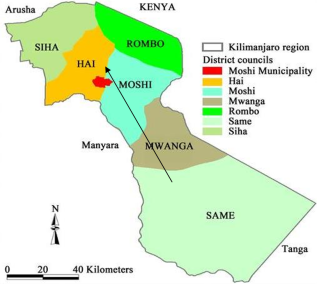
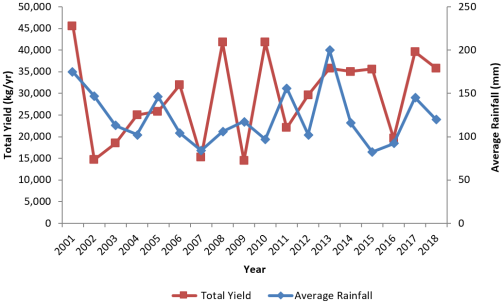
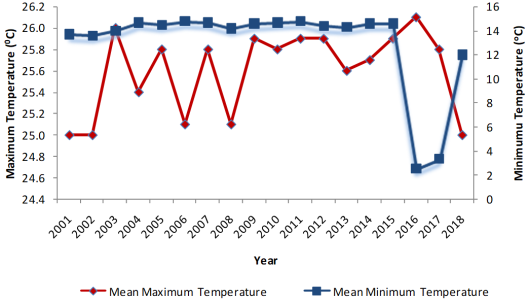
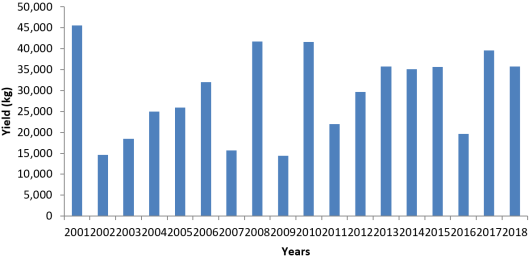
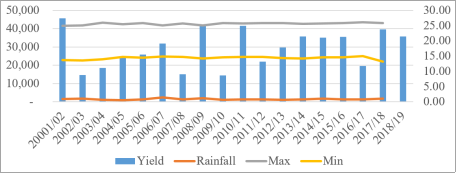
A study investigated the impact of climate change on coffee production on the slopes of Mt. Kilimanjaro by analyzing climatic and yield data trends over 30 years from 1989 to 2018. Meteorological data, including rainfall and temperature, were extracted from the Lyamungu meteorological station. Data on yield were collected through questionnaires, interviews, and focus group discussions with the farmer. Furthermore, data analysis was performed using SPSS version 12.0 and COSATAT for regression analysis, the results showed that total rainfall distribution remained relatively stable, though there were slight changes in trends, with long rain peaks becoming steeper. The mean maximum temperature exhibited significant variation over the years, averaging around 25°C, which is still within the optimal range for coffee cultivation. Notably, the temperature in 1997 deviated most from the mean, rising by almost 1°C. Despite these climatic fluctuations, coffee yield trends were not significantly affected. The study suggests that coffee production in Machame Mashariki ward has not yet been severely impacted by climate change. However, it recommends adaptive strategies such as mulching, trickle irrigation, and rainwater harvesting to mitigate potential future effects. This comprehensive assessment provides valuable insights into the resilience of coffee production to climatic variations on the slopes of Mt. Kilimanjaro.
| Published in | Science Discovery Food (Volume 1, Issue 3) |
| DOI | 10.11648/j.sdf.20260103.12 |
| Page(s) | 111-116 |
| Creative Commons |
This is an Open Access article, distributed under the terms of the Creative Commons Attribution 4.0 International License (http://creativecommons.org/licenses/by/4.0/), which permits unrestricted use, distribution and reproduction in any medium or format, provided the original work is properly cited. |
| Copyright |
Copyright © The Author(s), 2026. Published by Science Publishing Group |
Climate Change, Coffee Production, Mt. Kilimanjaro, Meteorological Data, Yield Trends, Adaptive Strategies
Model | B | T | sig |
|---|---|---|---|
Rainfall | 0.56 | 1.72 | 0.098 |
T.max | -1.33 | -.33803 | 0.935 |
T.min | 122.42 | 0.275 | 0.785 |
Constant | 2492.7 | 0.12 | 0.906 |
SPSS | Statistical Package for Social Science |
| [1] | Adhikari, M., Isaac, E. L., Paterson, R. R. M., & Maslin, M. A. (2020). A review of potential impacts of climate change on coffee cultivation and mycotoxigenic fungi. Microorganisms, 8(10), 1625. |
| [2] | Asegid, A. (2020). Impact of climate change on production and diversity of coffee (Coffea arabica L.) in Ethiopia. Int. J. Res. Stud. Sci. Eng. Technol, 7, 31-38. |
| [3] | Estrada, F., Tol, R. S., & Botzen, W. J. (2017). Global economic impacts of climate variability and change during the 20th century. PloS one, 12(2), e01722. |
| [4] | Gokavi, N., & Kishor, M. (2020). Impact of climate change on coffee production: an overview. Journal of Pharmacognosy and Phytochemistry, 9(3), 1850-1858. |
| [5] | Humphries, U. W., Waqas, M., Hlaing, P. T., Wangwongchai, A., & Dechpichai, P. (2024). Determination of crop water requirements and potential evapotranspiration for sustainable coffee farming in response to future climate change scenarios. Smart Agricultural Technology, 8, 100435. |
| [6] | Jawo, T. O., Kyereh, D., & Lojka, B. (2023). The impact of climate change on coffee production of small farmers and their adaptation strategies: a review. Climate and Development, 15(2), 93-109. |
| [7] | Kiwelu, L. K., Damas, P., & Mpenda, Z. (2021). Assessment of Factors Causing Coffee Yield Gap among Smallholder Farmers in Mbinga and Mbozi Districts. |
| [8] | Klein, H. S., & Luna, F. V. (2023). Coffee. In Brazilian Crops in the Global Market: The Emergence of Brazil as a World Agribusiness Exporter since 1950 (pp. 239-267). Cham: Springer Nature Switzerland. |
| [9] | Lemma, D. T., & Megersa, H. G. (2021). Impact of climate change on East African coffee production and its mitigation strategies. World Journal of Agricultural Sciences, 17(2), 81-89. |
| [10] | Mbuba, A. R., & Shechambo, L. F. (2024). Positional Effects of Bottle-Baited Traps in Reducing Infestation Level of Coffee Berry Borer Hypothenemus Hampei Ferrari in Kilimanjaro Region, Tanzania. Journal of Agricultural Science, 16(5), 32-41. |
| [11] | Mbuba, A., & Shechambo, L. (2023). Efficacy of Plastic Bottle-Baited Traps for Capturing Coffee Berry Borer and Other Coffee Insects Pests in Kilimanjaro Region-Tanzania. American Journal of Entomology, 7(3) 100-108. |
| [12] | Mbwambo, S. G., Mourice, S. K., & Tarimo, A. J. (2021). Climate change perceptions by smallholder coffee farmers in the Northern and Southern Highlands of Tanzania. Climate, 9(6), 90. |
| [13] | Mbwambo, S. G., Mourice, S. K., & Tarimo, A. J. (2022). The impacts of current climate variability on coffee production in the northern and southern highlands of Tanzania. Journal of Agricultural Science, 14(3). |
| [14] | Melese, Y. Y., & Kolech, S. A. (2021). Coffee (Coffea arabica L.): methods, objectives, and future strategies of breeding in Ethiopia. Sustainability, 13(19), 10814. |
| [15] | Mulinde, C., Majaliwa, J. M., Twinomuhangi, R., Mfitumukiza, D., Waiswa, D., Tumwine, F. & Mukasa, D. (2022). Projected climate in coffee-based farming systems: implications for crop suitability in Uganda. Regional Environmental Change, 22(3), 83. |
| [16] | Orindi, VA. Kibona, E and Moindi, DM. (2006). Addressing climate change in the development process in Tanzania, African Centre for Technology Studies (ACTS), Eco policy series no. 18, Acts press, P. O. BOX 45917, Nairobi, Kenya. 34 pp. |
| [17] | Rhiney, K., Guido, Z., Knudson, C., Avelino, J., Bacon, C. M., Leclerc, G. & Bebber, D. P. (2021). Epidemics and the future of coffee production. Proceedings of the National Academy of Sciences, 118(27). |
| [18] | Teran, E. (2024). Enhancement of Coffee Quality Attributes by Combining Processing Methods and Varieties. Beverages, 10(1), 10. |
| [19] | VanRanst, E. Vedoodt, A. and Louwagie, G. (2002). Land evaluation: Practical exercises manual. Lab of soil sci, Ghant University, Belgium. 117 pp. |
| [20] | Wagner, S., Jassogne, L., Price, E., Jones, M., & Preziosi, R. (2021). Impact of climate change on the production of Coffea arabica at Mt. Kilimanjaro, Tanzania. Agriculture, 11(1), 53. |
APA Style
Mbuba, A., Lameck, D. (2026). Assessing Climate Change Impacts on Coffee Production in Hai District, Tanzania: Evidence from Climate Data and Smallholder Farmers. Science Discovery Food, 1(3), 111-116. https://doi.org/10.11648/j.sdf.20260103.12
ACS Style
Mbuba, A.; Lameck, D. Assessing Climate Change Impacts on Coffee Production in Hai District, Tanzania: Evidence from Climate Data and Smallholder Farmers. Sci. Discov. Food 2026, 1(3), 111-116. doi: 10.11648/j.sdf.20260103.12
@article{10.11648/j.sdf.20260103.12,
  author = {Aden Mbuba and Domic Lameck},
  title = {Assessing Climate Change Impacts on Coffee Production in Hai District, Tanzania: Evidence from Climate Data and Smallholder Farmers},
  journal = {Science Discovery Food},
  volume = {1},
  number = {3},
  pages = {111-116},
  doi = {10.11648/j.sdf.20260103.12},
  url = {https://doi.org/10.11648/j.sdf.20260103.12},
  eprint = {https://article.sciencepublishinggroup.com/pdf/10.11648.j.sdf.20260103.12},
  abstract = {A study investigated the impact of climate change on coffee production on the slopes of Mt. Kilimanjaro by analyzing climatic and yield data trends over 30 years from 1989 to 2018. Meteorological data, including rainfall and temperature, were extracted from the Lyamungu meteorological station. Data on yield were collected through questionnaires, interviews, and focus group discussions with the farmer. Furthermore, data analysis was performed using SPSS version 12.0 and COSATAT for regression analysis, the results showed that total rainfall distribution remained relatively stable, though there were slight changes in trends, with long rain peaks becoming steeper. The mean maximum temperature exhibited significant variation over the years, averaging around 25°C, which is still within the optimal range for coffee cultivation. Notably, the temperature in 1997 deviated most from the mean, rising by almost 1°C. Despite these climatic fluctuations, coffee yield trends were not significantly affected. The study suggests that coffee production in Machame Mashariki ward has not yet been severely impacted by climate change. However, it recommends adaptive strategies such as mulching, trickle irrigation, and rainwater harvesting to mitigate potential future effects. This comprehensive assessment provides valuable insights into the resilience of coffee production to climatic variations on the slopes of Mt. Kilimanjaro.},
 year = {2026}
}
TY  - JOUR
T1  - Assessing Climate Change Impacts on Coffee Production in Hai District, Tanzania: Evidence from Climate Data and Smallholder Farmers
AU  - Aden Mbuba
AU  - Domic Lameck
Y1  - 2026/08/10
PY  - 2026
N1  - https://doi.org/10.11648/j.sdf.20260103.12
DO  - 10.11648/j.sdf.20260103.12
T2  - Science Discovery Food
JF  - Science Discovery Food
JO  - Science Discovery Food
SP  - 111
EP  - 116
PB  - Science Publishing Group
SN  - 3143-6781
UR  - https://doi.org/10.11648/j.sdf.20260103.12
AB  - A study investigated the impact of climate change on coffee production on the slopes of Mt. Kilimanjaro by analyzing climatic and yield data trends over 30 years from 1989 to 2018. Meteorological data, including rainfall and temperature, were extracted from the Lyamungu meteorological station. Data on yield were collected through questionnaires, interviews, and focus group discussions with the farmer. Furthermore, data analysis was performed using SPSS version 12.0 and COSATAT for regression analysis, the results showed that total rainfall distribution remained relatively stable, though there were slight changes in trends, with long rain peaks becoming steeper. The mean maximum temperature exhibited significant variation over the years, averaging around 25°C, which is still within the optimal range for coffee cultivation. Notably, the temperature in 1997 deviated most from the mean, rising by almost 1°C. Despite these climatic fluctuations, coffee yield trends were not significantly affected. The study suggests that coffee production in Machame Mashariki ward has not yet been severely impacted by climate change. However, it recommends adaptive strategies such as mulching, trickle irrigation, and rainwater harvesting to mitigate potential future effects. This comprehensive assessment provides valuable insights into the resilience of coffee production to climatic variations on the slopes of Mt. Kilimanjaro.
VL  - 1
IS  - 3
ER  -
Good Agricultural Practices Programme, Tanzania Coffee Research Institute (TaCRI), Moshi, Tanzania

Information



 Share This Article
 Twitter
 Linked In
 Facebook
 Copy
Copy Download