Abstract
The research portrayed the tutor’s behavior in a psychological, anthropological, philosophical and sociological way. The study pointed out that the abandonment of a pet in the environment is related to the behavior of the tutor. This problem of abandoning pets in the environment is frequent in several places in the city of Manaus and other capitals of the Brazilian states. Manaus was the capital selected to represent the study of this problem that plagues other Brazilian capitals. The objective of this research was to inform that the abandonment of pets in the environment will only reduce if the tutor practices responsible guardianship. The abandonment of pets in the environment, whether public or private, causes imbalance to fauna, society, biodiversity, the biome, the ecosystem and the Public Power. The research adopted a deductive approach with a qualitative focus. The primary data source was a field research conducted from 2021 to 2023 in the city of Manaus, Amazonas. This study involved direct observation of pet abandonment patterns in both public and private spaces. It was concluded in this research that the tutor's behavior is crucial to influence the reduction or increase in the pet abandonment rate in the environment.
|
Published in
|
Science Discovery Animals (Volume 1, Issue 2)
|
|
DOI
|
10.11648/j.sdan.20260102.11
|
|
Page(s)
|
58-65 |
|
Creative Commons
|

This is an Open Access article, distributed under the terms of the Creative Commons Attribution 4.0 International License (http://creativecommons.org/licenses/by/4.0/), which permits unrestricted use, distribution and reproduction in any medium or format, provided the original work is properly cited.
|
|
Copyright
|
Copyright © The Author(s), 2026. Published by Science Publishing Group
|
Keywords
Tutor Behavior, Pets, Abandonment of Pets
1. Introduction
The abandonment of pets in a public or private environment in the city of Manaus is a daily problem. The capital of the State of Amazonas will be the reference point for this study, but it is essential to mention that this problem also plagues the other capitals and municipalities of the other Brazilian states.
Pet abandonment is a visual pollution to the environment and society. Therefore, the certainty of an affirmative answer to the question: “Has anyone ever seen an abandoned pet in the environment?” It’s undeniable.
Pets are abandoned daily in the environment, whether it’s public or private. Regardless of the environment, these places represent a reality that can be seen daily anywhere in Brazil.
Pet abandonment is a structural problem, involving several issues, including: social-sociological issues, socio-environmental issues, the precarious efficiency of laws, and the omission of the Public Authorities aligned with the absence of administrative policy structures.
An of the objectives of this research is to study the guardian’s behavior from a sociological, psychological, philosophical, and anthropological perspective and to understand the main cause of pet abandonment in the environment.
Pets have rights; they are classified by doctrine as subjects of law or “sui generis.” These sentient beings are also protected by the international law of the Universal Declaration of Animal Rights.
The Universal Declaration of Animal Rights specifies that pets deserve care, protection, health, safety, and many other guardianship rights. However, for these living beings to receive this, they depend on the guardian’s behavior
Therefore, it’s fundamental that the guardian improves the care of the pet they chose to adopt. The pet is a species whose rights must be respected.
The guardian who does not practice responsible guardianship affects the environment, society, the Public Authorities, and the fauna. When they abandon their pet in the environment, it causes environmental, social, and economic damage, and ultimately affects public policies...
The research adopted a deductive approach with a qualitative focus. The primary data source was a field research conducted from 2021 to 2023 in the city of Manaus, Amazonas. This study involved direct observation of pet abandonment patterns in both public and private spaces. To complement the empirical data, a bibliographic review of environmental laws, jurisdictional doctrines, and academic articles was performed to provide a theoretical framework for the observed phenomena.
2. Responsible Guardianship: The Best form of Protection for Pets
When an individual adopts a pet, they become a guardian. When the individual becomes a guardian, due to their choice and personal will, the natural expectation would be for them to be aware of the burdens and responsibilities that the pet will bring.
Before deciding to be a guardian, awareness of the responsibility of guardianship for the pet they chose to adopt would be fundamental.
The guardian’s lack of commitment to assuming the responsibilities, obligations, burdens, and duties they chose to take on by adopting a pet is the main cause of the abandonment of this species in the environment.
This problem of pet abandonment in the environment also happens due to the guardian’s failure to reflect before adopting a pet.
Responsible guardianship should be an ethical, moral, civic, environmental, and respectful practice that should be carried out by the guardian when caring for the pet.
| [14] | SINGER, Peter. Libertação Animal [Animal Liberation]. Nova revista, 1975. |
[14].
It’s due to this absence of responsible guardianship practice on the part of the guardian that the abandonment of these species in the environment is occurring
.
The Responsible Guardianship Booklet, from, FAMV - Faculty of Agronomy and Veterinary Medicine, p. 2, has the following concept of a responsible pet guardian):
A guardian is the person responsible for caring for a pet. Therefore, before becoming a guardian and taking custody of a dog or cat, you need to know that some basic care is essential, such as those related to the pet's health, feeding, and safety. Thus, before adopting a little animal, reflect carefully on some important points. (Online, 2023).
This responsibility for the guardian’s duties, such as providing a home, food, safety, health assistance, and other obligations to ensure the pet's well-being, is what is called responsible guardianship
| [6] | NASCIMENTO, Ana Paula, da Silva. The importance of responsible guardianship for the well-being of the pet. Univesidade do Estado do Amazonas (UEA). 2023. Available at: https://ri.uea.edu.br/handle/riuea/2409 |
[6]
.
This conduct of responsible guardianship, which the guardian should perform for their pet, is elucidated in article 2 of the Universal Declaration of Animal Rights, 1978
:
Art. 2
1. All animals have the right to be respected.
2. Man, as an animal species, cannot exterminate other animals or exploit them by violating this right; he has the duty to put his knowledge at the service of animals.
3. Every animal has the right to attention, care, and protection from man.
When the guardian abandons their pet in the environment, they disrespect the species they adopted. Because, with this criminal conduct, they contribute to the extermination of the sentient being, condemning it to a slow and deplorable death, whether from malnutrition or a variety of other diseases
| [6] | NASCIMENTO, Ana Paula, da Silva. The importance of responsible guardianship for the well-being of the pet. Univesidade do Estado do Amazonas (UEA). 2023. Available at: https://ri.uea.edu.br/handle/riuea/2409 |
[6]
.
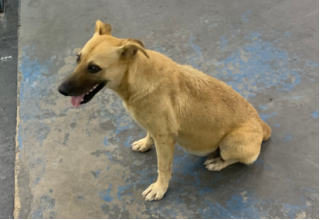
Figure 1. Female dog abandoned in the supermarket parking lot.
When the guardian can no longer bear the burdens of having a pet, the solution many think of is to abandon the sentient being in the environment.
The excuses of the guardians who abandon their pets in the environment are as varied as possible. According to the literature, some of the many reasons mentioned by them are: the pet’s old age, the diseases that a sentient being of this category may acquire or has acquired, the guardian’s change of domicile, lack of financial resources, the guardian’s travel to one place or another, the animal’s behavior, the noises produced, the female dog that reproduced (remembering that she is an irrational being, therefore the person who could prevent the species from reproducing is the guardian, and this is possible through spaying/neutering), the coronavirus pandemic, and so on
| [6] | NASCIMENTO, Ana Paula, da Silva. The importance of responsible guardianship for the well-being of the pet. Univesidade do Estado do Amazonas (UEA). 2023. Available at: https://ri.uea.edu.br/handle/riuea/2409 |
[6]
.
There is still no specific law on responsible pet guardianship, so these sentient beings depend on the goodwill of the guardian to practice it.
Anterioridade da Lei
Art. 1º - Não há crime sem lei anterior que o defina. Não há pena sem prévia cominação legal. (Código Penal Brasileiro, Site do Planalto, 2023).
Translate of english:
Legality Principle (Prior Law)
Art. 1º - There is no crime without a previous law that defines it. There is no penalty without prior legal sanction. (Brazilian Penal Code, Planalto Website, 2023).
For the time being, pets—in order to have protection, security, and other necessary care—remain hostage to the guardian’s behavior and their goodwill to practice responsible guardianship.
Without a responsible guardianship law to support them, the guardian will continue the behavior of abandoning the adopted sentient being in the environment.
Punishment only exists if the crime is defined in law. Therefore, unfortunately, under Brazilian legislation, it will still not be possible to punish the guardian who abandons a pet in the environment. The guardian will remain immune from punishment (Art. 1º of the Brazilian Penal Code).
When the guardian no longer wants to practice responsible guardianship and discards the pet in the environment, they end up transferring their responsibility to third parties (Civil Society, Public Authorities, Non-Governmental Organization, animal rescuers, and other actors).
The concern for the well-being of the abandoned species ends up becoming a problem for civil societyand the Public Authorities to solve.
The guardian knows that their conduct of abandoning the pet in the environment is wrong, immoral, unethical, and not civic, yet the delinquent practice remains habitual.
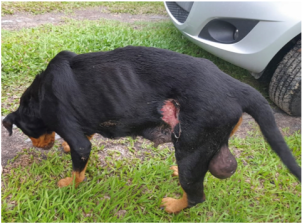
The photo below represents one of the many reasons why certain guardians abandon their pets:
Figure 2. Female dog abandoned on Highway AM 010, KM 32.
In the image, an can see an emaciated, apathetic, poorly cared for female dog, with an injury and a clump of matted fur (or “ball of fur”). The dog is a Rottweiler, and was likely used for breeding in an illegal kennel or by the owner/guardian to obtain financial gain.
The pet, upon falling ill, was abandoned by its guardian on Highway AM 010, KM 32, Manaus – Itacoatiara.
The photographic record was taken on June 26, 2022. This is an example of why a law for responsible guardianship/ownership is necessary to protect pets and also to legally regulate the healthy breeding of these species.
A responsible guardianship law would be extremely important for inspecting the legal and natural persons (companies and individuals) who use pet breeding to generate income and profits.
Ensuring the pet’s health is a basic necessity of responsible guardianship, which the guardian should provide for the species.
The practice of abandoning pets is so common that it is possible to encounter animals on street corners, streets, supermarkets, squares, parks, gas stations, and many other types of public or private environments
.
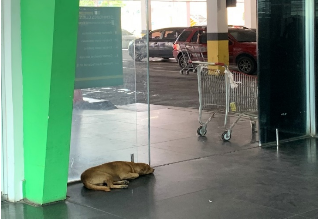
Figure 3. Pet abandoned in a private environment.
The image shows a pet abandoned in a supermarket (a private environment, a commercial location). The caramel-colored dog was abandoned at a supermarket located in the South Zone of the city of Manaus. The photographic record was taken on March 4, 2023.
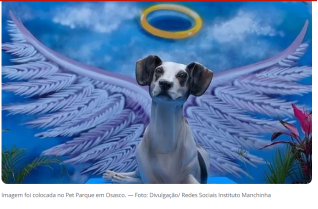
This environmental problem is just as present in other capitals, cities, and municipalities throughout Brazil. The case of this caramel-colored dog is similar to the case of the dog Manchinha, who was abandoned in a supermarket in the city of Osasco, São Paulo. However, the end for that sentient being was tragic: it was beaten and cruelly killed by an employee of the Carrefour supermarket
.
Figure 4. Pet abandoned in a supermarket.
By exempting themselves from their responsible guardianship, the owner (guardian) is committing an environmental, criminal, moral, ethical, and social crime. In addition to this offense, the guardian contributes to various psychological damages to the pet, because this sentient being understands and feels the contempt of having been abandoned, discarded, or thrown away
| [9] | NASCIMENTO, Ana Paula da Silva; NOGUEIRA JÚNIOR, Bianor Saraiva; BRAGA, Mauro. Comparative of Aristotle's doctrinal ideas with the responsible guardianship of pets. Revista de Direito Público da Procuradoria-Geral do Município de Londrina, v. 12, n. 2, Dec. 2023. ISSN: 2317-4188. Available at: http://www.aprolon.com.br |
[9]
.
When the guardian abandons the pet in a public or private environment, they are not fulfilling their role of caring for and protecting the adopted animal they chose to look after.
The guardian should care for the pet responsibly; therefore, they should not abandon the sentient being they chose to adopt into the environment. In other words, they should not pass their responsibility on to others.
Responsible guardianship is not merely providing the basic care the pet needs for survival; it also signifies respect for the adopted species, physically, psychologically, and physiologically. For the pet to receive responsible guardianship, an empathetic character on the part of the guardian is necessary.
3. Abandonment of Pets: A form of Animal Cruelty (Mistreatment)
Mistreatment isn’t solely causing physical harm to the pet. The abandonment of a pet in the environment is a form of human cruelty and mistreatment.
Legally, in Brazil, there is only one article covering physical mistreatment, abuse, violence, and aggression against pets, which is Article 32 of the Environmental Crimes Law (Lei de Crimes Ambientais).
Art. 32. Praticar ato de abuso, maus-tratos, ferir ou mutilar animais silvestres, domésticos ou domesticados, nativos ou exóticos:
§ 1º-A Quando se tratar de cão ou gato, a pena para as condutas descritas no caput deste artigo será de reclusão, de 2 (dois) a 5 (cinco) anos, multa e proibição da guarda. (Incluído pela Lei nº 14.064, de 2020).
Translate of english: Article 32. To commit acts of abuse, mistreatment, injury, or mutilation against wild, domestic, or domesticated animals, native or exotic:
§ 1º-A When the animal is a dog or cat, the penalty for the conduct described in the caput (main part) of this article shall be imprisonment, from 2 (two) to (five) years, a fine, and prohibition from guardianship (owning/keeping the animal). (Included by Law No. 14.064, of 2020)
Article 32 of the Environmental Crimes Law addresses the physical mistreatment of pets. In this case, it becomes easy to punish the guardian; however, it is fundamental to ask how to apply this punishment when the offender is any other individual?
When this practice is committed against a pet abandoned in a public or private environment? How to punish the offender? Since it’s not always possible to identify them. What is then observed is that the pet abandoned in the environment has been neglected and forgotten by the legislation.
Article 32 of the Environmental Crimes Law merely demonstrated that there was no significant legislative change to protect pets, because increasing the penalty for those who practice abuse, injure, mutilate, aggress, or cause any violence or mistreatment to dogs or cats will not inhibit the behavior; it only signifies an aggravation of a longer-term punishment against the offender. This is clearly a provision that is only applicable to the guardian and not to any common person who engages in this type of conduct.
The legal innovation of this Article 32 of the Environmental Crimes Law was: the prohibition of responsible guardianship of the pet.
When the pet is discarded in the environment and does not receive responsible guardianship, this is still a cruel act of mistreatment on the part of the guardian, because the species was not adapted to be self-sufficient; it needs human care to have a quality of life and survival.
Abandoning a pet in the environment is the decree of a slow and cruel death for this species. For every day of life that this sentient being spends in a public or private environment, it will suffer mistreatment in different categories such as: hunger, thirst, the insecurity of not having an adequate environment to sleep, psychological damage, lack of health care (which is gradually being depreciated), or all of them together, in addition to physical violence committed by third parties.
The pet should not be subjected to any form of mistreatment, as described in Article 3, paragraph 1 and Article 6, paragraph 2 of the Universal Declaration of Animal Rights. The aforementioned articles are presented below:
Articles from the Universal Declaration of Animal Rights
Article 3
No animal shall be subjected to mistreatment or cruel acts.
Article 6
1) Every animal that man has chosen as a companion has the right to a lifespan in accordance with its natural longevity.
2) The abandonment of an animal is a cruel and degrading act.
Unfortunately, not every guardian wants to practice what is described in Article 6, paragraph 1, which would be to care for the adopted pet until the end of it’s natural longevity or for the time the species has to live. This legal provision deals with an implicit principle of responsible guardianship.
The guardian who has commitment and responsibility for their pet takes care of their companion’s life, providing quality of life for the species and respecting the duration of this sentient being’s natural longevity.
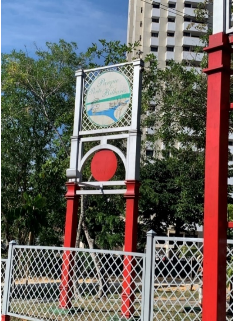
Parque Ponte dos Bilhares or in english Pont of the Bilhares Park is another example of a public location in the City of Manaus that is used by the guardian to carry out the criminal act of abandoning their pet. The image of the entrance to this place was recorded on August 12, 2022.
By abandoning their pet in Bilhares Park, the guardian passed on their responsibility of responsible guardianship.
When the guardian introduces or leaves a pet in an environment belonging to others, whether public or private property, they commit the offense described in Article 164 of the Penal Code. This criminal practice causes harm to the Public Authority, society, the environment, and many others involved.
| [13] | SANTANA, Luciano Rocha. OLIVEIRA, Thiago Pires. Direito da Saúde Animal [Animal Health Law]. Curitiba: Juruá, 2019. |
[13].
Introdução ou abandono de animais em propriedade alheia
Art. 164 - Introduzir ou deixar animais em propriedade alheia, sem consentimento de quem de direito, desde que o fato resulte prejuízo:
Pena - detenção, de quinze dias a seis meses, ou multa.
Translate of english:
Introduction or Abandonment of Animals on Property Belonging to Others
Art. 164 - To introduce or leave animals on property belonging to others, without the consent of the rightful person, provided that the act results in damages:
Penalty - Detention, from fifteen days to six months, or a fine.
Article 164 of the Penal Code briefly discusses the abandonment of pets in the environment.
The public servants at Bilhares Park, sensitized by the abandonment of these pets within the premises of their work environment, end up bringing food and providing water for the minimum survival of these sentient beings.
The employees of Bilhares Park attempt to guarantee the minimum level of responsible guardianship for these abandoned animals in that public environment.
Following is a photo of a pet that was abandoned in Pont of the Bilhares Park.
Figure 6. Dog abandoned in Bilhares Park.
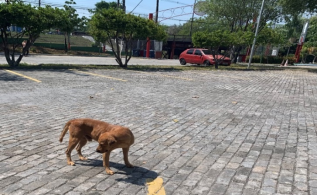
The image shows a pet abandoned in a Municipal Public Square in the city of Manaus. The dog is popularly known as a “caramel dog” (in Brazil tell “cachorro caramelo”); it’s a mixed-breed or “without a defined breed”. The photographic record was taken on Friday, August 12, 2022.
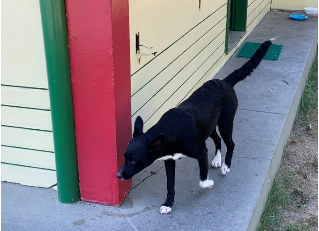
Figure 7. “Pretinha” the female dog.
The image shows a mixed-breed female dog; it was abandoned at Pont of the Bilhares Park. The pet is affectionately called “Pretinha” (Little Black) by the park employees. The photographic record was taken on August 15, 2022.
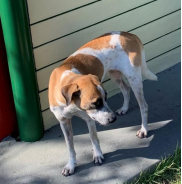
The following image shows another mixed-breed female dog; it was also abandoned at Pont of the Bilhares Park. The photographic record was taken on August 15, 2022.
Figure 8. The sentience of an animal.
In this photo, one can see the sadness in the female dog’s eyes. She understood that it was abandoned by her guardian and is suffering the pain of rejection and abandonment. Her expression clearly demonstrates that pets possess feelings—that they can experience, identify, comprehend, discern, and understand what has happened. Its expression reflects her emotions.
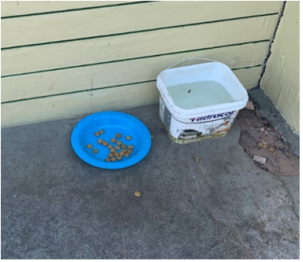
By bringing food and providing water for the abandoned pets, the employees show an attitude of humanity, care, and concern for the well-being of these sentient beings, in addition to bringing a minimal sense of dignity to the species.
Figure 9. Food and Water.
The image shows food and water, nourishment offered by the employees of Bilhares Park to the pets abandoned in this environment. The photographic record was taken on August 12, 2022.
4. Why a Specific Law Is Required to Protect Responsible Pet Guardianship: Evidence from Field Research
Pets will never be like human beings, nor can they have the same rights, as they are living beings with different biological peculiarities, but this does not prevent them from being respected.
No lives are more important than others; all are in a cycle where each contributes to the survival of all. The environment depends on all forms of life to remain healthy and with quality
| [11] | PHILIPPI JR., Arlindo. ALVES, Alaôr Caffé. Curso Interdisciplinar de Direito Ambiental [Interdisciplinary Course on Environmental Law]. São Paulo: Manole, 2005. |
[11].
.
No matter the environment—whether on a Highway at AM 010, KM 33, or in a private environment like a supermarket, or in a public environment like a square, these pets are being abandoned by their guardians (due to their unwillingness to practice responsible guardianship and their lack of commitment to care).
Responsible guardianship of a pet depends on the behavior of the guardian.
There are still no articles or a federal-level law that addresses the abandonment of pets in the environment and clarifies the importance of maintaining responsible guardianship by the owner.
When educational campaigns are carried out, they are not bringing benefits to animal welfare because the abandonment of these species in the environment still continues
.
Educational campaigns are unable to ensure the sensitization and awareness of responsible guardianship on the part of the owner.
It is pointless to run educational campaigns about the environment, animal rights, or responsible guardianship if they depend on the individual’s behavior and environmental education awareness. Therefore, it’s necessary to create rules and norms to coerce and contain human behavior. Laws are created to maintain social order
.
As long as there is no law to curb the guardian's conduct of abandoning a pet in the environment, they will continue to practice it and get away unpunished. It’s because of this legislative failure to typify (legally define as a crime) this type of conduct that it is not possible to punish it, because without legal typification, there is no punishment.
It is necessary for the representatives of the Legislative Power to take the initiative to create a bill to protect pets
| [10] | NASCIMENTO, Ana Paula da Silva; NOGUEIRA JÚNIOR, Bianor Saraiva. The protection of pets based on Kelsenian ethics and morality. Revista da ESDM, v. 9, n. 18, pp. 107-118, 2024. Available at: https://doi.org/10.29282/esdm.v9i18.206 |
[10]
.
This bill needs to be conceptualized by the legislators so that, henceforth, it becomes a specific law. This law is in the interest of everyone, and this includes civil society, researchers, and Non-Governmental Organization...
To alleviate the abandonment of pets, a specific law to protect them is fundamental, as this would lead to more effective and efficient sanctions against guardians who discard their adopted sentient being in the environment.
If a law were created, it could be a way to reduce this reality of pet abandonment in the environment because it would be possible to punish the perpetrator
| [8] | NASCIMENTO, Ana Paula da Silva; JÚNIOR NOGUEIRA, Bianor Saraiva. The creation of a law to protect and legalize responsible guardianship and improve the prevention of pet mistreatment. Deerfield Beach, FL: Pembroke Collins, 2023. |
[8]
.
In short, responsible pet guardianship remains without public policy, without legislation, without oversight, and without punishment from the Public Authority
| [8] | NASCIMENTO, Ana Paula da Silva; JÚNIOR NOGUEIRA, Bianor Saraiva. The creation of a law to protect and legalize responsible guardianship and improve the prevention of pet mistreatment. Deerfield Beach, FL: Pembroke Collins, 2023. |
[8]
.
5. Conclusion
The guardian who decided to have a pet should have the awareness to maintain the responsible guardianship that they sought to possess. Those, they should not abandon the pet in the environment.
If the guardian fulfilled the role of responsible guardianship, they would avoid environmental, social, and economic problems for the Public Authority. Therefore, new ways of legal protection for pets are necessary, which means new measures for the practice of responsible guardianship.
By abandoning their pet in the environment, the guardian does not respect the collective right. For this reason, pet abandonment needs to be solved by the Public Authority, the Executive Power, and the Legislative Power.
A solution to improve the responsible guardianship of pets by the owner could be the creation of a specific protection law for these sentient beings.
The creation of a specific protection law for pets could guarantee the dignity and respect that these species deserve. Furthermore, it would restrain the guardian’s behavior when seeking to abandon the sentient being in the environment. And finally, it could help inhibit the abandonment of these sentient beings in the environment because it would be a legislative tool to oversee and punish these types of crimes practiced by the guardian.
Law is a device of norms. Norms serve as a way to dictate the conducts that should be practiced in society.
Abbreviations
FAMV | Faculty of Agronomy and Veterinary Medicine |
Highway AM 010, KM 32 | Name of the State Highway AM-010 and localizacion kilometer 32 |
Author Contributions
Ana Paula da Silva Nascimento: Conceptualization, Methodology, Investigation, Formal Analysis, Writing – original draft
Conflicts of Interest
The author declares no conflicts of interest.
References
| [1] |
Cartilha Tutela Responsável [Responsible Guardianship Booklet]. Faculty of Agronomy and Veterinary Medicine. Available at:
https://www.upf.br/_uploads/Conteudo/a-universidade/cartilha-tutela-responsavel_compressed.pdf
(Accessed: August 12, 2022).
|
| [2] |
Código Penal Brasileiro [Brazilian Penal Code]. Available at:
https://www.planalto.gov.br/ccivil_03/decreto-lei/del2848compilado.htm
(Accessed: August 24, 2023).
|
| [3] |
LAW No. 6.670, OF DECEMBER 22, 2023 [Animal Rights and Welfare Code of Amazonas]. Available at:
https://legisla.imprensaoficial.am.gov.br/diario_am/12/2023/12/10921
(Accessed: March 2, 2026).
|
| [4] |
NASCIMENTO, Ana Paula, da Silva. Abandono de animais de companhia [Abandonment of Companion Animals]. Conteúdo Jurídico. Published on December 17, 2019. Available at:
https://conteudojuridico.com.br/consulta/artigos/54000/abandono-de-animais-de-companhia
(Accessed: December 12, 2022).
|
| [5] |
NASCIMENTO, Ana Paula, da Silva. O círculo vicioso do tutor em abandonar seu animal de companhia [The Vicious Cycle of the Guardian Abandoning Their Companion Animal]. Available at:
https://www.direitonet.com.br/artigos/exibir/11989/O-circulo-vicioso-do-tutor-em-abandonar-seu-animal-de-companhia
(Accessed: December 12, 2022).
|
| [6] |
NASCIMENTO, Ana Paula, da Silva. The importance of responsible guardianship for the well-being of the pet. Univesidade do Estado do Amazonas (UEA). 2023. Available at:
https://ri.uea.edu.br/handle/riuea/2409
|
| [7] |
NASCIMENTO, Ana Paula da Silva. Abandonment of Pet Animals at the Federal University of Amazonas. v. 2, p. 21-27, 2025.
https://doi.org/10.58806/ijsrs.2025.v2i2n02
|
| [8] |
NASCIMENTO, Ana Paula da Silva; JÚNIOR NOGUEIRA, Bianor Saraiva. The creation of a law to protect and legalize responsible guardianship and improve the prevention of pet mistreatment. Deerfield Beach, FL: Pembroke Collins, 2023.
|
| [9] |
NASCIMENTO, Ana Paula da Silva; NOGUEIRA JÚNIOR, Bianor Saraiva; BRAGA, Mauro. Comparative of Aristotle's doctrinal ideas with the responsible guardianship of pets. Revista de Direito Público da Procuradoria-Geral do Município de Londrina, v. 12, n. 2, Dec. 2023. ISSN: 2317-4188. Available at:
http://www.aprolon.com.br
|
| [10] |
NASCIMENTO, Ana Paula da Silva; NOGUEIRA JÚNIOR, Bianor Saraiva. The protection of pets based on Kelsenian ethics and morality. Revista da ESDM, v. 9, n. 18, pp. 107-118, 2024. Available at:
https://doi.org/10.29282/esdm.v9i18.206
|
| [11] |
PHILIPPI JR., Arlindo. ALVES, Alaôr Caffé. Curso Interdisciplinar de Direito Ambiental [Interdisciplinary Course on Environmental Law]. São Paulo: Manole, 2005.
|
| [12] |
Dog Manchinha, killed by Carrefour security guard in 2018, honored with monument in Osasco, Greater São Paulo.
https://g1.globo.com/sp/sao-paulo/noticia/2021/11/28/cachorro-manchinha-morto-por-seguranca-do-carrefour-em-2018-ganha-monumento-em-osasco-na-grande-sp.ghtml
(Acessed: July 02, 2024).
|
| [13] |
SANTANA, Luciano Rocha. OLIVEIRA, Thiago Pires. Direito da Saúde Animal [Animal Health Law]. Curitiba: Juruá, 2019.
|
| [14] |
SINGER, Peter. Libertação Animal [Animal Liberation]. Nova revista, 1975.
|
| [15] |
[Universal Declaration of Animal Rights]. Available at:
https://www.mamiraua.org.br/pdf/e9b4b78d53d8ade06367be893d9bd826.pdf
(Accessed: March 21, 2023).
|
Cite This Article
-
APA Style
Nascimento, A. P. D. S. (2026). The Influence of the Guardian’s Behavior Is the Main Factor for Pet Abandonment in the Environment. Science Discovery Animals, 1(2), 58-65. https://doi.org/10.11648/j.sdan.20260102.11
 Copy
|
Copy
|
 Download
ACS Style
Nascimento, A. P. D. S. The Influence of the Guardian’s Behavior Is the Main Factor for Pet Abandonment in the Environment. Sci. Discov. Anim. 2026, 1(2), 58-65. doi: 10.11648/j.sdan.20260102.11
Copy
|
Download
AMA Style
Nascimento APDS. The Influence of the Guardian’s Behavior Is the Main Factor for Pet Abandonment in the Environment. Sci Discov Anim. 2026;1(2):58-65. doi: 10.11648/j.sdan.20260102.11
Copy
|
Download
-
@article{10.11648/j.sdan.20260102.11,
  author = {Ana Paula da Silva Nascimento},
  title = {The Influence of the Guardian’s Behavior Is the Main Factor for Pet Abandonment in the Environment},
  journal = {Science Discovery Animals},
  volume = {1},
  number = {2},
  pages = {58-65},
  doi = {10.11648/j.sdan.20260102.11},
  url = {https://doi.org/10.11648/j.sdan.20260102.11},
  eprint = {https://article.sciencepublishinggroup.com/pdf/10.11648.j.sdan.20260102.11},
  abstract = {The research portrayed the tutor’s behavior in a psychological, anthropological, philosophical and sociological way. The study pointed out that the abandonment of a pet in the environment is related to the behavior of the tutor. This problem of abandoning pets in the environment is frequent in several places in the city of Manaus and other capitals of the Brazilian states. Manaus was the capital selected to represent the study of this problem that plagues other Brazilian capitals. The objective of this research was to inform that the abandonment of pets in the environment will only reduce if the tutor practices responsible guardianship. The abandonment of pets in the environment, whether public or private, causes imbalance to fauna, society, biodiversity, the biome, the ecosystem and the Public Power. The research adopted a deductive approach with a qualitative focus. The primary data source was a field research conducted from 2021 to 2023 in the city of Manaus, Amazonas. This study involved direct observation of pet abandonment patterns in both public and private spaces. It was concluded in this research that the tutor's behavior is crucial to influence the reduction or increase in the pet abandonment rate in the environment.},
 year = {2026}
}
Copy
|
Download
-
TY  - JOUR
T1  - The Influence of the Guardian’s Behavior Is the Main Factor for Pet Abandonment in the Environment
AU  - Ana Paula da Silva Nascimento
Y1  - 2026/07/22
PY  - 2026
N1  - https://doi.org/10.11648/j.sdan.20260102.11
DO  - 10.11648/j.sdan.20260102.11
T2  - Science Discovery Animals
JF  - Science Discovery Animals
JO  - Science Discovery Animals
SP  - 58
EP  - 65
PB  - Science Publishing Group
SN  - 3142-8983
UR  - https://doi.org/10.11648/j.sdan.20260102.11
AB  - The research portrayed the tutor’s behavior in a psychological, anthropological, philosophical and sociological way. The study pointed out that the abandonment of a pet in the environment is related to the behavior of the tutor. This problem of abandoning pets in the environment is frequent in several places in the city of Manaus and other capitals of the Brazilian states. Manaus was the capital selected to represent the study of this problem that plagues other Brazilian capitals. The objective of this research was to inform that the abandonment of pets in the environment will only reduce if the tutor practices responsible guardianship. The abandonment of pets in the environment, whether public or private, causes imbalance to fauna, society, biodiversity, the biome, the ecosystem and the Public Power. The research adopted a deductive approach with a qualitative focus. The primary data source was a field research conducted from 2021 to 2023 in the city of Manaus, Amazonas. This study involved direct observation of pet abandonment patterns in both public and private spaces. It was concluded in this research that the tutor's behavior is crucial to influence the reduction or increase in the pet abandonment rate in the environment.
VL  - 1
IS  - 2
ER  -
Copy
|
Download





 Share This Article
 Twitter
 Linked In
 Facebook