
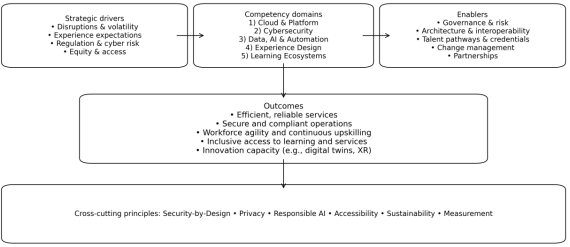
Digital transformation has shifted from a technology modernization agenda to a capability agenda—one that depends on how effectively organizations develop, govern, and sustain IT competencies across cloud platforms, cybersecurity, data and AI, and digitally mediated learning and service ecosystems. This integrative review synthesizes peer-reviewed research and authoritative standards (2018-2025) to identify core competency domains and organizational enablers required to transcend incremental, legacy-bound models. Findings converge on five domains—(1) cloud and platform engineering, (2) cybersecurity and digital trust, (3) data, AI and automation (including generative AI governance), (4) experience engineering and service design, and (5) learning ecosystem engineering—supported by cross-cutting mechanisms in architecture, risk management, talent pathways, and change leadership. Building on this synthesis, the paper proposes an actionable competency-based framework and a phased implementation roadmap that organizations can use to assess readiness, prioritize investments, and operationalize continuous upskilling. The central contribution is practical and policy-relevant: it positions IT competency as the enterprise control point that converts technology investments into resilience, inclusion, and measurable operational performance in the information age.
| Published in | Science Discovery Artificial Intelligence (Volume 1, Issue 1) |
| DOI | 10.11648/j.sdai.20260101.12 |
| Page(s) | 7-13 |
| Creative Commons |
This is an Open Access article, distributed under the terms of the Creative Commons Attribution 4.0 International License (http://creativecommons.org/licenses/by/4.0/), which permits unrestricted use, distribution and reproduction in any medium or format, provided the original work is properly cited. |
| Copyright |
Copyright © The Author(s), 2026. Published by Science Publishing Group |
Digital Transformation, IT Competency, Cloud Computing, Cybersecurity, Artificial Intelligence, Generative AI, Learning Ecosystems, Organizational Resilience
Domain | Core Competencies | Example Operational Indicators | Representative Sources |
|---|---|---|---|
Cloud & Platform Engineering | Cloud architecture; platform engineering; automation; reliability; cost governance | IaC and CI/CD standards; SRE practices; hybrid integration patterns; policy-as-code guardrails | [8, 10] |
Cybersecurity & Digital Trust | Zero trust; IAM; incident response; security governance; privacy | Continuous monitoring; segmentation; third-party risk controls; ISMS controls | [15-17, 20] |
Data, AI & Automation | Data stewardship; MLOps; evaluation and monitoring; responsible AI; generative AI workflow design | Model registry and monitoring; secure data pipelines; AI risk controls; human-in-the-loop escalation | [10, 12, 13, 18, 19] |
Experience Engineering | Service design; UX and accessibility; analytics-driven personalization; change adoption | Journey mapping; accessibility audits; experience KPIs; integrated front/back-stage architecture | [1-3, 11] |
Learning Ecosystem Engineering | EdTech architecture; identity integration; learning analytics governance; digital literacy enablement | Interoperability; accessible/multi-modal delivery; support capacity; measurement of learning outcomes | [7, 21, 22] |
Phase | Primary Actions | Outputs / Evidence of Progress |
|---|---|---|
0-90 days (Stabilize & Govern) | Establish DT governance; define competency domains and skill inventory; adopt baseline cybersecurity controls and a zero trust roadmap; set AI usage policy aligned to AI RMF; identify priority learning services and accessibility requirements. | Governance charter; skills baseline; risk register; minimum security and AI guardrails; prioritized service/learning backlog. |
3-12 months (Build & Enable) | Stand up platform engineering (IaC, CI/CD, reliability practices); implement identity-centric controls; deploy data governance and MLOps foundations; create role-based learning pathways and micro-credentials; modernize learning platform integration and analytics governance. | Reusable platform templates; reliability KPIs; operational ISMS controls; model monitoring; proficiency evidence; integrated learning services. |
12-24 months (Scale & Optimize) | Scale automation and AI with human oversight; expand digital twin and extended reality (XR) pilots [23-29] for training and operations; institutionalize cost governance; measure experience and learning outcomes; refine controls based on audits and incidents; sustain communities of practice. | Reduced cycle time and incidents; validated pilots with return on investment (ROI); improved access and satisfaction metrics; continuous improvement cadence; repeatable audit outcomes. |
AI | Artificial Intelligence |
CI/CD | Continuous Integration/Continuous Delivery |
DT | Digital Transformation |
EdTech | Educational Technology |
IaC | Infrastructure-as-code |
IAM | Identity and Access Management |
ISMS | Information Security Management System |
KPI | Key Performance Indicator |
LMS | Learning Management System |
MLOps | Machine Learning Operations |
NIST | National Institute of Standards and Technology |
ROI | Return on Investment |
SLI | Service Level Indicator |
SLO | Service Level Objective |
SRE | Site Reliability Engineering |
UX | User Experience |
XR | Extended Reality |
| [1] | Vial, G. (2019). Understanding digital transformation: A review and a research agenda. Journal of Strategic Information Systems, 28(2), 118-144. |
| [2] | Verhoef, P. C., Broekhuizen, T., Bart, Y., Bhattacharya, A., Qi Dong, J., Fabian, N., & Haenlein, M. (2021). Digital transformation: A multidisciplinary reflection and research agenda. Journal of Business Research, 122, 889-901. |
| [3] | Hanelt, A., Bohnsack, R., Marz, D., & Antunes Marante, C. (2021). A systematic review of the literature on digital transformation: Insights and implications for strategy and organizational change. Journal of Management Studies, 58(5), 1159-1197. |
| [4] | Bharadwaj, A., El Sawy, O. A., Pavlou, P. A., & Venkatraman, N. (2013). Digital business strategy: Toward a next generation of insights. MIS Quarterly, 37(2), 471-482. |
| [5] | Matt, C., Hess, T., & Benlian, A. (2015). Digital transformation strategies. Business & Information Systems Engineering, 57, 339-343. |
| [6] | Gong, C., & Ribiere, V. (2021). Developing a unified definition of digital transformation. Technovation, 102, 102217. |
| [7] | Trenerry, B., Chng, S., Wang, Y., Lu, H., & Abukhait, R. (2021). Preparing workplaces for digital transformation: An integrative review and framework of multi-level factors. Frontiers in Psychology, 12, 620241. |
| [8] | Warner, K. S., & Wäger, M. (2019). Building dynamic capabilities for digital transformation: An ongoing process of strategic renewal. Long Range Planning, 52(3), 326-349. |
| [9] | Vogelsang, K., Liere-Netheler, K., Packmohr, S., & Hoppe, U. (2019). Success factors for fostering a digital transformation in manufacturing companies. Journal of Enterprise Transformation, 8(1-2), 121-142. |
| [10] | Bouwmans, A., de Leeuw, A., & van der Heijden, B. (2024). The digital transformation skills framework: A new tool to support organizational transformation. PLOS ONE, 19(1), e0296374. |
| [11] | Kretschmer, T., & Khashabi, P. (2020). Digital transformation and organization design: An integrated approach. California Management Review, 62(4), 86-104. |
| [12] | Batool, A., Sefat, M., & Mahmoud, Q. (2025). AI governance in organizations: A systematic literature review. International Journal of Information Management, 74, 102695. |
| [13] | Mallinson, R. (2025). A unified approach to AI governance: Bridging theory and practice. AI and Ethics, 5, 1-15. |
| [14] | Volberda, H. W., Khanagha, S., Baden-Fuller, C., Mihalache, O. R., & Birkinshaw, J. (2021). Strategizing in a digital world: Overcoming cognitive barriers, reconfiguring routines and introducing new organizational forms. Long Range Planning, 54(5), 102110. |
| [15] | Rose, S., Borchert, O., Mitchell, S., & Connelly, S. (2020). Zero Trust Architecture (NIST Special Publication 800-207). National Institute of Standards and Technology. |
| [16] | ISO/IEC. (2022). ISO/IEC 27001: 2022 Information security, cybersecurity and privacy protection — Information security management systems — Requirements. International Organization for Standardization. |
| [17] | ISO/IEC. (2022). ISO/IEC 27002: 2022 Information security, cybersecurity and privacy protection — Information security controls. International Organization for Standardization. |
| [18] | National Institute of Standards and Technology. (2023). AI Risk Management Framework (AI RMF 1.0). National Institute of Standards and Technology. |
| [19] | Autio, C., Schwartz, R., Dunietz, J., Jain, S., Stanley, M., Tabassi, E., Hall, P., & Roberts, K. (2024). Artificial Intelligence Risk Management Framework: Generative Artificial Intelligence Profile (NIST AI 600-1). National Institute of Standards and Technology. |
| [20] |
ISC2. (2024). ISC2 cybersecurity workforce study 2024. ISC2.
https://www.isc2.org/Insights/2024/10/ISC2-2024-Cybersecurity-Workforce-Study |
| [21] | International Telecommunication Union. (2024). Measuring Digital Development: Facts and Figures 2024. ITU Publications. |
| [22] | United Nations Sustainable Development Group. (2020). Policy Brief: Education during COVID-19 and beyond. United Nations. |
| [23] | Burke, D., Crompton, H., & Nickel, C. (2025). The Use of Extended Reality (XR) in Higher Education: A Systematic Review. TechTrends, 69, 998-1011. |
| [24] | Bödding, R., Schriek, S. A., & Maier, G. W. (2025). A systematic review and meta-analysis of mixed reality in vocational education and training. Virtual Reality, 29, 44. |
| [25] | Steen, C. W., Söderström, K., Stensrud, B., et al. (2024). Virtual reality-based mental health training: A systematic review. BMC Medical Education, 24, 587. |
| [26] | Moulaei, K., Sharifi, H., Bahaadinbeigy, K., et al. (2024). Virtual reality for cognitive disorders and dementia: A systematic review and meta-analysis. BMC Psychiatry, 24, 678. |
| [27] | Al-Emran, M., et al. (2024). Virtual, augmented reality and learning analytics impact on learners and educators: A systematic review. Education and Information Technologies, 29, 19913-19962. |
| [28] | Pellegrino, G., Gervasi, M., Angelelli, M., & Corallo, A. (2025). Digital twins to increase sustainability throughout the system life cycle: A systematic literature review. Information Systems Frontiers, 27, 7-32. |
| [29] | Isaza Domínguez, L. G. (2024). Digital twins for Industry 5.0: A systematic literature review. Engineering Proceedings, 82(1), 5. |
| [30] | World Economic Forum. (2023). The Future of Jobs Report 2023. World Economic Forum. |
| [31] | Viswanathan, R., & Telukdarie, A. (2021). A systems dynamics approach to SME digitalization. Procedia Computer Science, 180, 816-824. |
APA Style
Sarwar, M. J. (2026). Advancing IT Competency for Digital Transformation and Learning Ecosystem Expansion: An Integrative Review and Practical Framework. Science Discovery Artificial Intelligence, 1(1), 7-13. https://doi.org/10.11648/j.sdai.20260101.12
ACS Style
Sarwar, M. J. Advancing IT Competency for Digital Transformation and Learning Ecosystem Expansion: An Integrative Review and Practical Framework. Sci. Discov. Artif. Intell. 2026, 1(1), 7-13. doi: 10.11648/j.sdai.20260101.12
@article{10.11648/j.sdai.20260101.12,
  author = {Mohammed Jahed Sarwar},
  title = {Advancing IT Competency for Digital Transformation and Learning Ecosystem Expansion: An Integrative Review and Practical Framework},
  journal = {Science Discovery Artificial Intelligence},
  volume = {1},
  number = {1},
  pages = {7-13},
  doi = {10.11648/j.sdai.20260101.12},
  url = {https://doi.org/10.11648/j.sdai.20260101.12},
  eprint = {https://article.sciencepublishinggroup.com/pdf/10.11648.j.sdai.20260101.12},
  abstract = {Digital transformation has shifted from a technology modernization agenda to a capability agenda—one that depends on how effectively organizations develop, govern, and sustain IT competencies across cloud platforms, cybersecurity, data and AI, and digitally mediated learning and service ecosystems. This integrative review synthesizes peer-reviewed research and authoritative standards (2018-2025) to identify core competency domains and organizational enablers required to transcend incremental, legacy-bound models. Findings converge on five domains—(1) cloud and platform engineering, (2) cybersecurity and digital trust, (3) data, AI and automation (including generative AI governance), (4) experience engineering and service design, and (5) learning ecosystem engineering—supported by cross-cutting mechanisms in architecture, risk management, talent pathways, and change leadership. Building on this synthesis, the paper proposes an actionable competency-based framework and a phased implementation roadmap that organizations can use to assess readiness, prioritize investments, and operationalize continuous upskilling. The central contribution is practical and policy-relevant: it positions IT competency as the enterprise control point that converts technology investments into resilience, inclusion, and measurable operational performance in the information age.},
 year = {2026}
}
TY  - JOUR
T1  - Advancing IT Competency for Digital Transformation and Learning Ecosystem Expansion: An Integrative Review and Practical Framework
AU  - Mohammed Jahed Sarwar
Y1  - 2026/02/21
PY  - 2026
N1  - https://doi.org/10.11648/j.sdai.20260101.12
DO  - 10.11648/j.sdai.20260101.12
T2  - Science Discovery Artificial Intelligence
JF  - Science Discovery Artificial Intelligence
JO  - Science Discovery Artificial Intelligence
SP  - 7
EP  - 13
PB  - Science Publishing Group
UR  - https://doi.org/10.11648/j.sdai.20260101.12
AB  - Digital transformation has shifted from a technology modernization agenda to a capability agenda—one that depends on how effectively organizations develop, govern, and sustain IT competencies across cloud platforms, cybersecurity, data and AI, and digitally mediated learning and service ecosystems. This integrative review synthesizes peer-reviewed research and authoritative standards (2018-2025) to identify core competency domains and organizational enablers required to transcend incremental, legacy-bound models. Findings converge on five domains—(1) cloud and platform engineering, (2) cybersecurity and digital trust, (3) data, AI and automation (including generative AI governance), (4) experience engineering and service design, and (5) learning ecosystem engineering—supported by cross-cutting mechanisms in architecture, risk management, talent pathways, and change leadership. Building on this synthesis, the paper proposes an actionable competency-based framework and a phased implementation roadmap that organizations can use to assess readiness, prioritize investments, and operationalize continuous upskilling. The central contribution is practical and policy-relevant: it positions IT competency as the enterprise control point that converts technology investments into resilience, inclusion, and measurable operational performance in the information age.
VL  - 1
IS  - 1
ER  -
York College, City University of New York (CUNY), New York, The United States
Biography: Mohammed Jahed Sarwar is a Senior Systems Administrator and doctoral candidate (Doctor of Business Administration, Information Systems Management). His work focuses on digital transformation governance, secure cloud and cybersecurity operating models, and the expansion of inclusive learning ecosystems through resilient IT architectures and responsible AI practices.
Research Fields: Digital Transformation; IT Service Management; Cloud Platforms; Cybersecurity Governance; Responsible AI; Digital Learning Ecosystems.

Information



 Share This Article
 Twitter
 Linked In
 Facebook
 Copy
Copy Download