Abstract
In communities where a girl's marriage is arranged before she can speak for herself, consent does not disappear it is simply made invisible. This study interrogates the mechanisms of agency and coercion that shape girl child marriage decisions in Korr-Ngurnit Ward, Marsabit County, Kenya, a predominantly pastoralist setting where the practice remains deeply entrenched. Drawing on a convergent parallel mixed-methods design, the study analyzed data from 296 household surveys, nine focus group discussions, and 16 key informant interviews with Rendille and Samburu community members. Quantitative findings revealed that 51% of respondents were married before the age of 18 years, and 65.5% reported that their marriages occurred without their consent. Logistic regression showed that lack of consent increased the odds of girl child marriage by 4.27 times (OR = 4.27, p < 0.001). Decision-making authority rested almost exclusively with community elders (42.9%) and fathers (30.7%), effectively institutionalizing the exclusion of girls from choices about their own futures. Qualitative narratives illuminated how coercion operates not through overt force alone, but through social stigma, fear of community gossip, patriarchal honour systems, dowry economies, and culturally sanctioned rites such as female genital mutilation and beading forces that constrain girls' agency long before any marriage negotiation begins. Grounded in Social Norms Theory and Gender and Power Theory, the study argues that consent in this context is not simply withheld but structurally pre-empted. Addressing girl child marriage in pastoralist Kenya therefore demands more than legal enforcement it requires dismantling the normative architecture that renders girls' voices inaudible before they are ever heard. Implications for policy and community-level programming are discussed.
|
Published in
|
Research & Development (Volume 7, Issue 2)
|
|
DOI
|
10.11648/j.rd.20260702.11
|
|
Page(s)
|
63-73 |
|
Creative Commons
|

This is an Open Access article, distributed under the terms of the Creative Commons Attribution 4.0 International License (http://creativecommons.org/licenses/by/4.0/), which permits unrestricted use, distribution and reproduction in any medium or format, provided the original work is properly cited.
|
|
Copyright
|
Copyright © The Author(s), 2026. Published by Science Publishing Group
|
Keywords
Child Marriage, Consent, Pastoralist Communities, Gender and Power, Social Norms, Kenya, Girls' Rights
1. Introduction
Child marriage remains one of the most persistent violations of girls' rights across the globe, affecting approximately 650 million girls and women who were married before their eighteenth birthday
| [1] | UNICEF. (2021). Towards Ending Child Marriage: Global trends and profiles of progress. UNICEF, New York. |
[1]
. Despite international commitments to eliminate this practice by 2030 under Sustainable Development Goal 5.3, child marriage continues to thrive in contexts where poverty, cultural traditions, and weak legal enforcement intersect
| [2] | Cordova-Pozo, K. L., Anishettar, S. S., Kumar, M., & Chokhandre, P. K. (2023). Trends in child marriage, sexual violence, early sexual intercourse and the challenges for policy interventions to meet the sustainable development goals. International Journal for Equity in Health, 22(1), 250. |
[2]
. In Kenya, the Marriage Act of 2014 and the Children's Act of 2022 explicitly prohibit child marriage and impose penalties on perpetrators. Yet among women aged twenty to twenty-four, 23 percent were married before reaching age eighteen, with stark regional disparities revealing that pastoralist counties bear a disproportionate burden
| [3] | KNBS (Kenya National Bureau of Statistics). (2023). Kenya Demographic and Health Survey 2022. KNBS. |
[3]
. Marsabit County exemplifies this crisis, where girl child marriage prevalence reaches approximately 40 percent and teenage pregnancy among girls aged fifteen to nineteen stands at 29 percent, nearly double the national average of 15 percent
| [4] | KNBS & ICF. (2023). Kenya Demographic and Health Survey 2022: Key Indicators Report. KNBS and ICF. |
[4]
.
What makes girl child marriage in Marsabit particularly troubling is not merely its prevalence but the invisibility of consent. In this pastoralist context, marriages are rarely conducted with the explicit agreement of the girls involved. The concept of consent becomes blurred when decisions are made by fathers, elders, and religious leaders who view marriage as a family or community affair rather than an individual choice
| [5] | Kok, M. C., Kakal, T., Kassegne, A. B., Hidayana, I. M., Munthali, A., Menon, J. A.,... & Van Der Kwaak, A. (2023). Drivers of child marriage in specific settings of Ethiopia, Indonesia, Kenya, Malawi, Mozambique and Zambia–findings from the Yes I Do! baseline study. BMC Public Health, 23(1), 794. |
[5]
. Girls are socialized from an early age to accept that their futures are not theirs to determine. They are prepared for marriage through cultural rites such as female genital mutilation and beading practices among the Samburu community, rituals that mark their transition from childhood to perceived womanhood without any accompanying recognition of their right to refuse
| [6] | Biwott, S. K., Otieno, J. A., & Wanjala, M. N. (2024). Determinants of structural, behavioral and cultural practices that perpetuate child marriage in Siaya, Homabay and Kisumu Counties in Kenya. International Journal of Social Science, 9(3), 112–125. |
[6]
. The dowry economy further complicates consent, as bride price transforms daughters into economic assets whose marriages provide livestock, cash, or social alliances for their families
| [7] | Rose, G. K. (2023). Cultural Norms and Early Child Marriage (Doctoral dissertation, Kampala International University). |
[7]
. Many families view girl child marriage as a way to avoid shame, scandal, or loss of respect, thereby maintaining a favorable reputation within the community
| [8] | Lowe, H., Kenny, L., Hassan, R., Bacchus, L. J., Njoroge, P., Dagadu, N. A., Hossain, M., & Cislaghi, B. (2022). 'If she gets married when she is young, she will give birth to many kids': A qualitative study of child marriage practices amongst nomadic pastoralist communities in Kenya. Culture, Health & Sexuality, 24(7), 886–901. |
[8]
.
This study seeks to unpack the relationship between agency and coercion in girl child marriage in Marsabit County. Child marriage among girls poses a major barrier to achieving the Sustainable Development Goals (SDGs), particularly SDG 5 on gender equality and women’s empowerment. It directly undermines progress toward Target 5.3, which calls for the elimination of child, early, and forced marriages by 2030. Drawing on survey data from 296 women and qualitative insights from focus group discussions and key informant interviews, we examine how social pressures, cultural expectations, economic desperation, and limited parental education interact to produce a context where girls marry without consent yet may not recognize their lack of agency as coercion. Social norms and community surveillance impose immense pressure on families to get daughters married at a young age, with beliefs that connect female chastity and compliance with family honor remaining emphatically prevalent
| [5] | Kok, M. C., Kakal, T., Kassegne, A. B., Hidayana, I. M., Munthali, A., Menon, J. A.,... & Van Der Kwaak, A. (2023). Drivers of child marriage in specific settings of Ethiopia, Indonesia, Kenya, Malawi, Mozambique and Zambia–findings from the Yes I Do! baseline study. BMC Public Health, 23(1), 794. |
[5]
. The concept of invisible consent captures this paradox: marriages occur without explicit agreement, yet the absence of overt force allows communities to normalize the practice as tradition rather than violation. Understanding these dynamics is essential for designing interventions that move beyond legal prohibitions to address the normative and structural conditions that render girls' consent irrelevant in the eyes of their families and communities.
2. Statement of the Problem
Kenya's Marriage Act of 2014 and Children's Act of 2022 prohibit child marriage, yet the practice persists, with 23 percent of women aged 20 to 24 married before age 18 years
| [3] | KNBS (Kenya National Bureau of Statistics). (2023). Kenya Demographic and Health Survey 2022. KNBS. |
[3]
. Marsabit County has one of the highest prevalence areas, with rates around 40 percent
| [4] | KNBS & ICF. (2023). Kenya Demographic and Health Survey 2022: Key Indicators Report. KNBS and ICF. |
[4]
. What existing literature fails to capture is the nature of consent within these unions. While national discourse frames child marriage as a violation of children's rights, the lived reality in pastoralist communities reveals a more complex picture where marriages occur without explicit consent yet are not perceived as coerced by those who arrange them.
The problem is not merely that girls marry young. It is that 65.5 percent of married women in Marsabit did not consent to their marriages, with lack of consent increasing the odds of child marriage approximately 3.5 times. Yet these marriages proceed under the weight of community expectations, elder authority, and dowry economies that render a girl's agreement irrelevant. Social norms and traditions are cited by 88.8 percent of respondents as drivers of girl child marriage, while 86.1 percent emphasize virginity protection as a key reason for marrying girls under 18 years. The concept of consent becomes invisible when fathers, elders, and religious leaders, identified by 73.6 percent as primary decision makers, view marriage as a family or community affair rather than an individual choice
| [9] | Agi, C. W., & Emelie, C. (2023). Influence of early marriage on academic achievement of female adolescent students in public senior secondary schools in Rivers State. International Journal of Innovative Psychology & Social Development, 11(4), 58–70. |
[9]
.
This study addresses the gap by unpacking how coercion operates through invisible mechanisms where collective expectations override individual agency. Understanding the disconnect between legal definitions of consent and community practices is essential for designing effective interventions in Marsabit's pastoralist context.
3. Research Objective
The specific objectives of this study were to:
i. Unpack the social, cultural, and economic mechanisms that render consent invisible by examining how community expectations, elder authority, dowry economies, and gender norms override individual agency in marriage decisions.
ii. Examine the prevalence and nature of nonconsensual girl child marriage among pastoralist communities in Marsabit County, Kenya, and determine how lack of consent influences age at first marriage.
iii. Assess how parental education levels shape household decision making structures and influence whether girls can exercise consent or refuse early marriage.
4. Research Question
i. How do social norms, cultural practices including elder authority, dowry economies, and economic pressures interact to render consent invisible and override individual agency in marriage decisions for girls?
ii. What is the prevalence of non-consensual girl child marriage among pastoralist communities in Marsabit County, Kenya, and how does lack of consent influence the likelihood of marriage before age 18 years?
iii. To what extent does parental education level influence household decision making structures and a girl's ability to exercise consent or decline early marriage in Marsabit County, Kenya?
5. Literature Review
Child marriage remains a deeply entrenched social issue affecting millions of girls globally, with over 650 million women alive today having been child brides
| [10] | Kohno, A., Techasrivichien, T., Suguimoto, S. P., Dahlui, M., Nik Daliana Nik Farid, N., & Nakayama, T. (2020). Investigation of the key factors that influence the girls to enter into child marriage: A meta synthesis of qualitative evidence. PLoS One, 15(7), e0235959.
https://doi.org/10.1371/journal.pone.0235959 |
[10]
. In Sub–Saharan Africa, 34 percent of girls are married before age 18 years, with countries such as Niger at 76 percent, Chad at 67 percent, and the Central African Republic at 61 percent leading in prevalence
| [11] | Wopara, N. E. (2025). Child marriage in Africa: The effectiveness of international organizations in ending child marriage in Africa. University of California, Santa Barbara. |
[11]
. The East African region features high girl child marriage rates in South Sudan at 52 percent, Ethiopia at 40 percent, Tanzania at 36 percent, and Uganda at 34 percent
| [12] | Ahinkorah, B. O., Aboagye, R. G., Okyere, J., Seidu, A.-A., Budu, E., & Yaya, S. (2023). Child marriage and its association with partner controlling behaviour against adolescent girls and young women in sub-Saharan Africa. BMC Global and Public Health, 1, Article 9. |
[12]
.
Social factors such as community expectations, peer pressure, gender socialization, and collective sanctions play a central role in sustaining girl child marriages. Collective norms and social sanctions including ostracism, gossip, loss of family honor, and exclusion from community events create strong coercive pressure for compliance
| [13] | Cislaghi, B., & Heise, L. (2020). Gender norms and social norms: differences, similarities and why they matter in prevention science. Sociology of Health & Illness, 42(2), 407–422. |
| [14] | Greene, M. E., & Stiefvater, E. (2019). Social norms and child marriage: The limits of law and policy. Journal of International Development, 31(6), 977–993. |
[13, 14]
. In many contexts, peer dynamics normalize girl child marriage, as when young girls observe peers marrying early, it establishes a social standard that exerts pressure to conform
| [15] | Paul, P. (2020). Child marriage among girls in India: Prevalence, trends and socio-economic correlates. Indian Journal of Human Development, 14(2), 304–319. |
| [16] | Lebni, J. Y., Solhi, M., Azar, F. E. F., & Farahani, F. K. (2020). Qualitative study of social determinants of child marriage in Kurdish regions of Iran: Evidence for health promotion interventions. Journal of Education and Health Promotion, 9(1), 242. |
[15, 16]
.
Cultural traditions and norms perpetuate child marriage by embedding the practice within rites of passage, gender expectations, and family honor systems. Practices such as early betrothal, female genital mutilation as a marriage prerequisite, and clan alliances reinforce girls' subordination and frame early union as a cultural duty
| [17] | Kawai, D., Mbogo, B., Opanga, Y., Muhula, S., Esho, T. C., Conradi, H., Rutto, V. J., Lugayo, D., & Matanda, D. J. (2025). Digital tracking of girls exposed to community-led alternative rites of passage to prevent female genital mutilation/cutting, and child, early and forced marriages in Kenya: A longitudinal study. Frontiers in Reproductive Health, 7, Article 1445504. |
[17]
. Patriarchal norms and traditional rites often normalize child marriage as the natural transition to adulthood and social legitimacy. In Marsabit County, socio culturally, patriarchal norms frame girls primarily as economic assets rather than individuals with agency, with practices such as early betrothal and female genital mutilation viewed as prerequisites preparing girls for marriage
| [18] | Afunugo, K. N. (2025). Socio-cultural and religious implications of child marriage: Honouring Dora Moono Nyambe’s advocacy for female children. Integrity Journal of Arts and Humanities, 6(1). |
[18]
.
The dowry economy further complicates consent, as bride price transforms daughters into economic assets whose marriages provide livestock, cash, or social alliances for families
| [7] | Rose, G. K. (2023). Cultural Norms and Early Child Marriage (Doctoral dissertation, Kampala International University). |
[7]
. Families facing economic hardship and drought induced livestock losses describe girl child marriage as both a means to secure bride wealth and to reduce household dependents
| [8] | Lowe, H., Kenny, L., Hassan, R., Bacchus, L. J., Njoroge, P., Dagadu, N. A., Hossain, M., & Cislaghi, B. (2022). 'If she gets married when she is young, she will give birth to many kids': A qualitative study of child marriage practices amongst nomadic pastoralist communities in Kenya. Culture, Health & Sexuality, 24(7), 886–901. |
[8]
. This study addresses the gap in understanding how these intersecting pressures render consent invisible among pastoralist communities in Marsabit County.
5.1. Theoretical Review/Framework
This study is grounded in two complementary theoretical frameworks that together explain the persistence of girl child marriage and the invisibility of consent within pastoralist communities. Social Norms Theory explains how collective expectations and fear of sanctions drive compliance, while Gender and Power Theory reveal how patriarchal structures systematically exclude girls from decision making. These theories provide the analytical lens for understanding why 65.5 percent of women in Marsabit County married without consent yet did not perceive this as coercion.
5.1.1. Social Norms Theory
Social Norms Theory, as developed by
| [32] | Burgess, R. A., Jeffery, M., Odero, S. A., Rose-Clarke, K., & Devakumar, D. (2022). Overlooked and unaddressed: A narrative review of mental health consequences of child marriages. PLOS Global Public Health, 2(1), Article e0000131.
https://doi.org/10.1371/journal.pgph.0000131 |
[32]
and applied to girl child marriage by scholars such as
| [13] | Cislaghi, B., & Heise, L. (2020). Gender norms and social norms: differences, similarities and why they matter in prevention science. Sociology of Health & Illness, 42(2), 407–422. |
| [14] | Greene, M. E., & Stiefvater, E. (2019). Social norms and child marriage: The limits of law and policy. Journal of International Development, 31(6), 977–993. |
[13, 14]
, distinguishes between empirical expectations, which are beliefs about what others actually do, and normative expectations, which are beliefs about what others expect one to do. The theory emphasizes the role of social sanctions, which are punishments for deviation, and rewards, which are approvals for conformity, in maintaining compliance.
This theory was integrated into this study because it explains the coercive influence of collective expectations that sustains girl child marriage in Marsabit County even when many individuals privately recognize its harm. Far from an isolated custom, girl child marriage is inextricably linked to a broader constellation of gender norms that consign girls to subordinate roles, framing marriage and motherhood as their primary, if not sole, pathway to social legitimacy
| [14] | Greene, M. E., & Stiefvater, E. (2019). Social norms and child marriage: The limits of law and policy. Journal of International Development, 31(6), 977–993. |
| [19] | Bicchieri, C. (2005). The grammar of society: The nature and dynamics of social norms. Cambridge University Press. |
[14, 19]
. Within this normative architecture, early union is not simply a rite of passage but a compulsory affirmation of conformity, safeguarding family honor and securing a girl's future in contexts where alternative trajectories appear foreclosed.
| [20] | Agasimani, H. (2024). Forced and Early Marriage. In Violence Against Girl Child in India, Chapter 19. |
[20]
illuminate the intensity of stigma directed at unmarried girls, with pressure emanating from both kin and wider networks, compelling families to comply even when their private convictions or awareness of legal standards urge otherwise.
In the context of this research, Social Norms Theory performs two critical functions. First, it accounts for the resilience of the practice by showing how the fear of gossip, loss of respect, exclusion from communal events, and damage to family honor outweighs personal misgivings or knowledge of legal prohibitions
| [21] | Jahan, I. (2025). Child marriage in Bangladesh: Challenges and prospects for change. Global Educational Research Journal, 13(6), 192–195. |
[21]
. Second, it reveals girl child marriage as part of a broader cluster of interdependent gender norms that construct marriage and early motherhood as the only socially legitimate path for girls, thereby foreclosing alternative futures
| [22] | Nganga, D. M. (2023). Exploring the intersections of gender, religion, and culture when engaging the Pokot-Turkana conflict in Kenya between 1963 and 2015 (Doctoral dissertation). |
[22]
. This explains why consent becomes invisible: when normative expectations dictate that girls must marry young, their individual agreement becomes irrelevant.
5.1.2. Theory of Gender and Power
Connell R
| [23] | Connell, R. (2013). Gender and Power: Society, the Person and Sexual Politics. John Wiley & Sons. |
[23]
developed Gender and Power Theory, which identifies three interlocking structures that organize gender relations: the sexual division of labor, which is the allocation of tasks by gender; the sexual division of power, which is the hierarchies of authority and decision making; and the structure of cathexis, which is the emotional and moral investments in gendered roles and desires
| [23] | Connell, R. (2013). Gender and Power: Society, the Person and Sexual Politics. John Wiley & Sons. |
| [24] | Brubaker, S. J. (2021). Embracing and expanding feminist theory: (Re)conceptualizing gender and power. Violence Against Women, 27(5), 717–726. |
[23, 24]
. This theory provides a structural lens for dissecting how systemic inequalities anchor girl child marriage in Marsabit County's pastoralist communities.
The sexual division of labor consigns girls to domestic and caregiving spheres from an early age, framing marriage as the natural extension of these roles rather than education or economic autonomy
| [25] | Gedefie, A., Muche, A., Mohammed, A., et al. (2025). Prevalence and determinants of HIV among reproductive-age women in Africa: A multilevel analysis. Frontiers in Public Health, 13, Article 1376235. |
[25]
. In resource scarce households, a daughter's labor is first appropriated for household survival and then transferred, via bride price, to her husband's family, an exchange that recasts her as an economic asset rather than an independent actor
| [26] | Abera, M., Nega, A., Tefera, Y., & Gelagay, A. A. (2020). Early marriage and women's empowerment: The case of child-brides in Amhara National Regional State, Ethiopia. BMC International Health and Human Rights, 20, 1–16. |
[26]
. Compounding this is the sexual division of power, which vests decision making authority in men, fathers, elders, and religious Figures. Girls are systematically excluded from deliberations about their own futures, with their silence being institutionalized
| [20] | Agasimani, H. (2024). Forced and Early Marriage. In Violence Against Girl Child in India, Chapter 19. |
[20]
. Elders broker marriages, fathers negotiate bride wealth, and religious leaders sanctify unions, creating a hierarchy in which a girl's consent is neither sought nor recognized
| [27] | Joosse, P., & Willey, R. (2020). Gender and charismatic power. Theory and Society, 49(4), 533–561. |
[27]
.
The structure of cathexis further entrenches this order by attaching emotional and moral weight to girl child marriage. Cultural scripts cast it as a virtuous act preserving chastity, honoring lineage, and fulfilling divine or communal obligation while stigmatizing delay as shameful or rebellious
| [26] | Abera, M., Nega, A., Tefera, Y., & Gelagay, A. A. (2020). Early marriage and women's empowerment: The case of child-brides in Amhara National Regional State, Ethiopia. BMC International Health and Human Rights, 20, 1–16. |
[26]
. Together, these structures form a patriarchal triad that naturalizes girl child marriage as both inevitable and laudable. This theory is particularly useful for understanding why 73.6 percent of survey respondents identified fathers, elders, and community leaders as primary decision makers for a girl's marriage. Consent becomes invisible because girls are not recognized as decision makers at all. Their agreement or refusal is structurally irrelevant within a system that treats them as objects of exchange rather than subjects with rights and agency.
5.2. Empirical Review
This section examines existing empirical evidence on girl child marriage, with particular attention to studies that illuminate patterns of consent, agency, and decision-making authority. While the literature extensively documents the prevalence and drivers of child marriage globally, comparatively little attention has been paid to how consent operates within these unions and how girls' voices are systematically excluded from marriage decisions. The following review synthesizes findings from quantitative and qualitative studies across diverse contexts, identifying gaps that this research on invisible consent in Marsabit County seeks to address.
5.2.1. Consent and Agency in Girl Child Marriage
The issue of consent in child marriage remains critically under examined in existing literature. Studies consistently show that girls are rarely involved in decisions about their own marriages. In Sanandaj, Iran,
| [28] | Baraie, B., Rezaei, M., Nadrian, H., & Matlabi, H. (2024). What socio-cultural factors encourage child marriage in Sanandaj, Iran? A qualitative study. Child & Youth Services, 45(1), 23–44. |
[28]
found that norms of male authority in marriage decisions limit girls' autonomy, with families often viewing girl child marriage as a way to uphold patriarchal values. Similarly,
| [29] | Soler Hampejsek, E., Kangwana, B., Austrian, K., Amin, S., & Psaki, S. R. (2021). Education, child marriage, and work outcomes among young people in rural Malawi. Journal of Adolescent Health, 69(6, Suppl), S57–S64. |
[29]
highlights how gender inequality in Niger constrains girls' agency, positioning marriage as a primary pathway for social acceptance rather than education or personal development.
In Kenya, the intersection of girl child marriage with other issues such as female genital mutilation and teenage pregnancy further complicates measures. Among the Maasai, female genital mutilation is seen as a rite of passage; once girls undergo it, they are then married off to adult men to strengthen clan alliances
| [30] | Louku, S. (2025). Forced early marriage: Maasai girls’ education in Kenya (Master’s practicum, University of Manitoba). |
[30]
. Gender inequality plays a critical role, as patriarchal norms prioritize male authority, limiting girls' agency and decision-making power. Insecurity, such as banditry and inter communal violence in northern Kenya, also exacerbates the practice, as families use girl child marriage as a perceived form of protection from abduction or violence for their daughters, though this often subjects them to domestic violence
| [6] | Biwott, S. K., Otieno, J. A., & Wanjala, M. N. (2024). Determinants of structural, behavioral and cultural practices that perpetuate child marriage in Siaya, Homabay and Kisumu Counties in Kenya. International Journal of Social Science, 9(3), 112–125. |
[6]
.
5.2.2. Parental Education and Decision Making
Parental education levels significantly influence girl child marriage outcomes. Using bivariate and multinomial logistic regression analysis from the China Labor Force Dynamic Survey 2016,
| [31] | Lan, M., & Kuang, Y. (2023). The Influence of Parental Education on First Marriages in China: The Role of Child-hood Family Background. Journal of Family Issues, 44(11), 3017–3042. |
[31]
found that children of parents with higher education levels are more likely to remain in school, reducing the likelihood of child marriage. In Mozambique,
| [32] | Burgess, R. A., Jeffery, M., Odero, S. A., Rose-Clarke, K., & Devakumar, D. (2022). Overlooked and unaddressed: A narrative review of mental health consequences of child marriages. PLOS Global Public Health, 2(1), Article e0000131.
https://doi.org/10.1371/journal.pgph.0000131 |
[32]
conducted qualitative research with young girls aged 10 to 19 and found that parents with limited formal education often lack awareness of the benefits of delayed marriage. These parents view child marriage as a viable option to alleviate economic hardship or meet social expectations. In such contexts, low parental literacy reinforces traditional norms that prioritize marriage over education for girls.
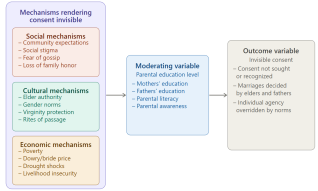
5.3. Conceptual Framework
Figure 1. Conceptual framework on invincible consent forcing girl child marriage.
6. Research Methodology
This study adopted a pragmatist research philosophy and employed a convergent parallel mixed methods design in Korr Ngurnit Ward, Marsabit County, Kenya. Quantitative data were collected from 296 women aged 18 to 49 years using structured household surveys. A three-stage cluster sampling design was used, with simple random sampling applied at each stage to select five Community Health Units (CHUs), two villages per community health unit, and households within each village. Fifty-one percent of the respondents were married before age 18 years.
Qualitative data were collected through 16 key informant interviews and nine focus group discussions involving approximately 81 participants, including married and unmarried adolescent girls, mothers and fathers of adolescent girls, women married before 18 years, religious leaders, head teachers, guidance and counseling teachers, health workers, community leaders, and elders. Purposive sampling was used to select participants with direct knowledge of girl child marriage practices.
Quantitative data were analyzed using SPSS version 26, employing descriptive statistics, cross tabulations, and binary logistic regression. Qualitative data were transcribed verbatim, translated from Rendille and Samburu into English, and analyzed thematically using NVivo 14. Inter coder reliability was established at 88 percent. Ethical approval was obtained from St. Paul's University, NACOSTI, and the County Government of Marsabit. Each participant was taken through an informed consent before accepting to participate in the study. Consent was sought from the guardians/parents of the adolescent girls under 18 years, and an assent was sought from all adolescent girls (minors) under 18 years who participated in the study.
6.1. Data Collection
Data collection took place in ten villages across five Community Health Units in Korr Ngurnit Ward, Marsabit County, Kenya. The villages included Barmin, Dogo, Urawen Ogom, Nebey Ilwas, Lorora 2, AIC Manyatta, Lekuchula, Toore, AIC, and Lukumai. Three main strategies were used for data collection: household surveys, focus group discussions, and key informant interviews. Observation of social, cultural, and economic activities in the study area was also considered. Before the actual collection of data, the research team held a meeting with community leaders and other stakeholders to introduce the purpose and objective of the study for buy-in and to seek their approval. During this period, the research team walked across the ten villages observing the physical, economic, and social structures to have a first-hand view of the environment and to study the possible cultural, economic, and social factors that may predispose girls to child marriage.
For the quantitative component, structured household survey questionnaires were administered face to face to women spouses aged 18 to 49 years. Half of the respondents were married before age 18 years and half married after attaining 18 years. The survey questionnaire was digitized using Kobo Collect, an open-source application compatible with Android and iOS devices. Kobo Collect allowed for live upload of data as it was collected, supported GPS tagging and audio recordings, and ensured better data quality through skip logic, formatting control, and constraints. The application significantly decreased the time taken for data collection and allowed for rich content collection. For the qualitative component, semi structured focus group discussion and key informant interview guides were employed to keep conversations focused on the research objectives and to ensure all participants had a chance to share their insights and experiences. Nine focus group discussions were conducted with groups of between 6 to 12 participants each. The FGD groups included unmarried adolescent girls, married adolescent girls, mothers of adolescent girls, fathers of adolescent girls, and women married before 18 years. Sixteen key informant interviews were conducted with religious leaders including sheikhs, priests, and pastors, head teachers, guidance and counseling teachers, health workers, community health assistants, community health volunteers, chiefs, youth leaders, women group leaders, and elders.
Focus group discussion sessions took between 45 to 60 minutes each, key informant interviews took between 30 to 45 minutes, and household surveys took between 30 to 40 minutes. A facilitator and a note taker facilitated every key informant interview and focus group discussion session using the semi structured guides. Digital audio recording of the interviews was conducted with participant consent. All interviews and discussions were conducted in convenient places for respondents to maintain privacy and comfort.
6.2. Data Analysis
6.2.1. Quantitative
The quantitative dataset comprised responses from 296 female household surveys. Structured questionnaire responses were downloaded from the Kobo Collect application, cleaned, coded, and entered into SPSS version 26 for analysis. Data cleaning involved screening for missing values, inconsistencies, and duplicates. Outliers were assessed using z scores and retained after verification with field notes to confirm their validity.
Variables were coded numerically to facilitate descriptive statistics and logistic regression. Education level was coded as 0 for no education, 1 for primary, and 2 for secondary. Girl child marriage as the dependent variable was coded as 0 for married at 18 years or above and 1 for married before 18 years. Control variables including religion, marriage type, marital status, and consent at marriage were also dummy coded. A codebook was developed that documented all variable definitions and coding schemes.
Prior to conducting binary logistic regression, multicollinearity among the predictor variables was assessed to ensure the reliability of the model. Variance Inflation Factor values were calculated for the control variables including religion, marital status, marriage type, consent at marriage, and respondent level of education. All Variance Inflation Factor values were below 5, indicating no significant multicollinearity among the predictors. This confirmed that the regression results were not unduly influenced by correlated predictors.
Logistic regression was selected as the primary inferential method to examine predictors of girl child marriage as a dichotomous outcome, specifically married before 18 years versus married at 18 years or above. This approach was well suited for binary dependent variables in girl child marriage research as it estimates odds ratios for the association between predictors such as education, income, family type, and religion, and the likelihood of child marriage while controlling for confounders. The model included five control variables: religion, marital status, marriage type, consent at marriage, and respondent level of education. Cross tabulations complemented the logistic regression by exploring bivariate associations and identifying the most influential socioeconomic and cultural factors associated with girl child marriage in Marsabit County.
6.2.2. Qualitative
A team of four data analysts transcribed the focus group discussion and key informant interview recordings verbatim. Recordings were listened to several times for better understanding, and nonverbal cues such as pauses, laughter, and tonal variations were included. Transcripts in local dialects of Rendille and Samburu were translated into English while preserving original meanings and connotations. Automated transcription tool Trint was used to generate initial text transcripts.
The qualitative dataset included transcripts from nine focus group discussions involving approximately 81 participants and 16 key informant interviews. Transcripts were anonymized, imported into NVivo 14, and coded line by line based on thematic domains including cultural norms, economic drivers, social pressures, community influence, family dynamics, support systems, and social status. Inter coder reliability was established at 88 percent through independent coding by two data analysts, with discrepancies resolved through consensus.
6.2.3. Integration
Mixed methods integration and triangulation occurred at the analysis and interpretation stages through joint displays and narrative weaving. Quantitative data from household surveys and qualitative data from focus group discussions and key informant interviews were analyzed separately before being compared and merged. Joint displays using side by side matrices were constructed to systematically compare statistical findings with thematic codes. Convergent findings were identified where both data strands pointed to similar conclusions. Divergent findings were examined against contextual notes from transect walks, focus group discussions, and key informant interviews to understand potential sources of discrepancy such as social desirability bias or measurement issues. Complementarity was achieved where qualitative narratives elaborated on statistical patterns, providing explanatory depth. This integrated analytical approach produced meta inferences that synthesized both forms of evidence, ensuring that the study's conclusions were grounded in the full range of data collected.
6.3. Ethical Considerations
The protocol received prior approval from the National Commission for Science, Technology, and Innovation (NACOSTI), St Paul’s University Ethics Review Board, and the office of the County secretary for Marsabit. All adult participants gave informed consents whereas emancipated minors provided assent with their guardian’s consent according to local regulation. Informed consent was read aloud where literacy was limited covering study aims, voluntary participation, confidentiality, the right to skip questions or withdraw without penalty, and data handling procedures. Interviews and FGDs were conducted in private, neutral spaces to minimize inadvertent disclosure and community visibility. To safeguard participants discussing sensitive topics (such as coercion, FGM, sexual and partner violence), interviewers were trained in trauma-informed techniques and safe-question sequencing. A referral protocol was operationalized with mapped services such as county child protection officers, nearby health facilities and trusted civil society partners. Audio files and datasets were stored on encrypted, password-protected devices, identifiers were removed at transcription, and role-based access controlled who could view link files. Team briefings included positionality and bias reflection to reduce power asymmetries and normative judgments during fieldwork. Community feedback was planned through CHU-level debriefs and accessible summaries (Kiswahili, English, Samburu or Rendille) to close the loop on results sharing without revealing individual identities.
7. Results and Discussions
This section presents the integrated findings of the study organized around the research objectives. Quantitative results from 296 household surveys are presented alongside qualitative themes from 9 focus group discussions and 16 key informant interviews. The findings are structured according to each research objective, with statistical patterns from the survey data complemented by narrative accounts from participants to provide a comprehensive understanding of consenting at marriage in Marsabit County.
7.1. Demographic Findings
The household survey achieved 296 analyzable interviews across five CHUs of Buri Aramia, Balla, Korr, Namarei, and Ngurnit. Respondents were predominantly aged between 25–34 (57.4%), with 22.0% aged 18–24 and 20.6% aged 35–49. Half identified as Rendille and half as Samburu, reflecting the study’s purposive ethnic balance. Location shares were broadly even (Buri Aramia 16.9%, Balla 20.6%, Korr 21.6%, Namarei 17.6%, Ngurnit 23.3%). In the qualitative strand, from the nine FGDs conducted there were 81 participants (90% female) and 16 KIIs (75% male) capturing lived experience and decision-making authority. A total of 393 respondents were engaged of whom 95% were female.
Table 1. Participant’s demographics.
Description | Respondents |
Frequency | Percentage |
Sex |
Female | 373 | 95 |
Male | 20 | 5 |
Age group |
Under 18 | 35 | 9 |
18 – 24 | 79 | 20 |
25 – 34 | 193 | 49 |
35 – 49 | 82 | 21 |
50 and above | 4 | 1 |
Source: Own (Author, 2026)
7.2. Findings
This section presents the results of the study organized by the three research objectives. Quantitative findings from 296 household surveys are presented first, including descriptive statistics and binary logistic regression results. Qualitative findings from 16 key informant interviews and nine focus group discussions follow, organized by emergent themes. The section concludes with a summary of key findings across both data strands on girl child marriage in Marsabit County.
7.2.1. Social, Cultural, and Economic Mechanisms Rendering Consent Invisible
This objective unpacked the social, cultural, and economic mechanisms that render consent invisible by examining how community expectations, elder authority, dowry economies, and gender norms override individual agency in marriage decisions.
The findings reveal that consent is rendered invisible through multiple intersecting mechanisms. Socially, 92 percent of respondents cited social stigma as a driver of girl child marriage, and 88.8 percent identified social norms and tradition. A focus group participant explained that, “if a girl stays long at her father's home after reaching maturity, people start gossiping, this puts a lot of pressure on the girl and the family”. A religious leader added that, “it is the community that decides for them who to marry, not the girl”.
Culturally, decision making authority rests with elders and fathers, who together account for 73.6 percent of primary decision makers on who a girl marries and when she gets married. A community leader confirmed that, “men are the decision makers here, they do not get the girl's consent or the mother's approval”. Gender norms are equally powerful, with 84.8 percent agreeing that money for education should not be wasted on girls, and 79.4 percent believing a girl's value lies in being a wife and mother. A father stated that, “a girl is born to bring children into the world, that is why we marry them early.”
Economically, 87.5 percent cited poverty and 90.5 percent cited dowry as key drivers of girl child marriage. A teacher noted that, “some families do not have three meals a day, so the only resolution is to marry off daughters for dowry.” An adolescent woman share, “I was forced to marry an old man. I dropped out of school because my parents wanted the bride price. Nobody asked for my consent.”
Table 2 below highlights the main social, cultural, and economic factors that make girls’ consent invisible or irrelevant in child marriage decisions. It shows the percentage of respondents who identified each mechanism as a significant driver. The data reveals that dowry economy (90.5%) is the strongest factor pushing girls into girl child marriage, followed closely by poverty (87.5%) and social stigma & norms (88.8%). Gender norms (84.8%) also play a major role, particularly the belief that investing in a girl’s education is a waste. Elder authority (73.6%) is slightly lower but still significant, showing that fathers and elders remain the primary decision-makers.
Table 2. Key Mechanisms Rendering Consent Invisible.
Mechanism | Key Indicator | Percentage |
Social stigma and norms | Social norms as driver of girl child marriage | 88.8% |
Elder authority | Elders and fathers as primary decision makers | 73.6% |
Gender norms | Belief that education money should not be wasted on girls | 84.8% |
Poverty | Economic instability as driver | 87.5% |
Dowry economy | Dowry as reason for marriage under 18 | 90.5% |
Source: Own (Author, 2026)
7.2.2. Prevalence and Nature of Nonconsensual Girl Child Marriage
The second objective sought to examine the prevalence and nature of nonconsensual girl child marriage among pastoralist communities in Marsabit County and determine how lack of consent influences age at first marriage. The findings reveal a stark reality where, among the 296 women surveyed, 51 percent were married before reaching 18 years of age, with ages at first marriage ranging from 8 to 23 years. Even more striking, 65.5 percent of women reported that their marriages occurred without their consent.
The relationship between consent and age at marriage is powerful. Among women who did not consent to their marriages, 62.9 percent were married before age 18 years. In contrast, among women who freely gave consent, only 28.4 percent were married as children. Statistical analysis confirmed that lack of consent increases the odds of girl child marriage by 3.45 times, with a confidence interval of 1.92 to 6.20. The logistic regression model was highly significant with a chi square of 258.44 and p value less than 0.001, explaining nearly 60 percent of the variance in age at marriage.
A focus group participant (mother of married adolescent girl) explained that, “according to our cultural norms and tradition, a girl does not give consent for her marriage and she is not aware of the risk she encounters for being ignorant. Girls are not involved in decision making processes”. Another participant (unmarried adolescent girl) stated that “according to society, girls don't consent to whom they are getting married to, parents are the one who make decisions on girl child marriages and a girl has no right to choose for herself because of her gender.” A community leader confirmed that “men in the society are decision makers and they're the ones who choose and give off their girl to get married, they don't seek the girl's consent or that of the mother.”
Table 3 below presents the prevalence of child marriage and the level of consent among the 296 respondents surveyed. The study found that 51.0% of the respondents were married before the age of 18, while 49.0% were married at 18 years or above. Regarding consent, only 34.8% of the respondents reported that they gave consent to their marriage, while a large majority (65.5%) stated they did not consent to the marriage.
Table 3. Prevalence of Girl Child Marriage and Consent (n=296).
Variable | Category | Percentage |
Age at first marriage | Under 18 years | 51.0% |
18 years and above | 49.0% |
Consent at marriage | Yes | 34.8% |
No | 65.5% |
Source: Own (Author, 2026)
Table 4 below shows the relationship between the age at which girls were married and whether they consented to the marriage. It also presents the Odds Ratio measuring the strength of this association. Among girls who did not consent to their marriage, 62.9% were married before 18 years, compared to only 37.1% married at 18 years and above. In contrast, among those who consented, the majority (71.6%) were married at 18 years or older. The Odds Ratio of 3.45 indicates that girls married before the age of 18 were 3.45 times more likely not to have given consent compared to those married at 18 years and above.
Table 4. Consent Status by Age at Marriage and Odds Ratio.
Consent Status | Married Before 18 Years | Married at 18+ Years | Odds Ratio |
Did not consent | 62.9% | 37.1% | 3.45 |
Consented | 28.4% | 71.6% | Reference |
Source: Own (Author, 2026)
7.2.3. Parental Education and Household Decision Making
The third objective sought to assess how parental education levels shape household decision making structures and influence whether girls can exercise consent or refuse early marriage.
The findings reveal a stark divide as nearly half of the respondents, 45.9 percent had no formal education. Only 22.3 percent had attained secondary education or higher. The protective effect of education is dramatic. Daughters of parents with primary education were nearly 13 times more likely to delay marriage until age 18 years or above compared to those whose parents had no education, with an odds ratio of 12.89. For daughters of parents with secondary education, the protective effect was even stronger at 19.43 (
Table 5).
A religious leader remarked that “parents feel girl education is a waste of resources as a girl's main role is to bear children”. A focus group participant (married adolescent girl) explained that, “due to illiteracy among certain individuals in the society, they advance girl child marriage because society considers a girl as a source of bride price through dowry.” A mother of an adolescent girl admitted that, “for us uneducated parents, we discourage young girls staying long at home, hence we marry them off early as we need these dowries.”
In contrast, educated parents championed schooling. A father of an adolescent girl noted that “modern education has changed cultural attitude that viewed girls' value as wives and mothers and now encourages girls to be educated”. A married adolescent girl emphasized that “educated girls know their rights, and when the girl becomes successful, she will support her vulnerable family financially the same way the boy child does.”
Table 5 below shows the distribution of respondents by education level and the protective effect of education against girl child marriage (measured through Odds Ratios). Nearly half of the respondents (45.9%) had no education, 31.8% had primary education, and only 22.3% had secondary education and above. The Odds Ratios indicate a strong protective effect of education: girls with primary education were 12.89 times more likely to have protective outcomes (e.g., consent or later marriage) compared to those with no education, while those with secondary education and above were 19.43 times more likely.
Table 5. Respondent Education Level and Protective Effect (n=296).
Education Level | Percentage | Odds Ratio (vs No Education) |
No education | 45.9% | Reference |
Primary education | 31.8% | 12.89 |
Secondary education and above | 22.3% | 19.43 |
Source: Own (Author, 2026)
Table presents respondents’ perceptions on how parents’ education level influences decisions regarding girl child marriage. According to the table a very high proportion of respondents agreed on the positive role of parental education:
1) 94.3% agreed that parents with higher education value their daughters’ education and delay marriage.
2) 84.4% agreed that parents with lower education tend to marry off their daughters early due to lack of awareness.
3) 79.4% agreed that educated parents challenge harmful social norms.
4) 79.7% agreed that educated parents encourage daughters to pursue higher education rather than early marriage.
Table 6. Parental Education Influence on Girl Child Marriage (n=296).
Statement | Agree (%) |
Parents with higher education value education for daughters and delay marriage | 94.3% |
Parents with lower education marry off daughters early due to lack of awareness | 84.4% |
Educated parents challenge social norms that support girl child marriage | 79.4% |
Educated parents encourage daughters to pursue higher education instead of marriage | 79.7% |
Source: Own (Author, 2026)
7.3. Discussion
This study sought to unpack the mechanisms rendering consent invisible in girl child marriage, examine the prevalence of nonconsensual unions, and assess how parental education shapes household decision making in Marsabit County.
The finding indicate that 65.5 percent of women were married without consent, with lack of consent tripling the odds of girl child marriage, challenges the notion that these unions represent culturally sanctioned choices. Instead, consent operates as an invisible construct within systems where community expectations, elder authority, and economic desperation override individual agency. Social Norms Theory explains this dynamic by showing how the fear of gossip and loss of family honor outweighs personal misgivings or knowledge of legal prohibitions
| [13] | Cislaghi, B., & Heise, L. (2020). Gender norms and social norms: differences, similarities and why they matter in prevention science. Sociology of Health & Illness, 42(2), 407–422. |
| [14] | Greene, M. E., & Stiefvater, E. (2019). Social norms and child marriage: The limits of law and policy. Journal of International Development, 31(6), 977–993. |
[13, 14]
.
The cultural mechanisms are equally powerful, with elders and fathers controlling marriage decisions in 73.6 percent of cases. Gender and Power Theory illuminate how the sexual division of power vests decision making authority in men, systematically excluding girls from deliberations about their own futures
| [23] | Connell, R. (2013). Gender and Power: Society, the Person and Sexual Politics. John Wiley & Sons. |
[23]
. The belief that 84.8 percent of respondents agreed money for education should not be wasted on girls reflects deep patriarchal norms that cast girls as wives and mothers rather than individuals with rights.
Economically, poverty and dowry drive girl child marriage by transforming daughters into assets. A young woman's account of being forced to marry an old man because her parents wanted the bride price illustrates how economic desperation renders consent irrelevant.
Parental education offers a pathway to change. Daughters of educated parents were 19 times more likely to delay marriage. Educated parents challenge social norms and encourage daughters to pursue higher education. This suggests that investing in parental literacy, particularly for mothers, may be as critical as supporting girls' schooling in breaking the cycle of nonconsensual girl child marriage.
7.4. Limitations
The study findings originate from ten villages in Korr Ngurnit Ward, limiting generalizability to wider Marsabit or other arid and semi-arid areas. Core variables such as consent and stigma were self-reported, with social desirability bias likely present given stated opposition to girl child marriage alongside high prevalence. The predominance of female participants in focus group discussions may have limited male perspectives on decision making.
8. Conclusions and Recommendations
8.1. Conclusions
This study reveals that girl child marriage in Marsabit County is predominantly nonconsensual, with 65.5 percent of women marrying without their agreement. Consent is rendered invisible through intersecting social pressures, elder authority, dowry economies, and patriarchal gender norms that systematically exclude girls from marriage decisions. Parental education emerges as a critical protective factor, with educated parents 19 times more likely to delay their daughters' marriage. Addressing invisible consent requires shifting community norms, provision of education incentives, engaging elders as change agents, providing economic alternatives to dowry, and investing in parental education to transform household decision making structures from within.
8.2. Recommendations
Based on the findings that 65.5 percent of women married without consent and that parental education is a critical protective factor, the following recommendations are proposed.
First, community-based norm change/social behavior change interventions should be prioritized to address the social mechanisms that render consent invisible. Given that 92 percent of respondents cited social stigma as a driver, programs should engage elders, religious leaders, and youth in sustained dialogue to redefine family honor around girls' education and consent rather than early marriage and virginity protection. Community barazas and intergenerational forums can create safe spaces for renegotiating marriage norms.
Second, economic alternatives to dowry must be established. With 90.5 percent of respondents citing dowry as a driver, conditional cash transfers tied to girls' school attendance, livestock insurance for drought affected pastoralist families, and microfinance programs for women could reduce household dependency on bride price. These programs should target the poorest households where 87.5 percent cited poverty as a driver.
Third, parental education programs should be expanded. Given that daughters of educated parents were 19 times more likely to delay marriage, adult literacy classes should integrate modules on child rights, legal marriage age, and the economic benefits of girls' education. Mobile learning units can reach a greater number of nomadic pastoralist communities.
Fourth, legal enforcement must be strengthened with clear reporting mechanisms from community level to police and judiciary. Community paralegals and child protection committees can bridge statutory and customary systems. Engaging traditional leaders as allies rather than adversaries in enhancing legitimacy and compliance.
Abbreviations
AOR | Adjusted Odds Ratio |
ASAL | Arid and Semi-Arid Lands |
CHA | Community Health Assistant |
CHU | Community Health Unit |
CI | Confidence Interval |
FGD | Focus Group Discussion |
FGM | Female Genital Mutilation |
KII | Key Informant Interview |
KNBS | Kenya National Bureau of Statistics |
NACOSTI | National Commission for Science, Technology, and Innovation |
OR | Odds Ratio |
SDG | Sustainable Development Goal |
SPSS | Statistical Package for the Social Sciences |
UNICEF | United Nations International Children's Emergency Fund |
Author Contributions
Kirleen Carolyne Athiambo: Conceptualization, Formal Analysis, Funding acquisition, Investigation, Methodology, Project administration, Resources, Software, Validation, Visualization, Writing – original draft
Conflicts of Interest
The author declares no conflicts of interest.
References
| [1] |
UNICEF. (2021). Towards Ending Child Marriage: Global trends and profiles of progress. UNICEF, New York.
|
| [2] |
Cordova-Pozo, K. L., Anishettar, S. S., Kumar, M., & Chokhandre, P. K. (2023). Trends in child marriage, sexual violence, early sexual intercourse and the challenges for policy interventions to meet the sustainable development goals. International Journal for Equity in Health, 22(1), 250.
|
| [3] |
KNBS (Kenya National Bureau of Statistics). (2023). Kenya Demographic and Health Survey 2022. KNBS.
|
| [4] |
KNBS & ICF. (2023). Kenya Demographic and Health Survey 2022: Key Indicators Report. KNBS and ICF.
|
| [5] |
Kok, M. C., Kakal, T., Kassegne, A. B., Hidayana, I. M., Munthali, A., Menon, J. A.,... & Van Der Kwaak, A. (2023). Drivers of child marriage in specific settings of Ethiopia, Indonesia, Kenya, Malawi, Mozambique and Zambia–findings from the Yes I Do! baseline study. BMC Public Health, 23(1), 794.
|
| [6] |
Biwott, S. K., Otieno, J. A., & Wanjala, M. N. (2024). Determinants of structural, behavioral and cultural practices that perpetuate child marriage in Siaya, Homabay and Kisumu Counties in Kenya. International Journal of Social Science, 9(3), 112–125.
|
| [7] |
Rose, G. K. (2023). Cultural Norms and Early Child Marriage (Doctoral dissertation, Kampala International University).
|
| [8] |
Lowe, H., Kenny, L., Hassan, R., Bacchus, L. J., Njoroge, P., Dagadu, N. A., Hossain, M., & Cislaghi, B. (2022). 'If she gets married when she is young, she will give birth to many kids': A qualitative study of child marriage practices amongst nomadic pastoralist communities in Kenya. Culture, Health & Sexuality, 24(7), 886–901.
|
| [9] |
Agi, C. W., & Emelie, C. (2023). Influence of early marriage on academic achievement of female adolescent students in public senior secondary schools in Rivers State. International Journal of Innovative Psychology & Social Development, 11(4), 58–70.
|
| [10] |
Kohno, A., Techasrivichien, T., Suguimoto, S. P., Dahlui, M., Nik Daliana Nik Farid, N., & Nakayama, T. (2020). Investigation of the key factors that influence the girls to enter into child marriage: A meta synthesis of qualitative evidence. PLoS One, 15(7), e0235959.
https://doi.org/10.1371/journal.pone.0235959
|
| [11] |
Wopara, N. E. (2025). Child marriage in Africa: The effectiveness of international organizations in ending child marriage in Africa. University of California, Santa Barbara.
|
| [12] |
Ahinkorah, B. O., Aboagye, R. G., Okyere, J., Seidu, A.-A., Budu, E., & Yaya, S. (2023). Child marriage and its association with partner controlling behaviour against adolescent girls and young women in sub-Saharan Africa. BMC Global and Public Health, 1, Article 9.
|
| [13] |
Cislaghi, B., & Heise, L. (2020). Gender norms and social norms: differences, similarities and why they matter in prevention science. Sociology of Health & Illness, 42(2), 407–422.
|
| [14] |
Greene, M. E., & Stiefvater, E. (2019). Social norms and child marriage: The limits of law and policy. Journal of International Development, 31(6), 977–993.
|
| [15] |
Paul, P. (2020). Child marriage among girls in India: Prevalence, trends and socio-economic correlates. Indian Journal of Human Development, 14(2), 304–319.
|
| [16] |
Lebni, J. Y., Solhi, M., Azar, F. E. F., & Farahani, F. K. (2020). Qualitative study of social determinants of child marriage in Kurdish regions of Iran: Evidence for health promotion interventions. Journal of Education and Health Promotion, 9(1), 242.
|
| [17] |
Kawai, D., Mbogo, B., Opanga, Y., Muhula, S., Esho, T. C., Conradi, H., Rutto, V. J., Lugayo, D., & Matanda, D. J. (2025). Digital tracking of girls exposed to community-led alternative rites of passage to prevent female genital mutilation/cutting, and child, early and forced marriages in Kenya: A longitudinal study. Frontiers in Reproductive Health, 7, Article 1445504.
|
| [18] |
Afunugo, K. N. (2025). Socio-cultural and religious implications of child marriage: Honouring Dora Moono Nyambe’s advocacy for female children. Integrity Journal of Arts and Humanities, 6(1).
|
| [19] |
Bicchieri, C. (2005). The grammar of society: The nature and dynamics of social norms. Cambridge University Press.
|
| [20] |
Agasimani, H. (2024). Forced and Early Marriage. In Violence Against Girl Child in India, Chapter 19.
|
| [21] |
Jahan, I. (2025). Child marriage in Bangladesh: Challenges and prospects for change. Global Educational Research Journal, 13(6), 192–195.
|
| [22] |
Nganga, D. M. (2023). Exploring the intersections of gender, religion, and culture when engaging the Pokot-Turkana conflict in Kenya between 1963 and 2015 (Doctoral dissertation).
|
| [23] |
Connell, R. (2013). Gender and Power: Society, the Person and Sexual Politics. John Wiley & Sons.
|
| [24] |
Brubaker, S. J. (2021). Embracing and expanding feminist theory: (Re)conceptualizing gender and power. Violence Against Women, 27(5), 717–726.
|
| [25] |
Gedefie, A., Muche, A., Mohammed, A., et al. (2025). Prevalence and determinants of HIV among reproductive-age women in Africa: A multilevel analysis. Frontiers in Public Health, 13, Article 1376235.
|
| [26] |
Abera, M., Nega, A., Tefera, Y., & Gelagay, A. A. (2020). Early marriage and women's empowerment: The case of child-brides in Amhara National Regional State, Ethiopia. BMC International Health and Human Rights, 20, 1–16.
|
| [27] |
Joosse, P., & Willey, R. (2020). Gender and charismatic power. Theory and Society, 49(4), 533–561.
|
| [28] |
Baraie, B., Rezaei, M., Nadrian, H., & Matlabi, H. (2024). What socio-cultural factors encourage child marriage in Sanandaj, Iran? A qualitative study. Child & Youth Services, 45(1), 23–44.
|
| [29] |
Soler Hampejsek, E., Kangwana, B., Austrian, K., Amin, S., & Psaki, S. R. (2021). Education, child marriage, and work outcomes among young people in rural Malawi. Journal of Adolescent Health, 69(6, Suppl), S57–S64.
|
| [30] |
Louku, S. (2025). Forced early marriage: Maasai girls’ education in Kenya (Master’s practicum, University of Manitoba).
|
| [31] |
Lan, M., & Kuang, Y. (2023). The Influence of Parental Education on First Marriages in China: The Role of Child-hood Family Background. Journal of Family Issues, 44(11), 3017–3042.
|
| [32] |
Burgess, R. A., Jeffery, M., Odero, S. A., Rose-Clarke, K., & Devakumar, D. (2022). Overlooked and unaddressed: A narrative review of mental health consequences of child marriages. PLOS Global Public Health, 2(1), Article e0000131.
https://doi.org/10.1371/journal.pgph.0000131
|
Cite This Article
-
APA Style
Athiambo, K. C. (2026). Invisible Consent: Unpacking Agency and Coercion in Girl Child Marriage in Marsabit County, Kenya. Research & Development, 7(2), 63-73. https://doi.org/10.11648/j.rd.20260702.11
 Copy
|
Copy
|
 Download
ACS Style
Athiambo, K. C. Invisible Consent: Unpacking Agency and Coercion in Girl Child Marriage in Marsabit County, Kenya. Res. Dev. 2026, 7(2), 63-73. doi: 10.11648/j.rd.20260702.11
Copy
|
Download
AMA Style
Athiambo KC. Invisible Consent: Unpacking Agency and Coercion in Girl Child Marriage in Marsabit County, Kenya. Res Dev. 2026;7(2):63-73. doi: 10.11648/j.rd.20260702.11
Copy
|
Download
-
@article{10.11648/j.rd.20260702.11,
  author = {Kirleen Carolyne Athiambo},
  title = {Invisible Consent: Unpacking Agency and Coercion in Girl Child Marriage in Marsabit County, Kenya},
  journal = {Research & Development},
  volume = {7},
  number = {2},
  pages = {63-73},
  doi = {10.11648/j.rd.20260702.11},
  url = {https://doi.org/10.11648/j.rd.20260702.11},
  eprint = {https://article.sciencepublishinggroup.com/pdf/10.11648.j.rd.20260702.11},
  abstract = {In communities where a girl's marriage is arranged before she can speak for herself, consent does not disappear it is simply made invisible. This study interrogates the mechanisms of agency and coercion that shape girl child marriage decisions in Korr-Ngurnit Ward, Marsabit County, Kenya, a predominantly pastoralist setting where the practice remains deeply entrenched. Drawing on a convergent parallel mixed-methods design, the study analyzed data from 296 household surveys, nine focus group discussions, and 16 key informant interviews with Rendille and Samburu community members. Quantitative findings revealed that 51% of respondents were married before the age of 18 years, and 65.5% reported that their marriages occurred without their consent. Logistic regression showed that lack of consent increased the odds of girl child marriage by 4.27 times (OR = 4.27, p < 0.001). Decision-making authority rested almost exclusively with community elders (42.9%) and fathers (30.7%), effectively institutionalizing the exclusion of girls from choices about their own futures. Qualitative narratives illuminated how coercion operates not through overt force alone, but through social stigma, fear of community gossip, patriarchal honour systems, dowry economies, and culturally sanctioned rites such as female genital mutilation and beading forces that constrain girls' agency long before any marriage negotiation begins. Grounded in Social Norms Theory and Gender and Power Theory, the study argues that consent in this context is not simply withheld but structurally pre-empted. Addressing girl child marriage in pastoralist Kenya therefore demands more than legal enforcement it requires dismantling the normative architecture that renders girls' voices inaudible before they are ever heard. Implications for policy and community-level programming are discussed.},
 year = {2026}
}
Copy
|
Download
-
TY  - JOUR
T1  - Invisible Consent: Unpacking Agency and Coercion in Girl Child Marriage in Marsabit County, Kenya
AU  - Kirleen Carolyne Athiambo
Y1  - 2026/06/10
PY  - 2026
N1  - https://doi.org/10.11648/j.rd.20260702.11
DO  - 10.11648/j.rd.20260702.11
T2  - Research & Development
JF  - Research & Development
JO  - Research & Development
SP  - 63
EP  - 73
PB  - Science Publishing Group
SN  - 2994-7057
UR  - https://doi.org/10.11648/j.rd.20260702.11
AB  - In communities where a girl's marriage is arranged before she can speak for herself, consent does not disappear it is simply made invisible. This study interrogates the mechanisms of agency and coercion that shape girl child marriage decisions in Korr-Ngurnit Ward, Marsabit County, Kenya, a predominantly pastoralist setting where the practice remains deeply entrenched. Drawing on a convergent parallel mixed-methods design, the study analyzed data from 296 household surveys, nine focus group discussions, and 16 key informant interviews with Rendille and Samburu community members. Quantitative findings revealed that 51% of respondents were married before the age of 18 years, and 65.5% reported that their marriages occurred without their consent. Logistic regression showed that lack of consent increased the odds of girl child marriage by 4.27 times (OR = 4.27, p < 0.001). Decision-making authority rested almost exclusively with community elders (42.9%) and fathers (30.7%), effectively institutionalizing the exclusion of girls from choices about their own futures. Qualitative narratives illuminated how coercion operates not through overt force alone, but through social stigma, fear of community gossip, patriarchal honour systems, dowry economies, and culturally sanctioned rites such as female genital mutilation and beading forces that constrain girls' agency long before any marriage negotiation begins. Grounded in Social Norms Theory and Gender and Power Theory, the study argues that consent in this context is not simply withheld but structurally pre-empted. Addressing girl child marriage in pastoralist Kenya therefore demands more than legal enforcement it requires dismantling the normative architecture that renders girls' voices inaudible before they are ever heard. Implications for policy and community-level programming are discussed.
VL  - 7
IS  - 2
ER  -
Copy
|
Download




 Share This Article
 Twitter
 Linked In
 Facebook