
Fournier's disease was considered a rare pathology, but over the past 10 years this trend has changed, the number of such patients has increased significantly. Mortality with untimely treatment reaches 90% due to the development of septic shock and multiple organ dysfunction syndrome. Purpose of the study. Study the results of BF treatment depending on the timing of admission and the method of surgical treatment. Methods. The results of treatment of 31 patients with BF who were admitted to the Republican Department of Surgical Infection, Makhachkala City Clinical Hospital were analyzed. The main group included 18 (58%), in the control group 13 (42%) The terms of admission of patients to the hospital from the onset of the disease were: during the first day from the onset of the disease, 7 (22.6%) patients were admitted (3 in the main and 4 in the control group); on the second day, 13 (41.95%) were admitted - (7 in the main and 6 control); 8 (32.3%) were admitted within 3 to 4 days (5 in the main and 3 in the control group). Upon admission, patients of both groups were hospitalized in the intensive care unit, where they received complex treatment, which included: antibacterial therapy, protein solutions, correction of electrolyte disorders and sugar, full parenteral and enteral nutrition, anticoagulant and detoxification therapy, proton pump preparations to protect the stomach from stress ulcers, vasopressor support-noradrenaline, if necessary, blood transfusion. In the main group, emergency surgical treatment consisted of a wide autopsy throughout the spread of the process, with the formation of a single open wound. In the control group, surgical treatment consisted of the use of separate incisions, along the spread, with their wide opening. Statistical data processing was performed using Student's t-test and χ2; correlation analysis - using the r criterion. Data processing is performed using Statistic 6.0. Results. The use of the developed surgical treatment method in the integrated treatment of Fournier's disease significantly reduced the number of repeated interventions and reduced the mortality rate to 5.6%, compared with the control group, where the mortality rate was 38.4%. The highest mortality was noted in patients admitted late from the onset of the disease. Conclusion. Wide autopsy throughout the spread of the process with the formation of a single wound in Fournier's disease can significantly improve treatment results and reduce mortality.
| Published in | Medicine and Life Sciences (Volume 2, Issue 2) |
| DOI | 10.11648/j.mls.20260202.12 |
| Page(s) | 52-58 |
| Creative Commons |
This is an Open Access article, distributed under the terms of the Creative Commons Attribution 4.0 International License (http://creativecommons.org/licenses/by/4.0/), which permits unrestricted use, distribution and reproduction in any medium or format, provided the original work is properly cited. |
| Copyright |
Copyright © The Author(s), 2026. Published by Science Publishing Group |
Fournier's Disease, Timing of Admission, Emergency Surgical Treatment, Necrectomies
Dates of admission (days) | Groups, number of patients and case fatality | P (Fisher exact test) | |||
|---|---|---|---|---|---|
Basic | mortality | control | mortality | ||
1 day | 3 | 0 | 4 | 1 (25%) | 0, 33 |
2 days | 8 | 0 | 6 | 2 (33, 3%) | 0, 05 |
З-4 day | 7 | 1 (14, 3%) | 3 | 2 (66, 7%) | 0, 042 |
Total | 18 | 1 (5, 6%) | 13 | 5 (38, 4%) | 0, 035 |
BF | Fournier's Disease |
SPON | Multiple Organ Dysfunction Syndrome |
| [1] | Actuality. Abdullaev S. A. Choice of surgical treatment method and Fournier's disease. Research Focus, T. 4, Issue 1, 2025, Research Bip. Samarkand State Medical University |
| [2] | Abdullaev S. A. Tactics of treating purulent necrotizing fasciitis in diabetes mellitus. Research Focus. – 2025. - VOL. 4. – №. 1. - S. 187-191. |
| [3] | Abdullaevich, A. S., Usmonovich, B. Sh. (2023). Fournier's disease is a rare disease in surgery.. Central Asian Journal of Medical and Natural Science, 4(6)-2023, 212–216. |
| [4] | Aliyev S. A., Aliyev ES, Zeynalov B. M. Gangrena Fournier in the light of modern ideas. Surgery 2014, No. 4, S. 34-39. |
| [5] | Aliyev S. A. O., Aliyev E. S. O. Gangrena Fournier-multidisciplinary problem of purulent-septic surgery Clinical medicine. – 2023. - T. 101. – №. 7-8. - S. 368-375. |
| [6] | allazov S. A., Yuldashev S. S., Gafarov R. R. Gangrena Fournier. Doctor's Bulletin, 2016; 2: 54-62. |
| [7] | Beloborodov V. A., Frolov A. P. Gangrena Fournier in modern conditions Tauride medical and biological bulletin. – 2023. - VOL. 26. – №. 3. - S. 18-25. |
| [8] | Grinev M. V., Soroka I. V., Grinev K. M. Gangrene Fournier - model of necrotising fascitis (clinical and pathogenetic aspects). Urology. 2007; (6): 69–73. |
| [9] | Efimenko N. A., Privolnev V. V. Gangrena Fournier. Wedge. microbiol. and anti-microbe. chemoterap. 2008; 10(1): 34–42 (In Russ.)]. |
| [10] | Plekhanov A. N. Case of successful treatment of Fournier gangrene. Yakut Medical Journal. – 2025. – №. 3. - S. 74-76. |
| [11] | Prokopovich M. A., Korchagin M. P., Zuban O. N. Clinical case of Fournier gangrene in a patient with tuberculosis Tuberculosis and socially significant diseases. – 2025. - T. 13. – №. 1. - S. 79-83. |
| [12] | Samorodov K. S., Belikov A. V. Opportunities to improve treatment results in gangrene Fournier. Week of Russian science (WeRuS-2023). – 2023. - С. 1056-1057. |
| [13] | Altarac S., Katusin D., Crnica S. et al. Fournier’s gangrene: etiology and outcome analysis of 41 patients. Urol. Int. 2012; 88: 289–293. |
| [14] | Barreda J. T., Scheiding M. M., Fernandez C. S. et al. Fournier’s gangrene. A retrospective study of 41 cases. Cir. Esp. 2010; 87: 218–223. |
| [15] | Benjelloun E. B., Souiki T., Yakla N. et al. Fournier’s gangrene: our experience with 50 patients and analysis of factors affecting mortality. WJES. 2013; 8: 1–5. |
APA Style
Alievich, A. M., Aliyevich, S. Z., Alievich, S. S. (2026). Features of the Clinical Course of Fournier's Disease and the Results of an Improved Method of Surgical Treatment. Medicine and Life Sciences, 2(2), 52-58. https://doi.org/10.11648/j.mls.20260202.12
ACS Style
Alievich, A. M.; Aliyevich, S. Z.; Alievich, S. S. Features of the Clinical Course of Fournier's Disease and the Results of an Improved Method of Surgical Treatment. Med. Life Sci. 2026, 2(2), 52-58. doi: 10.11648/j.mls.20260202.12
@article{10.11648/j.mls.20260202.12,
  author = {Aliyev Magomed Alievich and Svelimanov Zulkarnay Aliyevich and Suleimanov Sharip Alievich},
  title = {Features of the Clinical Course of Fournier's Disease and the Results of an Improved Method of Surgical Treatment},
  journal = {Medicine and Life Sciences},
  volume = {2},
  number = {2},
  pages = {52-58},
  doi = {10.11648/j.mls.20260202.12},
  url = {https://doi.org/10.11648/j.mls.20260202.12},
  eprint = {https://article.sciencepublishinggroup.com/pdf/10.11648.j.mls.20260202.12},
  abstract = {Fournier's disease was considered a rare pathology, but over the past 10 years this trend has changed, the number of such patients has increased significantly. Mortality with untimely treatment reaches 90% due to the development of septic shock and multiple organ dysfunction syndrome. Purpose of the study. Study the results of BF treatment depending on the timing of admission and the method of surgical treatment. Methods. The results of treatment of 31 patients with BF who were admitted to the Republican Department of Surgical Infection, Makhachkala City Clinical Hospital were analyzed. The main group included 18 (58%), in the control group 13 (42%) The terms of admission of patients to the hospital from the onset of the disease were: during the first day from the onset of the disease, 7 (22.6%) patients were admitted (3 in the main and 4 in the control group); on the second day, 13 (41.95%) were admitted - (7 in the main and 6 control); 8 (32.3%) were admitted within 3 to 4 days (5 in the main and 3 in the control group). Upon admission, patients of both groups were hospitalized in the intensive care unit, where they received complex treatment, which included: antibacterial therapy, protein solutions, correction of electrolyte disorders and sugar, full parenteral and enteral nutrition, anticoagulant and detoxification therapy, proton pump preparations to protect the stomach from stress ulcers, vasopressor support-noradrenaline, if necessary, blood transfusion. In the main group, emergency surgical treatment consisted of a wide autopsy throughout the spread of the process, with the formation of a single open wound. In the control group, surgical treatment consisted of the use of separate incisions, along the spread, with their wide opening. Statistical data processing was performed using Student's t-test and χ2; correlation analysis - using the r criterion. Data processing is performed using Statistic 6.0. Results. The use of the developed surgical treatment method in the integrated treatment of Fournier's disease significantly reduced the number of repeated interventions and reduced the mortality rate to 5.6%, compared with the control group, where the mortality rate was 38.4%. The highest mortality was noted in patients admitted late from the onset of the disease. Conclusion. Wide autopsy throughout the spread of the process with the formation of a single wound in Fournier's disease can significantly improve treatment results and reduce mortality.},
 year = {2026}
}
TY  - JOUR
T1  - Features of the Clinical Course of Fournier's Disease and the Results of an Improved Method of Surgical Treatment
AU  - Aliyev Magomed Alievich
AU  - Svelimanov Zulkarnay Aliyevich
AU  - Suleimanov Sharip Alievich
Y1  - 2026/06/10
PY  - 2026
N1  - https://doi.org/10.11648/j.mls.20260202.12
DO  - 10.11648/j.mls.20260202.12
T2  - Medicine and Life Sciences
JF  - Medicine and Life Sciences
JO  - Medicine and Life Sciences
SP  - 52
EP  - 58
PB  - Science Publishing Group
SN  - 3071-0618
UR  - https://doi.org/10.11648/j.mls.20260202.12
AB  - Fournier's disease was considered a rare pathology, but over the past 10 years this trend has changed, the number of such patients has increased significantly. Mortality with untimely treatment reaches 90% due to the development of septic shock and multiple organ dysfunction syndrome. Purpose of the study. Study the results of BF treatment depending on the timing of admission and the method of surgical treatment. Methods. The results of treatment of 31 patients with BF who were admitted to the Republican Department of Surgical Infection, Makhachkala City Clinical Hospital were analyzed. The main group included 18 (58%), in the control group 13 (42%) The terms of admission of patients to the hospital from the onset of the disease were: during the first day from the onset of the disease, 7 (22.6%) patients were admitted (3 in the main and 4 in the control group); on the second day, 13 (41.95%) were admitted - (7 in the main and 6 control); 8 (32.3%) were admitted within 3 to 4 days (5 in the main and 3 in the control group). Upon admission, patients of both groups were hospitalized in the intensive care unit, where they received complex treatment, which included: antibacterial therapy, protein solutions, correction of electrolyte disorders and sugar, full parenteral and enteral nutrition, anticoagulant and detoxification therapy, proton pump preparations to protect the stomach from stress ulcers, vasopressor support-noradrenaline, if necessary, blood transfusion. In the main group, emergency surgical treatment consisted of a wide autopsy throughout the spread of the process, with the formation of a single open wound. In the control group, surgical treatment consisted of the use of separate incisions, along the spread, with their wide opening. Statistical data processing was performed using Student's t-test and χ2; correlation analysis - using the r criterion. Data processing is performed using Statistic 6.0. Results. The use of the developed surgical treatment method in the integrated treatment of Fournier's disease significantly reduced the number of repeated interventions and reduced the mortality rate to 5.6%, compared with the control group, where the mortality rate was 38.4%. The highest mortality was noted in patients admitted late from the onset of the disease. Conclusion. Wide autopsy throughout the spread of the process with the formation of a single wound in Fournier's disease can significantly improve treatment results and reduce mortality.
VL  - 2
IS  - 2
ER  -
Ministry of Health of the Russian Federation, Dagestan State Medical University, Makhachkala, Russia
Ministry of Health of the Russian Federation, Dagestan State Medical University, Makhachkala, Russia
City Clinical Hospital, Makhachkala, Russia

Figure 1. 4 hours from the onset of the disease. Severe swelling of the scrotum.
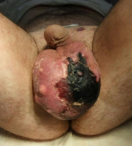
Figure 2. 16 hours after onset.
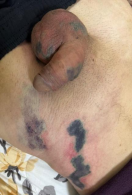
Figure 3. 16 hours after onset.
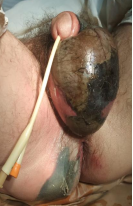
Figure 4. 48 hours after onset.
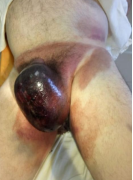
Figure 5. 4 days after the onset of the disease.
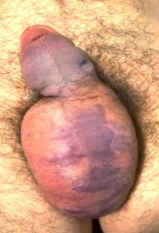
Figure 6. Type at receipt.
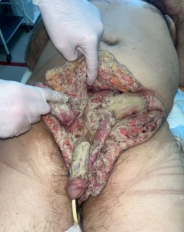
Figure 7. Surgical treatment, common necrotizing.
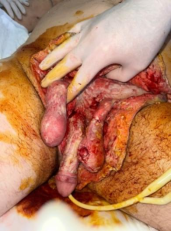
Figure 8. Day 10 of treatment.
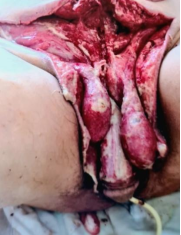
Figure 9. Day 16 of treatment.
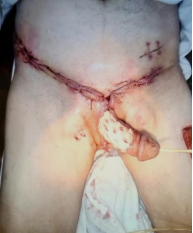
Figure 10. 20 days. Secondary suturing and skin grafting.
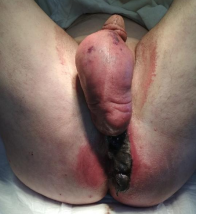
Figure 11. Fournier's disease with spread to the perineum.
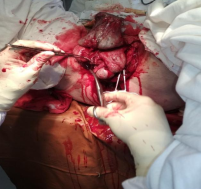
Figure 12. Сourse of an operation.
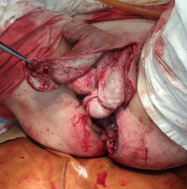
Figure 13. Type of wound after radical surgical treatment.
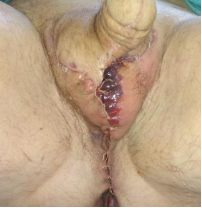
Figure 14. Wound closure with local tissues.

Information



 Share This Article
 Twitter
 Linked In
 Facebook
 Copy
Copy Download