1. Introduction
This study proposes an innovative reflection within the field of language and culture didactics. It embodies a linguistic-cultural dialogue between two sociocultural poles: Lusophony and Francophony. In this ongoing dialogue, the linguistic-cultural representations of both sides are constantly challenged in pursuit of comprehensive and inclusive didactic and linguistic platforms for the efficient teaching/learning of French for specific purposes. Its main objective is to contribute to the search for answers regarding the relevance of the communication and action methodologies for teaching/learning French for international relations and diplomacy.
As this concerns a language for specific purposes, it seems important to clarify this concept from the outset. «We believe that this language is, on the one hand, the one used in bilateral or multilateral relations between countries or states and, on the other, the one used in international organisations of a global nature, such as the United Nations (UN), or continental such as the African Union (AU) and the European Union (EU), among others
| [1] | CUMBANE, D. S. Une proposition de Curriculum de Français Sur Objectifs Spécifiques pour la première année de F.L.E de l’Institut Supérieur des Relations Internationales (ISRI) de Maputo. Université de Franche Comté. Mémoire de Master Sous la direction du Professor SOUCHON M. Volume 1: texte principal 88 p. et Volume II: annexes 300 p, Besançon, 2008. |
[1]
». «This language is grammatically marked, as it requires its speakers to master a specific discursive genre
| [12] | RICHER J.-J. Le cadre européen, ou l'émergence d'un nouveaux paradigme didactique. Le Français dans le Monde, n 359, p. 88, 2008. |
[12]
. In this regard, we agree with Richer who addresses the issue of specialised discursive genres.
1.1. Theoretical Framework
This study is supported by extensive literature on the teaching and learning of languages for specific purposes. Notable recent works include those of Puren
| [11] | PUREN, C. Entre l'approche communicative et l'approche actionnelle quoi de neuf? http://www.christianpuren.com consulted on 22 January 2023, 1-4, 2009. |
[11]
on the genesis and development of the New Action Perspective and its relationship with the communicative methodology; Richer
| [12] | RICHER J.-J. Le cadre européen, ou l'émergence d'un nouveaux paradigme didactique. Le Français dans le Monde, n 359, p. 88, 2008. |
[12]
on the relationship between French as a foreign language and French for specific purposes; Evelyne
| [8] | EVELYNE, B. L'approche communicative: théorie et pratiques. Hachette, pp 62-63, 1991. |
[8]
on the communicative methodology; and Cumbane
| [1] | CUMBANE, D. S. Une proposition de Curriculum de Français Sur Objectifs Spécifiques pour la première année de F.L.E de l’Institut Supérieur des Relations Internationales (ISRI) de Maputo. Université de Franche Comté. Mémoire de Master Sous la direction du Professor SOUCHON M. Volume 1: texte principal 88 p. et Volume II: annexes 300 p, Besançon, 2008. |
| [2] | CUMBANE, D. S. Do paradigma da comunicação ao paradigma da acção: será que a abordagem da acção favorece a aprendizagem da compreensão e produção da escrita em língua francesa para fins específicos (F.F.E.)? Rev.Cient.U.E.M. Sér. ciênc. Soc. Vol. 2, N 1. pp 19-34, 2021. |
| [3] | CUMBANE, D. S. Du paradigme de communication au paradigme de l'action: est-ce que l'approche actionnelle favorise l'enseignement du F.O.S? Université de Normandie. Doctoral thesis in Language Sciences-Linguistics under the direction of LARRIVEE P. Single volume of 355 p, 2016. |
| [4] | CUMBANE, D. S. L'approche actionnelle favorise-t-elle l'enseignement du F.O.S.? ISBN 9783639503395, E.U.E. Germany, 416 p, 2016. http://www.amazon.com |
| [5] | CUMBANE, D. S. Que Opções Metodológicas para o Ensino da Compreensão da Escrita em Língua Francesa da Diplomacia e de Relações Internacionais? PsiEDU: Rev. Moç. De Psicologia, VOL 1, Número 4, Junho, pp. 124-138, 2022. |
| [6] | CUMBANE, D. S. Que opções paradigmáticas para o ensino da produção da escrita em língua francesa da diplomacia e de relações internacionais? PsiEDU: Rev. Moç. De Psicologia, VOL. 1, Número 3, Setembro, pp. 131-145, 2021. |
| [7] | CUMBANE, D. S. Opções metodológicas para o ensino da produção da oralidade: o caso do discurso de relações internacionais e diplomacia. Via Litterae (Revista de Linguística e teoria literária. Anápolis. V3, n 2. 2023, Jul/Dez, p. 234-248. https://doi.org/10.5281/zenodo.5592474 |
[1-7]
on the relevance of the action and communication methodologies in teaching languages for specific purposes.
1.2. Methodology
Our reflection begins with the teaching/learning of French for specific purposes using the communication methodology and the action methodology. To this end, we designed and administered two questionnaires: thirty pre- and post-tests for participants in the communication methodology and the same number for those in the action methodology. It is important to note that our participants were young adults and adolescents with an intermediate level of French, equivalent to 160 hours of exposure to the language as a foreign language. The pre-tests provided the initial assessment of the knowledge of the two groups, revealing their strengths and weaknesses. This information was used to design two training programmes (one based on communication and the other on action), which were delivered to the two groups before the post-test. The post-test served as the final assessment, providing reliable and comparable data to that of the pre-test. This process led to the results presented and discussed in this article.
Unlike previous studies
| [1] | CUMBANE, D. S. Une proposition de Curriculum de Français Sur Objectifs Spécifiques pour la première année de F.L.E de l’Institut Supérieur des Relations Internationales (ISRI) de Maputo. Université de Franche Comté. Mémoire de Master Sous la direction du Professor SOUCHON M. Volume 1: texte principal 88 p. et Volume II: annexes 300 p, Besançon, 2008. |
| [2] | CUMBANE, D. S. Do paradigma da comunicação ao paradigma da acção: será que a abordagem da acção favorece a aprendizagem da compreensão e produção da escrita em língua francesa para fins específicos (F.F.E.)? Rev.Cient.U.E.M. Sér. ciênc. Soc. Vol. 2, N 1. pp 19-34, 2021. |
| [3] | CUMBANE, D. S. Du paradigme de communication au paradigme de l'action: est-ce que l'approche actionnelle favorise l'enseignement du F.O.S? Université de Normandie. Doctoral thesis in Language Sciences-Linguistics under the direction of LARRIVEE P. Single volume of 355 p, 2016. |
| [4] | CUMBANE, D. S. L'approche actionnelle favorise-t-elle l'enseignement du F.O.S.? ISBN 9783639503395, E.U.E. Germany, 416 p, 2016. http://www.amazon.com |
| [5] | CUMBANE, D. S. Que Opções Metodológicas para o Ensino da Compreensão da Escrita em Língua Francesa da Diplomacia e de Relações Internacionais? PsiEDU: Rev. Moç. De Psicologia, VOL 1, Número 4, Junho, pp. 124-138, 2022. |
| [6] | CUMBANE, D. S. Que opções paradigmáticas para o ensino da produção da escrita em língua francesa da diplomacia e de relações internacionais? PsiEDU: Rev. Moç. De Psicologia, VOL. 1, Número 3, Setembro, pp. 131-145, 2021. |
| [7] | CUMBANE, D. S. Opções metodológicas para o ensino da produção da oralidade: o caso do discurso de relações internacionais e diplomacia. Via Litterae (Revista de Linguística e teoria literária. Anápolis. V3, n 2. 2023, Jul/Dez, p. 234-248. https://doi.org/10.5281/zenodo.5592474 |
[1-7]
, the language examined in this work «... is a communication tool...
| [9] | MARTINET, A. Eléments de linguistique générale. Armand Colin, Paris, 2005. |
[9]
», complex as it encompasses the four skills: written production; reading comprehension; oral production; and listening comprehension — without neglecting the intercultural and extra-linguistic aspects specific to the language under study, particularly in the field of international relations and diplomacy.
1.3. Resources
For this study, we mobilised resources from Normandie Université; C.R.I.S.C.O. (Inter-language Research Centre on Meaning in Context); Eduardo Mondlane University; and the Cooperation and Cultural Action Services of the French Embassy in Maputo, Mozambique.
2. Results
2.1. Communication Methodology: Pre-test Results
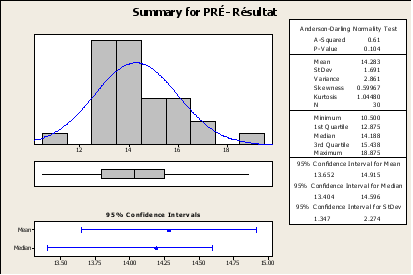
In this article, we analyse the specialised language in its complexity by cross-referencing, from a comparative perspective, data on the four skills. Thus, it is important to recall that all pre-tests served to assess the initial knowledge of the participants in both methodologies. The results are summarised in the following figure:
Figure 1. Summary for Pre-Results. Source: MiniTab 17 Software.
Figure 1 reveals two important aspects: success in the exercise and the dispersion of results. On the one hand, success in the exercise is undeniable. A clear success rate of 100% is observed. This is evidenced by the location of the bars to the right of the median point, fixed at 10.0 points, and the trajectory of the curve covering the entire figure. Both show that the highest scores are on the right, the area reserved for positive marks. These data indicate that the participants in the communication methodology understood the exercise very well, although there is a significant dispersion of scores (1.691 points).
The bars in the
Figure 1 are distributed along the axis of possible scores. However, the wide variety of score occurrences indicates heterogeneity in the levels of the participants in this methodology during the pre-test. This contributes to the fact that, in
Figure 1, only the scores of 10.5 points (participant n°. 6, first bar on the left) and 18.875 points (participant n°. 29, last bar on the right) have exclusive bars. All other cases can only be subject to approximate readings, showing that the participants in the communication methodology did not share the same competencies before the respective training. Finally, the 100% positive scores confirm success in the exercise, despite its diverse and not always progressive nature.
2.2. Communication Methodology: Post-test Results
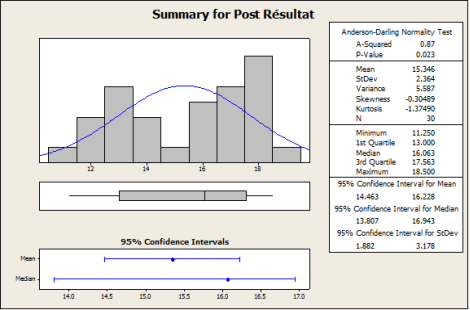
The participants in this study received training in either communication or action between the pre- and post-tests. The post-test serves to assess the level achieved after this activity. The following figure succinctly provides important data and insights for this analysis:
Figure 2. Summary for Post-Results. Source: MiniTab 17 Software.
Figure 2 reveals two undeniable aspects: success in the exercise and the dispersion of scores. Success is evident, as this group achieved
100% of the possible marks in the test. Unlike the previous
Figure 1, the summary for Post-Results is unique in that its bars are grouped at the extremes left and right. The first, on the left, represents the occurrence of scores between
0.0 and
15.0 points. The second, on the right, illustrates the occurrence of scores in the closed interval of
15.1 to
20.0 points.
In
Figure 2, the bars follow the axis of possible scores. From left to right, the first and second bars represent scores between
11.25 and
11.75 points; the second, third, and fourth bars represent all scores between
12.25 and
14.25 points; the fourth, fifth, and sixth bars represent scores between
14.26 and
16.0 points; the sixth, seventh, and eighth bars represent scores between
16.1 and
18.0 points; and finally, the eighth and ninth bars represent scores between 18.1 and
20.0 points. As in the previous case (summary for Pre-Results), the layout of
Figure 2 suggests heterogeneity in the levels of the communicative group, and the extreme variety of scores reinforces the idea of significant dispersion.
2.3. Action Methodology: Pre-test Results
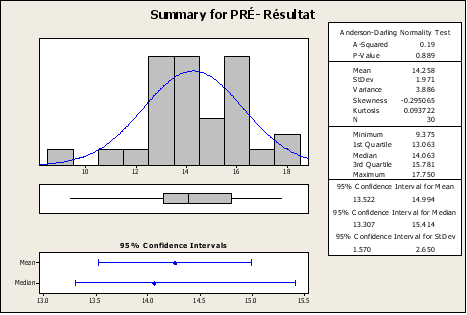
As in the previous figures (
Figures 1 and 2), success in the exercise and the dispersion of results are undeniable. A success rate of
96.7% is observed, compared to
3.3% of scores below the median point fixed at
10.0 points. This is evidenced by the location of all bars to the right of the median point and the trajectory of the curve covering the entire right-hand side. Both show that the highest scores occur on the right, the area reserved for good results. In this regard, it can be affirmed that the participants in the action methodology understood the exercise very well, despite the significant dispersion of scores (
1.971 points).
In this
Figure 3, the bars follow the scale of possible scores. In this representation, the exclusive bar corresponds to the only negative score (
9.375 points), obtained by participant n°.
21.
Figure 3. Summary for Pre-Results. Source: MiniTab 17 Software.
The layout of the figure suggests significant heterogeneity in the levels of the action methodology group, while the extreme variety of scores reinforces the idea of significant dispersion.
2.4. Action Methodology: Post-test Results
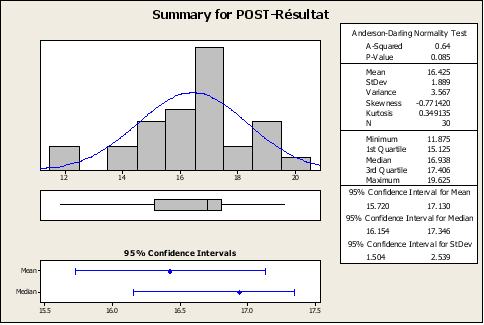
Figure 4. Summary for Post-Results. Source: MiniTab 17 Software.
Figure 4 provides information on two important aspects: success in the exercise and the dispersion of results. The 100% success rate is illustrated by the location of all bars to the right of the median point fixed at 10.0 points and the trajectory of the figure's curve covering the entire right-hand side. Both show that the highest scores occur on the right, the area reserved for good results. Thus, we can affirm that the participants in the action methodology understood the exercise very well, despite the significant dispersion (1.971 points) of their respective scores.
In the summary for Post-Results figure, the bars occur along the axis of possible scores, and in this representation, many scores share the same bars, meaning that the scores are close to each other.
3. Conclusion
In previous studies
| [1] | CUMBANE, D. S. Une proposition de Curriculum de Français Sur Objectifs Spécifiques pour la première année de F.L.E de l’Institut Supérieur des Relations Internationales (ISRI) de Maputo. Université de Franche Comté. Mémoire de Master Sous la direction du Professor SOUCHON M. Volume 1: texte principal 88 p. et Volume II: annexes 300 p, Besançon, 2008. |
| [2] | CUMBANE, D. S. Do paradigma da comunicação ao paradigma da acção: será que a abordagem da acção favorece a aprendizagem da compreensão e produção da escrita em língua francesa para fins específicos (F.F.E.)? Rev.Cient.U.E.M. Sér. ciênc. Soc. Vol. 2, N 1. pp 19-34, 2021. |
| [3] | CUMBANE, D. S. Du paradigme de communication au paradigme de l'action: est-ce que l'approche actionnelle favorise l'enseignement du F.O.S? Université de Normandie. Doctoral thesis in Language Sciences-Linguistics under the direction of LARRIVEE P. Single volume of 355 p, 2016. |
| [4] | CUMBANE, D. S. L'approche actionnelle favorise-t-elle l'enseignement du F.O.S.? ISBN 9783639503395, E.U.E. Germany, 416 p, 2016. http://www.amazon.com |
| [5] | CUMBANE, D. S. Que Opções Metodológicas para o Ensino da Compreensão da Escrita em Língua Francesa da Diplomacia e de Relações Internacionais? PsiEDU: Rev. Moç. De Psicologia, VOL 1, Número 4, Junho, pp. 124-138, 2022. |
| [6] | CUMBANE, D. S. Que opções paradigmáticas para o ensino da produção da escrita em língua francesa da diplomacia e de relações internacionais? PsiEDU: Rev. Moç. De Psicologia, VOL. 1, Número 3, Setembro, pp. 131-145, 2021. |
| [7] | CUMBANE, D. S. Opções metodológicas para o ensino da produção da oralidade: o caso do discurso de relações internacionais e diplomacia. Via Litterae (Revista de Linguística e teoria literária. Anápolis. V3, n 2. 2023, Jul/Dez, p. 234-248. https://doi.org/10.5281/zenodo.5592474 |
[1-7]
, we focused on sections, each representing one of the four skills. The results were as follows:
1. In the pre-test of both methodologies (section I), the
84.7% of the communication methodology were higher than the
81.1% of the action methodology. The difference between the two was
3.6%. In the respective post-test (section I), the
89.4% of the communication methodology were also higher than the
83.3% of the action methodology. In this case, the difference was
6.1%. These data allow us to affirm that the communication methodology enhances, in the pre-test global results, the teaching and learning of specialised reading comprehension
| [2] | CUMBANE, D. S. Do paradigma da comunicação ao paradigma da acção: será que a abordagem da acção favorece a aprendizagem da compreensão e produção da escrita em língua francesa para fins específicos (F.F.E.)? Rev.Cient.U.E.M. Sér. ciênc. Soc. Vol. 2, N 1. pp 19-34, 2021. |
[2]
.
2. In the pre-test of the communication and action methodologies (section II), the
61.80% of the communication methodology were higher than the
52.5% of the action methodology. Here, the difference was
9.3%. In the post-test (section II), the
80.7% of the communication methodology were higher than the
74.72% of the action methodology. The difference between the two was
5.98%. These data indicate that the communication methodology enhances the teaching of specialised writing production
| [5] | CUMBANE, D. S. Que Opções Metodológicas para o Ensino da Compreensão da Escrita em Língua Francesa da Diplomacia e de Relações Internacionais? PsiEDU: Rev. Moç. De Psicologia, VOL 1, Número 4, Junho, pp. 124-138, 2022. |
| [6] | CUMBANE, D. S. Que opções paradigmáticas para o ensino da produção da escrita em língua francesa da diplomacia e de relações internacionais? PsiEDU: Rev. Moç. De Psicologia, VOL. 1, Número 3, Setembro, pp. 131-145, 2021. |
[5, 6]
.
3. In the pre-test of the methodologies under study (section III), the
78.09% of the communication methodology were lower than the
79.52% of the action methodology. The difference, though small, was
1.43%. In the post-test (section III), the
67.61% of the communication methodology were lower than the
86.42% of the action methodology. The difference, now significant, was
18.81%. These data suggest that the action methodology enhances the teaching of specialised listening comprehension
| [3] | CUMBANE, D. S. Du paradigme de communication au paradigme de l'action: est-ce que l'approche actionnelle favorise l'enseignement du F.O.S? Université de Normandie. Doctoral thesis in Language Sciences-Linguistics under the direction of LARRIVEE P. Single volume of 355 p, 2016. |
[3]
.
4. In the pre-test of the communication and action methodologies (section IV), the
63.75% of the communication methodology were lower than the
73.75% of the action methodology. The difference was
10%. In the post-test (section IV), the
79.58% of the communication methodology were lower than the
86.45% of the action methodology. The difference between the two was
6.87%. Clearly, these results suggest that the action methodology enhances the teaching and learning of specialised oral production
| [7] | CUMBANE, D. S. Opções metodológicas para o ensino da produção da oralidade: o caso do discurso de relações internacionais e diplomacia. Via Litterae (Revista de Linguística e teoria literária. Anápolis. V3, n 2. 2023, Jul/Dez, p. 234-248. https://doi.org/10.5281/zenodo.5592474 |
[7]
.
In this study, the language was analysed «... as a complex communication system specific to human communities
| [10] | NEVEU, F. Dictionnaire des sciences du langage. Armand Colin, Paris, 2004. |
[10]
». The overall results are as follows:
In the pre-tests of the communication and action methodologies, the 71.41% of the communication methodology were slightly higher than the 71.31% of the action methodology. The difference of 0.10% confirms this reality and compels us to acknowledge the importance of both methodologies in teaching languages for specific purposes.
Conversely, in the post-tests of both methodologies, the 76.72% of the communication methodology were lower than the 82.16% of the action methodology. The difference of 5.44% in favour of the action methodology highlights its significant impact on the teaching and learning of French for international relations and diplomacy.





 Share This Article
 Twitter
 Linked In
 Facebook
 Copy
Copy Download