
The development of environmentally friendly radiation shielding materials has gained considerable attention as an alternative to toxic lead-based shields used in medical and industrial applications. In the present study, a series of WO3-doped boro-tellurite glasses with the composition (55−x) TeO2-20B2O3-15ZnO-10Na2CO3-xWO3 (where x = 5, 10, 15, and 20 mol%) were successfully synthesized using the conventional melt-quenching technique. The X-ray shielding performance of the prepared glass samples (TBZNW1-TBZNW4) was experimentally evaluated using an Ultisys 52 diagnostic X-ray system operated over the tube voltage range of 50-140 kVp. The shielding characteristics were assessed in terms of the linear attenuation coefficient (LAC), mass attenuation coefficient (MAC), half-value layer (HVL), tenth-value layer (TVL), mean free path (MFP), radiation attenuation efficiency (Att%), and lead equivalent thickness (LET). The results revealed that increasing the WO3 concentration significantly enhanced the attenuation capability of the glass system owing to the increase in density and effective atomic number. The TBZNW4 glass, containing 20 mol% WO3, exhibited the highest LAC and MAC values together with the lowest HVL, TVL, and MFP, indicating superior X-ray shielding performance. Moreover, the attenuation efficiency increased with WO3 content, while the lead equivalent thickness demonstrated the potential of the developed glasses to replace conventional lead-based shielding in diagnostic energy ranges. Comparison with previously reported shielding materials further confirmed the improved attenuation performance of the present glass system. These findings demonstrate that WO3-doped boro-tellurite glasses are promising, environmentally benign candidates for transparent radiation shielding applications in medical diagnostic facilities, laboratories, and other radiation environments.
| Published in | Journal of Photonic Materials and Technology (Volume 11, Issue 2) |
| DOI | 10.11648/j.jpmt.20261102.11 |
| Page(s) | 23-32 |
| Creative Commons |
This is an Open Access article, distributed under the terms of the Creative Commons Attribution 4.0 International License (http://creativecommons.org/licenses/by/4.0/), which permits unrestricted use, distribution and reproduction in any medium or format, provided the original work is properly cited. |
| Copyright |
Copyright © The Author(s), 2026. Published by Science Publishing Group |
Boro-tellurite Glass, WO3, X-ray Shielding, Radiation Attenuation, Linear Attenuation Coefficient, Lead-free Shielding Materials, Heavy Metal Oxide, Diagnostic X-rays
Sample Code | WO3 (mol%) | Peak Voltage (kVp) | LAC (cm⁻1) | MAC (cm2 g⁻1) | HVL (cm) | TVL (cm) | MFP (cm) | Attenuation (%) | LET at 100 kVp (mm) |
|---|---|---|---|---|---|---|---|---|---|
TBZNW1 | 5 | 75 | 21.68987 | 4.94976 | 0.03195 | 0.10613 | 0.04610 | 99.987 | 2.514 |
100 | 15.59872 | 3.55973 | 0.04443 | 0.14758 | 0.06411 | 99.842 | |||
120 | 12.20462 | 2.78517 | 0.05678 | 0.18862 | 0.08194 | 99.358 | |||
140 | 10.07095 | 2.29826 | 0.06881 | 0.22858 | 0.09930 | 98.449 | |||
TBZNW2 | 10 | 75 | 23.52658 | 5.09454 | 0.02946 | 0.09785 | 0.04251 | 99.993 | 2.784 |
100 | 17.32026 | 3.75060 | 0.04001 | 0.13291 | 0.05774 | 99.921 | |||
120 | 13.81081 | 2.99065 | 0.05018 | 0.16668 | 0.07241 | 99.664 | |||
140 | 11.32111 | 2.45152 | 0.06121 | 0.20334 | 0.08833 | 99.063 | |||
TBZNW3 | 15 | 75 | 25.60983 | 5.27277 | 0.02706 | 0.08989 | 0.03905 | 99.997 | 3.152 |
100 | 19.75709 | 4.06776 | 0.03508 | 0.11652 | 0.05061 | 99.969 | |||
120 | 16.00276 | 3.29478 | 0.04331 | 0.14385 | 0.06249 | 99.857 | |||
140 | 13.27234 | 2.73262 | 0.05221 | 0.17344 | 0.07534 | 99.563 | |||
TBZNW4 | 20 | 75 | 28.38071 | 5.56266 | 0.02442 | 0.08111 | 0.03524 | 99.999 | 3.560 |
100 | 22.24693 | 4.36043 | 0.03115 | 0.10347 | 0.04495 | 99.990 | |||
120 | 18.31758 | 3.59027 | 0.03783 | 0.12567 | 0.05459 | 99.950 | |||
140 | 15.34601 | 3.00784 | 0.04516 | 0.15001 | 0.06516 | 99.829 |
LAC | Linear Attenuation Coefficient |
MAC | Mass Attenuation Coefficient |
HVL | Half-Value Layer |
TVL | Tenth-Value Layer |
MFP | Mean Free Path |
LET | Lead Equivalent Thickness |
| [1] | A. Ali, et al., Influence of WO3 on gamma radiation shielding efficiency, physical and optical properties of newly developed Li2O-CaO-Bi2O3-B2O3 glasses, Radiat. Phys. Chem. 198 (2022) 110240. |
| [2] | M. Samdani, et al., Gamma shielding performance of B2O3/BaO-based glassy system: synthesis and simulation study, Radiat. Phys. Chem. 214 (2024) 111301. |
| [3] | M. Mhareb, et al., The impact of barium oxide on physical, structural, optical, and shielding features of sodium zinc borate glass, J. Non-Cryst. Solids 541 (2020) 120090. |
| [4] | G. Almisned, et al., A promising glass type in electronic and laser applications: elastic moduli, mechanical, and photon transmission properties of WO3 reinforced ternary-tellurite glasses, Symmetry 15(3) (2023) 602. |
| [5] | R. B. Malidarre, et al., Analysis of radiation shielding, physical and optical qualities of various rare earth dopants on barium tellurite glasses: a comparative study, Radiat. Phys. Chem. 207 (2023) 110823. |
| [6] | A. S. Ali, et al., Unveiling the structural, optical, and electromagnetic attenuation characteristics of B2O3-SiO2-CaO-Bi2O3 glasses with varied WO3 content, Radiat. Phys. Chem. 212 (2023) 111089. |
| [7] | N. J. AbuAlRoos, et al., Tungsten-based material as promising new lead-free gamma radiation shielding material in nuclear medicine, Phys. Med. 78 (2020) 48-57. |
| [8] | Protection, N. C. o. R. and Measurements, NCRP Report, National Council on Radiation Protection and Measurements, 1990. |
| [9] | A. Bijanu, et al., Metal-polymer composites for radiation protection: a review, J. Polym. Res. 28(10) (2021) 392. |
| [10] | J. Valentin, The 2007 Recommendations of the International Commission on Radiological Protection, vol. 37, Elsevier Oxford, 2007. |
| [11] | A. Aboalatta, et al., Experimental investigation of zinc sodium borate glass systems containing barium oxide for gamma radiation shielding applications, Nucl. Eng. Technol. 53(9) (2021) 3058-3067. |
| [12] | A. Madbouly, E. Atta, Comparative study between lead oxide and lead nitrate polymer as gamma-radiation shielding materials, J. Environ. Protect. 7(2) (2016) 268. |
| [13] | Y. Rammah, et al., The f-factor, neutron, gamma radiation and proton shielding competences of glasses with Pb or Pb/Bi heavy elements for nuclear protection applications, Ceram. Int. 46(17) (2020) 27163-27174. |
| [14] | M. Sayyed, et al., Exploring Gamma radiation shielding: the role of BaO in borosilicate glasses, Silicon (2024) 1-10. |
| [15] | S. Malekie, H. Shooli, M. A. Hosseini, Assessment of new composites containing polyamide-6 and lead monoxide as shields against ionizing photonic radiation based on computational and experimental methods, Sci. Rep. 12(1) (2022) 9259. |
| [16] | V. Agrawal, et al., Green conversion of hazardous red mud into diagnostic X-ray shielding tiles, J. Hazard Mater. 424 (2022) 127507. |
| [17] | M. Sayyed, G. Lakshminarayana, Structural, thermal, optical features and shielding parameters investigations of optical glasses for gamma radiation shielding and defense applications, J. Non-Cryst. Solids 487 (2018) 53-59. |
| [18] | M. I. Sayyed, et al. “Impacts of BaO additions on structure, linear/nonlinear optical properties and radiation shielding competence of BaO–NiO–ZnO–B₂O₃ glasses,” Optical Materials, 144 (2023) 114300. |
| [19] | S. Ravangvong, et al., Effects of WO3 on radiation shielding properties of WO3-TeO2 binary tellurite glass system, Integrated Ferroelectrics Int. J. 222(1) (2022) 125-135. |
| [20] | S. M. Ngaram, et al., Enhanced physical, optical and radiation shielding properties of tungsten modified potassium boro-tellurite glass systems: theoretical approach, Radiat. Phys. Chem. 226 (2025) 112355. |
| [21] | R. Ruamnikhom, et al., Hazardous radiation protective glasses for medical and research laboratories, Heliyon 9(9) (2023) e19935. |
| [22] | H. Tekin, et al., Transmission factors, mechanical, and gamma ray attenuation properties of barium-phosphate-tungsten glasses: incorporation impact of WO3, Optik 267 (2022) 169643. |
| [23] | A. M. Babeer, et al., Impact of mixed heavy metal cations (Ba and Bi) on the structure, optical and ionizing radiation shielding parameters of Bi2O3-BaO-Fe2O3-SrO-B2O3 glass matrix, Ceram. Int. 50(11) (2024) 19245-19258. |
| [24] | K. Boonin, et al., Effect of BaO on lead free zinc barium tellurite glass for radiation shielding materials in nuclear application, J. Non-Cryst. Solids 550 (2020) 120386. |
| [25] | R. K. Sk, et al., Structural, thermal and X-ray photoelectron spectroscopic properties of boro-tellurite based quaternary glass system, Opt. Mater. 156 (2024) 115989. |
| [26] | B. B. Solak, et al., Exploring the radiation shielding properties of B2O3-PbO-TeO2- CeO2-WO3 glasses: a comprehensive study on structural, mechanical, gamma, and neutron attenuation characteristics, Mater. Chem. Phys. 312 (2024) 128672. |
| [27] | M. Sayyed, et al., Effect of TeO2 addition on the gamma radiation shielding competence and mechanical properties of boro-tellurite glass: an experimental approach, J. Mater. Res. Technol. 18 (2022) 1017-1027. |
| [28] | S. Biradar, et al., Comprehensive investigation of borate-based glasses doped with BaO: an assessment of physical, structural, thermal, optical, and radiation shielding properties, Opt. Mater. 150 (2024) 115176. |
| [29] | M. Sayyed, et al., The combination of high optical transparency and radiation shielding effectiveness of zinc sodium borate glasses by tungsten oxide additions, J. Alloys Compd. 904 (2022) 164037. |
| [30] | S. Ravangvong, et al., Behaviors of TeO2-B2O3-WO3 glass system for ionizing radiation shielding performance: photon, protons and alpha particles, Mater. Today Proc. 65 (2022) 2269-2276. |
| [31] | M. Elsafi, et al., Experimental investigation of the radiation shielding performance of a newly developed silicon-epoxy resin doped with WO3 micro/ nanoparticles, Silicon 16(13) (2024) 5439-5446. |
| [32] | W. Cheewasukhanont, et al., High density of tungsten gadolinium borate glasses for radiation shielding material: effect of WO3 concentration, Radiat. Phys. Chem. 192 (2022) 109926. |
| [33] | V. Zanganeh, Effect of WO3 addition on mechanical, structural, optical, and radiation shielding properties of lead boro phosphate glasses system using Monte Carlo simulation, Optik 269 (2022) 169900. |
| [34] | A. H. Hammad, A. Abdelghany, G. Rabie, Extensive research into the structure, elasticity, optical, and radiation-shielding properties of zinc phosphate glasses doped with tungsten ions, Appl. Phys. A 130(4) (2024) 229. |
| [35] | M. K. Hamad, Effect of WO3 on structural, optical, mechanical, and ionizing radiation shielding properties of borate-tellurite glass network, Ceram. Int. 51(8) (2025) 9763-9771. |
| [36] | Y. S. Itas, et al., Studies of gamma ray shielding properties of lead-free tungsten- borate-tellurite glasses (x WO3-20B2O3-(80 x) TeO2);(x= 10, 15, 20 and 25), J. Electron. Mater. 53(9) (2024) 5696-5705. |
| [37] | H. A. Esawii, et al., High impact tungsten-doped borosilicate glass composite for gamma and neutron transparent radiation shielding, Prog. Nucl. Energy 150 (2022) 104321. |
| [38] | S. R. Karim, et al., X-ray attenuation performance of a newly synthesized tellurium based lead-free radiation shielding glass system, Radiat. Phys. Chem. (2023) 111477. |
| [39] | S. Kaewjaeng, et al., Fabrication luminescence and radiation shielding properties of Gd2O3-La2O3-ZnO-B2O3-Sm2O3 glasses, Radiat. Phys. Chem. 202 (2023) 110537. |
| [40] | A. H. Almuqrin, et al., Physical, optical and mechanical properties of BaO-WO3- P2O5 (BWP) glass system for radiation shielding, Opt. Quant. Electron. 56(6) (2024) 914. |
| [41] | S. Sarachai, et al., Radiation shielding properties of BaO-ZnO-B2o3 glass for X- Ray room, Key Eng. Mater. 766 (2018) 88-93. |
| [42] | S. Kaewjaeng, et al., X-ray radiation shielding of CeO2 doped borosilicate glasses and their luminescence characteristics, Radiat. Phys. Chem. 191 (2022) 109825. |
| [43] | S. Mukamil, et al., Lead-borate glass system doped with Sm3+ ions for the X-ray shielding applications, Results Phys. 43 (2022) 106121. |
| [44] | M. Ghaseminejad, L. Gholamzadeh, F. Ostovari, Investigation of x-ray attenuation property of modification PbO with graphene in epoxy polymer, Mater. Res. Express 8(3) (2021) 35008. |
| [45] | A. Henaish, et al., Spectral, electrical, magnetic and radiation shielding studies of Mg-doped ni-cu-zn nanoferrites, J. Mater. Sci. Mater. Electron. 31 (2020) 20210-20222. |
| [46] | M. Rashad, et al., Physical and nuclear shielding properties of newly synthesized magnesium oxide and zinc oxide nanoparticles, Nucl. Eng. Technol. 52(9) (2020) 2078-2084. |
| [47] | N. A. Alsaif, et al., Influence of WO3 replacement for CaO on physical, optical, and γ-ray protection properties of borotellurite glasses: a comparative study, Ceram. Int. 50 (2024) 32687-32698. |
| [48] | M. Zhukovsky, et al., Dielectric, structural, optical and radiation shielding properties of newly synthesized CaO-SiO2-Na2O-Al2O3 glasses: experimental and theoretical investigations on impact of Tungsten (III) oxide, Appl. Phys. A 128(3) (2022) 205. |
| [49] | National Council on Radiation Protection and Measurements (NCRP), Structural shielding design and evaluation for medical use of x rays and gamma rays of energies up to 10 MeV, Bethesda: NCRP (1976) 49. |
| [50] | American National Standards Institute (ANSI), ANSI/HPS N43.3. Installations Using Non-medical x-ray and Sealed gamma-ray Sources, Energies up to 10 Mev, ANSI, 2008. |
| [51] | N. H. Kwon, et al., Review of shielding evaluation methodology for facilities using kV energy radiation generating devices based on the NCRP-49 report, Progress in Medical Physics 33(4) (2022) 53-62. |
| [52] | S. A. Issa, et al., Structure, optical, and radiation shielding properties of PVA-BaTiO3 nanocomposite films: an experimental investigation, Radiat. Phys. Chem. 180 (2021) 109281. |
APA Style
VT, S., Ansari, G. F. (2026). Development and Experimental Evaluation of WO3-Doped Boro-Tellurite Glasses as Transparent Lead-Free X-ray Shielding Materials. Journal of Photonic Materials and Technology, 11(2), 23-32. https://doi.org/10.11648/j.jpmt.20261102.11
ACS Style
VT, S.; Ansari, G. F. Development and Experimental Evaluation of WO3-Doped Boro-Tellurite Glasses as Transparent Lead-Free X-ray Shielding Materials. J. Photonic Mater. Technol. 2026, 11(2), 23-32. doi: 10.11648/j.jpmt.20261102.11
@article{10.11648/j.jpmt.20261102.11,
  author = {Shihabudheen VT and Ghizal Firdous Ansari},
  title = {Development and Experimental Evaluation of WO3-Doped Boro-Tellurite Glasses as Transparent Lead-Free X-ray Shielding Materials},
  journal = {Journal of Photonic Materials and Technology},
  volume = {11},
  number = {2},
  pages = {23-32},
  doi = {10.11648/j.jpmt.20261102.11},
  url = {https://doi.org/10.11648/j.jpmt.20261102.11},
  eprint = {https://article.sciencepublishinggroup.com/pdf/10.11648.j.jpmt.20261102.11},
  abstract = {The development of environmentally friendly radiation shielding materials has gained considerable attention as an alternative to toxic lead-based shields used in medical and industrial applications. In the present study, a series of WO3-doped boro-tellurite glasses with the composition (55−x) TeO2-20B2O3-15ZnO-10Na2CO3-xWO3 (where x = 5, 10, 15, and 20 mol%) were successfully synthesized using the conventional melt-quenching technique. The X-ray shielding performance of the prepared glass samples (TBZNW1-TBZNW4) was experimentally evaluated using an Ultisys 52 diagnostic X-ray system operated over the tube voltage range of 50-140 kVp. The shielding characteristics were assessed in terms of the linear attenuation coefficient (LAC), mass attenuation coefficient (MAC), half-value layer (HVL), tenth-value layer (TVL), mean free path (MFP), radiation attenuation efficiency (Att%), and lead equivalent thickness (LET). The results revealed that increasing the WO3 concentration significantly enhanced the attenuation capability of the glass system owing to the increase in density and effective atomic number. The TBZNW4 glass, containing 20 mol% WO3, exhibited the highest LAC and MAC values together with the lowest HVL, TVL, and MFP, indicating superior X-ray shielding performance. Moreover, the attenuation efficiency increased with WO3 content, while the lead equivalent thickness demonstrated the potential of the developed glasses to replace conventional lead-based shielding in diagnostic energy ranges. Comparison with previously reported shielding materials further confirmed the improved attenuation performance of the present glass system. These findings demonstrate that WO3-doped boro-tellurite glasses are promising, environmentally benign candidates for transparent radiation shielding applications in medical diagnostic facilities, laboratories, and other radiation environments.},
 year = {2026}
}
TY  - JOUR
T1  - Development and Experimental Evaluation of WO3-Doped Boro-Tellurite Glasses as Transparent Lead-Free X-ray Shielding Materials
AU  - Shihabudheen VT
AU  - Ghizal Firdous Ansari
Y1  - 2026/08/27
PY  - 2026
N1  - https://doi.org/10.11648/j.jpmt.20261102.11
DO  - 10.11648/j.jpmt.20261102.11
T2  - Journal of Photonic Materials and Technology
JF  - Journal of Photonic Materials and Technology
JO  - Journal of Photonic Materials and Technology
SP  - 23
EP  - 32
PB  - Science Publishing Group
SN  - 2469-8431
UR  - https://doi.org/10.11648/j.jpmt.20261102.11
AB  - The development of environmentally friendly radiation shielding materials has gained considerable attention as an alternative to toxic lead-based shields used in medical and industrial applications. In the present study, a series of WO3-doped boro-tellurite glasses with the composition (55−x) TeO2-20B2O3-15ZnO-10Na2CO3-xWO3 (where x = 5, 10, 15, and 20 mol%) were successfully synthesized using the conventional melt-quenching technique. The X-ray shielding performance of the prepared glass samples (TBZNW1-TBZNW4) was experimentally evaluated using an Ultisys 52 diagnostic X-ray system operated over the tube voltage range of 50-140 kVp. The shielding characteristics were assessed in terms of the linear attenuation coefficient (LAC), mass attenuation coefficient (MAC), half-value layer (HVL), tenth-value layer (TVL), mean free path (MFP), radiation attenuation efficiency (Att%), and lead equivalent thickness (LET). The results revealed that increasing the WO3 concentration significantly enhanced the attenuation capability of the glass system owing to the increase in density and effective atomic number. The TBZNW4 glass, containing 20 mol% WO3, exhibited the highest LAC and MAC values together with the lowest HVL, TVL, and MFP, indicating superior X-ray shielding performance. Moreover, the attenuation efficiency increased with WO3 content, while the lead equivalent thickness demonstrated the potential of the developed glasses to replace conventional lead-based shielding in diagnostic energy ranges. Comparison with previously reported shielding materials further confirmed the improved attenuation performance of the present glass system. These findings demonstrate that WO3-doped boro-tellurite glasses are promising, environmentally benign candidates for transparent radiation shielding applications in medical diagnostic facilities, laboratories, and other radiation environments.
VL  - 11
IS  - 2
ER  -
Physics Department, Madhyanchal Professional University, Bhopal, India
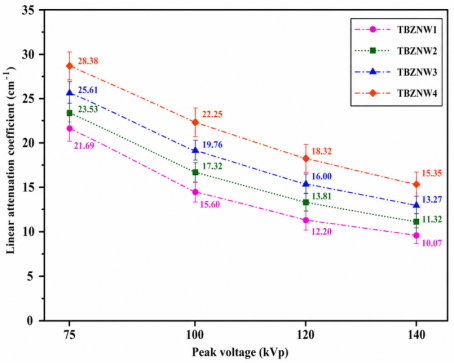
Figure 1. Linear attenuation coefficient (LAC) Vs Peak Voltage.
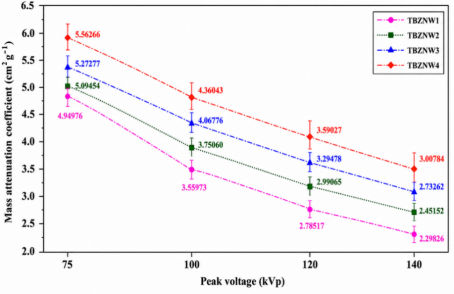
Figure 2. Mass attenuation coefficient (MAC) Vs X-ray tube voltage.
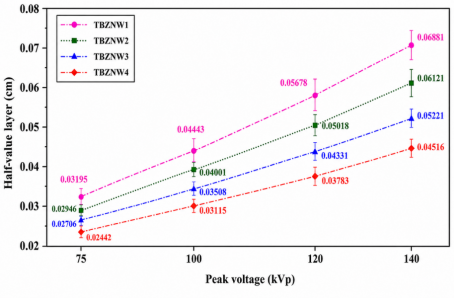
Figure 3. Half-value layer (HVL) Vs X-ray tube voltage.
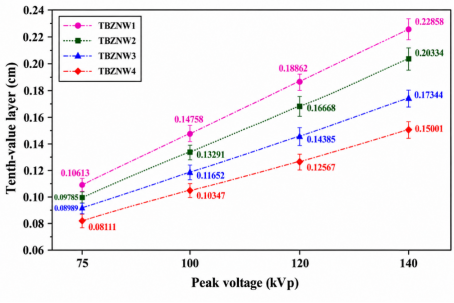
Figure 4. Tenth-value layer (TVL) Vs X-ray tube voltage.
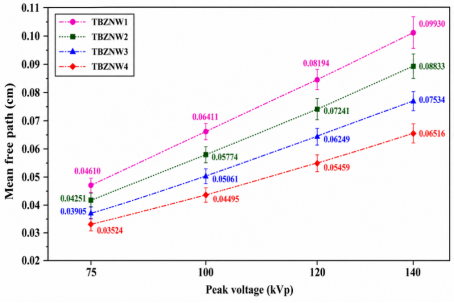
Figure 5. Mean free path (MFP) Vs X-ray tube voltage.
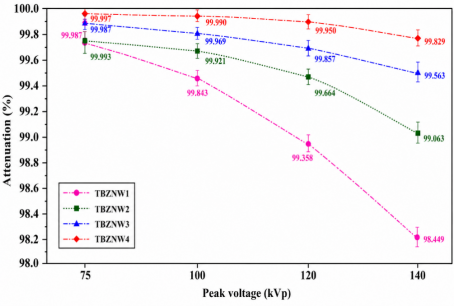
Figure 6. Radiation shielding efficiency (Att%) Vs X-ray tube voltage.
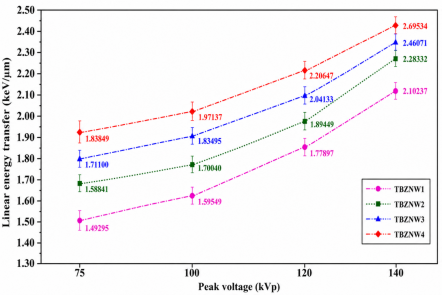
Figure 7. Lead equivalent thickness (LET) Vs Peak Voltage.

Information



 Share This Article
 Twitter
 Linked In
 Facebook
 Copy
Copy Download