
Background: Occupational exposure to petroleum products poses substantial physiological risks to oil company workers. Aim: This study assessed the physiological effects of fuel exposure among oil company workers in Delta State, Nigeria. Methods: This study employed a comparative cross-sectional design involving 330 participants comprising 165 exposed workers (fuel attendants, refinery workers, and maintenance/technical staff) and 165 non-exposed academic staff of Delta State University, Abraka, serving as controls. Measurements of systolic and diastolic blood pressure (SBP and DBP), pulse rate (PR), oxygen saturation (SpO2), peak expiratory flow rate (PEFR), and body temperature were obtained, alongside assessment of clinical symptoms across four physiological domains. Data were analyzed using independent t-tests and chi-square tests at p < 0.05. Results: Exposed workers demonstrated significantly higher mean SBP (136.5 ± 14.2 vs. 124.3 ± 11.8 mmHg), DBP (88.7 ± 9.6 vs. 79.5 ± 8.4 mmHg), PR (84.2 ± 10.5 vs. 76.8 ± 8.9 bpm), and body temperature (37.2 ± 0.4 vs. 36.8 ± 0.3°C) compared to controls (all p < 0.001). Conversely, SpO2 (94.8 ± 2.1 vs. 97.1 ± 1.5%) and PEFR (410.6 ± 65.3 vs. 465.2 ± 58.7 L/min) were significantly lower in exposed workers (p < 0.001). Chi-square analysis revealed significantly higher prevalence of respiratory (χ2 = 42.67), neurological (χ2 = 46.18), and dermatological symptoms (χ2 = 32.54), and overall physiological symptom burden (χ2 = 52.89) among exposed workers (all p < 0.001). These findings demonstrate that occupational fuel exposure significantly impairs multi-system physiological function.
| Published in | Journal of Health and Environmental Research (Volume 12, Issue 3) |
| DOI | 10.11648/j.jher.20261203.11 |
| Page(s) | 43-59 |
| Creative Commons |
This is an Open Access article, distributed under the terms of the Creative Commons Attribution 4.0 International License (http://creativecommons.org/licenses/by/4.0/), which permits unrestricted use, distribution and reproduction in any medium or format, provided the original work is properly cited. |
| Copyright |
Copyright © The Author(s), 2026. Published by Science Publishing Group |
Petroleum Exposure, Occupational Health, Volatile Organic Compounds, Blood Pressure, Lung Function, Nigeria
Age Group (years) | Exposed (n=165) | Control (n=165) | Total (n=330) | Percentage (%) |
|---|---|---|---|---|
20-29 | 40 | 55 | 95 | 28.8% |
30-39 | 60 | 50 | 110 | 33.3% |
40-49 | 45 | 40 | 85 | 25.8% |
50 and above | 20 | 20 | 40 | 12.1% |
Total | 165 | 165 | 330 | 100% |
Gender | Exposed (n=165) | Control (n=165) | Total (n=330) | Percentage (%) |
|---|---|---|---|---|
Male | 110 | 95 | 205 | 62.1% |
Female | 55 | 70 | 125 | 37.9% |
Total | 165 | 165 | 330 | 100 |
Occupation | Exposed (n=165) | Control (n=165) | Total | Percentage (%) |
|---|---|---|---|---|
Fuel Attendants | 70 | 70 | 21.2% | |
Refinery Workers | 60 | 60 | 18.2% | |
Maintenance/Technicians | 35 | 35 | 10.6% | |
Academic Staff | 165 | 165 | 50.0% | |
Total | 165 | 165 | 330 | 100 |
Duration (years) | Exposed (n=165) | Control (n=165) | Total | Percentage (%) |
|---|---|---|---|---|
1-5 | 50 | 60 | 110 | 33.3 |
6-10 | 60 | 55 | 115 | 34.8 |
11-15 | 35 | 30 | 65 | 19.7 |
Above 15 | 20 | 20 | 40 | 12.1 |
Total | 165 | 165 | 330 | 100 |
PPE Usage | Frequency (n=165) | Percentage (%) |
|---|---|---|
Regular Use | 50 | 30.3 |
Occasional Use | 70 | 42.4 |
No Use | 45 | 27.3 |
Total | 165 | 100 |
Parameter | Exposed (n=165) Mean ± SD | Control (n=165) Mean ± SD | t-value | p-value |
|---|---|---|---|---|
Systolic BP (mmHg) | 136.5 ± 14.2 | 124.3 ± 11.8 | 8.21 | 0.000* |
Diastolic BP (mmHg) | 88.7 ± 9.6 | 79.5 ± 8.4 | 8.05 | 0.000* |
Pulse Rate (bpm) | 84.2 ± 10.5 | 76.8 ± 8.9 | 6.73 | 0.000* |
SpO2 (%) | 94.8 ± 2.1 | 97.1 ± 1.5 | -11.02 | 0.000* |
PEFR (L/min) | 410.6 ± 65.3 | 465.2 ± 58.7 | -7.84 | 0.000* |
Body Temp (°C) | 37.2 ± 0.4 | 36.8 ± 0.3 | 9.15 | 0.000* |
BP Category | Exposed (n=165) | Control (n=165) | Total | Percentage (%) |
|---|---|---|---|---|
Normal | 50 | 110 | 160 | 48.5 |
Pre-hypertension | 60 | 35 | 95 | 28.8 |
Hypertension Stage 1 | 40 | 15 | 55 | 16.7 |
Hypertension Stage 2 | 15 | 5 | 20 | 6.1 |
Total | 165 | 165 | 330 | 100 |
Parameter | Group | Mean ± SD (mmHg) | Range (mmHg) |
|---|---|---|---|
Systolic BP | Exposed | 136.5 ± 14.2 | 110-165 |
Control | 124.3 ± 11.8 | 100-150 | |
Diastolic BP | Exposed | 88.7 ± 9.6 | 70-105 |
Control | 79.5 ± 8.4 | 65-95 |
SpO2 Level | Exposed (n=165) | Control (n=165) | Total | Percentage (%) |
|---|---|---|---|---|
Normal (≥96%) | 60 | 130 | 190 | 57.6 |
Mildly Reduced (93-95%) | 75 | 30 | 105 | 31.8 |
Low (<93%) | 30 | 5 | 35 | 10.6 |
Total | 165 | 165 | 330 | 100 |
Group | Mean ± SD (%) | Range (%) |
|---|---|---|
Exposed | 94.8 ± 2.1 | 89-98 |
Control | 97.1 ± 1.5 | 94-99 |
PEFR Category | Exposed (n=165) | Control (n=165) | Total | Percentage (%) |
|---|---|---|---|---|
Normal | 70 | 130 | 200 | 60.6 |
Mild Reduction | 60 | 25 | 85 | 25.8 |
Moderate Reduction | 25 | 8 | 33 | 10.0 |
Severe Reduction | 10 | 2 | 12 | 3.6 |
Total | 165 | 165 | 330 | 100 |
Group | Mean ± SD (L/min) | Range (L/min) |
|---|---|---|
Exposed | 410.6 ± 65.3 | 280-520 |
Control | 465.2 ± 58.7 | 350-580 |
Pulse Rate Category | Exposed (n=165) | Control (n=165) | Total | Percentage (%) |
|---|---|---|---|---|
Normal (60-80 bpm) | 65 | 120 | 185 | 56.1 |
Elevated (81-100 bpm) | 80 | 40 | 120 | 36.4 |
Tachycardia (>100 bpm) | 20 | 5 | 25 | 7.6 |
Total | 165 | 165 | 330 | 100 |
Group | Mean ± SD (bpm) | Range (bpm) |
|---|---|---|
Pulse rate (Exposed) | 84.2 ± 10.5 | 65-110 |
Pulse Rate (Control) | 76.8 ± 8.9 | 60-95 |
Group | N | Mean (°C) | SD | Min (°C) | Max (°C) | Range (°C) | Frequency (%) |
|---|---|---|---|---|---|---|---|
Exposed | 165 | 37.2 | 0.4 | 36.4 | 38.0 | 1.6 | 50.0% |
Control | 165 | 36.8 | 0.3 | 36.2 | 37.5 | 1.3 | 50.0% |
Total | 330 | 37.0 | 0.4 | 36.2 | 38.0 | 1.8 | 100% |
Symptom Category | Group | Present (n,%) | Absent (n,%) | Total (n) | Mean ± SD |
|---|---|---|---|---|---|
Neurological Symptoms (headache, dizziness, fatigue) | Exposed | 90 (54.5%) | 75 (45.5%) | 165 | 0.55 ± 0.50 |
Control | 35 (21.2%) | 130 (78.8%) | 165 | 0.21 ± 0.41 | |
Skin Conditions (irritation, dermatitis, itching) | Exposed | 70 (42.4%) | 95 (57.6%) | 165 | 0.42 ± 0.49 |
Control | 25 (15.2%) | 140 (84.8%) | 165 | 0.15 ± 0.36 | |
Overall Symptoms | Exposed | 120 (72.7%) | 45 (27.3%) | 165 | 0.73 ± 0.45 |
Control | 55 (33.3%) | 110 (66.7%) | 165 | 0.33 ± 0.47 |
Category | Exposed (O) | Control (O) | Expected (E) | O−E | (O−E)2 | (O−E)2/E |
|---|---|---|---|---|---|---|
Present | 95 | 40 | 67.5 | 27.5 | 756.25 | 11.20 |
Absent | 70 | 125 | 97.5 | -27.5 | 756.25 | 7.76 |
Total | 165 | 165 | χ2 = 42.67 |
Parameter | Exposed Mean ± SD | Control Mean ± SD | Mean Difference | t-value | p-value |
|---|---|---|---|---|---|
Systolic BP | 136.5 ± 14.2 | 124.3 ± 11.8 | 12.2 | 8.21 | 0.000 |
Diastolic BP | 88.7 ± 9.6 | 79.5 ± 8.4 | 9.2 | 8.05 | 0.000 |
Pulse Rate | 84.2 ± 10.5 | 76.8 ± 8.9 | 7.4 | 6.73 | 0.000 |
Category | Exposed (O) | Control (O) | Expected (E) | O−E | (O−E)2 | (O−E)2/E |
|---|---|---|---|---|---|---|
Present | 90 | 35 | 62.5 | 27.5 | 756.25 | 12.10 |
Absent | 75 | 130 | 102.5 | -27.5 | 756.25 | 7.38 |
Total | 165 | 165 | χ2 = 46.18 |
Category | Exposed (O) | Control (O) | Expected (E) | O−E | (O−E)2 | (O−E)2/E |
|---|---|---|---|---|---|---|
Present | 70 | 25 | 47.5 | 22.5 | 506.25 | 10.66 |
Absent | 95 | 140 | 117.5 | -22.5 | 506.25 | 4.31 |
Total | 165 | 165 | χ2 = 32.54 |
Category | Exposed (O) | Control (O) | Expected (E) | O−E | (O−E)2 | (O−E)2/E |
|---|---|---|---|---|---|---|
Present | 120 | 55 | 87.5 | 32.5 | 1056.25 | 12.07 |
Absent | 45 | 110 | 77.5 | -32.5 | 1056.25 | 13.63 |
Total | 165 | 165 | χ2 = 52.89 |
| [1] | Khoshakhlagh, A. H., Yazdanirad, S., Mousavi, M., Gruszecka-Kosowska, A., Shahriyari, M. and Rajabi-Vardanjani, H. (2023). Summer and winter variations of BTEX concentrations in an oil refinery complex and health risk assessment based on Monte-Carlo simulations. Scientific Reports 13: 10670. |
| [2] | Geraldino, B. R., Nunes, R. N., Gomes, J. B., da Poça, K. S., Giardini, Otero, U. B. and Sarpa, M. (2021). Evaluation of exposure to toluene and xylene in gasoline station workers. Advances in Preventive Medicine 2021: 5553633. |
| [3] | Hoseini, M., Samaei, M. R., Shahesmaeili, A., Martínez, S. S. and Amiri, H. (2023). Using biomonitoring as a complementary approach in BTEX exposure assessment in the general population and occupational settings: A systematic review and meta-analysis. Reviews on Environmental Health 38(3): 493-510. |
| [4] | Jalilian, S., Sabzalipour, S., Mohammadi Rouzbahani, M., Rajabzadeh Ghatrami, E. and Ibrahimy Ghavamabadi, L. (2022). Assessing the effect of BTEX on blood and spirometry parameters staff in a petroleum refinery. Frontiers in Public Health 10: 1037413. |
| [5] | Anigilaje, E. A., Nasir, Z. A. and Walton, C. (2024). Exposure to benzene, toluene, ethylbenzene, and xylene (BTEX) at Nigeria’s petrol stations: A review of current status, challenges and future directions. Frontiers in Public Health 12: 1295758. |
| [6] | Ismail, A. U., Ibrahim, S. A., Gambo, M. D., Muhammad, R. F., Badamasi, M. M. and Sulaiman, I. (2023). Impact of differential occupational LPG exposure on cardiopulmonary indices, liver function, and oxidative stress in Northwestern city of Nigeria. Science of the Total Environment 862: 160881. |
| [7] | Mendes, M. P. R., Paiva, M. J. N., Costa-Amaral, I. C., Carvalho, L. V. B., Figueiredo, V. O., Gonçalves, E. S., Larentis, A. L. and André, L. C. (2022). Metabolomic study of urine from workers exposed to low concentrations of benzene by UHPLC-ESI-QToF-MS reveals potential biomarkers associated with oxidative stress and genotoxicity. Metabolites 12(10): 978. |
| [8] | Zhou, B., Wu, Q., Fan, S., Su, Z., Lu, C., Peng, J., Zhang, N., Jin, L., Yu, D. and Zhang, J. (2024). Mediating effect of oxidative stress on blood pressure elevation in workers exposed to low concentrations of benzene, toluene, and xylene (BTX). Scientific Reports 14: 26139. |
| [9] | Liao, Q., Du, R., Ma, R., Liu, X., Zhang, Y., Zhang, Z., Ji, P., Xiao, M., Cui, Y., Xing, X., Liu, L., Dang, S., Deng, Q. and Xiao, Y. (2022). Association between exposure to a mixture of benzene, toluene, ethylbenzene, xylene, and styrene (BTEXS) and small airways function: A cross-sectional study. Environmental Research 212: 113488. |
| [10] | Warnakulasuriya, T., Medagoda, K., Kottahachchi, D., Luke, D., Wadasinghe, D., Rathnayake, P., Ariyawansa, J., Dissanayake, T., Sandeepani, P., De Silva, D. C. and Devanarayana, N. M. (2024). Exploring the impact of occupational exposure: A study on cardiovascular autonomic functions of male gas station attendants in Sri Lanka. Physiological Reports 12(21): e70071. |
| [11] | Denic-Roberts, H., Rowley, N., Haigney, M. C., Christenbury, K., Barrett, J., Thomas, D. L., Engel, L. S. and Rusiecki, J. A. (2022). Acute and longer-term cardiovascular conditions in the Deepwater Horizon oil spill Coast Guard cohort. Environment International 158: 106937. |
| [12] | Teklu, G., Negash, M., Asefaw, T., Tesfay, F., Gebremariam, G., Teklehaimanot, G., Gebretsadik, D. and Hailu, T. (2021). Effect of gasoline exposure on hematological parameters of gas station workers in Mekelle City, Tigray Region, Northern Ethiopia. Journal of Blood Medicine 12: 839-847. |
| [13] | Ufelle, S., Onyekwelu, K., Chinweoke, A., Ibegbu, D., Okoli, U. and Ikekpeazu, J. (2021). Assessment of hepatic functions, hematopoietic cytokines and haematological parameters in people occupationally exposed to volatile petroleum hydrocarbons. Archives of Environmental & Occupational Health 76(8): 567-571. |
| [14] | Chen, D., Werder, E. J., Stewart, P. A., Stenzel, M. R., Gerr, F. E., Lawrence, K. G., Groth, C. P., Huynh, T. B., Ramachandran, G., Banerjee, S., Jackson II, W. B., Christenbury, K., Kwok, R. K., Sandler, D. P. and Engel, L. S. (2023). Exposure to volatile hydrocarbons and neurologic function among oil spill workers up to 6 years after the Deepwater Horizon disaster. Environmental Research 231: 116069. |
| [15] | Badejo, D. A., Dele-Ochei, P. E., Akhaumere, E. O., Odionyenma, U. C., Oyakhire, F. O., Dimkpa, U., Abdulkadir, U. I., Usman-Onoruvie, V. O., Udoh, W. P., Kamdem, A. J., Obasuyi, G. E., Aiyesoro, F. O., Adejumo, B. I. G., Moses-Otutu, I. M., Abouo, A. M., Efenarhua, S. and Esezobor, K. I. (2025). Haematological profile of a cross-section of workers occupationally and environmentally exposed to petroleum products in Abuja and its environs. Health 17(3): 213-232. |
| [16] | Krajnak, K., Russ, K. A., McKinney, W., Waugh, S., Zheng, W., Kan, H., Kashon, M. L., Cumpston, J. and Fedan, J. S. (2022). Biological effects of inhaled vapors from crude oil IV. Cardiovascular effects. Toxicology and Applied Pharmacology 447: 116071. |
| [17] | Fedan, J. S., Thompson, J. A., Russ, K. A., Dey, R. D., Reynolds, J. S., Kashon, M. L., Jackson, M. C. and McKinney, W. (2022). Biological effects of inhaled crude oil vapor II. Pulmonary effects. Toxicology and Applied Pharmacology 450: 116154. |
| [18] | Amor-Carro, Ó., White, K. M., Fraga-Iriso, R., Mariñas-Pardo, L. A., Núñez-Naveira, L., Lema-Costa, B., Villarnovo, M., Verea-Hernando, H. and Ramos-Barbón, D. (2020). Airway hyperresponsiveness, inflammation, and pulmonary emphysema in rodent models designed to mimic exposure to fuel oil-derived volatile organic compounds encountered during an experimental oil spill. Environmental Health Perspectives 128: 027003. |
| [19] | Chen, D., Lawrence, K. G., Pratt, G. C., Stenzel, M. R., Stewart, P. A., Kwok, R. K., Sandler, D. P. and Engel, L. S. (2022). Fine particulate matter and lung function among burning-exposed Deepwater Horizon oil spill workers. Environmental Health Perspectives 130(2): 027003. |
| [20] | Sager, T. M., Joseph, P., Umbright, C. M., Hubbs, A. F., Barger, M., Kashon, M. L., Fedan, J. S. and Roberts, J. R. (2023). Biological effects of inhaled crude oil vapor III. Pulmonary inflammation, cytotoxicity, and gene expression profile. Inhalation Toxicology 35(9-10): 241-253. |
| [21] | Chaiklieng, S. (2021). Risk assessment of workers’ exposure to BTEX and hazardous area classification at gasoline station. PLOS ONE 16(4): 0250467. |
| [22] | Lawrence, K. G., Keil, A. P., Garantziotis, S., Umbach, D. M., Stewart, P. A., Stenzel, M. R., McGrath, J. A., Jackson, W. B., Kwok, R. K., Curry, M. D., Engel, L. S. and Sandler, D. P. (2020). Lung function in oil spill responders 4-6 years after the Deepwater Horizon disaster. Journal of Toxicology and Environmental Health, Part A 83(6): 233-248. |
| [23] | Qafisheh, N., Mohamed, O. H., Elhassan, A., Ibrahim, A. and Hamdan, M. (2021). Effects of the occupational exposure on health status among petroleum station workers, Khartoum State, Sudan. Toxicology Reports 8: 171-176. |
| [24] | Sriram, K., Lin, G. X., Jefferson, A. M., McKinney, W., Jackson, M. C., Cumpston, J. L., Cumpston, J. B., Leonard, H. D., Kashon, M. L. and Fedan, J. S. (2022). Biological effects of inhaled crude oil vapor V. Altered biogenic amine neurotransmitters and neural protein expression. Toxicology and Applied Pharmacology 449: 116137. |
| [25] | Chen, D., Lawrence, K. G., Stewart, P. A., Gorman Ng, M., Stenzel, M. R., Cherrie, J. W., Christenbury, K. E., Jackson II, W. B., Engel, L. S. and Sandler, D. P. (2025). Skin conditions associated with dermal exposure to oil spill chemicals among Deepwater Horizon disaster response and cleanup workers. Ecotoxicology and Environmental Safety 294: 118076. |
| [26] | Takeshita, R., Bursian, S. J., Colegrove, K. M., Collier, T. K., Deak, K., Dean, K. M., De Guise, S., DiPinto, L. M., Elferink, C. J., Esbaugh, A. J., Griffitt, R. J., Grosell, M., Harr, K. E., Incardona, J. P., Kwok, R. K., Lipton, J., Mitchelmore, C. L., Morris, J. M., Peters, E. S., Roberts, A. P., Rowles, T. K., Rusiecki, J. A., Schwacke, L. H., Smith, C. R., Wetzel, D. L., Ziccardi, M. H. and Hall, A. J. (2021). A review of the toxicology of oil in vertebrates: What we have learned following the Deepwater Horizon oil spill. Journal of Toxicology and Environmental Health, Part B: Critical Reviews 24(7): 355-394. |
APA Style
Godsday, O. U., Christabel, N. I., Junior, N. J., Ojimba, A. O., Precious, I., et al. (2026). Effect of Fuel Exposure on Oil Company Workers. Journal of Health and Environmental Research, 12(3), 43-59. https://doi.org/10.11648/j.jher.20261203.11
ACS Style
Godsday, O. U.; Christabel, N. I.; Junior, N. J.; Ojimba, A. O.; Precious, I., et al. Effect of Fuel Exposure on Oil Company Workers. J. Health Environ. Res. 2026, 12(3), 43-59. doi: 10.11648/j.jher.20261203.11
@article{10.11648/j.jher.20261203.11,
  author = {Ogbutor Udoji Godsday and Ndubuishi Ifechukwudeni Christabel and Nwose Jephtah Junior and Anastacia Okwudili Ojimba and Isaac Precious and Erumi Blessing Selly-U and Ogbutor Emeke Godson},
  title = {Effect of Fuel Exposure on Oil Company Workers},
  journal = {Journal of Health and Environmental Research},
  volume = {12},
  number = {3},
  pages = {43-59},
  doi = {10.11648/j.jher.20261203.11},
  url = {https://doi.org/10.11648/j.jher.20261203.11},
  eprint = {https://article.sciencepublishinggroup.com/pdf/10.11648.j.jher.20261203.11},
  abstract = {Background: Occupational exposure to petroleum products poses substantial physiological risks to oil company workers. Aim: This study assessed the physiological effects of fuel exposure among oil company workers in Delta State, Nigeria. Methods: This study employed a comparative cross-sectional design involving 330 participants comprising 165 exposed workers (fuel attendants, refinery workers, and maintenance/technical staff) and 165 non-exposed academic staff of Delta State University, Abraka, serving as controls. Measurements of systolic and diastolic blood pressure (SBP and DBP), pulse rate (PR), oxygen saturation (SpO2), peak expiratory flow rate (PEFR), and body temperature were obtained, alongside assessment of clinical symptoms across four physiological domains. Data were analyzed using independent t-tests and chi-square tests at p 2 (94.8 ± 2.1 vs. 97.1 ± 1.5%) and PEFR (410.6 ± 65.3 vs. 465.2 ± 58.7 L/min) were significantly lower in exposed workers (p 2 = 42.67), neurological (χ2 = 46.18), and dermatological symptoms (χ2 = 32.54), and overall physiological symptom burden (χ2 = 52.89) among exposed workers (all p < 0.001). These findings demonstrate that occupational fuel exposure significantly impairs multi-system physiological function.},
 year = {2026}
}
TY  - JOUR
T1  - Effect of Fuel Exposure on Oil Company Workers
AU  - Ogbutor Udoji Godsday
AU  - Ndubuishi Ifechukwudeni Christabel
AU  - Nwose Jephtah Junior
AU  - Anastacia Okwudili Ojimba
AU  - Isaac Precious
AU  - Erumi Blessing Selly-U
AU  - Ogbutor Emeke Godson
Y1  - 2026/08/22
PY  - 2026
N1  - https://doi.org/10.11648/j.jher.20261203.11
DO  - 10.11648/j.jher.20261203.11
T2  - Journal of Health and Environmental Research
JF  - Journal of Health and Environmental Research
JO  - Journal of Health and Environmental Research
SP  - 43
EP  - 59
PB  - Science Publishing Group
SN  - 2472-3592
UR  - https://doi.org/10.11648/j.jher.20261203.11
AB  - Background: Occupational exposure to petroleum products poses substantial physiological risks to oil company workers. Aim: This study assessed the physiological effects of fuel exposure among oil company workers in Delta State, Nigeria. Methods: This study employed a comparative cross-sectional design involving 330 participants comprising 165 exposed workers (fuel attendants, refinery workers, and maintenance/technical staff) and 165 non-exposed academic staff of Delta State University, Abraka, serving as controls. Measurements of systolic and diastolic blood pressure (SBP and DBP), pulse rate (PR), oxygen saturation (SpO2), peak expiratory flow rate (PEFR), and body temperature were obtained, alongside assessment of clinical symptoms across four physiological domains. Data were analyzed using independent t-tests and chi-square tests at p 2 (94.8 ± 2.1 vs. 97.1 ± 1.5%) and PEFR (410.6 ± 65.3 vs. 465.2 ± 58.7 L/min) were significantly lower in exposed workers (p 2 = 42.67), neurological (χ2 = 46.18), and dermatological symptoms (χ2 = 32.54), and overall physiological symptom burden (χ2 = 52.89) among exposed workers (all p < 0.001). These findings demonstrate that occupational fuel exposure significantly impairs multi-system physiological function.
VL  - 12
IS  - 3
ER  -
Department of Human Physiology, Delta State University, Abraka, Nigeria
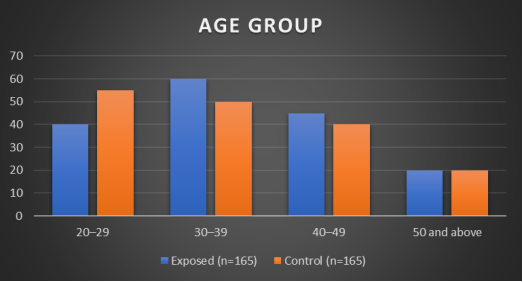
Figure 1. Age Group Chart.
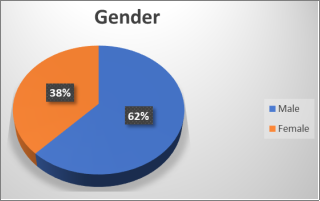
Figure 2. Gender chart.
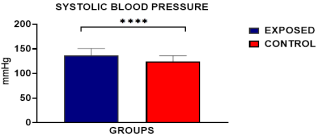
Figure 3. Comparison on Systolic Blood Pressure among Exposed and Control Group.
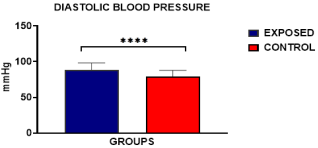
Figure 4. Comparison on Diastolic Blood Pressure among Exposed and Control Group.
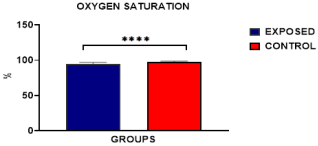
Figure 5. Comparison on Oxygen Saturation among Exposed and Control Group.
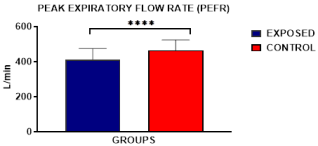
Figure 6. Comparison on PEFR among Exposed and Control Group.
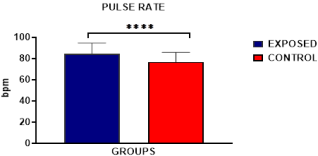
Figure 7. Comparison on Pulse Rate among Exposed and Control Group.
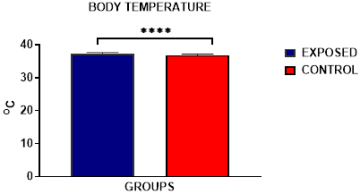
Figure 8. Comparison on body Temperature among Exposed and Control Group.

Information



 Share This Article
 Twitter
 Linked In
 Facebook
 Copy
Copy Download