Abstract
The Dominican Republic’s electricity system remains structurally exposed to fossil fuel import dependence and price volatility, underscoring the need for diversified, predictable renewable resources. This paper presents a quantitative resource assessment and conceptual development framework for marine current energy exploitation in the Mona Channel, a hydrodynamically active corridor between the Dominican Republic and Puerto Rico. Oceanographic measurements indicate peak current velocities up to 1.54 m/s within 200–350 m depth zones suitable for seabed-mounted turbine deployment. Using the kinetic power density formulation and conservative operational assumptions, a 30 MW pilot marine energy park consisting of thirty 1 MW horizontal-axis turbines is proposed as Phase I deployment. Assuming a 42% capacity factor, estimated annual generation reaches approximately 110 GWh, representing a stable, dispatchable-profile renewable contribution to the Dominican National Interconnected Electric System (SENI). Conceptual array spacing, subsea collection infrastructure, and staged grid integration pathways are defined in accordance with international marine energy deployment benchmarks. Beyond technical feasibility, the study frames marine current energy as a strategic resilience asset for island power systems. Unlike intermittent solar and wind resources, marine currents offer high predictability and seasonal complementarity, enhancing adequacy and reducing thermal dispatch requirements. A phased deployment strategy is recommended to enable environmental validation, regulatory development, and performance verification prior to large-scale expansion. The findings position the Mona Channel as a scalable blue-economy energy resource capable of strengthening long-term energy security, decarbonization efforts, and infrastructure resilience in the Caribbean region.
|
Published in
|
Journal of Energy and Natural Resources (Volume 15, Issue 1)
|
|
DOI
|
10.11648/j.jenr.20261501.14
|
|
Page(s)
|
26-32 |
|
Creative Commons
|

This is an Open Access article, distributed under the terms of the Creative Commons Attribution 4.0 International License (http://creativecommons.org/licenses/by/4.0/), which permits unrestricted use, distribution and reproduction in any medium or format, provided the original work is properly cited.
|
|
Copyright
|
Copyright © The Author(s), 2026. Published by Science Publishing Group
|
Keywords
Marine Current Energy, Tidal Turbines, Mona Channel, Renewable Energy, Marine Park, Dominican Republic,
Ocean Currents, Pilot Deployment
1. Introduction
Islanded electricity systems exhibit structural constraints including limited generation diversification, reduced reserve margins, high fossil fuel import dependence, and exposure to external price volatility. The Dominican Republic is no exception: despite recent renewable growth, its National Interconnected Electric System (SENI) remains predominantly thermal-based, with system adequacy and fuel cost exposure representing persistent strategic challenges.
While solar and wind capacity have expanded in the Caribbean region, both resources exhibit variability that increases balancing requirements in systems with limited interconnection capability. In contrast, marine current energy offers high predictability driven by large-scale ocean circulation dynamics. For islanded grids, predictable marine kinetic resources may provide complementary generation profiles that enhance system resilience and long-term adequacy.
The Mona Channel, located between the Dominican Republic and Puerto Rico, forms a major hydrodynamic passage influenced by the Caribbean Current and Atlantic circulation patterns. Prior feasibility analyses and oceanographic measurements have identified current velocities reaching approximately 1.5 m/s in selected depth corridors, suggesting potential suitability for submerged turbine deployment. Although theoretical assessments indicate significant long-term resource potential, international experience demonstrates that marine energy deployment must proceed in phased and risk-mitigated stages.
Globally, marine current energy has transitioned from experimental prototypes to early commercial arrays, with operational validation in Scotland and other regions. However, deployment in tropical island contexts remains limited, and structured techno-economic frameworks tailored to Caribbean conditions are scarce in the literature
.
This paper addresses that gap by developing a structured resource assessment and conceptual deployment strategy for marine current energy exploitation in the Mona Channel. Rather than proposing immediate large-scale development, the study advances a realistic 30 MW pilot marine park as Phase I implementation. The work integrates hydrodynamic resource characterization, array configuration principles, energy production estimation, and grid integration considerations within a staged development pathway.
By positioning marine current energy within the broader context of energy security, renewable diversification, and blue-economy infrastructure development, this research contributes to the emerging discussion on ocean energy as a resilience-enhancing asset for small island and semi-island power systems.
2. Objective
The objectives of this paper are:
1. To assess the potential of the marine currents of the Mona Channel
2. To propose a 30 MW marine energy park (Phase I)
3. To outline methodological steps for resource validation and prototype testing
4. To position the project within global marine energy deployment frameworks
3. Methodology
3.1. Oceanographic and Bathymetric Assessment
The methodology follows the structured approach described in
, including:
1. Acoustic Doppler current profiling
2. Bathymetric evaluation of 200–350 m depth zones
3. Geological and seismic risk assessment
Marine kinetic power density is estimated as:
P = ½ ρ A V3
where:
ρ = 1025 kg/m3
A = Turbine swept area, m2
V = Flow velocity, m/sec
3.2. Conceptual Design of the 30 MW Marine Park
The proposed pilot park consists of:
1. 30 marine turbines
2. Rated capacity: 1 MW per unit
3. Total installed capacity: 30 MW
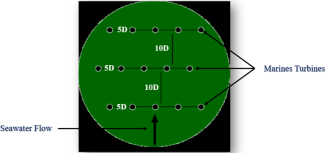
Hydrodynamic spacing follows established marine array practices
:
Lateral spacing ≥ 5D
Downstrem spacing ≥ 10D
Where D is the turbine rotor diameter.
Figure 1. Seabed turbines distribution.
3.3. Expected Energy Production
Annual energy production is estimated as:
E = PInstalled x CF x 8760
Assuming a conservative capacity factor of 42%:
This is consistent with early-stage marine arrays such as MeyGen Phase 1A
.
3.4. Grid Integration Concept
Collected power would be transmitted via subsea cables to an onshore substation. Offshore renewable integration practices described in
would guide design of subsea collection systems and potential HVDC reinforcement for future expansion.
The energy produced by the marine turbines will be injected into the Dominican Republic's National Interconnected Electric System, initially sold at the spot market price.
4. The Electrical Power System in the Dominican Republic
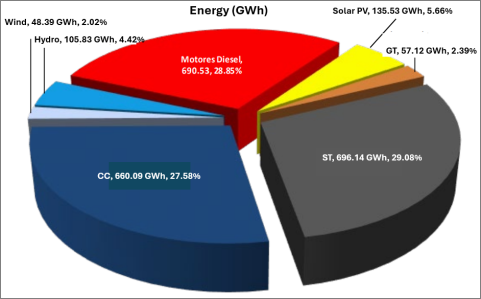
The Dominican Republic’s National Interconnected System (SENI, in Spanish) installed capacity exceeds 4 GW, predominantly thermal-based
| [4] | SENI Coordination Organism, Annual Report of the National Interconnected Electric System, Santo Domingo, October 2023. Available: https://www.oc.do |
[4]
. Marine energy is currently absent from the national generation mix.
Distribution losses and fuel expenditures remain structural challenges
| [4] | SENI Coordination Organism, Annual Report of the National Interconnected Electric System, Santo Domingo, October 2023. Available: https://www.oc.do |
| [9] | World Bank, Dominican Republic Energy Sector Overview, 2022. Available: https://data360.worldbank.org |
[4, 9]
. A 30 MW marine park would:
1. Supply approximately 110 GWh annually
2. Offset thermal generation
3. Contribute to renewable diversification
Figure 2. Energy generated in the Dominican Republic by type of technology.
5. Potentials of the Marine Currents in La Mona Channel
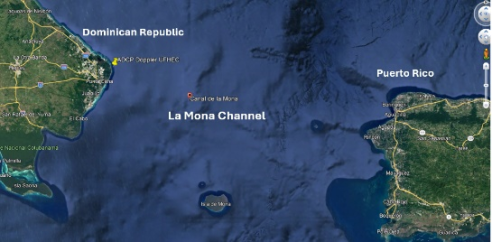
The Mona Channel characteristics include:
1. Width ≈ 107 km
2. Depth range: 200–350 m
3. Measured surface velocities up to 1.54 m/s
Ocean circulation modeling confirms persistent westward flow influenced by Caribbean Current dynamics [5, 10].
While theoretical long-term capacity may exceed 1 GW
, this study proposes phased scaling beginning with 30 MW.
Figure 3. La Mona Channer, between Dominican Republic and Puerto Rico, the Caribbean.
6. Overview of Marine Turbines and HVDC Subsea Cables
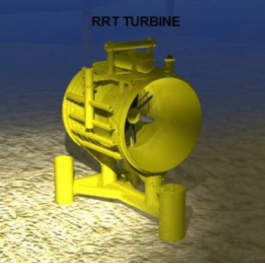
6.1. Marine Current Turbines Typically Operate Efficiently at Velocities Between 1.5–3 m/s Technologies include:
1. Horizontal-axis turbines
2. Modular offshore units deployed in Scotland
3. Corrosion-resistant subsea designs with advanced power electronics
| [11] | J. Thomson, B. Polagye, V. Durgesh, and M. C. Richmond, “Measurements of turbulence at two tidal energy sites in Puget Sound, WA,” IEEE Journal of Oceanic Engineering, vol. 37, no. 3, pp. 363–374, July 2012.
https://doi.org/10.1109/JOE.2012.2191656 |
[11]
Commercial experience from EMEC demonstrates increasing technological maturity
| [13] | European Marine Energy Centre (EMEC), “Operational Marine Energy Projects,” 2024. Available:
https://www.emec.org.uk |
[13]
.
Figure 4. RRT turbine for dual kinetic acceleration nozzle.
6.2. Subsea Cables
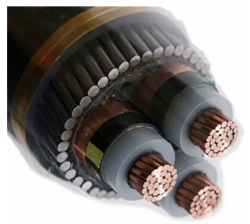
To transport the energy produced by the marine turbines, high-voltage direct current (HVDC) cables of the cross-linked polyethylene (XLPE) type will be used to withstand the underwater current conditions existing in the Mona Passage.
Figure 5 shows an XLPE cable.
Figure 5. Cross-linked Polyethylene Cable (XLPE).
Source: Final Report Prefeasibility Study for the Interconnection of Dominican Republic and Puerto Rico, TRACTEBEL Engineering, V. Lambillon, C. Nagel, J. Dubois & G. Bourgain, Tractebel Engineeering GDF Suez, Brussels, Belgium, September 2012, Page 13.
| [17] | TransGrid Solutions Inc., “Environmental Aspects of HVDC Transmission Systems”, World Bank, Report R1660.05.01, June 29, 2020. Available: https://www1.upme.gov.co |
[17]
7. Environmental Aspects
Environmental impacts of the HVDC cables have been addressed, and are presented in the following table:
Table 1. Environmental aspects of HVDC subsea cables.
Environmental Impacts | Mitigation Measures |
Habitat destruction | Avoid critical marine areas |
Disruption of the behavior of marine species | Use of horizontal plowing and drilling techniques |
Potential spill of pollutants | Submarine cable monitoring to prevent spills |
Effects of the magnetic field induced by high transmission voltage | Burial from a depth of 5 meters cancel the effect of the magnetic field |
Source: TransGrid Solutions Inc., “Environmental Aspects of HVDC Transmission Systems”, World Bank, Report R1660.05.01, June 29, 2020. Available: https://www1.upme.gov.co
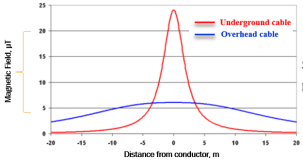
HVDC underground cables produce electromagnetic forces (EMFs) as an overhead transmission line, but the cable’s protective insulation and sheath contain the EMFs. On the other hand, the magnetic field passes through the sheath, so there is a magnetic field associated with the HVDC buried cables. The behavior of the magnetic field generated by underground and overhead transmission conductors has been documented in previous electromagnetic field studies
.
Figure 6. Magnetic Field Vs Distance for Underground and Overhead conductor.
Source: EMFs.info. “Electric Systems and Sources. Underground transmission cables”. Available: https://www.emfs.info/sources+of+emfs/underground/
As may be seen in
Figure 6, the magnetic field of the underground cable has an intensity of about 23 µT but only affect up to 5 meters from de cable itself. Nevertheless, even 25 µT of magnetic field represents 50% of the Earth’s magnetic field, as shown below:
25 µT = 0.25 Gauss; Earth’s Magnetic Field = 0.50 Gauss
Therefore, the magnetic field of the underground high voltage cable has less effect than the Earth’s magnetic field, which serves as support for the navigation of marine species and flying of birds.
8. Successful Marine Projects in the World
Examples include:
1. 50 MW Scottish MeyGen Tidal Stream Project
2. 240 MW French Rance Tidal Plant
3. 254 MW South Korean Sihwa Lake Tidal Power Station
| [16] | Final Report Prefeasibility Study for the Interconnection of Dominican Republic and Puerto Rico, TRACTEBEL Engineering, V. Lambillon, C. Nagel, J. Dubois & G. Bourgain, Tractebel Engineeering GDF Suez, Brussels, Belgium, September 2012, Page 13. |
[16]
These projects validate staged deployment strategies and grid integration feasibility.
9. Justification and Importance of the Project and Next Steps
9.1. Justification
The 30 MW pilot marine park would:
1. Reduce fossil fuel imports
2. Enhance energy security
3. Support decarbonization goals
4. Establish marine regulatory frameworks
5. Attract international marine technology partners
Ocean energy is identified by IRENA as a strategic long-term resource for island states
. Regional sustainable infrastructure development under the blue-economy framework is actively promoted by multilateral institutions in the Caribbean
.
A pilot deployment reduces technical and financial risk while enabling environmental monitoring and scaling validation.
9.2. Next Steps
This project is an ongoing research project funded by the Ministry of Higher Education, Science, and Technology of the Dominican Republic. The next steps in the route of the research shall be:
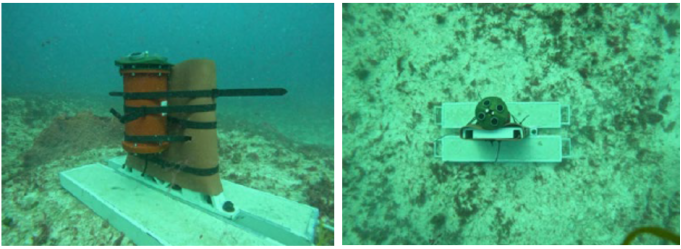
1. Installation of an ADCP device at the bottom of La Mona Channel to measure velocity and directions of the marine currents. The ADCP will remain at the bottom of the La Mona Channel for a period of 8 months, recording information.
Figure 6 shows the process of installation of the ADCP;
2. Remove the ADCP from the bottom of the La Mona Channel;
3. Extract the data from the ADCP;
4. Conduct a statistical analysis of the extracted data;
5. Design, using the ANSYS’ Turbomachinery software, an efficient marine turbo-generator of about 1 MW;
6. Project an initial commercial marine generation farm of 30 MW;
7. Calculate the required financial investment;
8. Make financial and economical studies to determine the internal return rate for this investment; and
9. Widely disseminate the findings of the research project among the scientific and academic community.
Figure 7. ADCP device installed at the bottom of the La Mona Channel at 64 feet of depth.
10. Conclusions
This study evaluated the technical feasibility and strategic relevance of marine current energy exploitation in the Mona Channel through a structured resource assessment and conceptual pilot development framework. Oceanographic and bathymetric data indicate that selected zones within 200–350 m depth corridors exhibit current velocities approaching 1.5 m/s, supporting the deployment of seabed-mounted marine turbines under conservative hydrodynamic assumptions.
Using established kinetic power density formulations and a 42% capacity factor assumption, a 30 MW pilot marine energy park was proposed as a staged Phase I implementation. Estimated annual generation of approximately 110 GWh demonstrates that marine current energy can provide a measurable and predictable renewable contribution to the Dominican National Interconnected Electric System. While modest relative to total installed capacity, such deployment would represent the country’s first marine energy integration and establish technical, regulatory, and environmental baselines for future scaling.
The findings confirm that the Mona Channel constitutes a technically viable marine energy corridor. However, large-scale exploitation should not be approached as an immediate objective. International deployment experience suggests that phased validation, environmental monitoring, and performance benchmarking are essential to risk mitigation and long-term bankability.
From a strategic perspective, marine current energy offers characteristics particularly valuable for islanded systems: high predictability, seasonal complementarity with solar resources, and reduced exposure to fuel price volatility. As such, it should be considered not only as an additional renewable source, but as a resilience-enhancing infrastructure asset within a broader blue-economy framework.
Future research should include high-resolution current profiling campaigns, detailed techno-economic modeling (including LCOE sensitivity), environmental impact assessment under tropical conditions, and grid adequacy simulations incorporating marine generation variability.
In summary, a phased 30 MW pilot development in the Mona Channel represents a technically sound and strategically prudent pathway toward long-term marine energy integration in the Dominican Republic.
Abbreviations
CF | Capacity Factor |
EMEC | European Marine Energy Centre |
EMFs | Electromagnetic Fields |
GDP | Gross Domestic Product |
HVDC | High Voltage Direct Current |
MW | Megawatt |
MWh | Megawatt-hour |
SENI | National Interconnected Electric System (Sistema Eléctrico Nacional Interconectado) |
XLPE | Cross-linked Polyethylene Cable |
Author Contributions
Francisco Nunez-Ramirez: Conceptualization, Methodology, Investigation, Formal analysis, Data curation, Writing – original draft, Writing – review & editing
Conflicts of Interest
The author declares no conflicts of interest.
References
| [1] |
W. E. R. Camilo Reynoso, “Estudio de factibilidad para un modelo energético sostenible a través del aprovechamiento de las corrientes marinas del Canal de la Mona,” 2015. Available:
https://www.researchgate.net/publication/280733655
|
| [2] |
International Renewable Energy Agency (IRENA), Ocean Energy: Technology Readiness, Patents, Deployment Status and Outlook, Abu Dhabi, 2020. Available:
https://www.irena.org/Publication/2020/Dec
|
| [3] |
Ocean Energy: Technology Readiness, Patents, Deployment Status and Outlook International Renewable Energy Agency (IRENA) — Abu Dhabi, 2020. Available:
https://www.irena.org/publications/2020/Dec/Ocean-Energy-Technology-Readiness-Patents-Deployment-Status-and-Outlook
|
| [4] |
SENI Coordination Organism, Annual Report of the National Interconnected Electric System, Santo Domingo, October 2023. Available:
https://www.oc.do
|
| [5] |
NOAA, “Caribbean Current System Overview,” 2022. Available:
https://oceanservice.noaa.gov
|
| [6] |
A. Bahaj and L. Myers, “Fundamentals of Marine Current Energy Conversion,” Renewable Energy, vol. 36, 2021. Available:
https://sciencedirect.com/journal/renewable-energy/issues
|
| [7] |
SIMEC Atlantis Energy, “MeyGen Tidal Stream Project Performance Update,” 2023. Available:
https://tethys.pnnl.gov/maygen
|
| [8] |
National Renewable Energy Laboratory (NREL), Offshore Renewable Energy Grid Integration, 2023. Available:
https://atb.nrel.gov/electricity
|
| [9] |
World Bank, Dominican Republic Energy Sector Overview, 2022. Available:
https://data360.worldbank.org
|
| [10] |
R. Lumpkin and K. Garzoli, “Near-surface circulation in the tropical Atlantic Ocean,” Progress in Oceanography, Vol. 89, Issues 1-4, 2011, pp. 1-12. Available:
https://doi.org/10.1016/j.pocean.2011.02.001
|
| [11] |
J. Thomson, B. Polagye, V. Durgesh, and M. C. Richmond, “Measurements of turbulence at two tidal energy sites in Puget Sound, WA,” IEEE Journal of Oceanic Engineering, vol. 37, no. 3, pp. 363–374, July 2012.
https://doi.org/10.1109/JOE.2012.2191656
|
| [12] |
EDF, “La Rance Tidal Power Plant,” 2022. Available:
https://tethys.pnnl.gov/la-rance-tidal-power-plant
|
| [13] |
European Marine Energy Centre (EMEC), “Operational Marine Energy Projects,” 2024. Available:
https://www.emec.org.uk
|
| [14] |
Inter-American Development Bank (IDB), Blue Economy and Sustainable Infrastructure in the Caribbean, 2022. Available:
https://www.unepfi.org/upload
|
| [15] |
South Korean Sihwa Lake Tidal Power Station. Pacific Northwest National Laboratory. Available:
https://tethys.pnnl.gov/sihwa-tidal-power-station
|
| [16] |
Final Report Prefeasibility Study for the Interconnection of Dominican Republic and Puerto Rico, TRACTEBEL Engineering, V. Lambillon, C. Nagel, J. Dubois & G. Bourgain, Tractebel Engineeering GDF Suez, Brussels, Belgium, September 2012, Page 13.
|
| [17] |
TransGrid Solutions Inc., “Environmental Aspects of HVDC Transmission Systems”, World Bank, Report R1660.05.01, June 29, 2020. Available:
https://www1.upme.gov.co
|
| [18] |
EMFs.info. “Electric Systems and Sources. Underground transmission cables”. Available:
https://www.emfs.info/sources+of+emfs/underground/
|
Cite This Article
-
APA Style
Nunez-Ramirez, F. (2026). Marine Current Energy Exploitation in the Mona Channel: Resource Assessment and Conceptual Development for the Dominican Republic. Journal of Energy and Natural Resources, 15(1), 26-32. https://doi.org/10.11648/j.jenr.20261501.14
 Copy
|
Copy
|
 Download
ACS Style
Nunez-Ramirez, F. Marine Current Energy Exploitation in the Mona Channel: Resource Assessment and Conceptual Development for the Dominican Republic. J. Energy Nat. Resour. 2026, 15(1), 26-32. doi: 10.11648/j.jenr.20261501.14
Copy
|
Download
AMA Style
Nunez-Ramirez F. Marine Current Energy Exploitation in the Mona Channel: Resource Assessment and Conceptual Development for the Dominican Republic. J Energy Nat Resour. 2026;15(1):26-32. doi: 10.11648/j.jenr.20261501.14
Copy
|
Download
-
@article{10.11648/j.jenr.20261501.14,
  author = {Francisco Nunez-Ramirez},
  title = {Marine Current Energy Exploitation in the Mona Channel: Resource Assessment and Conceptual Development for the Dominican Republic},
  journal = {Journal of Energy and Natural Resources},
  volume = {15},
  number = {1},
  pages = {26-32},
  doi = {10.11648/j.jenr.20261501.14},
  url = {https://doi.org/10.11648/j.jenr.20261501.14},
  eprint = {https://article.sciencepublishinggroup.com/pdf/10.11648.j.jenr.20261501.14},
  abstract = {The Dominican Republic’s electricity system remains structurally exposed to fossil fuel import dependence and price volatility, underscoring the need for diversified, predictable renewable resources. This paper presents a quantitative resource assessment and conceptual development framework for marine current energy exploitation in the Mona Channel, a hydrodynamically active corridor between the Dominican Republic and Puerto Rico. Oceanographic measurements indicate peak current velocities up to 1.54 m/s within 200–350 m depth zones suitable for seabed-mounted turbine deployment. Using the kinetic power density formulation and conservative operational assumptions, a 30 MW pilot marine energy park consisting of thirty 1 MW horizontal-axis turbines is proposed as Phase I deployment. Assuming a 42% capacity factor, estimated annual generation reaches approximately 110 GWh, representing a stable, dispatchable-profile renewable contribution to the Dominican National Interconnected Electric System (SENI). Conceptual array spacing, subsea collection infrastructure, and staged grid integration pathways are defined in accordance with international marine energy deployment benchmarks. Beyond technical feasibility, the study frames marine current energy as a strategic resilience asset for island power systems. Unlike intermittent solar and wind resources, marine currents offer high predictability and seasonal complementarity, enhancing adequacy and reducing thermal dispatch requirements. A phased deployment strategy is recommended to enable environmental validation, regulatory development, and performance verification prior to large-scale expansion. The findings position the Mona Channel as a scalable blue-economy energy resource capable of strengthening long-term energy security, decarbonization efforts, and infrastructure resilience in the Caribbean region.},
 year = {2026}
}
Copy
|
Download
-
TY  - JOUR
T1  - Marine Current Energy Exploitation in the Mona Channel: Resource Assessment and Conceptual Development for the Dominican Republic
AU  - Francisco Nunez-Ramirez
Y1  - 2026/03/17
PY  - 2026
N1  - https://doi.org/10.11648/j.jenr.20261501.14
DO  - 10.11648/j.jenr.20261501.14
T2  - Journal of Energy and Natural Resources
JF  - Journal of Energy and Natural Resources
JO  - Journal of Energy and Natural Resources
SP  - 26
EP  - 32
PB  - Science Publishing Group
SN  - 2330-7404
UR  - https://doi.org/10.11648/j.jenr.20261501.14
AB  - The Dominican Republic’s electricity system remains structurally exposed to fossil fuel import dependence and price volatility, underscoring the need for diversified, predictable renewable resources. This paper presents a quantitative resource assessment and conceptual development framework for marine current energy exploitation in the Mona Channel, a hydrodynamically active corridor between the Dominican Republic and Puerto Rico. Oceanographic measurements indicate peak current velocities up to 1.54 m/s within 200–350 m depth zones suitable for seabed-mounted turbine deployment. Using the kinetic power density formulation and conservative operational assumptions, a 30 MW pilot marine energy park consisting of thirty 1 MW horizontal-axis turbines is proposed as Phase I deployment. Assuming a 42% capacity factor, estimated annual generation reaches approximately 110 GWh, representing a stable, dispatchable-profile renewable contribution to the Dominican National Interconnected Electric System (SENI). Conceptual array spacing, subsea collection infrastructure, and staged grid integration pathways are defined in accordance with international marine energy deployment benchmarks. Beyond technical feasibility, the study frames marine current energy as a strategic resilience asset for island power systems. Unlike intermittent solar and wind resources, marine currents offer high predictability and seasonal complementarity, enhancing adequacy and reducing thermal dispatch requirements. A phased deployment strategy is recommended to enable environmental validation, regulatory development, and performance verification prior to large-scale expansion. The findings position the Mona Channel as a scalable blue-economy energy resource capable of strengthening long-term energy security, decarbonization efforts, and infrastructure resilience in the Caribbean region.
VL  - 15
IS  - 1
ER  -
Copy
|
Download





 Share This Article
 Twitter
 Linked In
 Facebook