
The escalating global burden of dengue virus (DENV) infection and the lack of specific antiviral therapies necessitate the development of effective therapeutics targeting the highly conserved non-structural protein 5 RNA-dependent RNA polymerase (NS5 RdRp). This study employed an integrated computer-aided drug discovery (CADD) and machine learning (ML) framework to screen a library of 14 phytoconstituents against DENV-2 NS5 RdRp. Following molecular docking, the top-ranked compounds were evaluated for pharmacokinetic safety through cross-docking with CYP3A4, OATP1B1, and OATP1B3, complemented by ADMET prediction using SwissADME and ProTox-II. In parallel, ML-based quantitative structure-activity relationship (QSAR) models using Random Forest (RF) and Extreme Gradient Boosting (XGBoost) were developed using hybrid descriptors comprising Morgan fingerprints, physicochemical properties, experimental IC50 values, and docking scores derived from validated DENV RdRp inhibitors. Docking analysis identified Glycyrrhizin, Curcumin, Boswellic acid, Mangiferin, Azadirachtin, and Forskolin as promising inhibitors, exhibiting binding affinities comparable to or greater than those of remdesivir. Although several lead compounds demonstrated potential interactions with CYP3A4, their weak binding to OATP1B1 and OATP1B3 suggested a reduced risk of transporter-mediated toxicity and favorable hepatic safety, supported by ADMET predictions indicating favorable drug-like properties. Among the developed ML- based QSAR models, XGBoost outperformed RF in predicting nonlinear structure-activity relationships. Overall, the integrated molecular docking, pharmacokinetic profiling, and ML-based QSAR analyses identified Glycyrrhizin, Curcumin, Boswellic acid, and Azadirachtin as the most promising antiviral lead scaffolds and demonstrate the value of AI-driven drug discovery for accelerating antiviral lead identification. Further in vitro and in vivo studies are warranted to validate their therapeutic efficacy and safety.
| Published in | Journal of Drug Design and Medicinal Chemistry (Volume 12, Issue 2) |
| DOI | 10.11648/j.jddmc.20261202.11 |
| Page(s) | 29-45 |
| Creative Commons |
This is an Open Access article, distributed under the terms of the Creative Commons Attribution 4.0 International License (http://creativecommons.org/licenses/by/4.0/), which permits unrestricted use, distribution and reproduction in any medium or format, provided the original work is properly cited. |
| Copyright |
Copyright © The Author(s), 2026. Published by Science Publishing Group |
Phytoconstituents, Dengue Fever, AI & ML Models, Insilico, Computer-aided Drug Discovery (CADD), Molecular Docking, Random Forest, Extreme Gradient Boosting
S. No | Name of compounds | PubChem UID | Targeted proteins |
|---|---|---|---|
1. | Resveratrol | 445154 | 6KR2, 2V0M, 8HNH, 8PG0 |
2. | Curcumin | 969516 | 6KR2, 2V0M, 8HNH, 8PG0. |
3. | Mangiferin | 5281647 | 6KR2, 2V0M. |
4. | Glycyrrhizin | 14982 | 6KR2, 2V0M, 8HNH, 8PG0 |
5. | Forskolin | 47936 | 6KR2, 2V0M, 8HNH, 8PG0 |
6. | Boswillic acid | 168928 | 6KR2, 2V0M, 8HNH, 8PG0 |
7. | Berberin | 2353 | 6KR2, 2V0M, 8HNH, 8PG0 |
8. | Azadirechtin | 5281303 | 6KR2. |
9. | Andrographolide | 5318517 | 6KR2. |
10. | Phyllanthin | 358901 | 6KR2. |
11. | Nirtetralin | 182644 | 6KR2. |
12. | Niranthin | 11575632 | 6KR2. |
13. | Limonene | 440917 | 6KR2. |
14. | Beta Myrcene | 31253 | 6KR2. |
15. | Remidesivir | 121304016 | 6KR2. |
Training data descriptors | ||||
|---|---|---|---|---|
Compound ID | Smiles | IC50 | Physicochemical descriptors (MW, TPSA, HBD, HBA, Log P, &RotB) | Docking Score of RDRP |
S. No | Name of the compound | Binding energy (Ki) Kcal/mol | Type of bond interactions |
|---|---|---|---|
1. | Resveratrol | -6.5 Kcal/mol | H:B - ASP 146. Pi-Sigma - LYS 105, ILE 147. Pi-Alkyl - VAL 132, ILE 147. VI - GLY 81, THR 104, GLU 111, VAL 130, ASP 131, PHE 133, LYS 181. |
2. | Curcumin | -8.0 Kcal/mol | H:B - GLY 85, GLY 148, LYS 181. Pi Sigma - LYS 105, ILE 147. Alkyl - ARG 84, VAL 132. Pi Alkyl - LYS 105, LYS 87. VI - VAL 55, GLY 58, GLY 81, CYS 82, GLY 83, GLY 86, THR 104, HIS 110, GLU 111, ASP 131, PHE 133, ASP 146. |
3. | Mangiferin | -8.5 Kcal/mol | H:B - MET 116, TRP 121, ARG 353, GLY 463. C:H - VAL 124, LYS 356. Pi-Alkyl - PRO 115, ALA 468. VI - TYR 89, PRO 113, ILE 114, ASN 122, ARG 125, PHE 349, GLU 464, PHE 465, LYS 469. |
4. | Glycyrrhizin | -9.5 Kcal/mol | H:B - GLY 106, ASP 146, SER 150. C:H - GLY 81, GLY 83. Alkyl - ILE 147. VI - PHE 25, LYS 29, LYS 61, CYS 82, ARG 84, LEU 103, THE 104, LYS 105, HIS 110, GLU 111, VAL 132, GLY 148, GLU 149, SER 151, PRO 152, ARG 212, SER 214, THR 215, GLU 217. |
5. | Forskolin | -7.6 Kcal/mol | H:B - SER 56, TRP 87, GLY 86, ASP 146. Alkyl - ILE147. Pi Sigma - TRP 87. VI - ARG 57, GLY 58, LYS 61, CYS 82, GLY 83, ARG 84, THR 104, GLU 111, LYS 181. |
6. | Boswillic acid | -8.3 Kcal/mol | H:B - ARG 84. Pi-Sigma - HIS 110. Pi-Alkyl - LYS 105, HIS 110, ILE 147. VI - SER 56, GLY 81, CYS 82, GLY 83, THR 104, GLU 111, PHE 133, GLY 148, GLU 149. |
7. | Berberin | -7.8 Kcal/mol | C:H - GLY 81, ASP 146. Pi-Alkyl - LYS 105, ILE 147. Pi-Cation - HIS 100. VI - GLY 83, THR 104, GLY 106, GLU 111, ASP 131, VAL 132, PHE 133, GLY 148, ARG 163, LYS 181. |
8. | Azadirechtin | -7.9 Kcal/mol | H:B - LYS 61, GLU 217, SER 56. Pi-Sigma - TRP 87. VI - ARG 57, GLY 58, ASP 79, GLY 81, CYS 82, GLY 83, ARG 84, GLY 85, GLY 86, THR 104, HIS 110, GLU 111, ASP 146, ILE 147, GLY 148, ARG 212, THR 215. |
9. | Andrographolide | -.6.3 Kcal/mol | H:B - VAL 124, LEU 126, SER 128. C:H - LYS 356. Alkyl - PRO 115, LEU 126. VI - TYR 89, PRO 113, ILE 114, MET 116, TRP 121, ARG 125, GLN 127, ARG 353. |
10. | Phyllanthin | -6.2 Kcal/mol | H:B - SER 56, HIS 110, C:H - GLY 81, ASP 131. Pi-Cation - HIS 110, ASP 146. Pi-Alkyl - TRP 87, LYS 105, ILE 147. Pi-Sigma - ILE 147. VI - GLY 82, CYS 82, GLY 86, ARG 57, GLY 106, THR 104, GLU 111, VAL 132, PHE 133, GLY 148, GLU 149. |
11. | Nirtetralin | -6.3 Kcal/mol | H:B - ARG 353, LEU 126. Pi-Akyl - PRO 113, PRO 115, LEU 126, ALA 468. |
12. | Niranthin | -7.1 Kcal/mol | H:B - GLY 86. C:H - ASP 79, GLY 81, GLU 111. Pi-Sigma - TRP 87, ILE 147. Pi-Cation - HIS 110. Alkyl - LYS 105, VAL 132, ILE 147. |
13. | Limonene | -5.4 Kcal/mol | Pi-Alkyl - LYS 105, VAL 132, PHE 133, ILE 147. VI - GLY 81, GLY 83, THR 104, VAL 130, ASP 131. |
14. | Beta Myrcene | -4.6 Kcal/mol | Alkyl - LYS 105, HIS 110, ILE 147. VI - GLY 81, GLY 83, GLY 106, GLU 111, ASP 131, VAL 130. |
15. | Remidsivir | -7.6 Kcal/mol | H:B - SER 56, GLY 86, LYS 105, GLU 111. C:H - ARG 57, GLY 81, GLY 83. Pi-Sigma - GLU 111. Alkyl - VAL 132, PHE 133, ILE 147. VI - GLY 58, CYS 82, GLY 85, TRP 87, ARG 84, GLY 109, THR 104, HIS 110, ASP 131, ASP 146. |
S. No | Name of the compounds | Binding energy Kcal/mol | Type of bond interactions |
|---|---|---|---|
1. | Glycyrrhizin | -11.75 kcal/mol | H:B - ASP 76, PHE 220. Pi-Alkyl - PHE 108, PHE 213, PHE 220. VI - ILE 50, TYR 53, PHE 57, ARG 106, MET 114, SER 119, LEU 210, LEU 211, PHE 215, ASP 217, LEU216, ILE 223, PHE 241, ILE 301, PHE 304, GLY 481, LEU 482. |
2. | Mangiferin | -8.70 kcal/mol | H:B - ARG 106, LEU 216, GLU 374. Pi-Alkyl - ILE 50. Pi-Pi T Shaped - TYR 53, PHE 57. VI - LEU 51, ASP 76, PRO 107, PHE 108, GLY 109, PHE 215, PHE 220, LEU 221, ILE 223, THR 224, |
3. | Boswillic acid | -10.55 kcal/mol | H:B - LEU 216, THR 224. C:H - PHE 215. Pi-Alkyl - TYR 53. VI - ILE 50, PHE 57, ARG 106, PHE 108, PHE 213, ASP 214, ASP 217, PHE 220, LEU 221, GLU 374, GLY 481, LEU 482. |
4. | Curcumin | -8.09 kcal/mol | H:B - 216. C:H - PHE 213, LEU 221. Alkyl - ILE 50, LEU221. Pi-Pi Stacked - PHE 220. VI - TYR 53, ASP 76, GLN 79, ARG 106, PRO 107, PHE 108, GLY 109, PHE 215, ASP 217, ILE 223, THR 224, PRO 227, ILE 230. |
5. | Forskolin | -8.76 kcal/mol | H:B - ARG 106, THR 224. Pi-Alkyl - TYR 53, PHE 57, LEU 221. VI - ASP 76, PHE 108, PHE 213, PHE 220, GLU 374, GLY 481. |
6. | Ketoconazole | -9.51 kcal/mol | H:B - THR 224. C:H - PHE 220. Pi-Akyl - ILE 50, PHE 57, PHE 108, LEU 221, LEU 216. Pi-Pi - PHE 213. VI - TYR 53, ASP 76, ILE 120, LEU 211, PHE 215, PHE 241, GLY 481. |
S. No | Name of the compounds | Binding energy Kcal/mol | Type of bond interactions |
|---|---|---|---|
1. | Glycyrrhizin | -9.1 kcal/mol | H:B - ASP 70, ARG 580, GLY 584. C:H - ASP 70. Pi-Alkyl - PHE 356, PHE 360. VI - ALA 45, ILE 46, LYS 49, PHE 73, GLU 74, PHE 224, ILE 353, THR 357, SER 371, ASN 375, ILE 585, PRO 588, ILE 589. |
2. | Boswillic acid | -9.0 kcal/mol | Pi-Alkyl - PHE 356. VI - LYS 41, THR 42, ASN 213, ALA 216, MET 217, PRO 220, PHE 224, TYR 352, GLY 379, THR 382, ILE 383, PHE 386, LEU 545, |
3. | Curcumin | -7.8 kcal/mol | Alkyl - MET 217, PRO 220, VAL 359, LEU 378, ALA 216, PHE 386, MET 390, VAL 538, VAL 542. VI - THR 42, ASN 213, TYR 352, PHE 356, PHE 360, GLY 379, THR 382, ILE 383, PHE 537, GLN 541, LEU 545. |
4. | Forskolin | -6.9 kcal/mol | H:B - ASN 213. Alkyl - PHE 38, VAL 189, LEU 193, VAL 556. VI - LYS 41, VAL 349, TYR 352, ILE 353, PHE 386, MET 390, GLY 552, HIS 555, HIS 575, SER 576, ILE 579, ARG 580. |
5. | Simeprevir | -11.2 kcal/mol | C:H - GLY 379. Pi-Sigma - PHE 224, THR 382. Pi-Pi - PHE 356. Alkyl - PRO 220, TYR 352, ILE 383. Pi-Sulphur - PHE 224. VI - THR 42, ILE 353, PHE 360, ASN 375, ILE 376, VAL 380, PHE 386, MET 390, GLN 541, LEU 545, ARG 580. |
6. | Rifampacin | -10.9 kcal/mol | H:B - ASN 213, ARG 580. C:H - THR 42. Pi-Sigma - TYR 352, PHE 356. Pi-Cation - LYS 41. VI - PHE 38, ALA 45, ILE 46, VAL 189, LEU 193, MET 217, PRO 220, VAL 349, ILE 353, ILE 383, PHE 386, GLY 552, HIS 555, VAL 556, HIS 575, SER 576. |
S. No | Name of the compounds | Binding energy Kcal/mol | Type of bond interactions |
|---|---|---|---|
1. | Glycyrrhizin | -10.5 kcal/mol | H:B - LYS 49, GLU 74, ARG 181, ARG 633. C:H - PHE 73, PHE 362, SER 365. Pi-Sigma - PHE 366. Pi-Alkyl - LYS 49, PHE 73. VI - LYS 41, GLY 45, ILE 46, ILE 363, THR 382, VAL 386, GLN 422, TYR 425, GLN 541, ASN 544, SER 545, SER 548, GLY 584. |
2. | Boswillic acid | -10.4 kcal/mol | H:B - ASN 544, SER 548. Pi-Alkyl PHE 356. VI - PHE 352, ILE 353, SER 355, VAL 359, THR 382, VAL 386, TYR 425, GLN 541, SER 545. |
3. | Curcumin | -8.2 kcal/mol | H:B - ASP 70. Pi-Pi - PHE 356. Pi-Alkyl - PHE 352. VI - GLY 45, ILE 46, MET 48, GLY 71, PHE 73, GLU 74, ASN 178, ARG 181, THR 382, VAL 386, GLN 541, SER 545, SER 548, GLY 584, |
4. | Forskolin | -7.3 kcal/mol | H:B - PHE 352, THR 382, GLN 541. Pi-Sigma - PHE 356. Pi-Alkyl - VAL 359, PHE 356. VI - ILE 353, SER 355, LEU 378, ILE 381, VAL 386, GLN 422, TYR 425, TYR 537, ASN 544, SER 545, SER 548, TYR 625, ARG 633. |
5. | Simeprevir | -11.5 kcal/mol | H:B - GLN 541, SER 548. Pi-Cation - LYS 49, GLU 74. Pi-Sulphur - PHE 73. Pi-Pi - PHE 73. Alkyl - VAL 386, ALA 549. VI - LYS 41, ALA 42, GLY 45, ASP 70, GLY 71, ARG 181, GLU 185, ILE 353, PHE 352, PHE 356, SER 355, THR 382, ASN 544, SER 545, GLY 584, PRO 588, ARG 633. |
6. | Rifampacin | -10.1 kcal/mol | H:B - GLU 185, ARG 580. C:H - GLY 584. Pi-Sigma - PHE 73. VI - TYR 38, LYS 41, ALA 42, GLY 45, ILE 46, LYS 49, GLU 74, ARG 181, ASN 213, GLY 216, PRO 220, PHE 224, VAL 349, ILE 353, PHE 356, THR 382, VAL 386, ILE 579. |
S. No | Compound | Water solubility | lipophilicity | Absorption GI | Permeability BBB | P-Gp Substrate | CYP3A4 inhibition | Lipinski rule |
|---|---|---|---|---|---|---|---|---|
1. | Glycyrrhizin | Poorly Soluble (-6.24) | 1.49 | Low | No | Yes | No | No |
2. | Mangiferin | Soluble (-2.44) | -0.77 | Low | No | No | No | No |
3. | Boswillic acid | Poorly Soluble (-7.81) | 6.12 | Low | No | No | No | Yes (1 violation) |
4. | Curcumin | Soluble (3.94) | 3.03 | High | No | No | Yes | Yes |
5. | Forskolin | Soluble (-2.82) | 1.72 | High | No | No | Yes | Yes |
S. No | Compound | Molecular formula | Molecular weight g/mol | No. of rotatable bonds | No. of H bond acceptors | No. of H bond donors | Molar Refractivity | TPSA |
|---|---|---|---|---|---|---|---|---|
1. | Glycyrrhizin | C42H62O16 | 822.93 | 7 | 16 | 8 | 202.84 | 267.04 |
2. | Mangiferin | C19H18O11 | 422.34 | 2 | 11 | 8 | 100.70 | 201.28 |
3. | Boswillic acid | C30H48O3 | 456.70 | 1 | 3 | 2 | 136.91 | 57.53 |
4. | Curcumin | C21H20O6 | 368.38 | 8 | 6 | 2 | 102.80 | 93.06 |
5. | Forskolin | C22H34O7 | 410.50 | 3 | 7 | 3 | 106.70 | 113.29 |
S. No | Compound | Toxicity class | carcinogenic | Hepatotoxic | Nuclear signaling toxicity | Stress toxicity |
|---|---|---|---|---|---|---|
1. | Glycyrrhizin | 4 | No | No | No | No |
2. | Mangiferin | 1 | No | Yes | No | No |
3. | Boswillic acid | 2 | Yes | No | No | No |
4. | Curcumin | 4 | No | No | No | Yes |
5. | Forskolin | 5 | No | No | Yes | Yes |
S. No | Compound | Predicted IC 50 (μM) | |
|---|---|---|---|
XG Boost Regression | Random Forest Regression | ||
1. | Glycyrrhizin | 5.22 | 5.70 |
2. | Curcumin | 5.25 | 5.85 |
3. | Boswellic Acid | 5.81 | 5.88 |
4. | Azadirachtin | 5.58 | 5.53 |
5. | Forskolin | 5.6 | 5.83 |
6. | Mangiferin | 6.18 | 6.09 |
7. | Berberin | 5.87 | 6.13 |
8. | Andrographillide | 6.1 | 5.8 |
9. | Phyllanthin | 5.58 | 5.7 |
10. | Niranthin | 5.9 | 6.05 |
11. | Beta myrcene | 4.62 | 5.18 |
12. | Limonene | 4.8 | 5.06 |
13. | Remdesivir | 2.73 | 2.66 |
NS5 RDRP | Non-Structural 5 RNA Dependent RNA Polymerase |
CADD | Computer-Aided Drug Design |
AI&ML | Artificial Intelligence & Machine Learning |
CYP3A4 | Cytochrome P450 3A4 |
OATP1B1 | Organic Anion Transporting Polypeptide 1B1 |
OATP1B3 | Organic Anion Transporting Polypeptide 1B3 |
ADME | Absorption, Distribution, Metabolism, and Excretion |
| [1] | G. Fibriansah, T. S. Ng, X. N. Lim, A. Shebanova, L. C. Ng, S. L. Tan, A. W. K. Tan, J. Shi, J. E. Crowe, S. M. Lok. Ultrapotent human antibodies lock E protein dimers central region of diverse DENV3 morphological variants. Nature Communications. 16 (2025). |
| [2] | J. Zheng, H. Tong, M. Chen, L. Duan, P. Song, J. Sun, X. Zhou, X. Feng. Global burden of dengue from 1990 to 2021: a systematic analysis from the Global Burden of Disease study 2021. Infectious Diseases of Poverty. 14 (2025). |
| [3] | Y. Zhou, Y. Zhang, X. Lian, F. Li, C. Wang, F. Zhu, Y. Qiu, Y. Chen. Therapeutic target database update 2022: Facilitating drug discovery with enriched comparative data of targeted agents. Nucleic Acids Research. 50 (2022) D1398-D1407. |
| [4] | S. Pushpakom, F. Iorio, P. A. Eyers, K. J. Escott, S. Hopper, A. Wells, A. Doig, T. Guilliams, J. Latimer, C. McNamee, A. Norris, P. Sanseau, D. Cavalla, M. Pirmohamed. Drug repurposing: Progress, challenges and recommendations. Nature Reviews Drug Discovery. 18 (2018) 41-58. |
| [5] | Atanasov, A.G., Zotchev, S.B., Dirsch, V.M. et al. Natural products in drug discovery: advances and opportunities. Nat Rev Drug Discov 20, 200–216 (2021). |
| [6] | M. Rudrapal, N. Gogoi, D. Chetia, J. Khan, S. Banwas, B. Alshehri, M. A. Alaidarous, U. D. Laddha, S. J. Khairnar, S. G. Walode. Repurposing of phytomedicine-derived bioactive compounds with promising anti-SARS-CoV-2 potential: Molecular docking, MD simulation and drug-likeness/ADMET studies. Saudi Journal of Biological Sciences. 29 (2022) 2432-2446. |
| [7] | P. A. Velásquez, J. C. Hernandez, E. Galeano, J. Hincapié-García, M. T. Rugeles, W. Zapata-Builes. Effectiveness of Drug Repurposing and Natural Products Against SARS-CoV-2: A Comprehensive Review. Clinical Pharmacology: Advances and Applications. 16 (2024) 1-25. |
| [8] | P. C. Agu, C. A. Afiukwa, O. U. Orji, E. M. Ezeh, I. H. Ofoke, C. O. Ogbu, E. I. Ugwuja, P. M. Aja. Molecular docking as a tool for the discovery of molecular targets of nutraceuticals in diseases management. Scientific Reports. 13 (2023). |
| [9] | T. L. Yap, T. Xu, Y.-L. Chen, H. Malet, M.-P. Egloff, B. Canard, S. G . Vasudevan, J. Lescar. Crystal Structure of the Dengue Virus RNA-Dependent RNA Polymerase Catalytic Domain at 1.85-Angstrom Resolution. Journal of Virology. 81 (2007) 4753-4765. |
| [10] | H. Malet, N. Massé, B. Selisko, J. L. Romette, K. Alvarez, J. C. Guillemot, H. Tolou, T. L. Yap, S. G. Vasudevan, J. Lescar, B. Canard. The flavivirus polymerase as a target for drug discovery. Antiviral Research. 80 (2008) 23-35. |
| [11] | S. P. Lim, C. G. Noble, P. Y. Shi. The dengue virus NS5 protein as a target for drug discovery. Antiviral Research. 119 (2015). 57-67. |
| [12] | V. J. Klema, M. Ye, A. Hindupur, T. Teramoto, K. Gottipati, R. Padmanabhan, K. H. Choi. Dengue Virus Nonstructural Protein 5 (NS5) Assembles into a Dimer with a Unique Methyltransferase and Polymerase Interface. PLoS Pathogens. 12 (2016). |
| [13] | S. S. Good, A. Shannon, K. Lin, A. Moussa, J. G. Julander, P. La Colla, G. Collu, B. Canard, J. P. Sommadossi. Evaluation of AT-752, a double prodrug of a guanosine nucleotide analog with in vitro and in vivo activity against dengue and other flaviviruses. Antimicrobial Agents and Chemotherapy. 65 (2021). |
| [14] | H. Shimizu, A. Saito, J. Mikuni, E. E. Nakayama, H. Koyama, T. Honma, M. Shirouzu, S. I. Sekine, T. Shioda. Discovery of a small molecule inhibitor targeting dengue virus NS5 RNA-dependent RNA polymerase. PLoS Neglected Tropical Diseases. 13 (2019). |
| [15] | D. G. Telléz Ruiz, J. Guevara-Pulido. Recent advances in drug discovery and development through machine learning : A rational drug design (2000-2024). Revista Facultad de Ciencias Básicas. 19 (2025) 107-123. |
| [16] | M. Venkataraman, G. C. Rao, J. K. Madavareddi, S. R. Maddi. Leveraging machine learning models in evaluating ADMET properties for drug discovery and development. ADMET and DMPK. 13 (2025). |
| [17] | S. K. Niazi, Z. Mariam. Recent Advances in Machine-Learning-Based Chemoinformatics: A Comprehensive Review. International Journal of Molecular Sciences. 24 (2023). |
| [18] | M. M, M. S, S. S. Kate, I. Taneja, S. Jaiswal, B. Pratap, P. C. Rathi, S. Thakur, D. Paul, M. Wahajuddin. A review on integrated machine learning and deep learning driven artificial intelligence models for pharmacokinetics and toxicokinetics predictions, and their application. Drug Metabolism and Disposition 54 (2026). |
| [19] | Z. X. Low, B. M. OuYong, P. Hassandarvish, C. L. Poh, B. Ramanathan. Antiviral activity of silymarin and baicalein against dengue virus. Scientific Reports11 (2021). |
| [20] | L. Lim, M. Dang, A. Roy, J. Kang, J. Song. Curcumin Allosterically Inhibits the Dengue NS2B-NS3 Protease by Disrupting Its Active Conformation. ACS Omega5 (2020) 25677-25686. |
| [21] | C. N. Powers, W. N. Setzer. An In-Silico Investigation of Phytochemicals as Antiviral Agents Against Dengue Fever. Combinatorial Chemistry & High Throughput Screening19 (2016) 516-536. |
| [22] | Y. Amen, M. A. Selim, R. A. Suef, A. M. Sayed, A. Othman. Unveiling the Antiviral Efficacy of Forskolin: A Multifaceted In Vitro and In Silico Approach. Molecules. 29 (2024). |
| [23] | L. A. Baltina, Y. T. Tasi, S. H. Huang, H. C. Lai, L. A. Baltina, S. F. Petrova, M. S. Yunusov, C. W. Lin. Glycyrrhizic acid derivatives as Dengue virus inhibitors. Bioorganic and Medicinal Chemistry Letters. 29 (2019). |
| [24] | Y. F. Lin, H. C. Lai, C. S. Lin, P. Y. Hung, J. Y. Kan, S. W. Chiu, C. H. Lu, S. F. Petrova, L. Baltina, C. W. Lin. Discovery of Potent Dengue Virus NS2B-NS3 Protease Inhibitors Among Glycyrrhizic Acid Conjugates with Amino Acids and Dipeptides Esters. Viruses. 16 (2024). |
| [25] | A. NAWAZ, B. IJAZ. Antiviral Screening of Azadirachta Indica Phytochemicals As Dengue Ns5 Inhibitor: a Molecular Docking Approach. Biological and Clinical Sciences Research Journal. 2023 (2023) 560. |
| [26] | B. Swain, S. Maddi. Molecular Interaction Analysis of Phytochemicals as the Prospective Potential Multi-Target Inhibitors Related to Psoriasis and Other Autoimmune Disorders. Journal of Drug Design and Medicinal Chemistry (2024). |
| [27] | S. Forli, R. Huey, M. E. Pique, M. F. Sanner, D. S. Goodsell, A. J. Olson. Computational protein-ligand docking and virtual drug screening with the AutoDock suite. Nature Protocols. 11 (2016) 905-919. |
| [28] | D. Seeliger, B. L. De Groot. Ligand docking and binding site analysis with PyMOL and Autodock/Vina. Journal of Computer-Aided Molecular Design. 24 (2010) 417-422. |
| [29] | Z. Bikadi, E. Hazai. Application of the PM6 semi-empirical method to modeling proteins enhances docking accuracy of AutoDock. Journal of Cheminformatics. 1 (2009). |
| [30] | O. Trott, A. J. Olson. AutoDock Vina: Improving the speed and accuracy of docking with a new scoring function, efficient optimization, and multithreading. Journal of Computational Chemistry. 31 (2010) 455-461. |
| [31] | G. M. Morris, H. Ruth, W. Lindstrom, M. F. Sanner, R. K. Belew, D. S. Goodsell, A. J. Olson. Software news and updates AutoDock4 and AutoDockTools4: Automated docking with selective receptor flexibility. Journal of Computational Chemistry. 30 (2009) 2785-2791. |
| [32] | M. Koirala, L. Yan, Z. Mohamed, M. DiPaola. AI-Integrated QSAR Modeling for Enhanced Drug Discovery: From Classical Approaches to Deep Learning and Structural Insight. International Journal of Molecular Sciences. 26 (2025). |
| [33] | F. J. N. Ferreira, A. S. Carneiro. AI-Driven Drug Discovery: A Comprehensive Review. ACS Omega. 10 (2025) 23889-23903. |
| [34] | M. K. Khan, M. Raza, M. Shahbaz, I. Hussain, M. F. Khan, Z. Xie, S. S. A. Shah, A. K. Tareen, Z. Bashir, K. Khan. The recent advances in the approach of artificial intelligence (AI) towards drug discovery. Frontiers in Chemistry. 12 (2024). |
| [35] | I. D. Putra, P. Maitarad, M. Yokoya, Z. Z. Ei, D. Hotta, L. Shi, T. Rungrotmongkol, P. Chanvorachote. QSAR machine learning-guided discovery of renieramycin right-half derivatives with cytotoxic activity against NSCLC cells. Scientific Reports. 15 (2025). |
| [36] | A. B. Lopes, C. F. Rodrigues, F. A. M. Silva. From Algorithm to Medicine: AI in the Discovery and Development of New Drugs. Ai. 7 (2026) 26. |
| [37] | A. Daina, O. Michielin, V. Zoete. SwissADME: A free web tool to evaluate pharmacokinetics, drug-likeness and medicinal chemistry friendliness of small molecules. Scientific Reports. 7 (2017). |
| [38] | Y. Zhang, Z. Wang, Y. Wang, W. Jin, Z. Zhang, L. Jin, J. Qian, L. Zheng. CYP3A4 and CYP3A5: the crucial roles in clinical drug metabolism and the significant implications of genetic polymorphisms. PeerJ. 12 (2024). |
| [39] | A. D. Ciută, K. Nosol, J. Kowal, S. Mukherjee, A. S. Ramírez, B. Stieger, A. A. Kossiakoff, K. P. Locher. Structure of human drug transporters OATP1B1 and OATP1B3. Nature Communications. 14 (2023). |
| [40] | P. Banerjee, A. O. Eckert, A. K. Schrey, R. Preissner. ProTox-II: A webserver for the prediction of toxicity of chemicals. Nucleic Acids Research. 46 (2018) W257-W263. |
| [41] | V. Verma, D. Kumar. Artificial intelligence and machine learning in drug discovery: From lead discovery to clinical validation (2020-2025). Letters in Drug Design and Discovery (2026). |
| [42] | C. Fu, Q. Chen. The future of pharmaceuticals: Artificial intelligence in drug discovery and development. Journal of Pharmaceutical Analysis. 15 (2025). |
| [43] | A. Pathak, R. Theagarajan, M. M. Rizqi, A. S. Nugraha, T. Boruah, Pratiksha, H. Kumar, B. Naik, S. Yadav, A. K. Jha, A. Trivedi, A. K. Gupta, P. Kumar. AI-enabled drug and molecular discovery: computational methods, platforms, and translational horizons. Discover Molecules. 2 (2025). |
| [44] | A. Balasubramanian, R. Pilankatta, T. Teramoto, A. M. Sajith, E. Nwulia, A. Kulkarni, R. Padmanabhan. Inhibition of dengue virus by curcuminoids. Antiviral Research. 162 (2019) 71-78. |
| [45] | J. M. Crance, N. Scaramozzino, A. Jouan, D. Garin. Interferon, ribavirin, 6-azauridine and glycyrrhizin: Antiviral compounds active against pathogenic flaviviruses. Antiviral Research. 58 (2003) 73-79. |
APA Style
Jiraka, L., Madavareddi, J. K., Cheruku, M., Maddi, S. R. (2026). Machine Learning-Assisted in Silico Identification of Phytoconstituents as Potential NS5 RdRp Inhibitors for Dengue Therapeutics. Journal of Drug Design and Medicinal Chemistry, 12(2), 29-45. https://doi.org/10.11648/j.jddmc.20261202.11
ACS Style
Jiraka, L.; Madavareddi, J. K.; Cheruku, M.; Maddi, S. R. Machine Learning-Assisted in Silico Identification of Phytoconstituents as Potential NS5 RdRp Inhibitors for Dengue Therapeutics. J. Drug Des. Med. Chem. 2026, 12(2), 29-45. doi: 10.11648/j.jddmc.20261202.11
@article{10.11648/j.jddmc.20261202.11,
  author = {Lokesh Jiraka and Jeevan Karthik Madavareddi and Manaswini Cheruku and Srinivas Rao Maddi},
  title = {Machine Learning-Assisted in Silico Identification of Phytoconstituents as Potential NS5 RdRp Inhibitors for Dengue Therapeutics},
  journal = {Journal of Drug Design and Medicinal Chemistry},
  volume = {12},
  number = {2},
  pages = {29-45},
  doi = {10.11648/j.jddmc.20261202.11},
  url = {https://doi.org/10.11648/j.jddmc.20261202.11},
  eprint = {https://article.sciencepublishinggroup.com/pdf/10.11648.j.jddmc.20261202.11},
  abstract = {The escalating global burden of dengue virus (DENV) infection and the lack of specific antiviral therapies necessitate the development of effective therapeutics targeting the highly conserved non-structural protein 5 RNA-dependent RNA polymerase (NS5 RdRp). This study employed an integrated computer-aided drug discovery (CADD) and machine learning (ML) framework to screen a library of 14 phytoconstituents against DENV-2 NS5 RdRp. Following molecular docking, the top-ranked compounds were evaluated for pharmacokinetic safety through cross-docking with CYP3A4, OATP1B1, and OATP1B3, complemented by ADMET prediction using SwissADME and ProTox-II. In parallel, ML-based quantitative structure-activity relationship (QSAR) models using Random Forest (RF) and Extreme Gradient Boosting (XGBoost) were developed using hybrid descriptors comprising Morgan fingerprints, physicochemical properties, experimental IC50 values, and docking scores derived from validated DENV RdRp inhibitors. Docking analysis identified Glycyrrhizin, Curcumin, Boswellic acid, Mangiferin, Azadirachtin, and Forskolin as promising inhibitors, exhibiting binding affinities comparable to or greater than those of remdesivir. Although several lead compounds demonstrated potential interactions with CYP3A4, their weak binding to OATP1B1 and OATP1B3 suggested a reduced risk of transporter-mediated toxicity and favorable hepatic safety, supported by ADMET predictions indicating favorable drug-like properties. Among the developed ML- based QSAR models, XGBoost outperformed RF in predicting nonlinear structure-activity relationships. Overall, the integrated molecular docking, pharmacokinetic profiling, and ML-based QSAR analyses identified Glycyrrhizin, Curcumin, Boswellic acid, and Azadirachtin as the most promising antiviral lead scaffolds and demonstrate the value of AI-driven drug discovery for accelerating antiviral lead identification. Further in vitro and in vivo studies are warranted to validate their therapeutic efficacy and safety.},
 year = {2026}
}
TY  - JOUR
T1  - Machine Learning-Assisted in Silico Identification of Phytoconstituents as Potential NS5 RdRp Inhibitors for Dengue Therapeutics
AU  - Lokesh Jiraka
AU  - Jeevan Karthik Madavareddi
AU  - Manaswini Cheruku
AU  - Srinivas Rao Maddi
Y1  - 2026/08/10
PY  - 2026
N1  - https://doi.org/10.11648/j.jddmc.20261202.11
DO  - 10.11648/j.jddmc.20261202.11
T2  - Journal of Drug Design and Medicinal Chemistry
JF  - Journal of Drug Design and Medicinal Chemistry
JO  - Journal of Drug Design and Medicinal Chemistry
SP  - 29
EP  - 45
PB  - Science Publishing Group
SN  - 2472-3576
UR  - https://doi.org/10.11648/j.jddmc.20261202.11
AB  - The escalating global burden of dengue virus (DENV) infection and the lack of specific antiviral therapies necessitate the development of effective therapeutics targeting the highly conserved non-structural protein 5 RNA-dependent RNA polymerase (NS5 RdRp). This study employed an integrated computer-aided drug discovery (CADD) and machine learning (ML) framework to screen a library of 14 phytoconstituents against DENV-2 NS5 RdRp. Following molecular docking, the top-ranked compounds were evaluated for pharmacokinetic safety through cross-docking with CYP3A4, OATP1B1, and OATP1B3, complemented by ADMET prediction using SwissADME and ProTox-II. In parallel, ML-based quantitative structure-activity relationship (QSAR) models using Random Forest (RF) and Extreme Gradient Boosting (XGBoost) were developed using hybrid descriptors comprising Morgan fingerprints, physicochemical properties, experimental IC50 values, and docking scores derived from validated DENV RdRp inhibitors. Docking analysis identified Glycyrrhizin, Curcumin, Boswellic acid, Mangiferin, Azadirachtin, and Forskolin as promising inhibitors, exhibiting binding affinities comparable to or greater than those of remdesivir. Although several lead compounds demonstrated potential interactions with CYP3A4, their weak binding to OATP1B1 and OATP1B3 suggested a reduced risk of transporter-mediated toxicity and favorable hepatic safety, supported by ADMET predictions indicating favorable drug-like properties. Among the developed ML- based QSAR models, XGBoost outperformed RF in predicting nonlinear structure-activity relationships. Overall, the integrated molecular docking, pharmacokinetic profiling, and ML-based QSAR analyses identified Glycyrrhizin, Curcumin, Boswellic acid, and Azadirachtin as the most promising antiviral lead scaffolds and demonstrate the value of AI-driven drug discovery for accelerating antiviral lead identification. Further in vitro and in vivo studies are warranted to validate their therapeutic efficacy and safety.
VL  - 12
IS  - 2
ER  -
Acubiosys Private Limited, Hyderabad, India
Biography: Lokesh Jiraka is a junior Research Associate at Acubiosys Pvt. Ltd., Hyderabad, India. He received his Master of Pharmacy (M. Pharm) in Pharmacology from Acharya Nagarjuna University, Guntur, India, in 2024, and his Bachelor of Pharmacy (B. Pharm.) from Jawaharlal Nehru Technological University, Anantapur in 2022. He is involved in the end-to-end execution of in vitro, DMPK, in vivo pharmacology, and toxicology studies, including mammalian cell culture, cytotoxicity assays, efficacy, maximum tolerated dose (MTD), acute toxicity, and biological sample collection. He has experience in experimental execution, data analysis, result interpretation, and scientific documentation. His research interests include computational drug discovery, molecular docking, molecular dynamics simulations, and AI-assisted drug development. He is currently involved in computational drug discovery research, integrating molecular docking, molecular dynamics simulations, and machine learning techniques for virtual screening, lead prioritization, predictive potency modeling, and lead optimization against diverse therapeutic targets.
Research Fields: In vitro-In vivoPharmacology, DMPK/ADME, Preclinical toxicology, Computational Drug discovery, Machine learning in drug discovery

Acubiosys Private Limited, Hyderabad, India
Biography: Jeevan Karthik Madavareddi is a senior Research Associate in the In Vitro and In Vivo Pharmacology Department at Acubiosys Private Limited, Hyderabad, India. He obtained his Master of Pharmacy (M. Pharm) in Pharmacology from Jamia Hamdard in 2023 and his Bachelor of Pharmacy (B. Pharm.) from Vishnu College of Pharmacy in 2021. His expertise includes the end-to-end execution of in vitro and in vivo pharmacology studies, encompassing 2D mammalian cell culture, pharmacological assays, DMPK studies, pharmacokinetic (PK), efficacy studies, maximum tolerated dose (MTD), acute toxicity, and genotoxicity (Mini Ames). He is experienced in study design, biological sample collection, experimental execution, data analysis, result interpretation, and scientific documentation. His research interests focus on AI-assisted drug discovery, preclinical pharmacology, ADMET prediction, and the translational evaluation of novel therapeutics for autoimmune disorders, wound healing, and infectious diseases.
Research Fields: In vitro-In vivo Pharmacology, DMPK/ADME, Preclinical toxicology, Computational Drug discovery, Machine learning in drug discovery

Acubiosys Private Limited, Hyderabad, India
Biography: Manaswini Cheruku is a junior Research Associate at Acubiosys Pvt. Ltd., Hyderabad, India. She obtained her Master of Science (M. Sc.) in Microbiology from Osmania University, Hyderabad, India, in 2024, and her Bachelor of Science (B. Sc.) in Microbiology, Zoology, and Chemistry (MZC) from Osmania University, Hyderabad, India, in 2022. She is involved in the end-to-end execution of in vitro pharmacology, DMPK studies, Mammalian cell culture, cytotoxicity assays, and biological sample processing. She has experience in experimental execution, data analysis, result interpretation, and scientific documentation. Her research interests include preclinical drug discovery, advanced in vitro models-3D cell culture systems (Spheroids, Organoids, etc.) DMPK, and the application of innovative cellular platforms for translational evaluation of novel therapeutics.
Research Fields: In vitro Cell-Based Assays, Cell Culture, DMPK/ADME, 3D Cell Culture Models, Cell-Based Screening

Acubiosys Private Limited, Hyderabad, India
Biography: Srinivas Rao Maddi is the Founder and Chief Executive Officer (CEO) of Acubiosys Private Limited, Hyderabad, India. He has over 20 years of experience in the Contract Research Organization (CRO), pharmaceutical, and biotechnology sectors. His expertise spans preclinical drug discovery and development, pharmacology, toxicology, DMPK/ADME, translational research, drug delivery systems and regulatory science. He has successfully led multidisciplinary research programs from target identification to preclinical proof-of-concept, contributing to the development of innovative therapeutics for autoimmune, inflammatory, infectious, and metabolic disorders. His research interests include AI-assisted drug discovery, advanced in vitro models, preclinical pharmacology, and translational medicine and Nano technology drug delivery systems. Under his leadership, Acubiosys has built an integrated drug discovery platform that combines AI-driven target and lead identification, advanced in vitro models, DMPK/ADME profiling, preclinical pharmacology, and translational research to accelerate the development of safe and effective therapeutic candidates from early discovery through preclinical validation.
Research Fields: Drug Discovery & Development, In Vitro Models, Preclinical Pharmacology, DMPK/ADME, AI-Assisted Drug Discovery, Nano formulation development, Novel-phyto medicine development

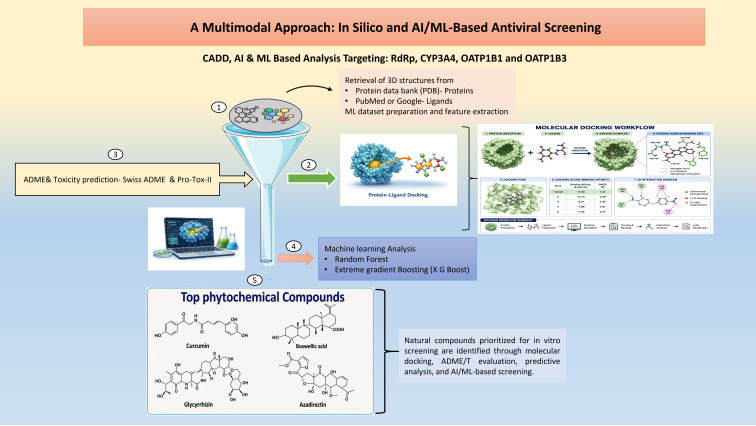
Figure 1. The workflow integrates molecular docking, ADME/T profiling, and machine learning approaches to screen phytochemicals against Dengue virus NS5 RdRp and key pharmacokinetic proteins. Based on binding interactions, pharmacokinetic properties, and predicted IC50 values, Curcumin, Boswellic acid, Glycyrrhizin, and Azadirachtin emerged as promising antiviral candidates for further validation. (Courtesy: Bioicons, Diagram generator AI).
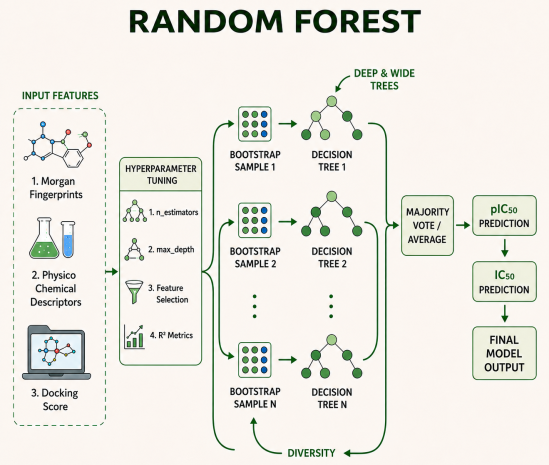
Figure 2. The workflow illustrates the development of a Random Forest regression model using multiple input features, including Morgan fingerprints, physicochemical descriptors, and docking scores of RDRP. Hyperparameter tuning was performed by optimizing parameters such as the number of estimators, maximum tree depth, feature selection, and R2 metrics. Multiple bootstrap samples were generated to train diverse decision trees, and the final prediction was obtained by averaging the outputs of all trees. The model predicts pIC50 values, which were subsequently converted into IC50 predictions for the final model output. (Courtesy: Bio icons, Float icons, Diagram generator AI).
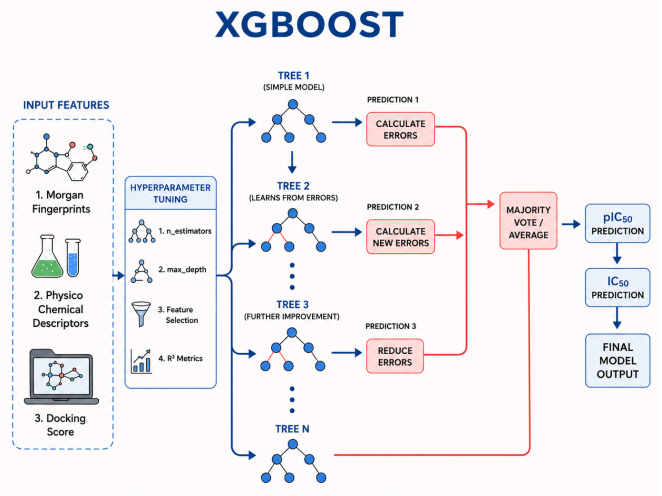
Figure 3. The workflow illustrates the implementation of an XGBoost regression model using multiple molecular input features, including Morgan fingerprints, physicochemical descriptors, and docking scores of RDRP. Hyperparameter tuning was performed by optimizing parameters such as the number of estimators, maximum tree depth, feature selection, and R2 metrics. In the boosting process, the first decision tree generates an initial prediction, while subsequent trees iteratively learn from the prediction errors of previous trees to improve model performance. Each new tree reduces residual errors and enhances predictive accuracy. The outputs of all trees are combined to generate the final pIC50 prediction, which is subsequently converted into IC50 values for the final model output. (Courtesy: Bio icons, Float icons, Diagram generator AI).

Information



 Share This Article
 Twitter
 Linked In
 Facebook
 Copy
Copy Download