Abstract
The premature deterioration of concrete infrastructures in West Africa is frequently attributed to mechanical and environmental factors, while the role of chemical soil aggressiveness remains largely underestimated and insufficiently investigated. In many developing countries, geotechnical studies rarely include comprehensive chemical characterization of soils, despite its critical importance for long-term infrastructure durability. This study evaluates the relevance of Baumann-Gully acidity as a low-cost, reliable, and accessible indicator of soil aggressiveness toward concrete. A total of nine soil samples collected from various locations in Benin were analyzed using the standardized method EN 16502. The results revealed acidity values ranging from 165 to 257 mL/kg, indicating predominantly moderate to high aggressiveness levels. Notably, several samples exceeded the commonly accepted threshold associated with severe chemical attack risks. Graphical analysis further highlights the significance of these findings. The distribution of acidity values across sampling sites shows a consistent prevalence of aggressive conditions, while the histogram confirms a concentration of results within the upper range of aggressiveness. The boxplot analysis reveals a relatively high variability, with extreme values indicating localized zones of particularly high chemical risk. In addition, the relationship between depth and acidity suggests that aggressive conditions are not limited to surface soils but may persist across deeper layers, which has important implications for foundation design. These findings emphasize the critical need to systematically integrate chemical soil analysis into geotechnical investigations in developing countries. The study demonstrates that Baumann-Gully acidity is not only a practical and cost-effective tool, but also a scientifically relevant parameter for predicting soil-induced degradation of concrete. Its adoption could significantly improve infrastructure durability and reduce maintenance costs in resource-limited settings.
Keywords
Soil Acidity, Baumann-Gully, Concrete Durability, West Africa, Soil Aggressiveness, Low-cost Analysis
1. Introduction
The durability of concrete infrastructures remains a major challenge in many developing regions, particularly in West Africa, where premature degradation of buildings, bridges, and foundations is frequently reported. These failures are commonly attributed to mechanical deficiencies, poor construction practices, or environmental exposure. However, the chemical characteristics of soils, which play a critical role in long-term concrete performance, are often underestimated or entirely neglected in routine geotechnical investigations
. Soil–concrete interactions are governed not only by physical parameters but also by complex chemical processes. Acidic soils, especially those rich in organic matter, can induce deleterious reactions such as calcium leaching, dissolution of cement hydrates, and progressive weakening of the cementitious matrix
| [2] | AIKEN, Timothy A., GU, Lei, KWASNY, Jacek, et al. Acid resistance of alkali-activated binders: A review of performance, mechanisms of deterioration and testing procedures. Construction and Building Materials, 2022, vol. 342, p. 128057.
https://doi.org/10.1016/j.conbuildmat.2022.128057 |
| [3] | TULUMCU, Zeynep, OZTURK, Murat, et CIFTCI, Mustafa. Enhanced mechanical performance of cement paste through incorporation of a tailored terpolymer. Polymers for Advanced Technologies, 2025, vol. 36, no 10, p. e70386.
https://doi.org/10.1002/pat.70386 |
[2, 3]
. These processes ultimately reduce the structural integrity and service life of concrete infrastructures. In tropical environments such as those found in West Africa, soils are often characterized by significant organic content, seasonal water saturation, and intense weathering, all of which may enhance their chemical aggressiveness
| [4] | TRUDGILL, Stephen T., GOUDIE, Andrew S., et VILES, Heather A. Weathering processes and forms. 2022.
https://doi.org/10.1144/M58-2022-2 |
| [5] | HAZELTON, Pam et MURPHY, Brian. Understanding soils in urban environments. Csiro publishing, 2021. |
[4, 5]
.
Despite this, geotechnical studies in many developing countries continue to focus primarily on mechanical properties such as bearing capacity, compaction, and granulometry, while chemical parameters are rarely assessed. This gap in practice may lead to inadequate material selection and insufficient protective measures, thereby increasing the risk of premature infrastructure failure
| [6] | TAMBARA JR, L. U. D., CHERIAF, Malik, ROCHA, J. C., et al. Effect of alkalis content on calcium sulfoaluminate (CSA) cement hydration. Cement and concrete research, 2020, vol. 128, p. 105953.
https://doi.org/10.1016/j.cemconres.2019.105953 |
[6]
. International standards such as EN 206 emphasize the importance of considering chemical exposure classes (e.g., XA1–XA3), yet their application remains limited in resource-constrained contexts. Tropical soils, particularly lateritic soils common in West Africa, are known for their complex chemical behavior
| [7] | FOKO TAMBA, Carlos, KENGNI, Lucas, et TEMATIO, Paul. Geotechnical suitability of soils in road construction for sustainable development in Tropical Africa: case of lateritic graveled soils of Bandjoun (West, Cameroon). Advances in Civil Engineering, 2023, vol. 2023, no 1, p. 6662521.
https://doi.org/10.1155/2023/6662521 |
[7]
.
Among the available methods for assessing soil chemical aggressiveness, the Baumann-Gully acidity test offers a simple, rapid, and cost-effective approach. Standardized under EN 16502, this method quantifies the exchangeable acidity of soils, primarily associated with humic substances. It is based on the principle of ion exchange between soil colloids and a sodium acetate solution, leading to the release of hydrogen ions that are subsequently quantified by titration. This parameter provides valuable insight into the potential of soils to induce chemical degradation of concrete
| [8] | EHRENBERG. Studies on humic acids. II. The ‘free humic acids’ of the raised bog: Baumann, A., and Gully, E., (Proceedings of the Royal Bavarian Institute for Peatland Cultivation, Issues 3 and 41). Journal of Colloid Chemistry and Industry, 1910, vol. 7, no 3, p. 170-170.
https://doi.org/10.1007/BF01503164 |
[8]
.
Although widely recognized in certain geotechnical contexts, the Baumann-Gully method remains underutilized in many parts of the world, particularly in developing countries. Its simplicity and low operational cost make it especially suitable for laboratories with limited resources, offering a practical alternative to more complex and expensive analytical techniques.
In this context, the present study aims to evaluate the relevance of Baumann-Gully acidity as an indicator of soil aggressiveness toward concrete in West African conditions. Using a set of soil samples collected from different regions of Benin, the study seeks to (i) characterize the variability of soil acidity, (ii) assess its potential impact on concrete durability, and (iii) highlight the importance of integrating chemical soil analysis into geotechnical investigations. Ultimately, this work contributes to the development of more sustainable and resilient infrastructure practices in resource-limited settings.
2. Materials and Methods
2.1. Study Area and Sampling
This study was conducted in the northern and central regions of Benin, characterized by tropical climatic conditions, seasonal rainfall, and diverse soil profiles. The selected sampling sites—Kalale, Kouande, Ouinhi, and Nikki—represent typical geotechnical environments encountered in infrastructure development projects in West Africa.
A total of nine soil samples were collected at different depths ranging from surface layers to 28 m, in order to capture vertical variability in soil chemical properties. The sampling strategy was designed to reflect a variety of soil types, including sandy, clayey, and silty formations, commonly used as foundation materials in civil engineering projects.
Samples were collected during geotechnical investigations commissioned by a local engineering company. Each sample was stored in airtight containers, transported to the laboratory, and air-dried prior to analysis. Coarse particles and debris were removed by sieving at 2 mm to ensure sample homogeneity.
2.2. Analytical Method
The determination of soil acidity was carried out using the Baumann-Gully method, in accordance with EN 16502. This method quantifies the exchangeable acidity of soils, primarily associated with humic substances and colloidal organic matter. The analytical procedure is based on the displacement of exchangeable hydrogen ions (H⁺) from soil particles by a neutral salt solution, followed by titration of the released acidity. Briefly, a known mass of air-dried soil was mixed with a sodium acetate (CH₃COONa) solution of known concentration. During this process, hydrogen ions adsorbed on soil colloids were exchanged with sodium ions (Na⁺), leading to the formation of acetic acid (CH₃COOH). The resulting solution was filtered, and an aliquot was titrated with a standardized sodium hydroxide (NaOH) solution using phenolphthalein as an indicator. The volume of NaOH consumed corresponds to the amount of acetic acid formed and, consequently, to the exchangeable acidity of the soil. Results were expressed as milliliters of NaOH per kilogram of dry soil (mL/kg), providing a quantitative measure of the soil’s potential acidity.
2.3. Quality Control and Reproducibility
All reagents used were of analytical grade, and solutions were prepared using distilled water. The NaOH titrant was standardized prior to use to ensure accuracy of the measurements. Each analysis was performed at least in duplicate, and the average value was reported. To minimize experimental errors, particular attention was paid to:
1) consistent sample mass
2) controlled agitation time during extraction
3) accurate endpoint detection during titration
The overall uncertainty of the method is considered low for comparative assessment of soil aggressiveness.
2.4. Interpretation Criteria
The aggressiveness of soils toward concrete was assessed based on Baumann-Gully acidity values using commonly accepted geotechnical thresholds. Soil samples were classified into three categories:
1) < 50 mL/kg: low aggressiveness
2) 50–200 mL/kg: moderate aggressiveness
3) > 200 mL/kg: high aggressiveness
These thresholds are widely used in engineering practice as indicative values for evaluating the potential chemical impact of soils on concrete structures. However, it should be noted that soil aggressiveness is a multi-parameter phenomenon and should ideally be assessed in conjunction with other chemical indicators such as pH, sulfate content, and ammonium concentration, as recommended in EN 206.
3. Results
3.1. Distribution of Baumann-Gully Acidity
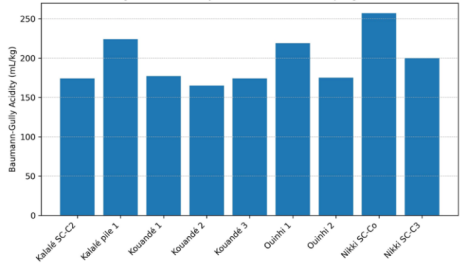
The Baumann-Gully acidity values obtained for the nine soil samples ranged from 165 to 257 mL/kg, indicating predominantly moderate to high levels of soil aggressiveness. A significant proportion of samples exhibited values close to or exceeding the commonly accepted threshold of 200 mL/kg, which is associated with strong chemical aggressiveness toward concrete.
As illustrated in
Figure 1, the distribution of acidity across the different sampling sites reveals a relatively consistent pattern of elevated values. Sites such as Nikki and Kalale (
Figure 1) exhibit particularly high acidity levels, reaching 257 mL/kg and 224 mL/kg, respectively, indicating potentially severe chemical conditions for concrete durability.
Figure 1. Soil acidity distribution across sampling sites.
3.2. Frequency Distribution and Statistical Trends
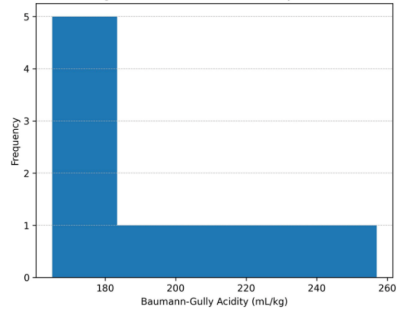
The histogram presented in
Figure 2 highlights the frequency distribution of Baumann-Gully acidity values. The majority of samples fall within the high range (≥ 170 mL/kg), confirming that moderately to highly aggressive soils dominate the dataset.
The distribution appears slightly skewed toward higher values, suggesting that extreme acidity conditions are not isolated cases but rather a recurring feature in the studied regions. This observation reinforces the hypothesis that chemical aggressiveness may be a widespread and underrecognized issue in West African soils.
Figure 2. Distribution of soil acidity values.
3.3. Influence of Depth on Soil Acidity
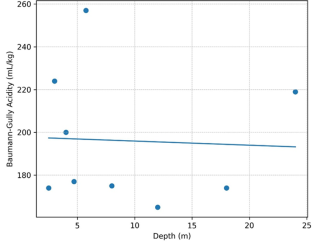
The relationship between soil depth and Baumann-Gully acidity is presented in
Figure 3. The scatter plot, combined with a linear regression line, suggests that soil acidity is not confined to surface layers but persists across deeper horizons.
Although no strong linear correlation is observed, the data indicate that significant acidity values are present throughout the depth profile, including depths exceeding 20 m. This finding is particularly important for civil engineering applications, as it implies that deep foundations may also be exposed to chemically aggressive environments.
Figure 3. Relationship between depth and soil acidity.
3.4. Variability of Soil Acidity
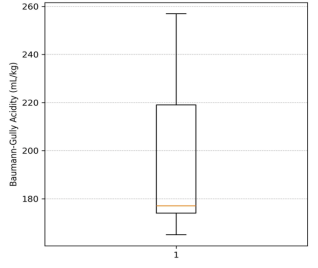
The variability of the measured acidity values is further illustrated by the boxplot in
Figure 4. The interquartile range indicates moderate dispersion, while the presence of upper extreme values reflects localized zones of significantly higher acidity.
The median value lies within the upper range of moderate aggressiveness, confirming that most soils exhibit conditions that may pose a risk to concrete structures. The upper whisker extends beyond 250 mL/kg, highlighting the presence of highly aggressive environments.
Figure 4. Statistical distribution of soil acidity.
3.5. Summary of Key Findings
Overall, the results demonstrate that:
1) All analyzed soils exhibit moderate to high acidity levels
2) Several samples exceed the 200 mL/kg threshold, indicating strong aggressiveness
3) The distribution of acidity values is consistently elevated across sites
4) Significant variability exists, with localized zones of extreme acidity
5) Soil aggressiveness persists across both shallow and deep layers
These findings provide strong evidence that chemical soil conditions represent a critical factor influencing concrete durability in the studied regions.
4. Discussion
4.1. Prevalence of Chemically Aggressive Soils
The results obtained in this study clearly demonstrate that the majority of the analyzed soils exhibit moderate to high levels of Baumann-Gully acidity, with values ranging from 165 to 257 mL/kg. Such levels indicate a significant presence of exchangeable hydrogen ions, primarily associated with humic substances and organic colloids. These findings suggest that chemically aggressive soils are not isolated occurrences but rather a widespread characteristic of the investigated regions.
The distribution patterns observed (
Figures 1 and 2) confirm that elevated acidity values are consistently encountered across different locations, reinforcing the hypothesis that chemical aggressiveness may be a common but underestimated feature of West African soils. This is particularly relevant in tropical environments, where intense weathering and organic matter accumulation contribute to the development of acidic soil conditions
| [9] | LI, Qingchao, WANG, Lingli, FU, Yu, et al. Transformation of soil organic matter subjected to environmental disturbance and preservation of organic matter bound to soil minerals: a review. Journal of Soils and Sediments, 2023, vol. 23, no 3, p. 1485-1500. https://doi.org/10.1007/s11368-022-03381-y |
| [10] | XU, Zibo et TSANG, Daniel CW. Mineral-mediated stability of organic carbon in soil and relevant interaction mechanisms. Eco-Environment & Health, 2024, vol. 3, no 1, p. 59-76.
https://doi.org/10.1016/j.eehl.2023.12.003 |
| [11] | WANG, Anning, ZHA, Tonggang, et ZHANG, Zhiqiang. Variations in soil organic carbon storage and stability with vegetation restoration stages on the Loess Plateau of China. Catena, 2023, vol. 228, p. 107142.
https://doi.org/10.1016/j.catena.2023.107142 |
[9-11]
.
4.2. Implications for Concrete Durability
From a materials science perspective, high soil acidity can significantly affect the long-term performance of concrete structures. The presence of exchangeable hydrogen ions promotes chemical reactions such as the dissolution of calcium hydroxide (portlandite) and the destabilization of calcium silicate hydrates (C–S–H), which are essential for the mechanical strength of cementitious materials.
Recent advances in cement science highlight the importance of adapting materials to aggressive environments
| [12] | LI, Qi, LI, Linfeng, DU, Huihui, et al. Soil conditioners promote the formation of Fe-bound organic carbon and its stability. Journal of Environmental Management, 2024, vol. 349, p. 119480.
https://doi.org/10.1016/j.jenvman.2023.119480 |
| [13] | MANZONI, Stefano et COTRUFO, M. Francesca. Mechanisms of soil organic carbon and nitrogen stabilization in mineral-associated organic matter–insights from modeling in phase space. Biogeosciences, 2024, vol. 21, no 18, p. 4077-4098. https://doi.org/10.5194/bg-21-4077-2024 |
[12, 13]
.
These degradation mechanisms can lead to increased porosity, reduced mechanical strength, and ultimately structural failure. The fact that several samples exceed the 200 mL/kg threshold indicates that severe chemical attack conditions may be present in the studied areas. According to EN 206, such environments may correspond to moderate to high chemical exposure classes (XA2–XA3), requiring specific design considerations and protective measures
| [14] | NIU, Shan, DONG, Zhaomin, LI, Li, et al. Identifying the long-term health risks associated with environmental chemical incidents. Journal of Hazardous Materials, 2024, vol. 478, p. 135432. https://doi.org/10.1016/j.jhazmat.2024.135432 |
| [15] | AL-HADDAD, Diala Basim, JOKHIO, Gul Ahmed, et ABU-TAIR, Abid. Comparison and Critical Review of Durability Design in Design Codes. ACI Materials Journal, 2024, vol. 121, no 1, p. 119-128. |
[14, 15]
.
4.3. Depth-related Persistence of Soil Aggressiveness
One of the most important findings of this study is the persistence of soil acidity across depth profiles, as illustrated in
Figure 3. The presence of significant acidity values at depths exceeding 20 m suggests that aggressive conditions are not limited to surface soils but extend to deeper layers.
This has major implications for civil engineering practice, particularly for deep foundations such as piles and drilled shafts. In many construction projects, deeper soil layers are often assumed to be chemically stable. However, the results of this study challenge this assumption and highlight the need for chemical characterization at all relevant depths.
4.4. Variability and Localized Risk
The statistical dispersion observed in the boxplot (
Figure 4) indicates that soil acidity is not uniform but varies significantly between locations and depths. The presence of high-end values suggests localized zones of extreme aggressiveness, which may pose a greater risk to infrastructure.
Such variability underscores the importance of site-specific analysis rather than relying on generalized assumptions. In practical terms, this means that even within a single project site, certain zones may require enhanced protective measures, while others may not.
4.5. Underestimation of Chemical Factors in Developing Countries
A key contribution of this study lies in highlighting the systematic underestimation of chemical soil properties in geotechnical investigations conducted in developing countries. In many West African contexts, soil studies focus almost exclusively on mechanical parameters such as bearing capacity, compaction, and grain size distribution.
This practice overlooks critical chemical interactions that can significantly reduce the lifespan of concrete structures. Previous studies have emphasized that neglecting chemical aggressiveness can lead to inappropriate material selection and increased maintenance costs
| [16] | SCRIVENER, Karen, MARTIRENA, Fernando, BISHNOI, Shashank, et al. Calcined clay limestone cements (LC3). Cement and concrete research, 2018, vol. 114, p. 49-56.
https://doi.org/10.1016/j.cemconres.2017.08.017 |
| [17] | SAINGAM, Panumas, CHATVEERA, Burachat, PROMSAWAT, Pongsakon, et al. Synergizing Portland Cement, high-volume fly ash and calcined calcium carbonate in producing self-compacting concrete: A comprehensive investigation of rheological, mechanical, and microstructural properties. Case Studies in Construction Materials, 2024, vol. 21, p. e03832. https://doi.org/10.1016/j.cscm.2024.e03832 |
[16, 17]
.
The widespread presence of moderate to highly aggressive soils observed in this study suggests that current practices may expose infrastructures to avoidable risks.
4.6. Relevance and Practicality of the Baumann-Gully Method
The Baumann-Gully acidity test proves to be particularly well-suited for application in resource-limited environments. Its advantages include:
1) low cost of implementation
2) simple experimental procedure
3) minimal equipment requirements
4) rapid and reproducible results
Compared to more advanced analytical techniques, the Baumann-Gully method offers a practical alternative for routine soil assessment in developing countries. Its ability to capture exchangeable acidity linked to humic substances provides valuable insight into soil–concrete interactions
| [18] | DAMION, Tom et CHAUNSALI, Piyush. Evaluating acid resistance of Portland cement, calcium aluminate cement, and calcium sulfoaluminate based cement using acid neutralisation. Cement and Concrete Research, 2022, vol. 162, p. 107000.
https://doi.org/10.1016/j.cemconres.2022.107000 |
[18]
.
4.7. Toward Improved Engineering Practices
The findings of this study strongly support the integration of chemical soil analysis into standard geotechnical investigations. In particular, Baumann-Gully acidity should be considered as a preliminary screening tool to identify potentially aggressive environments.
For a more comprehensive assessment, this parameter should be combined with other chemical indicators such as:
1) soil pH
2) sulfate concentration (SO42-)
3) ammonium content (NH4+)
Such an approach would align with the recommendations of EN 206 and contribute to more durable and resilient infrastructure design.
4.8. Limitations and Perspectives
While this study provides valuable insights, certain limitations should be acknowledged. The number of samples remains relatively limited, and additional data from other regions would further strengthen the conclusions. Moreover, the absence of complementary chemical parameters such as sulfates and pH limits the ability to fully classify exposure conditions.
Future research should aim to:
1) expand the geographical scope of sampling
2) integrate multi-parameter chemical analysis
3) establish correlations between Baumann-Gully acidity and concrete degradation in field conditions
5. Conclusion
This study demonstrates that Baumann-Gully acidity is a relevant, reliable, and practical indicator of soil aggressiveness toward concrete in West African conditions. The results obtained from nine soil samples collected across different regions of Benin reveal consistently moderate to high acidity levels, with several values exceeding 200 mL/kg, indicating potentially severe chemical attack risks.
The integration of graphical and statistical analyses further highlights the widespread nature of soil aggressiveness, as well as its variability and persistence across depth profiles. These findings challenge the common assumption that chemical soil conditions are secondary compared to mechanical properties in geotechnical investigations.
From a materials science perspective, the presence of significant exchangeable acidity suggests a strong potential for deleterious interactions with concrete, including calcium leaching and progressive degradation of the cement matrix. This underscores the critical role of soil chemistry in determining the durability and service life of infrastructure.
Importantly, this study highlights a major gap in current engineering practices in many developing countries, where chemical soil analysis is often neglected. The widespread occurrence of aggressive soils observed in this work suggests that this omission may contribute significantly to the premature deterioration of concrete structures.
Overall, the results confirm that Baumann-Gully acidity is not only scientifically relevant but also operationally suitable for routine application in resource-limited environments. Its simplicity, low cost, and effectiveness make it a valuable tool for improving infrastructure resilience in West Africa and similar contexts.
6. Recommendations for Engineering Practice
Based on the findings of this study, several practical recommendations can be proposed:
6.1. Systematic Integration of Chemical Soil Analysis
Chemical characterization of soils should be systematically included in geotechnical investigations, alongside mechanical testing. In particular, Baumann-Gully acidity can serve as a rapid screening tool to identify potentially aggressive environments.
6.2. Adaptation of Concrete Design to Soil Conditions
In soils exhibiting moderate to high acidity, appropriate measures should be implemented in accordance with EN 206, including:
1) use of sulfate-resistant or low-alkali cement
2) reduction of concrete permeability
3) application of protective barriers or coatings
Innovative cement formulations could improve durability in such environments
| [19] | GRUBE. The Formation and Properties of Humic Substances: Ehrenberg, P., (Chem.-Ztg. 34, 1157, 1910). Journal of Colloid Chemistry and Industry, 1912, vol. 10, no 1, p. 57-57.
https://doi.org/10.1007/BF01466580 |
| [20] | MANJUNATH, Reddy et NARASIMHAN, Mattur C. Alkali-activated concrete systems: A state of art. New Materials in Civil Engineering, 2020, p. 459-491.
https://doi.org/10.1016/B978-0-12-818961-0.00013-2 |
[19, 20]
.
6.3. Site-specific Risk Assessment
Given the variability observed in soil acidity, localized assessments should be prioritized over generalized assumptions. Even within a single construction site, zones of higher aggressiveness may require targeted mitigation strategies.
6.4. Development of Regional Guidelines
There is a need to develop technical guidelines adapted to African soil conditions, incorporating chemical parameters such as Baumann-Gully acidity. This would facilitate the standardization of practices and improve infrastructure durability.
6.5. Recommendations for Research
To further advance the understanding of soil–concrete interactions in tropical environments, future research should focus on:
1) multi-parameter analysis, combining Baumann-Gully acidity with pH, sulfates (SO42-), and ammonium (NH4+)
2) long-term field studies, to correlate soil acidity with actual degradation of concrete structures
3) model development, to predict concrete durability based on chemical soil parameters
4) expansion of datasets, covering a wider range of geographical regions and soil types
BibliographieThis study provides strong evidence that chemical soil aggressiveness represents a critical yet underrecognized factor in infrastructure durability in developing countries. By promoting the use of simple and accessible analytical tools such as the Baumann-Gully method, it is possible to significantly enhance the resilience and sustainability of construction practices.
In this context, the integration of chemistry into geotechnical engineering should no longer be considered optional, but rather essential for ensuring the long-term performance of infrastructure in challenging environments.
Abbreviations
EN | European Standard |
XA1 | Slightly Aggressive |
XA3 | Highly Aggressive |
mL | Milliliter |
kg | Kilogram |
pH | Hydrogen Potential |
Author Contributions
Joachim Dalohoun: Conceptualization, Writing – original draft
Trall Zeynabou Ndao: Data curation, Investigation
Egbemimon Daniel Ahlonsou: Formal Analysis
Hubert Frederic Gbaguidi: Visualization
Yaye Kole: Investigation
Edmond Adjovi: Supervision
Conflicts of Interest
There is no conflicts of interest with other units, businesses, affiliates, and other authors in the work of this study.
References
| [1] |
DAMION, Tom et CHAUNSALI, Piyush. Biogenic acid resistance of calcium sulfoaluminate cement: Revelations from a field study. Cement and Concrete Composites, 2024, vol. 145, p. 105324.
https://doi.org/10.1016/j.cemconcomp.2023.105324
|
| [2] |
AIKEN, Timothy A., GU, Lei, KWASNY, Jacek, et al. Acid resistance of alkali-activated binders: A review of performance, mechanisms of deterioration and testing procedures. Construction and Building Materials, 2022, vol. 342, p. 128057.
https://doi.org/10.1016/j.conbuildmat.2022.128057
|
| [3] |
TULUMCU, Zeynep, OZTURK, Murat, et CIFTCI, Mustafa. Enhanced mechanical performance of cement paste through incorporation of a tailored terpolymer. Polymers for Advanced Technologies, 2025, vol. 36, no 10, p. e70386.
https://doi.org/10.1002/pat.70386
|
| [4] |
TRUDGILL, Stephen T., GOUDIE, Andrew S., et VILES, Heather A. Weathering processes and forms. 2022.
https://doi.org/10.1144/M58-2022-2
|
| [5] |
HAZELTON, Pam et MURPHY, Brian. Understanding soils in urban environments. Csiro publishing, 2021.
|
| [6] |
TAMBARA JR, L. U. D., CHERIAF, Malik, ROCHA, J. C., et al. Effect of alkalis content on calcium sulfoaluminate (CSA) cement hydration. Cement and concrete research, 2020, vol. 128, p. 105953.
https://doi.org/10.1016/j.cemconres.2019.105953
|
| [7] |
FOKO TAMBA, Carlos, KENGNI, Lucas, et TEMATIO, Paul. Geotechnical suitability of soils in road construction for sustainable development in Tropical Africa: case of lateritic graveled soils of Bandjoun (West, Cameroon). Advances in Civil Engineering, 2023, vol. 2023, no 1, p. 6662521.
https://doi.org/10.1155/2023/6662521
|
| [8] |
EHRENBERG. Studies on humic acids. II. The ‘free humic acids’ of the raised bog: Baumann, A., and Gully, E., (Proceedings of the Royal Bavarian Institute for Peatland Cultivation, Issues 3 and 41). Journal of Colloid Chemistry and Industry, 1910, vol. 7, no 3, p. 170-170.
https://doi.org/10.1007/BF01503164
|
| [9] |
LI, Qingchao, WANG, Lingli, FU, Yu, et al. Transformation of soil organic matter subjected to environmental disturbance and preservation of organic matter bound to soil minerals: a review. Journal of Soils and Sediments, 2023, vol. 23, no 3, p. 1485-1500.
https://doi.org/10.1007/s11368-022-03381-y
|
| [10] |
XU, Zibo et TSANG, Daniel CW. Mineral-mediated stability of organic carbon in soil and relevant interaction mechanisms. Eco-Environment & Health, 2024, vol. 3, no 1, p. 59-76.
https://doi.org/10.1016/j.eehl.2023.12.003
|
| [11] |
WANG, Anning, ZHA, Tonggang, et ZHANG, Zhiqiang. Variations in soil organic carbon storage and stability with vegetation restoration stages on the Loess Plateau of China. Catena, 2023, vol. 228, p. 107142.
https://doi.org/10.1016/j.catena.2023.107142
|
| [12] |
LI, Qi, LI, Linfeng, DU, Huihui, et al. Soil conditioners promote the formation of Fe-bound organic carbon and its stability. Journal of Environmental Management, 2024, vol. 349, p. 119480.
https://doi.org/10.1016/j.jenvman.2023.119480
|
| [13] |
MANZONI, Stefano et COTRUFO, M. Francesca. Mechanisms of soil organic carbon and nitrogen stabilization in mineral-associated organic matter–insights from modeling in phase space. Biogeosciences, 2024, vol. 21, no 18, p. 4077-4098.
https://doi.org/10.5194/bg-21-4077-2024
|
| [14] |
NIU, Shan, DONG, Zhaomin, LI, Li, et al. Identifying the long-term health risks associated with environmental chemical incidents. Journal of Hazardous Materials, 2024, vol. 478, p. 135432.
https://doi.org/10.1016/j.jhazmat.2024.135432
|
| [15] |
AL-HADDAD, Diala Basim, JOKHIO, Gul Ahmed, et ABU-TAIR, Abid. Comparison and Critical Review of Durability Design in Design Codes. ACI Materials Journal, 2024, vol. 121, no 1, p. 119-128.
|
| [16] |
SCRIVENER, Karen, MARTIRENA, Fernando, BISHNOI, Shashank, et al. Calcined clay limestone cements (LC3). Cement and concrete research, 2018, vol. 114, p. 49-56.
https://doi.org/10.1016/j.cemconres.2017.08.017
|
| [17] |
SAINGAM, Panumas, CHATVEERA, Burachat, PROMSAWAT, Pongsakon, et al. Synergizing Portland Cement, high-volume fly ash and calcined calcium carbonate in producing self-compacting concrete: A comprehensive investigation of rheological, mechanical, and microstructural properties. Case Studies in Construction Materials, 2024, vol. 21, p. e03832.
https://doi.org/10.1016/j.cscm.2024.e03832
|
| [18] |
DAMION, Tom et CHAUNSALI, Piyush. Evaluating acid resistance of Portland cement, calcium aluminate cement, and calcium sulfoaluminate based cement using acid neutralisation. Cement and Concrete Research, 2022, vol. 162, p. 107000.
https://doi.org/10.1016/j.cemconres.2022.107000
|
| [19] |
GRUBE. The Formation and Properties of Humic Substances: Ehrenberg, P., (Chem.-Ztg. 34, 1157, 1910). Journal of Colloid Chemistry and Industry, 1912, vol. 10, no 1, p. 57-57.
https://doi.org/10.1007/BF01466580
|
| [20] |
MANJUNATH, Reddy et NARASIMHAN, Mattur C. Alkali-activated concrete systems: A state of art. New Materials in Civil Engineering, 2020, p. 459-491.
https://doi.org/10.1016/B978-0-12-818961-0.00013-2
|
Cite This Article
-
APA Style
Dalohoun, J., Togbe, F. C. A., Ndao, T. Z., Ahlonsou, E. D., Gbaguidi, H. F., et al. (2026). Underestimated Chemical Risks in West African Soils:
The Role of Baumann-Gully Acidity in Concrete Durability. Journal of Civil, Construction and Environmental Engineering, 11(3), 53-60. https://doi.org/10.11648/j.jccee.20261103.11
 Copy
|
Copy
|
 Download
ACS Style
Dalohoun, J.; Togbe, F. C. A.; Ndao, T. Z.; Ahlonsou, E. D.; Gbaguidi, H. F., et al. Underestimated Chemical Risks in West African Soils:
The Role of Baumann-Gully Acidity in Concrete Durability. J. Civ. Constr. Environ. Eng. 2026, 11(3), 53-60. doi: 10.11648/j.jccee.20261103.11
Copy
|
Download
AMA Style
Dalohoun J, Togbe FCA, Ndao TZ, Ahlonsou ED, Gbaguidi HF, et al. Underestimated Chemical Risks in West African Soils:
The Role of Baumann-Gully Acidity in Concrete Durability. J Civ Constr Environ Eng. 2026;11(3):53-60. doi: 10.11648/j.jccee.20261103.11
Copy
|
Download
-
@article{10.11648/j.jccee.20261103.11,
  author = {Joachim Dalohoun and Finagnon Crepin Alexis Togbe and Trall Zeynabou Ndao and Egbemimon Daniel Ahlonsou and Hubert Frederic Gbaguidi and Yaye Kole and Edmond Adjovi},
  title = {Underestimated Chemical Risks in West African Soils:
The Role of Baumann-Gully Acidity in Concrete Durability},
  journal = {Journal of Civil, Construction and Environmental Engineering},
  volume = {11},
  number = {3},
  pages = {53-60},
  doi = {10.11648/j.jccee.20261103.11},
  url = {https://doi.org/10.11648/j.jccee.20261103.11},
  eprint = {https://article.sciencepublishinggroup.com/pdf/10.11648.j.jccee.20261103.11},
  abstract = {The premature deterioration of concrete infrastructures in West Africa is frequently attributed to mechanical and environmental factors, while the role of chemical soil aggressiveness remains largely underestimated and insufficiently investigated. In many developing countries, geotechnical studies rarely include comprehensive chemical characterization of soils, despite its critical importance for long-term infrastructure durability. This study evaluates the relevance of Baumann-Gully acidity as a low-cost, reliable, and accessible indicator of soil aggressiveness toward concrete. A total of nine soil samples collected from various locations in Benin were analyzed using the standardized method EN 16502. The results revealed acidity values ranging from 165 to 257 mL/kg, indicating predominantly moderate to high aggressiveness levels. Notably, several samples exceeded the commonly accepted threshold associated with severe chemical attack risks. Graphical analysis further highlights the significance of these findings. The distribution of acidity values across sampling sites shows a consistent prevalence of aggressive conditions, while the histogram confirms a concentration of results within the upper range of aggressiveness. The boxplot analysis reveals a relatively high variability, with extreme values indicating localized zones of particularly high chemical risk. In addition, the relationship between depth and acidity suggests that aggressive conditions are not limited to surface soils but may persist across deeper layers, which has important implications for foundation design. These findings emphasize the critical need to systematically integrate chemical soil analysis into geotechnical investigations in developing countries. The study demonstrates that Baumann-Gully acidity is not only a practical and cost-effective tool, but also a scientifically relevant parameter for predicting soil-induced degradation of concrete. Its adoption could significantly improve infrastructure durability and reduce maintenance costs in resource-limited settings.},
 year = {2026}
}
Copy
|
Download
-
TY  - JOUR
T1  - Underestimated Chemical Risks in West African Soils:
The Role of Baumann-Gully Acidity in Concrete Durability
AU  - Joachim Dalohoun
AU  - Finagnon Crepin Alexis Togbe
AU  - Trall Zeynabou Ndao
AU  - Egbemimon Daniel Ahlonsou
AU  - Hubert Frederic Gbaguidi
AU  - Yaye Kole
AU  - Edmond Adjovi
Y1  - 2026/06/02
PY  - 2026
N1  - https://doi.org/10.11648/j.jccee.20261103.11
DO  - 10.11648/j.jccee.20261103.11
T2  - Journal of Civil, Construction and Environmental Engineering
JF  - Journal of Civil, Construction and Environmental Engineering
JO  - Journal of Civil, Construction and Environmental Engineering
SP  - 53
EP  - 60
PB  - Science Publishing Group
SN  - 2637-3890
UR  - https://doi.org/10.11648/j.jccee.20261103.11
AB  - The premature deterioration of concrete infrastructures in West Africa is frequently attributed to mechanical and environmental factors, while the role of chemical soil aggressiveness remains largely underestimated and insufficiently investigated. In many developing countries, geotechnical studies rarely include comprehensive chemical characterization of soils, despite its critical importance for long-term infrastructure durability. This study evaluates the relevance of Baumann-Gully acidity as a low-cost, reliable, and accessible indicator of soil aggressiveness toward concrete. A total of nine soil samples collected from various locations in Benin were analyzed using the standardized method EN 16502. The results revealed acidity values ranging from 165 to 257 mL/kg, indicating predominantly moderate to high aggressiveness levels. Notably, several samples exceeded the commonly accepted threshold associated with severe chemical attack risks. Graphical analysis further highlights the significance of these findings. The distribution of acidity values across sampling sites shows a consistent prevalence of aggressive conditions, while the histogram confirms a concentration of results within the upper range of aggressiveness. The boxplot analysis reveals a relatively high variability, with extreme values indicating localized zones of particularly high chemical risk. In addition, the relationship between depth and acidity suggests that aggressive conditions are not limited to surface soils but may persist across deeper layers, which has important implications for foundation design. These findings emphasize the critical need to systematically integrate chemical soil analysis into geotechnical investigations in developing countries. The study demonstrates that Baumann-Gully acidity is not only a practical and cost-effective tool, but also a scientifically relevant parameter for predicting soil-induced degradation of concrete. Its adoption could significantly improve infrastructure durability and reduce maintenance costs in resource-limited settings.
VL  - 11
IS  - 3
ER  -
Copy
|
Download





 Share This Article
 Twitter
 Linked In
 Facebook