Railway fastening systems are a crucial component of railway tracks, playing a significant role in ensuring the stability of the track and preventing gauge widening and rolling. The ability to resist longitudinal loads along the rail is among the most important qualities a good fastening system should have. This value is usually measured as a fastening system’s longitudinal restraint and has stipulated procedures to perform the test, in accordance with the international standard or the European standard requirements. Longitudinal loads mainly occur due to creep, rail thermal expansion and contraction, acceleration and deceleration of the train. In view of the fact that the modern tracks experiences large longitudinal forces, the fastening systems should provide adequate restraint force to withstand these types of forces. In this paper, we will study the longitudinal restraint of the recently developed Jiuzhou floating fastener. The test is conducted in accordance with the procedure provided by the European railway fastening system testing standard. The fastener was fastened to a concrete block, and a hydraulic actuator of 25kN was used to apply a push to the rail fixed to the concrete block by the floating fastener. A displacement accelerometer was placed on the end of the rail at the centroid region of the rail to ensure that accurate and reliable results were collected. A push force was applied on the rail until the rail slipped from the assembly while simultaneously recording the rail displacement in relative to the support using the displacement sensors. The load is then unloaded to zero. This procedure was repeated for four times without any adjustment to the set-up, the first data was ignored, and the other three data were collected and averaged to obtain the final longitudinal restraint of the fastening assembly. The floating fastening assembly longitudinal restraint was calculated to be 14.04kN, which satisfactorily meets the standard requirement for longitudinal restraint value which should not be less than 9kN for fasteners intended for high-speed railways.
This is an Open Access article, distributed under the terms of the Creative Commons Attribution 4.0 International License (http://creativecommons.org/licenses/by/4.0/), which permits unrestricted use, distribution and reproduction in any medium or format, provided the original work is properly cited.
Train wheels subject various loads on the rail track in different directions, these loads comprise of vertical, lateral and longitudinal loads. With the rapid increase in traffic tonnage and speed of train, much tractive force is produced increasing the longitudinal forces experienced on the rail track by modern railway tracks. The highest longitudinal force is imparted on the rail track when an accelerating train passes.
[1]
Z. Zhang, B. Andrawes, and J. R. Edwards, ‘Parametric Study on the Distribution of Longitudinal Load in Railway Track under Dynamic Wheel Loading using Finite Element Analysis’, 2015. [Online]. Available:
These loads can pose a big safety threat on the track as they can lead to gauge widening and rail dis-alignment. The longitudinal loads are transferred from the rails to the fastening system imposing a higher loading demand on the fastening systems. The railway fastening system core function is to firmly hold the rail to the sleeper and prevent large rail displacement. An increase on the longitudinal force can lead to tracks instability and derailment. Therefore, the fastening system has to prevent the longitudinal forces by adequately and strictly meeting the standard requirements of longitudinal restraint value
[2]
‘Cost vs. Performance: Rail Fastening Systems in High-Speed Railways - SFFST’. Accessed: Feb. 07, 2026. [Online]. Available:
. This ensures safety and smooth train travel without encountering derailment.
Most failures on the fastening system components like spike fatigue failure, rail seat deterioration and rail pad movements are associated with excessive longitudinal forces
[3]
Christian J. Khachaturian, Marcus S. Dersch, P.E, J. Riley Edwards, Ph.D., P.E, Matheus Trizotto ‘EFFECT OF LONGITUDINAL FASTENER STIFFNESS AND FASTENING SYSTEM LOADING ’Proceedings of the 2021 Joint Rail Conference, April 20-21, 2021, Virtual, Online 2021.JRC2021-1066, 5pages
. These parts are mostly prone to the excessive longitudinal forces and they are essential in the fastening system resistance to longitudinal forces. This further highlights the importance of quantifying a fastener’s longitudinal stiffness.
The longitudinal track rigidity which is essential for preventing gauge widening and derailment is provided by the rail fastening system
[4]
I. Lotfy and M. A. Issa, ‘Evaluation of the longitudinal restraint, uplift resistance, and long-term performance of high-density polyethylene crosstie rail support system using static and cyclic loading’, Proc. Inst. Mech. Eng. F J. Rail Rapid Transit, vol. 231, no. 8, pp. 835-849, Sep. 2017,
. Longitudinal restraint of a railway fastening system is the ability of the fastening system to resist forces that acts in the direction of the rail. Due to creep, rail thermal expansion and contraction, acceleration and deceleration of the train, the track experience large longitudinal forces which particularly puts much stress on the fastening systems. Therefore, the fastening systems should be able to adequately withstand and resist these types of forces.
Longitudinal forces mainly occur when the rail is subjected to tensile or compressive forces. Compressive force on rail is caused by temperature changes during summer and they lead to rails buckling while tensile force is caused by drop in temperature during winters which leads to rail fracture. With braking and acceleration of the train the dead weight of the vehicle causes notable strains on the rails. Adequate longitudinal restraint prevents the rail from undergoing large longitudinal movements which can cause instability of the track and misalignment which will compromise the safety and durability of the track. The rail fastening system is the part that is greatly affected by the longitudinal forces and thus it crucial for the fastening system to have adequate longitudinal resistance since they hold the rail together
[5]
M. A. Toprak et al., ‘Experimental Investigation on the Performance of Rail Fastening Systems’, in International Conference on Civil, Structural and Transportation Engineering, Avestia Publishing, 2021.
. In order to reduce risks of fasteners failures; quantification of the fastener’s longitudinal loads is required so as to meet current truck designs methods
[4]
I. Lotfy and M. A. Issa, ‘Evaluation of the longitudinal restraint, uplift resistance, and long-term performance of high-density polyethylene crosstie rail support system using static and cyclic loading’, Proc. Inst. Mech. Eng. F J. Rail Rapid Transit, vol. 231, no. 8, pp. 835-849, Sep. 2017,
. The test particularly aims to determine the maximum longitudinal force that can be applied to rail secured on a concrete block, sleeper, bearer or element of a ballast-less track by a fastening assembly without undergoing non-elastic displacements or the longitudinal stiffness at a specified longitudinal displacement of a specimen of embedded rail with an adhesive fastening system or any other type of a fastening system
[7]
‘Railway infrastructure-Rail fastening systems-Part 2: Test method for longitudinal rail restraint Infrastructure ferroviaire-Systèmes de fixation du rail-Partie 2: Méthode d’essai pour la détermination de résistance longitudinale au glissement’, 2021. [Online]. Available:
. In this study a newly developed Jiuzhou floating fastening system is our case of study. This fastener is designed for application in high-speed railway track and urban railway line for vibration and noise isolations. The fastener’s design of ensuring that the rail foot is not in contact with the rail pad, makes it much elastic and have a reduces vertical stiffness and hence excellent in vibration isolation. The fastener is similar to the existing vanguard fastening system
[8]
Pandrol Track Systems ‘Vanguard Fastening Systems’. ISSUE 4 2015
. According to the European standard the maximum longitudinal force determined according to EN 13146-1 of rail longitudinal restraint should not be less than 7kN. For fastening systems intended for high -speed railway traffics with a speed more than 250km/h the value of the longitudinal restrain should at least be 9kN. The floating fastening system is intended to be applied to both high speed and low-medium speed railways thus it longitudinal values must meet both requirements.
This fastening system resistance to longitudinal force is expected to be a combination of frictions between the side rubber wedges supporting the rail at web and the rail and the friction between the steel baseplate and the nylon baseplate and the sleepers and between the rail and the rail pad.
2. Experiment Set up
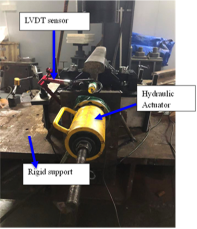
The experiment was conducted under controlled laboratory conditions, the equipment used include a 0.5m rail, a hydraulic actuator capable of applying a force 25kN load longitudinally on the rail, a Linear variable displacement transducer LVDT sensor to measure the longitudinal displacement of the rail. The displacement sensor is capable of measuring a displacement of which is in accordance to the standard. The sensor is classified as class 2 and are in accordance to the standard requirement. All the measuring equipment including the actuator were certified to the standard. All the components used in the experiment were kept at room temperature for a period of 6 hours prior to the experiments this is to eliminate any influence of environment change on the results. The test was conducted in an enclosed laboratory at a room temperature of around (25). A concrete slab was used as the anchor for the rail. The concrete slab is stable and fixed to its base and it is rigid enough to restrain the rail support from rotating. The rail is fastened tightly to the slab using the newly developed floating fastening system. Given that the fastener is a web type fastener, the load force was made certain that it is applied on the centroid of the rail. The force is applied at an increasing rate of 10kN/min to the end of the rail. The linear variable displacement transducers (LVDTs) sensor was placed at the 0.75 height from the base of the rail. The load force and the longitudinal displacements is measured simultaneously as the load is applied. The force applied was a push force in relative to the support. The rail moved without tilt, in the direction of the longitudinal axis. A tensile load was applied on the rail at a rate of 10 The load was applied until when the rail slipped from the fastening assembly then the load was rapidly unloaded to zero while still taking the measurements of the rail displacement. This procedure was repeated for four times giving an interval of three minutes in the unloaded condition between each sequence. The first test results were ignored while the other test results were recorded and averaged to calculate the longitudinal restraint of the fastening assembly. Figure 1 shows the test rig arrangement for the longitudinal test.
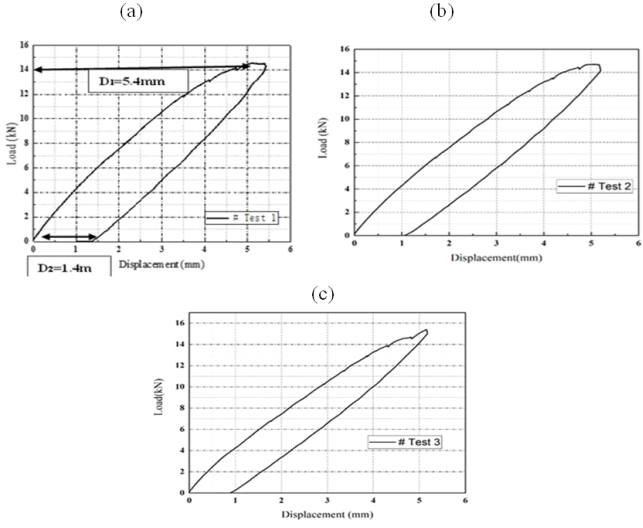
Four tests were conducted on the fastener and the first test’s result was ignored while the second, the third and fourth test results were taken. The load displacement diagrams for the three tests are as shown in the Figure 2, the D1, D2 and D3 of all the graphs were calculated according to the formula below
(1)
D1 is defined as the maximum longitudinal displacement experienced by the rail during the loading and D2 is the residual longitudinal displacement measured in the rail after the load is removed. D3 is the elastic longitudinal displacement of the rail before it starts slipping and it is calculated as the difference between D1 and D2. The maximum rail axial load in the elastic rail displacement region F is the force value when the longitudinal rail displacement is equal to D3. The longitudinal force F value should be neglected for the first cycle as stated in the standard. Longitudinal rail restraint equals the mean of the remaining three values, which are listed in Table 1 for the three tests. According to the standard the prescribed value of a fastening assembly is 9kN and the longitudinal restraint of a fastening system is required to exceed this value in order to meet the standards requirements
[11]
‘Railway applications. Track. Test methods for fastening systems’, Nov. 2014,
After the tests measurements, the fastening system’s average longitudinal restraint was calculated to be a value of 14.04kN. Thus, the fastening system longitudinal restraint met the performance requirements as the value exceeded the prescribed value of 9kN.
4. Conclusions
The longitudinal test was performed on the newly developed floating fastener in accordance to the BS EN 13146-1:2019-Railway applications. Track. Test methods for fastening systems. Determination of longitudinal rail restraint
[10]
‘BS EN 13146-1:2019 - Railway applications. Track. Test methods for fastening systems. Determination of longitudinal rail restraint’. Accessed: Feb. 03, 2026. [Online]. Available:
1) The longitudinal restraint of the floating fastening system was calculated to be 14.04 kN and this value is large than the prescribed performance value of 9kN therefore the fastener met the standard requirement for longitudinal rail test.
2) The average longitudinal elastic displacement for the fastening system before the rail begins to slip was calculated to be 4.45mm and thus it satisfactorily meets the requirement as it is low displacement occurrence in comparison to the threshold requirement of 5.08mm. Additionally, there was also no any physical damage observed on the fastener during the test and after the test.
The data is available from the corresponding author upon reasonable request.
Conflicts of Interest
The authors declare no conflicts of interest.
References
[1]
Z. Zhang, B. Andrawes, and J. R. Edwards, ‘Parametric Study on the Distribution of Longitudinal Load in Railway Track under Dynamic Wheel Loading using Finite Element Analysis’, 2015. [Online]. Available:
Christian J. Khachaturian, Marcus S. Dersch, P.E, J. Riley Edwards, Ph.D., P.E, Matheus Trizotto ‘EFFECT OF LONGITUDINAL FASTENER STIFFNESS AND FASTENING SYSTEM LOADING ’Proceedings of the 2021 Joint Rail Conference, April 20-21, 2021, Virtual, Online 2021.JRC2021-1066, 5pages
I. Lotfy and M. A. Issa, ‘Evaluation of the longitudinal restraint, uplift resistance, and long-term performance of high-density polyethylene crosstie rail support system using static and cyclic loading’, Proc. Inst. Mech. Eng. F J. Rail Rapid Transit, vol. 231, no. 8, pp. 835-849, Sep. 2017,
M. A. Toprak et al., ‘Experimental Investigation on the Performance of Rail Fastening Systems’, in International Conference on Civil, Structural and Transportation Engineering, Avestia Publishing, 2021.
‘Railway infrastructure-Rail fastening systems-Part 2: Test method for longitudinal rail restraint Infrastructure ferroviaire-Systèmes de fixation du rail-Partie 2: Méthode d’essai pour la détermination de résistance longitudinale au glissement’, 2021. [Online]. Available:
Zhiping, Z., Rempeyian, J. K., Sampson, K. N., Xingzhe, Q., Ahmed, A. (2026). Longitudinal Restrain of the Newly Developed Floating Fastener. Journal of Civil, Construction and Environmental Engineering, 11(2), 48-52. https://doi.org/10.11648/j.jccee.20261102.13
Zhiping, Z.; Rempeyian, J. K.; Sampson, K. N.; Xingzhe, Q.; Ahmed, A. Longitudinal Restrain of the Newly Developed Floating Fastener. J. Civ. Constr. Environ. Eng.2026, 11(2), 48-52. doi: 10.11648/j.jccee.20261102.13
Zhiping Z, Rempeyian JK, Sampson KN, Xingzhe Q, Ahmed A. Longitudinal Restrain of the Newly Developed Floating Fastener. J Civ Constr Environ Eng. 2026;11(2):48-52. doi: 10.11648/j.jccee.20261102.13
@article{10.11648/j.jccee.20261102.13,
  author = {Zeng Zhiping and Joel Koilel Rempeyian and Kofi Nti Sampson and Qi Xingzhe and Ayaz Ahmed},
  title = {Longitudinal Restrain of the Newly Developed Floating Fastener},
  journal = {Journal of Civil, Construction and Environmental Engineering},
  volume = {11},
  number = {2},
  pages = {48-52},
  doi = {10.11648/j.jccee.20261102.13},
  url = {https://doi.org/10.11648/j.jccee.20261102.13},
  eprint = {https://article.sciencepublishinggroup.com/pdf/10.11648.j.jccee.20261102.13},
  abstract = {Railway fastening systems are a crucial component of railway tracks, playing a significant role in ensuring the stability of the track and preventing gauge widening and rolling. The ability to resist longitudinal loads along the rail is among the most important qualities a good fastening system should have. This value is usually measured as a fastening system’s longitudinal restraint and has stipulated procedures to perform the test, in accordance with the international standard or the European standard requirements. Longitudinal loads mainly occur due to creep, rail thermal expansion and contraction, acceleration and deceleration of the train. In view of the fact that the modern tracks experiences large longitudinal forces, the fastening systems should provide adequate restraint force to withstand these types of forces. In this paper, we will study the longitudinal restraint of the recently developed Jiuzhou floating fastener. The test is conducted in accordance with the procedure provided by the European railway fastening system testing standard. The fastener was fastened to a concrete block, and a hydraulic actuator of 25kN was used to apply a push to the rail fixed to the concrete block by the floating fastener. A displacement accelerometer was placed on the end of the rail at the centroid region of the rail to ensure that accurate and reliable results were collected. A push force was applied on the rail until the rail slipped from the assembly while simultaneously recording the rail displacement in relative to the support using the displacement sensors. The load is then unloaded to zero. This procedure was repeated for four times without any adjustment to the set-up, the first data was ignored, and the other three data were collected and averaged to obtain the final longitudinal restraint of the fastening assembly. The floating fastening assembly longitudinal restraint was calculated to be 14.04kN, which satisfactorily meets the standard requirement for longitudinal restraint value which should not be less than 9kN for fasteners intended for high-speed railways.},
 year = {2026}
}
TY  - JOUR
T1  - Longitudinal Restrain of the Newly Developed Floating Fastener
AU  - Zeng Zhiping
AU  - Joel Koilel Rempeyian
AU  - Kofi Nti Sampson
AU  - Qi Xingzhe
AU  - Ayaz Ahmed
Y1  - 2026/04/21
PY  - 2026
N1  - https://doi.org/10.11648/j.jccee.20261102.13
DO  - 10.11648/j.jccee.20261102.13
T2  - Journal of Civil, Construction and Environmental Engineering
JF  - Journal of Civil, Construction and Environmental Engineering
JO  - Journal of Civil, Construction and Environmental Engineering
SP  - 48
EP  - 52
PB  - Science Publishing Group
SN  - 2637-3890
UR  - https://doi.org/10.11648/j.jccee.20261102.13
AB  - Railway fastening systems are a crucial component of railway tracks, playing a significant role in ensuring the stability of the track and preventing gauge widening and rolling. The ability to resist longitudinal loads along the rail is among the most important qualities a good fastening system should have. This value is usually measured as a fastening system’s longitudinal restraint and has stipulated procedures to perform the test, in accordance with the international standard or the European standard requirements. Longitudinal loads mainly occur due to creep, rail thermal expansion and contraction, acceleration and deceleration of the train. In view of the fact that the modern tracks experiences large longitudinal forces, the fastening systems should provide adequate restraint force to withstand these types of forces. In this paper, we will study the longitudinal restraint of the recently developed Jiuzhou floating fastener. The test is conducted in accordance with the procedure provided by the European railway fastening system testing standard. The fastener was fastened to a concrete block, and a hydraulic actuator of 25kN was used to apply a push to the rail fixed to the concrete block by the floating fastener. A displacement accelerometer was placed on the end of the rail at the centroid region of the rail to ensure that accurate and reliable results were collected. A push force was applied on the rail until the rail slipped from the assembly while simultaneously recording the rail displacement in relative to the support using the displacement sensors. The load is then unloaded to zero. This procedure was repeated for four times without any adjustment to the set-up, the first data was ignored, and the other three data were collected and averaged to obtain the final longitudinal restraint of the fastening assembly. The floating fastening assembly longitudinal restraint was calculated to be 14.04kN, which satisfactorily meets the standard requirement for longitudinal restraint value which should not be less than 9kN for fasteners intended for high-speed railways.
VL  - 11
IS  - 2
ER  -
School of Civil Engineering, Central South University, Changsha, China;Key Laboratory of Engineering Structure of Heavy Railway, Central South University, Changsha, China
Joel Koilel Rempeyian
School of Civil Engineering, Central South University, Changsha, China
Zhiping, Z., Rempeyian, J. K., Sampson, K. N., Xingzhe, Q., Ahmed, A. (2026). Longitudinal Restrain of the Newly Developed Floating Fastener. Journal of Civil, Construction and Environmental Engineering, 11(2), 48-52. https://doi.org/10.11648/j.jccee.20261102.13
Zhiping, Z.; Rempeyian, J. K.; Sampson, K. N.; Xingzhe, Q.; Ahmed, A. Longitudinal Restrain of the Newly Developed Floating Fastener. J. Civ. Constr. Environ. Eng.2026, 11(2), 48-52. doi: 10.11648/j.jccee.20261102.13
Zhiping Z, Rempeyian JK, Sampson KN, Xingzhe Q, Ahmed A. Longitudinal Restrain of the Newly Developed Floating Fastener. J Civ Constr Environ Eng. 2026;11(2):48-52. doi: 10.11648/j.jccee.20261102.13
@article{10.11648/j.jccee.20261102.13,
  author = {Zeng Zhiping and Joel Koilel Rempeyian and Kofi Nti Sampson and Qi Xingzhe and Ayaz Ahmed},
  title = {Longitudinal Restrain of the Newly Developed Floating Fastener},
  journal = {Journal of Civil, Construction and Environmental Engineering},
  volume = {11},
  number = {2},
  pages = {48-52},
  doi = {10.11648/j.jccee.20261102.13},
  url = {https://doi.org/10.11648/j.jccee.20261102.13},
  eprint = {https://article.sciencepublishinggroup.com/pdf/10.11648.j.jccee.20261102.13},
  abstract = {Railway fastening systems are a crucial component of railway tracks, playing a significant role in ensuring the stability of the track and preventing gauge widening and rolling. The ability to resist longitudinal loads along the rail is among the most important qualities a good fastening system should have. This value is usually measured as a fastening system’s longitudinal restraint and has stipulated procedures to perform the test, in accordance with the international standard or the European standard requirements. Longitudinal loads mainly occur due to creep, rail thermal expansion and contraction, acceleration and deceleration of the train. In view of the fact that the modern tracks experiences large longitudinal forces, the fastening systems should provide adequate restraint force to withstand these types of forces. In this paper, we will study the longitudinal restraint of the recently developed Jiuzhou floating fastener. The test is conducted in accordance with the procedure provided by the European railway fastening system testing standard. The fastener was fastened to a concrete block, and a hydraulic actuator of 25kN was used to apply a push to the rail fixed to the concrete block by the floating fastener. A displacement accelerometer was placed on the end of the rail at the centroid region of the rail to ensure that accurate and reliable results were collected. A push force was applied on the rail until the rail slipped from the assembly while simultaneously recording the rail displacement in relative to the support using the displacement sensors. The load is then unloaded to zero. This procedure was repeated for four times without any adjustment to the set-up, the first data was ignored, and the other three data were collected and averaged to obtain the final longitudinal restraint of the fastening assembly. The floating fastening assembly longitudinal restraint was calculated to be 14.04kN, which satisfactorily meets the standard requirement for longitudinal restraint value which should not be less than 9kN for fasteners intended for high-speed railways.},
 year = {2026}
}
TY  - JOUR
T1  - Longitudinal Restrain of the Newly Developed Floating Fastener
AU  - Zeng Zhiping
AU  - Joel Koilel Rempeyian
AU  - Kofi Nti Sampson
AU  - Qi Xingzhe
AU  - Ayaz Ahmed
Y1  - 2026/04/21
PY  - 2026
N1  - https://doi.org/10.11648/j.jccee.20261102.13
DO  - 10.11648/j.jccee.20261102.13
T2  - Journal of Civil, Construction and Environmental Engineering
JF  - Journal of Civil, Construction and Environmental Engineering
JO  - Journal of Civil, Construction and Environmental Engineering
SP  - 48
EP  - 52
PB  - Science Publishing Group
SN  - 2637-3890
UR  - https://doi.org/10.11648/j.jccee.20261102.13
AB  - Railway fastening systems are a crucial component of railway tracks, playing a significant role in ensuring the stability of the track and preventing gauge widening and rolling. The ability to resist longitudinal loads along the rail is among the most important qualities a good fastening system should have. This value is usually measured as a fastening system’s longitudinal restraint and has stipulated procedures to perform the test, in accordance with the international standard or the European standard requirements. Longitudinal loads mainly occur due to creep, rail thermal expansion and contraction, acceleration and deceleration of the train. In view of the fact that the modern tracks experiences large longitudinal forces, the fastening systems should provide adequate restraint force to withstand these types of forces. In this paper, we will study the longitudinal restraint of the recently developed Jiuzhou floating fastener. The test is conducted in accordance with the procedure provided by the European railway fastening system testing standard. The fastener was fastened to a concrete block, and a hydraulic actuator of 25kN was used to apply a push to the rail fixed to the concrete block by the floating fastener. A displacement accelerometer was placed on the end of the rail at the centroid region of the rail to ensure that accurate and reliable results were collected. A push force was applied on the rail until the rail slipped from the assembly while simultaneously recording the rail displacement in relative to the support using the displacement sensors. The load is then unloaded to zero. This procedure was repeated for four times without any adjustment to the set-up, the first data was ignored, and the other three data were collected and averaged to obtain the final longitudinal restraint of the fastening assembly. The floating fastening assembly longitudinal restraint was calculated to be 14.04kN, which satisfactorily meets the standard requirement for longitudinal restraint value which should not be less than 9kN for fasteners intended for high-speed railways.
VL  - 11
IS  - 2
ER  -





 Share This Article
 Twitter
 Linked In
 Facebook
 Copy
Copy Download