2. Materials and Research Methods
Regarding the ways and means of state regulation of the development of the agro-industrial complex, it is worth mentioning several draft laws
| [1] | Federal Law of 29.12.2006 N 264-FZ (as amended on 25.12.2023) "On the Development of Agriculture" dated 25.12.2023 N 264-FZ. Collection of Legislation of the Russian Federation. |
| [2] | On improving the mechanisms of state support for the agro-industrial complex of the Russian Federation. Parliamentary hearings. February 15, 2018.
http://council.gov.ru/events/news/89348/ |
[1, 2]
, which discuss key issues and objectives of the industries responsible for the implementation of the concept of food safety of the state. The expediency of regulation using various forms and methods of preferential influence on the agro-industrial complex is noted.
Regarding the problem raised, there are numerous scientific and applied publications in Russian and foreign literature. The series of articles addresses issues of state financing of the agricultural sector and the possibilities of developing the agro-industrial complex, taking into account the usual conditions and economic instability. A number of publications raise the problems of state support for the agro-industrial complex and the prospects of agricultural production in the context of the economic crisis. Various aspects of the heterogeneity of the effects of state support for agriculture are emphasized
| [3] | Samarino V. P. Review of methods of state support for the agro-industrial complex and prospects for agricultural production in the context of a new crisis. Bulletin of the Voronezh State Agrarian University. 2021 - No. 2 (69). P. 81-102. |
| [4] | Svetlov N. M., Yanbykh R. G., Loginova D. A. On the heterogeneity of the effects of state support for agriculture // Voprosy ekonomiki. 2019. No. 4. P. 59-73. |
[3, 4]
. The issues raised in the articles focus on the need for an economic assessment of the effectiveness of public financing of the agro-industrial complex. This assessment should help to establish optimal levels of budget financing for both agriculture and fisheries, including fish farming.
It should be noted that publications summarize the problems of the need to accelerate the development of the agro-industrial complex of the Russian economy based on increasing the effectiveness of state support for rural and fisheries producers. It is emphasized that the acceleration of the development of the agricultural sector of the Russian economy can be achieved by increasing the effectiveness of state support for agricultural producers. At the same time, attention is focused on improving state support for agriculture in the regional context of the country
| [5] | Denisov V. I. Acceleration of the development of the agricultural sector of the Russian economy based on increasing the efficiency of state support for rural producers // Problems of forecasting. 2019. No. 1. P. 95-105. |
| [6] | Aganbegyan A. G. Agriculture is the locomotive of socio-economic growth in Russia // ECO. All-Russian Economic Journal. 2017. No. 5. P. 5-22. |
| [7] | Neganova V. P., Dudnik A. V. Improving state support for the regional agro-industrial complex // Economy of the region. 2018. Vol. 14. Issue. 2. P. 651-662. |
[5-7]
.
Some attention in the research of Russian scientists is paid to the consideration of state support for agriculture in the context of the WTO, sanctions pressure from unfriendly countries and anti-sanctions
| [8] | Gataulina E. A., Uzun V. Ya. State support for agriculture in the context of the WTO, sanctions and anti-sanctions // ECO. All-Russian Economic Journal. 2015. No. 1. P. 115-123. |
[8]
. The researchers identify the main trends in state regulation of agriculture in the context of the development and application of digital economy technologies at both the federal and regional levels. Based on this and other progressive forms of state regulation, the modern system of economic relations in agriculture and the formation of a new image of the agro-industrial complex are considered
| [9] | Platonova T. E. The main trends in state regulation of the agro-industrial complex in light of the use of digital economy technologies: regional aspect / T. E. Platonova, O. N. Sklyueva // Regional Economics and Management: electronic scientific journal. 2019. - No. 1 (57). P. 12. |
| [10] | Popova S. A. Modern agricultural economics: formation of a new image / S. A. Popova // Bulletin of the Institute of World Civilizations. 2020. - Vol. 11, No. 2 (27). P. 117-127. |
[9, 10]
.
Important importance in research is given to the consideration and evaluation of the effectiveness of financial support for agriculture. At the same time, a place is given to generalizing the inter-budgetary effect in the process of functioning of the agro-industrial complex, highlighting the problems of forecasting the development of the industry
| [11] | Kalinin A. M., Samokhvalov V. A. Efficiency of financial support for agriculture: general assessment and interbudgetary effect. Problems of Forecasting. 2020, No. 5. P. 142 – 152. |
[11]
. Publications related to state support for the country's fisheries sector should be noted. These studies emphasize the content of state support for development with the allocation of infrastructure elements of the fisheries complex at the federal level. The role and importance of state support for the fisheries sector is emphasized in the context of systematic organizational regulation measures. The problems of state support, as well as the creation of favorable conditions for the functioning of enterprises of the fisheries complex of the Russian Federation are highlighted
| [12] | Alekseev K. I. State support for the development of infrastructure elements of the fisheries complex at the federal level / K. I. Alekseev, E. Novoselov, A. Lankin et al. // Economy, labor, management in agriculture. 2020. - No. 7 (64). P. 50-80. |
| [13] | Kabir L. S. State support for the fisheries complex: systematicity of measures. Economy and Management. No. 5 2014. P. 50 – 55. |
| [14] | Demchuk O. V. Problems of state support and creation of favorable conditions for the functioning of enterprises of the fisheries complex of the Russian Federation. Bulletin of the Kerch State Marine Technological University. 2023. No. 4. Economic sciences. P. 243-251. |
[12-14]
.
Issues of the development of strategic management in the fishing industry occupy a significant place in the research of the economy of the agro-industrial complex
| [15] | Strategic management in the fishing industry. Textbook for universities / L. I. Sergeev [et al.]; edited by L. I. Sergeev. Yurait Publishing House. 2021. 327 p. (Higher education). |
[15]
. These studies emphasize the relevance of the problems and tasks for improving the functioning of the country's fisheries sector. Of particular interest are the works
| [16] | Fisheries complex: economy and development. Monograph / Edited by K. V. Kolonchin, O. I. Betin. Moscow: VNIRO. 2022. 368 p. |
| [17] | Volkogon V. A., Sergeev L. I. Audit of budgetary efficiency of program development of the RHC in the context of comparability of costs and products. Fisheries Industry Journal | No. 4 | 2018. - P. 12 – 20. |
| [18] | Sergeev L. I., Sergeev D. L. Study of the impact of budget support on the functioning of the agricultural and fisheries industries of the country. Baltic Economic Journal. 2024. Issue. 2(46). P. 104-120. |
[16-18]
, which summarize numerous areas and problems of the fisheries complex in the context of strategic economic development. In addition, the audit of the budgetary effectiveness of the RHC program development in terms of cost and product comparability is being considered. A study of the impact of budget support on the functioning of the country's agricultural and fishing industries is summarized.
Support for the development of the agricultural sector is, therefore, an important and significant component of government regulation of the industry.
Given the importance and relevance of the effectiveness of the economic complex in solving the tasks of ensuring the country's food security, the state pays the necessary attention to this area of activity. Therefore, budgetary support from public funds plays a significant role in the development of economic sectors.
Table 1 shows the values of federal budget expenditures on the national economy.
Table 1. Federal budget expenditures on the national economy in 2024-2026, billion rubles.
Years | Total | National economy | Share, % |
2024 | 36660,7 | 4203,2 | 11,5 |
2025 | 33523,2 | 3405,9 | 10,2 |
2026 | 33808,0 | 3693,9 | 10,9 |
Source. The main directions of budget, tax, and customs tariff policy for 2024 and for the planned period of 2025 and 2026. Ministry of Finance of the Russian Federation. M.- 162 p. Federal Law "On the Federal Budget for 2024 and for the Planning period of 2025 and 2026" dated 11/27/2023 N 540-FZ
As the numerical indicators show, the share of federal budget expenditures to support sectors of the national economy is quite significant - from 10.2% (2025 years) to 11.5% (2024 years). At the same time, the target orientation of expenditures is aimed at solving specific national projects. For example, in 2024 years, the amount of federal budget expenditures was as follows: labor productivity - 5.3; safe, high-quality roads - 621.4; digital economy of the Russian Federation - 141.4; small and medium-sized enterprises and support for individual entrepreneurial initiatives - 67.8 billion rubles; unmanned aircraft systems - 10.2 billion rubles. These areas of budget financing lead to the necessary results of the implementation of national projects, leading to the necessary increase in the efficiency of public production.
It is interesting to analyze the main financial indicators of Fishing and fish farming (
Table 2), which, as a result of preferential support, look pretty good compared to other sectors of the national economy.
Table 2. Key performance indicators of organizations by type of economic activity "Fishing and fish farming" for 2021-2023.
| Indicators | 2021 | 2022 | 2023 |
1 | Number of organizations (at the end of the year), thousand | 6,4 | 6,3 | 6,4 |
2 | Average annual number of employees of organizations (including fish farming), thousand people | 62,5/12,9 | 64,4/13,4 | 63,0/13,9 |
3 | Net financial result (profit minus loss), million rubles. | 214 337 | 115 634 | 82 164 |
4 | Profitability of goods sold, products (works, services), % | 69,5 | 32,4 | 34,5 |
5 | Profitability of organizations (excluding small businesses) in the Russian Federation (according to accounting statements, in %) | 14,7 | 14,2 | 12,7 |
Source: https://www.testfirm.ru/finfactor/grossmargin / (date of access (03/06/2025) and calculations by the authors
Despite the insignificant indicators of employment and the number of employees in the industry, the profitability of goods and products sold is higher than in the country's enterprises as a whole. All this is facilitated by preferential support from the state of the country's agricultural sector.
3. Theoretical Provisions of the Assessment of Preferential Activity
Methodological approaches to the provisions of Fisheries Complex (RHC) support should be based on such postulates that characterize the economic essence of the need for the industry to function in a single national economic complex of the country.
The agro-industrial complex, which includes the fisheries complex. It is an important element of ensuring food security, as well as the development of other sectors of the economy of the regions and solving social issues of the territorial construction of the country. The territorial and sectoral development of the economic complex is a necessary element of a single coordinated mechanism for equalizing all vertical and horizontal links between the organization and regulation of equally beneficial conditions for the activities of various industries and ensuring the same living conditions for the population throughout the country. Such a task is a rather complex problem that should be solved using scientifically based provisions for balancing various multilateral economic conditions in the country.
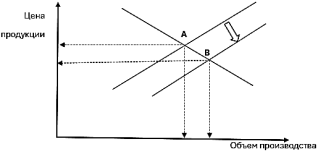
Figure 1. The impact of fisheries support on the reduction of the equilibrium price with an increase in the volume of products.
The most important reproduction parameters of the industry's activity are price indicators and production volumes. The natural conditions of water bodies and coastal marine areas require special consideration of vital activity and consideration of the specifics of fisheries regulation of business operations in the field of mining and processing in the field of agriculture. The general theoretical representation of the provisions of industry support for agricultural enterprises can currently be considered as the intersection of the price of demand and the price of supply of products in market equilibrium, when preferential regimes are introduced for producers of products (
Figure 1). The shift of the straight line of the supply price down and to the right is indicated by an arrow.
State support for the manufacturer of products (preferences) In both organizational and financial forms of activity, it leads to a downward shift in the line of dependence of the supply price on the volume of production. The equilibrium price moves from point A to point B while increasing the volume of products produced, which allows businesses to reduce costs, some of which are usually shifted to the government. Practically, the difference in the actual price of products is offset by the amount of government support for the manufacturer of goods, works and services. The higher the amount of support, the higher the value of the products produced by the business and the lower the market prices. At the same time, the volume of production is increasing, which is especially important for the fishing industry, which should contribute to an increase in the consumption of fish products by the population in the country, which is required by the doctrine of food security.
The graphical representation indicates a kind of compensatory effect of producer support, which, in its absence, is characterized by high prices and low production volumes. Support compensates for the costs of manufacturers, which allows them to reduce the prices of their products. However, defining the boundaries of support, the size and forms of preferential relations is a difficult national economic task for authorities, which must seek optimal cost proportions between intersectoral cooperative activities and the areas of functioning of all the numerous economic structures of the country. Equalization of market conditions is a regulatory tool that is designed to provide equally favorable conditions for the activities of each industry and sub-sectors of the national economic complex.
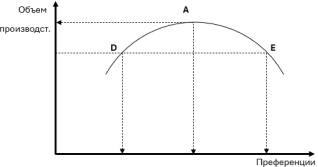
The logic of the relationship between the volume of preferences and the amount of production can theoretically be represented aggregated in the form of a parabola, placed in
Figure 2.
Figure 2. The logic of the dependence of the volume of production on the volume of preferences.
The behavior of product manufacturers is determined by an increase in production volume with an increase in production support in various forms to the optimal preferential value of A - the vertex of the parabola. The optimal level is characterized by such a ratio of the parameters of preferences and the volume of production (supply), which achieves the best result of a relative comparison of the studied parameters. A further increase in preferential values (benefits, financial support, administrative measures and other forms of preferential economic activity) for enterprises to the right of point A leads to a drop in production volumes. The logic of this reduction is characterized by a reduction in business efforts, and hence production volumes, as its costs are offset by increased support. The growth of support reduces market incentives for the development of production, increased competition to increase the efficiency of economic activity.
A decrease in production volumes to the right of point A may also be a consequence of a reduction in incentives to increase consumer support for goods, works and services to purchase products. In this case, there is a drop in production, as demand for manufactured products decreases. For example, customers receive fewer subsidies for social products, which leads to the need for manufacturers to reduce their production. Therefore, the nature of the change in the right branch of the parabola is characterized primarily by an increase in preferences for product manufacturers.
It should be noted that the same volume of production can be achieved under different conditions of the amount of support (preferences) both low and high values (points D and E, respectively), which indicates the need for a careful approach to determining the amount of preferences, the change of which has a sensitive effect on business processes. The deviation of preferences from the top of the parabola in both directions can have the same consequences when determining the volume of production. Obtaining optimal parameters for the values of point A is an important task of the state regulatory authorities for economic development.
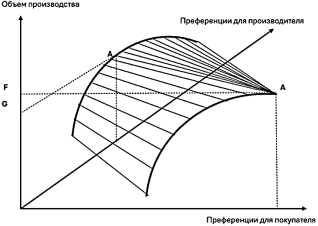
If we consider the axonometry of the dependence of production volume on the influence of preferential regulation in its ratio separately on producers and buyers, we can identify the curved surface of the parabola shown in
Figure 3. It is conventionally assumed that the optimal volume of production with preferences for buyers is limited to point F, which is characterized by the absence of further growth in benefits and subsidies for consumers of goods and services. This situation indicates that there is a natural limitation of public resources (preferences) to solve the full range of social problems when purchasing goods and services from customers. The optimal volume of production for producers is reflected by the G-spot, which is characterized by the possibility of further reduction of production while increasing preferences for producers. This attitude develops, as noted above, with a decrease in business interest in the growth of production in conditions of its excessive preferential support. Incentives for production growth are being replaced by benefits and other public resources (including administrative levers).
Figure 3. Axonometry of the dependence of production volume on a complex change in preferences for the manufacturer and the buyer of products.
The considered theoretical calculations have the widest practical use of the forms, meanings and substantive provisions of the values of preferential relations, which are quite difficult to reduce to single parameters that affect production volumes. This complex cumulative effect is quite difficult to quantify, since each preferential assignment has its own form and conditions of use. It is difficult to imagine and model a quantitative assessment of each component and the total volume of preferences in a single coordinate system of their complex impact on production volumes.
4. The Main Preferential Forms of RHK Support.
4.1. Classification of Resource Allocation and Organizational Support for RHC Development
The classification criteria for financial and other types of resources (including organizational forms of support) can be considered in the following main sections of their use for the purposes of preferences for the activities of RHC enterprises:
1. Direct sources of financial resources external to the industry to support RHC enterprises include:
federal budget resources in various forms of financing;
funds from the budgets of the constituent entities of the Russian Federation as a form of support for the economic structures of the Russian Agricultural Complex;
resources of municipal budgets for fisheries enterprises;
funds of state insurance funds;
resources of state reserves;
funds from extra-budgetary funds.
2. Forms of state and municipal budgetary financial support:
Direct financing is provided by budgetary funds from various levels of government; indirect support includes tax expenditures and benefits such as tax exemptions, discounts, customs preferences, a reduced fee rate, deductions for manufacturers of highly processed products on new domestic ships and debt relief due to objective circumstances. Tax privileges for fisheries management organizations include the following elements:
Zero income tax rate for city-forming fisheries management organizations that meet the criteria specified in the Tax Code of the Russian Federation.
The fee rate for the use of aquatic biological resources is 15% for the city-forming organizations included in the list.
The zero rate is also applied in cases of fishing aimed at reproduction and scientific research.
The VAT rate of 0% for fish exports and VAT exemption for the import of marine products.
10% VAT rate on the sale of fish and seafood on the domestic market for the sale of live fish (except for valuable species), seafood and fish products, including chilled, frozen and other processed fish, herring, canned food and preserves (except for delicatessen).
Grants for enterprises subject to certain conditions, optimization of the tax system to reduce the burden, as well as loans with preferential terms from the budget. In addition, it is used:
optimization of the taxation system for various types of activities, extraction and processing of various types of fishery and fish products in order to reduce the tax burden;
lending at the expense of budgetary funds (including the availability of preferential interest rates on loans and preferential conditions for the organization of lending).
3. Methods of non-governmental participation in the support of the fisheries industry:
preferential bank lending to investment and ongoing activities of agricultural enterprises;
sponsorship system of support for industry enterprises in various operating conditions, including force majeure;
use of charitable funds;
funds of non-governmental insurance funds.
4. Forms of providing support tools:
monetary resources to support RHK enterprises;
tangible natural resources (buildings, structures, equipment, fishing gear and vehicles), various types of quotas (including investment quotas) for fishing, and others.
An important form of support for RHC enterprises is the system of providing investment quotas, which makes it possible to obtain the right to extract CFR in cases of investment in fishing vessels, fish processing plants, and a port structure. For example, according to the results of the first stage of the implementation of the investment quota mechanism, the renewal of the Far Eastern fishing fleet is about 80%, as well as the creation of additional processing facilities on the shore. As part of the first stage of the program, 105 vessels are being built, and about 45 more vessels will be built as part of the second stage. There are already 14 coastal factories operating - 6 plants for processing pollock and other types of high-capacity, 8 small-capacity fish processing plants, except pollock.
By the end of December 2023, the construction of 20 vessels was completed, of which 11 are intended for fishing and 9 for crab fishing. In addition, 25 fish processing plants were built with a total investment of about 26.4 billion rubles. In the Far East, 6 fishing vessels and 14 fish processing plants have been commissioned, of which 7 plants specialize in processing pollock and other large fish, and 7 in processing small—capacity fish (except pollock). The construction of 5 fishing vessels and 11 fish processing plants has been completed in the Northern Basin.; Among them, 6 operate with large processing capacity for cod, haddock and other fish species, and 5 plants are aimed at processing the same types of fish, but with medium and low capacity.
The second stage is aimed at further developing onshore processing and the infrastructure of the fishing industry as a whole, including the construction of a transport and refrigerated fleet, port facilities for storing and servicing fish cargoes. The second stage of the implementation of the program of investment quotas for the extraction of aquatic biological resources began on January 1, 2023. The law obliges to set a limit on the amount of investment and historical quotas for the catch of certain types of IBR in each fishing basin, which can be distributed based on the results of auctions. According to the document, the agreement on investment quotas for fish will imply the annual production of fish products at the built plant for 2 consecutive years in an amount equivalent to 60% of the user quotas.
5. Resources by different types of ownership relative to the owners:
1) internal resources of the owners of the enterprise;
2) various external sources of resource owners for financial support of enterprises.
One of the types of government support for RHC enterprises is grant support to Russian companies implementing digital transformation projects and implementing national IT solutions, as well as developers of digital solutions. Grants for digitalization can be received from 20 to 500 million rubles. The amount of support for certification of agricultural products can range from 50% to 90% of the actual costs of the organization incurred within 12 months prior to the date of application for a support agreement, depending on the cost of transported products, according to 13 types of budget cost classification codes. The cost of the products of the agro-industrial complex, which were supplied by the organization within 12 months prior to the date of submission of the application for support, must exceed the amount of the requested financing by at least 5 times.
Support is provided for the following expenses of RHK enterprises:
to assess the conformity of agricultural products with the requirements of foreign markets;
carrying out veterinary and sanitary and phytosanitary measures;
transportation, storage, testing and disposal of test samples;
to assess the conformity of products with the requirements contained in the foreign trade contract for the supply of agricultural products to foreign markets, including when conducting voluntary certification to obtain Halal and Kosher certificates.
Support for the development of the RHC infrastructure with investment commitments. At the end of 2023, 105 of the 188 hydraulic structures (GTS) were leased with investment obligations. At the beginning of 2024, of the 16,328 sq. m of berthing facilities leased, more than 3,897 sq. m. m has been reconstructed, which is 24% of the total length of the berthing facilities. 7 refrigeration units with a total capacity of 32,500 tons were put into operation.
From the practical measures aimed at supporting agricultural enterprises, it can be seen that a wide variety of forms and methods are used, differing in essence and content. This diversity of approaches makes it difficult to conduct a comprehensive final assessment of the impact of individual factors on the performance of the industry.
At the beginning of 2024, under lease agreements with investment obligations, out of 16,328 square meters of leased berthing facilities, more than 3,897 square meters were reconstructed, which is 24% of the total length of berthing facilities, 7 refrigeration units with a total capacity of 32,500 tons were built and put into operation.
As can be seen from the practical steps to support the activities of RHK enterprises, the forms and methods have the widest and most diverse applications in essence and content. Such a variety of forms and methods makes it difficult to carry out a comprehensive final assessment of the impact of individual factors on the results of the industry.
4.2. Practical Assessment of the Results of Budget Support for the Agricultural Sector
The considered theoretical provisions of the impact of RHC support for the purpose of increasing the production of RBM can be considered using the example of allocating budgetary resources to Rosrybolovstvo as the main administrator of the federal budget.
Table 3 shows the indicators of financing Rosrybolovstvo as the main administrator of federal budget funds.
Table 3. Financing of Rosrybolovstvo from the federal budget (million rubles) in 2024.
Directions | Limits | Completed |
Total | 32 427,9 | 32 323,8 |
- International contributions | 82,2 | 68,7 |
- Inter-budget transfers | 236,2 | 231,5 |
- Subsidies to federal budget institutions | 22 370,9 | 22 370,9 |
-Средства на реализацию федеральной адресной программы | 2 215,4 | 2 215,4 |
- Funds for the implementation of the federal targeted program | 7 437,2 | 7 316,5 |
- Other activities (support for orphaned children, FGGS subsidy for housing purchase) | 147,9 | 147,9 |
Source: Collegium. The results of the activities of the Federal Agency for Fisheries in 2024 and the tasks for 2025. Materials for the April 2025 meeting
The total amount of federal budget expenditures on Rosrybolovstvo is quite significant. In addition to these costs for the development and support of the industry, the federal budget and regional budgets allocate funds to agricultural development for various national projects and programs. All this contributes to the growth of RBF production and to ensuring the implementation of the country's doctrine on ensuring Russia's food security.
To assess the effectiveness of the support, it is advisable to analyze a comparison of the growth of support and the volume of production of the Aquatic Biological Resources (VBR).
Table 4 shows the dynamics of VBR production, federal budget expenditures on Rosrybolovstvo, and the cost of federal support for 2015-2026.
Table 4. Dynamics of RBF production, federal budget expenditures on Rosrybolovstvo, and the cost of federal support for 2015-2026.
| Federal budget expenditures, million rubles | WBR production, thousand tons | Cost of federal support, thousand rubles/ton | Increase in WBR production | Increase in federal budget expenditures |
2015 | 15816,6 | 4492,5 | 3,521 | | |
2016 | 15026,2 | 4812 | 3,123 | 1,071 | 0,950 |
2017 | 13751,6 | 4951,7 | 2,777 | 1,029 | 0,915 |
2018 | 16182,7 | 5109,8 | 3,167 | 1,032 | 1,177 |
2019 | 17927,3 | 4983,3 | 3,597 | 0,975 | 1,108 |
2020 | 22298,5 | 4974,8 | 4,482 | 0,998 | 1,244 |
2021 | 19497,2 | 5053,4 | 3,858 | 1,016 | 0,874 |
2022 | 21185,5 | 4920,3 | 4,306 | 0,974 | 1,087 |
2023 | 19714,2 | 5369 | 3,672 | 1,091 | 0,931 |
2024 | 31171,4 | 5070 | 6,148 | 0,944 | 1,581 |
2025 | 31207 | 5080 | 6,143 | 1,002 | 1,001 |
2026 | 30594 | 5090 | 6,011 | 1,002 | 0,980 |
Sources: Finance of Russia. 2022: Statistical collection/ Rosstat. - M., 2022. - 392 p. Finance of Russia. 2018: Statistical collection/ Rosstat. - M., 2018. - 439 p. The main directions of budget, tax, and customs tariff policy for 2024 and for the planned period of 2025 and 2026. Ministry of Finance of the Russian Federation. M.- 162 p. The Federal Law "On the Federal Budget for 2024 and for the planning period of 2025 and 2026" dated 11/27/2023 N 540-FZ and the calculations of the authors.
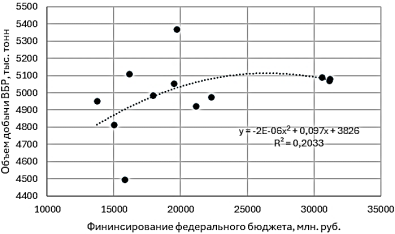
Figure 4. Dependence of the volume of VBR production on federal budget expenditures on Rosrybolovstvo for 2015-2026.
Considering the dynamics of federal budget expenditures on Rosrybolovstvo and the growth
of production of RBM by industry enterprises, it is possible to build a macroeconomic regression model of the dependence of the volume of production of RBM on federal budget expenditures for 2015-2026. We have constructed this dependence in the form of a polynomial curve of the line in the second degree in
Figure 4. The relationship of the parameters has a low value (the coefficient of determination is an insignificant value - 0.2053). This fact indicates the presence of a large number of other factors that affect the production of VBR, as noted above. But the final complex trend of catch changes due to the growth of budget support shows the existence of an optimal volume of preferences, which ensures the maximum volume of production of the RBF. These optimal parameters are calculated using the found polynomial equation.
It should be noted that the detailed formalization of the entire set of preferential measures to support the RHC is a complex independent task that requires a detailed factor-by-factor analysis of the impact of each measure.
However, the proposed macro-econometric approach, using the example of budget support, makes it possible to identify a general trend in the influence of all forms of support on the results of fishing, which confirms theoretical approaches to assessing changes in its effectiveness.
Taking into account the importance and significance of the influence of the central office of the Russian Fisheries Committee (Rosrybolovstvo) on the organization of increased production of UBR, it is possible to trace the effectiveness of incremental indicators of federal budget expenditures and catch volumes. At the same time, it should be borne in mind that the amount of budget expenditures in the total current and budgetary expenditures of RHK enterprises is about 16%, which indicates that they are not large enough, but their impact on the effectiveness of the industry is quite large. The protection of fish stocks, the organization of fishery management, the safety of navigation, the regulatory regulation of activities on ships of the fishing fleet, personnel training and other functional tasks of Rosrybolovstvo have a direct impact on the production of fishing gear. Therefore, the budget expenditures of Rosrybolovstvo have not only an indirect, but also a direct impact on the production of the Arctic Ocean.
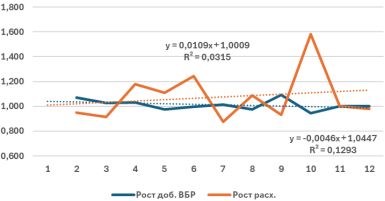
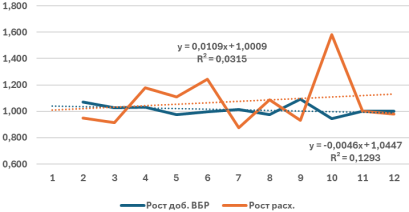
Figure 5 shows the dynamics of the annual growth of RBF production and the annual increase in budget financing of Rosrybolovstvo for 2016-2026.
Figure 5. Dynamics of the annual growth of RBF production and the annual increase in budget financing of Rosrybolovstvo for 2016-2026.
The analyzed years have shown, on average, a decrease in the annual growth of VBR production by 0.0046 points. At the same time, the average annual production growth was 1,012 times. The analysis showed an average annual increase in federal budget expenditures on Rosrybolovstvo by 0.0109 points, with an average increase of 1.077 times. This suggests that federal budget expenditures have increased at a relatively higher rate than the production of mineral resources, which requires careful consideration of the effectiveness of government support, taking into account the increase in its effectiveness.
It should also be noted that the rate of change of the parameters is low over the years of the analyzed period, which is characterized by low values of the coefficients of determination (0.0315 and 0.1293). The dynamics of the annual rate of change in federal budget expenditures is significantly higher than the annual catch index of the RBF. This indicates that the annual fluctuations in the change in federal support are higher than the growth in annual production.
Of particular interest is the generalization of the impact of the volume of specific budget financing on the production of the UBR.
Figure 6 shows the dependence of the volume of production of the RBF on the cost of catch in terms of federal budget expenditures on the RHC as the main administrator of federal budget funds. As calculations show, there is practically no connection between the studied indicators, since the coefficient of determination has a low value and is only 0.0711. But the general macroeconomical trend shows an increase in the catch of RBF with an increase in the cost of production (in terms of federal budget expenditures on agricultural production). Each thousand rubles of the cost of production (in terms of federal budget expenditures) leads to an overall increase in the production of VBR by 45,241 thousand tons.
Figure 6. Dependence of the volume of production of the UBR on the cost of production in terms of federal budget expenditures on the RHC as the main administrator of federal budget funds.
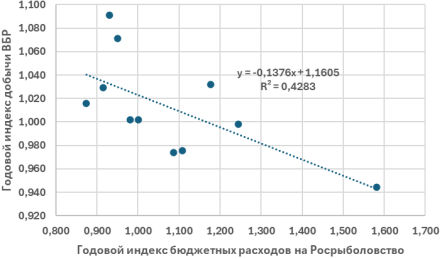
Figure 7. Dependence of the annual change in production of the Siberian Federal District on the annual growth of federal budget expenditures on Rosrybolovstvo for 2016-2026.
This trend is characterized by a generally steady increase in the cost of mining, which shows a decrease in the return on budget expenditures due to the general dynamics of increasing prices for industrial and other products in the country over the analyzed years of economic dynamics (2015-2026). It should be noted that the actual parameters of the rate of change in the annual production of UBR and the volume of budget expenditures (annual indices) have a satisfactory relationship, since the coefficient of determination is 0.4283. This is reflected in
Figure 7. Each point of increase in budget support led to a decrease in the production index of the RBB by 0.1375 points.
In our opinion, this cannot be a negative characteristic of the results of supporting the industry from the federal budget, since the consequences of reducing annual catch growth without such budgetary preferences could be more significant. It is necessary to analyze more deeply the effectiveness of the federal center's support, taking into account all the numerous preferential factors of the RCC's activities.
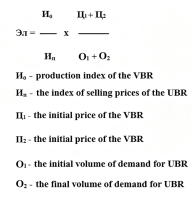
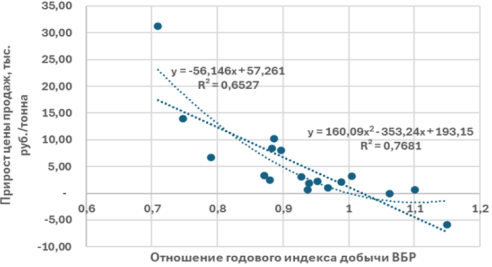
The calculation of the arc elasticity and the dependence of the sales price increase on the ratio of the annual production index of the UBR is carried out using the following formula. (
Figure 8).
Figure 8. Calculation of arc elasticity and dependence of sales price increase on the ratio of the annual production index.
Figure 9. The dependence of the sales price increase on the ratio of the annual production index of the UBR.
As the macroeconomic modeling of the dynamics of incremental prices and mining shows, with a certain ratio of these indicators, there are minimum values of indicators (
Figure 9). This ratio should be a target guideline for regulating the degree of support for the activities of the RHC.





 Share This Article
 Twitter
 Linked In
 Facebook
 Copy
Copy Download