Research Article | | Peer-Reviewed

Women’s Agricultural Empowerment as a Catalyst for Sustainable Land Use Management Among Small-scale Farmers in Njoro, Kenya

Received: 5 September 2026     Accepted: 15 September 2026     Published: 14 October 2026
Views:       Downloads:
Abstract

This study examined the extent of women’s empowerment in agriculture as a catalyst for sustainable land use management practices among small-scale farmers in Njoro Sub-County, Nakuru County, Kenya. Specifically, the study sought to: (i) assess the level of women’s empowerment using the Women Empowerment in Agriculture Index (WEAI); (ii) determine the extent to which women farmers have adopted sustainable land use management practices (SLUMP); and (iii) evaluate the influence of women’s empowerment on the uptake of these practices. An ex-post facto research design was employed. A multi-stage sampling approach was used to identify three locations, from which a stratified random sample of 243 women farmers was drawn from a sampling frame of 659 households. Data were collected using a structured questionnaire and analyzed using descriptive and inferential statistics. Findings indicated that women’s empowerment in agriculture was generally low (M = .439, SD = .196) on a 0–1 scale. Adoption of sustainable land use management practices was moderate (M = 11.16, SD = 5.98) on a scale ranging from 0 to 20, with significant variation across Njoro, Kihingo, and Nessuit locations (p < .001). Regression analysis revealed that women’s empowerment had a significant positive contribution to sustainable land use management practices (β = .144, t = 2.25, p < .001). The results demonstrate that the WEAI is an effective tool for assessing the empowerment of women farmers and for understanding its role in promoting sustainable land use decisions.

Published in International Journal of Natural Resource Ecology and Management (Volume 11, Issue 4)
DOI 10.11648/j.ijnrem.20261104.11
Page(s) 143-156
Creative Commons

This is an Open Access article, distributed under the terms of the Creative Commons Attribution 4.0 International License (http://creativecommons.org/licenses/by/4.0/), which permits unrestricted use, distribution and reproduction in any medium or format, provided the original work is properly cited.

Copyright

Copyright © The Author(s), 2026. Published by Science Publishing Group

Keywords

Njoro Sub-County, Women Empowerment Index in Agriculture, Adoption, Women Action, Environmental Conservation

1. Introduction
1.1. Women’s Empowerment in Agriculture
Women’s empowerment is broadly defined as the process through which individuals expand their capacity to make strategic life choices and act upon them . Within agricultural systems, empowerment encompasses women’s agency, access to and control over productive resources, participation in decision-making, leadership capacity, and the ability to allocate time in ways that optimize productivity and well-being . Empowerment is therefore multidimensional, involving economic, social, psychological, and political dimensions that collectively influence women’s ability to contribute to and benefit from agricultural development .
A growing body of literature demonstrates that empowered women tend to make decisions that enhance household welfare, improve resource allocation, and strengthen livelihood outcomes ). Empirical evidence further suggests that improvements in women’s agency and resource control positively affect not only economic productivity but also nutrition, food security, and community development . Globally, women’s empowerment has been linked to successful implementation of agricultural and community development projects across regions such as Asia, Europe, and North America . However, persistent structural constraints—such as gender norms, limited land rights, low educational attainment, and weak institutional support—continue to hinder women’s full participation in development initiatives in many low- and middle-income countries .
In sub-Saharan Africa, gender disparities in access to land, credit, agricultural inputs, and decision-making power remain widespread, despite constitutional reforms and gender-sensitive policy initiatives . Although countries such as South Africa and Liberia have made notable progress in advancing women’s rights in land and natural resource governance, many rural communities continue to operate under patriarchal norms that limit women’s autonomy . In Kenya, women contribute significantly to agricultural labor yet often have limited control over productive resources, household income, and agricultural decisions . Omweri identified level of education, cultural values, lack of finances, lack of information and marital status as limiting women participation in Kenya. These constraints undermine not only gender equality but also agricultural sustainability and climate resilience. The adoption of the Sustainable Development Goals (SDGs), particularly SDG 5—Achieve gender equality and empower all women and girls—reaffirmed global commitments to reducing these inequalities .
The Women’s Empowerment in Agriculture Index (WEAI), developed by Alkire et al. , provides a comprehensive framework for measuring empowerment across five domains: decisions about agricultural production, access to and control over resources, control over income, leadership in the community, and time allocation. The index has been widely applied across Africa and Asia to understand how empowerment influences agricultural outcomes, with growing emphasis on its role in driving environmental stewardship and sustainable land management .
1.2. Sustainable Use and Management of Natural Resources
Sustainable land use and natural resource management are essential for supporting rural livelihoods, particularly for the more than one billion smallholder farmers who depend on land resources for food production and income generation . Unsustainable land use practices have accelerated global land degradation, which now affects approximately 3.2 billion people and contributes to biodiversity loss, reduced agricultural productivity, and diminished ecosystem services . In recognition of this crisis, SDG 15.3 calls for the global community to combat desertification, restore degraded land, and achieve a land degradation-neutral world by 2030 .
Sustainable Land Management Practices (SLMPs) offer an effective pathway for restoring degraded landscapes, improving soil health, and enhancing resilience to climate change. These practices include agroforestry, intercropping, conservation tillage, mulching, water harvesting, terracing, controlled grazing, and the establishment of buffer zones . Adoption of SLMPs has been shown to improve soil fertility, increase yields, reduce erosion, and strengthen household food security. However, adoption rates vary widely across communities, often influenced by socio-economic factors, access to information, extension services, and gender dynamics.
Recent research highlights that women farmers, when empowered, are more likely to adopt climate-smart and conservation-oriented practices . Empowerment enhances their decision-making capacity, control of resources, and ability to participate in farmer groups where knowledge on sustainable practices is shared. Thus, examining the relationship between women’s empowerment and sustainable land management is critical fr informing gender-responsive environmental policy and promoting climate-resilient agriculture in Kenya.
Given the centrality of women in smallholder agricultural systems and the growing importance of sustainable land management for food security and climate adaptation, this study investigates the extent of women’s empowerment in agriculture and its contribution to the adoption of sustainable land use management practices among small-scale farmers in Njoro Sub-County, Kenya.
1.3. Statement of the Problem
Women in the rural areas play a big role in agricultural food production and in the conservation of the environmental resources within their small-scale farms. Women empowerment enhances the capacity of the women to make choices that can translate into desired actions and outcomes with the aim of changing their lives and that of their families. Many projects undertaken by the government and non-governmental organizations have been designed to enable the women to meet gender equity, increase their income through provision of credit, elevate their education and solve their health challenges. In order to provide the women with credit, the women enterprise fund (WEF). These projects have been instrumental in enhancing the capacities of women to meet their families’ obligation and environmental conservation. These programmes have had big success especially in the business sector in the urban areas but their success in the rural areas and the farming sector has been questionable, as land degradation has increased and agricultural production has been declining over the years.
In the farming, areas of Njoro sub-county, women empowerment projects have been implemented through women groups and individuals and there is evidence to show that the agricultural production, economic and social status of the women has been enhanced , but the impact of these activities on the sustainability of the environmental resources have not been ascertained, leading to the critical question: does the empowerment of women have an impact in the management of land resources and in the production of food crops in Njoro. This study therefore, was conceived to meet the following three objectives:
1) To measure the extent of women empowerment using the women empowerment in agriculture index (WEAI) developed by Alkire et al. .
2) To assess the level of sustainable land use management practices (SLUMP) among small scale farmers in Njoro sub-county,
3) To determine the relationship between WEAI and SLUMP among the small-scale farmers in Njoro sub-county
2. Conceptual Framework
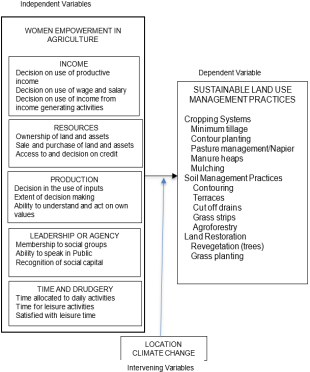
The independent variable for this study is women empowerment in agriculture index (WEAI) composed of five domains. These domains are (i) decisions about agricultural production, (ii) access to and decision-making power about productive resources, (iii) control of use of income, (iv) leadership in the community, and (v) time allocation (as depicted in Figure 1).
The Five Domains of Empowerment in Agriculture (5DE) are defined in the Instructional Guide on the Women’s Empowerment in Agriculture Index as follows:
1) Production: This dimension concerns decisions about agricultural production and refers to sole or joint decision making about food and cash crop farming, livestock and fisheries, and autonomy in agricultural production, with no judgment on whether sole or joint decision making was better or reflected greater empowerment.
2) Resources: This dimension concerns ownership of, access to, and decision-making power about productive resources such as land, livestock, agricultural equipment, consumer durables, and credit.
3) Income: This dimension concerns sole or joint control over the use of income and expenditures.
4) Leadership: This dimension concerns leadership in the community, here measured by membership in economic or social groups and comfort speaking in public.
5) Time: This dimension concerns the allocation of time to productive and domestic tasks and satisfaction with the time available for leisure activities.
The 5DE are measured using 10 indicators (see conceptual framework (Figure 1). Each indicator is designed to measure whether each individual reached a certain threshold (has adequate achievement) with respect to each indicator.
The dependent variable, sustainable land use management practices (SLUMP) is conceptualised as a multi-indicator index, divided into three (3) domains and twenty (20) indicators. The domains include: land restoration, cropping systems and soil management practices. The relationship is shown in Figure 1.
Figure 1. Conceptual framework showing the contribution of women empowerment to sustainable land use management among Farming households in Njoro sub-county.
3. Materials and Methods
3.1. Research Design
The study employed the ex-post-facto research design, involving causal comparative . An ex post facto study or after-the-fact research is a category of research design in which the investigation starts after the fact that it has already occurred without interference from the researcher . This was a systematic empirical inquiry in which there was no direct control of the independent variable. The design was deemed appropriate for this study because the manifestation of the independent variable (women empowerment) had already occurred without any manipulation. The contribution of the independent variable on the dependent variable (sustainable land use management) was then determined.
3.2. Description of the Study Area
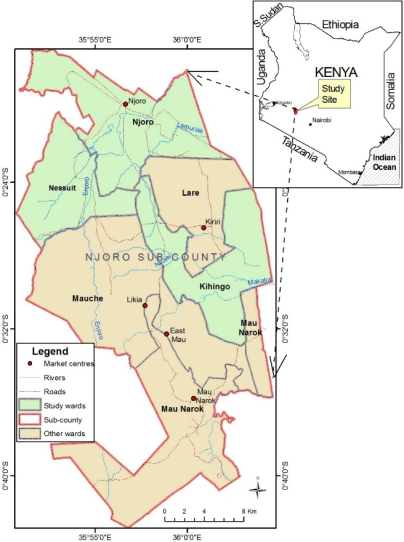
This study was conducted within Njoro Sub-County located in Nakuru County, Kenya. The location of the three locations studied (Njoro, Kihingo and Nessuit) are shown in (Figure 2).
The study area, offers an important case study due to its agro-ecological diversity, mixed crop–livestock systems, and increasing pressures from land fragmentation, soil degradation, and climate variability. The produce from the farms are used by the household and the extra are sold commercially in the local markets and agricultural industries located at Egerton University, Njoro and Mau Narok towns.
Figure 2. Map showing the location of Njoro Sub-county and the three study sites.
3.3. Target Population
The target population for this study was the small-scale farmers within the Njoro sub-county. The population consisted of women who were living on their farm with or without their husbands. Njoro sub-county has an area of 202.4 Km2 with a population of 98,376 people and 27,163 households. . The households that formed the sampling frame were 659 households (Personal communication with Chief and Nyumba Kumi Initiative). These were households that owned a piece of land and had a woman as one of the household heads and were members of women groups. A sample of 243 households was determined as appropriate using the Krejcie and Morgan formula. Stratified random sampling technique was used to select the households. The sample was selected proportionally to the population within the three locations (Njoro, Kihingo and Nessuit) that formed the strata. The selected female household heads were interviewed using a structured questionnaire.
3.4. Data Collection Instruments
A researcher-administered structured questionnaire was used to collect information from the women household heads within the study area. The questionnaire had three sections: section one had questions related to the characteristics of the respondents, section two had questions on the independent variables, which was an index developed by Alkire et al. . The index, Women Empowerment in Agriculture Index (WEAI), is a multi-indicator variable composed of five domains (as shown in the conceptual framework, Figure 1). The third section elicited information on the level of sustainable land use management practices (SLUMP) undertaken by the households.
3.5. Data Analysis
The descriptive and inferential statistics was used to analyse data using the Statistical Package for the Social Sciences (IBM SPSS version 26).
4. Results
4.1. Characteristics of the Respondents
The characteristics of the research participants are presented in Table 1, they include: location of the farm, age of respondents, marital status, level of formal education attained, and household number.
Table 1. Characteristics of the Respondents.

Category

Frequency

Percent

Location of the Farm

Kihingo

136

56.0

Nessuit

62

25.5

Njoro

45

18.5

Age Categories

20-30

39

16.0

31-40

92

37.9

41-50

54

22.2

51-60

27

11.1

61-70

22

9.1

71-80

9

3.7

Level of Formal Education Attained

Never Went to School (illiterate)

12

4.9

Lower Primary (1-4)

22

9.1

Upper Primary (5-8)

156

64.2

Secondary (Form 4)

47

19.3

College (Diploma)

4

1.6

Master and above

2

0.8

Number of People living in the household

1.00

5

2.1

2.00

19

7.8

3.00

18

7.4

4.00

39

16.0

5.00

40

16.5

6.00

16

6.6

7.00

36

14.8

8.00

21

8.6

9.00

25

10.3

10.00 and above

24

9.9

n=243
The average age for the respondents was (M=41.9, SD=14.46), while the minimum age was 20 and the maximum age was 81 years old. Majority below 40 years old.
The majority (70%) of the households were dual adult households (husband and wife) and the single women households (single, widowed or divorced) formed 30% of the participants in the study.
The average number of people living in the households was M=5.9, (SD=2.5), and ranged between 1 and 13. Majority (56.4%) of the households had less than 6 members of the family.
4.2. Level of Women Empowerment Among Women Farmers in Njoro Sub-County
The independent variable level of women empowerment used for this study was conceptualized as a multi-indicator index. The variable, women empowerment in agriculture index (WEAI) was developed by Alkire et al. . The index is composed of five domains (5DE), these domains are (i) decisions about agricultural production, (ii) access to and decision-making power about productive resources, (iii) control of use of income, (iv) leadership in the community, and (v) time allocation. The domains are measured using indicators as shown in Table 2.
The indicators were measured by asking the women to state whether the indicator (or activity) was solely owned or performed by the women, or jointly with their spouse or were solely owned or performed by their husbands. The responses were rated on a 0-2 Scale with a score of 0 indicating ownership by husband alone, score of 1 indicating joint ownership and 2 indicating sole ownership by the women depicting a higher level of empowerment. The scores for each indicator were then combined to form the index.
The constructed indices were evaluated for their reliability and validity using the Cronbach’s alpha . The indices met their minimum threshold for reliability and validity as they exceeded the recommended threshold of (α = 0.7), indicating a high level of internal consistency . The descriptive statistics for the indicators and the aggregated overall index are shown in Table 2.
Table 2. Descriptive Statistics for the Njoro Women Empowerment in Agriculture Index.

No

Domains

Indicators

Descriptive statistics of the farmers rating

Total

Mean

SD

α

1

Household resources

Ownership of resources

87

.360

.345

Transactions of land and assets

78

.321

.444

Decision on Credit

88

.362

.441

Women resources

84

.348

.401

.864

2

Agricultural production

Decision on Production

103

.426

.414

Extent of Decision Making

407

1.67

.895

Personal Ability and Motivation

180

.741

.299

Agricultural production

231

.948

.374

.801

3

Household Income

Use of income generated from farm production

87

.358

.480

Use of income from employment

97

.399

.490

Use of income from income generating activities (IGA)

95

.390

.498

Income Decision Making

93

.382

.463

.798

4

Leadership/Agency

Women membership to groups

147

.607

.287

Speaking in public

24

.099

.206

Index of Ease of Public Speaking

24

.099

.206

Women Leadership (Agency)

85

.269

.167

.802

5

Time allocation

Time allocated to work in a 24hr day

209.8

.86

2.41

Adequacy of workload (below 10.5 hrs. /day)

35

.44

.351

Leisure related activities

87

.358

.157

Time allocation

81

.251

.184

WEAI for Njoro farmers

106

.439

.196

.761

n=243
The WEAI for Njoro women was found to be (M=.439, SD= .196) on a scale of 0 to 1, this was a low level of empowerment. The index was divided into ten categories and the chi-square test for the equality of categories was conducted for WEAI and the results are presented in Table 3.
Table 3. Chi-square Test for Equality of Categories for the WEAI.

Categories

Description

Observed N

Expected N

Residual

Statistics

.01- .10

Extremely low

4

24.3

-20.3

χ2=234.65

.11- .20

Very low

12

24.3

-12.3

df=9

.21- .30

Low

38

24.3

13.7

p<.001

.31- .40

88

24.3

63.7

.41- .50

Medium

22

24.3

-2.3

.51- .60

20

24.3

-4.3

.61- .70

21

24.3

-3.3

.71- .80

High

30

24.3

5.7

.81- .90

Very High

5

24.3

-19.3

.91- 1.0

Extremely high

3

24.3

-21.3

Total

243

Mean .439±.012, Median .358, Mode .310, SD .196, minimum .05 maximum .99
The chi-square test (Table 3) revealed statistical (p < .001) significant differences among the different WEAI categories of the participants. The WEAI category of (.31-.40) was found to be statistically significantly (χ2=234.65, df = 9, p < .001) higher than the other categories, indicating that the majority of the women empowerment were at this level (below the medium level).
4.3. Household Sustainable Land Use Management Practices
The independent variable for this study—the level of Sustainable Land Use Management Practices (SLUMP) undertaken by women farmers in Njoro Sub-county—was conceptualized as a multi-indicator index based on the number of sustainable land use practices adopted by each farmer. Respondents were asked to indicate the SLUM practices applied on their farms, and these were verified through direct field observation. A total of twenty (20) different sustainable land use management practices were identified and are presented in Table 4.
Each practice was converted into a binary variable, where households applying a particular practice received a score of 1, and those not applying it received 0. The scores were then summed to generate an index ranging from 0 to 20, with 0 indicating no adoption of SLUM practices and 20 indicating the highest possible adoption level. Descriptive statistics and frequency distributions for all practices are shown in Table 4.
Table 4. Descriptive Statistics for SLUM Practices Among Women Farmers in Njoro Sub-county.

Sustainable Land Use Management Practices

Descriptive Statistics

Sum

Mean

Std. dev

1

Manure compositing and application

184

.757

.429

17

Rain water harvesting (roof catchment)

184

.757

.429

2

Intercropping

183

.753

.432

3

Minimum tillage

178

.732

.443

4

Use of cover crops (legumes, clover)

169

.695

.461

5

Grassed fallows

154

.633

.482

6

Grazing management / controlled grazing

152

.625

.484

7

Crop rotation

151

.621

.486

8

Fodder plots (enclosures)

151

.621

.486

9

Mulching

149

.613

.488

10

Restoration/revegetation on bare areas

147

.604

.489

11

Planting on contours

146

.648

.478

12

Drip irrigation

141

.580

.494

13

Agroforestry practices

136

.633

.490

14

Grass strips or trash lines on cropland

133

.547

.498

15

Zero grazing / stall feeding

125

.514

.500

16

Rain water harvesting (surface water)

123

.506

.500

18

Cut off drains

109

.484

.500

19

Contour furrows

91

.404

.491

20

Terraces on farms

68

.279

.449

n=243
The mean value of the SLUMP index was M = 11.16 (SD = 5.98), on a scale of 0–20. A chi-square test for equality of categories of the SLUMP index (Table 5) showed statistically significant differences across categories (χ2 = 45.03, df = 6, p < .001). The most commonly practiced SLUM activities were manure composting and application, intercropping, and minimum tillage.
The chi-square test indicated that households were unevenly distributed across the SLUMP categories. The medium category (12–14) had significantly more households than expected (χ2 = 45.03, p < .001), suggesting that the majority of women farmers in the area practiced a moderate level of sustainable land use management.
Table 5. Chi-square Test for the Equality of Categories for the SLUMP Index.

Index Categories

Observed N

Expected N

Residual

Statistics

0-2

35

34.7

.3

χ2=45.03

3-5

11

34.7

-23.7

df=6

6-8

30

34.7

-4.7

p<.001

9-11

28

34.7

-6.7

12-14

59

34.7

24.3

15-17

52

34.7

17.3

18-20

28

34.7

-6.7

Total

243

Mean 11.16 ± 38, Median 13, mode 0, SD 5.98, minimum 0, maximum 20
4.4. Comparison of the Level of Sustainable Land Use Management Practices in Njoro, Kihingo and Nessuit Location
An ANOVA test was conducted to compare mean SLUMP levels across the three study locations: Njoro, Kihingo, and Nessuit. Descriptive statistics are presented in Table 6.
Table 6. Descriptive Statistics for SLUMP Across the Three Locations.

n

Mean

Standard. Deviation

Std. Error

Minimum

Maximum

Njoro

45

14.02

4.73

.705

.00

20.00

Kihingo

136

9.47

6.31

.541

.00

20.00

Nessuit

62

12.82

4.72

.600

6.00

20.00

Total

243

11.16

5.98

.383

.00

20.00

The results showed statistically significant differences among the three mean SLUMP scores (F(1, 240) = 14.41, p = .001), indicating that at least one location differed significantly from the others. Tukey’s HSD post-hoc test (Table 7) revealed that the difference between Njoro and Kihingo was statistically significant (p < .001), with Njoro having a higher mean SLUMP score by 4.55. However, the difference between Njoro and Nessuit was not statistically significant (p > .05).
Table 7. Multiple Mean Comparisons for SLUMP Using Tukey HSD.

(I) Locality

(J) Locality

Mean Difference (I-J)

Std. Error

p

Njoro

Kihingo

4.55

.975

.001

Nessuit

1.19

1.111

.528

ANOVA: (F (1, 240) = 14.41, p=.001)
Overall, the SLUMP levels varied significantly across the three locations, with Njoro exhibiting the highest level of sustainable land management practices, followed by Nessuit, while Kihingo had the lowest.
4.5. Contribution of the Level of Women Empowerment in Agriculture Index on the Adoption of Sustainable Land Use Management Practices
Table 8. Regression Coefficients for the contribution of Women Empowerment in Agriculture Index to the Adoption of Sustainable Land Use Management index.

Unstandardized Coefficients

Standardized Coefficients

t

p.

B

Std. Error

Beta

(Constant)

9.249

.933

9.917

.001

WEAI

4.364

1.936

.144

2.254

.025

F test = (F (1, 241) = 5.08, p=.025).
R2 value of .117
A simple linear regression analysis was conducted to examine the extent to which women’s empowerment influences the adoption of sustainable land use management practices. In this model, the Women Empowerment in Agriculture Index (WEAI) served as the independent variable, while the Sustainable Land Use Management (SLUM) index was the dependent variable. Table 8 presents the regression coefficients.
The overall regression model was statistically significant, F(1, 241) = 5.08, p = .025, indicating that WEAI is a meaningful contributor of sustainable land use outcomes. The model explained approximately 11.7% of the variance in sustainable land use management practices (R2 = .117), suggesting a modest but noteworthy influence of empowerment on land management decisions.
The coefficient for WEAI was statistically significant (β = .144, t = 2.254, p = .025), demonstrating that higher levels of empowerment among women farmers were associated with increased adoption of sustainable land use management practices. In practical terms, women who reported stronger decision-making capacity, enhanced control over productive resources, and greater agency within agricultural activities tended to implement more sustainable practices on their farms. This finding underscores the importance of empowering women as a strategic pathway for strengthening environmentally sustainable land management within the study area.
5. Discussion
5.1. The Extent of Women Empowerment in Agriculture Index for Njoro Farmers
The results of this study demonstrate that women farmers in Njoro Sub-county experience generally low levels of empowerment across the five domains of the Women’s Empowerment in Agriculture Index (WEAI). This is not the case when compared to other forms of empowerment, such as in health, entrepreneurship and politics . This pattern reflects persistent gender disparities in agricultural decision-making, resource access, income control, leadership, and time use. Such disparities have been widely documented in sub-Saharan Africa, indicating that despite women’s critical contributions to agricultural production and household food security, their empowerment remains significantly constrained .
The findings highlight limited control over household resources, including land ownership, asset transactions, and credit decisions. This aligns with scholarship showing that gendered land tenure systems and patriarchal inheritance norms often restrict women’s ability to own or control productive assets . Without secure rights to land and other resources, women’s bargaining power within households and communities is diminished, reducing their capacity to participate in agricultural planning, adopt innovations, or negotiate access to credit and inputs.
Within the agricultural production domain, the results suggest that although women participate extensively in farm labor, they often lack authority in decisions related to crop choice, input use, and production planning. This finding mirrors research across East Africa indicating that men commonly dominate strategic agricultural decisions even when women contribute the majority of labor . Limited decision-making power in agricultural production can reduce women’s ability to influence household food security outcomes, productivity levels, and the adoption of climate-smart or sustainable practices.
Empowerment was also low in the household income domain, reflecting limited control over income generated from farm activities, employment, and income-generating enterprises. This is consistent with existing research showing that even when women contribute significantly to household earnings, intra-household norms often restrict their control over income . Restricted financial autonomy reduces women’s ability to invest in productive assets, education, or improved household nutrition, thereby perpetuating gendered welfare inequalities.
The leadership and agency domain had particularly low scores, with minimal participation in public speaking, group leadership, or community decision-making. This outcome aligns with evidence that women in rural contexts face social and cultural constraints that limit their leadership roles, including norms around public visibility, confidence, and gendered expectations of behavior . Limited agency restricts women’s access to collective action groups—such as cooperatives and self-help groups—which are essential for accessing credit, extension services, and market information.
In terms of time allocation, many women experienced considerable time burdens due to the dual responsibilities of agricultural labor and unpaid domestic work. Global literature consistently shows that women face acute time poverty, which restricts their ability to participate in leadership activities, educational opportunities, and income-generating ventures . The persistent imbalance in time use reinforces gender inequalities across all other domains of empowerment.
The significant differences across WEAI categories indicate that women’s empowerment in Njoro is unevenly distributed, with the majority concentrated in low empowerment levels. This clustering in lower categories suggests that empowerment constraints reflect systemic issues rather than isolated cases. Similar patterns have been documented in rural Ethiopia, Uganda, and Ghana, where empowerment levels are shaped by intersecting drivers such as education, access to extension services, household structure, and prevailing cultural norms . The levels of women empowerment can also be enhanced through social support, land rights, legal rights, and land entitlements .
Overall, the findings affirm that while women are central to agricultural production and household food security, structural and institutional barriers continue to constrain their empowerment across multiple domains. Addressing these barriers is essential for improving agricultural productivity, enhancing women’s well-being, and achieving gender equity goals within agricultural development initiatives.
5.2. The Level of Land Use Management Practices Adopted by Women Farmers
The findings of this study demonstrate that women farmers in Njoro Sub-county are actively engaging in a range of Sustainable Land Use Management Practices (SLUMP), though adoption patterns vary considerably across specific practices and geographic locations. Overall, the farmers exhibited a moderate level of engagement with sustainable land management, reflecting both growing environmental awareness and persistent structural constraints.
A key insight emerging from the study is the predominance of low-cost, labor-efficient, and knowledge-based practices such as manure use, intercropping, minimum tillage, rainwater harvesting, and cover cropping. These practices align closely with the livelihood realities of smallholder farmers, who often operate under limited financial and technological resources. Similar adoption patterns have been observed across East Africa, where women farmers, in particular, rely on resource-conserving, affordable techniques that enhance soil health and buffer climate-related risks . The emphasis on these practices suggests increasing uptake of regenerative agriculture principles among rural households.
Conversely, practices requiring substantial labor, specialized skills, or external support—such as terracing, contour structures, and advanced water conservation technologies—were less frequently adopted. This aligns with growing evidence that gendered disparities in access to extension services, labor, tools, credit, and land tenure security disproportionately affect women, limiting their engagement with capital-intensive conservation measures . These structural barriers highlight the continued need for gender-responsive interventions that support equitable participation in sustainable land management.
Spatial variations across Njoro, Kihingo, and Nessuit further illustrate how context-specific conditions shape adoption behavior. Differences in institutional support, extension service reach, agro-ecological conditions, and community networks likely contribute to the uneven distribution of SLUMP engagement. Prior studies emphasize that farmers’ adoption of conservation practices is strongly influenced by localized environmental challenges, access to information, and the presence of community-based support systems . Areas with higher adoption may benefit from stronger extension linkages or more conducive environmental and socioeconomic conditions, while areas with lower adoption may face compounded resource limitations.
Collectively, these findings underscore the importance of designing spatially and socially targeted strategies to strengthen sustainable land management among women farmers. Interventions should prioritize enhancing access to extension services, improving women’s control over productive resources, supporting farmer training, and promoting community-based knowledge exchange. Strengthening these enabling conditions has been shown to significantly improve the adoption of sustainable agricultural innovations and enhance resilience to climate variability .
5.3. The relationship between Empowerment in Agriculture and the Sustainable Land Use Management Practices
This study demonstrates that women’s empowerment in agriculture is a significant driver of sustainable land use management practices among smallholder farmers. Empowered women, who exercise greater agency, decision-making power, and control over household and productive resources, are more likely to adopt environmentally sustainable farming practices. This finding aligns with established literature indicating that empowerment enhances women’s capacity to make autonomous decisions regarding resource allocation and farm management, thereby facilitating adoption of conservation-oriented practices .
The mechanisms linking empowerment to sustainable land management are multifaceted. Women with greater control over productive resources—such as land, inputs, and income—can make strategic choices about crop diversification, soil and water conservation, and organic amendments. Empowerment also enhances access to information, agricultural knowledge, and extension services, enabling women to implement contextually appropriate sustainable practices . Moreover, women’s participation in leadership and community groups fosters knowledge exchange and collective action, further promoting the adoption of environmentally beneficial practices .
Despite the positive association, it is important to recognize that empowerment interacts with other determinants of adoption. Socio-cultural norms, household labor allocation, education, farm size, and access to extension services all shape women’s capacity to implement sustainable practices . This suggests that empowerment, while critical, functions alongside structural and contextual factors to influence sustainable land use outcomes. Therefore, interventions aimed at promoting sustainable land management should adopt a holistic approach that combines gender empowerment with technical support, resource provision, and institutional strengthening.
Overall, these findings reinforce the conceptual link between gender empowerment and environmental sustainability. Enhancing women’s agency, resource access, and decision-making power can generate tangible benefits for sustainable agriculture, climate adaptation, and household welfare. The study contributes to the growing body of evidence that gender-responsive agricultural policies and programs are essential for achieving long-term environmental and developmental goals.
6. Conclusions
Women’s empowerment in agriculture is a key social enabler of sustainable land use management among smallholder farmers both at household and community-level outcomes. Empowered women are better positioned to make informed decisions, access and utilize productive resources effectively, and engage in environmentally sustainable practices. Policies and interventions that strengthen women’s control over resources, enhance agency and leadership, and address socio-cultural constraints are essential to promoting sustainable land management. Integrating gender-responsive approaches into agricultural development programs not only supports environmental sustainability but also advances equitable rural development and household well-being.
The disparities in adoption across practices and locations reflect underlying socioeconomic and institutional constraints. Addressing these constraints through gender-responsive, context-specific policies and extension programs is essential to advancing sustainable land management and enhancing the livelihoods of rural women. Future research should explore other socio-economic and environmental determinants to complement empowerment-focused interventions.
Abbreviations

WEAI

Women Empowerment in Agriculture Index

SLUMP

Sustainable Land Use Management Practices

SLUM

Sustainable Land Use Management

SLMPs

Sustainable Land Management Practices

SDGs

Sustainable Development Goals

WEF

Women Enterprise Fund

5DE

Five Domains of Empowerment

SPSS

Statistical Package for the Social Sciences

IBM

International Business Machines

Acknowledgments
My expression of gratitude to all individuals and institutions who provided valuable insights, datasets, and constructive feedback that enriched this study. Special thanks go to my academic supervisors, stakeholders, and colleagues for their insightful contribution of knowledge, guidance, and support.
Author Contributions
Hafsa Ahmed Mohamed: Conceptualization, Data curation, Formal Analysis, Investigation, Methodology, Writing- original draft
Elizabeth Mumbi Ndunda: Funding acquisition, Resources, Software, Supervision, Validation, Writing – review & editing
Mark Ndunda Mutinda: Methodology, Project administration, Supervision, Validation, Writing – review & editing
Data Availability Statement
All data supporting the findings of this publication are available within this article. The SPSS data file is available upon request.
Conflict of Interest
The authors declare no conflicts of interest.
References
[1] Kabeer, N. (1999). Resources, agency, and achievements: Reflections on the measurement of women’s empowerment. Development and Change, 30(3): 435-464.
[2] Alkire, S., Meinzen-Dick, R., Peterman, A., Quisumbing, A., Seymour, G., & Vaz, A. (2013). The Women’s Empowerment in Agriculture Index. World Development, 52: 71–91.
[3] Klasen, S. (2018). The impact of gender inequality on economic performance in developing countries. Annual Review of Resource Economics 10(1), 279–298.
[4] Doss, C., & Meinzen-Dick, R. (2020). Land tenure security for women: A conceptual framework. Land Use Policy, 99, 105080.
[5] Quisumbing, A. R., Rubin, D., Manfre, C., Waithanji, E., van den Bold, M., Olney, D., Johnson, N., & Meinzen-Dick, R. (2015). Gender, assets, and market-oriented agriculture: Learning from high-value crop and livestock projects in Africa and Asia. Agriculture and Human Values, 32(4), 705–725.
[6] Malapit, H. J., & Quisumbing, A. R. (2015). What dimensions of women’s empowerment matter for nutrition? Evidence from five countries in Africa and Asia. Global Food Security, 6, 1–11.
[7] Owoo, N. S., & Boakye-Yiadom, L. (2023). Women’s control over income, household decision-making and food security in sub-Saharan Africa. Development Studies Research, 10(1), 1–13.
[8] Salcedo, M., Ruiz-Bravo, P., Barrantes, N. et al. Measuring Multidimensional Women’s Empowerment with Data From Partnered Women Across 45 Low- And Middle-Income Countries. Soc Indic Res 176, 1093–1119 (2025).
[9] Njuki, J., Kruger, E., & Starr, L. (2022). Strengthening gender integration in agricultural value chains: Lessons from sub-Saharan Africa. Agriculture and Human Values, 39(3), 715–732.
[10] Balasubramanian, P., Ibanez, M., Khan, S., Sahoo, S. (2024). Does women’s economic empowerment promote human development in low- and middle-income countries? A meta-analysis. World Development 178 (2024): 106588.
[11] Kaaria, S., Osorio, M., Wagner, S., & Gallina, A. (2016). Gender inequalities in rural employment in Kenya. Journal of Gender Studies, 25(4), 433–448.
[12] Yimer, F., & Tadesse, M. (2023). Determinants of women’s empowerment in agriculture in rural Ethiopia. Journal of Agricultural Economics and Development, 12(2), 45–59.
[13] United Nations [UN] (2017). With Equal Rights, Empowerment, Women Can Be Agents of Change’ for sustained Socio-economic Development Security around World, Third Committee Told.
[14] Omweri, F. (2015). Factors influencing rural women’s participation in community development projects in Mosocho Division of Kisii County; Kenya. –College of Education and External Studies (CEES).
[15] United Nations. (2015). Transforming our world: The 2030 Agenda for Sustainable Development. United Nations.
[16] Ariti, A. T., Van Rompaey, A., & Poesen, J. (2023). Adoption of sustainable land management practices in the East African highlands: Drivers, barriers, and policy implications. Land Use Policy, 132, 106995.
[17] Mfitumukiza, D., Radeny, M., & Kyazze, F. (2022). Smallholder farmers’ use of soil and water conservation practices in East Africa: Responses to climate risk. Climate Risk Management, 37, 100445.
[18] Kassie, M., Teklewold, H., Jaleta, M., Marenya, P., & Erenstein, O. (2022). Understanding the adoption of sustainable intensification practices in smallholder farming systems. Agricultural Systems, 201, 103456.
[19] Karogi, A. N. (2016). Factors influencing the role of women in devolved funded projects: A case of Njoro subcounty, Nakuru county, Kenya. A thesis submitted to the University of Nairobi.
[20] Njogu, S., Nyokagi, D., Wambu, C. (2017) Women Empowerment for Sustainable Rural Livelihoods: Voices from Kenyacation. International Journal of Social Research 1: 1.
[21] Opil, A. A. (2019). Impact of Women Enterprise Fund on Women Socio-Economic Empowerment in Nakuru County Kenya. master’s thesis. Kenyatta University.
[22] Dione, M., Seymour, G., Ferguson, N., & Malapit, H. (2024). Calculating the Women’s Empowerment in Agriculture Index (WEAI) using Stata. The Stata Journal: Promoting Communications on Statistics and Stata, 24(4), 746-765.
[23] Alkire, S., Malapit, H., Meinzen-Dick, R., Peterman, A., Quisumbing, A., Seymour, G., & Vaz1, A. (2013). Instructional Guide on the Women’s Empowerment in Agriculture Index International Food Policy Research Institute (IFPRI).
[24] Trochim, W. M. K. & Donnelly, J. P. (2008) The Research Methods Knowledge Base. 3rd Edition, Atomic Dog, Mason.
[25] Salkind, N. J. (2010). Encyclopaedia of research design. Sage.
[26] Kenya National Bureau of Statistics [KNBS] (2019). 2019 Kenya Population and Housing Census. Vol II: Distribution of Population by Administrative Units. Nairobi: KNBS.
[27] Krejcie, R. V. and Morgan, D. W. (1970) Determining Sample Size for Research Activities. Educational and Psychological Measurement 30: 607-610.
[28] Tan, W (2022). Research Methods: A practical guide for students and researchers. Second edition. World Scientific, 312 pages.
[29] Cronbach, L. J. (1951). Coefficient alpha and the internal structure of tests. Psychometrika, 16(3), 297- 334.
[30] Ahmad, N., Alias, F. A., Hamat, M., Mohamed, S. A. (2024). Reliability analysis: Application of Cronbach's alpha in research instruments, SIG: e-Learning@CS
[31] Sekaran, U. and Bougie, R. (2009) Research Methods for Business: A Skill-Building Approach. 5th Edition, John Wiley and Sons Inc., Hoboken.
[32] Nganga, L. M., Paul, S. N., & Maronge M. (2025) Economic governance and women empowerment in selected County Governments Kenya. Reviewed Journal International of Business Management 6(1): 29–545.
[33] KNBS [Kenya National Bureau of Statistics] (2025}. Women’s Empowerment in Kenya: Developing a Measure, 2025. KNBS: Nairobi, Kenya.
[34] UN Women. (2019). The gender gap in agricultural productivity in sub-Saharan Africa: Causes, costs and solutions. UN Women.
[35] Kehinde, M. O., Shittu, A. M., Adeyonu, A. G. et al. (2021) Women empowerment, Land Tenure and Property Rights, and household food security among smallholders in Nigeria. Agric & Food Secur 10, 25(2021).
[36] Miedema, S. S., Haardörfer, R., Girard, A. W., Kathryn M. Yount, K. M. (2018). Women’s empowerment in East Africa: Development of a cross-country comparable measure. World Development 110: 453-464.
[37] Aziz, N. Nisar, Q. A. Koondhar, N. A., Meo, M. S., Kong Rong, K. (2020). Analyzing the women’s empowerment and food security nexus in rural areas of Azad Jammu & Kashmir, Pakistan: By giving consideration to sense of land entitlement and infrastructural facilities, Land Use Policy, 94: 104529.
[38] Doss, C., & Meinzen-Dick, R. (2020). Women’s land rights and gender equality: A systematic review of evidence. World Development, 130, 104922.
[39] FAO. (2023). The status of women in agrifood systems. Food and Agriculture Organization of the United Nations.
[40] Wekesa, B. M., Were, E., & Kipruto, J. (2024). Gendered constraints in the adoption of soil and water conservation structures among Kenyan smallholders. Land, 13(2), 215.
[41] Kim, S. (2021) Integration of Policy Decision Making for Sustainable Land Use within Cities. Sustainability 2021, 13, 10390.
[42] Kurgat, B. K., Lamanna, C., & Sseguya, H. (2021). Climate-smart agriculture adoption in Kenya: Understanding farmers’ decision-making. Sustainability, 13(9), 4820.
[43] Njeru, T. N., Mwangi, J. K., & Kinyua, J. (2023). Gender-sensitive extension services and the adoption of sustainable land management in Kenya. Journal of Sustainable Agriculture, 47(5), 623–640.
[44] Makate, C., Wang, R., Makate, M., & Mango, N. (2022). Adoption of climate-smart agricultural technologies in sub-Saharan Africa: A multilevel meta-analysis. Environmental Science & Policy, 128, 197–207.
[45] Mukwada, G., & Hebinck, P. (2021). Agrarian change and the adoption of conservation agriculture in Africa. Geoforum, 126, 102–112.
[46] Mbawala, T. G. & Yihuan, W. (2018) Women Participation in Land Use Planning and Its Impact to Land Ownership Through Customary Tenure Case of Ilalasimba village in Iringa, Tanzania International Journal of African and Asian Studies An International Peer-reviewed Journal 42: 13-25.
Cite This Article
  • APA Style

    Mohamed, H. A., Ndunda, E. M., Mutinda, M. N. (2026). Women’s Agricultural Empowerment as a Catalyst for Sustainable Land Use Management Among Small-scale Farmers in Njoro, Kenya. International Journal of Natural Resource Ecology and Management, 11(4), 143-156. https://doi.org/10.11648/j.ijnrem.20261104.11

    Copy | Download

    ACS Style

    Mohamed, H. A.; Ndunda, E. M.; Mutinda, M. N. Women’s Agricultural Empowerment as a Catalyst for Sustainable Land Use Management Among Small-scale Farmers in Njoro, Kenya. Int. J. Nat. Resour. Ecol. Manag. 2026, 11(4), 143-156. doi: 10.11648/j.ijnrem.20261104.11

    Copy | Download

    AMA Style

    Mohamed HA, Ndunda EM, Mutinda MN. Women’s Agricultural Empowerment as a Catalyst for Sustainable Land Use Management Among Small-scale Farmers in Njoro, Kenya. Int J Nat Resour Ecol Manag. 2026;11(4):143-156. doi: 10.11648/j.ijnrem.20261104.11

    Copy | Download

  • @article{10.11648/j.ijnrem.20261104.11,
      author = {Hafsa Ahmed Mohamed and Elizabeth Mumbi Ndunda and Mark Ndunda Mutinda},
      title = {Women’s Agricultural Empowerment as a Catalyst for Sustainable Land Use Management Among Small-scale Farmers in Njoro, Kenya},
      journal = {International Journal of Natural Resource Ecology and Management},
      volume = {11},
      number = {4},
      pages = {143-156},
      doi = {10.11648/j.ijnrem.20261104.11},
      url = {https://doi.org/10.11648/j.ijnrem.20261104.11},
      eprint = {https://article.sciencepublishinggroup.com/pdf/10.11648.j.ijnrem.20261104.11},
      abstract = {This study examined the extent of women’s empowerment in agriculture as a catalyst for sustainable land use management practices among small-scale farmers in Njoro Sub-County, Nakuru County, Kenya. Specifically, the study sought to: (i) assess the level of women’s empowerment using the Women Empowerment in Agriculture Index (WEAI); (ii) determine the extent to which women farmers have adopted sustainable land use management practices (SLUMP); and (iii) evaluate the influence of women’s empowerment on the uptake of these practices. An ex-post facto research design was employed. A multi-stage sampling approach was used to identify three locations, from which a stratified random sample of 243 women farmers was drawn from a sampling frame of 659 households. Data were collected using a structured questionnaire and analyzed using descriptive and inferential statistics. Findings indicated that women’s empowerment in agriculture was generally low (M = .439, SD = .196) on a 0–1 scale. Adoption of sustainable land use management practices was moderate (M = 11.16, SD = 5.98) on a scale ranging from 0 to 20, with significant variation across Njoro, Kihingo, and Nessuit locations (p < .001). Regression analysis revealed that women’s empowerment had a significant positive contribution to sustainable land use management practices (β = .144, t = 2.25, p < .001). The results demonstrate that the WEAI is an effective tool for assessing the empowerment of women farmers and for understanding its role in promoting sustainable land use decisions.},
     year = {2026}
    }
    

    Copy | Download

  • TY  - JOUR
    T1  - Women’s Agricultural Empowerment as a Catalyst for Sustainable Land Use Management Among Small-scale Farmers in Njoro, Kenya
    AU  - Hafsa Ahmed Mohamed
    AU  - Elizabeth Mumbi Ndunda
    AU  - Mark Ndunda Mutinda
    Y1  - 2026/10/14
    PY  - 2026
    N1  - https://doi.org/10.11648/j.ijnrem.20261104.11
    DO  - 10.11648/j.ijnrem.20261104.11
    T2  - International Journal of Natural Resource Ecology and Management
    JF  - International Journal of Natural Resource Ecology and Management
    JO  - International Journal of Natural Resource Ecology and Management
    SP  - 143
    EP  - 156
    PB  - Science Publishing Group
    SN  - 2575-3061
    UR  - https://doi.org/10.11648/j.ijnrem.20261104.11
    AB  - This study examined the extent of women’s empowerment in agriculture as a catalyst for sustainable land use management practices among small-scale farmers in Njoro Sub-County, Nakuru County, Kenya. Specifically, the study sought to: (i) assess the level of women’s empowerment using the Women Empowerment in Agriculture Index (WEAI); (ii) determine the extent to which women farmers have adopted sustainable land use management practices (SLUMP); and (iii) evaluate the influence of women’s empowerment on the uptake of these practices. An ex-post facto research design was employed. A multi-stage sampling approach was used to identify three locations, from which a stratified random sample of 243 women farmers was drawn from a sampling frame of 659 households. Data were collected using a structured questionnaire and analyzed using descriptive and inferential statistics. Findings indicated that women’s empowerment in agriculture was generally low (M = .439, SD = .196) on a 0–1 scale. Adoption of sustainable land use management practices was moderate (M = 11.16, SD = 5.98) on a scale ranging from 0 to 20, with significant variation across Njoro, Kihingo, and Nessuit locations (p < .001). Regression analysis revealed that women’s empowerment had a significant positive contribution to sustainable land use management practices (β = .144, t = 2.25, p < .001). The results demonstrate that the WEAI is an effective tool for assessing the empowerment of women farmers and for understanding its role in promoting sustainable land use decisions.
    VL  - 11
    IS  - 4
    ER  - 

    Copy | Download

Author Information
  • Environment and Resource Management Department, Africa Nazarene University, Nairobi, Kenya

  • Environment and Resource Management Department, Africa Nazarene University, Nairobi, Kenya

  • Environment and Resource Management Department, Africa Nazarene University, Nairobi, Kenya

  • Abstract
  • Keywords
  • Document Sections

    1. 1. Introduction
    2. 2. Conceptual Framework
    3. 3. Materials and Methods
    4. 4. Results
    5. 5. Discussion
    6. 6. Conclusions
    Show Full Outline
  • Abbreviations
  • Acknowledgments
  • Author Contributions
  • Data Availability Statement
  • Conflict of Interest
  • References
  • Cite This Article
  • Author Information