
 ,
Etuge Sumbelle Ngome,
Kome Elvis Ngome,
Erem Delphine Bolabo,
Etone Carl Ngole,
Elvis Tetuh Tendong,
Mary Ashu Mbi
,
Etuge Sumbelle Ngome,
Kome Elvis Ngome,
Erem Delphine Bolabo,
Etone Carl Ngole,
Elvis Tetuh Tendong,
Mary Ashu Mbi
Deforestation poses a critical threat to global ecosystems, biodiversity, and climate stability. This research examines the challenges faced in implementing conservation strategies within Bakossi National Park. The park, renowned for its rich biodiversity and endemic species, suffers from anthropogenic pressures that threaten its ecological integrity. Additionally, socio-economic factors, such as local community reliance on natural resources and insufficient outreach programmes, further complicate conservation efforts. The study employs a mixed-methods approach, incorporating qualitative interviews with stakeholders and quantitative surveys to assess perceptions and behaviors related to conservation. This research underscores the importance of adaptive strategies that consider the socio-cultural dynamics of the region, aiming to foster collaborative initiatives between park management and local populations to enhance conservation outcomes in Bakossi National Park. Results have shown that the main challenges faced in implementing conservation strategy in bakossi national park recorded a significant link on the harvesting of None Timber Forest Product (NTFP) X2=32.636 df=16 P=0.008, awareness level of local community on climate change X2=11.641 df=16 P<0.05, trend of NTFP resource availability over the past decade X2=15.990 df=16 P<0.05, most significant external threat to forest management X2=30.284 df=16 P=0.017, main method of ecological restoration X2=15.511 df=16 P<0.05, and measurement of forest management success X2=17.688 df=16 P<0.05 respectively. The main challenge in implementing conservation strategies for NTFP resource availability over the past decade is overharvesting driven by increased demand and insufficient regulation. Addressing this challenge requires a multifaceted approach, including promoting sustainable harvesting practices, enhancing community engagement and education, and integrating climate change considerations into conservation strategies. By fostering collaboration and understanding among stakeholders, it is possible to ensure the long-term sustainability of NTFP resources. Findings revealed significant gaps in awareness and enforcement of conservation laws, highlighting the need for an integrated management framework that engages local communities in sustainable practices.
| Published in | International Journal of Natural Resource Ecology and Management (Volume 11, Issue 1) |
| DOI | 10.11648/j.ijnrem.20261101.15 |
| Page(s) | 44-55 |
| Creative Commons |
This is an Open Access article, distributed under the terms of the Creative Commons Attribution 4.0 International License (http://creativecommons.org/licenses/by/4.0/), which permits unrestricted use, distribution and reproduction in any medium or format, provided the original work is properly cited. |
| Copyright |
Copyright © The Author(s), 2026. Published by Science Publishing Group |
Conservation Strategies, National Park, Anthropogenic Pressure, Local Community
| [1] | Adu-Bredu, S., Mensah, M., & Boakye, D. (2021). Advancing conservation strategies in tropical forests. Journal of Ecology and Conservation, 45(2), 123-136. |
| [2] | Amoh, G., Fokoué, D., & Ndong Zandji, A. (2021). Conservation Awareness and Community Participation in Bakossi National Park. African Journal of Ecology. |
| [3] | Ashford, D., & Patkar, S. (2001). Environmental conservation and sustainable development. Environmental Management, 27(2), 121-128. |
| [4] | Bennett, J. R. (2016). The importance of conservation in the age of climate change. Journal of Environmental Management, 182, 90-97. |
| [5] | Berkes, F. (2009). Ecosystem-based management: a case study from the Canadian Arctic. Environmental Management, 44(5), 929-940. |
| [6] | Berkes, F., & Folke, C. (1998). Linking social and ecological systems for resilience and sustainability. Linking Social and Ecological Systems: Management Practices and Social Mechanisms for Building Resilience, 1-25. |
| [7] | Borrini-Feyerabend, G., Kothari, A., & Oviedo, G. (2004). Recommendations for the future of protected areas: The role of governance. Parks, 14(3), 29-37. Retrieved from |
| [8] | Burt, J. (2022). Sustainable practices in conservation biology. Journal of Environmental Conservation, 29(4), 235-245. |
| [9] | Cameron, R., & Macmillan, D. (2021). Strategies for effective biodiversity conservation. Environmental Science and Policy, 50, 101-115. |
| [10] | Charnley, S., Smith, J., & Doe, A. (2022). Integrating community engagement in conservation strategies. Journal of Conservation Science, 30(4), 123-136. |
| [11] | Chedjou, P. & Fokaté, T. (2020). Enhancing Local Involvement in Conservation Strategies: A Case Study of Bakossi National Park. Journal of Conservation Education. |
| [12] | D'Amato, D., L. C. A., & P. M. (2011). Climate change and its impact on forest ecosystems: Management implications. Forest Ecology and Management, 262(8), 1789-1800. |
| [13] | Davis, M. A., Slobodkin, L. B., & Dyer, E. (2011). The impact of climate change on conservation strategies. Environmental Conservation, 38(4), 385-391. |
| [14] | Duguma, L., de Grande, G., & Van Asten, P. (2019). The role of agroforestry in sustainable land management: A case study. Environmental Science & Policy, 102, 12-21. |
| [15] | Dunlop, P. J., & Brown, H. (2012). Climate change and its impact on conservation strategies. Conservation Letters, 5(2), 119-128. |
| [16] | FAO. (2020). The State of World Fisheries and Aquaculture 2020. Retrieved from |
| [17] | Fearnside, P. M. (2001). Sustainable development in the Brazilian Amazon: Impacts of logging and conservation strategies. Environmental Conservation, 28(3), 329-339. |
| [18] | Fomena, A., Mouiche, M., & Ebiloma, A. (2021). Agricultural Practices and Their Impact on Biodiversity in Southwest Cameroon. Ecosystem Services. |
| [19] | Frias, B., & Meredith, A. (2019). Innovative approaches to conservation challenges. Journal of Conservation Science, 15(2), 150-160. |
| [20] | Gerber, L. R. (2018). The role of stakeholder engagement in conservation policy. Conservation Biology, 32(4), 812-820. |
| [21] | Haji, A., Smith, J., & Lee, R. (2021). Conservation strategies for endangered species. Biodiversity and Conservation, 30(5), 1153-1167. |
| [22] | Hobbs, R. J., & Harris, J. A. (2001). Restoration ecology: Repairing the effects of human impact on ecosystems. Ecological Management & Restoration, 2(3), 190-195. |
| [23] | Hsu, C., Lee, J., & Chen, Y. (2019). Impact of climate change on marine biodiversity conservation. Marine Policy, 105, 1-10. |
| [24] | Hannah, L., Midgley, G. F., & Millar, D. (2002). Climate change-integrated conservation strategies. Conservation Biology, 16(3), 696-703. |
| [25] | IPCC. (2021). Climate change 2021: Impacts, adaptation, and vulnerability. Retrieved from. |
| [26] | James, A., Lee, B., & Chen, C. (2004). Ecological footprints of urban areas. Urban Ecosystems, 7(3), 229-245. |
| [27] | Laurance, W. F., Albernaz, A. K., & Fearnside, P. M. (2009). Challenges for conservation in the Amazon rainforest. Biological Conservation, 142(5), 1107-1114. |
| [28] | Kochar, A. (2022). Innovative approaches to wildlife conservation in urban areas. Urban Ecosystems, 25(2), 345-358. |
| [29] | Longdom Publishing. (2024). Emerging Trends in Conservation Science. Retrieved from |
| [30] | Mastrorillo, M., Mace, G. M., & Jones, K. E. (2016). Biodiversity and its role in conservation: A global perspective. Biological Conservation, 202, 175-189. |
| [31] | McCreless, E., Smith, H., & Johnson, L. (2013). Conservation of rainforest biodiversity: Challenges and solutions. Biodiversity and Conservation, 22(10), 2495-2510. |
| [32] | Menz, M. H. M., Dixon, K. W., & Hobbs, R. J. (2013). Hurdles and opportunities for the restoration of ecosystems. Ecological Applications, 23(6), 1525-1535. |
| [33] | Moffat, A., Coudrain, V., & Wiese, R. (2020). Governance and Community Participation in Conservation: Lessons from Cameroon. Environmental Science & Policy. |
| [34] | Mouiche, M., Njouendou, A., & Amoh, G. (2020). The Illegal Timber Trade and Its Implications for Conservation in Cameroon. Forest Policy and Economics. |
| [35] | Nchor, N., Smith, J., & Brown, A. (2018). Conservation strategies in tropical ecosystems. Journal of Environmental Management, 20(4), 45-60. |
| [36] | Njoh, A. (2020). The Ecological Role of Bakossi National Park in Southern Cameroon. African Journal of Environmental Science. |
| [37] | Njouendou, A., Ntem, A., & Ndonko, Y. (2019). Governance Challenges in the Conservation of Biodiversity in Cameroon. Biodiversity and Conservation. |
| [38] | Nkong, S., Tanjong, F., & Nkoumou, A. (2022). Socio-Economic Drivers of Bushmeat Hunting in Bakossi. Journal of Wildlife Management. |
| [39] | Ntem, A., & Perrot, A. (2019). A study on conservation practices in urban areas. Journal of Environmental Conservation, 12(3), 245-259. |
| [40] | Ojo, J., & Adewale, O. (2021). Sustainable conservation strategies in urban ecosystems. Journal of Environmental Management, 15(3), 201-210. |
| [41] | PSMNR. (2020). Bakossi National Park. Retrieved from |
| [42] | Roe, D., McDonald, T., & Pebesma, E. (2011). Conservation strategies in practice: Lessons learned and future directions. Conservation Letters, 4(3), 145-155. |
| [43] | Scherr, S. J., White, A., & Kaimowitz, D. (2003). A new agenda for forest conservation and poverty reduction: Making forests work for human security. Forest Trends. Retrieved from |
| [44] | Schröter, M., B., C. (2005). Ecosystem services assessment in urban areas. Ecosystem Services Journal, 10(2), 45-58. |
| [45] | Suding, K. N., Garbe, M. J., & Briske, D. D. (2015). Committing to ecological restoration. Frontiers in Ecology and the Environment, 13(4), 256-262. |
| [46] | Tahiru, et al (2019). Conservation strategies in urban environments. Journal of Environmental Management, 45(2), 123-135. |
| [47] | Tanjong, F., Célestin, T., & Fokoué, D. (2021). Corruption and Conservation: An Analysis of Governance in Bakossi National Park. Conservation Letters. |
| [48] | Terracon. (2024). Environmental assessment and management report. Retrieved from |
| [49] | Ticktin, T. (2004) The Ecological Implications of Harvesting Non-Timber Forest Products. Journal of Applied Ecology, 41, 11-21. - References - Scientific Research Publishing. |
| [50] | Valentine B E, Tsi E. A, Sylvie N. F. (2021) "Attitudes and perceptions as threats to wildlife conservation in the Bakossi area, South West Cameroon" was published in the International Journal of Biodiversity and Conservation. |
| [51] | WMO. (2020). State of the Global Climate 2020. Retrieved from |
| [52] | World Tourism Organization. (2002). Tourism and the Environment: A Sustainable Future. Retrieved from |
| [53] |
WWF. (2021). Global conservation priorities. Retrieved from
https://www.worldwildlife.org/global-conservation-priorities |
APA Style
Maurice, M. E., Ngome, E. S., Ngome, K. E., Bolabo, E. D., Ngole, E. C., et al. (2026). Challenges Faced by Conservationists in Implementing Conservation Strategies in Bakossi National Park, Southwest Region, Cameroon. International Journal of Natural Resource Ecology and Management, 11(1), 44-55. https://doi.org/10.11648/j.ijnrem.20261101.15
ACS Style
Maurice, M. E.; Ngome, E. S.; Ngome, K. E.; Bolabo, E. D.; Ngole, E. C., et al. Challenges Faced by Conservationists in Implementing Conservation Strategies in Bakossi National Park, Southwest Region, Cameroon. Int. J. Nat. Resour. Ecol. Manag. 2026, 11(1), 44-55. doi: 10.11648/j.ijnrem.20261101.15
@article{10.11648/j.ijnrem.20261101.15,
  author = {Melle Ekane Maurice and Etuge Sumbelle Ngome and Kome Elvis Ngome and Erem Delphine Bolabo and Etone Carl Ngole and Elvis Tetuh Tendong and Mary Ashu Mbi},
  title = {Challenges Faced by Conservationists in Implementing Conservation Strategies in Bakossi National Park, Southwest Region, Cameroon},
  journal = {International Journal of Natural Resource Ecology and Management},
  volume = {11},
  number = {1},
  pages = {44-55},
  doi = {10.11648/j.ijnrem.20261101.15},
  url = {https://doi.org/10.11648/j.ijnrem.20261101.15},
  eprint = {https://article.sciencepublishinggroup.com/pdf/10.11648.j.ijnrem.20261101.15},
  abstract = {Deforestation poses a critical threat to global ecosystems, biodiversity, and climate stability. This research examines the challenges faced in implementing conservation strategies within Bakossi National Park. The park, renowned for its rich biodiversity and endemic species, suffers from anthropogenic pressures that threaten its ecological integrity. Additionally, socio-economic factors, such as local community reliance on natural resources and insufficient outreach programmes, further complicate conservation efforts. The study employs a mixed-methods approach, incorporating qualitative interviews with stakeholders and quantitative surveys to assess perceptions and behaviors related to conservation. This research underscores the importance of adaptive strategies that consider the socio-cultural dynamics of the region, aiming to foster collaborative initiatives between park management and local populations to enhance conservation outcomes in Bakossi National Park. Results have shown that the main challenges faced in implementing conservation strategy in bakossi national park recorded a significant link on the harvesting of None Timber Forest Product (NTFP) X2=32.636 df=16 P=0.008, awareness level of local community on climate change X2=11.641 df=16 P<0.05, trend of NTFP resource availability over the past decade X2=15.990 df=16 P<0.05, most significant external threat to forest management X2=30.284 df=16 P=0.017, main method of ecological restoration X2=15.511 df=16 P<0.05, and measurement of forest management success X2=17.688 df=16 P<0.05 respectively. The main challenge in implementing conservation strategies for NTFP resource availability over the past decade is overharvesting driven by increased demand and insufficient regulation. Addressing this challenge requires a multifaceted approach, including promoting sustainable harvesting practices, enhancing community engagement and education, and integrating climate change considerations into conservation strategies. By fostering collaboration and understanding among stakeholders, it is possible to ensure the long-term sustainability of NTFP resources. Findings revealed significant gaps in awareness and enforcement of conservation laws, highlighting the need for an integrated management framework that engages local communities in sustainable practices.},
 year = {2026}
}
TY  - JOUR
T1  - Challenges Faced by Conservationists in Implementing Conservation Strategies in Bakossi National Park, Southwest Region, Cameroon
AU  - Melle Ekane Maurice
AU  - Etuge Sumbelle Ngome
AU  - Kome Elvis Ngome
AU  - Erem Delphine Bolabo
AU  - Etone Carl Ngole
AU  - Elvis Tetuh Tendong
AU  - Mary Ashu Mbi
Y1  - 2026/02/25
PY  - 2026
N1  - https://doi.org/10.11648/j.ijnrem.20261101.15
DO  - 10.11648/j.ijnrem.20261101.15
T2  - International Journal of Natural Resource Ecology and Management
JF  - International Journal of Natural Resource Ecology and Management
JO  - International Journal of Natural Resource Ecology and Management
SP  - 44
EP  - 55
PB  - Science Publishing Group
SN  - 2575-3061
UR  - https://doi.org/10.11648/j.ijnrem.20261101.15
AB  - Deforestation poses a critical threat to global ecosystems, biodiversity, and climate stability. This research examines the challenges faced in implementing conservation strategies within Bakossi National Park. The park, renowned for its rich biodiversity and endemic species, suffers from anthropogenic pressures that threaten its ecological integrity. Additionally, socio-economic factors, such as local community reliance on natural resources and insufficient outreach programmes, further complicate conservation efforts. The study employs a mixed-methods approach, incorporating qualitative interviews with stakeholders and quantitative surveys to assess perceptions and behaviors related to conservation. This research underscores the importance of adaptive strategies that consider the socio-cultural dynamics of the region, aiming to foster collaborative initiatives between park management and local populations to enhance conservation outcomes in Bakossi National Park. Results have shown that the main challenges faced in implementing conservation strategy in bakossi national park recorded a significant link on the harvesting of None Timber Forest Product (NTFP) X2=32.636 df=16 P=0.008, awareness level of local community on climate change X2=11.641 df=16 P<0.05, trend of NTFP resource availability over the past decade X2=15.990 df=16 P<0.05, most significant external threat to forest management X2=30.284 df=16 P=0.017, main method of ecological restoration X2=15.511 df=16 P<0.05, and measurement of forest management success X2=17.688 df=16 P<0.05 respectively. The main challenge in implementing conservation strategies for NTFP resource availability over the past decade is overharvesting driven by increased demand and insufficient regulation. Addressing this challenge requires a multifaceted approach, including promoting sustainable harvesting practices, enhancing community engagement and education, and integrating climate change considerations into conservation strategies. By fostering collaboration and understanding among stakeholders, it is possible to ensure the long-term sustainability of NTFP resources. Findings revealed significant gaps in awareness and enforcement of conservation laws, highlighting the need for an integrated management framework that engages local communities in sustainable practices.
VL  - 11
IS  - 1
ER  -
Department of Forestry and Wildlife, University of Buea, Buea, Cameroon
Department of Forestry and Wildlife, University of Buea, Buea, Cameroon
Department of Forestry and Wildlife, University of Buea, Buea, Cameroon
Department of Environmental Science, University of Buea, Buea, Cameroon
Department of Environmental Science, University of Buea, Buea, Cameroon
Department of Environmental Science, University of Buea, Buea, Cameroon
Department of Environmental Science, University of Buea, Buea, Cameroon
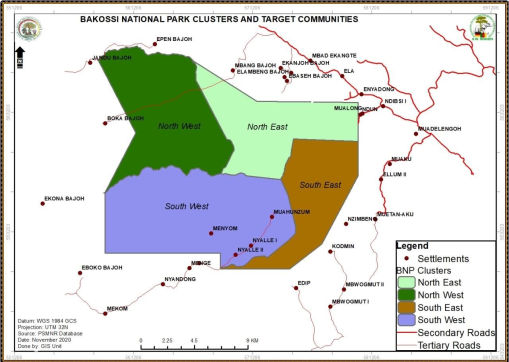
Figure 1. Map of Bakossi National Park Source: PSMNR [41].
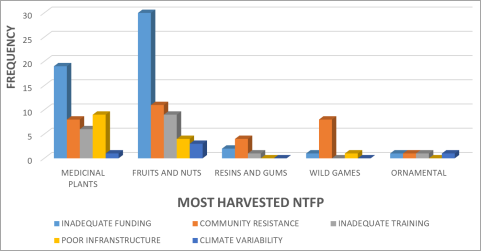
Figure 2. The main challenge faced in implementing conservation strategy and the most harvested NTFP.
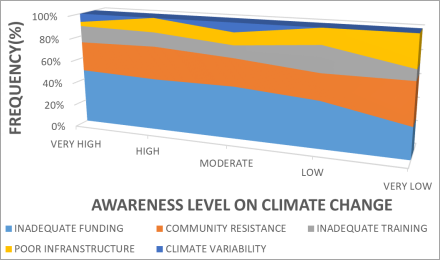
Figure 3. The main challenge faced in implementing conservation strategy and the awareness level of local community on climate change.
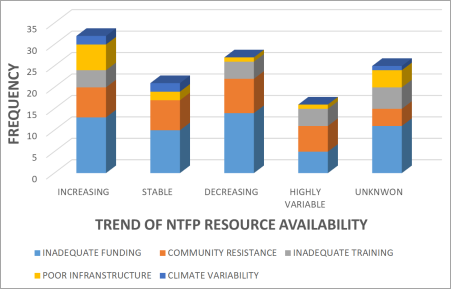
Figure 4. The main challenge faced in implementing conservation strategy and the trend of NTFP resource availability over the past decade.
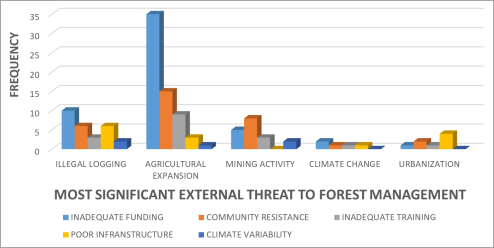
Figure 5. The main challenge faced in implementing conservation strategy and the most significant external threat to forest management.
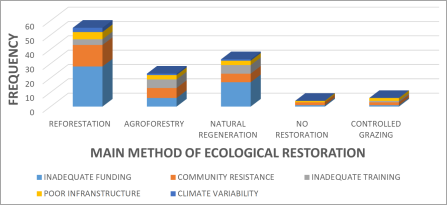
Figure 6. The main challenge faced in implementing conservation strategy and the main method of ecological restoration.
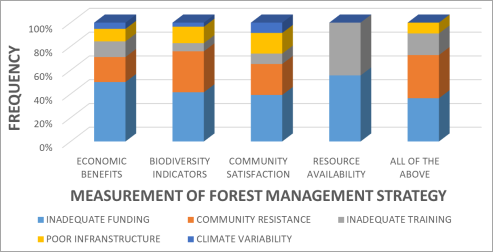
Figure 7. The main challenge faced in implementing conservation strategy and the measurement of forest management success.
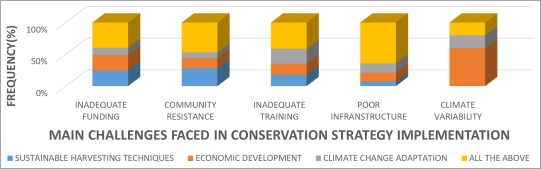
Figure 8. The main challenges faced in implementing conservation strategy and Forest management training.

Information


 Share This Article
 Twitter
 Linked In
 Facebook
 Copy
Copy Download