1. Introduction
The growing demand for sustainable and nutrient-dense foods has intensified interest in underutilized legumes as alternative sources of dietary protein. In many low- and middle-income countries, particularly in sub-Saharan Africa, food and nutrition insecurity remains a major challenge, necessitating the exploration of resilient crops that can contribute to dietary diversification and improved nutritional outcomes. Beyond their nutritional value, the utilization of underexploited legumes offers an opportunity to broaden dietary diversity, strengthen local food systems, and develop affordable, nutrient-rich food products that can contribute to improved nutrition and healthier diets
| [1] | Samtiya, M., Aluko, R. E. & Dhewa, T. Plant food anti-nutritional factors and their reduction strategies: an overview. Food Production, Processing and Nutrition 2020 2: 1 2, 6- (2020). https://doi.org/10.3390/foods10040839 |
| [2] | FAO. The State of Food Security and Nutrition in the World 2024. The State of Food Security and Nutrition in the World 2024 https://doi.org/10.4060/CD1254EN |
[1, 2]
.
Among these underexploited legumes,
Mucuna pruriens (velvet bean) has attracted considerable attention due to its high protein content (23-35%), appreciable levels of dietary fibre, minerals, and bioactive compounds, as well as its adaptability to marginal environments. The crop is drought tolerant, capable of biological nitrogen fixation, and suitable for low-input agricultural systems, making it an attractive candidate for sustainable food production in tropical regions
| [3] | Mugendi J, Njagi E, Kuria E, Mwasaru M, Mureithi J & Apostolides Z. Effects of Processing Methods on The Protein Quality of Mucuna Bean (Mucuna pruriens L.). AJFAND 10, 2394-2412 (2010). |
| [4] | Siddhuraju, P., Vijayakumari, K. & Janardhanan, K. Chemical Composition and Protein Quality of the Little-Known Legume, Velvet Bean (Mucuna pruriens (L.) DC.). J. Agric. Food Chem. 44, 2636-2641 (1996). https://doi.org/10.1021/jf950776x |
[3, 4]
. Consequently,
Mucuna has been proposed as a promising ingredient for the development of functional and protein-rich foods.
Despite these advantages, the utilization of
Mucuna pruriens for human consumption remains limited because of its high content of antinutritional and potentially toxic compounds. The principal concern is L-3,4-dihydroxyphenylalanine (L-DOPA), a non-protein amino acid that can account for a substantial proportion of seed dry matter. Excessive intake of L-DOPA may cause adverse physiological effects, thereby limiting the direct consumption of untreated seeds. In addition to L-DOPA,
Mucuna contains phytates, tannins, oxalates, trypsin inhibitors, and cyanogenic compounds, all of which may impair protein digestibility, mineral bioavailability, and overall nutritional quality
| [4] | Siddhuraju, P., Vijayakumari, K. & Janardhanan, K. Chemical Composition and Protein Quality of the Little-Known Legume, Velvet Bean (Mucuna pruriens (L.) DC.). J. Agric. Food Chem. 44, 2636-2641 (1996). https://doi.org/10.1021/jf950776x |
| [5] | Vadivel, V. & Janardhanan, K. Nutritional and anti-nutritional composition of velvet bean: an under-utilized food legume in south India. Int. J. Food Sci. Nutr. 51, 279-287 (2000).
https://doi.org/10.1080/09637480050077167 |
[4, 5]
. Recent reviews have further emphasized that antinutritional factors remain one of the primary obstacles to the wider adoption of legumes and other plant-based proteins in human diets
| [1] | Samtiya, M., Aluko, R. E. & Dhewa, T. Plant food anti-nutritional factors and their reduction strategies: an overview. Food Production, Processing and Nutrition 2020 2: 1 2, 6- (2020). https://doi.org/10.3390/foods10040839 |
| [6] | Bajo, W., Chambal, B. & Macuamule, C. Effect of processing methods on mineral bioaccessibility in common beans. Scientific Reports 2026 16: 1 16, 4593- (2026).
https://doi.org/10.1038/s41598-025-34639-3 |
[1, 6]
.
Various processing techniques have been developed to improve the nutritional quality and safety of
Mucuna seeds. Traditional approaches such as dehulling, soaking, germination, fermentation, boiling, roasting, and steaming have been shown to reduce antinutritional factors through physical removal, enzymatic degradation, leaching, and thermal inactivation . Recent studies have demonstrated that appropriate processing techniques can improve the nutritional quality and bioavailability of nutrients in legumes, while reducing or modifying antinutritional factors and other undesirable compounds, thereby enhancing their safety, digestibility, and suitability for human consumption
| [1] | Samtiya, M., Aluko, R. E. & Dhewa, T. Plant food anti-nutritional factors and their reduction strategies: an overview. Food Production, Processing and Nutrition 2020 2: 1 2, 6- (2020). https://doi.org/10.3390/foods10040839 |
| [8] | Nkhata, S. G., Ayua, E., Kamau, E. H. & Shingiro, J. B. Fermentation and germination improve nutritional value of cereals and legumes through activation of endogenous enzymes. Food Sci. Nutr. 6, 2446-2458 (2018).
https://doi.org/10.1002/fsn3.846 |
| [9] | Ezegbe, C. C., Nwosu, J. N., Owuamanam, C. I., Victor-Aduloju, T. A. & Nkhata, S. G. Proximate composition and anti-nutritional factors in Mucuna pruriens (velvet bean) seed flour as affected by several processing methods. Heliyon 9, e18728 (2023). https://doi.org/10.1016/j.heliyon.2023.e18728 |
[1, 8, 9]
. Among these methods, soaking and thermal treatments are particularly attractive because they are inexpensive, easy to adopt at household and artisanal scales, and compatible with traditional food-processing practices.
In West Africa, Toubani is a traditional steamed dough food commonly prepared from cowpea (
Vigna unguiculata) and widely consumed as a breakfast meal and street food
| [10] | Hongbete, F., Tidjani, A.-K. & Kindossi, J. M. Traditional production technology, consumption and quality attributes of toubani: A ready-to-eat legume food from West Africa. Afr. J. Biotechnol. 16, 1123-1130 (2017).
https://doi.org/10.5897/AJB2017.15913 |
| [11] | Bio Nikki Sare, O. É., Hongbete, F., Kindossi, M. J., Houssou, P. A. F. & Tchobo, P. F. Evaluation of microbiological and chemical quality of Toubani, a traditional African dish made from cowpea. Rev. Mar. Sci. Agron. Vét. 11, 395-400 (2023). https://doi.org/10.5281/zenodo.10351545 |
[10, 11]
. The product is appreciated for its affordability, sensory quality, and nutritional value
| [10] | Hongbete, F., Tidjani, A.-K. & Kindossi, J. M. Traditional production technology, consumption and quality attributes of toubani: A ready-to-eat legume food from West Africa. Afr. J. Biotechnol. 16, 1123-1130 (2017).
https://doi.org/10.5897/AJB2017.15913 |
| [12] | Bio Nikki Sare O. E., Hongbete F., Kindossi M. J., Houssou A. P. F., Tchobo P. F & Bagoudou A. F. Effect of Processing on Physicochemical and Nutritional Quality of Toubani, a Traditional Steamed Cowpea-Based Moist Paste from West Africa. Int. J. Adv. Res. (Indore). 13, 511-522 (2025).
https://doi.org/10.21474/IJAR01/21938 |
[10, 12]
The incorporation of
Mucuna pruriens into Toubani production could offer an innovative strategy for diversifying protein sources, promoting the utilization of underexploited legumes, and increasing the nutritional value of traditional foods. However, limited information is available regarding the effectiveness of the complete Toubani processing chain in reducing antinutritional compounds while preserving nutritional quality.
Most previous studies on
Mucuna pruriens have evaluated the effects of individual processing techniques such as soaking, boiling, fermentation, germination, or roasting on nutrient composition and antinutritional factors
| [3] | Mugendi J, Njagi E, Kuria E, Mwasaru M, Mureithi J & Apostolides Z. Effects of Processing Methods on The Protein Quality of Mucuna Bean (Mucuna pruriens L.). AJFAND 10, 2394-2412 (2010). |
| [7] | Mugendi, JB, Njagi, ENM, Kuria, EN, Mwasaru, MA, Mureithi, JG & Apostolides, Z. Effects of processing technique on the nutritional composition and anti-nutrient content of mucuna bean (Mucuna pruriens L.). African Journal of Food Science vol. 4 156-166 Preprint at
http://hdl.handle.net/2263/16076 (2010) |
| [9] | Ezegbe, C. C., Nwosu, J. N., Owuamanam, C. I., Victor-Aduloju, T. A. & Nkhata, S. G. Proximate composition and anti-nutritional factors in Mucuna pruriens (velvet bean) seed flour as affected by several processing methods. Heliyon 9, e18728 (2023). https://doi.org/10.1016/j.heliyon.2023.e18728 |
[3, 7, 9]
.
Despite the growing interest in Mucuna as an underutilized, protein-rich legume with potential to contribute to food and nutrition security, limited attention has been given to the sequential transformations that occur during the preparation of traditional Mucuna-based foods. In particular, the combined evolution of physicochemical properties, mineral composition, antinutritional factors, and their interrelationships throughout processing remains poorly understood. Addressing this knowledge gap is essential because the nutritional and technological quality of Mucuna products is determined not only by the composition of the raw seeds but also by the extent to which processing modifies nutrients and undesirable compounds. A comprehensive assessment of these changes, supported by multivariate statistical approaches, can therefore provide valuable insights into the effectiveness of traditional processing practices, identify critical processing steps associated with detoxification and nutritional improvement, and support the development and optimization of safer, more nutritious, and culturally appropriate Mucuna-based
While these studies have provided valuable information on the efficacy of specific treatments, they do not reflect the complexity of traditional food-processing systems in which several operations are applied sequentially. Toubani production represents a distinct technological system that combines dehulling, prolonged soaking, drying, milling, dough formation, and steaming into a structured processing chain. The cumulative and interactive effects of these operations on the detoxification and nutritional quality of Mucuna have not been previously documented.
The present study aimed to evaluate the effects of successive processing steps involved in Toubani production on the proximate composition, mineral content, and antinutritional factors of Mucuna pruriens beans. We hypothesized that (i) the sequential processing operations would significantly reduce the levels of major antinutritional factors, particularly L-DOPA, tannins, phytates, oxalates, and cyanogenic compounds; and (ii) despite some processing losses, the final Toubani product would retain substantial amounts of proteins, minerals, and other nutrients, thereby improving its suitability for human consumption.
Therefore, the objective of this study was to evaluate the effects of dehulling, soaking, drying, milling, dough preparation, and steaming on the physicochemical properties, mineral composition, and antinutritional factors of Mucuna pruriens during the production of Toubani. Particular emphasis was placed on assessing the reduction of L-DOPA and other antinutritional compounds, determining nutrient retention, and elucidating compositional relationships using Pearson correlation analysis and principal component analysis. The findings contribute to current efforts aimed at valorizing underutilized legumes and developing safe, nutritious, and sustainable plant-based foods.
2. Materials and Methods
2.1. Study Design
The experiment was conducted using two independent processing batches (biological replicates) prepared on separate occasions following the same Toubani production protocol. For each batch, samples were collected at five processing steps: raw Mucuna (RM), dehulled Mucuna (DM), soaked dehulled Mucuna (SDM), dried soaked Mucuna (DSM), and steamed Toubani (TOU). All physicochemical, mineral, and antinutritional analyses were performed in triplicate. Therefore, the study incorporated both biological replication (two independent processing batches) and analytical replication (triplicate measurements).
2.2. Raw Materials
Mature beans of Mucuna pruriens brown-white seed were obtained from agri-livestock farmers who received the seed for soil restoration and regeneration during the project BENCOUT AGRODUR in Tchaourou, Borgou, Benin. Foreign materials broken seeds, and damaged seeds were manually removed prior to processing.
2.3. Processing of Mucuna into Toubani
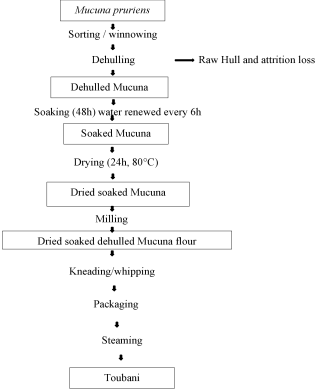
Mucuna beans were first crushed in a mill to facilitate hull removal. Following crushing, the beans were manually winnowed and cleaned to remove hull fragments and foreign materials, resulting in dehulled Mucuna beans for subsequent processing. The dehulled beans were washed thoroughly and soaked using a bean-to-water ratio of 1:5 (w/v) for 48 hours at ambient temperature. The soaking water was renewed every 6 hours to facilitate the removal of water soluble anti-nutrient compounds. Following soaking, the beans were then dried at 80°C for 24 hours and subsequently milled into flour. The flour was mixed with water and thoroughly kneaded to achieve a homogeneous and smooth dough. The resulting dough was packaged in suitable steam-resistant containers and steamed at 120°C for 60 min (
Figure 1). After steaming, the Toubani samples were allowed to cool to room temperature before physicochemical, mineral, and antinutritional analyses were conducted.
Figure 1. Toubani based Mucuna beans processing technology.
2.4. Sample Preparation
Prior to analysis, sample of raw Mucuna beans, intermediate product and Toubani were collected during Toubani production, were finely ground using a mixer and passed through a 0.5 mm sieve to obtain a homogeneous powder. The milled samples were stored in airtight containers at refrigerated conditions until physicochemical and mineral analyses were performed.
2.5. Physicochemical Analysis
Moisture ash, crude fat, crude protein, crude fibre contents were determined according to standard AOAC methods
| [13] | AOAC. Official Methods of Analysis of the Association of Official Analytical Chemists. (1995). |
[13]
. Carbohydrate content was calculated by difference and expressed as nitrogen-free extractives (NFE). Metabolizable energy values were estimated using Atwater conversion factors
| [14] | MacLean, W. C. & Warwick, Penny. Food Energy : Methods of Analysis and Conversion Factors : Report of a Technical Workshop, Rome, 3-6 December 2002. (Food and Agriculture Organization of the United Nations, Rome, 2003). |
[14]
.
2.6. Mineral Analysis
Mineral composition was determined after wet digestion of samples using a nitric acid-perchloric acid mixture. Approximately 0.5 g of powdered sample was digested with concentrated nitric acid (HNO
3) and perchloric acid (HClO
4) until complete mineralization was achieved. The digested solution was filtered and diluted to a known volume with deionized water. Potassium (K), sodium (Na), calcium (Ca), magnesium (Mg), iron (Fe), zinc (Zn), copper (Cu), manganese (Mn), and phosphorus (P) were quantified using Atomic Absorption Spectrophotometry (AAS) and flame photometry, depending on the element analyzed
| [15] | Rico, R., Bulló, M. & Salas-Salvadó, J. Nutritional composition of raw fresh cashew (Anacardium occidentale L.) kernels from different origin. Food Sci. Nutr. 4, 329 (2015).
https://doi.org/10.1002/fsn3.294 |
[15]
. Calibration curves were prepared using certified standard solutions prior to analysis. Analytical blanks and calibration standards were included throughout the analytical procedure to verify instrument performance and analytical accuracy.
2.7. Evaluation of Mineral Quality Indices
Two nutritionally relevant mineral ratios were calculated:
Calcium-to-Phosphorus Ratio (Ca/P)
Sodium-to-Potassium Ratio (Na/K)
These indices were used to assess the nutritional quality of the mineral profile regarding bone health and cardiovascular health, respectively
| [16] | Calvo, M. S. Dietary phosphorus, calcium metabolism and bone. Journal of Nutrition 123, 1627-1633 (1993).
https://doi.org/10.1093/jn/123.9.1627 |
| [17] | Calvo, M. S. & Tucker, K. L. Is phosphorus intake that exceeds dietary requirements a risk factor in bone health? Ann. N. Y. Acad. Sci. 1301, 29-35 (2013).
https://doi.org/10.1111/nyas.12300 |
| [18] | WHO. Guideline. Sodium Intake for Adults and Children. (World Health Organization, 2012). |
| [19] | WHO. Potassium intake for adults and children. WHO, Geneva, Switzerland. Geneva. 1-42 (2012). |
[16-19]
.
2.8. Antinutrient Analysis
L-DOPA content was determined using a modified LC-MS/MS method based on Hasegawa et al
| [20] | Hasegawa, T., Takahashi, K., Fukiwake, T., Saijo, M. & Motoki, Y. Enantiomeric determination of DOPA in dietary supplements containing Mucuna pruriens by liquid chromatography/mass spectrometry. Shokuhin Eiseigaku Zasshi 54, 379-383 (2013). https://doi.org/10.3358/shokueishi.54.379 |
[20]
and Yumoto et al
| [21] | Yumoto, E., Yanagihara, N. & Asahina, M. The simple and rapid quantification method for L-3,4-dihydroxyphenylalanine (L-DOPA) from plant sprout using liquid chromatography-mass spectrometry. Plant Biotechnology 39, 199-204 (2022). https://doi.org/10.5511/plantbiotechnology.21.1126a |
[21]
. Briefly, 50 mg of flour from each
Mucuna samples were extracted with 10 ml of 80% methanol (MeOH) containing L-DOPA-d3 (10 mg/100 mL MeOH) as an internal standard. The mixture was homogenized and centrifugated at 3500 rpm for 10 min. The resulting supernatant was collected, diluted 10-to 1000-fold as required, and filtered through a 0.22 µm nylon membrane filter. The filtrate was subsequently analysed using liquid chromatography-tandem mass spectrometry (LC-MS/MS) for L-dopa quantification. Phytate content was determined using ferric ion precipitation and colorimetric quantification methods
| [22] | Raboy, V., Gibson, R. S., Bailey, K. B. & King, J. C. Comparison of four methods for phytate analysis in plant-based foods. Journal of Food Composition and Analysis 90, 103481 (2020). https://doi.org/10.1016/j.jfca.2020.103481 |
[22]
. Tannins were determined using the Folin-Denis method described by Elgailani e al.
| [23] | Elgailani, I. E. H. & Ishak, C. Y. Determination of Tannins of Three Common Acacia Species of Sudan. Advances in Chemistry 2014, 192708 (2014).
https://doi.org/10.1155/2014/192708 |
[23]
. Total oxalates were determined by acid extraction following titrimetric analysis
| [9] | Ezegbe, C. C., Nwosu, J. N., Owuamanam, C. I., Victor-Aduloju, T. A. & Nkhata, S. G. Proximate composition and anti-nutritional factors in Mucuna pruriens (velvet bean) seed flour as affected by several processing methods. Heliyon 9, e18728 (2023). https://doi.org/10.1016/j.heliyon.2023.e18728 |
[9]
. Trypsin inhibitor activity (TIA) was determined using a standard enzymatic inhibition method reported by Nwosu et al.
| [24] | Nwosu, C. U., Hassan, S. W., Abubakar, M. G. & Ebbo, A. A. Anti-diarrhoeal and toxicological studies of leaf extracts of Khaya senegalensis. Journal of Pharmacology and Toxicology 7, 1-10 (2012). https://doi.org/10.3923/jpt.2012.1.10 |
[24]
. Hydrogen cyanide content was determined using alkaline picrate method described by Olawuyi et al.
| [25] | Olawuyi, O. J., Adeyeye, E. F. & Ajayi, I. I. Morphological Characterisation and Cyanide Content Determination in Phaseolus lunatus Linn. (Lima Beans) Accessions. J. Adv. Biol. Biotechnol. 26, 11-27 (2023).
https://doi.org/10.9734/jabb/2023/v26i7643 |
[25]
.
2.9. Anti-nutrient Reduction Efficiency
The percentage reduction of each antinutrient during processing was calculated using equation:
Where: = concentration in raw Mucuna beans; = concentration after processing.
The reduction rates were used to evaluate detoxification efficiency throughout Toubani production
2.10. Statistical Analysis
Data were generated from two independent processing batches (biological replicates), with each analytical determination performed in triplicate. Results are expressed as mean ± standard error. Normality and homogeneity of variances were assessed prior to hypothesis testing. Because heteroscedasticity was detected among processing steps, Welch’s one-way ANOVA was applied to evaluate processing effects on physicochemical, mineral, and antinutritional parameters. Pairwise comparisons were performed using the Games-Howell post hoc test. Differences were considered significant at p ˂ 0.05. Pearson correlation analysis was used to investigate relationships among nutritional, mineral, and antinutritional variables. Principal component analysis (PCA) was performed on standardized data to identify the main factors explaining variability among processing steps and to visualize compositional changes throughout Toubani production. Statistical analyses were carried out using Statistica version 7.1 (StatSoft, France) and Jamovi software version 2.7.12.
3. Results and Discussion
3.1. Changes in Physicochemical Composition During Processing
Physicochemical changes occurring from
Mucuna pruriens into Toubani during processing are summarized in
Table 1. The pH decreased progressively from 6.50 in raw
Mucuna beans to 4.80 in the final product (Toubani), with soaking constituting the major acidification step. Games-Howell comparisons indicated that raw and dehulled samples did not differ significantly (p ˃ 0.05), whereas soaked (5.2), dried (5.11), and steamed (4.80) products formed a statistically distinct group. This decrease may result from the solubilization of organic compounds and spontaneous microbial or enzymatic activities occurring during hydration
| [26] | Purlis, E., Cevoli, C. & Fabbri, A. Modelling Volume Change and Deformation in Food Products/Processes: An Overview. Foods 10, 778 (2021). https://doi.org/10.3390/foods10040778 |
| [27] | Miano, A. C. & Augusto, P. E. D. The Hydration of Grains: A Critical Review from Description of Phenomena to Process Improvements. Compr. Rev. Food Sci. Food Saf. 17, 352-370 (2018). https://doi.org/10.1111/1541-4337.12328 |
[26, 27]
.
Table 1. Changes in physicochemical composition of Mucuna to Toubani.
Parameters | Raw Mucuna | Dehulled Mucuna | Soaked Dehulled Mucuna | Dried soaked Mucuna | Toubani |
pH | 6.50 ± 0.04a | 6.50 ± 0.03a | 5.26 ± 0.31b | 5.11 ± 0.04b | 4.80 ± 0.01b |
Moisture (%) | 9.77 ± 0.05a | 9.64 ± 0.07a | 10.8 ±0.10b | 8.47 ± 0.29c | 73.9 ± 0.08d |
Dry matter (%) | 90.2 ± 0.05a | 90.4 ± 0.07a | 89.2 ± 0.10b | 91.5 ± 0.29c | 26.1 ± 0.08d |
Crude Protein (g/100 g DM) | 28.3 ± 0.81a | 26.5 ± 0.18b | 21.7 ± 0.19c | 23.5 ± 0.13c | 25.0 ± 0.04b |
Crude Fat (g/100 g DM) | 6.67 ± 0.59a | 5.43 ± 0.12ab | 4.39 ± 0.31bc | 3.49 ± 0.09c | 3.21 ± 0.03c |
Crude Fiber (g/100 g DM) | 8.67 ± 0.33a | 7.26 ± 0.13b | 7.75 ± 0.06bc | 8.38 ± 0.21ac | 8.89 ± 0.03a |
Ash (g/100 g DM) | 4.01 ± 0.44a | 3.54 ± 0.23ab | 3.79 ± 0.12a | 2.82 ± 0.18bc | 2.28 ± 0.10c |
Nitrogen Free Extractives (NFE) (g/100 g DM) | 47.4 ± 0.82a | 52.3 ± 0.32b | 57.3 ± 0.18c | 56.8 ± 0.18c | 34.6 ± 0.09d |
Energy (kJ/100 g) | 1540 ± 14.0a | 1545 ± 1.52a | 1511 ± 6.12ab | 1498 ± 4.62b | 1134 ± 2.29c |
Values are means of three replicates. Means in the same line with different superscripts (a, b, c, d) are significantly different (p < 0.05); Mean ± standard error, n = 6, corresponding to two independent batches analyzed in triplicate.
Moisture content remained relatively low in the raw and dehulled Mucuna flour samples (9.77-9.64%) but increased to 10.8% after soaking, reflecting both water absorption by the dehulled seeds and the presence of added soaking water. A much greater increase was observed in the Toubani (73.9%), which should be interpreted primarily in relation to the deliberate addition of water during dough preparation, followed by steaming, rather than as an effect of steaming alone. The resulting high moisture content is characteristic of steamed, dough-based legume products and contributes to the soft texture and palatability of Toubani. Accordingly, the marked decrease in dry matter from 91.5% in the dried soaked Mucuna to 26.1% in Toubani mainly reflects the incorporation and retention of water during dough preparation and steaming. These changes highlight the importance of considering water addition and processing conditions when interpreting moisture and dry matter variations across the Mucuna processing sequence.
Crude protein decreased significantly after dehulling and soaking, from 28.3 to 21.7 g/100 g DM, likely due to leaching of soluble nitrogenous compounds into soaking water. Similar reductions have been reported in legumes subjected to hydration and thermal treatment, where protein losses are generally limited and do not significantly compromise nutritional value
| [8] | Nkhata, S. G., Ayua, E., Kamau, E. H. & Shingiro, J. B. Fermentation and germination improve nutritional value of cereals and legumes through activation of endogenous enzymes. Food Sci. Nutr. 6, 2446-2458 (2018).
https://doi.org/10.1002/fsn3.846 |
| [9] | Ezegbe, C. C., Nwosu, J. N., Owuamanam, C. I., Victor-Aduloju, T. A. & Nkhata, S. G. Proximate composition and anti-nutritional factors in Mucuna pruriens (velvet bean) seed flour as affected by several processing methods. Heliyon 9, e18728 (2023). https://doi.org/10.1016/j.heliyon.2023.e18728 |
| [28] | Abdulsalami, M. & Sheriff, H. Effect of processing on the proximate composition and mineral content of Bambara groundnut (voandezeia subterranean). Bayero Journal of Pure and Applied Sciences 3, (2010).
https://doi.org/10.35629/5252-0210104107 |
| [29] | Sowdhanya, D., Singh, J., Rasane, P., Kaur, S., Kaur, J., Ercisli, S., & Verma, H. Nutritional significance of velvet bean (Mucuna pruriens) and opportunities for its processing into value-added products. J. Agric. Food Res. 15, 100921 (2024). https://doi.org/10.1016/j.jafr.2023.100921 |
[8, 9, 28, 29]
. Despite these losses, the final product remained high protein content (25.0 g/100 g DM), confirming the suitability of
Mucuna pruriens as a valuable plant protein source.
Crude fat content decreased progressively throughout processing, from 6.67 g/100 g DM in raw Mucuna to 3.21 g/100 g DM in Toubani, corresponding to an overall reduction of approximately 52%. This decrease may reflect the combined effects of dehulling, soaking, and subsequent processing operations, which can promote the removal or redistribution of lipid-containing fractions within the food matrix. In particular, soaking may facilitate the loss of lipid-associated components through the soaking medium, while subsequent processing may further modify the distribution and extractability of lipids. Similar reductions in crude fat have been reported during the processing of pulses and underutilized legumes, including Bambara groundnut
| [1] | Samtiya, M., Aluko, R. E. & Dhewa, T. Plant food anti-nutritional factors and their reduction strategies: an overview. Food Production, Processing and Nutrition 2020 2: 1 2, 6- (2020). https://doi.org/10.3390/foods10040839 |
| [30] | Adegunwa, M. O., Adebowale, A. A., Bakare, H. A. & Kalejaiye, K. K. Effects of treatments on the antinutritional factors and functional properties of bambara groundnut (Voandzeia Subterranea) flour. J. Food Process. Preserv. 38, 1875-1881 (2014). https://doi.org/10.1111/jfpp.12159 |
[1, 30]
.
Fiber content was less affected. Dehulling caused an initial decrease due to removal of fibrous seed coats, whereas drying and steaming slightly increased apparent fibre concentration. The final Toubani showed fibre levels comparable to raw Mucuna beans.
Ash content decreased significantly (p ˂ 0.05) from 4.01 to 2.28 g/100 g DM, indicating mineral losses through soaking and processing water. Similarly, nitrogen-free extract (NFE) increased after dehulling and soaking but decreased significantly in Toubani because of compositional redistribution associated with hydration. The energy value decreased significantly (p ˂ 0.05) from 1540 to 1134 kJ/100 g in Toubani, mainly due to moisture incorporation and fat reduction.
Overall, soaking was the critical stage affecting chemical composition, while steaming mainly modified moisture content and product acidity. The final Toubani retained substantial protein and fibre contents despite moderate nutrient losses.
3.2. Changes in Mineral Composition During Processing
Significant differences were observed for most minerals during processing (p ˂ 0.05), whereas magnesium and the Ca/P ratio remained relatively stable (
Table 2).
Table 2. Changes in mineral composition of Mucuna into toubani.
Parameters | Raw Mucuna | Dehulled Mucuna | Soaked Dehulled Mucuna | Dried soaked Mucuna | Toubani |
Calcium (Ca) | 701.3 ± 33.6a | 595.7 ± 4.3b | 574.1 ± 3.9b | 626.2 ± 7.4b | 624.3 ±0.0b |
Magnesium (Mg) | 334.9 ± 11.7a | 339.2 ± 0.6a | 337.6 ± 0.6a | 341.1 ± 0.9a | 344.8 ± 0.3a |
Potassium (K) | 1652.6 ± 45.9a | 1523.9 ± 7.6b | 1487.6 ±0.9b | 1501.3 ± 0.6b | 1503.9 ± 0.4b |
Iron (Fe) (mg/100 g) | 13.9 ± 0.6a | 12.0 ± 0.1b | 11.2 ±0.1b | 11.7 ± 0.01b | 11.8 ± 0.0b |
Zinc (Zn) (mg/100 g) | 5.59 ± 0.4a | 3.83 ± 0.0b | 3.88 ±0.0b | 4.17 ± 0.0b | 4.26 ±0.0b |
Phosphorus (P) (mg/100 g) | 473.9 ± 9.3a | 382.4 ± 12.6b | 377.0 ± 1.0b | 387.0 ± 0.3b | 388.4 ± 0.2b |
Sodium (Na) (mg/100 g) | 128.1 ± 3.7a | 123.4 ± 1.6a | 103.0 ± 0.7b | 109.0 ± 0.2b | 110.6 ± 0.2b |
Na/K | 0.0775a | 0.0810b | 0.0693c | 0.0726cd | 0.0735d |
Ca/P | 1.48 ± 0.07a | 1.56 ± 0.04a | 1.52 ± 0.01a | 1.62 ± 0.02a | 1.61 ± 0.0a |
Values are means of three replicates. Means in the same line with different superscripts (a, b, c, d) are significantly different (p < 0.05); Mean ± standard error. n = 6, corresponding to two independent batches analyzed in triplicate.
Calcium content decreased from 701.3 to 624.3 mg/100 g, while phosphorus decreased from 473.9 to 388.4 mg/100 g. Potassium, the most abundant mineral, declined from 1652.6 to 1503.9 mg/100 g. Iron and zinc also decreased significantly after dehulling and soaking. The reductions are attributable to mineral diffusion into soaking water and the removal of mineral rich outer tissues during dehulling. Similar observations have been reported in studies investigating processing methods for Bambara groundnut
| [31] | Adebowale, A. A., Awolala, F. M., Fetuga, G. O., Sanni, S. A. & Adegunwa, M. O. Effect of soaking pre-treatments on nutritional composition and functional properties of Bambara groundnut (Vigna Subterranea) flour. Acta Hortic. 979, 139-146 (2013). https://doi.org/10.17660/ActaHortic.2013.979.12 |
[31]
.
In contrast, magnesium remained statistically unchanged throughout processing, Magnesium remained statistically unchanged throughout processing, likely because it is predominantly localized within the cotyledon tissues and forms relatively stable complexes with intracellular components. Consequently, magnesium appears less susceptible to leaching during soaking than more mobile minerals such as potassium and sodium.
Sodium decreased significantly after soaking but remained relatively stable thereafter. Consequently, the Na/K ratio remained very low (0.069-0.081), well below the recommended threshold of 01 for cardiovascular health.
3.3. Reduction of Antinutritional Factor During Processing
Table 3 presents the changes in antinutritional composition during Toubani processing. L-DOPA showed the greatest reduction, decreasing from 6680 mg/100 g in raw seeds to 94.7 mg/100 g in Toubani, corresponding to a removal efficiency of 98.6% (
Table3;
Figure 1). The final concentration decreased to 94.7 mg/100 g, which is below the literature-based target value of 100 mg/100 g frequently proposed for processed
Mucuna pruriens products intended for human consumption. This result indicates a substantial reduction in the toxicological risk associated with L-DOPA
| [4] | Siddhuraju, P., Vijayakumari, K. & Janardhanan, K. Chemical Composition and Protein Quality of the Little-Known Legume, Velvet Bean (Mucuna pruriens (L.) DC.). J. Agric. Food Chem. 44, 2636-2641 (1996). https://doi.org/10.1021/jf950776x |
| [29] | Sowdhanya, D., Singh, J., Rasane, P., Kaur, S., Kaur, J., Ercisli, S., & Verma, H. Nutritional significance of velvet bean (Mucuna pruriens) and opportunities for its processing into value-added products. J. Agric. Food Res. 15, 100921 (2024). https://doi.org/10.1016/j.jafr.2023.100921 |
[4, 29]
. The progressive reduction indicates complementary effects of dehulling, soaking, and steaming process. Because L-DOPA is highly water-soluble, soaking appears to be the most influential operation
| [9] | Ezegbe, C. C., Nwosu, J. N., Owuamanam, C. I., Victor-Aduloju, T. A. & Nkhata, S. G. Proximate composition and anti-nutritional factors in Mucuna pruriens (velvet bean) seed flour as affected by several processing methods. Heliyon 9, e18728 (2023). https://doi.org/10.1016/j.heliyon.2023.e18728 |
| [29] | Sowdhanya, D., Singh, J., Rasane, P., Kaur, S., Kaur, J., Ercisli, S., & Verma, H. Nutritional significance of velvet bean (Mucuna pruriens) and opportunities for its processing into value-added products. J. Agric. Food Res. 15, 100921 (2024). https://doi.org/10.1016/j.jafr.2023.100921 |
[9, 29]
. The recorded reduction exceeds or equals those reported for many conventional Mucuna-processing systems.
Table 3. Changes in antinutrients composition of Mucuna into Toubani.
Parameters | Raw Mucuna | Dehulled Mucuna | Soaked Dehulled Mucuna | Dried soaked Mucuna | Toubani | Proposed target level based on literature* |
L-DOPA | Content (mg/100 g) | 6680.0 ± 149.8a | 4393.3 ± 76.7b | 1536.7 ± 33.3c | 500.0 ± 158.7d | 94.7 ± 2.8d | <100 | [4] | Siddhuraju, P., Vijayakumari, K. & Janardhanan, K. Chemical Composition and Protein Quality of the Little-Known Legume, Velvet Bean (Mucuna pruriens (L.) DC.). J. Agric. Food Chem. 44, 2636-2641 (1996). https://doi.org/10.1021/jf950776x | | [29] | Sowdhanya, D., Singh, J., Rasane, P., Kaur, S., Kaur, J., Ercisli, S., & Verma, H. Nutritional significance of velvet bean (Mucuna pruriens) and opportunities for its processing into value-added products. J. Agric. Food Res. 15, 100921 (2024). https://doi.org/10.1016/j.jafr.2023.100921 |
[4, 29] |
RD (%) | | 34.2 | 77.0 | 92.5 | 98.6 | |
Phytate | Content (mg/100 g) | 22.7 ± 0.7a | 18.6 ± 0.3b | 17.2 ± 0.1bc | 15.7 ± 0.7c | 13.1 ± 0.1d | <5.0 |
RD (%) | | 18.1 | 24.2 | 30.8 | 42.3 | |
Tannins | Content (mg TAE/g) | 8.75 ±0.6a | 1.13 ± 0.1b | 0.86 ± 0.04b | 0.32 ± 0.01b | 0.34 ±0.01b | <1.0 | [1] | Samtiya, M., Aluko, R. E. & Dhewa, T. Plant food anti-nutritional factors and their reduction strategies: an overview. Food Production, Processing and Nutrition 2020 2: 1 2, 6- (2020). https://doi.org/10.3390/foods10040839 | | [6] | Bajo, W., Chambal, B. & Macuamule, C. Effect of processing methods on mineral bioaccessibility in common beans. Scientific Reports 2026 16: 1 16, 4593- (2026).
https://doi.org/10.1038/s41598-025-34639-3 | | [32] | Popova, A. & Mihaylova, D. Antinutrients in Plant-based Foods: A Review. Open Biotechnol. J. 13, 68-76 (2019).
http://dx.doi.org/10.2174/1874070701913010068 |
[1, 6, 32] |
RD (%) | | 87.1 | 90.2 | 96.3 | 96.2 | |
Oxalates | Content (mg/100 g) | 443.6 ±29.6a | 375.0 ± 7.8ab | 361.0 ± 35.1ab | 302.5 ± 1.2 b | 282.1 ± 3.6b | <50 | [1] | Samtiya, M., Aluko, R. E. & Dhewa, T. Plant food anti-nutritional factors and their reduction strategies: an overview. Food Production, Processing and Nutrition 2020 2: 1 2, 6- (2020). https://doi.org/10.3390/foods10040839 | | [9] | Ezegbe, C. C., Nwosu, J. N., Owuamanam, C. I., Victor-Aduloju, T. A. & Nkhata, S. G. Proximate composition and anti-nutritional factors in Mucuna pruriens (velvet bean) seed flour as affected by several processing methods. Heliyon 9, e18728 (2023). https://doi.org/10.1016/j.heliyon.2023.e18728 |
[1, 9] |
RD (%) | | 15.54 | 18.69 | 31.76 | 36.49 | |
Trypsin Inhibitor Activity | Content (TIU/mg protein) | 40.2 ± 3.0a | 37.7 ± 0.6a | 29.8 ± 0.3b | 14.5 ± 0.2c | 13.8 ± 0.0c | <5 | [1] | Samtiya, M., Aluko, R. E. & Dhewa, T. Plant food anti-nutritional factors and their reduction strategies: an overview. Food Production, Processing and Nutrition 2020 2: 1 2, 6- (2020). https://doi.org/10.3390/foods10040839 | | [33] | Adeleke, O., Adiamo, O. Q., Fawale, O. S. & Olamiti, G. Effect of Soaking and Boiling on Anti-nutritional Factors, Oligosaccharide Contents and Protein Digestibility of Newly Developed Bambara Groundnut Cultivars. Turkish Journal of Agriculture - Food Science and Technology 5, 1006-1014 (2017).
https://doi.org/10.24925/turjaf.v5i9.1006-1014.949 |
[1, 33] |
RD (%) | | 6.2 | 25.9 | 63.9 | 65.7 | |
Hydrogen cyanide | Content (mg/100 g) | 0.379 ± 0.084a | 0.028 ± 0.008b | 0.029 ± 0.004b | nd | nd | |
RD (%) | | 92.6 | 92.3 | 100 | 100 | |
Values are means of three replicates. Means in the same line with different superscripts (a, b, c) are significantly different (p < 0.05); Mean ± standard error. TIA= Trypsin Inhibitor Activity, TIA=trypsin inhibitor activity, L-DOPA= L 3,4-dihydroxyphenylalanine, RD =reduction; nd= not detect.
n = 6, corresponding to two independent batches analyzed in triplicate.
*Proposed target levels are literature-based reference values used to evaluate the effectiveness of antinutrient reduction during processing. These values should not be interpreted as universal regulatory safety limits but rather as targets commonly reported for improving the nutritional quality and safety of legume-based foods.
Phytate content decreased from 22.7 to 13.1 mg/100 g, corresponding to a 42.3% reduction. Although a significant reduction was observed, the final phytate concentration remained higher than the literature-based target value frequently proposed for maximizing mineral bioavailability in processed legume foods. This suggests that additional treatments such as germination or fermentation may further improve phytate degradation. Samtiya et al.
| [1] | Samtiya, M., Aluko, R. E. & Dhewa, T. Plant food anti-nutritional factors and their reduction strategies: an overview. Food Production, Processing and Nutrition 2020 2: 1 2, 6- (2020). https://doi.org/10.3390/foods10040839 |
[1]
Popova et al.
reviewed the effects of processing on antinutrients and reported phytate reductions generally ranging from 20% to 60% after soaking and cooking, whereas germination and fermentation often produce greater reductions. Tannins declined dramatically from 8.75 to 0.34 mg TAE/g, achieving a 96.2% reduction. The final concentration was below the literature-based target value of 1.0 mg TAE/g, indicating effective removal of polyphenolic compounds that may interfere with protein digestibility and mineral utilization. This reduction demonstrates the major contribution of dehulling, since tannins are concentrated in the seed coat. Similar observations have been reported in legumes where removal of outer seed tissues substantially decreases tannin content and improves nutritional quality. Similar results have been observed in other legumes where removal of outer layers contributes substantially to tannin reduction
| [1] | Samtiya, M., Aluko, R. E. & Dhewa, T. Plant food anti-nutritional factors and their reduction strategies: an overview. Food Production, Processing and Nutrition 2020 2: 1 2, 6- (2020). https://doi.org/10.3390/foods10040839 |
| [6] | Bajo, W., Chambal, B. & Macuamule, C. Effect of processing methods on mineral bioaccessibility in common beans. Scientific Reports 2026 16: 1 16, 4593- (2026).
https://doi.org/10.1038/s41598-025-34639-3 |
| [32] | Popova, A. & Mihaylova, D. Antinutrients in Plant-based Foods: A Review. Open Biotechnol. J. 13, 68-76 (2019).
http://dx.doi.org/10.2174/1874070701913010068 |
[1, 6, 32]
.
Oxalate concentration decreased from 443.6 to 282.1 mg/100 g, corresponding to a reduction of only 36.5%. Despite a significant reduction during processing, the residual oxalate concentration remained above the reference value often considered desirable for minimizing the adverse effects of oxalates on mineral utilization and kidney stone risk
| [1] | Samtiya, M., Aluko, R. E. & Dhewa, T. Plant food anti-nutritional factors and their reduction strategies: an overview. Food Production, Processing and Nutrition 2020 2: 1 2, 6- (2020). https://doi.org/10.3390/foods10040839 |
| [33] | Adeleke, O., Adiamo, O. Q., Fawale, O. S. & Olamiti, G. Effect of Soaking and Boiling on Anti-nutritional Factors, Oligosaccharide Contents and Protein Digestibility of Newly Developed Bambara Groundnut Cultivars. Turkish Journal of Agriculture - Food Science and Technology 5, 1006-1014 (2017).
https://doi.org/10.24925/turjaf.v5i9.1006-1014.949 |
[1, 33]
. The oxalate reduction was lower than that observed for L-DOPA and tannins, which is consistent with reports showing that insoluble oxalate forms are relatively resistant to conventional processing treatments
| [6] | Bajo, W., Chambal, B. & Macuamule, C. Effect of processing methods on mineral bioaccessibility in common beans. Scientific Reports 2026 16: 1 16, 4593- (2026).
https://doi.org/10.1038/s41598-025-34639-3 |
| [9] | Ezegbe, C. C., Nwosu, J. N., Owuamanam, C. I., Victor-Aduloju, T. A. & Nkhata, S. G. Proximate composition and anti-nutritional factors in Mucuna pruriens (velvet bean) seed flour as affected by several processing methods. Heliyon 9, e18728 (2023). https://doi.org/10.1016/j.heliyon.2023.e18728 |
[6, 9]
.
Trypsin inhibitor activity declined from 40.2 to 13.8 TIU/mg protein, corresponding to a 65.7% reduction. Most inactivation occurred during drying and steaming, confirming the heat-sensitive nature of protease inhibitors. Nevertheless, residual trypsin inhibitor activity remained above the target level generally considered indicative of effective thermal inactivation of protease inhibitors in processed legumes. Similar reductions have been reported for thermally processed legumes and pulse products
| [6] | Bajo, W., Chambal, B. & Macuamule, C. Effect of processing methods on mineral bioaccessibility in common beans. Scientific Reports 2026 16: 1 16, 4593- (2026).
https://doi.org/10.1038/s41598-025-34639-3 |
| [33] | Adeleke, O., Adiamo, O. Q., Fawale, O. S. & Olamiti, G. Effect of Soaking and Boiling on Anti-nutritional Factors, Oligosaccharide Contents and Protein Digestibility of Newly Developed Bambara Groundnut Cultivars. Turkish Journal of Agriculture - Food Science and Technology 5, 1006-1014 (2017).
https://doi.org/10.24925/turjaf.v5i9.1006-1014.949 |
[6, 33]
.
Hydrogen cyanide decreased by over 92% immediately after dehulling and became undetectable after drying and steaming. This demonstrates the effectiveness of thermal processing in eliminating volatile cyanogenic compounds. Among all antinutrients, the process was most effective for L-DOPA, tannins, and cyanide removal.
The attainment of a L-DOPA concentration below the literature-based reference value of 100 mg/100 g, together with the complete elimination of hydrogen cyanide, indicates a substantial reduction in toxicological risk. However, the persistence of phytates, oxalates, and trypsin inhibitor activity above their respective literature-derived target values suggests that further process optimization may enhance nutritional quality and mineral bioavailability. However, the persistence of phytates, oxalates, and trypsin inhibitor activity above proposed target levels suggests that the product cannot be considered completely detoxified and that further process optimization may be beneficial.
3.4. Correlation Analysis and Principal Component Analysis (PCA)
3.4.1. Relationship Between Antinutrient Reduction and Nutritional Quality
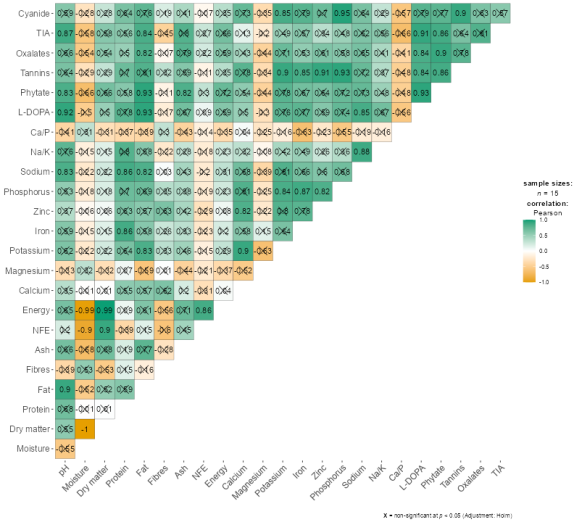
Figure 2. Pearson correlation of physicochemical, mineral and antinutrients composition.
TIA=trypsin inhibitor activity, L-DOPA= L 3,4-dihydroxyphenylalanine, NFE=Nitrogen Free Extractives.
Green pane= positive Pearson correlation coefficient (up to 1.0), indicating a direct relationship where higher values of one variable correspond to higher values of the other.
White pane= neutral or near-zero correlation (0.0), indicating no linear relationship between the two variables.
Orange pane= negative Pearson correlation coefficient (down to -1.0) indicating an inverse relationship where higher values of one variable correspond to lower values of the other.
"X" Marking= correlation is non-significant at p ˂ 0.05 (using the Holm adjustment method).
The correlation analysis revealed important insights into the nutritional transformations occurring during Toubani production (
Figure 2). Strong positive correlations were observed among L-DOPA, phytates, tannins, oxalates, and trypsin inhibitor activity (TIA), indicating that these antinutritional compounds responded similarly to processing operations. In particular, L-DOPA was highly correlated with phytates (r = 0.929, p ˂ 0.001), TIA (r = 0.906, p ˂ 0.001), tannins (r = 0.841, p ˂ 0.001), and oxalates (r = 0.838, p ˂ 0.001). These relationships suggest that dehulling, soaking, and steaming simultaneously reduced several antinutritional factors rather than targeting a single compound. Such coordinated reductions are nutritionally beneficial because phytates, tannins, oxalates, and trypsin inhibitors are known to impair protein digestibility and mineral utilization
| [1] | Samtiya, M., Aluko, R. E. & Dhewa, T. Plant food anti-nutritional factors and their reduction strategies: an overview. Food Production, Processing and Nutrition 2020 2: 1 2, 6- (2020). https://doi.org/10.3390/foods10040839 |
| [34] | Dong, G., Hu, Z., Tang, J., Das, R. S., Sun, D. W., & Tiwari, B. K.. Reducing anti-nutritional factors in pea protein using advanced hydrodynamic cavitation, ultrasonication, and high-pressure processing technologies. Food Chem. 488, 144834 (2025). https://doi.org/10.1016/j.foodchem.2025.144834 |
| [35] | Das, R., Islam, M., Mahajan, P., Kaur, R., Gaur, S., Giri, S., & Mann, S. Emerging Non-Thermal Technologies for Reducing Anti-Nutritional Factors in Food Systems: A Systematic Review. J. Food Sci. 90, e70781 (2025).
https://doi.org/10.1111/1750-3841.70781 |
| [36] | Alsalman, F. B. & Ramaswamy, H. Reduction in soaking time and anti-nutritional factors by high pressure processing of chickpeas. J. Food Sci. Technol. 57, 2572-2585 (2020). https://doi.org/10.1007/s13197-020-04294-9 |
[1, 34-36]
.
Phytates were positively correlated with potassium (r = 0.776, p ˂ 0.001), phosphorus (r = 0.719, p ˂ 0.01), and iron (r = 0.672, p ˂ 0.01), while tannins showed strong correlations with phosphorus (r = 0.925, p ˂ 0.001), zinc (r = 0.907 p ˂ 0.001), and iron (r = 0.854, p ˂ 0.001). These strong positive relationships between antinutritional factors and minerals further support the role of processing in improving nutrient availability. Although processing caused some mineral losses through leaching, the concurrent degradation of phytates and tannins may enhance the bioavailability of retained minerals because these compounds possess strong metal-chelating properties that limit intestinal absorption
| [1] | Samtiya, M., Aluko, R. E. & Dhewa, T. Plant food anti-nutritional factors and their reduction strategies: an overview. Food Production, Processing and Nutrition 2020 2: 1 2, 6- (2020). https://doi.org/10.3390/foods10040839 |
| [6] | Bajo, W., Chambal, B. & Macuamule, C. Effect of processing methods on mineral bioaccessibility in common beans. Scientific Reports 2026 16: 1 16, 4593- (2026).
https://doi.org/10.1038/s41598-025-34639-3 |
[1, 6]
.
Moisture content showed strong negative correlations with energy value (r = -0.900, p ˂ 0.001), indicating that hydration reduced caloric density through dilution effects. At the same time, moisture showed negative associations with several antinutritional factors, particularly phytates (r = -0.663, p ˂ 0.01), TIA (r = -0.576, p ˂ 0.05), and oxalate (r = -0.538, p ˂ 0.05). These results highlight the importance of soaking and steaming as key processing steps responsible for both detoxification and the modification of nutritional characteristics.
Interestingly, the Ca/P ratio was negatively correlated with L-DOPA (r = -0.562, p ˂ 0.05), cyanide (r = -0.570, p ˂ 0.05), and TIA (r = -0.656, p ˂ 0.01), suggesting that improvements in mineral balance occurred concurrently with reductions in antinutritional compounds. Since Ca/P ratios above unity are generally associated with favourable calcium utilisation and bone health, this relationship further supports the nutritional value of the processed product.
Overall, the correlation structure indicates that traditional processing improved nutritional quality through two complementary mechanisms: (i) substantial reductions in antinutritional compounds, including L-DOPA, phytates, tannins, oxalates, and trypsin inhibitors, and (ii) preservation of nutritionally relevant amounts of proteins and minerals. Consequently, although some nutrients were partially lost during processing, the reduction of compounds that impair digestion and mineral absorption is expected to increase the nutritional effectiveness of the final Toubani
| [1] | Samtiya, M., Aluko, R. E. & Dhewa, T. Plant food anti-nutritional factors and their reduction strategies: an overview. Food Production, Processing and Nutrition 2020 2: 1 2, 6- (2020). https://doi.org/10.3390/foods10040839 |
| [6] | Bajo, W., Chambal, B. & Macuamule, C. Effect of processing methods on mineral bioaccessibility in common beans. Scientific Reports 2026 16: 1 16, 4593- (2026).
https://doi.org/10.1038/s41598-025-34639-3 |
[1, 6]
.
3.4.2. Principal Component Analysis
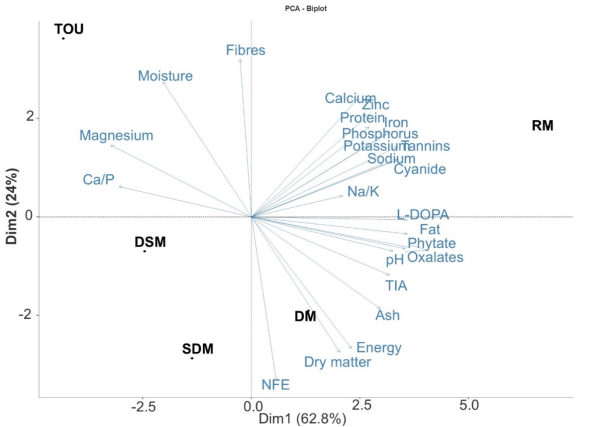
Principal component analysis (PCA) was used to visualize relationships among samples and compositional variables. The first two principal components account for approximately 86.8% of total dataset variability (Dim1 = 62.8%, Dim2 = 24.0%), indicating that the PCA model adequately described the major sources of variation (
Figure 3)The PCA biplot clearly separated raw and processed materials along the first principal component. Raw Mucuna clustered with antinutritional variables such as L-DOPA, tannins, phytates, oxalates and trypsin inhibitors activity, confirming their high concentrations before processing. In contrast, Toubani occupied the opposite side of the plot and was associated with moisture content and reduced antinutrient levels. The intermediate products formed a processing trajectory between these two extremes, demonstrating the cumulative effects of dehulling, soaking, drying and steaming. The PCA therefore confirmed that Toubani production based on Mucuna pruriens led to a progressive nutritional transformation characterized by detoxification while retaining substantial amounts of protein and essential minerals.
An important contribution of this study is the evaluation of Toubani production as an integrated processing technology rather than as a collection of independent unit operations. The PCA trajectory demonstrated that each processing step contributed incrementally to compositional changes, highlighting the cumulative detoxification effect of the entire system. This finding suggests that the effectiveness of Toubani production cannot be attributed solely to a single operation such as soaking or steaming but rather to the synergistic interaction of successive treatments. Consequently, the traditional Toubani process may be viewed as a practical indigenous food technology capable of enhancing the utilization of underexploited legumes such as Mucuna pruriens.
The traditional processing technology substantially improved both the safety and nutritional value of Mucuna pruriens. The reduction of L-DOPA to below the recommended safety threshold, coupled with complete cyanide elimination, demonstrates the effectiveness of the process in detoxifying the seeds. Simultaneously, the retention of high protein levels and nutritionally relevant mineral concentrations indicates that processing preserved the major nutritional attributes of Mucuna. Although residual phytates, oxalates and trypsin inhibitor activity suggest that additional process optimization could further improve quality, the current process produced a product with significantly enhanced nutritional potential and reduced toxicological risk. Consequently, Mucuna-based Toubani represents a promising protein-rich functional food capable of contributing to food and nutrition security in West Africa.
Figure 3. Principal component analysis (PCA) biplot of Nutrition composition, mineral and antinutrients composition of Toubani based Mucuna.
RM= raw Mucuna, DM= dehulled Mucuna, SDM=soaked dehulled Mucuna, DSM= dried soaked Mucuna and Tou =Toubani, steamed dough based Mucuna, TIA=trypsin inhibitor activity, L-DOPA= L 3,4-dihydroxyphenylalanine, NFE=Nitrogen Free Extractives.
4. Conclusion
The present study demonstrated that the traditional processing sequence used to produce Mucuna -based Toubani including dehulling, soaking, drying, milling, dough preparation, and steaming substantially modifies the nutritional, physicochemical, and safety-related characteristics of Mucuna pruriens. Among the processing steps, soaking and steaming appeared to be particularly influential, contributing to changes in the composition and reduction of undesirable compounds. These findings provide evidence that traditional processing plays a critical role in determining the nutritional quality and food-use potential of Mucuna pruriens and may contribute to the development of safer and more nutritionally suitable Mucuna-based foods. The final product retained a high protein content (25.0 g/100 g DM) and appreciable concentrations of essential minerals, including calcium, magnesium, potassium, phosphorus, iron, and zinc. Although moderate mineral losses occurred during processing, favorable Na/K and Ca/P ratios were maintained, suggesting good nutritional quality. Most importantly, the process effectively detoxified Mucuna seeds, resulting in substantial reductions in L-DOPA (98.6%), tannins (96.2%), trypsin inhibitor activity (65.7%), phytates (42.3%), and oxalates (36.5%), while hydrogen cyanide was completely eliminated. The reduction of L-DOPA to below the recommended safety threshold confirms the suitability of the processing method for improving the safety of Mucuna-based foods.
Correlation analysis and principal component analysis further demonstrated that the successive processing operations produced a clear transition from antinutrient-rich raw seeds to a nutritionally enhanced and safer food product. These findings highlight the potential of traditional Toubani processing as an effective strategy for valorising Mucuna pruriens, an underutilized legume with considerable promise for sustainable food systems and nutrition security in West Africa.
Study limitations
Despite these promising findings, several limitations should be acknowledged. First, the study focused primarily on changes in chemical composition and antinutritional factors and did not evaluate protein digestibility, amino acid availability, or mineral bioaccessibility, which are important indicators of nutritional quality. Second, no in vitro or in vivo assessment of nutrient absorption was conducted to confirm the nutritional benefits associated with antinutrient reduction. Third, the study did not investigate the effects of processing on functional properties, sensory acceptability, or consumer perception of the final product. In addition, only one processing scheme was evaluated, and alternative treatments such as germination, fermentation, pressure cooking, or enzymatic processing were not examined.
Future perspectives
Future research should focus on evaluating protein digestibility, mineral bioavailability, sensory quality, and shelf stability of Mucuna-based Toubani. Investigations combining traditional processing with germination, fermentation, or other bioprocessing approaches may further reduce residual phytates, oxalates, and trypsin inhibitors while enhancing nutrient utilization. Such studies would strengthen the evidence supporting the incorporation of Mucuna pruriens into sustainable, protein-rich food products and contribute to the diversification of local food resources in Africa and other developing regions.
Practical implication
Overall, the results indicate that traditional Toubani processing can successfully transform Mucuna pruriens from a legume constrained by high antinutrient levels into a safer, nutrient-dense, and protein-rich food, thereby providing a promising avenue for the utilization of underexploited agricultural resources in food and nutrition security programs.

 ,
Janvier Melegnonfan Kindossi*
,
Janvier Melegnonfan Kindossi*


 Share This Article
 Twitter
 Linked In
 Facebook
 Copy
Copy Download