
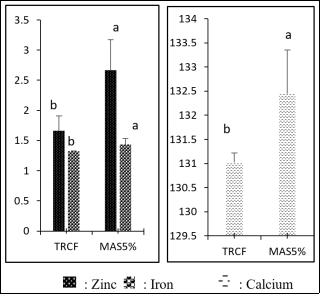
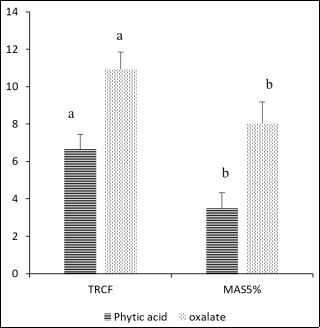
In Ivory Coast, roasted corn kernels are used to produce roasted corn flour, which is rich in carbohydrates but low in protein, vitamins, and minerals. To enhance the nutritional value of this flour, 5% roasted peanut powder and 5% roasted soybean powder were added. The objective is to highlight the nutritional and health benefits by assessing the predictive bioavailability of nutrients such as calcium, zinc, and iron in the composite flour formulated from roasted ingredients. The methodology involved determining the levels of calcium, zinc, and iron using atomic absorption spectrophotometry, analyzing antinutritional factors (phytic acid, oxalate), and calculating predictive bioavailability based on molar ratios. The results showed that the levels of zinc, iron, calcium, oxalate, and phytic acid, in the composite flour, were 2.67 mg/100 g MS; 1.44 mg/100 g MS; 132.45 mg/100 g MS; 8.03 mg/100 g MS; and 3.48 mg/100 g MS, respectively. In addition, the molar ratios phytates/Ca, phytates/Fe, phytates/Zn, Calcium×Phytate/ Zinc et oxalates/Ca were well below their critical values, indicating high bioavailability. It is therefore necessary to promote the use of soybean and peanut powders in the production of composite flours in order to improve the nutritional quality and health benefits of foods made from local agricultural resources.
| Published in | International Journal of Nutrition and Food Sciences (Volume 15, Issue 5) |
| DOI | 10.11648/j.ijnfs.20261505.12 |
| Page(s) | 191-198 |
| Creative Commons |
This is an Open Access article, distributed under the terms of the Creative Commons Attribution 4.0 International License (http://creativecommons.org/licenses/by/4.0/), which permits unrestricted use, distribution and reproduction in any medium or format, provided the original work is properly cited. |
| Copyright |
Copyright © The Author(s), 2026. Published by Science Publishing Group |
Composite Flours, Micronutrients, Malnutrition, Antinutrients, Predictive Bioavailability, Absorption
Phytate/Ca | Phytate/Fe | Phytate/Zn | Oxalate/Ca | [Calcium]×[Phytate]/ [Zinc] | |
|---|---|---|---|---|---|
TRCF flour | 0,0031a± 0,000 | 0,4275a± 0,01 | 0,3945a± 0,001 | 0,0380a± 0,002 | 0,0013a± 0,000 |
MAS5% flour | 0,0016b± 0,000 | 0,2051b± 0,003 | 0,1284b± 0,004 | 0,0276b± 0,001 | 0,0004b± 0,000 |
Standards | < 0,24 | < 1 | < 15 | < 1 | < 0,5 |
TRCF | Traditional Roasted Corn Flour |
MAS5% | Composite Flour Made from Roasted Corn |
| [1] | R. E. Black et al., “Maternal and child undernutrition and overweight in low-income and middle-income countries,” The Lancet, vol. 382, no. 9890, pp. 427–451, Aug. 2013, |
| [2] | A. Steiber et al., “Spotlight on Global Malnutrition: A Continuing Challenge in the 21st Century,” Journal of the Academy of Nutrition and Dietetics, vol. 115, no. 8, pp. 1335–1341, Aug. 2015, |
| [3] | M. V. De Vita et al., “Malnutrition, morbidity and infection in the informal settlements of Nairobi, Kenya: an epidemiological study,” Ital J Pediatr, vol. 45, no. 1, p. 12, Dec. 2019, |
| [4] | A. Suryawan et al., “Malnutrition in early life and its neurodevelopmental and cognitive consequences: a scoping review,” Nutrition Research Reviews, vol. 35, no. 1, pp. 136–149, Jun. 2022, |
| [5] | J. N. Mogaka et al., “Investigating the Impact of Moringa oleifera Supplemented to Kenyan Breastfeeding Mothers on Maternal and Infant Health: A Cluster Randomized Single-Blinded Controlled Pilot Trial Protocol,” JPGN Rep, vol. 3, no. 3, p. e237, Aug. 2022, |
| [6] | O. A. Tano et al., “Malnutrition chronique chez les enfants de moins de 5 ans au nord de la Côte d’Ivoire,” Santé Publique, vol. 22, no. 2, pp. 213–220, May 2010, |
| [7] |
M. M. Hollingworth and O. Hantz, 2026. World Food Programme; Conseil d’administration Session annuelle Rome; 29P.
https://executiveboard.wfp.org/document_download/WFP-0000173133 |
| [8] | J. Boye, F. Zare, and A. Pletch, “Pulse proteins: Processing, characterization, functional properties and applications in food and feed,” Food Research International, vol. 43, no. 2, pp. 414–431, Mar. 2010, |
| [9] | S. Ghosh, D. Suri, and R. Uauy, “Assessment of protein adequacy in developing countries: quality matters,” British Journal of Nutrition, vol. 108, no. S2, pp. S77–S87, Aug. 2012, |
| [10] | C. Ladeira, E. Carolino, M. C. Gomes, and M. Brito, “Role of Macronutrients and Micronutrients in DNA Damage: Results From a Food Frequency Questionnaire,” Nutr Metab Insights, vol. 10, p. 1178638816684666, Feb. 2017, |
| [11] |
D. Dupont and F. Nau, “La structure des aliments affecte la biodisponibilité des nutriments,” Cahiers de nutrition et de diététique, vol. 57, no. 3, pp. 182–193, 2022, Accessed: Aug. 02, 2026. [Online]. Available:
https://agris.fao.org/search/en/providers/122535/records/65de42de7c7033e84bea5e5e |
| [12] | D. Turck, “EFSA PANEL ON NUTRITION, NOVEL FOODS AND FOOD ALLERGENS (NDA),” 2024. |
| [13] | E. Lemmens et al., “Impact of Cereal Seed Sprouting on Its Nutritional and Technological Properties: A Critical Review,” Comprehensive Reviews in Food Science and Food Safety, vol. 18, no. 1, pp. 305–328, 2019, |
| [14] | K. Platel and K. Srinivasan, “Bioavailability of Micronutrients from Plant Foods: An Update,” Critical Reviews in Food Science and Nutrition, vol. 56, no. 10, pp. 1608–1619, Jul. 2016, |
| [15] | R. K. Raigar and H. N. Mishra, “Study on the effect of pilot scale roasting conditions on the physicochemical and functional properties of maize flour (Cv. Bio 22027),” Journal of Food Processing and Preservation, vol. 42, no. 5, p. e13602, 2018, |
| [16] | M. A. Y. Abdualrahman et al., “Postharvest physicochemical properties of the pulp and seed oil from Annona squamosa L. (Gishta) fruit grown in Darfur region, Sudan,” Arab J Chem, vol. 12, no. 8, pp. 4514–4521, Dec. 2019, |
| [17] | K. Reichwald and F. Hatzack, “Application of a Modified Haug and Lantzsch Method for the Rapid and Accurate Photometrical Phytate Determination in Soybean, Wheat, and Maize Meals,” 2008, Accessed: Aug. 04, 2026. [Online]. Available: |
| [18] | U. H. Patil and D. K. Gaikwad, “SEASONAL DYNAMICS IN THE NUTRITIONAL AND ANTINUTRITIONAL STATUS OF STEM BARK OF ANOGEISSUS LATIFOLIA.,” 2011. |
| [19] | E. R. Morris and R. Ellis, “Usefulness of the dietary phytic acid/ zinc molar ratio as an index of zinc bioavailability to rats and humans,” Biol Trace Elem Res, vol. 19, no. 1, pp. 107–117, Jan. 1989, |
| [20] | S. A. Agumba, C. Serem, F. Wamunga, and G. Were, “The Impact of Soy Fortification in Early Childhood Foods on Child Nutrition Outcomes: A Systematic Review,” African Journal of Nutrition and Dietetics, vol. 5, no. 01, pp. 377–386, Mar. 2026, |
| [21] | P. Ayoola and A. Adeyeye, “Chemical evaluation of food value of groundnut (Arachi hypogaea) seeds,” AJFN, vol. 2, no. 3, pp. 55–57, Sep. 2012, |
| [22] | O. Etiosa, N. Chika, and A. Benedicta, “Mineral and Proximate Composition of Soya Bean,” AJOPACS, vol. 4, no. 3, pp. 1–6, Jan. 2018, |
| [23] | O. P. Gupta et al., “Critical assessment of wheat biofortification for iron and zinc: a comprehensive review of conceptualization, trends, approaches, bioavailability, health impact, and policy framework,” Front. Nutr., vol. 10, Jan. 2024, |
| [24] | T. Chondrou, N. Adamidi, D. Lygouras, S. A. Hirota, O. Androutsos, and V. Svolos, “Dietary Phytic Acid, Dephytinization, and Phytase Supplementation Alter Trace Element Bioavailability—A Narrative Review of Human Interventions,” Nutrients, vol. 16, no. 23, p. 4069, Jan. 2024, |
| [25] | J. Godrich, P. Rose, M. Muleya, and J. Gould, “The effect of popping, soaking, boiling and roasting processes on antinutritional factors in chickpeas and red kidney beans,” Int J Food Sci Tech, vol. 58, no. 1, pp. 279–289, Jan. 2023, |
| [26] | N. Mesfin, A. Belay, and E. Amare, “Effect of germination, roasting, and variety on physicochemical, techno-functional, and antioxidant properties of chickpea (Cicer arietinum L.) protein isolate powder,” Heliyon, vol. 7, no. 9, Sep. 2021, |
| [27] | W. N. Wafula, N. K. Korir, H. F. Ojulong, M. Siambi, and J. P. Gweyi-Onyango, “Protein, Calcium, Zinc, and Iron Contents of Finger Millet Grain Response to Varietal Differences and Phosphorus Application in Kenya,” Agronomy, vol. 8, no. 2, p. 24, Feb. 2018, |
| [28] | R. Poorvisha, T. N. Uma, and A. Jyothi Lakshmi, “Dephytinising efficacy of wheat phytase in enhancing the bioaccessibility of minerals in high phytate foods,” Food Measure, vol. 14, no. 6, pp. 3040–3047, Dec. 2020, |
| [29] | N. Me and N. F. A. Aw, “Determination of Phytate, Iron, Zinc, Calcium Contents and Their Molar Ratios in Commonly Consumed Raw and Prepared Food in Malaysia,” 2009. |
| [30] | K. L. Moore et al., “The stage of seed development influences iron bioavailability in pea (Pisum sativum L.),” Sci Rep, vol. 8, no. 1, p. 6865, May 2018, |
| [31] | L. Davidsson, T. Walczyk, N. Zavaleta, and R. F. Hurrell, “Améliorer l’absorption du fer contenu dans un petit-déjeuner scolaire péruvien en y ajoutant de l’acide ascorbique ou du Na₂EDTA 1 2 3,” The American Journal of Clinical Nutrition, vol. 73, no. 2, pp. 283–287, Feb. 2001, |
| [32] | A. M. Magallanes-López et al., “Variability in iron, zinc and phytic acid content in a worldwide collection of commercial durum wheat cultivars and the effect of reduced irrigation on these traits,” Food Chemistry, vol. 237, pp. 499–505, Dec. 2017, |
| [33] | R. S. Gibson, K. B. Bailey, M. Gibbs, and E. L. Ferguson, “A Review of Phytate, Iron, Zinc, and Calcium Concentrations in Plant-Based Complementary Foods Used in Low-Income Countries and Implications for Bioavailability,” Food Nutr Bull, vol. 31, no. 2_suppl2, pp. S134–S146, Jun. 2010, |
| [34] | H. Elliott, P. Woods, B. D. Green, and A. P. Nugent, “Can sprouting reduce phytate and improve the nutritional composition and nutrient bioaccessibility in cereals and legumes?,” Nutr Bull, vol. 47, no. 2, pp. 138–156, Jun. 2022, |
APA Style
Paterne, R. N., Joseph, K. N., Ahossi, K. K., Bernard, S. T. (2026). Predictive Bioavailability of Iron, Calcium, and Zinc in Traditional and Composite Flours Made from Roasted Corn, Soybean, and Peanut Powders. International Journal of Nutrition and Food Sciences, 15(5), 191-198. https://doi.org/10.11648/j.ijnfs.20261505.12
ACS Style
Paterne, R. N.; Joseph, K. N.; Ahossi, K. K.; Bernard, S. T. Predictive Bioavailability of Iron, Calcium, and Zinc in Traditional and Composite Flours Made from Roasted Corn, Soybean, and Peanut Powders. Int. J. Nutr. Food Sci. 2026, 15(5), 191-198. doi: 10.11648/j.ijnfs.20261505.12
@article{10.11648/j.ijnfs.20261505.12,
  author = {Rougbo Ndjomon Paterne and Kouadio Natia Joseph and Konan Kouakou Ahossi and Sea Tehi Bernard},
  title = {Predictive Bioavailability of Iron, Calcium, and Zinc in Traditional and Composite Flours Made from Roasted Corn, Soybean, and Peanut Powders},
  journal = {International Journal of Nutrition and Food Sciences},
  volume = {15},
  number = {5},
  pages = {191-198},
  doi = {10.11648/j.ijnfs.20261505.12},
  url = {https://doi.org/10.11648/j.ijnfs.20261505.12},
  eprint = {https://article.sciencepublishinggroup.com/pdf/10.11648.j.ijnfs.20261505.12},
  abstract = {In Ivory Coast, roasted corn kernels are used to produce roasted corn flour, which is rich in carbohydrates but low in protein, vitamins, and minerals. To enhance the nutritional value of this flour, 5% roasted peanut powder and 5% roasted soybean powder were added. The objective is to highlight the nutritional and health benefits by assessing the predictive bioavailability of nutrients such as calcium, zinc, and iron in the composite flour formulated from roasted ingredients. The methodology involved determining the levels of calcium, zinc, and iron using atomic absorption spectrophotometry, analyzing antinutritional factors (phytic acid, oxalate), and calculating predictive bioavailability based on molar ratios. The results showed that the levels of zinc, iron, calcium, oxalate, and phytic acid, in the composite flour, were 2.67 mg/100 g MS; 1.44 mg/100 g MS; 132.45 mg/100 g MS; 8.03 mg/100 g MS; and 3.48 mg/100 g MS, respectively. In addition, the molar ratios phytates/Ca, phytates/Fe, phytates/Zn, Calcium×Phytate/ Zinc et oxalates/Ca were well below their critical values, indicating high bioavailability. It is therefore necessary to promote the use of soybean and peanut powders in the production of composite flours in order to improve the nutritional quality and health benefits of foods made from local agricultural resources.},
 year = {2026}
}
TY  - JOUR
T1  - Predictive Bioavailability of Iron, Calcium, and Zinc in Traditional and Composite Flours Made from Roasted Corn, Soybean, and Peanut Powders
AU  - Rougbo Ndjomon Paterne
AU  - Kouadio Natia Joseph
AU  - Konan Kouakou Ahossi
AU  - Sea Tehi Bernard
Y1  - 2026/09/09
PY  - 2026
N1  - https://doi.org/10.11648/j.ijnfs.20261505.12
DO  - 10.11648/j.ijnfs.20261505.12
T2  - International Journal of Nutrition and Food Sciences
JF  - International Journal of Nutrition and Food Sciences
JO  - International Journal of Nutrition and Food Sciences
SP  - 191
EP  - 198
PB  - Science Publishing Group
SN  - 2327-2716
UR  - https://doi.org/10.11648/j.ijnfs.20261505.12
AB  - In Ivory Coast, roasted corn kernels are used to produce roasted corn flour, which is rich in carbohydrates but low in protein, vitamins, and minerals. To enhance the nutritional value of this flour, 5% roasted peanut powder and 5% roasted soybean powder were added. The objective is to highlight the nutritional and health benefits by assessing the predictive bioavailability of nutrients such as calcium, zinc, and iron in the composite flour formulated from roasted ingredients. The methodology involved determining the levels of calcium, zinc, and iron using atomic absorption spectrophotometry, analyzing antinutritional factors (phytic acid, oxalate), and calculating predictive bioavailability based on molar ratios. The results showed that the levels of zinc, iron, calcium, oxalate, and phytic acid, in the composite flour, were 2.67 mg/100 g MS; 1.44 mg/100 g MS; 132.45 mg/100 g MS; 8.03 mg/100 g MS; and 3.48 mg/100 g MS, respectively. In addition, the molar ratios phytates/Ca, phytates/Fe, phytates/Zn, Calcium×Phytate/ Zinc et oxalates/Ca were well below their critical values, indicating high bioavailability. It is therefore necessary to promote the use of soybean and peanut powders in the production of composite flours in order to improve the nutritional quality and health benefits of foods made from local agricultural resources.
VL  - 15
IS  - 5
ER  -
Science and Technology Training and Research Unit, Alassane Ouattara University, Bouake, Ivory Coast;Bioscience Training and Research Unit, Felix Houphouet-Boigny University, Abidjan, Ivory Coast
Research Fields: Enzymology, Biotechnology, Biochemistry, Nutrition, Food Technology, Food Chemistry, Food Safety
Bioscience Training and Research Unit, Felix Houphouet-Boigny University, Abidjan, Ivory Coast
Research Fields: Biotechnology, Biochemistry, Nutrition, Food Technology, Food Chemistry, Food Safety
Science and Technology Training and Research Unit, Alassane Ouattara University, Bouake, Ivory Coast
Research Fields: Food Microbiology, Environmental Microbiology and Biowaste Valorization and Bioindustries, Food Safety, Fermentation, Biotechnology
Bioscience Training and Research Unit, Felix Houphouet-Boigny University, Abidjan, Ivory Coast
Research Fields: Enzymology, Biotechnology, Biochemistry, Nutrition, Food Technology, Food Chemistry, Food Safety

Information



 Share This Article
 Twitter
 Linked In
 Facebook
 Copy
Copy Download