
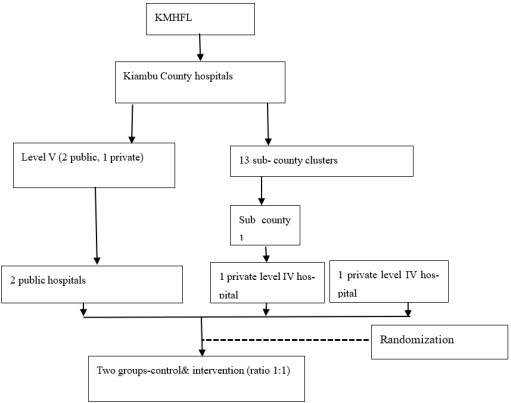
The prevalence of exclusive breastfeeding (EBF) stands at 41% globally, 43% in Africa, 61% in Kenya. The World Health Organization recommends EBF for six months. About half (49.2%) of Kenyan women are in the work force. These women are entitled to a three-month maternity leave under the Kenyan Constitution. They therefore do not have the privilege of being with their children all day to breastfeed and may require additional support to be able to breastfeed exclusively for 6 months. The purpose of this study was to determine the effect that counselling on expressed breast milk has on the duration of EBF among working mothers in Kiambu County. A cluster-based randomized controlled trial was adopted. The mothers in the intervention group received counselling on the benefits of EBF, breastmilk expression methods, benefits of expressing, storage, and feeding of expressed breastmilk. A researcher administered semi-structured questionnaire was administered to collect baseline data on socio-demographic factors among working mothers. Follow-up questionnaires were administered to both groups to collect information on breastfeeding practices. The data was analyzed using the Statistical Package for the Social Sciences (SPSS). Chi-square tests, odds ratios, and regression analyses were used to determine associations between variables. The prevalence of EBF was 70.4%. Significantly, the prevalence of EBF in the intervention group (86.1%) was higher than in the control group (54.9%). Mothers who received counselling (intervention) were five times more likely to practice EBF than mothers who did not receive counselling ([OR]: 5.105; CI 2.570-10.137; p<0.001). This contributed to the higher rates in EBF in the intervention group. This study established that counselling of working mothers on the use of expressed breastmilk could result in increased rates of EBF in Kiambu County. Therefore, working mothers need to be educated on optimal breastfeeding practices so that the rates of exclusive breastfeeding can improve.
| Published in | International Journal of Nutrition and Food Sciences (Volume 15, Issue 4) |
| DOI | 10.11648/j.ijnfs.20261504.12 |
| Page(s) | 159-170 |
| Creative Commons |
This is an Open Access article, distributed under the terms of the Creative Commons Attribution 4.0 International License (http://creativecommons.org/licenses/by/4.0/), which permits unrestricted use, distribution and reproduction in any medium or format, provided the original work is properly cited. |
| Copyright |
Copyright © The Author(s), 2026. Published by Science Publishing Group |
Working Mother, Exclusive Breastfeeding, Counselling, Expressed Breastmilk, Expressing, Breastmilk
Indicator | Category | Control (N=102) | Intervention (N=101) | Total (N=203) | Chi square P value |
|---|---|---|---|---|---|
Maternal age (mean±SD) | 27.92±5.02 | 27.16±4.81 | 27.54±4.93 | 0.119 | |
Marital status | Married | 83 (81.4) | 80 (79.2) | 163 (80.3) | 0.919 |
Single | 16 (15.7) | 18 (17.8) | 34 (16.7) | ||
Separated/divorced | 3 (2.9) | 3 (3.0) | 6 (3.0) | ||
Number of children | 1 | 35 (34.3) | 46 (45.5) | 81 (39.9) | 0.306 |
2 | 45 (44.1) | 35 (34.7) | 80 (39.4) | ||
3 | 15 (14.7) | 17 (16.8) | 32 (15.8) | ||
≥4 | 7 (5.9) | 3 (3.0) | 10 (4.9) | ||
Child’s gender | Male | 49 (48.0) | 47 (46.1) | 96 (47.3) | 0.830 |
Female | 53 (52.0) | 54 (52.9) | 107 (52.7) | ||
Maternal level of education | Postgraduate degree | 4 (3.9) | 3 (3.0) | 7 (3.4) | 0.364 |
College/university | 69 (67.6) | 67 (66.3) | 136 (67.0) | ||
Secondary (A level) | 29 (28.4) | 28 (27.7) | 57 (28.1) | ||
Primary | 0 | 3 (3.0) | 3 (1.5) | ||
Maternal occupation | Formal employment | 44 (43.1) | 40 (39.6) | 84 (41.4) | 0.052 |
Informal employment | 55 (53.9) | 49 (48.5) | 104 (51.2) | ||
Business | 3 (2.9) | 12 (11.9) | 15 (7.4) | ||
Duration of maternity leave | 2 months | 2 (2.0) | 2 (2.0) | 4 (2.0) | 0.839 |
3 months | 100 (98.0) | 99 (98.0) | 199 (98.0) |
Variable | Control | Intervention | P value |
|---|---|---|---|
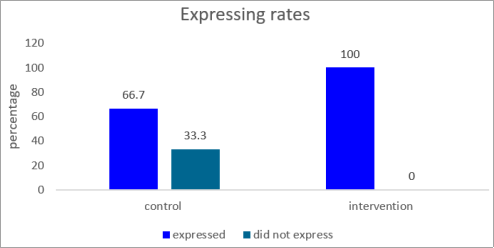
Expressed | 68 (66.7) | 101 (100) | <0.001 |
Did not express | 34 (33.3) | 0 (0.0) | |
Source of expressing information (N=169) | |||
Hospital/health worker | 39 (54.9) | 46 (45.5) | |
Friend | 28 (39.4) | 34 (33.7) | <0.001 |
Family/relative | 21 (29.6) | 30 (29.7) | |
Media | 44 (62.0) | 55 (54.5) |
Age of the infant | Control (N=102) | Intervention (N=101) | Chi square | P value |
|---|---|---|---|---|
1 month | 102 (100) | 101 (100) | ||
2 months | 101 (99.0) | 100 (99.0) | 0.000 | 0.994 |
3 months | 91 (89.2) | 98 (97.0) | 4.826 | 0.028* |
4 months | 79 (77.5) | 94 (93.1) | 9.829 | 0.002* |
5 months | 77 (75.5) | 91 (90.1) | 7.590 | 0.006* |
6 months | 56 (54.9) | 87 (86.1) | 23.783 | <0.001* |
Variable | Value (odds ratio) | 95% CI | Chi square | |
|---|---|---|---|---|
Lower | Upper | |||
Counselled/not counselled | 5.105 | 2.570 | 10.137 | 23.783 |
Independent variable | Prevalence of exclusive breastfeeding | |||
|---|---|---|---|---|
Value (odds ratio) | 95% | CI | Chi square | |
Age of the mother | 1.017 | 0.950 | 1.089 | 0.629 |
Marital status | 1.785 | 0.900 | 3.541 | 0.097 |
Level of education | 4.625 | 2.507 | 8.533 | <0.001* |
Gender | 1.137 | 0.609 | 2.122 | 0.687 |
Birth number | 1.578 | 1.131 | 2.201 | 0.007* |
Duration of maternity leave | 1.432 | 1.307 | 1.568 | 0.191 |
Type of employment (occupation) | 2.555 | 1.512 | 4.316 | <0.001* |
EBF | Exclusive Breastfeeding |
WHO | World Health Organization |
SPSS | Statistical Package for Social Sciences |
UNICEF | United Nations International Children's Emergency |
BFCI | Baby-friendly Community Initiative |
BFHI | Baby-friendly Hospital Initiative |
CHP | Community Health Promoters |
KDHS | Kenya Demographic and Health Survey |
EBM | Expressed Breastmilk |
IYCF | Infant and Young Child Feeding |
RCT | Randomized Controlled Trial |
CI | Confidence Interval |
| [1] |
WHO, & UNICEF. WHO | Protecting, promoting, and supporting breastfeeding in facilities providing maternity and newborn services: the revised Baby-friendly Hospital Initiative 2018. WHO, 47. 2018.
http://www.who.int/nutrition/publications/infantfeeding/bfhi-implementation/en/ |
| [2] | Subandrate, S., Amalia, E., Athiah, M., Safyudin, S., Prasetyo, M. N., & Arrafi, M. H. Macronutrient and Micronutrient Content in Breast Milk. In Conferences of Medical Sciences Dies Natalis 2021; 3, No. 1, pp. 51-56. |
| [3] |
WHO. Infant and Young Child Feeding.
https://www.who.int/news-room/fact-sheets/detail/infant-and-young-child-feeding (Accessed on 24th April 2026). |
| [4] | North, K., Gao, M., Allen, G., & Lee, A. C. Breastfeeding in a global context: epidemiology, impact, and future directions. Clinical Therapeutics, 2022: 44(2), 228-244. |
| [5] | Chai, Y., Nandi, A., & Heymann, J. Does extending the duration of legislated paid maternity leave improve breastfeeding practices? Evidence from 38 low-income and middle-income countries. BMJ Global Health, 2018; 3(5), e001032. |
| [6] | Bhattacharjee NV, Schaeffer L. E., Marczak L. B., Ross J. M, Swartz S. J., Albright J., et al. Mapping exclusive breastfeeding in Africa between 2000 and 2017. Nature Medicine. 2019; 25(8): 1205-12. pmid: 31332393. |
| [7] |
UNICEF. Breastfeeding. 2025.
https://data.unicef.org/topic/nutrition/breastfeeding/#:~:text=Too%20few%20children%20benefit%20from,%20no%20matter%20where%20they%20live (Accessed April 28th 2026) |
| [8] | KNBS and ICF. Kenya Demographic and Health Survey 2022. Key Indicators Report. Nairobi, Kenya, and Rockville, Maryland, USA: KNBS and ICF. 2023. |
| [9] | WHO. Evidence for Nutrition Actions (eLENA) [Internet]. WHO. World Health Organization. 2017. |
| [10] | Republic of Kenya. National Nutrition Action plan 2012-2017 [Internet]. Minister for Public Health and Sanitation; 2012. |
| [11] | Kavle, J. A., Ahoya, B., Kiige, L., Mwando, R., Olwenyi, F., Straubinger, S., & Gathi, C. M. Baby-Friendly Community Initiative-From national guidelines to implementation: A multisectoral platform for improving infant and young child feeding practices and integrated health services. Maternal & child nutrition, 2019; 15 Suppl 1, e12747. |
| [12] |
KNBS. 2021.
https://www.knbs.or.ke/reports/2021-kenya-facts-figures/ (Accessed 21st April 2026). |
| [13] | KNBS. Kenya Integrated Household Budget Survey 2015-2016. 2018. |
| [14] |
Government of Kenya. Republic of Kenya. The Breastfeeding Mothers Bill. 2017.
http://www.kenyalaw.org/kl/fileadmin/pdfdownloads/Acts/EmploymentAct_Cap226-No11of2007_01.pdf |
| [15] | Talbert, A. W., Tsofa, B., Mumbo, E., Berkley, J. A., & Mwangome, M. Knowledge of, and attitudes to giving expressed breastmilk to infants in rural coastal Kenya; focus group discussions of first time mothers and their advisers. International Breastfeeding Journal, 2018; 13(1), 1-7. |
| [16] | Monika Lama, C., & Lama, M. Working mother’s awareness and practice regarding feeding of expressed breast milk. Journal of Patan Academy of Health Sciences, 2019; 6(2), 60-63. |
| [17] | Pandey, S. Awareness about expressed breast milk feeding among working mothers visiting a tertiary level hospital, Kathmandu. Journal of Kathmandu Medical College. 2019; 8(2), 60-65. |
| [18] | Kelsey, Jennifer L. Methods in observational epidemiology. Vol. 26. Monographs in Epidemiology and, 1996. |
| [19] | KNBS. 2019 Kenya Population and Housing Census Volume I: Population by County and Sub-County - Kenya National Bureau of Statistics. 2019. |
| [20] | Ogada, I. A. Effectiveness of Couple Counselling Versus Maternal Counselling in Promoting Exclusive Breast Feeding: A Randomised Controlled Trial in Nyando District, Kenya. 284. Kenyatta University thesis repository. Kenyatta University. 2014. |
| [21] | Gliem, J. a, & Gliem, R. R. (2003). Calculating, Interpreting, and Reporting Cronbach’s Alpha Reliability Coefficient for Likert-Type Scales,. 2003 Midwest Research to Practice Conference in Adult, Continuing, and Community Education, 1992, 82-88. |
| [22] | Mohamed, M. J., Ochola, S. & Owino, V. O. Comparison of knowledge, attitudes and practices on exclusive breastfeeding between primiparous and multiparous mothers attending Wajir District hospital, Wajir County, Kenya: a cross-sectional analytical study. Int Breastfeed J 13, 11 (2018). |
| [23] |
Mbuthia, Jane W. Factors influencing exlcusive breastfeeding among working mothers at kangemi informal settlement, Nairobi. 2022.
https://erepository.uonbi.ac.ke/items/e8e2e7d0-67f6-4fa4-b38a-c3f894750b23 |
| [24] | Shabbir, F., Nina, H., Lim, Z., Amelia, A., Nor Ain, M. Z., Shareena, I., & Rohana, J. Expressed Breast Milk Feeding: Knowledge and Attitude of Employed Mothers. Med & Health Jun 2020; 15(1): 177-186. |
| [25] | Mututho, L. N., Kiboi, W. K., & Mucheru, P. K. Factors associated with exclusive breastfeeding in Kenya: a systematic review. International Journal of Community Medicine and Public Health, 2017; 4(12), 4358-62. |
| [26] | Ickes, Scott B., Sanders, H., Denno, D. M., Myhre, J. A., Kinyua, J., Singa, B., Lemein, H. S., Iannotti, L. L., Farquhar, C., Walson, J. L., & Nduati, R. Exclusive breastfeeding among working mothers in Kenya: Perspectives from women, families and employers. Maternal and Child Nutrition, 2021; 17(4), e13194. |
| [27] | Wako, W. G., Wayessa, Z., & Fikrie, A. Effects of maternal education on early initiation and exclusive breastfeeding practices in sub-saharan Africa: a secondary analysis of demographic and health surveys from 2015 to 2019. BMJ open, 2022; 12(3), e054302. |
| [28] | Magnano San Lio, R., Maugeri, A., La Rosa, M. C., Cianci, A., Panella, M., Giunta, G., Agodi, A., & Barchitta, M. The Impact of Socio-Demographic Factors on Breastfeeding: Findings from the “Mamma & Bambino” Cohort. Medicina, 2021; 57(2), 103. |
| [29] | Tang, K., Wang, H., Tan, S. H., Xin, T., Qu, X., Tang, T.,. & Gaoshan, J. Association between maternal education and breast feeding practices in China: a population-based cross-sectional study. BMJ open, 2019; 9(8), e028485. |
| [30] | Howard TF, Ye Y, Hinten B, Szychowski J, Tita ATN. Factors That Influence Posthospital Infant Feeding Practices Among Women Who Deliver at a Baby Friendly Hospital in Southern United States. Breastfeeding Medicine. 2022; 17(7): 584-592. |
| [31] | Muluneh M. W. Determinants of exclusive breastfeeding practices among mothers in Ethiopia. PloS one, 2023; 18(2), e0281576. |
| [32] | Habtewold, T. D., Endalamaw, A., Mohammed, S. H., Mulugeta, H., Dessie, G., Kassa, G. M.,. & Alemu, S. M. Sociodemographic factors predicting exclusive breastfeeding in Ethiopia: Evidence from a meta-analysis of studies conducted in the past 10 years. Maternal and child health journal, 2021; 25, 72-94. |
| [33] | Lenka Benova, Manahil Siddiqi, Ibukun-Oluwa Omolade Abejirinde, Okikiolu Badejo - Time trends and determinants of breastfeeding practices among adolescents and young women in Nigeria, 2003-2018: BMJ Global Health 2020; 5: e002516. |
| [34] | Cozma-Petruţ, A., Filip, L., Banc, R., Mîrza, O., Gavrilaş, L., Ciobârcă, D.,. & Miere, D. Breastfeeding practices and determinant factors of exclusive breastfeeding among mothers of children aged 0-23 months in northwestern Romania. Nutrients, 2021; 13(11), 3998. |
| [35] | Ragusa, R.; Giorgianni, G.; Marranzano, M.; Cacciola, S.; La Rosa, V. L.; Giarratana, A.; Altadonna, V.; Guardabasso, V. Breastfeeding in hospitals: Factors influencing maternal choice in Italy. Int. J. Environ. Res. Public Health. 2020, 17, 3575. |
| [36] | Watetu, W. E. Determinants and Prevalence of Exclusive Breastfeeding among Working Mothers Attending Child Welfare Clinic at Kiambu Hospital, Kiambu County, Kenya. 2022. |
| [37] | Nirali. S. Tank, Rajshree Yadav and Justin Doss K. Jeenath. Effectiveness of structured teaching programme on knowledge regarding the expressed breast milk among postnatal working mothers in selected area in Junagadh District. Asian Journal of Nursing Education and Research. 2021; 11, pp 23-24. |
| [38] | M'liria, J. K., Kimiywe, J., & Ochola, S. Impact of mother-to-mother support groups in promoting exclusive breastfeeding in a low-resource rural community in kenya: A randomized controlled trial. Current Research in Nutrition and Food Science, 2020; 8(2), 609-621. |
| [39] | Mwiza, Twaambo & Chanda, Dorothy & Musenge, Emmanuel. Determinants of Breastfeeding Practices among Working Mothers in Solwezi District of Zambia. Open Journal of Obstetrics and Gynecology. 2023; 13. 465-480. |
| [40] | Nankumbi, Joyce & Nabimba, Ronald & Muhindo, Richard & Ayebare, Elizabeth. Perceptions of breast milk expression practices among working mothers. African Journal of Midwifery and Women's Health. 2017; 11. 169-175. |
| [41] | Bagga, N., Nadipineni, R., Mohamed, A., Poddutoor, P., & Chirla, D. K. (2018). A quality initiative to improve exclusive breast milk feeding in preterm neonates. International Journal of Pediatrics and Adolescent Medicine, 5(4), 131-134. |
| [42] | Attahiru, A., Awosan, K. J., Oche, M. O., Kaoje, A. U., Yusuf, T., & Ango, U. M. Breastfeeding Support and Determinants of Expressed Breast Milk Feeding Practice among Working Mothers in Sokoto, Nigeria. International Journal of Contemporary Medical Research [IJCMR], 2018; 5(8), 1-8. |
APA Style
Wainaina, E. W., Chege, P. M., Kamuhu, R. W. (2026). Effect of Counselling on Expressing Breastmilk, on the Duration of Exclusive Breastfeeding Among Working Mothers in Kiambu County, Kenya. International Journal of Nutrition and Food Sciences, 15(4), 159-170. https://doi.org/10.11648/j.ijnfs.20261504.12
ACS Style
Wainaina, E. W.; Chege, P. M.; Kamuhu, R. W. Effect of Counselling on Expressing Breastmilk, on the Duration of Exclusive Breastfeeding Among Working Mothers in Kiambu County, Kenya. Int. J. Nutr. Food Sci. 2026, 15(4), 159-170. doi: 10.11648/j.ijnfs.20261504.12
@article{10.11648/j.ijnfs.20261504.12,
  author = {Esther Watetu Wainaina and Peter Maina Chege and Regina Wangui Kamuhu},
  title = {Effect of Counselling on Expressing Breastmilk, on the Duration of Exclusive Breastfeeding Among Working Mothers in Kiambu County, Kenya},
  journal = {International Journal of Nutrition and Food Sciences},
  volume = {15},
  number = {4},
  pages = {159-170},
  doi = {10.11648/j.ijnfs.20261504.12},
  url = {https://doi.org/10.11648/j.ijnfs.20261504.12},
  eprint = {https://article.sciencepublishinggroup.com/pdf/10.11648.j.ijnfs.20261504.12},
  abstract = {The prevalence of exclusive breastfeeding (EBF) stands at 41% globally, 43% in Africa, 61% in Kenya. The World Health Organization recommends EBF for six months. About half (49.2%) of Kenyan women are in the work force. These women are entitled to a three-month maternity leave under the Kenyan Constitution. They therefore do not have the privilege of being with their children all day to breastfeed and may require additional support to be able to breastfeed exclusively for 6 months. The purpose of this study was to determine the effect that counselling on expressed breast milk has on the duration of EBF among working mothers in Kiambu County. A cluster-based randomized controlled trial was adopted. The mothers in the intervention group received counselling on the benefits of EBF, breastmilk expression methods, benefits of expressing, storage, and feeding of expressed breastmilk. A researcher administered semi-structured questionnaire was administered to collect baseline data on socio-demographic factors among working mothers. Follow-up questionnaires were administered to both groups to collect information on breastfeeding practices. The data was analyzed using the Statistical Package for the Social Sciences (SPSS). Chi-square tests, odds ratios, and regression analyses were used to determine associations between variables. The prevalence of EBF was 70.4%. Significantly, the prevalence of EBF in the intervention group (86.1%) was higher than in the control group (54.9%). Mothers who received counselling (intervention) were five times more likely to practice EBF than mothers who did not receive counselling ([OR]: 5.105; CI 2.570-10.137; p<0.001). This contributed to the higher rates in EBF in the intervention group. This study established that counselling of working mothers on the use of expressed breastmilk could result in increased rates of EBF in Kiambu County. Therefore, working mothers need to be educated on optimal breastfeeding practices so that the rates of exclusive breastfeeding can improve.},
 year = {2026}
}
TY  - JOUR
T1  - Effect of Counselling on Expressing Breastmilk, on the Duration of Exclusive Breastfeeding Among Working Mothers in Kiambu County, Kenya
AU  - Esther Watetu Wainaina
AU  - Peter Maina Chege
AU  - Regina Wangui Kamuhu
Y1  - 2026/07/22
PY  - 2026
N1  - https://doi.org/10.11648/j.ijnfs.20261504.12
DO  - 10.11648/j.ijnfs.20261504.12
T2  - International Journal of Nutrition and Food Sciences
JF  - International Journal of Nutrition and Food Sciences
JO  - International Journal of Nutrition and Food Sciences
SP  - 159
EP  - 170
PB  - Science Publishing Group
SN  - 2327-2716
UR  - https://doi.org/10.11648/j.ijnfs.20261504.12
AB  - The prevalence of exclusive breastfeeding (EBF) stands at 41% globally, 43% in Africa, 61% in Kenya. The World Health Organization recommends EBF for six months. About half (49.2%) of Kenyan women are in the work force. These women are entitled to a three-month maternity leave under the Kenyan Constitution. They therefore do not have the privilege of being with their children all day to breastfeed and may require additional support to be able to breastfeed exclusively for 6 months. The purpose of this study was to determine the effect that counselling on expressed breast milk has on the duration of EBF among working mothers in Kiambu County. A cluster-based randomized controlled trial was adopted. The mothers in the intervention group received counselling on the benefits of EBF, breastmilk expression methods, benefits of expressing, storage, and feeding of expressed breastmilk. A researcher administered semi-structured questionnaire was administered to collect baseline data on socio-demographic factors among working mothers. Follow-up questionnaires were administered to both groups to collect information on breastfeeding practices. The data was analyzed using the Statistical Package for the Social Sciences (SPSS). Chi-square tests, odds ratios, and regression analyses were used to determine associations between variables. The prevalence of EBF was 70.4%. Significantly, the prevalence of EBF in the intervention group (86.1%) was higher than in the control group (54.9%). Mothers who received counselling (intervention) were five times more likely to practice EBF than mothers who did not receive counselling ([OR]: 5.105; CI 2.570-10.137; p<0.001). This contributed to the higher rates in EBF in the intervention group. This study established that counselling of working mothers on the use of expressed breastmilk could result in increased rates of EBF in Kiambu County. Therefore, working mothers need to be educated on optimal breastfeeding practices so that the rates of exclusive breastfeeding can improve.
VL  - 15
IS  - 4
ER  -
Outreach Division, Aga Khan University Hospital, Nairobi, Kenya
Biography: Esther Watetu Wainaina is a nutritionist at Aga Khan University Hospital, Nairobi. She is a PhD student at Kenyatta University, department of Food, Nutrition and Dietetics. She holds a masters’ degree from the same university (2022) and a Bachelor’s degree in Nutrition and Dietetics from the Technical University of Kenya. Her specialty is in maternal nutrition and she is passionate about working mothers finding the right balance between work and optimal breastfeeding.
Research Fields: maternal and child nutrition, breastfeeding

School of Health Sciences, Kenyatta University, Nairobi, Kenya
Biography: Peter Maina Chege is an associate professor at Kenyatta University, department of Food, Nutrition and Dietetics. He holds a PhD and a master’s degree from Kenyatta University. He is passionate about research and has contributed to the publications of studies in the fields of food security and malnutrition, as well as maternal and child nutrition.
Research Fields: malnutrition, maternal and child nutrition, agri-nutrition, food security, micronutrients

School of Health Sciences, Kenyatta University, Nairobi, Kenya
Biography: Regina Wangui Kamuhu is a lecturer at Kenyatta University, department of Food, Nutrition and Dietetics. She holds a PhD from Kenyatta University and a master’s degree from University of Punjab, India. Her specialty is in clinical nutrition, and she has contributed to studies involving non-communicable diseases in Kenya.
Research Fields: clinical nutrition, maternal and child nutrition, non-communicable diseases, Dyslipidemia, food safety, malnutrition.


Information



 Share This Article
 Twitter
 Linked In
 Facebook
 Copy
Copy Download