
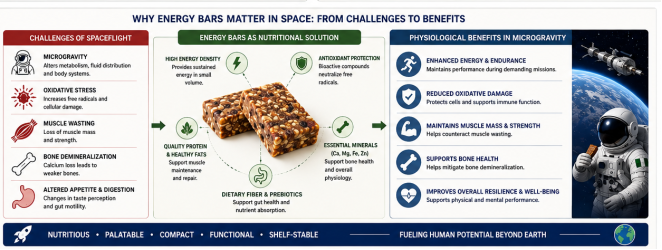
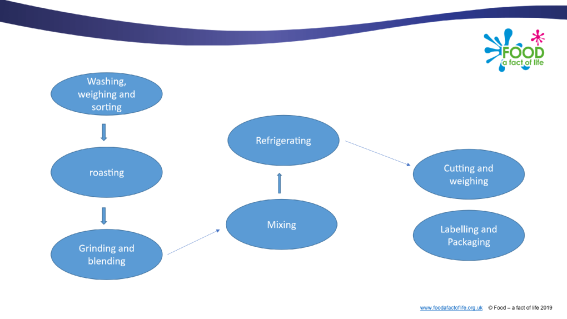
Energy bars are compact, nutrient-dense, shelf-stable foods with significant potential to reduce physiological decline during spaceflight. In long-duration missions, factors such as limited payload capacity, metabolic changes, bone demineralization, and radiation-induced oxidative stress require the development of specific functional countermeasures. The goal of this study was to create and test functional energy bars made from climate-resilient, plant-derived indigenous ingredients rich in essential macronutrients, micronutrients, and bioactive substances that would be suitable for future long-duration flight profiles. Raw materials were systematically cleaned, sorted, graded, and processed via controlled thermal roasting and precision milling to regulate moisture activity. Four distinct formulations (Samples A, B, C, and D) were developed by modulating the ingredient ratios to optimize caloric density, antioxidant defense, and structural integrity. The resulting composites were homogenized, molded, stabilized via controlled thermal setting (28°C for 6 hours), and portioned into standardized 40g square rations. Proximate composition, caloric density, and organoleptic viability were determined, with sensory acceptability evaluated via a 5-point hedonic scale. The developed formulations exhibited a mean caloric density of 216kcal per 40g serving, which aligns with the strict aerospace mass-to-energy constraints. Sensory data revealed that Formulations A and B achieved significantly higher scores for overall acceptability compared to formulations C and D. These findings demonstrate that precisely engineered energy bars derived from indigenous ingredients offer a palaTable, highly nutritious countermeasure for microgravity environments while providing high-performance applications on Earth.
| Published in | International Journal of Nutrition and Food Sciences (Volume 15, Issue 3) |
| DOI | 10.11648/j.ijnfs.20261503.15 |
| Page(s) | 134-142 |
| Creative Commons |
This is an Open Access article, distributed under the terms of the Creative Commons Attribution 4.0 International License (http://creativecommons.org/licenses/by/4.0/), which permits unrestricted use, distribution and reproduction in any medium or format, provided the original work is properly cited. |
| Copyright |
Copyright © The Author(s), 2026. Published by Science Publishing Group |
Energy Bars, Nutrient-dense, Functional Foods, Fortification, Sensory Properties, Space Environment
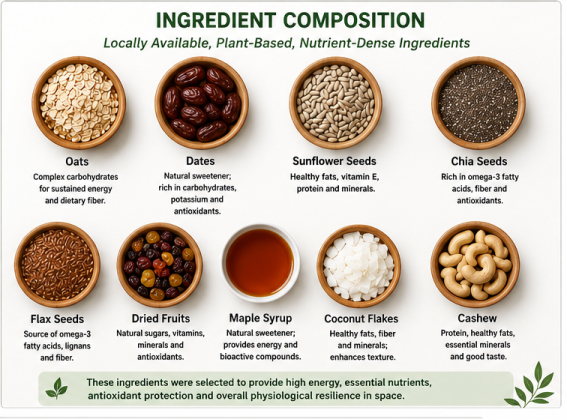
Ingredients | Scientific Name | Sample A | Sample B | Sample C | Sample D |
|---|---|---|---|---|---|
Rolled oats | Avena sativa L. | ✔ | ✔ | ✔ | |
Maple syrup | - | ✔ | |||
Honey | - | ✔ | ✔ | ||
Flaxseeds | Linum usitatissimum | ✔ | ✔ | ✔ | |
Chia seeds | Salvia Hispanica | ✔ | ✔ | ✔ | |
Almonds | Prunus dulcis | ✔ | ✔ | ✔ | |
Sunflower seeds | Helianthus annuus | ✔ | ✔ | ✔ | |
Coconut flakes | Cocos nucifera | ✔ | |||
Coconut almond butter | Cocos nucifera Prunus dulcis | ✔ | |||
Coconut oil | Cocos nucifera | ✔ | |||
Dates | Phoenix dactylifera | ✔ | ✔ | ||
Dried fruits (Mango, Pineapple, Strawberry) | Mangifera indica Ananas comosus Fragaria x ananassa | ✔ | |||
Sesame seeds | Sesamum indicum | ✔ | ✔ | ||
Cashews | Anacardium occidentale | ✔ | |||
Raisins | Vitis vinifera | ✔ | ✔ | ||
Cranberries | Vaccinum oxycoccus | ✔ | ✔ |
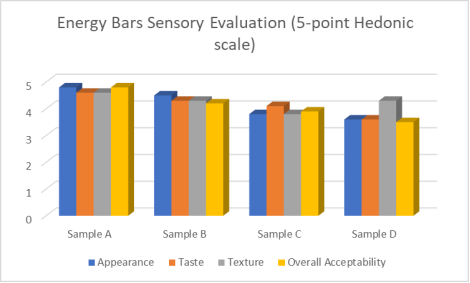
5-Point Hedonic Rating Scale (40 panelists) | ||||||||
|---|---|---|---|---|---|---|---|---|
Food characteristics | Appearance, Taste, Texture, Overall Acceptability | |||||||
Sample A | Average | Sample B | Average | Sample C | Average | Sample D | Average | |
Appearance | 190 | 4.8 | 181 | 4.5 | 152 | 3.8 | 132 | 3.6 |
Taste | 183 | 4.6 | 171 | 4.3 | 163 | 4.1 | 132 | 3.6 |
Texture | 184 | 4.6 | 173 | 4.3 | 151 | 3.8 | 155 | 4.3 |
Overall Acceptability | 187 | 4.8 | 169 | 4.2 | 156 | 3.9 | 127 | 3.5 |
Sample A | Sample B | Sample C | Sample D | |||||
Appearance | 4.8 | 4.5 | 3.8 | 3.6 | ||||
Taste | 4.6 | 4.3 | 4.1 | 3.6 | ||||
Texture | 4.6 | 4.3 | 3.8 | 4.3 | ||||
Overall Acceptability | 4.8 | 4.2 | 3.9 | 3.5 | ||||
NASRDA | National Space Research and Development Agency |
| [1] | AlJaloudi R, Al-Dabbas M, Hamad H, Amara R, Al-Bashabsheh Z, Abughoush M, Iqbal S. Development and Characterization of High-Energy Protein Bars with Enhanced Antioxidant, Chemical, Nutritional, Physical, and Sensory Properties. Foods. 2024; 13: 259. |
| [2] | Barakat H, Alfheeaid HA. Date Palm Fruit (Phoenix dactylifera) and its Promising Potential in Developing Functional Energy Bars: Review of Chemical, Nutritional, Functional, and Sensory Attributes. Nutrition and Public Health. 2023; 7: 2134. |
| [3] |
Bhatt S. Dried Fruits, Nuts, and Seeds Energy Bars. TheRoute2roots. Published March 15, 2026. Available from:
https://www.theroute2roots.com/dried-fruits-nuts-energy-bars/ [Accessed May 29, 2026]. |
| [4] |
Cleveland Clinic. How to Choose the Best Health Bars. Diet, Food & Fitness/Nutrition. Published May 19, 2025. Available from:
https://health.clevelandclinic.org [Accessed May 29, 2026]. |
| [5] | Coello K, Frias J, Martinez-Villaluenga C, Cartea M, Velasco P, Penas E. Manufacture of healthy snack bars supplemented with moringa sprout powder. LWT - Food Science and Technology. 2022; 154: 112701. |
| [6] | Gill A, Singh AK. Energy Bars: Quick, healthy, and wholesome snacks for Adolescents. EARDA Publications / Traditional Lifestyle and Adolescents. 2019; 4: 45-52. ISBN 978-81-941704-3-3. |
| [7] | Gonzalo Miranda M, Ángel B, Antonio M. Dried-Fruit Storage: An Analysis of Package Headspace Atmosphere. Foods. 2019; 8(3): 56. |
| [8] | Ilic J, Djekic I, Tomasevic I, Oosterlinck F, van den Berg MA. Materials properties, Oral Processing, and Sensory Analysis of Eating Meat and Meat Analogs. Annual Review of Food Science and Technology. 2022; 13: 193-215. |
| [9] | Menglan Z. Food Systems for long-term spaceflight: Understanding the role of non-nutrient polyphenols in astronauts' health. Food Science and Nutrition. 2024; 12: 37452. |
| [10] | Mercado PV, Mojica P, Morales H. Protein Ingredients in Bread: Technological, Textural and Health Implications. Foods. 2022; 11: 2399. |
| [11] | Mohammed F, Sibley P, Abdulwali N, Guillaume D. Nutritional, pharmacological, and sensory properties of maple syrup: A comprehensive review. Journal of Food Biochemistry. 2023; 47: 19216. |
| [12] |
Nourish Organics. The Role of Nuts & Seeds in Keeping Your Energy High During Festivities. Nourish Organics. Published October 10, 2025. Available from:
https://nourishorganics.in/blogs [Accessed May 29, 2026]. |
| [13] | Piana M, Oddo LP, Bentabol A, Bruneau E, Bogdanov S, Declerck CG. Sensory Analysis Applied to Honey: State of the Art. Apidologie. 2004; 35: 26-37. |
| [14] | Research and Markets. Snack Bar Market Forecasts from 2020 to 2025. Dublin: Research and Markets; 2023. |
| [15] | Ruiz-Capillas C, Herrero AM, Pintado T, Delgado-Pando G. Sensory Analysis and Consumer Research in New Meat Products. Foods. 2021; 10: 429. |
| [16] | Saraiva A, Carrascosa C, Ramos F, Raheem D, Lopes M, Raposo A. Maple Syrup: Chemical Analysis and Nutritional Profile, Health Impacts, Safety and Quality Control, and Food Industry Applications. International Journal of Environmental Research and Public Health. 2022; 19: 13684. |
| [17] | Saravanan G, Yusri AS, Sarbon N. Investigation of the Nutritional Value, Physicochemical Properties, Antioxidant Activity, and Sensory Acceptability of Fiber- and Protein-enriched Fruit-based Energy Bars. Food Chemistry Advances. 2026; 4: 101196. |
| [18] | Szydlowska A, Zielinska D, Lepecka A, Trzaskowska M, Neffe-Skocinska K, Kolozyn-Krajewska D. Development of Functional High-Protein Organic Bars with the Addition of Whey Protein Concentrate and Bioactive Ingredients. Agriculture. 2020; 10: 390. |
| [19] | Tastan O. Effect of Dietary Fiber Enrichment on Quality Characteristics and Consumer Acceptance of Fruit Snacks. Akademik Gida. 2023; 21: 343-352. |
| [20] | Temessek B, Rebai O, Sulli M, Abdallah B, Diretto G, Fattouch S. Synergizing tradition and innovation: Fortification of milk kefir with date syrup, a novel functional beverage. Acta Alimentaria. 2024; 53: 120. |
| [21] | Yadav L, Bhatnagar V. Optimization of Ingredients in a Cereal Bar. Food Science Research Journal. 2015; 6: 273-278. |
| [22] | Zeroual S, Gaouaoui R, Deghima A. Polyphenolic Profile and in-vitro Antioxidant activity of Three Algerian Date (Phoenix dactylifera) varieties. Journal of Agricultural Sciences. 2024; 29: 112-121. |
| [23] | Schoeneck M, Iggman D. Beyond the Classical Nutrients: The Role of Dietary Phytochemicals and Bioactives in Chronic Disease Prevention. Nutrition Reviews. 2021; 79(11): 1223-1241. |
| [24] | Whitehead A, Beck EJ, Tosh SM, Wolever TM. Cholesterol-lowering effects of oat β-glucan: a meta-analysis of randomized controlled trials. The American Journal of Clinical Nutrition. 2014; 100(6): 1413-1421. |
| [25] | Llanaj E, Dejanovic M, Valido E, Bano A, Gamba M, Aguiar M, Muka T. Effect of dietary phytochemicals on cardiovascular health: A systematic review and meta-analysis of randomized controlled trials. European Journal of Nutrition. 2022; 61(7): 3315-3331. |
| [26] | Petcu F, Sibley P, Abdulwali N, Guillaume D. Nutritional, pharmacological, and sensory properties of dehydrated tropical fruits: A comprehensive review. Journal of Food Composition and Analysis. 2023; 115: 104921. |
| [27] | Phillips KM, Carlsen MH, Blomhoff R. Total antioxidant content of alternatives to refined sugar. Journal of the American Dietetic Association. 2009; 109(1): 64-71. |
APA Style
Abdulrasheed, H. H., Akilu, M., Adamu, A., Jeffree, L., Ibrahim, A. C. (2026). Design, Formulation, and Sensory Acceptability of Functional Energy Bars for Astronaut Nutrition. International Journal of Nutrition and Food Sciences, 15(3), 134-142. https://doi.org/10.11648/j.ijnfs.20261503.15
ACS Style
Abdulrasheed, H. H.; Akilu, M.; Adamu, A.; Jeffree, L.; Ibrahim, A. C. Design, Formulation, and Sensory Acceptability of Functional Energy Bars for Astronaut Nutrition. Int. J. Nutr. Food Sci. 2026, 15(3), 134-142. doi: 10.11648/j.ijnfs.20261503.15
@article{10.11648/j.ijnfs.20261503.15,
  author = {Hadiza Haruna Abdulrasheed and Mariya Akilu and Abubakar Adamu and Leleji Jeffree and Abubakar Ciroma Ibrahim},
  title = {Design, Formulation, and Sensory Acceptability of Functional Energy Bars for Astronaut Nutrition},
  journal = {International Journal of Nutrition and Food Sciences},
  volume = {15},
  number = {3},
  pages = {134-142},
  doi = {10.11648/j.ijnfs.20261503.15},
  url = {https://doi.org/10.11648/j.ijnfs.20261503.15},
  eprint = {https://article.sciencepublishinggroup.com/pdf/10.11648.j.ijnfs.20261503.15},
  abstract = {Energy bars are compact, nutrient-dense, shelf-stable foods with significant potential to reduce physiological decline during spaceflight. In long-duration missions, factors such as limited payload capacity, metabolic changes, bone demineralization, and radiation-induced oxidative stress require the development of specific functional countermeasures. The goal of this study was to create and test functional energy bars made from climate-resilient, plant-derived indigenous ingredients rich in essential macronutrients, micronutrients, and bioactive substances that would be suitable for future long-duration flight profiles. Raw materials were systematically cleaned, sorted, graded, and processed via controlled thermal roasting and precision milling to regulate moisture activity. Four distinct formulations (Samples A, B, C, and D) were developed by modulating the ingredient ratios to optimize caloric density, antioxidant defense, and structural integrity. The resulting composites were homogenized, molded, stabilized via controlled thermal setting (28°C for 6 hours), and portioned into standardized 40g square rations. Proximate composition, caloric density, and organoleptic viability were determined, with sensory acceptability evaluated via a 5-point hedonic scale. The developed formulations exhibited a mean caloric density of 216kcal per 40g serving, which aligns with the strict aerospace mass-to-energy constraints. Sensory data revealed that Formulations A and B achieved significantly higher scores for overall acceptability compared to formulations C and D. These findings demonstrate that precisely engineered energy bars derived from indigenous ingredients offer a palaTable, highly nutritious countermeasure for microgravity environments while providing high-performance applications on Earth.},
 year = {2026}
}
TY  - JOUR
T1  - Design, Formulation, and Sensory Acceptability of Functional Energy Bars for Astronaut Nutrition
AU  - Hadiza Haruna Abdulrasheed
AU  - Mariya Akilu
AU  - Abubakar Adamu
AU  - Leleji Jeffree
AU  - Abubakar Ciroma Ibrahim
Y1  - 2026/06/30
PY  - 2026
N1  - https://doi.org/10.11648/j.ijnfs.20261503.15
DO  - 10.11648/j.ijnfs.20261503.15
T2  - International Journal of Nutrition and Food Sciences
JF  - International Journal of Nutrition and Food Sciences
JO  - International Journal of Nutrition and Food Sciences
SP  - 134
EP  - 142
PB  - Science Publishing Group
SN  - 2327-2716
UR  - https://doi.org/10.11648/j.ijnfs.20261503.15
AB  - Energy bars are compact, nutrient-dense, shelf-stable foods with significant potential to reduce physiological decline during spaceflight. In long-duration missions, factors such as limited payload capacity, metabolic changes, bone demineralization, and radiation-induced oxidative stress require the development of specific functional countermeasures. The goal of this study was to create and test functional energy bars made from climate-resilient, plant-derived indigenous ingredients rich in essential macronutrients, micronutrients, and bioactive substances that would be suitable for future long-duration flight profiles. Raw materials were systematically cleaned, sorted, graded, and processed via controlled thermal roasting and precision milling to regulate moisture activity. Four distinct formulations (Samples A, B, C, and D) were developed by modulating the ingredient ratios to optimize caloric density, antioxidant defense, and structural integrity. The resulting composites were homogenized, molded, stabilized via controlled thermal setting (28°C for 6 hours), and portioned into standardized 40g square rations. Proximate composition, caloric density, and organoleptic viability were determined, with sensory acceptability evaluated via a 5-point hedonic scale. The developed formulations exhibited a mean caloric density of 216kcal per 40g serving, which aligns with the strict aerospace mass-to-energy constraints. Sensory data revealed that Formulations A and B achieved significantly higher scores for overall acceptability compared to formulations C and D. These findings demonstrate that precisely engineered energy bars derived from indigenous ingredients offer a palaTable, highly nutritious countermeasure for microgravity environments while providing high-performance applications on Earth.
VL  - 15
IS  - 3
ER  -
Physical and Life Sciences Department, National Space Research and Development Agency, Abuja, Nigeria
Research Fields: Food product development, Functional foods, Space nutrition, Space Life Sciences, Food processing and preservation, Sustainable food systems
Physical and Life Sciences Department, National Space Research and Development Agency, Abuja, Nigeria
Research Fields: Space Human Physiology and Health, Space Medicine, Public Health and Epidemiology, Food Biochemistry, Space Nutrition, Space Life Sciences, and Food Product Development
Physical and Life Sciences Department, National Space Research and Development Agency, Abuja, Nigeria
Research Fields: Space Life Sciences, Space Medicine, Pharmacognosy and Drug Development, Pharmacy, Space Human Health and Physiology, and Space Nutrition
Physical and Life Sciences Department, National Space Research and Development Agency, Abuja, Nigeria
Research Fields: Space Life Sciences, Radiation Biology, Space Health, Biochemistry, Space Physiology, and Space Nutrition
Physical and Life Sciences Department, National Space Research and Development Agency, Abuja, Nigeria
Research Fields: Space Life Sciences, Space Health, Space Agriculture, Sustainable food systems, and Advanced food processing techniques

Information



 Share This Article
 Twitter
 Linked In
 Facebook
 Copy
Copy Download