
Organophosphorus (OP) compounds are widely used in livestock farming to control external parasites. However, their extensive application has led to significant environmental contamination, including soil, water, and air pollution, as well as adverse effects on non-target organisms and disruption of ecosystem processes. These challenges necessitate the development of sustainable, cost-effective, and environmentally friendly approaches for OP detoxification. Compared to conventional remediation methods such as chemical treatment, incineration, and landfill disposal, which are often costly and environmentally harmful, microbial-based bioremediation offers a promising alternative. This study aimed to isolate and characterize fungi from OP-contaminated soils collected in Kilifi County and assess their potential for molecular identification and future bioremediation applications. Fungal isolates were obtained using an enrichment culture technique and purified through repeated sub-culturing. Morphological characterization was performed to confirm isolate purity. Genomic DNA was extracted from pure cultures, and its quality and concentration were evaluated using a Nano Drop spectrophotometer, while agarose gel electrophoresis was used to assess DNA integrity. Molecular identification was conducted by amplifying the internal transcribed spacer (ITS) region using ITS1-F and ITS4 primers. The amplified PCR products were purified and sequenced using the Sanger dideoxy sequencing method. Sequence analysis using BLASTn against the NCBI database revealed that most isolates showed 100% similarity with known fungal species. Phylogenetic relationships were inferred using the Maximum Likelihood method in MEGA X software. The findings confirm the successful isolation and molecular identification of OP-tolerant fungi from contaminated soils, highlighting their potential application in the bioremediation of organophosphate-polluted environments. These results provide a foundation for further studies on the development of efficient fungal-based systems for chlorpyrifos and related OP degradation.
| Published in | International Journal of Microbiology and Biotechnology (Volume 11, Issue 3) |
| DOI | 10.11648/j.ijmb.20261103.11 |
| Page(s) | 96-105 |
| Creative Commons |
This is an Open Access article, distributed under the terms of the Creative Commons Attribution 4.0 International License (http://creativecommons.org/licenses/by/4.0/), which permits unrestricted use, distribution and reproduction in any medium or format, provided the original work is properly cited. |
| Copyright |
Copyright © The Author(s), 2026. Published by Science Publishing Group |
Organophosphate (OP), Enrichment, BLASTn, Phylogenetic Analysis
Isolate | Colony Colour | Texture | Margin | Growth Rate | Microscopic Features |
|---|---|---|---|---|---|
KA1 | Cream-white | Smooth | Entire | Rapid | Oval budding yeast cells |
KB2 | Yellow-green | Powdery | Entire | Fast | Aspergillus-type conidial heads |
KC3 | Blue-green | Velvety | Entire | Fast | Columnar conidial heads |
KD4 | Yellow-brown | Velvety | Entire | Moderate | Septate hyphae, globose conidia |
KE5 | Green with white margin | Powdery | Entire | Moderate | Brush-like penicilli |
KF6 | White | Cottony | Irregular | Very fast | Non-septate hyphae, sporangia present |
KG7 | Brownish | Velvety | Entire | Moderate | Aspergillus-type conidial heads |
KH8 | Olive-greenish | Velvety | Entire | Fast | Septate hyphae, conidiophores with globose vesicles |
KJ10 | Black | Granular | Entire | Fast | Black conidia, biseriate phialides |
KK9 | Yellow-green | Powdery | Entire | Fast | Rough conidia in chains |
Fungal isolate | Accession | Species (ITS gene analysis) | % Identity |
|---|---|---|---|
KA1 | MT071785.1 | Pichia kudriavzevii | 100 |
KB2 | OQ438650 | Aspergillus fumigatus | 100 |
KC3 | OM980663 | Aspergillus flavus | 100 |
KD4 | KJ173526 | Aspergillus ochraceopetaliformis | 100 |
KE5 | PP385661 | Penicillium citrinum | 100 |
KF6 | OM959554 | Rhizopus arrhizus | 100 |
KG7 | PP385269 | Aspergillus brunneoviolaceus | 99 |
KH8 | PX970377 | Aspergillus flavus | 99 |
KJ10 | ON688455 | Aspergillus niger | 100 |
KK9 | MW250193 | Aspergillus oryzae | 100 |
PCR | Polymerase Chain Reaction |
eDNA | Environmental Deoxyribonucleic Acid |
| [1] | Adum, A. N., Gibson, G., Chimbevo, L. M., Oshule, P. S., Essuman, S. and Asamba, M. N., 2021. Detection and quantification of chlorpyrifos in soil, milk, dip wash, spray race residues using high performance liquid chromatography in selected dairy farms in Kenya. Science, 9(4), pp. 88-95. |
| [2] | Asamba, M. N., Mugendi, E. N., Oshule, P. S., Essuman, S., Chimbevo, L. M. and Adum, N. A., 2022. Molecular characterization of chlorpyrifos degrading bacteria isolated from contaminated dairy farm soils in Nakuru County, Kenya. Heliyon, 8(3). |
| [3] | Biolabs, N. E., 2024. Protocol for OneTaq® Quick-Load 2X Master Mix with Standard Buffer (M0486). |
| [4] | Bosu, S., Rajamohan, N., Al Salti, S., Rajasimman, M. and Das, P., 2024. Biodegradation of chlorpyrifos pollution from contaminated environment-A review on operating variables and mechanism. Environmental Research, 248, p. 118212. |
| [5] | Dar, M. A., & Kaushik, G. (2023). Biodegradation of malathion in amended soil by indigenous novel bacterial consortia and analysis of degradation pathway. Soil Systems, 7(4), 81. |
| [6] | Elzakey, E. M., El-Sabbagh, S. M., Nour Eldeen, E. E. S., et al. (2023). Bioremediation of chlorpyrifos residues using indigenous bacterial and fungal species in wastewater. Environmental Monitoring and Assessment, 195, 779. |
| [7] | Kilonzi, J. M., & Otieno, S. (2024). Degradation kinetics and physiological studies of organophosphate-degrading microorganisms for soil bioremediation. Stress Biology, 4, 11. |
| [8] | Elzakey, E. M., El-Sabbagh, S. M., Eldeen, E. E. S. N., Adss, I. A. A. and Nassar, A. M. K., 2023. Bioremediation of chlorpyrifos residues using some indigenous species of bacteria and fungi in wastewater. Environmental Monitoring and Assessment, 195(6), p. 779. |
| [9] | Giri, B. S., Geed, S., Vikrant, K., Lee, S. S., Kim, K. H., Kailasa, S. K., Vithanage, M., Chaturvedi, P., Rai, B. N. and Singh, R. S., 2021. Progress in bioremediation of pesticide residues in the environment. Environmental Engineering Research, 26(6). |
| [10] | Haro, L. A., Mjomba, F. M., Chimbevo, L. M., Gicharu, G. K., Tom, F. J. and Makenzi, N. G., 2024. Development Synergy and Optimization of Growth Conditions of Chlorpyrifos Degrading Bacteria Consortium. Multidisciplinary Journal of Technical University of Mombasa, 3(1), pp. 21-46. |
| [11] | Saad, H., Elfeky, S. A., El-Gamel, N. E. A., & Abo Dena, A. S. (2025). Organophosphate pesticides: A review on classification, synthesis, toxicity, remediation and analysis. RSC Advances, 15, 40802–40822. |
| [12] | Kiran, M., Sindhu, R., Raju, N. S., 2025. Recent advances in biological removal of chlorpyrifos from the environment. International Journal of Environmental Research. |
| [13] | Kumar, G., Lal, S., Soni, S. K., Maurya, S. K., Shukla, P. K. and Chaudhary, P., 2022. Mechanism and kinetics of chlorpyrifos co-metabolism by using environment. Restoring microbes isolated from rhizosphere of horticultural crops under subtropics. Front Microbiol 13: 2796. |
| [14] | Kumar, S., Verma, P., & Singh, A. (2021). Biodegradation of organophosphorus insecticide chlorpyrifos by Trametes hirsuta MTCC-1171 using mineral salt medium. Journal of the Indian Chemical Society, 98(9), 100120. |
| [15] | Lewis, W. H., Tahon, G., Geesink, P., et al. (2021). Innovations to culturing the microbial majority. Nature Reviews Microbiology, 19, 726–740. |
| [16] | Lian, L., Xing, Y., Zhang, N. and Jiang, B., 2022. Identification of chlorpyrifos-degrading microorganisms in farmland soils via cultivation-independent and-dependent approaches. Environmental Science: Processes & Impacts, 24(7), pp. 1050-1059. |
| [17] | Matúš, P., Littera, P., Farkas, B. and Urík, M., 2023. Review on performance of Aspergillus and Penicillium species in biodegradation of organochlorine and organophosphorus pesticides. Microorganisms, 11(6), p. 1485. |
| [18] | Mohamed, A. H., Noorhisham, N. A., Yahaya, N., Mohamad, S., Kamaruzzaman, S., Osman, H., & Aboul-Enein, H. Y. (2023). Sampling and sample preparation techniques for the analysis of organophosphorus pesticides in soil matrices. Critical Reviews in Analytical Chemistry, 53(4), 906–927. |
| [19] | Niu, B., Paulson, J. N., Zheng, X., & Kolter, R. (2020). Simplified and representative microbial communities in culture-based studies reveal uncultured diversity. Nature Microbiology, 5, 1110–1118. |
| [20] | Pardini AA, Iurlina MO, Reynals Marcangeli A, Robles AD, Saiz AI, 2026. Lactic acid bacteria as bioremediation agents for chlorpyrifos degradation: a combined chemical and in silico approach. Explor Foods Foodomics. 2026; 4: 1010127. |
| [21] | Pathak, V. M., Verma, V. K., Rawat, B. S., Kaur, B., Babu, N., Sharma, A., Dewali, S., Yadav, M., Kumari, R., Singh, S. and Mohapatra, A., 2022. Current status of pesticide effects on environment, human health and it’s eco-friendly management as bioremediation: A comprehensive review. Frontiers in microbiology, 13, p. 962619. |
| [22] |
Sanyal, D. (2024). Effective soil sampling for sustainable crop production. University of Arizona Cooperative Extension. Retrieved from
https://extension.arizona.edu/publication/effective-soil-sampling-sustainable-crop-production |
| [23] | Sehrawat, A., Phour, M., Kumar, R. and Sindhu, S. S., 2021. Bioremediation of pesticides: an eco-friendly approach for environment sustainability. In Microbial Rejuvenation of Polluted Environment: Volume 1 (pp. 23-84). Singapore: Springer Singapore. |
| [24] | Tejashwini, P., Baker, S., Parashiva, J., & Satish, S. (2026). Biodegradation potential of chlorpyrifos from soil microbiont Trichoderma asperellum S8 and its biocontrol efficacy. The Microbe, 10, 100681. |
| [25] | Thomas, T., Gilbert, J., & Meyer, F. (2021). Metagenomics in soil microbiology: From diversity assessment to functional insights. Nature Reviews Microbiology, 19, 581–596. |
| [26] | Tom, F. J., Gicharu, G. K., Makenzi, N. G., Chimbevo, L. M., Mjomba, F. M., Amana, M. J., Norbert, A. A. and Haro, A. L., 2024. Optimization of Growth Conditions for Production of Organophosphorous Phosphatase Enzymes in Three Bacteria Species Isolated from Dairy Farms in Kenya. Multidisciplinary Journal of Technical University of Mombasa, 3(2), pp. 19-31. |
| [27] | Trollip, C., Kaur, J., Piper, A. M., Martoni, F., Mann, R., Dinh, Q., Carnegie, A. J., Rodoni, B. and Edwards, J., 2024. Modular, multi‐barcode amplicon sequencing for improved species‐level detection of fungal phytopathogens: A case study of pipeline establishment targeting the Ophiostomatales. Environmental DNA, 6(1), p. e368. |
| [28] | Varghese, E. M., Aswani, P., & Jisha, M. S. 2021. Strategies in microbial degradation enhancement of chlorpyrifos. Biocatalysis and Biotransformation, 40(12), 1–12. |
| [29] | Wepukhulu, M., Wachira, P., Huria, N., Sifuna, P., Essuman, S. and Asamba, M., 2024. Optimization of Growth Conditions for Chlorpyrifos‐Degrading Bacteria in Farm Soils in Nakuru County, Kenya. BioMed Research International, 2024(1), p. 1611871. |
| [30] | Jokar, S. H., Shavandi, M., Haddadi, A. and Alaie, E., 2021. Impacts of Chlorpyrifos and Deltamethrin on soil bacterial community composition in different salinity soils: natural attenuation microcosm studies. |
| [31] | Pathak, V. M., Verma, V. K., Rawat, B. S., Kaur, B., Babu, N., Sharma, A., Dewali, S., Yadav, M., Kumari, R., Singh, S. and Mohapatra, A., 2022. Current status of pesticide effects on environment, human health and it’s eco-friendly management as bioremediation: A comprehensive review. Frontiers in microbiology, 13, p. 962619. |
APA Style
Adum, A. N., Okeri, C., Gicharu, G., Peter, M. (2026). Morphological and Molecular Characterization of Fungi Isolated from Organophosphate Contaminated Dairy Farm Soils in Kilifi County, Kenya. International Journal of Microbiology and Biotechnology, 11(3), 96-105. https://doi.org/10.11648/j.ijmb.20261103.11
ACS Style
Adum, A. N.; Okeri, C.; Gicharu, G.; Peter, M. Morphological and Molecular Characterization of Fungi Isolated from Organophosphate Contaminated Dairy Farm Soils in Kilifi County, Kenya. Int. J. Microbiol. Biotechnol. 2026, 11(3), 96-105. doi: 10.11648/j.ijmb.20261103.11
@article{10.11648/j.ijmb.20261103.11,
  author = {Atego Norbert Adum and Carren Okeri and Gibson Gicharu and Makan Peter},
  title = {Morphological and Molecular Characterization of Fungi Isolated from Organophosphate Contaminated Dairy Farm Soils in Kilifi County, Kenya},
  journal = {International Journal of Microbiology and Biotechnology},
  volume = {11},
  number = {3},
  pages = {96-105},
  doi = {10.11648/j.ijmb.20261103.11},
  url = {https://doi.org/10.11648/j.ijmb.20261103.11},
  eprint = {https://article.sciencepublishinggroup.com/pdf/10.11648.j.ijmb.20261103.11},
  abstract = {Organophosphorus (OP) compounds are widely used in livestock farming to control external parasites. However, their extensive application has led to significant environmental contamination, including soil, water, and air pollution, as well as adverse effects on non-target organisms and disruption of ecosystem processes. These challenges necessitate the development of sustainable, cost-effective, and environmentally friendly approaches for OP detoxification. Compared to conventional remediation methods such as chemical treatment, incineration, and landfill disposal, which are often costly and environmentally harmful, microbial-based bioremediation offers a promising alternative. This study aimed to isolate and characterize fungi from OP-contaminated soils collected in Kilifi County and assess their potential for molecular identification and future bioremediation applications. Fungal isolates were obtained using an enrichment culture technique and purified through repeated sub-culturing. Morphological characterization was performed to confirm isolate purity. Genomic DNA was extracted from pure cultures, and its quality and concentration were evaluated using a Nano Drop spectrophotometer, while agarose gel electrophoresis was used to assess DNA integrity. Molecular identification was conducted by amplifying the internal transcribed spacer (ITS) region using ITS1-F and ITS4 primers. The amplified PCR products were purified and sequenced using the Sanger dideoxy sequencing method. Sequence analysis using BLASTn against the NCBI database revealed that most isolates showed 100% similarity with known fungal species. Phylogenetic relationships were inferred using the Maximum Likelihood method in MEGA X software. The findings confirm the successful isolation and molecular identification of OP-tolerant fungi from contaminated soils, highlighting their potential application in the bioremediation of organophosphate-polluted environments. These results provide a foundation for further studies on the development of efficient fungal-based systems for chlorpyrifos and related OP degradation.},
 year = {2026}
}
TY  - JOUR
T1  - Morphological and Molecular Characterization of Fungi Isolated from Organophosphate Contaminated Dairy Farm Soils in Kilifi County, Kenya
AU  - Atego Norbert Adum
AU  - Carren Okeri
AU  - Gibson Gicharu
AU  - Makan Peter
Y1  - 2026/07/17
PY  - 2026
N1  - https://doi.org/10.11648/j.ijmb.20261103.11
DO  - 10.11648/j.ijmb.20261103.11
T2  - International Journal of Microbiology and Biotechnology
JF  - International Journal of Microbiology and Biotechnology
JO  - International Journal of Microbiology and Biotechnology
SP  - 96
EP  - 105
PB  - Science Publishing Group
SN  - 2578-9686
UR  - https://doi.org/10.11648/j.ijmb.20261103.11
AB  - Organophosphorus (OP) compounds are widely used in livestock farming to control external parasites. However, their extensive application has led to significant environmental contamination, including soil, water, and air pollution, as well as adverse effects on non-target organisms and disruption of ecosystem processes. These challenges necessitate the development of sustainable, cost-effective, and environmentally friendly approaches for OP detoxification. Compared to conventional remediation methods such as chemical treatment, incineration, and landfill disposal, which are often costly and environmentally harmful, microbial-based bioremediation offers a promising alternative. This study aimed to isolate and characterize fungi from OP-contaminated soils collected in Kilifi County and assess their potential for molecular identification and future bioremediation applications. Fungal isolates were obtained using an enrichment culture technique and purified through repeated sub-culturing. Morphological characterization was performed to confirm isolate purity. Genomic DNA was extracted from pure cultures, and its quality and concentration were evaluated using a Nano Drop spectrophotometer, while agarose gel electrophoresis was used to assess DNA integrity. Molecular identification was conducted by amplifying the internal transcribed spacer (ITS) region using ITS1-F and ITS4 primers. The amplified PCR products were purified and sequenced using the Sanger dideoxy sequencing method. Sequence analysis using BLASTn against the NCBI database revealed that most isolates showed 100% similarity with known fungal species. Phylogenetic relationships were inferred using the Maximum Likelihood method in MEGA X software. The findings confirm the successful isolation and molecular identification of OP-tolerant fungi from contaminated soils, highlighting their potential application in the bioremediation of organophosphate-polluted environments. These results provide a foundation for further studies on the development of efficient fungal-based systems for chlorpyrifos and related OP degradation.
VL  - 11
IS  - 3
ER  -
Department of Chemistry and Biological Sciences, Technical University of Mombasa, Mombasa, Kenya
Department of Chemistry and Biological Sciences, Technical University of Mombasa, Mombasa, Kenya
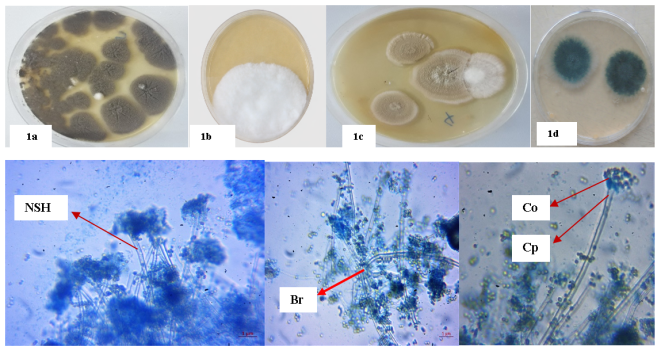
Figure 1. Plate cultures and the microscopic features of some representative fungal isolates, 1a, 1b, 1c and 1d represent 5-day old plate cultures; the microscopic features of some of the fungal isolates, Cp-Conidiophore, Co-Conidia, Br-Branched hyphae, NSH-Septate hyphae.
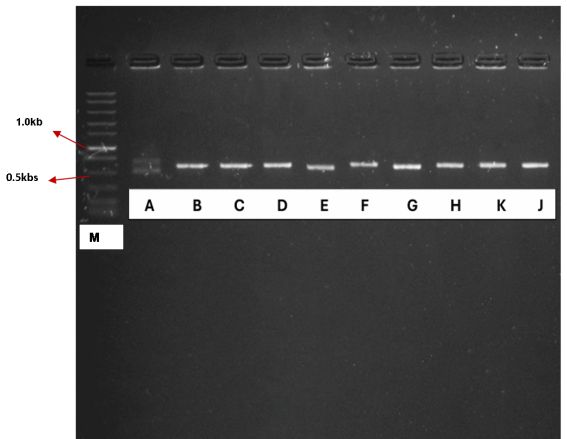
Figure 2. Amplification of ITS gene regions of the fungal isolates. A-J are the fungal PCR amplicons and M represents a 1 kb DNA maker. The expected band size amplified was approximately 700bps.
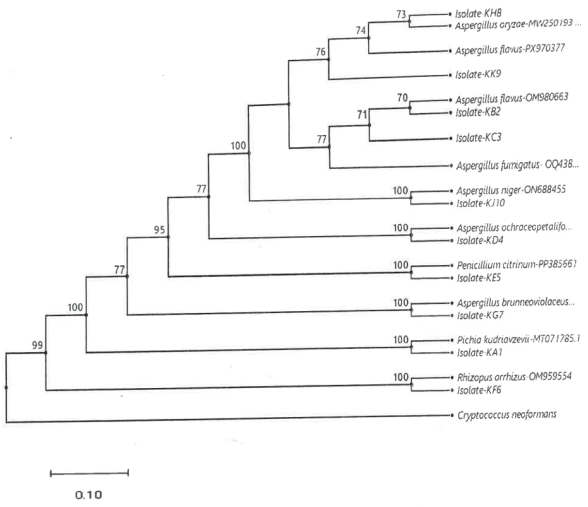
Figure 3. Molecular phylogenetic tree of fungal isolates based on ITS rDNA sequences.

Information



 Share This Article
 Twitter
 Linked In
 Facebook
 Copy
Copy Download