1. Introduction
Hotel is a place that offers accommodation, food and drinks at a price that enables it to make profit
| [34] | Raghubalan, G., & Raghubalan, S. (2015). Hotel housekeeping: Operation and Management (3rd ed.) Oxford University Press. |
[34]
. Housekeeping is an act of providing a clean, comfortable, safe and aesthetic environment. In a hotel, housekeeping entails cleaning, maintenance and upkeep of rooms, public areas and the entire hotel environment to make it look attractive and comfortable. The housekeeping department is a part of the hotel industry, responsible for providing guests accommodation. Housekeeping department is in charge of cleanliness, upkeep, decoration, and maintenance of the whole hotel
| [9] | Bhatnagar, E., & Nim, D. (2019). Impact of housekeeping services and practices on customer satisfaction and repeat business. Prabandhan Indian Journal of Management, 46-57. |
[9]
. The success of the hotel business rest majorly on the service quality of the housekeeping professionals who perform the task of keeping the hotel area clean and tidy. Though the role of every person working in the hotel industry is important, the housekeeping department is the most important. It is regarded as the “lifeline” to the hotel business
. Hotel is regarded as an essential part of the tourism industry because it offers the guests accommodation which is their most important need
| [32] | Phabhu, M., Abdullah, N. N., & Ahmed, R. (2020). Segmenting the manufacturing industries and measuring the performance: Using interval-valued triangular fuzzy Topsis method. Complex Intell. Sys.
https://doi.org/10.1007/40747-020-00157-0 |
[32]
. The housekeeping department has also been described as the backbone of the hotel industry as it is perhaps responsible for bringing back the guests to the hotel again and again, and it is responsible for earning the maximum revenue for the hotel
| [23] | Mohamed, K., & Arun, A. (2023). Impact of housekeeping services and practices on customer satisfaction and repeat business. International Journal of Advances in Engineering and Management (IJAEM), 5(3), 1297-1310. |
[23]
.
The hotel industry is essentially customer driven, as such the key to its survival and success rest on the customer. In this present time of high competition in business, the secret to sustainable competitive advantages rest on providing high standard service, to satisfy customers
| [29] | Nzei, J. A. (2018). Effect of service quality on customers’ satisfaction and loyalty among guests in selected hotels in Delta State, Nigeria. Journal of Research in Tourism, 6, 183-191. |
| [36] | Saleh, P. F., Ali, B. J., Akoi, S., Najmalddin, B., Ali, R. S., & Anwar, G. (2021). Factors affecting the success of female entrepreneurs in Kurdistan International Journal of Engineering, Business and Management (IJEMB), 5. |
[29, 36]
. Delivery of good quality service to the customer influence the extent of customer satisfaction with the hotel services. A practical way to retain customers is to ensure high level of customer satisfaction, which may result in strong customer loyalty. Hotel housekeeping service could be instrumental to guest's satisfaction and repeat patronage, as the cleanliness and tidiness of a hotel room makes a significant impression on the guest, as a well maintained room can enhance the guest overall hotel experience. The housekeeping department is central in creating the experience of a home away from home for the guest. The housekeeping service quality can make the customers delight, and they may want to revisit or recommend the hotel to other people, which will enable the hotel to make more profit
| [14] | Giovanni, N. T., Alessandro, G. A., & Napolitano, F. P. (2022). The role of housekeeping department towards guest satisfaction in Isola Sacra hotel, Italy. Journal of Hospitality and Tourism Management 5(2), 1-10.
https://doi.org/10.53819/81018102t5133 |
[14]
. An efficient housekeeping service can result to positive word-of-mouth recommendations from guests while poor housekeeping service quality can lead to negative perception, which diminishes guest satisfaction and decreases repeat patronage, which may result to loss of customers. It was noted that most hotel organisations may lose half of their customers because they are not satisfied with the services rendered by the room attendants, and poor service quality leads to low satisfaction, discouraging customers from returning
.
The reviewed literatures established that the housekeeping department significantly influenced customers’ satisfaction. Customer satisfaction is very important in the hotel industry as it enhances hotel’s reputation and increases room sales. It was noted that when guests are determining whether to return to or recommend a hotel, housekeeping service was rated more highly as a factor than reception and food/beverage services
| [23] | Mohamed, K., & Arun, A. (2023). Impact of housekeeping services and practices on customer satisfaction and repeat business. International Journal of Advances in Engineering and Management (IJAEM), 5(3), 1297-1310. |
[23]
. Despite the importance of the housekeeping services in the hotel business, only few studies have attempted to pin-point the specific aspects of the housekeeping service quality dimensions that have high significant impact on guests level of satisfaction. This study is therefore intended to fill this gap and contribute to the existing knowledge by attempting to find out the housekeeping service quality dimensions that significantly influence customers satisfaction in the hotel industry.
1.1. Concept of Service Quality
Service quality is the ability or capability of the hotels to meet customers’ expectations
| [6] | Anwar, K., & Climis, R. (2017). Analyzing the relationship between advertisement and customer choice: A study of retailer stores in Erbil. The International Journal of Accounting and Business Society, 25(2), 43-52. |
[6]
. Service quality is an evaluation of how a provided service meets up to the customer expectation. Service quality is said to be a divergence among consumer’s anticipation of service provided and their assessment of the services
| [4] | Ali, B., Othman, J. B., Gardi, B., & Ahmed, A. S. (2021). Hotel service quality: The impact of service quality on customer satisfaction in hospitality. International Journal of Engineering Business and Management (IJEBM), 5(3), 14-28. |
[4]
. Service quality is seen as the dissimilarity among customers’ anticipation of the service performance before the service encounter, and their perception of the rendered services
| [31] | Othman, M., & Abdullah, N. (2016). The conceptual assessment of Malaysian entrepreneurship environment and EO economic contribution. Journal of Resources Development and Management, 20, 15-20. |
[31]
. Service quality can be said to be the assessment of how a provided service measures up to the guest’s expectations
| [7] | Anwar, K., & Qadir, G. H. (2017). A study of the relationship between work, engagement and Job satisfaction in private companies in Kurdistan. International Journal of Advanced Engineering Management Science 3(2), 1102-1110. |
[7]
. Customer satisfaction is enhanced by service quality, as satisfaction is determined by the quality of service expected by the customer
| [38] | Sit, W., Ooi, K., Lin, B., & Chong, A. Y. (2009). TQM and customers satisfaction in Malaysia service sector. Industrial Management and Data system, 109 (7), 957-975. |
[38]
. The increase in the number of hotels make customers to have more alternatives to choose from, they are not only satisfied with just the quality of the food and drink (products) offered by the hotels, but also the conditions in which the services are provided. Guests want to be comfortable and feel safe during their stay in the hotel, they expect good service quality. Measuring service quality is necessary for quality improvement, as it helps to generate feedback concerning services offered, to determine whether guests needs have been met or not.
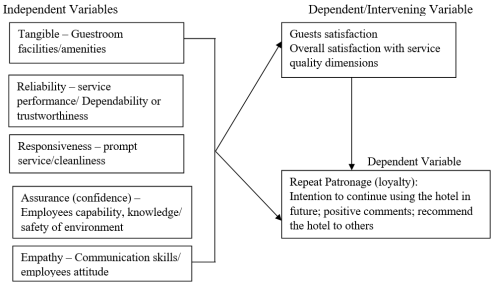
Previous researchers asserted that there are five dimensions of service quality that can be assessed, they are: tangible, reliability, responsiveness, assurance, and empathy
| [5] | Anwar, G., & Abdullah, N. N. (2021). Inspiring future entrepreneur: The effect of experiential learning on the entrepreneurial intention of higher education. International Journal of English Literature and Social Sciences 6. |
| [30] | Othman, B., Harun, A., Rashid, W., & Ali, R. (2019). The impact of Umrah service quality on customer satisfaction towards Umrah travel agents in Malaysia. Management Sciences Letters, 9(11), 1763-1772. |
| [31] | Othman, M., & Abdullah, N. (2016). The conceptual assessment of Malaysian entrepreneurship environment and EO economic contribution. Journal of Resources Development and Management, 20, 15-20. |
| [37] | Samat, N., & Gopi, B. (2020). The influence of food trucks service quality on customer satisfaction and its impact towards customer loyalty. British Food Journal, 122, 3213-3226. |
[5, 30, 31, 37]
. The five dimensions are said to impact guests perception of service quality
| [4] | Ali, B., Othman, J. B., Gardi, B., & Ahmed, A. S. (2021). Hotel service quality: The impact of service quality on customer satisfaction in hospitality. International Journal of Engineering Business and Management (IJEBM), 5(3), 14-28. |
| [37] | Samat, N., & Gopi, B. (2020). The influence of food trucks service quality on customer satisfaction and its impact towards customer loyalty. British Food Journal, 122, 3213-3226. |
[4, 37]
. A study in Nigeria found that all the five service quality dimensions had positive significant relationship with customer satisfaction in the hotels
| [22] | Makinde, A. J., & Eyinade, S. A. (2021). Service quality dimensions and correlates of customer satisfaction in selected hotels in Ibadan. Direct Research Journal of Management and Strategic Studies, 2, 13-21. |
[22]
. It was concluded that tangible, reliable, responsiveness, assurance and empathy service quality dimensions are good predictors of customers satisfaction with hotel services
| [22] | Makinde, A. J., & Eyinade, S. A. (2021). Service quality dimensions and correlates of customer satisfaction in selected hotels in Ibadan. Direct Research Journal of Management and Strategic Studies, 2, 13-21. |
[22]
.
Tangible (Guestroom facilities/amenities)
Tangibles are the physical facilities and amenities, cleanliness, comfort of a room, communication and entertainment equipment, employees appearance, parking space available and others. The hotel equipment and the appearance of the employees serving guests, can create a memorable impression on customers
| [8] | Balinado, J. R., Praselyo, T. Y., Young, N. M., & Persada, F. S. (2021). The effect of service quality on customer satisfaction in an automotive after-sales service. Journal of Open Innovation: Technology, Market and Complexity, 7(2), 116. |
[8]
. The study by Bhatnagar and Nim
found that décor and cleanliness (tangible) significantly correlate with guest satisfaction
| [9] | Bhatnagar, E., & Nim, D. (2019). Impact of housekeeping services and practices on customer satisfaction and repeat business. Prabandhan Indian Journal of Management, 46-57. |
[9]
. It was noted that, the better the tangible provided by the organization, the greater the satisfaction experienced by customers
| [18] | Jatmika, R. M., & Abdurrahman, A. (2023). The influence of service quality dimension on customer loyalty with customer satisfaction as an intervening variable. International Journal of Science, Technology and Management., 1067-1080.
http://ijstm.inarah.co.id |
[18]
. The appearance and ability (functionality) of physical facilities and infrastructures, and the conditions of the surrounding environment gives a clue of the services offered by the service provider
| [18] | Jatmika, R. M., & Abdurrahman, A. (2023). The influence of service quality dimension on customer loyalty with customer satisfaction as an intervening variable. International Journal of Science, Technology and Management., 1067-1080.
http://ijstm.inarah.co.id |
[18]
. It was found that cleanliness of both housekeeping staff and the hotel premises, influenced customers satisfaction
| [28] | Nikhil, K. S., Himanshu, S., & Rajiv, M. (2022). A study on the impact of housekeeping service on customer satisfaction and repeat business in crown plaza hotel, Greater Noida. Global Journal of Management and Business Research, F Real Estate, Event and Tourism Management 22(2). |
[28]
. A study found out that tangible service quality dimension greatly influenced customers satisfaction
| [4] | Ali, B., Othman, J. B., Gardi, B., & Ahmed, A. S. (2021). Hotel service quality: The impact of service quality on customer satisfaction in hospitality. International Journal of Engineering Business and Management (IJEBM), 5(3), 14-28. |
[4]
. Another study showed that tangible had strong effect on customers’ satisfaction
| [16] | Hassan, H. N., Ruswanti, E., & Januarko, M. U. (2018). The effect of hospital service quality on patient loyalty and patent satisfaction (Hospital case in Indonesia) International Journal of Business and Management Invention (IJBMI), 7(6) 49-55. |
[16]
. It was also found that guests considered the interior design and cleanliness of a room as important factor that influenced their satisfaction
| [33] | Radder, L., & Wang, Y. (2006). Dimensions of guest house service managers: Perceptions and expectations. International Journal of Contemporary Hospitality Management, 18(7), 554-562. |
[33]
. The quality of bathroom, bed and bed linen were also found to be factors that influenced guests satisfaction in the hotel
| [21] | Lockyer, T. (2002). Business guest accommodation selection. The view from both sides. International Journal of Contemporary Hospitality Management, 14(6) 294-300. |
[21]
.
Reliability (Service performance/dependability)
Reliability is the hotel’s capability to provide promised services efficiently and dependably. Reliability relates to constant availability, precision and speed of service
| [24] | Muhammad, Y. S., Aslam, S., Afgan, N., & Abbasi, A. M. (2014). Performance evaluation of automated teller machine (ATM) with fuzzy TOPSIS using sample survey results. International Journal of Business and social Science, 5(13), 216-231. |
[24]
. Reliability is also the ability of the employees to render the promised service faithfully, consistently and precisely; it also mean the hotel keeps to its promise
| [26] | Narteh, B. (2015). Perceived service quality and satisfaction of self-service technology: The case of automated teller machine. International Journal of Quality and Reliability Management, 32 (4), 361-380. |
[26]
. Reliability and empathy had a significant relationship to customers satisfaction (8). Reliability service quality dimension was found to be significantly related to customer satisfaction
| [9] | Bhatnagar, E., & Nim, D. (2019). Impact of housekeeping services and practices on customer satisfaction and repeat business. Prabandhan Indian Journal of Management, 46-57. |
[9]
. The study by Ali, Othman, Gardi and Ahmed, found that the hotel guests were not satisfied with the aspect of providing services as promised, the hotel staff were not dependable in handling guests service problems; so reliability dimension did not have a significant relationship with customers satisfaction
| [4] | Ali, B., Othman, J. B., Gardi, B., & Ahmed, A. S. (2021). Hotel service quality: The impact of service quality on customer satisfaction in hospitality. International Journal of Engineering Business and Management (IJEBM), 5(3), 14-28. |
[4]
.
Responsiveness (Prompt service)
Responsiveness is being willing to assist customers, and render quick service to guests
| [35] | Ramya, N., Kowsalya, A., & Dharamipriya, K. (2019). Service quality and it dimension. EPRA International Journal of Research and Development (IJRD), 4 (2), 38-41. |
[35]
. It was found that responsiveness of employees had positive effect on customer satisfaction
| [17] | Islam, R., Ahmed, S., Rahman, M., & Al-Asheq, A. (2020). Determinants of service quality and its effects on customer satisfaction and loyalty: An empirical study of private banking sector. TQM Journal, 33, 163-1182. |
[17]
. Responsiveness dimension was found to have a significant relationship with customer satisfaction
| [9] | Bhatnagar, E., & Nim, D. (2019). Impact of housekeeping services and practices on customer satisfaction and repeat business. Prabandhan Indian Journal of Management, 46-57. |
[9]
. Responsiveness of employees had a significant effect on customers satisfaction
| [17] | Islam, R., Ahmed, S., Rahman, M., & Al-Asheq, A. (2020). Determinants of service quality and its effects on customer satisfaction and loyalty: An empirical study of private banking sector. TQM Journal, 33, 163-1182. |
| [18] | Jatmika, R. M., & Abdurrahman, A. (2023). The influence of service quality dimension on customer loyalty with customer satisfaction as an intervening variable. International Journal of Science, Technology and Management., 1067-1080.
http://ijstm.inarah.co.id |
[17, 18]
. Responsiveness has been found to be a crucial factor in service quality
| [3] | Al-Hawary, S., & Al-Smeran, W. F. (2017). Impact of electronic service quality on customer satisfaction of Islamic bank in Jordan. International Journal of Academic Research in Accounting, Finance and Management Sciences, 7 (1), 170 – 188. |
[3]
.
Assurance (Capability of employees and safety of guestroom/environment)
Assurance is the capability of employees to convey confidence and trust. Assurance is indicated by the knowledge, courtesy and ability of employees to inspire confidence and trust
| [4] | Ali, B., Othman, J. B., Gardi, B., & Ahmed, A. S. (2021). Hotel service quality: The impact of service quality on customer satisfaction in hospitality. International Journal of Engineering Business and Management (IJEBM), 5(3), 14-28. |
[4]
. It was also noted that, it is necessary for a hotel to prove that it is trustworthy of the money the customer is paying
| [4] | Ali, B., Othman, J. B., Gardi, B., & Ahmed, A. S. (2021). Hotel service quality: The impact of service quality on customer satisfaction in hospitality. International Journal of Engineering Business and Management (IJEBM), 5(3), 14-28. |
[4]
, and that guests should perceive that they are safe in all financial transactions when they consume different services from the hotel
| [4] | Ali, B., Othman, J. B., Gardi, B., & Ahmed, A. S. (2021). Hotel service quality: The impact of service quality on customer satisfaction in hospitality. International Journal of Engineering Business and Management (IJEBM), 5(3), 14-28. |
[4]
. Assurance dimension was found to positively impact customers satisfaction. It was observed that employees skills and competencies inspired confidence and trust in the customers which resulted in perceived safety and comfort in the process of service delivery
| [40] | Wu, Y. C., Tsai, C. S., Hsiung, H. W., & Chen, K. Y. (2015). Linkage between frontline employee service competence scale and customer perceptions of service quality. Journal of Service Market, 29, 224-234.
https://doi.org/10.1108/JSM-02-2014-0058 |
[40]
. Customers are more likely to patronize the hotel again, if they have confidence in ability of the employees to perform their tasks
| [11] | Elmadag, A. B., Ellinger, A. E., & Franke, G. R. (2018). Antecedents and consequences of frontline service employee commitment to service quality. Journal of Market Theory Practice, 16, 95-110. https://doi.org/10.2753/MTP1069-6679160201 |
[11]
.
Empathy (Employees communication skills/attitude)
Empathy is trying to understand customers’ needs or expectations. It involves understanding the guests feelings and expectations by imagining oneself to be in the guest’s situation. Through communication skills and attitude, the housekeeping staff can impress the guests. In the studies conducted, empathy dimension was found to have a significant relationship with customers satisfaction
| [4] | Ali, B., Othman, J. B., Gardi, B., & Ahmed, A. S. (2021). Hotel service quality: The impact of service quality on customer satisfaction in hospitality. International Journal of Engineering Business and Management (IJEBM), 5(3), 14-28. |
| [18] | Jatmika, R. M., & Abdurrahman, A. (2023). The influence of service quality dimension on customer loyalty with customer satisfaction as an intervening variable. International Journal of Science, Technology and Management., 1067-1080.
http://ijstm.inarah.co.id |
[4, 18]
. It was also reported that empathy service quality dimension was the most significant predictor of revisit intention among spa goers in Malaysia
| [2] | Al-alak, B. A. (2012). The relationship between service quality, satisfaction and behavioural intentions of Malaysian Spa Centre Customers. International Journal of Business and Social Sciences, 3(1), 198-204. |
[2]
. The study conducted by Ali
et al., indicated that the hotel guests were satisfied with tangible, responsiveness, assurance and empathy, but not satisfied with reliability dimension
| [4] | Ali, B., Othman, J. B., Gardi, B., & Ahmed, A. S. (2021). Hotel service quality: The impact of service quality on customer satisfaction in hospitality. International Journal of Engineering Business and Management (IJEBM), 5(3), 14-28. |
[4]
.
Concept of Customer Satisfaction
A customer is a person who purchases a product or service provided by an organization. The customer pays for the offer hoping to fulfil a need. Satisfaction implies that the customer is contented with the product or service received. Satisfaction could be the pleasure experienced from consuming a product or service. Customer satisfaction was described as a person’s feeling of pleasure or disappointment after comparing the actual rendered service /product to the anticipated performance
| [20] | Kotler, P., & Lane, K. (2015). Marketing Management. New Jersey: Prentice Hall. |
[20]
. Customer satisfaction was said to be a behaviour that shows how customer feels after experiencing the performance of a particular product or service
| [18] | Jatmika, R. M., & Abdurrahman, A. (2023). The influence of service quality dimension on customer loyalty with customer satisfaction as an intervening variable. International Journal of Science, Technology and Management., 1067-1080.
http://ijstm.inarah.co.id |
[18]
. Customer satisfaction is when customer expectation meets or exceeds customer perceived service quality rendered by the hotel. Customer satisfaction is determined by assessing or measuring the disparity between expected service quality and experienced (perceived) service quality. Customer satisfaction is a key factor in customer’s decision of repeat patronage intention. Understanding customer satisfaction and factors influencing it, is very important these days, as it is a marketing strategy for attracting and retaining customers. It was noted that customers satisfaction is influenced by the service quality an organisation offers, as well as the price it charges for such services
| [15] | Hapsari, R., Clemes, M. D., & Dean, D. (2017). The impact of service quality, customer engagement and selected marketing construct on airline passenger loyalty. International Journal of Quality and Service Sciences, 9(1) 21-40. |
[15]
. The study by Kadek
et al., indicated that service quality had a significant influence on customer satisfaction in the hotel business
| [19] | Kadek, M., Waya, B. S. S., & Made, S. M. (2019). The influence of customer satisfaction in terms of service quality and perceived value. Advances in Economics, Business and Management Research, 103, 358-362. |
[19]
.
Concept of Repeat Patronage (Customer Loyalty)
Customer satisfaction increases the chances of their coming back to the hotel. High service quality contributes to customer satisfaction which may result in repeat patronage intention and makes the customer willing to recommend the hotel to others. Service quality and customer satisfaction are said to be important antecedents of customer loyalty
| [27] | Ngo, V. M., Phan, Q. P. T., Nguyen, N. V., & Vu, H. M. (2019). The mediating effects of switching cost on the relationship between service quality, customer satisfaction and customer loyalty: A study in retail banking industry in Vietnam. International Journal of Supply Chain Management, 8(2), 389-393. |
[27]
. The perceived differences between earlier expectation and the actual execution of a service, significantly determines customer loyalty
| [1] | Akunja, L. (2020). Effects of Customer satisfaction on customer loyalty in selected hotels in Nairobi, Kenya. Saudi Journal of Business and Management Science, 5 (6), 334 – 343. |
[1]
. The concept of customer loyalty is very crucial for every business organization because it is more costly to attract new customers than to retain existing ones, and a satisfied customer is more likely to repeat patronage and also help to bring new customers to the hotel through word-of-mouth recommendations
| [9] | Bhatnagar, E., & Nim, D. (2019). Impact of housekeeping services and practices on customer satisfaction and repeat business. Prabandhan Indian Journal of Management, 46-57. |
[9]
. A loyal customer regularly repeats purchases and refers others. The study conducted by Akunja found that, there is a significant relationship between customer satisfaction and customer loyalty
| [1] | Akunja, L. (2020). Effects of Customer satisfaction on customer loyalty in selected hotels in Nairobi, Kenya. Saudi Journal of Business and Management Science, 5 (6), 334 – 343. |
[1]
. In another study, it was found that guests satisfaction had positive impact on repeat patronage intention in the Chinese hotels
| [39] | Su, L., Swanson, S. R., & Chen, X. (2016). The effect of perceived service quality on repurchase intention and subjective well-being of Chinese tourists: The mediating role of relationship quality. Tourism Management, 52, 82-95.
https://doi.org/10.1016/j.tourman.2015.06.012 |
[39]
. Customer satisfaction depends on improving the service quality, which will result in a large number of potential long-term loyal customers, and this will help to increase the hotel profit
| [25] | Nabiyeva, D. B. (2022). Factors influencing customer satisfaction and customer loyalty in the hotel industry. Central Asian Journal of Social Sciences and History, 3(1) 11-13. |
[25]
.
1.2. Purpose of the Study
The purpose of the study is to examine the impact of specific housekeeping service quality dimensions on customers satisfaction and repeat patronage intention in the selected hotels in Ughelli town, Delta State, Nigeria. The information supplied by the study will reveal the specific housekeeping service quality dimensions that may be improved upon for better service delivery, to attract and retain more customers, in order for the hotels to increase profit and remain in business.
1.3. Statement of Problem
The competition in the hotel industry which makes target customers to make comparison in the services they desire, generates the need for higher quality of service. Customers compare the perceived (rendered) service quality to the expected (anticipated) service quality. If the perceived service quality falls below the expected service quality, customers may loose interest in the hotel and stop patronage, which will result in the hotel folding up. Guest lodging in a hotel have some expectations from the housekeeping department, which would enhance their satisfaction and repeat patronage. Customers repeat patronage helps the hotel to make more profit and remain in business. It has been observed that currently many hotels in Nigeria are folding up due to low patronage as a result of their inability to retain old customers and attract new ones. Many researchers have acknowledged that the housekeeping department is the back bone and lifeline of the hotel business. Despite the importance of the housekeeping department to the survival of the hotel business, only few studies have been conducted on the house keeping department to determine the specific service quality dimensions that greatly influence customers satisfaction, and those that need to be improved upon to offer the customers their desired services, to enhance their satisfaction and influence their loyalty, resulting in repeat patronage. This study therefore intends to fill this gap by examining the influence of the specific housekeeping service quality dimensions on customers satisfaction and repeat patronage intention in selected hotels in Ughelli town in Delta State, Nigeria.
1.4. Research Questions
The following research questions guided the study:
1) What is the influence of tangible (facilities/amenities) service quality dimension on guests satisfaction in the hotels?
2) What is the influence of reliability (service performance/dependability) service quality dimension on guests satisfaction in the hotels?
3) What is the influence of responsiveness (prompt service/cleanliness) service quality dimension on guests satisfaction in the hotels?
4) What is the influence of assurance (employees capabilities/guest safety) service quality dimension on guests satisfaction in the hotels?
5) What is the influence of empathy (employees’ attitude/communication skills) service quality dimension on guests satisfaction in the hotels?
6) Are the guests satisfied with the general housekeeping service quality of the hotels?
7) Do guests have the intention to revisit the hotels (repeat patronage intention)?
1.5. Hypothesis
The following hypothesis was developed for the study:
Ho1: There is no significant relationship between guests satisfaction and repeat patronage intention in the hotels.
3. Method and Procedure
3.1. Design of the Study
The study is a descriptive survey which adopted the Ex-post facto research design, as there was no manipulation of the variables since the action of the independent variables on the dependent variables had already occurred.
The area for the study is Ughelli town in Ughelli North Local Government Area, Delta State, Nigeria. The population of the study was made up of customers who lodged in the eight selected hotels in Ughelli town. The population for the study was indefinite (exact figure not known) since the number of guests who visit the hotels is not consistent. The population of the study was the guests that were available as at the time of collecting data, and not necessarily a representation of the customers population.
The sample size was determined by adopting the estimation of percentage of population method by Freund and Williams
| [13] | Freund, A., & William, F. (1975). Quick Statistics. Penguin Publishers. |
[13]
. The researcher had to assume 80% probability using the formula:
n = sample size
p = the percentage of items possessing a given characteristics (0.80)
q = the percentage of items not possessing the characteristics (1 – 0.80 = 0.20)
z = 1.96 (given)
E = 0.05 (given)
n = pq
n = 0.80 x 0.20
n = 0.16 [39.2]2
n = 0.16 x 1536.64
n = 245.86 (Approx 246)
Based on the above formula, a sample size of 246 hotel guests was used for the study. The 246 was proportionately drawn from the eight randomly selected hotels in Ughelli town, based on the number of guests who lodged in the hotels for at least two nights at the time of collecting data.
3.2. Research Instrument
The instrument used for data collection is a structured questionnaire made up of two parts. Part one consisted of items to obtain the demographic data of the respondents while part two comprised of seven sections A – G, made up of items constructed on a 4-point scale based on the research questions. The 4-point scale was rated as Strongly Agree, (4 points), Agree (3 points), Disagree (2 points), Strongly Disagree (1 point). A mean () score of 2.50 to 4.00 was regarded as “agreed” while a mean () score below 2.50 indicated “disagreed”.
3.3. Validity of the Instrument
The instrument was evaluated for both face and content validity by two experts in Home Economics and one expert in Measurement and Evaluation, all from Delta State University, Abraka, Delta State, Nigeria. The questionnaire was modified based on their suggestions.
3.4. Reliability of the Instrument
A pilot study was conducted to determine the reliability of the instrument, using test retest method. Copies of the questionnaire were administered on 20 guests in a hotel also in Ughelli town, which was not a part of the sample for the study. They were administered to them twice at an internal of 2 weeks. The data obtained were analysed using Pearson Product Moment Correlation Coefficient, and a coefficient of 0.80 was obtained, which indicated a high reliability index. As such the instrument was accepted for use in collecting data for the study.
3.5. Method of Data Collection
Copies of the questionnaire were administered on the guests who have lodged in the hotels for at least two nights. The completed questionnaire were retrieved immediately, which ensured a return rate of 100 percent.
3.6. Method of Data Analysis
Frequency count and percentage were used to analyse the demographic data. Mean () and Standard deviation were used to answer the research questions. The hypothesis was tested using Pearson Product Moment Correlation Coefficient at 0.05 level of significance.
4. Result
Research Question 1
What is the influence of tangible (facilities/amenities) service quality dimension on guests’ satisfaction in the hotels?
Table 1. Mean and Standard deviation on influence of tangible (facilities/amenities) service quality dimension on guests’ satisfaction in the hotels.
S/N | Item Statement | Mean () | Standard Deviation | Remark |
1. | The guestroom has functional internet/intercom connectivity. | 2.91 | 0.45 | Agree |
2. | The guestroom has facilities for entertainment such as television/cable network. | 3.48 | 0.63 | Agree |
3. | The bathroom/toilet are of good quality. | 2.97 | 0.75 | Agree |
4. | The facilities in the room are comfortable to use. | 2.72 | 0.89 | Agree |
5. | The guestroom is beautifully decorated. | 3.22 | 0.75 | Agree |
| Total (Grand Mean () | 3.06 | 0.69 | |
Table 1, showed that the respondents agreed to items 1 – 5, with mean (
) range of 2.72 – 3.48, and a grand mean of 3.06, which were above the cut-off point of 2.50 and above. This indicated that tangible service quality dimension greatly influenced customers satisfaction in the hotels. However, the customers were less influenced by the comfort of the facilities in the room with a mean (
) score of 2.72.
Research Question 2
What is the influence of reliability (service performance/dependability) service quality dimension on guests’ satisfaction in the hotels?
Table 2. Mean () and standard deviation on influence of reliability (service performance/dependability) service quality dimension on guests’ satisfaction in the hotels.
S/N | Item Statement | Mean () | Standard Deviation | Remark |
6 | My reservation was handled efficiently. | 3.06 | 0.95 | Agree |
7 | The hotel offers its services as promised, | 3.10 | 0.74 | Agree |
8 | The housekeeping staff are very concerned about guests welfare/satisfaction. | 3.17 | 0.85 | Agree |
9 | Facilities/equipment in the room function properly. | 3.05 | 0.59 | Agree |
10 | I got what I paid for (value for money). | 2.91 | 0.76 | Agree |
| Total (Grand Mean () | 3.06 | 0.78 | |
Table 2 showed that the respondents agreed to items 6 – 10, with mean (
) range of 2.91 – 3.17, and a grand mean of 3.06, which were above the criterion mean (
) of 2.50. This indicated that reliability service quality dimension (service performance/dependability) had great influence on guests satisfaction in the hotels but they were less influenced by item 10, which is getting the exact value for money paid with a mean (
) score of 2.91.
Research Question 3
What is the influence of responsiveness (prompt service/cleanliness) on guests satisfaction in the hotels?
Table 3. Mean () and standard deviation on influence of responsiveness (prompt service/cleanliness) service quality dimension on guests’ satisfaction in the hotels.
S/N | Item Statement | Mean () | Standard Deviation | Remark |
11 | Check-in process takes a short time. | 3.30 | 0.97 | Agree |
12 | Guest room is cleaned on time. | 2.86 | 0.89 | Agree |
13 | Guestroom is spotlessly cleaned. | 3.12 | 0.85 | Agree |
14 | Room service is prompt/request attended to quickly. | 2.89 | 0.88 | Agree |
15 | Laundry services is quick and effective. | 3.00 | 0.84 | Agree |
| Total (Grand Mean () | 3.03 | 0.89 | |
The result on
Table 3 indicated that the respondents agreed to items 11 – 15, with the mean (
) range of 2.86 – 3.30, and a grand mean of 3.03, which were above the cut-off point of 2.50. This showed that the responsiveness service quality dimension had great influence on guests satisfaction in the hotels, though they were less influenced with the item 12 and 14 which are: the guestroom is cleaned on time; room service is prompt/request attended to quickly with mean (
) scores of 2.86 and 2.89 respectively.
Research Question 4
What is the influence of assurance (employees capabilities/guests safety) service quality dimension on guests satisfaction in the hotels?
Table 4. Mean () and standard deviation on influence of assurance (employees capabilities/guest safety) service quality dimension on guests’ satisfaction in the hotels.
S/N | Item Statement | Mean () | Standard Deviation | Remark |
16 | The cleanliness/hygienic condition of the guestroom make me feel safe. | 2.90 | 0.95 | Agree |
17 | The hotel has well trained capable housekeeping staff which give guests individualized attention. | 3.03 | 0.68 | Agree |
18 | Room attendant is knowledgeable about the hotel environment, so I feel safe. | 2.76 | 0.89 | Agree |
19 | There is strict control system with regards to handling guestroom keys. | 3.36 | 0.67 | Agree |
20 | The hotel provides secured environment. | 3.10 | 0.91 | Agree |
| Total (Grand Mean () | 3.03 | 0.82 | |
Table 4, showed that the respondents agreed to items 16 – 20, with mean (
) range of 2.76 – 3.36, and a grand mean (
) of 3.03, which were above the cut-off point of 2.50. This indicated that all aspects of the assurance service quality dimension had great influence on guests satisfaction in the hotels, though they were less influenced (satisfied) by item 18, the room attendant is knowledgeable about the hotel environment, so I feel safe; and item 16: the cleanliness/hygienic conditions of the guestroom makes me feel safe with mean (
) scores of 2.90 and 2.76 respectively.
Research Question 5
What is the influence of empathy (employees’ attitude/communication skills) service quality dimension on guests satisfaction in the hotels?
Table 5. Mean () and standard deviation on the influence of empathy (employees attitude/communication skills) service quality dimension on guests satisfaction in the hotels.
S/N | Item Statement | Mean () | Standard Deviation | Remark |
21 | Employees understand guests feelings (anticipated guest expectations). | 2.83 | 0.96 | Agree |
22 | Housekeeping staff are friendly (willing to help). | 3.50 | 0.72 | Agree |
23 | Housekeeping staff are polite/respectful. | 2.85 | 0.86 | Agree |
24 | Housekeeping staff ensure that guests’ lodging experience is, home away from home (guest enjoy their stay). | 3.15 | 0.69 | Agree |
25 | Employees are apologetic when they are wrong. | 3.76 | 0.67 | Agree |
| Total (Grand mean () | 3.21 | 0.77 | |
Table 5 showed that the respondents agreed to items 21 – 25, with mean (
) range of 2.83 – 3.76, and a grand mean (
) of 3.21, which were above the bench mark mean (
) of 2.50. This revealed that empathy (employees’ attitude/communication skills) service quality dimension greatly influenced guest satisfaction in the hotel. But item 21: Employee understand guest feelings (anticipated guest expectations) with a mean of 2.83 had less influence on guest satisfaction in the hotels.
Research Question 6
Are the guests satisfied with the general housekeeping service quality of the hotels?
Table 6. Mean () and standard deviation on guests satisfaction with the general housekeeping service quality of the hotels.
S/N | Item Statement | Mean () | Standard Deviation | Remark |
26 | The cleanliness of the hotel environment/guestroom is to my satisfaction. | 3.52 | 0.52 | Agree |
27 | I am satisfied with the hotel room service. | 3.70 | 0.46 | Agree |
28 | I am satisfied with the facilities/amenities in the guestroom. | 3.34 | 0.85 | Agree |
29 | I am satisfied with the hotel safety measures. | 3.46 | 0.50 | Agree |
30 | I am satisfied with the attitude of the housekeeping staff. | 3.06 | 0.44 | Agree |
| Total (Grand mean () | 3.42 | 0.48 | |
Table 6, indicated that the respondents agreed to items 26 – 30, with the mean (
) range of 3.06 – 3.70 and a grand mean (
) of 3.42, which were above the bench mark mean (
) of 2.50. This indicated that the guests were satisfied with the general housekeeping service quality of the hotels.
Research Question 7
Do guests have the intention to revisit the hotels (repeat patronage intention)
Table 7. Mean () and standard deviation on the guests repeat patronage intention in the hotels.
S/N | Item Statement | Mean () | Standard Deviation | Remark |
31 | There is the likelihood of my returning to this hotel in subsequent visit to this town. | 3.57 | 0.50 | Agree |
32 | I wish to stay in this same brand of hotel in other places in Delta State, Nigeria. | 3.43 | 0.50 | Agree |
33 | I would recommend this hotel to relatives/friends. | 3.42 | 0.50 | Agree |
34 | The quality of services delivered by the housekeeping staff is worth the hotel charges. So I am motivated to use the hotel again | 3.10 | 0.30 | Agree |
35 | The quality of services delivered by the housekeeping staff has created a positive image/reputation of the hotel. | 3.51 | 0.50 | Agree |
| Total (Grand mean () | 3.41 | 0.46 | |
The result in
Table 7, indicated that the respondents agreed to items 31 – 35, with the mean (
) range of 3.10 – 3.57 and a grand mean (
) of 3.41, which were above the bench mark mean (
) of 2.50. This revealed that the guests have a positive image of the hotels; have the intention of patronizing the hotels again; and also of recommending the hotels to other people.
4.1. Testing of Hypothesis
Ho1: There is no significant relationship between guests’ satisfaction and repeat patronage intention in the hotels.
Table 8. Pearson Product Moment Correlation coefficient analysis on guest satisfaction and repeat patronage intention in the hotels.
Variable | N | Mean (x) | SD | Df | r | Sig |
Guest satisfaction | 246 | 17.07 | 1.07 | 244 | 0.250 | 0.000 |
Repeat patronage intention | 246 | 17.03 | 0.60 | | | |
Table 8, indicated the r-value of 0.250 and a p-value of 0.000. Testing the null hypothesis at an alpha level of 0.05, the p-value of 0.000 was lesser than the alpha level of 0.05. Therefore, the null hypothesis was rejected. This showed that there is significant relationship between guest satisfaction and repeat patronage intention in the hotels.
4.2. Discussion of Results
The result of research question one in
Table 1, showed that tangible (facilities/amnesties) service quality dimension greatly influenced guests satisfaction in the hotels, with the mean (
) score range of 2.72-3.48 which were above the bench mark mean (
) of 2.50. Though tangible have a high mean (
) score, there is still need to improve on the facilities so that they are more comfortable to use, as it had the least mean (
) score (2.72) compared to other tangible items in the hotels. The findings of this study is in agreement with Bhatnagar and Nim who found out that décor and cleanliness (tangible) significantly correlate with guests’ satisfaction
| [9] | Bhatnagar, E., & Nim, D. (2019). Impact of housekeeping services and practices on customer satisfaction and repeat business. Prabandhan Indian Journal of Management, 46-57. |
[9]
. The finding is also in line with Lockyer who found that the quality of the bathroom, bed and bed linen are factor influencing guests’ satisfaction
| [21] | Lockyer, T. (2002). Business guest accommodation selection. The view from both sides. International Journal of Contemporary Hospitality Management, 14(6) 294-300. |
[21]
. The findings also agreed with Jatmika and Abdurrahman
assertion that, appearance and good functional physical facilities, and infrastructures influence satisfaction; Radder
et al., who found that guest satisfaction with a room was influenced by the interior design and cleanliness; and Ali, Othman, Gardi and Ahmed who found out that tangible service quality dimension significantly influenced customers’ satisfaction
| [4] | Ali, B., Othman, J. B., Gardi, B., & Ahmed, A. S. (2021). Hotel service quality: The impact of service quality on customer satisfaction in hospitality. International Journal of Engineering Business and Management (IJEBM), 5(3), 14-28. |
| [18] | Jatmika, R. M., & Abdurrahman, A. (2023). The influence of service quality dimension on customer loyalty with customer satisfaction as an intervening variable. International Journal of Science, Technology and Management., 1067-1080.
http://ijstm.inarah.co.id |
| [33] | Radder, L., & Wang, Y. (2006). Dimensions of guest house service managers: Perceptions and expectations. International Journal of Contemporary Hospitality Management, 18(7), 554-562. |
[4, 18, 33]
.
Result of research question 2 in
Table 2, indicated that reliability (service performance/ dependability) service quality dimension influenced customers satisfaction in the hotels, with a mean (
) range of 2.91-3.17, and a grand mean score of 3.06, which is above the bench mark mean (
) of 2.50.
This finding is in agreement with that of Bhatnagar, Nim
Bhatnagar and Nim
who found reliability service quality dimension to be significantly related to customer satisfaction, in their study
| [9] | Bhatnagar, E., & Nim, D. (2019). Impact of housekeeping services and practices on customer satisfaction and repeat business. Prabandhan Indian Journal of Management, 46-57. |
[9]
. This study is not in agreement with Ali
et al., who found out, that the hotel guests were not impressed or influenced by the reliability service quality dimension, which constituted providing service as promised; and the hotel staff dependability in handling guests’ service problems
| [4] | Ali, B., Othman, J. B., Gardi, B., & Ahmed, A. S. (2021). Hotel service quality: The impact of service quality on customer satisfaction in hospitality. International Journal of Engineering Business and Management (IJEBM), 5(3), 14-28. |
[4]
.
The result of research question 3 in
Table 3, indicated that the guests who lodged in the selected hotels indicated that responsiveness (prompt service/cleanliness) service quality dimension influenced their satisfaction in the hotels, with a mean (
) range of 2.86 – 3.30 and a grand mean of 3.03, which is above the bench mark mean (
) of 2.50. This finding confirmed that of Islam
et al., and Abdurrahman who found that responsiveness of staff had significant effect on customers’ satisfaction
| [17] | Islam, R., Ahmed, S., Rahman, M., & Al-Asheq, A. (2020). Determinants of service quality and its effects on customer satisfaction and loyalty: An empirical study of private banking sector. TQM Journal, 33, 163-1182. |
| [18] | Jatmika, R. M., & Abdurrahman, A. (2023). The influence of service quality dimension on customer loyalty with customer satisfaction as an intervening variable. International Journal of Science, Technology and Management., 1067-1080.
http://ijstm.inarah.co.id |
[17, 18]
. However, in this present study, items 12 and 14 which are: guestroom is cleaned on time; room service is prompt/request attended to quickly, had the least positive mean (
) scores of 2.86 and 2.89 respectively. This revealed the need for the hotels to still improve on these aspects of their services.
In research question 4 in
Table 4, the result showed that the hotel guests agreed that assurance (employees capabilities/guest safety) service quality dimension influenced their satisfaction in the hotels, with a mean (
) range of 2.76 – 3.36, and a grand mean (
) of 3.03. The finding of this study is in line with that of Al-Hawary and Al-Smeran who found responsiveness to be a crucial factor in service quality, that influenced customers’ satisfaction
| [3] | Al-Hawary, S., & Al-Smeran, W. F. (2017). Impact of electronic service quality on customer satisfaction of Islamic bank in Jordan. International Journal of Academic Research in Accounting, Finance and Management Sciences, 7 (1), 170 – 188. |
[3]
. This finding also confirmed Elmadag
et al., assertion that, customers are more likely to return to a hotel if they feel confident of the employees’ ability to perform their tasks
| [11] | Elmadag, A. B., Ellinger, A. E., & Franke, G. R. (2018). Antecedents and consequences of frontline service employee commitment to service quality. Journal of Market Theory Practice, 16, 95-110. https://doi.org/10.2753/MTP1069-6679160201 |
[11]
. The finding also agrees with Ali
et al., assertion that, the employees’ ability to inspire trust and confidence in all financial transactions and make customers feel safe, is crucial in guests’ satisfaction in the hotel
| [4] | Ali, B., Othman, J. B., Gardi, B., & Ahmed, A. S. (2021). Hotel service quality: The impact of service quality on customer satisfaction in hospitality. International Journal of Engineering Business and Management (IJEBM), 5(3), 14-28. |
[4]
. Based on the findings of this study, there is still need to improve on item 18, which is, the room attendant is knowledgeable about the hotel environment, so I feel safe, with a mean (
) of 2.76, which is least, though positive among the items on assurance service quality dimension.
The result of research question 5 in
Table 5, indicated that empathy (employees communication skills/attitude) service quality dimension, influenced guests satisfaction in the hotels, with a mean (
) score range of 2.83 – 3.76, and a grand mean (
) of 3.21 which is above the cut-off mean (
) of 2.50. The finding of this study is in agreement with the findings of Ali
et al., and Ahmed
et al., who found empathy service quality dimension to have a significant relationship with customer satisfaction
| [4] | Ali, B., Othman, J. B., Gardi, B., & Ahmed, A. S. (2021). Hotel service quality: The impact of service quality on customer satisfaction in hospitality. International Journal of Engineering Business and Management (IJEBM), 5(3), 14-28. |
| [18] | Jatmika, R. M., & Abdurrahman, A. (2023). The influence of service quality dimension on customer loyalty with customer satisfaction as an intervening variable. International Journal of Science, Technology and Management., 1067-1080.
http://ijstm.inarah.co.id |
[4, 18]
. This finding of this study also agrees with that of Al-alak
who found that empathy was a significant predictor of revisit intention among spa goers in Malaysia
| [2] | Al-alak, B. A. (2012). The relationship between service quality, satisfaction and behavioural intentions of Malaysian Spa Centre Customers. International Journal of Business and Social Sciences, 3(1), 198-204. |
[2]
. In this study, all the five service quality dimensions influenced guests satisfaction in the hotels.
The result of research question 6 in
Table 6, showed that the guests were satisfied with the overall services provided by the house keeping employees in the hotels, with mean (
) scores range of 3.06 – 3.70 and a grand mean (
) of 3.42 which is above the bench mark mean (
) of 2.50. This finding is in line with Kadek
et al., who indicated that, there is a significant influence of service quality on customers satisfaction; and Ramya
et al., assertion that, service quality has a direct impact on guest satisfaction
| [19] | Kadek, M., Waya, B. S. S., & Made, S. M. (2019). The influence of customer satisfaction in terms of service quality and perceived value. Advances in Economics, Business and Management Research, 103, 358-362. |
| [35] | Ramya, N., Kowsalya, A., & Dharamipriya, K. (2019). Service quality and it dimension. EPRA International Journal of Research and Development (IJRD), 4 (2), 38-41. |
[19, 35]
.
The result of research question 7 in
Table 7, indicated that guests satisfaction influenced repeat patronage or revisit intention in the hotels, with the mean (
) range of 3.10 – 3.57, which is above the bench mark of 2.50. This result is in line with Su
et al., finding that, guests satisfaction had positive impact on repeat patronage intention in the Chinese hotels
| [39] | Su, L., Swanson, S. R., & Chen, X. (2016). The effect of perceived service quality on repurchase intention and subjective well-being of Chinese tourists: The mediating role of relationship quality. Tourism Management, 52, 82-95.
https://doi.org/10.1016/j.tourman.2015.06.012 |
[39]
. This finding also confirmed Bhatnagar and Nim assertion that, when a guest is satisfied, the hotel will get repeat patronage, and the satisfied guest will help to bring new guests to the hotel
| [9] | Bhatnagar, E., & Nim, D. (2019). Impact of housekeeping services and practices on customer satisfaction and repeat business. Prabandhan Indian Journal of Management, 46-57. |
[9]
.
The result of the hypothesis in Table 8, indicated that there is a significant relationship between guests’ satisfaction and repeat patronage intention in the hotels. This finding is in agreement with Akunja who found that, there was a significant relationship between customers’ satisfaction and customers’ loyalty (repeat patronage)
| [1] | Akunja, L. (2020). Effects of Customer satisfaction on customer loyalty in selected hotels in Nairobi, Kenya. Saudi Journal of Business and Management Science, 5 (6), 334 – 343. |
[1]
.
4.3. Implication of the Findings for Hotel Managers
Globally, customer’s satisfaction is the key to unlock business success. The study revealed the service quality dimensions that significantly influenced the hotels’ housekeeping performance to enhance satisfaction. Notably, there is need for improvement on reliability dimension. Transparent and consistent service delivery will show that the hotel is reliable. This builds customers’ trust and foster confidence, shaping how they perceive the hotels’ ability to deliver on promises. The study found that empathy service quality dimension needs to be improved on too, as it remains a key ingredient in delivering impactful service. When a service provider is efficient and empathetic, it creates a lasting impression, which reinforces customer satisfaction and loyalty, and word-of-mouth referrals. Poor experience erodes trust and damage hotels' reputation, resulting in revenue loss. The finding indicate that tangibility service quality dimension needs to be improved upon. The training of housekeeping staff in this dimension should include focusing on cleanliness skill and safety protocols. Standardized training and monitoring housekeeping staff in this aspect of service delivery will help to reduce inefficiency and increase customers’ satisfaction, leading to repeat patronage. Responsiveness dimension of service quality was also found to require improvement as it was confirmed to be an essential part of service delivery. When customers reach out with a problem and experience timely response, the customer feels valued. When customers are sure that they can rely on the hotel to address their needs efficiently and empathetically, they are more likely to be loyal customers and less likely to switch to competitors.
The quality of service customers receive depends on the morale and capabilities of the service team. So it is very necessary that the hotel management equip the housekeeping team with the right training, tools and other resources to ensure high performance. Training of employees should focus on technical skills and product knowledge. Training on soft skills, particularly communication skill and emotional intelligence is also essential, to enable the housekeeping team handle various customers’ problems with confidence and empathy. Management should motivate employees by making them feel valued. By celebrating their successes and offering opportunities for growth, employees (service team) are more likely to deliver outstanding services that create positive impression on customers, which will result to business success and profitability.





 Share This Article
 Twitter
 Linked In
 Facebook
 Copy
Copy Download