Abstract
Community Based Tourism (CBT) development in ethnic communities is a participatory approach to tourism that empowers minority groups to manage, benefit from, and preserve their cultural and natural resources. The main objective of the study is to explore the potential of CBT development in Rajshahi City, with a specific emphasis on its ethnic communities. A mixed-methods approach is used as the study methodology. In total, 161 data points are collected from seven communities using a six-point Likert scale, and 27 interviews are conducted beforehand to understand the socio-economic, environmental, visitor-related, social, and regulatory aspects of ethnic communities for CBT development. These aspects are extracted from an extensive literature review. ANOVA and DMRT are conducted using SPSS software. Findings reveal that unique cultural assets and traditional knowledge, economic development, cultural preservation, environmental protection, and regulatory issues serve as a strong foundation for CBT development. In addition, it is observed that respondents express different opinions across destinations. The study also identifies significant challenges and opportunities for CBT development. Despite some drawbacks, community engagement, local governance, and potential collaboration with stakeholders are found to be important for CBT development. Theoretical and practical applications are discussed. This research also provides actionable recommendations to policymakers and tourism practitioners for enhancing inclusive tourism practices, promoting economic upliftment, and preserving the cultural heritage of ethnic communities in Rajshahi City.
Keywords
Community-based Tourism (CBT), Ethnic Communities, CBT Development, ANOVA and DMR Test
1. Introduction
Bangladesh is a country with rich diversity in cultures, traditions, and customs. In addition to the mainstream community, various ethnic groups such as Santals, Oraon, Paharia, Mundas, Mahili, Ho, Rajbanshi, Kot, Kocha, Kocch, Moshhor, Lahra, Malwa, Pahan, Malos, Malers, Malto, Mahatos, Bhuiya, and Bhumij reside in Bangladesh, particularly in Rajshahi City. It seen that that each ethnic is maintaining their own distinct ways of life. Since the 1970s, the concept of Community-Based Tourism (CBT) for ethnic groups gains recognition and is increasingly implemented as a sustainable tourism development. It is aimed at enhancing the well-being of local communities, preserving cultural heritage, and fostering environmental protection through the active involvement of community members in tourism planning and management
| [15] | Giampiccoli, A., Jugmohan, S., & Mtapuri, O. (2014). International cooperation, community-based tourism and capacity building: Results from a Mpondoland village in South Africa. Mediterranean Journal of Social Sciences, 5(23), 657–667.
https://doi.org/10.5901/mjss.2014.v5n23p657 |
[15]
. CBT serves as a development tool that empowers rural communities to manage tourism resources with active local participation, generate income, diversify the local economy, preserve culture, conserve the environment, and provide educational opportunities
| [18] | Hamzah, A., & Khalifah, Z. (2009). Handbook on community-based tourism: How to develop and sustain CBT. APEC Secretariat. |
[18]
.
Rajshahi Division, a culturally rich region in Bangladesh, holds significant potential for CBT due to its exciting ethnic diversity and cultural heritage. The region hosts several major ethnic communities, such as Santals, Mal-Paharia, and Oraon, each with unique traditions, crafts, and practices that can be integrated into authentic tourism experiences. However, despite its potential, tourism in Rajshahi City remains largely underdeveloped, and ethnic communities face challenges such as socio-economic marginalization and limited access to resources.
2. Background of the Study
Bangladesh is home to significant multicultural diversity, with around 54 indigenous groups constituting approximately 1–2% of the population
| [9] | Chowdhury, M. S., & Chakma, P. (2016). Human rights report 2015 on indigenous peoples in Bangladesh. Kapaeeng Foundation. |
[9]
. The 2022 census reports roughly 1,650,478 Indigenous people, about 1% of the national population. Rajshahi, in particular, hosts nearly 34 ethnic groups living alongside Bengali Muslims and Hindus
| [2] | Akand, M. M. K. (2005). Cultural adaptation of the ethnic migrants to an urban setting: An anthropological study of Rajshahi city in Bangladesh (Doctoral dissertation). University of Rajshahi. |
[2]
, concentrated in areas such as Dingadoba, Horrogram, Moheshbathan, Court Area, Darusa, City Bypass, Morshule, Dampara, Shithly, Godagari, Kashiadanga, and Durgapure. Major ethnic classifications in Rajshahi include: (a) General Ethnic Groups—Santals, Oraon, Paharia, Mundas, Mahili, Ho, Rajbanshi, Kot/Kocha, Moshhor, Lahra, Malwa; (b) Ethnic sub-groups; Kol, Pahan, Malos, Malers, Malto, Mahatos, Bhuiya, Bhumij, Ganjhu, Kukamar, Kurmis, Paliya, Bhil, Gorrats, Jung, Tures, Rajwars; and (c) Bengal aboriginal groups—Sabara, Namashudra, Jaliya Kaibarta, Bhuimali, Bade/Bedyas, Dosads, Ghassis, Doms, Bagdis, Baoris
| [2] | Akand, M. M. K. (2005). Cultural adaptation of the ethnic migrants to an urban setting: An anthropological study of Rajshahi city in Bangladesh (Doctoral dissertation). University of Rajshahi. |
[2]
.
Globally, tourism contributed approximately US$ 9.9 trillion to GDP which is around 9.1% in 2024. In Bangladesh, the tourism sector currently supports 0.5–0.6 million jobs, with projections of over 7.5 million by 2030 (BTB, 2023). Governments are increasingly promoting Community-Based Tourism (CBT) to showcase ethnic diversity and local festivals
| [44] | Stone, L. S., & Stone, T. M. (2010). Community-based tourism enterprises: Challenges and prospects for community participation; Khama Rhino Sanctuary Trust, Botswana. Journal of Sustainable Tourism, 19(1), 97–114.
https://doi.org/10.1080/09669582.2010.508527 |
[44]
. Since 2016–2017, CBT initiatives in Bangladesh, such as in Paharpur, Sylhet, Dinajpur, Sonargaon, Netrokona, Bandarban, Tangail, Manikganj, Srimangal, Cox’s Bazar, Kuakata, Mainamoti, and Bagerhat; have enhanced employment, living standards, and women’s participation in organic farming, handicrafts, festivals, and small-scale commerce
| [19] | Haque, M. Z., Reza, M. I. H., Alam, M. M., Ahmed, Z. U., & Islam, M. W. (2016). Discovery of potential site for community-based sustainable ecotourism in the Sundarbans reserve forests, Bangladesh. International Journal of Conservation Science, 7(2), 553–566. https://doi.org/10.31235/osf.io/fkza6 |
| [27] | Mtapuri, O., & Giampiccoli, A. (2014). Towards a comprehensive model of community-based tourism development. South African Geographical Journal, 98(1), 154–168.
https://doi.org/10.1080/03736245.2014.977813 |
[19, 27]
. In urban areas, positive interethnic relations are remaining which is essential for CBT development.
Thus, it can express that the curent study examines the potential for Community-Based Tourism (CBT) development among ethnic communities in Rajshahi City, Bangladesh. CBT is approached as a participatory model that empowers marginalized groups to manage tourism resources, preserve cultural heritage, and enhance socio-economic well-being. The research highlights Rajshahi’s diverse ethnic composition, including Santal, Oraon, and Mal-Paharia communities and identifies the city’s significant cultural and ecological assets that can support sustainable tourism.
3. Research Questions and Objectives
Despite the abundance of ethnicity-based tourism resources in Rajshahi City itself, there is a notable absence of research on CBT Development. Thus, some questions raise:
1) What aspects and variables influence the development of Community-Based Tourism (CBT) in Rajshahi City?
2) What are the existing challenges and opportunities for integrating ethnic communities into sustainable CBT initiatives?
3) How can policy interventions and stakeholder collaboration support the effective implementation of CBT and address associated challenges?
Considering multiple perspectives and above research questions, the current study has set two folds objectives.
1) General objective is to explore the responsible aspects for CBT development in Rajshahi City considering ethnic community.
2) Specific Objectives Are:
1) Identify the different aspects those have played important role for CBT development.
2) To identify the challenges and opportunities for developing CBT in Rajshahi City.
3) To assess the individual and combines roles of economic, social, physical, environmental, behavioral and cultural aspects for CBT development.
4) To propose strategies and best practices to the policy makers for developing CBT in Rajshahi City.
4. Literature Review and Extraction of Responsible Aspects
Jackson (2025) provides an empirical overview of CBT projects that explicitly link community empowerment and Sustainable Development Goals (SDGs), focusing on measurable outcomes for poverty reduction and decent work. It is proved that tourism and hospitality can contribute to the empowerment among the local communities
| [22] | Jackson, L. A. (2025). Community-Based Tourism: A catalyst for achieving SDG outcomes through community empowerment. MDPI Journal of Sustainable Tourism & Development, 6(1), 29. https://doi.org/10.3390/tourhosp6010029 |
| [40] | Schmidt, J., & Uriely, N. (2018). Tourism development and the empowerment of local communities: The case of Mitzpe Ramon. Journal of Sustainable Tourism, 26(12), 2130–2147.
https://doi.org/10.1080/09669582.2018.1526290 |
[22, 40]
. Many countries like; Vietnam, Malaysia, Laos, Thailand, India, Indonesia, Croatia, Uganda, Kenya, Jamaica, Peru, Philippines etc. are managed CBT properly and significantly contribute to the GDP
| [23] | Juma, L. O., & Khademi-Vidra, A. (2019). Community-based tourism and sustainable development of rural regions in Kenya: Perceptions of the citizenry. Sustainability, 11(17), 4733.
https://doi.org/10.3390/su11174733 |
| [45] | Suchana, J. J., & Munne, M. S. (2020). Potentials of community-based tourism development: A study on Maheshkhali, Bangladesh. International Journal of Science and Business, 4(5), 98–104. https://doi.org/10.5281/zenodo.3893476 |
[23, 45]
. The entire parts of northern and northwestern Bangladesh have remained culturally heterogeneous and diversified
| [2] | Akand, M. M. K. (2005). Cultural adaptation of the ethnic migrants to an urban setting: An anthropological study of Rajshahi city in Bangladesh (Doctoral dissertation). University of Rajshahi. |
[2]
. Despite of having greater influence Bengali cultural, the ethnic people have successfully maintained ethnicity and cultural autonomy from beginning to till date. In true sense, along with Bengali speaking people, there are also many people who are exclusively like to categorize themselves as other than Bengali
| [43] | Shamsuddoha, M., & Jahan, R. (2018). Santal community in Bangladesh: A socio-historical analysis. Asian Journal of Humanity, Art and Literature, 5(2), 89–100.
https://doi.org/10.18034/ajhal.v5i2.339 |
[43]
.
Community-Based Tourism (CBT) emerges as part of the global focus on sustainable development, aiming to empower local communities, preserve cultural heritage, and promote environmental stewardship
| [8] | Bucoy, A. I., & Moreno, F. (2024). Evaluating the efficacy of community-based tourism as a strategic public administration initiative for sustainable development: A case study of Zamboanga City, Philippines. |
| [15] | Giampiccoli, A., Jugmohan, S., & Mtapuri, O. (2014). International cooperation, community-based tourism and capacity building: Results from a Mpondoland village in South Africa. Mediterranean Journal of Social Sciences, 5(23), 657–667.
https://doi.org/10.5901/mjss.2014.v5n23p657 |
[8, 15]
. Historically, CBT originated in the 1970s as an alternative to mass tourism to address environmental damage, cultural erosion, and economic inequality. From the 1980s–1990s, grassroots organizations, NGOs, and international agencies promoted small-scale CBT in rural areas, while by the 2000s, governments and NGOs integrated it into broader sustainability agendas. Currently, CBT grows due to demand for authentic, responsible travel and digital platforms supporting community-focused policies.
Research highlights multiple benefits of CBT. Researchers emphasize capacity building beyond tourism skills to general community development and empowerment
| [13] | Giampiccoli, A., & Mtapuri, O. (2015). Between theory and practice: A conceptualization of community-based tourism and community participation. Loyola Journal of Social Sciences, 29(1), 27–52. |
[13]
. CBT enhances employment, income, skills, engagement, cultural preservation, and environmental awareness, though challenges include weak structures, commercialization, and limited government support
| [10] | Dangi, T. B., & Jamal, T. (2016). An integrated approach to “sustainable community-based tourism.” Sustainability, 8(5), 475. https://doi.org/10.3390/su8050475 |
| [11] | Dodds, R., Ali, A., & Galaski, K. (2016). Mobilizing knowledge: Determining key elements for success and pitfalls in developing community-based tourism. Current Issues in Tourism, 21(13), 1547–1568.
https://doi.org/10.1080/13683500.2016.1150257 |
[10, 11]
. Case studies from Kenya
, Taiwan
| [24] | Lee, T. H., & Jan, F. (2018). Can community-based tourism contribute to sustainable development? Evidence from residents’ perceptions of sustainability. Tourism Management, 70, 368–380. https://doi.org/10.1016/j.tourman.2018.09.003 |
[24]
, Thailand
| [25] | Lo, Y., & Janta, P. (2020). Resident’s perspective on developing community-based tourism: A qualitative study of Muen Ngoen Kong Community, Chiang Mai, Thailand. Frontiers in Psychology, 11, 1493. https://doi.org/10.3389/fpsyg.2020.01493 |
[25]
, China
, Nepal
| [38] | Sapkota, M. (2024). Changing livelihood of Tibetan women migrants in Nepal: How do gender values matter? Higher Education, 24, 14–37. |
[38]
, and Bangladesh
| [45] | Suchana, J. J., & Munne, M. S. (2020). Potentials of community-based tourism development: A study on Maheshkhali, Bangladesh. International Journal of Science and Business, 4(5), 98–104. https://doi.org/10.5281/zenodo.3893476 |
[45]
confirm CBT provides economic, social, and cultural benefits, while risks involve elite capture, top-down control, conflicts, limited participation, and infrastructure constraints.
| [46] | Sutresna, I., Suyana, U. I. M., Saskara, I., & Wiwin, S. (2019). Community-based tourism as sustainable tourism support. Russian Journal of Agricultural and Socio-Economic Sciences, 94(10), 70–78. https://doi.org/10.18551/rjoas.2019-10.09 |
[46]
and
| [17] | Habiba, M., & Lina, F. Y. (2023). Community-based tourism (CBT): A community development tool. European Journal of Business and Management, 15(17), 1–9.
https://doi.org/10.7176/EJBM/15-17-01 |
[17]
stress participatory planning, local involvement, partnerships, and training as critical for sustainability. Researchers further highlight CBT’s role in governance, transparency, job creation, cultural preservation, and environmental management, though disparities and waste management remain concerns
| [8] | Bucoy, A. I., & Moreno, F. (2024). Evaluating the efficacy of community-based tourism as a strategic public administration initiative for sustainable development: A case study of Zamboanga City, Philippines. |
| [33] | Prakoso, A. A., Pradipto, E., Roychansyah, M. S., & Nugraha, B. S. (2020). Community-based tourism: Concepts, opportunities and challenges. Journal of Sustainable Tourism and Entrepreneurship, 2(2), 95–107.
https://doi.org/10.35912/joste.v2i2.563 |
[8, 33]
. Thus, it can say that CBT offers a pathway for sustainable development, balancing economic, social, cultural, and environmental goals, but success depends on active community participation, equitable benefit distribution, and long-term strategic planning. Researchers also examine how ethnic communities perceive benefit-sharing, participation, and support for tourism using quantitative surveys and an asymmetry analysis to show that perceived fairness of benefit distribution strongly predicts community support for tourism
| [50] | Wei, X. (2024). Ethnic communities’ perception of benefit-sharing and community participation in tourism development. Tourism Management Perspectives/Elsevier (2024). Retrieved from ScienceDirect |
[50]
.
If we look into the above literatures, it is almost commonly seen that 6 major aspects were highlighted i.e. 1. Economics Aspect, 2) Environmental Aspects, 3) Cultural and Social Aspects, 4) Physical Aspects, 5) Visitor Aspects and 6) Regulatory Aspect. Theses aspects are directly or indirectly involved in CBT development in any region.
5. Hypothesis Development and Conceptual Framework
Hypothesis is an unproven statement which provides the relationship between independent and dependent variables. It enables a systematic investigation, ensure objectivity, and support the development of evidence-based conclusions.
Economic Aspect: Community-Based Tourism (CBT) enhances local economies by providing investment opportunities, employment, women’s empowerment, and entrepreneurship development
| [29] | Mtapuri, O., Camilleri, M. A., & Dłużewska, A. (2021). Advancing community-based tourism approaches for the sustainable development of destinations. Sustainable Development, 30(3), 423–432. https://doi.org/10.1002/sd.2257 |
| [16] | Goodwin, H. (2000). Pro-poor tourism: Opportunities for sustainable local development. Development and Cooperation, 5, 12–14. |
| [53] | Zielinski, S., Jeong, Y., Kim, S. I., & Milanés, C. B. (2020). Why community-based tourism and rural tourism in developing and developed nations are treated differently? A review. Sustainability, 12(15), 5938.
https://doi.org/10.3390/su12155938 |
[29, 16, 53]
. Tourism revenue is reinvested into community development and foreign exchange earnings, improving overall economic and social well-being (Sapkota, 2024). Therefore, economic aspect plays a positive role in CBT development.
Environmental Aspect: Environmental management, conservation, and awareness are crucial for CBT development
| [28] | Mtapuri, O., & Giampiccoli, A. (2018). Tourism, community-based tourism and ecotourism: A definitional problematic. South African Geographical Journal, 101(1), 22–35.
https://doi.org/10.1080/03736245.2018.1522598 |
| [34] | Phuong, N. T. M., Van Song, N., & Quang, T. X. (2020). Factors affecting community-based tourism development and environmental protection: Practical study in Vietnam. Journal of Environmental Protection, 11(2), 124–151.
https://doi.org/10.4236/jep.2020.112009 |
| [51] | Wijaya, P. Y., Hartati, P. S., & Sumadi, N. K. (2020). The readiness of community-based tourism village development: A case study at Bongkasa Pertiwi Tourism Village, Bali Province, Indonesia. European Journal of Business and Management Research, 5(3). https://doi.org/10.24018/ejbmr.2020.5.3.269 |
[28, 34, 51]
. Poor planning can lead to pollution, water strain, and reduced biodiversity
| [36] | Sardar, S., & Islam, M. M. (2024). The impact of recreational activities on ecology: Evidence-based systematic review and bibliometric analysis. Sustainability, 17(1), 74.
https://doi.org/10.3390/su17010074 |
| [47] | Teh, L., & Cabanban, A. S. (2007). Planning for sustainable tourism in southern Pulau Banggi: An assessment of biophysical conditions and their implications for future tourism development. Journal of Environmental Management, 85(4), 999–1008. https://doi.org/10.1016/j.jenvman.2006.11.004 |
[36, 47]
. Proper environmental management, including pollution control and infrastructure, is essential, showing a close relationship between environmental aspects and CBT development.
Cultural and Social Aspect: Local community participation strengthens sustainable CBT by enhancing cultural authenticity, social value, and welfare
| [7] | Boonratana, R. (2010). Community-based natural and biodiversity resources conservation and management: Lessons learned. In Proceedings of the International Conference on Environment and Natural Resources. |
| [14] | Giampiccoli, A., & Saayman, M. (2018). Community-based tourism development model and community participation. African Journal of Hospitality, Tourism and Leisure, 7(4), 1–27. |
| [21] | Hutnaleontina, P. N., Bendesa, I. K. G., & Yasa, I. G. W. M. (2022). Correlation of community-based tourism with sustainable development to improve community welfare: A review. International Journal of Applied Sciences in Tourism and Events, 6(2), 183–193. https://doi.org/10.31940/ijaste.v6i2.183-193 |
[7, 14, 21]
. Focusing on host life and culture ensures cultural preservation and community benefit, linking cultural and social aspects closely to tourism development
| [12] | Farzana, F. (2014). Pro-poor tourism: Unlocking the opportunities for the poor on Kuakata sea-beach of Bangladesh. Journal of Bangladesh Institute of Planners, 7(1), 97–109.
https://doi.org/10.3329/jbip.v7i1.77023 |
[12]
.
Physical Aspect: Infrastructure development is critical for CBT success, with governments and NGOs supporting community tourism in destinations like Kashidanga, Tahirpur, Durgapur, and others. Proper physical development supports small businesses, skill building, and overall destination functionality
, highlighting the importance of physical aspect in CBT.
Visitor Aspect: CBT educates visitors while promoting sustainability, offering authentic experiences, eco-friendly travel, cultural immersion, and affordable living
| [15] | Giampiccoli, A., Jugmohan, S., & Mtapuri, O. (2014). International cooperation, community-based tourism and capacity building: Results from a Mpondoland village in South Africa. Mediterranean Journal of Social Sciences, 5(23), 657–667.
https://doi.org/10.5901/mjss.2014.v5n23p657 |
[15]
. Community involvement ensures safety and a friendly environment, showing a strong connection between visitor aspects and CBT development.
Regulatory Aspect: Effective regulations in CBT protect cultural heritage, manage land and resources, and ensure fair revenue-sharing
| [12] | Farzana, F. (2014). Pro-poor tourism: Unlocking the opportunities for the poor on Kuakata sea-beach of Bangladesh. Journal of Bangladesh Institute of Planners, 7(1), 97–109.
https://doi.org/10.3329/jbip.v7i1.77023 |
| [32] | Nunkoo, R., & Smith, S. L. J. (2013). Political economy of tourism: Trust in government actors, political support, and their determinants. Tourism Management, 36, 120–132.
https://doi.org/10.1016/j.tourman.2012.11.018 |
| [47] | Teh, L., & Cabanban, A. S. (2007). Planning for sustainable tourism in southern Pulau Banggi: An assessment of biophysical conditions and their implications for future tourism development. Journal of Environmental Management, 85(4), 999–1008. https://doi.org/10.1016/j.jenvman.2006.11.004 |
[12, 32, 47]
. Regulatory frameworks safeguard socio-economic well-being and prevent exploitation, demonstrating a positive relationship between regulatory aspects and CBT development.
An extensive literature is reviewed in the previous sections as well as roles of aspects on CBT development mentioned. It is found that there are close relationships among the different aspects and CBT development. Thus, the following hypotheses are proposed which is developed based on the literature to find out the relationship among the aspects empirically.
(H1) there is a positive relation between economic aspect and community tourism development.
(H2) there is a positive relationship between development environmental aspects and community tourism.
(H3) there is a positive relationship between development of cultural & social aspects and CBT development.
(H4) there is a positive relationship between development physical aspect and CBT development.
(H5) there is a positive relationship between visitor's aspects and community tourism development.
(H6) there is a positive relationship between regulatory aspects and community tourism development.
Proposed Conceptual Framework
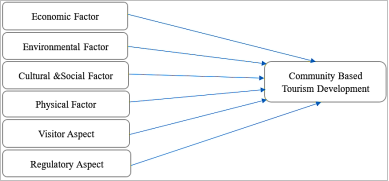
The conceptual framework for this study is grounded in the assumption that community-based tourism (CBT) development is shaped by multiple interrelated factors that operate at the local level i.e Rajshahi. Six key dimensions, economic, environmental, cultural & social, physical/institutional, visitor, and regulatory aspects, collectively influence how effectively CBT can grow within ethnic communities in Rajshahi.
The economic factor highlights the role of tourism in generating employment, diversifying income, attracting investment, and enhancing financial participation of ethnic people. A strong economic base encourages local engagement in tourism activities, thereby supporting CBT growth. The environmental factor emphasizes the importance of maintaining a clean, hazard-free, and ecologically balanced destination. Environmental management practices such as waste disposal, pollution control, and preservation of natural resources enhance the attractiveness and sustainability of CBT destinations. The cultural and social factor focuses on the preservation of ethnic heritage, strengthening community identity, enhancing local participation, and improving social cohesion. These cultural and social improvements foster a supportive environment for CBT development while promoting meaningful interactions between hosts and visitors. The physical or institutional factor stresses the role of local institutions, organizations, and tourism operators in providing necessary infrastructure, management systems, and services. Strong institutional support ensures smooth operations and capacity-building within community tourism settings. The visitor aspect relates to visitors' expectations regarding safety, amenities, accessibility, and overall experience. Meeting these expectations contributes to positive destination image, repeat visitation, and long-term tourism sustainability. Finally, the regulatory aspect underscores the importance of effective governance, land-use regulation, cultural protection policies, and participatory decision-making processes. These frameworks ensure that CBT develops responsibly while safeguarding community rights and environmental integrity.
Figure 1. Conceptual Framework for Community Based Tourism Development.
Together, these six dimensions form the foundation of the conceptual framework, where each factor is hypothesized to have a positive relationship with community-based tourism development (H1–H6). This framework illustrates how multidimensional influences interact to support sustainable CBT in ethnic communities.
6. Methodology
This study employs empirical research approach mainly followed quantitative methods to examine CBT development considering ethnic community. It aims to identify the relationship socio-economic, cultural, physical, visitors, regulatory and environmental aspects influencing ethnic communities’ participation in tourism development. Primary data were collected through a structured questionnaire, and focus group discussions with community members, local authorities, and tourists are conducted to explore the challenges and opportunities for CBT across seven ethnic-based destinations in Rajshahi City.
Survey Area
Pre-tested structured questionnaires are administered to 180 respondents across seven prominent, densely populated ethnic communities in Rajshahi City, including Baganpara, Dingadoba, Mollapara, Court Area, Daingpara, Bot Tola, and Durgapur. These are briefly presented in the following sections.
Baganpara, located near the central bypass in Rajshahi City, is home to Santals, Mal-Paharia, and Oraon communities, mostly Christian, and holds strong potential as a CBT hub. Dingadoba, in the city center near the bypass, is mainly inhabited by Mal-Paharia Christians and is also important for CBT development. Mollapara, or Purbopara, on the northwest side near the Rajshahi Divisional Ethnic Minority Cultural Academy, is inhabited by Santals who actively engage in promoting CBT. Court Area, near the Padma River and 1–1.5 km from the divisional court, houses the Santal community and presents high potential as an attractive CBT destination. Daingpara, in the western corner of Kashiadanga, hosts several tribal communities who are cooperative in CBT development, with notable local hospitality. Bot Tola, under Kashiadanga, is known for rich ethnic customs and cultural authenticity, enhancing its potential for showcasing traditions and storytelling. Puran Tahirpur, Durgapur, a scenic village home to Santal and Oraon communities for over a century, combines natural beauty and cultural heritage, making it highly suitable for CBT development. As density of the ethnics are not equals.
Sampling Process
A random sampling process is followed for current study because it ensures that the views and experiences of all segments of the ethnic communities. Since CBT development relies heavily on multiple ethnic groups’ perceptions, and benefits, random sampling is needed to avoids bias by giving every community member an equal chance of being included in the study. After collection the data it seen that from Baganpara 28, Dingadoba 18, Purbopara, Mollapara 14, Mohish Bathan Court Area 14, Daingpara, Kashiadanga 34, Bot Thola of Kashiadanga 20, and Puran Tahirpur, Durgapur 33. And the mail tribal communities are The Santals, Mal-Paharia and Oraon community.
Data Collection and Analysis
Respondent were asked to indicate the degree of their agreement or disagreement with each items using six-point Likert Scale where 1=Very Strongly Disagree, 2=Strongly Disagree, 3=Disagree, 4=Somewhat agree, 5=Strongly agree, 6=Very Strongly agree. Researcher used Six-point Likert Scale because if the author depicts neutral value, then respondent put tick (√) mark which is a common phenomenon in our culture. In total useable 161 response were considered where 85 respondents were santal, 30 respondents were Mal-paharia and 46 respondents were Oraon.
7. Analysis and Findings of the Study
Data were analyzed in three phases i.e. 1) Demographic analysis which is very common practice and 2) ANOVA Analysis and 3) DMRT Analysis employing SPSS software. The details are discussed below.
Table 1. Demographic Analysis of the Respondents.
Age | Fr. | %t | Cum % | Explanation |
Valid | Below 20 | 6 | 3.7 | 3.7 | This table summarizes the distribution of age groups among a sample of 161 individuals. The majority of participants are aged 21-30 (41%) and 31-40 (44.1%), making up 87.9% of the total. Smaller proportions are seen in the age groups Below 20 (3.7%), 41-50 (9.9%), and Above 51 (1.2%). The cumulative percentages show the progressive total of these groups, reaching 100% with the final age group. |
21-30 | 66 | 41.0 | 41.0 |
31-40 | 71 | 44.1 | 44.1 |
41-50 | 16 | 9.9 | 9.9 |
Abo 51 | 2 | 1.2 | 1.2 |
Total | 161 | 100.0 | 100.0 |
Education | | | | |
Valid | High School | 11 | 6.8 | 6.8 | This table outlines the highest formal education levels among 161 individuals. Most participants have a college education (66.5%), followed by those with a university degree (26.7%). A smaller percentage completed only high school (6.8%). The cumulative percentages show that 100% of respondents are accounted for by the university level. |
College | 107 | 66.5 | 66.5 |
University | 43 | 26.7 | 26.7 |
Total | 161 | 100.0 | 100.0 |
Status | | | | |
Valid | Student | 44 | 27.3 | 27.3 | The table of the left side shows the distribution of participants’ statuses. The largest group is involved in business (37.3%), followed by students (27.3%) and those in service (23.0%). A smaller portion falls into the "Other" category (12.4%). The cumulative percentages indicate that all respondents are accounted for the “Other" category, reaching 100%. |
Service | 37 | 23.0 | 23.0 |
Business | 60 | 37.3 | 37.3 |
Other | 20 | 12.4 | 12.4 |
Total | 161 | 100.0 | 100.0 |
Income Level | | | | |
Valid | Below 20,000 | 103 | 64.0 | 64.0 | This table represents the monthly income distribution among 91 participants. The majority (64%) earn below 20,000, while 27.3% fall in the 20,000-30,000 range. Smaller percentages earn 30,001-40,000 (7.5%) or 40,001 and above (1.2%). The cumulative percentages indicate that all respondents are included by the final income category, reaching 100%. |
20,000-30,000 | 44 | 27.3 | 27.3 |
30,001-40,000 | 12 | 7.5 | 7.5 |
40,001 or above | 2 | 1.2 | 1.2 |
Total | 161 | 100.0 | 100.0 |
Gender | | | | |
Valid | Male | 103 | 64.0 | 64.0 | The outcome shows the gender distribution of 161 participants. The majority are male (64%), while females make up 36%. The cumulative percentages confirm that all respondents are accounted for by the female category, reaching 100%. |
Female | 58 | 36.0 | 36.0 |
Total | 161 | 100.0 | 100.0 |
Ethnicity | | | | |
Valid | Santal | 85 | 52.8 | 52.8 | The result illustrates the ethnic distribution of 161 participants. The largest group is Santal (52.8%), followed by Oraon (28.6%) and Paharia (18.6%). The cumulative percentages indicate that all respondents are accounted for by the Oraon category, reaching 100%. |
Paharia | 30 | 18.6 | 18.6 |
Oraon | 46 | 28.6 | 28.6 |
Total | 161 | 100.0 | 100.0 |
Marital Status | | | | |
Valid | Married | 103 | 64.0 | 64.0 | This table shows the marital status of 161 participants. The majority are married (64%), while the remaining 36% are unmarried. The cumulative percentages confirm that all respondents are accounted by the unmarried category, reaching 100%. |
Unmarried | 58 | 36.0 | 36.0 |
Total | 161 | 100.0 | 100.0 |
Location | | | | |
Valid | Baganpara | 28 | 17.4 | 17.4 | This table details the geographical distribution of 161 participants. The large group comes from Puran Tahirpur, Durgapur (20.5%), followed by Daingpara, Kashiadanga largest (21.1%), and Baganpara (17.4%). Smaller groups are from Bot Tola, Kashiadanga (12.0%), Dingadoba (11.2%), Purbopara, Mollapara (8.7%), and Mohish Bathan, Court Area (8.7%). The cumulative percentages show that all respondents are accounted for by the final category, reaching 100%. |
Dingadoba | 18 | 11.2 | 11.2 |
Purbopara, Mollapara | 14 | 8.7 | 8.7 |
Mohish Bathan | 14 | 8.7 | 8.7 |
Daingpara | 34 | 21.1 | 21.1 |
Bot Thola | 20 | 12.4 | 12.4 |
Puran Tahirpur | 33 | 20.5 | 20.5 |
Total | 161 | 100.0 | 100.0 |
Phase 1: Demographic Data Analysis
This is an important part of academic research as it clarifies participant characteristics such as age, gender, education, occupation, and location. It ensures sample representativeness and enables the generalization of findings to broader populations
. Therefore, the current study has found the following outcome from the demographic analysis.
Phase 2: Hypothesis Testing Using ANOVA
ANOVA (Analysis of Variance) is appropriate when the researcher wants to compare mean differences across groups to see if consumer responses vary based on categorical factors. We know in the current study has considered seven areas for data collection on the same aspects and variables. It is wise to see whether there is different opinion of different respondents on different destinations on same aspects. Therefore, researchers in the current study, researchers collected data from seven destination.
Table 2. Analysis of Variances and Hypothesis Testing.
| Sum of Squares | df | Mean Square | F | Sig. | Status of Relationship | Interpretation |
Economic Aspect | Between Group | 14.208 | 4 | 3.552 | 4.409 | .002 | F = 4.409, p = .002 (<0.05) → Significant | There are significant differences among the groups regarding economic aspect |
Environmental Aspect | Between Group | 4.256 | 4 | 1.064 | 1.730 | .146 | F = 1.730, p = .146 (>0.05) → Not significant. | No meaningful differences among groups regarding environmental aspect. |
Cultural Aspect | Between Group | 6.087 | 4 | 1.522 | 2.439 | .049 | F = 2.439, p = .049 (~=0.05) → Marginally significant. | Groups differ slightly in perceptions of cultural and social aspect. |
Physical Aspect | Between Group | 13.311 | 4 | 3.328 | 3.563 | .008 | F = 3.563, p = .008 (<0.05) → Significant: | Significant group differences exist regarding physical aspect |
Visitors Aspect | Between Group | 10.505 | 4 | 2.626 | 2.756 | .030 | F = 2.756, p = .030 (<0.05) → Significant | Groups differ in their views about visitor-related aspects. |
Regulatory Aspects | Between Group | 10.800 | 4 | 2.700 | 2.511 | .044 | F = 2.511, p = .044 (<0.05) → Significant. | Significant differences exist among groups in perception of regulatory aspect. |
(The analysis of variance (ANOVA) results provides critical insights into group-level differences across six key aspects: economic (ECO), environmental (ENV), cultural (CUL), physical (PHY), visitor-related (VIS), and regulatory (REG). The findings suggest that perceptions are not uniform across all dimensions).
Phase 3: Duncan Multiple Range Test (DMRT)
The Duncan Multiple Range (DMR) test is applied after a statistically significant result is found in an ANOVA test. ANOVA identifies whether there are overall differences among group means, but it does not specify which groups differ from each other. The DMR test addresses this gap by performing pairwise comparisons to separate the means into homogeneous subsets, thereby indicating which groups are statistically different. In the following section outcome from this test is presented based on individual aspect.
Table 3. Duncan Multiple Range Test Regarding Economic Aspect.
Destinations | N | Subset for alpha = 0.05 | Brief Interpretation |
1 | 2 | 3 |
Purbopara, Mollapara | 28 | 4.18 | | | From the above table we can say that Purbopara is lowest (4.18), Botthola is highest (5.60). Means are grouped into subsets: similar scores are grouped together. Botthola stands significantly higher than most, while Purbopara is significantly lower. It does mean even though data were collected on same aspect from the seven communities but opinion is different for economic development. Community people from Purbopara have thought that economic contribution from the tourism development is not much more significant whether Botthola community thought it will be a way of economic development for them. |
Dingadoba | 10 | 4.60 | 4.60 | |
Mohish Bathan, Court Area | 79 | 4.65 | 4.65 | |
Daingpara, Kashiadanga | 39 | | 4.95 | 4.95 |
BotThola, Kashiadanga | 5 | | | 5.60 |
Sig. | 161 | .208 | .348 | .063 |
Table 4. Duncan Multiple Range Test Regarding Environmental Aspect.
Destinations | N | Subset for alpha = 0.05 | Brief Interpretation |
1 |
Purbopara, Mollapara | 28 | 4.18 | It is seen from the above table that only one subset, meaning no significant differences among destinations. Daingpara (4.62) is highest, Purbopara lowest (4.18), but variation is not statistically significant. It does mean even though data were collected on same aspect from the seven communities surprisingly opinion is also. Community people from the seven destinations have thought that environmental hazard will not be occurred if CBT develop in their community. |
Bot Thola, Kashiadanga | 5 | 4.20 |
Mohish Bathan, Court Area | 79 | 4.27 |
Dingadoba | 10 | 4.40 |
Daingpara, Kashiadanga | 39 | 4.62 |
Sig. | 161 | .206 |
Table 5. Duncan Multiple Range Test Regarding Cultural and Social Aspect.
Deatinations | N | Subset for alpha = 0.05 | Brief Interpretation |
1 |
Purbopara, Mollapara | 28 | 4.14 | As per the above table it is seen that all fall into one subset. Even though there is slightly deviation between Daingpara highest (4.72), Purbopara lowest (4.14), but differences are not statistically significant at α = 0.05 (p = .096). Therefore, in cultural aspect they are very much conscious regarding their own culture. Reality is also important that ethnic community would like to preserve their individual culture. |
Dingadoba | 10 | 4.20 |
Bot Thola, Kashiadanga | 5 | 4.40 |
Mohish Bathan, Court Area | 79 | 4.42 |
Daingpara, Kashiadanga | 39 | 4.72 |
Sig. | 161 | .096 |
Table 6. Duncan Multiple Range Test Regarding Physica Aspect.
Destinations | N | Subset for alpha = 0.05 | Brief Interpretation |
1 | 2 |
Purbopara, Mollapara | 28 | 3.64 | | If we look into above table, it is seen that Purbopara is significantly lower in physical aspect (3.64). Daingpara (4.54) is significantly higher than Purbopara. Middle three areas (Dingadoba, Bot Tola, Mohish Bathan) are in between. Thus, we can say ethnic people from the seven destinations has provided different opinion on Physical Aspect. In fact, infrastructural facilities and amenities are also different among the destinations. However, with help of CBT these facilities will better. |
Dingadoba | 10 | 4.10 | 4.10 |
Bot Thola, Kashiadanga | 5 | 4.20 | 4.20 |
Mohish Bathan, Court Area | 79 | 4.23 | 4.23 |
Daingpara, Kashiadanga | 39 | | 4.54 |
Sig. | 161 | .157 | .292 |
Table 7. DMRT Regarding Visitor Aspect.
Destinations | N | Subset for alpha = 0.05 | Brief Interpretation |
1 | 2 |
Purbopara, Mollapara | 28 | 3.82 | | Four areas (Purbopara, Dingadoba, Mohish Bathan, Daingpara) are not significantly different from each other. Bot Tola (5.20) is in a separate group, significantly higher than the rest. |
Dingadoba | 10 | 3.90 | |
Mohish Bathan, Court Area | 79 | 4.19 | |
Daingpara, Kashiadanga | 39 | 4.33 | |
Bot Thola, Kashiadanga | 5 | | 5.20 |
Sig. | 161 | .222 | 1.000 |
Table 8. DMRT on Regarding Regulatory Aspect.
Deatinations | N | Subset for alpha = 0.05 | Brief Interpretation |
1 |
Purbopara, Mollapara | 28 | 4.21 | All five areas fall in one subset. Daingpara and Bot Thola highest (5.00), Purbopara lowest (4.21). But since p = .082 > .05, differences are not statistically significant. |
Dingadoba | 10 | 4.60 |
Mohish Bathan, Court Area | 79 | 4.62 |
Daingpara, Kashiadanga | 39 | 5.00 |
Bot Thola, Kashiadanga | 5 | 5.00 |
Sig. | | .082 |
Result Discussion Based on ANOVA
In the following sections outcome from the ANNOVA analysis presented with interpretation and application in real life situation.
Economic Aspects: The results (F = 4.409, p = .002) show significant differences across groups, indicating that economic aspects like affordability, employment, and income distribution are unevenly experienced. This aligns with research highlighting that economic disparities influence well-being, social participation, and CBT development
| [3] | Ara, A. M., Hossain, E. M., & Sardar, S. (2020). An exploratory approach of pro-poor tourism and poverty alleviation on some selective tourism destinations in Bangladesh. Journal of Business Studies, 13(1), 68–83. |
| [35] | Ray, R., Tiew, F. N. H., Adeyinka-Ojo, S. F., Chitra, S. S., Hossain, M. I., & Sardar, S. (2021). Micro and small enterprises engagement in pro-poor tourism: Challenges and solutions. Rigeo, 11(8). https://doi.org/10.48047/rigeo.11.08.5 |
[3, 35]
. Economic dimensions are therefore critical for CBT development.
Environmental Aspect: No significant differences were found for environmental aspects (F = 1.730, p = .146), suggesting shared perceptions of ecological conditions. While group variation is minimal, environmental sustainability remains an important long-term concern
| [1] | Adam, I. (2021). Tourists’ perception of beach litter and willingness to participate in beach clean-up. Marine Pollution Bulletin, 170, 112591.
https://doi.org/10.1016/j.marpolbul.2021.112591 |
| [3] | Ara, A. M., Hossain, E. M., & Sardar, S. (2020). An exploratory approach of pro-poor tourism and poverty alleviation on some selective tourism destinations in Bangladesh. Journal of Business Studies, 13(1), 68–83. |
| [36] | Sardar, S., & Islam, M. M. (2024). The impact of recreational activities on ecology: Evidence-based systematic review and bibliometric analysis. Sustainability, 17(1), 74.
https://doi.org/10.3390/su17010074 |
[1, 3, 36]
.
Cultural and Social Aspect: Cultural and social aspects are marginally significant (F = 2.439, p = .049), indicating subtle differences in perceptions of traditions, social practices, and community values. Cultural influences thus operate as nuanced moderators shaping collective experiences
| [20] | Hofstede, G. (2001). Culture's recent consequences: Using dimension scores in theory and research. International Journal of Cross-Cultural Management, 1(1), 11–17.
https://doi.org/10.1177/147059580111002 |
| [31] | Nguyen, T. N., Lobo, A., & Greenland, S. (2017). The influence of cultural values on green purchase behaviour. Marketing Intelligence & Planning, 35(3), 377–396.
https://doi.org/10.1108/MIP-08-2016-0131 |
[20, 31]
.
Physical Aspect: Significant differences exist in physical aspects (F = 3.563, p = .008), showing that infrastructure, accessibility, and facility quality affect perceptions unevenly. Well-developed infrastructure enhances perceived conditions, while deficits reduce positive experiences
| [30] | Mondol, N., Hossain, E., & Sardar, S. (2025). Unveiling the drivers of young tourists’ environmentally responsible behavior: A study on Cox’s Bazar, Bangladesh. Tourism in Marine Environments, 20(2).
https://doi.org/10.3727/216901925X17589078253884 |
[30]
.
Visitor-Related Aspect: Visitor-related aspects also differ significantly (F = 2.756, p = .030), reflecting variations in experiences with tourists, crowding, and perceived benefits. Effective management of visitor impacts is crucial for balancing economic gains and community well-being
| [5] | Avi, M. A. R., & Sardar, S. (2021). Application of innovative technologies in the tourism and hospitality industry of Bangladesh: Challenges and suggestions. In Technology Application in the Tourism and Hospitality Industry of Bangladesh (pp. 369–379). Springer Singapore. |
| [6] | Ashraf, A., Sardar, S., Rity, N. M., & Bhadra, S. (2025). Segmentation and profile analysis of international tourists: A systematic literature review. Journal of Tourism Quarterly, 7(3–4), 78–96. |
| [37] | Sadar, S., & Rekha, R. S. (2016). Students’ attitude towards beach tourism in Bangladesh: A study on Saint Martin and Cox’s Bazar sea beaches. Bangladesh Journal of Tourism, 1(1). |
| [42] | Sharpley, R. (2014). Host perceptions of tourism: A review of the research. Tourism Management, 42, 37–49.
https://doi.org/10.1016/j.tourman.2013.10.007 |
[5, 6, 37, 42]
.
Regulatory Aspect: Significant differences appear in regulatory aspects (F = 2.511, p = .044), likely due to variations in governance quality, policy enforcement, and public awareness. Consistent implementation and communication of regulations are essential to reduce disparities in perception
| [41] | Scott, W. R. (2013). Institutions and organizations: Ideas, interests, and identities. Sage Publications. |
[41]
.
Result Discussion Based on DMRT
The Duncan Multiple Range Test (DMRT) was applied to assess the comparative performance of different community-based tourism development (CBTD) sites across economic, environmental, cultural-social, physical, and visitor aspects. The findings reveal a mixed pattern of significant and non-significant variations among the study areas. For the economic aspect, Purbopara, Mollapara recorded the lowest mean (4.18), while Bot Thola, Kashiadanga attained the highest (5.60). The grouping into distinct subsets indicates statistically meaningful differences, with Bot Thola standing out for its stronger economic outcomes and Purbopara lagging behind. This suggests unequal distribution of economic benefits, possibly linked to resource accessibility and market integration
. In contrast, the environmental (p =.206) and cultural-social (p = .096) aspects produced only one subset each, suggesting no significant variation among communities. While Daingpara scored highest in both dimensions (4.62 for environmental; 4.72 for cultural-social) and Purbopara lowest, the differences were not statistically meaningful. This homogeneity may reflect shared ecological conditions and cultural values across the sites
. For the physical aspect, results revealed two subsets, with Purbopara again lowest (3.64) and Daingpara highest (4.54). The separation indicates significant differences between these two communities, while Dingadoba, Bot Thola, and Mohish Bathan occupy a middle position. This disparity may reflect unequal investment in infrastructure and amenities, which are critical to sustaining tourism
. From the visitor aspect, Bot Thola (5.20) emerged as a distinct and significantly higher group compared to the other four areas, which clustered together. This finding suggests Bot Thola’s superior attractiveness to visitors, potentially due to stronger amenities, unique attractions, or better promotion. Finally, is seen in the regulatory aspect that mean scores, Daingpara and Bot Thola achieved the highest ratings (5.00), followed by Mohish Bathan, Court Area (4.62) and Dingadoba (4.60), while Purbopara recorded the lowest mean (4.21). Although numerical differences are evident, the lack of statistical significance implies that respondents’ perceptions across the five areas are relatively similar. Thus, variations observed in the mean values can be attributed to chance rather than meaningful differences between the destinations.
From the above analysis overall we can say, the DMRT results indicate that while economic, physical, and visitor dimensions show notable inter-community disparities, environmental and cultural-social aspects are more evenly distributed. These findings highlight the need for targeted policy interventions to reduce inequalities and ensure more balanced benefits from CBTD initiatives.
Table 9. Overall Objectives Based Findings.
Objectives | Findings |
a) General objective is to explore the responsible aspects for CBT development in Rajshahi City considering ethnic community. | a) If the CBT can be developed considering ethnicity, tourism will be booming in Rajshahi. In the meantime, Rajshahi is proved as a Smart city in Bangladesh. |
Specific Objectives: 1) Identify the different aspects those have played important role for CBT development. | Six aspects are identified based on literature i.e. economic, physical, cultural preservation, environmental, visitors, and regulatory issues are served as a strong foundation for CBT development. |
2). To identify the challenges and opportunities for developing CBT in Rajshahi City. | Major challenges are; Poor Infrastructure, Capacity of ethnic, Deficiency of CBT development Policy, no measures for Cultural and Environmental Preservation, Market Access and Promotion, less Community Awareness, No Active Participation, land ownership by main stream, Visitor Dissatisfaction, etc. |
3) To assess the individual and combines roles of economic, social, physical, environmental, behavioral and cultural aspects for CBT development. | The findings emphasize the economic aspect as crucial for CBT development, while environmental sustainability remains a long-term concern. Cultural aspect, though less evident, still shape collective experiences. Communities with better Physical infrastructure report more favorable conditions for CBT development. The results highlight the need to manage visitors impacts to balance economic benefits with community well-being and stress consistent regulatory implementation to avoid disparities. |
4. To propose strategies and best practices to the policy makers for developing CBT in Rajshahi City. | Proposed model will be validated using SME and constructive strategies will be offered for the local government and BTB and Ministry of Civil Aviation and Tourism. Rajshahi City corporation can also implement the outcome of the research. Individuals also may use in micro level for CBT development. |
8. Implications of the Study
Theoretical Applications: Theoretically, the results support the multi-factorial nature of social and economic environments, where structural (economic, physical, regulatory) aspects play a stronger role in differentiating group experiences compared to cultural or environmental dimensions.
Practical Applications: Practically, policymakers and practitioners should recognize the heterogeneous impacts of economic and physical infrastructure while ensuring fair regulatory practices. Meanwhile, the relative homogeneity in environmental perceptions suggests that sustainability programs can be applied broadly across groups without encountering significant perceptual resistance.
9. Limitation and Future Research Plan
The present study is subject to several limitations. First, the qualitative component has not yet been presented. Second, a large number of variables extracted from both the literature and field study were not incorporated into the content or statistical analysis. Third, the sample size is relatively small compared to the scope of the research. Finally, the most influential aspect for CBT development have not yet been identified through either qualitative or quantitative approaches. Accordingly, future research will focus on exploring the aspects and variables that influence CBT development in Rajshahi.
10. Conclusion
The selected 7 destinations show strong potential for CBT development due to their ethnic diversity and cultural heritage. Daingpara excels in traditions, crafts, music, and homestays but needs improved infrastructure and training. Baganpara offers cultural exchanges, handicrafts, and eco-tourism if commercialization is managed. Bot Tola, Kashiadanga supports agro-tourism and craft workshops with financial and facility support. Purbopara, Mollapara focuses on heritage-based activities and community participation, requiring organizational development. Mohish Bathan and Court Area enable agro-tourism, food festivals, and cultural events but risk elite capture and unequal benefits with mainstream habitant. Overall, CBT success depends on community engagement, capacity building, supportive policies, infrastructure investment, transparent governance, and collaboration among government, NGOs, private sectors, and local communities.
Abbreviations
CBT | Community Based Tourism |
CBTD | Community Based Tourism Development |
NGOs | Non-Government Organizations |
SME | Small and Medium Enterprises |
BTB | Bangladesh Tourism Board |
DMRT | Duncan Multiple Range Test |
SDGs | Sustainable Development Goals |
GDP | Gross Domestic Product |
Acknowledgments
The authors are thankful to Faculty of Business Studies, University of Rajshahi for funding this research project.
Conflicts of Interest
The authors declare no conflicts of interest for this study.
References
| [1] |
Adam, I. (2021). Tourists’ perception of beach litter and willingness to participate in beach clean-up. Marine Pollution Bulletin, 170, 112591.
https://doi.org/10.1016/j.marpolbul.2021.112591
|
| [2] |
Akand, M. M. K. (2005). Cultural adaptation of the ethnic migrants to an urban setting: An anthropological study of Rajshahi city in Bangladesh (Doctoral dissertation). University of Rajshahi.
|
| [3] |
Ara, A. M., Hossain, E. M., & Sardar, S. (2020). An exploratory approach of pro-poor tourism and poverty alleviation on some selective tourism destinations in Bangladesh. Journal of Business Studies, 13(1), 68–83.
|
| [4] |
Ashley, C., & Roe, D. (2002). Making tourism work for the poor: Strategies and challenges in southern Africa. Development Southern Africa, 19(1), 61–82.
https://doi.org/10.1080/03768350220123855
|
| [5] |
Avi, M. A. R., & Sardar, S. (2021). Application of innovative technologies in the tourism and hospitality industry of Bangladesh: Challenges and suggestions. In Technology Application in the Tourism and Hospitality Industry of Bangladesh (pp. 369–379). Springer Singapore.
|
| [6] |
Ashraf, A., Sardar, S., Rity, N. M., & Bhadra, S. (2025). Segmentation and profile analysis of international tourists: A systematic literature review. Journal of Tourism Quarterly, 7(3–4), 78–96.
|
| [7] |
Boonratana, R. (2010). Community-based natural and biodiversity resources conservation and management: Lessons learned. In Proceedings of the International Conference on Environment and Natural Resources.
|
| [8] |
Bucoy, A. I., & Moreno, F. (2024). Evaluating the efficacy of community-based tourism as a strategic public administration initiative for sustainable development: A case study of Zamboanga City, Philippines.
|
| [9] |
Chowdhury, M. S., & Chakma, P. (2016). Human rights report 2015 on indigenous peoples in Bangladesh. Kapaeeng Foundation.
|
| [10] |
Dangi, T. B., & Jamal, T. (2016). An integrated approach to “sustainable community-based tourism.” Sustainability, 8(5), 475.
https://doi.org/10.3390/su8050475
|
| [11] |
Dodds, R., Ali, A., & Galaski, K. (2016). Mobilizing knowledge: Determining key elements for success and pitfalls in developing community-based tourism. Current Issues in Tourism, 21(13), 1547–1568.
https://doi.org/10.1080/13683500.2016.1150257
|
| [12] |
Farzana, F. (2014). Pro-poor tourism: Unlocking the opportunities for the poor on Kuakata sea-beach of Bangladesh. Journal of Bangladesh Institute of Planners, 7(1), 97–109.
https://doi.org/10.3329/jbip.v7i1.77023
|
| [13] |
Giampiccoli, A., & Mtapuri, O. (2015). Between theory and practice: A conceptualization of community-based tourism and community participation. Loyola Journal of Social Sciences, 29(1), 27–52.
|
| [14] |
Giampiccoli, A., & Saayman, M. (2018). Community-based tourism development model and community participation. African Journal of Hospitality, Tourism and Leisure, 7(4), 1–27.
|
| [15] |
Giampiccoli, A., Jugmohan, S., & Mtapuri, O. (2014). International cooperation, community-based tourism and capacity building: Results from a Mpondoland village in South Africa. Mediterranean Journal of Social Sciences, 5(23), 657–667.
https://doi.org/10.5901/mjss.2014.v5n23p657
|
| [16] |
Goodwin, H. (2000). Pro-poor tourism: Opportunities for sustainable local development. Development and Cooperation, 5, 12–14.
|
| [17] |
Habiba, M., & Lina, F. Y. (2023). Community-based tourism (CBT): A community development tool. European Journal of Business and Management, 15(17), 1–9.
https://doi.org/10.7176/EJBM/15-17-01
|
| [18] |
Hamzah, A., & Khalifah, Z. (2009). Handbook on community-based tourism: How to develop and sustain CBT. APEC Secretariat.
|
| [19] |
Haque, M. Z., Reza, M. I. H., Alam, M. M., Ahmed, Z. U., & Islam, M. W. (2016). Discovery of potential site for community-based sustainable ecotourism in the Sundarbans reserve forests, Bangladesh. International Journal of Conservation Science, 7(2), 553–566.
https://doi.org/10.31235/osf.io/fkza6
|
| [20] |
Hofstede, G. (2001). Culture's recent consequences: Using dimension scores in theory and research. International Journal of Cross-Cultural Management, 1(1), 11–17.
https://doi.org/10.1177/147059580111002
|
| [21] |
Hutnaleontina, P. N., Bendesa, I. K. G., & Yasa, I. G. W. M. (2022). Correlation of community-based tourism with sustainable development to improve community welfare: A review. International Journal of Applied Sciences in Tourism and Events, 6(2), 183–193.
https://doi.org/10.31940/ijaste.v6i2.183-193
|
| [22] |
Jackson, L. A. (2025). Community-Based Tourism: A catalyst for achieving SDG outcomes through community empowerment. MDPI Journal of Sustainable Tourism & Development, 6(1), 29.
https://doi.org/10.3390/tourhosp6010029
|
| [23] |
Juma, L. O., & Khademi-Vidra, A. (2019). Community-based tourism and sustainable development of rural regions in Kenya: Perceptions of the citizenry. Sustainability, 11(17), 4733.
https://doi.org/10.3390/su11174733
|
| [24] |
Lee, T. H., & Jan, F. (2018). Can community-based tourism contribute to sustainable development? Evidence from residents’ perceptions of sustainability. Tourism Management, 70, 368–380.
https://doi.org/10.1016/j.tourman.2018.09.003
|
| [25] |
Lo, Y., & Janta, P. (2020). Resident’s perspective on developing community-based tourism: A qualitative study of Muen Ngoen Kong Community, Chiang Mai, Thailand. Frontiers in Psychology, 11, 1493.
https://doi.org/10.3389/fpsyg.2020.01493
|
| [26] |
Mayaka, M., Croy, W. G., & Cox, J. W. (2017). Participation as motif in community-based tourism: A practice perspective. Journal of Sustainable Tourism, 26(3), 416–432.
https://doi.org/10.1080/09669582.2017.1359278
|
| [27] |
Mtapuri, O., & Giampiccoli, A. (2014). Towards a comprehensive model of community-based tourism development. South African Geographical Journal, 98(1), 154–168.
https://doi.org/10.1080/03736245.2014.977813
|
| [28] |
Mtapuri, O., & Giampiccoli, A. (2018). Tourism, community-based tourism and ecotourism: A definitional problematic. South African Geographical Journal, 101(1), 22–35.
https://doi.org/10.1080/03736245.2018.1522598
|
| [29] |
Mtapuri, O., Camilleri, M. A., & Dłużewska, A. (2021). Advancing community-based tourism approaches for the sustainable development of destinations. Sustainable Development, 30(3), 423–432.
https://doi.org/10.1002/sd.2257
|
| [30] |
Mondol, N., Hossain, E., & Sardar, S. (2025). Unveiling the drivers of young tourists’ environmentally responsible behavior: A study on Cox’s Bazar, Bangladesh. Tourism in Marine Environments, 20(2).
https://doi.org/10.3727/216901925X17589078253884
|
| [31] |
Nguyen, T. N., Lobo, A., & Greenland, S. (2017). The influence of cultural values on green purchase behaviour. Marketing Intelligence & Planning, 35(3), 377–396.
https://doi.org/10.1108/MIP-08-2016-0131
|
| [32] |
Nunkoo, R., & Smith, S. L. J. (2013). Political economy of tourism: Trust in government actors, political support, and their determinants. Tourism Management, 36, 120–132.
https://doi.org/10.1016/j.tourman.2012.11.018
|
| [33] |
Prakoso, A. A., Pradipto, E., Roychansyah, M. S., & Nugraha, B. S. (2020). Community-based tourism: Concepts, opportunities and challenges. Journal of Sustainable Tourism and Entrepreneurship, 2(2), 95–107.
https://doi.org/10.35912/joste.v2i2.563
|
| [34] |
Phuong, N. T. M., Van Song, N., & Quang, T. X. (2020). Factors affecting community-based tourism development and environmental protection: Practical study in Vietnam. Journal of Environmental Protection, 11(2), 124–151.
https://doi.org/10.4236/jep.2020.112009
|
| [35] |
Ray, R., Tiew, F. N. H., Adeyinka-Ojo, S. F., Chitra, S. S., Hossain, M. I., & Sardar, S. (2021). Micro and small enterprises engagement in pro-poor tourism: Challenges and solutions. Rigeo, 11(8).
https://doi.org/10.48047/rigeo.11.08.5
|
| [36] |
Sardar, S., & Islam, M. M. (2024). The impact of recreational activities on ecology: Evidence-based systematic review and bibliometric analysis. Sustainability, 17(1), 74.
https://doi.org/10.3390/su17010074
|
| [37] |
Sadar, S., & Rekha, R. S. (2016). Students’ attitude towards beach tourism in Bangladesh: A study on Saint Martin and Cox’s Bazar sea beaches. Bangladesh Journal of Tourism, 1(1).
|
| [38] |
Sapkota, M. (2024). Changing livelihood of Tibetan women migrants in Nepal: How do gender values matter? Higher Education, 24, 14–37.
|
| [39] |
Scheyvens, R. (1999). Ecotourism and the empowerment of local communities. Tourism Management, 20(2), 245–249.
https://doi.org/10.1016/S0261-5177(98)00069-7
|
| [40] |
Schmidt, J., & Uriely, N. (2018). Tourism development and the empowerment of local communities: The case of Mitzpe Ramon. Journal of Sustainable Tourism, 26(12), 2130–2147.
https://doi.org/10.1080/09669582.2018.1526290
|
| [41] |
Scott, W. R. (2013). Institutions and organizations: Ideas, interests, and identities. Sage Publications.
|
| [42] |
Sharpley, R. (2014). Host perceptions of tourism: A review of the research. Tourism Management, 42, 37–49.
https://doi.org/10.1016/j.tourman.2013.10.007
|
| [43] |
Shamsuddoha, M., & Jahan, R. (2018). Santal community in Bangladesh: A socio-historical analysis. Asian Journal of Humanity, Art and Literature, 5(2), 89–100.
https://doi.org/10.18034/ajhal.v5i2.339
|
| [44] |
Stone, L. S., & Stone, T. M. (2010). Community-based tourism enterprises: Challenges and prospects for community participation; Khama Rhino Sanctuary Trust, Botswana. Journal of Sustainable Tourism, 19(1), 97–114.
https://doi.org/10.1080/09669582.2010.508527
|
| [45] |
Suchana, J. J., & Munne, M. S. (2020). Potentials of community-based tourism development: A study on Maheshkhali, Bangladesh. International Journal of Science and Business, 4(5), 98–104.
https://doi.org/10.5281/zenodo.3893476
|
| [46] |
Sutresna, I., Suyana, U. I. M., Saskara, I., & Wiwin, S. (2019). Community-based tourism as sustainable tourism support. Russian Journal of Agricultural and Socio-Economic Sciences, 94(10), 70–78.
https://doi.org/10.18551/rjoas.2019-10.09
|
| [47] |
Teh, L., & Cabanban, A. S. (2007). Planning for sustainable tourism in southern Pulau Banggi: An assessment of biophysical conditions and their implications for future tourism development. Journal of Environmental Management, 85(4), 999–1008.
https://doi.org/10.1016/j.jenvman.2006.11.004
|
| [48] |
Tian, B., Stoffelen, A., & Vanclay, F. (2021). Ethnic tourism in China: Tourism-related (dis)empowerment of Miao villages. Tourism Geographies, 25(2–3), 552–571.
https://doi.org/10.1080/14616688.2021.1938657
|
| [49] |
Tosun, C. (2006). Expected nature of community participation in tourism development. Tourism Management, 27(3), 493–504.
https://doi.org/10.1016/j.tourman.2004.12.004.
|
| [50] |
Wei, X. (2024). Ethnic communities’ perception of benefit-sharing and community participation in tourism development. Tourism Management Perspectives/Elsevier (2024). Retrieved from ScienceDirect
|
| [51] |
Wijaya, P. Y., Hartati, P. S., & Sumadi, N. K. (2020). The readiness of community-based tourism village development: A case study at Bongkasa Pertiwi Tourism Village, Bali Province, Indonesia. European Journal of Business and Management Research, 5(3).
https://doi.org/10.24018/ejbmr.2020.5.3.269
|
| [52] |
Yusuf, F., Martins, J. M., & Swanson, D. A. (2014). Methods of demographic analysis. Springer.
https://doi.org/10.1007/978-94-007-6784-3
|
| [53] |
Zielinski, S., Jeong, Y., Kim, S. I., & Milanés, C. B. (2020). Why community-based tourism and rural tourism in developing and developed nations are treated differently? A review. Sustainability, 12(15), 5938.
https://doi.org/10.3390/su12155938
|
Cite This Article
-
APA Style
Hossain, M. E., Sardar, S. (2026). Community Based Tourism (CBT) Development in Ethnic Community: An Empirical Study on Rajshahi City, Bangladesh. International Journal of Hospitality & Tourism Management, 10(1), 84-96. https://doi.org/10.11648/j.ijhtm.20261001.18
 Copy
|
Copy
|
 Download
ACS Style
Hossain, M. E.; Sardar, S. Community Based Tourism (CBT) Development in Ethnic Community: An Empirical Study on Rajshahi City, Bangladesh. Int. J. Hosp. Tour. Manag. 2026, 10(1), 84-96. doi: 10.11648/j.ijhtm.20261001.18
Copy
|
Download
AMA Style
Hossain ME, Sardar S. Community Based Tourism (CBT) Development in Ethnic Community: An Empirical Study on Rajshahi City, Bangladesh. Int J Hosp Tour Manag. 2026;10(1):84-96. doi: 10.11648/j.ijhtm.20261001.18
Copy
|
Download
-
@article{10.11648/j.ijhtm.20261001.18,
  author = {Md. Enayet Hossain and Sazu Sardar},
  title = {Community Based Tourism (CBT) Development in Ethnic Community: An Empirical Study on Rajshahi City, Bangladesh},
  journal = {International Journal of Hospitality & Tourism Management},
  volume = {10},
  number = {1},
  pages = {84-96},
  doi = {10.11648/j.ijhtm.20261001.18},
  url = {https://doi.org/10.11648/j.ijhtm.20261001.18},
  eprint = {https://article.sciencepublishinggroup.com/pdf/10.11648.j.ijhtm.20261001.18},
  abstract = {Community Based Tourism (CBT) development in ethnic communities is a participatory approach to tourism that empowers minority groups to manage, benefit from, and preserve their cultural and natural resources. The main objective of the study is to explore the potential of CBT development in Rajshahi City, with a specific emphasis on its ethnic communities. A mixed-methods approach is used as the study methodology. In total, 161 data points are collected from seven communities using a six-point Likert scale, and 27 interviews are conducted beforehand to understand the socio-economic, environmental, visitor-related, social, and regulatory aspects of ethnic communities for CBT development. These aspects are extracted from an extensive literature review. ANOVA and DMRT are conducted using SPSS software. Findings reveal that unique cultural assets and traditional knowledge, economic development, cultural preservation, environmental protection, and regulatory issues serve as a strong foundation for CBT development. In addition, it is observed that respondents express different opinions across destinations. The study also identifies significant challenges and opportunities for CBT development. Despite some drawbacks, community engagement, local governance, and potential collaboration with stakeholders are found to be important for CBT development. Theoretical and practical applications are discussed. This research also provides actionable recommendations to policymakers and tourism practitioners for enhancing inclusive tourism practices, promoting economic upliftment, and preserving the cultural heritage of ethnic communities in Rajshahi City.},
 year = {2026}
}
Copy
|
Download
-
TY  - JOUR
T1  - Community Based Tourism (CBT) Development in Ethnic Community: An Empirical Study on Rajshahi City, Bangladesh
AU  - Md. Enayet Hossain
AU  - Sazu Sardar
Y1  - 2026/02/24
PY  - 2026
N1  - https://doi.org/10.11648/j.ijhtm.20261001.18
DO  - 10.11648/j.ijhtm.20261001.18
T2  - International Journal of Hospitality & Tourism Management
JF  - International Journal of Hospitality & Tourism Management
JO  - International Journal of Hospitality & Tourism Management
SP  - 84
EP  - 96
PB  - Science Publishing Group
SN  - 2640-1800
UR  - https://doi.org/10.11648/j.ijhtm.20261001.18
AB  - Community Based Tourism (CBT) development in ethnic communities is a participatory approach to tourism that empowers minority groups to manage, benefit from, and preserve their cultural and natural resources. The main objective of the study is to explore the potential of CBT development in Rajshahi City, with a specific emphasis on its ethnic communities. A mixed-methods approach is used as the study methodology. In total, 161 data points are collected from seven communities using a six-point Likert scale, and 27 interviews are conducted beforehand to understand the socio-economic, environmental, visitor-related, social, and regulatory aspects of ethnic communities for CBT development. These aspects are extracted from an extensive literature review. ANOVA and DMRT are conducted using SPSS software. Findings reveal that unique cultural assets and traditional knowledge, economic development, cultural preservation, environmental protection, and regulatory issues serve as a strong foundation for CBT development. In addition, it is observed that respondents express different opinions across destinations. The study also identifies significant challenges and opportunities for CBT development. Despite some drawbacks, community engagement, local governance, and potential collaboration with stakeholders are found to be important for CBT development. Theoretical and practical applications are discussed. This research also provides actionable recommendations to policymakers and tourism practitioners for enhancing inclusive tourism practices, promoting economic upliftment, and preserving the cultural heritage of ethnic communities in Rajshahi City.
VL  - 10
IS  - 1
ER  -
Copy
|
Download





 Share This Article
 Twitter
 Linked In
 Facebook