
Background: Page kidney is an uncommon but reversible cause of secondary hypertension due to extrinsic compression of the renal parenchyma, triggering activation of the renin-angiotensin-aldosterone system (RAAS). Pancreatic pseudocysts are a well-recognized complication of acute or chronic pancreatitis and are a rare cause of this phenomenon. Case Presentation: A 21-year-old previously normotensive male presented to the Surgical Gastroenterology (SGE) Out-patient Department (OPD) with dull aching upper abdominal pain for 8 days and progressive abdominal distension for 6 months. At presentation patient had new-onset hypertension (150/100 mmHg) incidentally detected on admission. Contrast-enhanced computed tomography (CECT) of the abdomen revealed chronic calcific pancreatitis with a massive pancreatic tail pseudocyst (~1500 mL) extending into the left perirenal space, near-complete encasement of the left kidney, with a persistent nephrogram on delayed phase imaging, a pathognomonic radiological feature of ‘Page kidney’. The patient underwent laparotomy and Roux-en-Y cysto-jejunostomy in view of persistent abdominal symptoms and showed complete normalization of blood pressure. Patient remained normotensive and asymptomatic at 6 months on follow-up. Discussion: Page kidney secondary to a pancreatic pseudocyst is an exceptionally rare cause of secondary hypertension with very few cases reported in the world literature. All the patients reported in literature were managed conservatively by non-operative management, involving anti-hypertensives and USG (ultrasound) guided pigtail insertion. However, our case describes the management of a page kidney secondary to a pseudocyst by Roux-en-Y cysto-jejunostomy as a definitive therapy, achieving sustained medication-free normotension. Conclusion: Page kidney is a rare, curable cause of secondary hypertension. Early management helps prevent deterioration and salvage of renal function. Surgical drainage procedures are a feasible and durable alternative to conservative management in selected patients, particularly those with recurrent or complex pancreatic pseudocysts.
| Published in | International Journal of Gastroenterology (Volume 10, Issue 2) |
| DOI | 10.11648/j.ijg.20261002.11 |
| Page(s) | 67-73 |
| Creative Commons |
This is an Open Access article, distributed under the terms of the Creative Commons Attribution 4.0 International License (http://creativecommons.org/licenses/by/4.0/), which permits unrestricted use, distribution and reproduction in any medium or format, provided the original work is properly cited. |
| Copyright |
Copyright © The Author(s), 2026. Published by Science Publishing Group |
Page Kidney, Pancreatic Pseudocyst, Chronic Pancreatitis, Renin-angiotensin-aldosterone System, Roux-en-Y Cysto-jejunostomy, Nephrogram
Author / Year | Aetiology | Presentation | Imaging | Management | Outcome |
|---|---|---|---|---|---|
Aswani et al., 2015 [4] | Alcoholic CP | HTN + Abdominal pain | CECT | Percutaneous drainage | Normotensive |
Hiremath et al., 2022 [10] | Acute pancreatitis + PRP fistula | HTN + Weakness | CECT | USG aspiration + Pigtail | Normotensive |
Sharma et al., 2022 [11] | Alcoholic CP | Hypertensive crisis | CECT | ACEi + Observation | Improved |
Thakur et al., 2024 [7] | Acute pancreatitis | HTN | CECT+MRCP | ACEi+ Percutaneous drainage | Normotensive |
Gandhi et al., 2024 [12] | CP | HTN + Abdominal pain | CECT | Percutaneous drainage | Normotensive |
Present case, 2026 | Idiopathic CP | HTN + Lump | CECT | Roux-en-Y Cysto-jejunostomy | Normotensive (no medications) |
ACEi | Angiotensin-Converting Enzyme Inhibitor |
aPTT | Activated Partial Thromboplastin Time |
CECT | Contrast-Enhanced Computed Tomography |
eGFR | Estimated Glomerular Filtration Rate |
IU/L | International Units Per Liter |
MPD | Main Pancreatic Duct |
MRCP | Magnetic Resonance Cholangiopancreatography |
PT-INR | Prothrombin Time-International Normalized Ratio |
RAAS | Renin-Angiotensin-Aldosterone System |
USG | Ultrasonography |
| [1] | Koo JG, Liau MYQ, Kryvoruchko IA, et al. Pancreatic pseudocyst: The past, the present, and the future. World J Gastrointest Surg. 2024; 16(7): 1986-2002. |
| [2] | Banks PA, Bollen TL, Dervenis C, et al. Classification of acute pancreatitis - 2012: revision of the Atlanta classification and definitions by international consensus. Gut. 2013; 62(1): 102-111. |
| [3] | Vaidya PN, Rathi BM, Finnigan NA. Page Kidney. In: StatPearls [Internet]. Treasure Island (FL): StatPearls Publishing; Updated January 2023. Available from: |
| [4] | Aswani Y, Anandpara KM, Hira P. Page kidney due to a renal pseudocyst in a setting of pancreatitis. BMJ Case Rep. 2015; 2015: bcr2014207436. |
| [5] | Page IH. The production of persistent arterial hypertension by cellophane perinephritis. JAMA. 1939; 113(23): 2046-2048. |
| [6] | Smyth A, Collins CS, Thorsteinsdottir B, et al. Page kidney: etiology, renal function outcomes and risk for future hypertension. J Clin Hypertens (Greenwich). 2012; 14(4): 216-221. |
| [7] | Thakur S, Kapila S, Makhaik S, Jhobta A. Unusual presentation of subcapsular renal pseudocyst as page kidney - A case report. Case Rep Clin Radiol. 2024; 2: 95-8. |
| [8] | Ray MS, Raval A, Yadav P, et al. Large pseudocyst of pancreas: open surgical drainage by Roux-en-Y cystojejunostomy -- experience of 28 cases over 18 years. Int Surg J. 2025; 12(7): 1112-1118. |
| [9] | Badgurjar MK, Mandovra P, Mathur SK, Patankar R. Laparoscopic loop cystojejunostomy: An alternative to Roux-en-Y cystojejunostomy for pancreatic pseudocyst. Journal of Minimal Access Surgery. 2021 Apr-Jun; 17(2): 221-225. |
| [10] | Hiremath R, Kuttancheri T, Gurumurthy B, et al. A new page in the literature of pancreatic pseudocyst: case report on perirenal pseudocyst presenting as Page kidney. Egypt J Radiol Nucl Med. 2022; 53: 240. |
| [11] | Sharma R, Attarha B, Rechcigl K, Aung WM. Spontaneous Page kidney as a complication of a pancreatic pseudocyst. ACG Case Rep J. 2022; 9(7): e00813. |
| [12] | Gandhi M, Patel S, Shah N, et al. Pancreatic pseudocysts: a complication leads to Page kidney due to external compression of the kidney. J Krishna Inst Med Sci Univ. 2024; 13(4): 175-179. |
APA Style
G., V. H., Mangarai, M., Patil, A. (2026). Page Kidney Secondary to Pancreatic Pseudocyst: Definitive Surgical Management with Sustained Normotension: A Case Report with Literature Review. International Journal of Gastroenterology, 10(2), 67-73. https://doi.org/10.11648/j.ijg.20261002.11
ACS Style
G., V. H.; Mangarai, M.; Patil, A. Page Kidney Secondary to Pancreatic Pseudocyst: Definitive Surgical Management with Sustained Normotension: A Case Report with Literature Review. Int. J. Gastroenterol. 2026, 10(2), 67-73. doi: 10.11648/j.ijg.20261002.11
@article{10.11648/j.ijg.20261002.11,
  author = {Venugopal H. G. and Mukund Mangarai and Akshay Patil},
  title = {Page Kidney Secondary to Pancreatic Pseudocyst: Definitive Surgical Management with Sustained Normotension: A Case Report with Literature Review},
  journal = {International Journal of Gastroenterology},
  volume = {10},
  number = {2},
  pages = {67-73},
  doi = {10.11648/j.ijg.20261002.11},
  url = {https://doi.org/10.11648/j.ijg.20261002.11},
  eprint = {https://article.sciencepublishinggroup.com/pdf/10.11648.j.ijg.20261002.11},
  abstract = {Background: Page kidney is an uncommon but reversible cause of secondary hypertension due to extrinsic compression of the renal parenchyma, triggering activation of the renin-angiotensin-aldosterone system (RAAS). Pancreatic pseudocysts are a well-recognized complication of acute or chronic pancreatitis and are a rare cause of this phenomenon. Case Presentation: A 21-year-old previously normotensive male presented to the Surgical Gastroenterology (SGE) Out-patient Department (OPD) with dull aching upper abdominal pain for 8 days and progressive abdominal distension for 6 months. At presentation patient had new-onset hypertension (150/100 mmHg) incidentally detected on admission. Contrast-enhanced computed tomography (CECT) of the abdomen revealed chronic calcific pancreatitis with a massive pancreatic tail pseudocyst (~1500 mL) extending into the left perirenal space, near-complete encasement of the left kidney, with a persistent nephrogram on delayed phase imaging, a pathognomonic radiological feature of ‘Page kidney’. The patient underwent laparotomy and Roux-en-Y cysto-jejunostomy in view of persistent abdominal symptoms and showed complete normalization of blood pressure. Patient remained normotensive and asymptomatic at 6 months on follow-up. Discussion: Page kidney secondary to a pancreatic pseudocyst is an exceptionally rare cause of secondary hypertension with very few cases reported in the world literature. All the patients reported in literature were managed conservatively by non-operative management, involving anti-hypertensives and USG (ultrasound) guided pigtail insertion. However, our case describes the management of a page kidney secondary to a pseudocyst by Roux-en-Y cysto-jejunostomy as a definitive therapy, achieving sustained medication-free normotension. Conclusion: Page kidney is a rare, curable cause of secondary hypertension. Early management helps prevent deterioration and salvage of renal function. Surgical drainage procedures are a feasible and durable alternative to conservative management in selected patients, particularly those with recurrent or complex pancreatic pseudocysts.},
 year = {2026}
}
TY  - JOUR
T1  - Page Kidney Secondary to Pancreatic Pseudocyst: Definitive Surgical Management with Sustained Normotension: A Case Report with Literature Review
AU  - Venugopal H. G.
AU  - Mukund Mangarai
AU  - Akshay Patil
Y1  - 2026/08/10
PY  - 2026
N1  - https://doi.org/10.11648/j.ijg.20261002.11
DO  - 10.11648/j.ijg.20261002.11
T2  - International Journal of Gastroenterology
JF  - International Journal of Gastroenterology
JO  - International Journal of Gastroenterology
SP  - 67
EP  - 73
PB  - Science Publishing Group
SN  - 2640-169X
UR  - https://doi.org/10.11648/j.ijg.20261002.11
AB  - Background: Page kidney is an uncommon but reversible cause of secondary hypertension due to extrinsic compression of the renal parenchyma, triggering activation of the renin-angiotensin-aldosterone system (RAAS). Pancreatic pseudocysts are a well-recognized complication of acute or chronic pancreatitis and are a rare cause of this phenomenon. Case Presentation: A 21-year-old previously normotensive male presented to the Surgical Gastroenterology (SGE) Out-patient Department (OPD) with dull aching upper abdominal pain for 8 days and progressive abdominal distension for 6 months. At presentation patient had new-onset hypertension (150/100 mmHg) incidentally detected on admission. Contrast-enhanced computed tomography (CECT) of the abdomen revealed chronic calcific pancreatitis with a massive pancreatic tail pseudocyst (~1500 mL) extending into the left perirenal space, near-complete encasement of the left kidney, with a persistent nephrogram on delayed phase imaging, a pathognomonic radiological feature of ‘Page kidney’. The patient underwent laparotomy and Roux-en-Y cysto-jejunostomy in view of persistent abdominal symptoms and showed complete normalization of blood pressure. Patient remained normotensive and asymptomatic at 6 months on follow-up. Discussion: Page kidney secondary to a pancreatic pseudocyst is an exceptionally rare cause of secondary hypertension with very few cases reported in the world literature. All the patients reported in literature were managed conservatively by non-operative management, involving anti-hypertensives and USG (ultrasound) guided pigtail insertion. However, our case describes the management of a page kidney secondary to a pseudocyst by Roux-en-Y cysto-jejunostomy as a definitive therapy, achieving sustained medication-free normotension. Conclusion: Page kidney is a rare, curable cause of secondary hypertension. Early management helps prevent deterioration and salvage of renal function. Surgical drainage procedures are a feasible and durable alternative to conservative management in selected patients, particularly those with recurrent or complex pancreatic pseudocysts.
VL  - 10
IS  - 2
ER  -
Department of Surgical Gastroenterology, Bangalore Medical College and Research Institute, Bangalore, India
Department of Surgical Gastroenterology, Bangalore Medical College and Research Institute, Bangalore, India
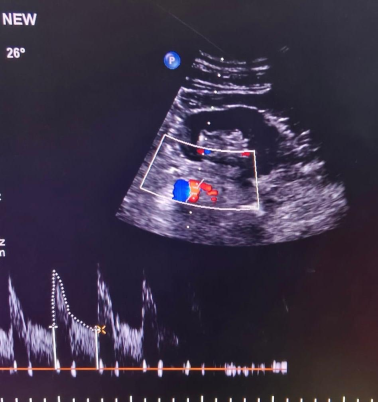
Figure 1. USG doppler showing a normal (low resistance, monophasic and continuous forward flow) waveform of the renal artery.
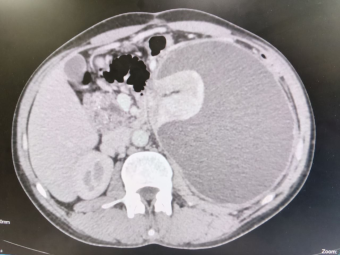
Figure 2. CECT abdomen (Axial section): Atrophic pancreas with calcifications and a large homogeneous hypodense pseudocyst occupying the left hemiabdomen, near-completely encasing the left kidney with demonstrable mass effect on the renal parenchyma.
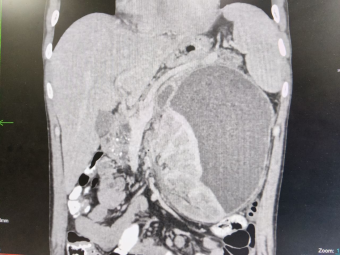
Figure 3. CECT abdomen (Coronal section): The massive pseudocyst (~1500 mL) arising from the pancreatic tail and extending inferiorly into the left perirenal space, displacing and compressing the left kidney. The kidney is sandwiched between the cyst and the posterior abdominal wall.
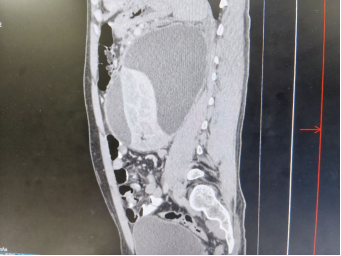
Figure 4. CECT abdomen (Sagittal section): The pseudocyst spans the entire left flank in the sagittal plane, demonstrating the extent of perirenal extension and the compressed, displaced left kidney (visible as a flattened parenchymal rim). The persistent nephrogram is appreciable on the delayed phase as reduced cortical opacification relative to the contralateral side.
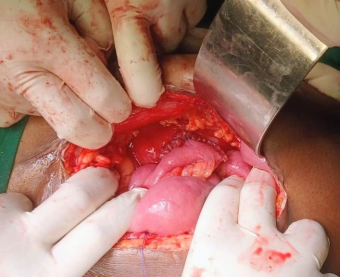
Figure 5. Intraoperative photograph showing the completed Roux-en-Y cysto-jejunostomy. Note the anastomosis fashioned at the most inferior point of the collection to ensure dependent gravitational drainage of the perirenal pseudocyst.
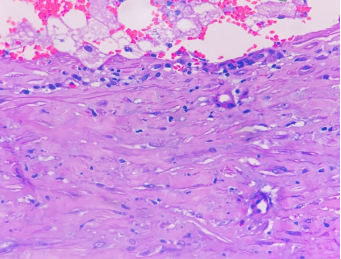
Figure 6. Microscopic image of wall of a pseudocyst of pancreas showing chronic inflammatory infiltration with fibroblasts and myofibroblasts.

Information



 Share This Article
 Twitter
 Linked In
 Facebook
 Copy
Copy Download