
Using A1VR, 941VR, M16VR, and HybridVR residues as feedstocks, the slurry-phase hydrocracking performance of two oil-soluble molybdenum catalysts, OMO and OMS, was systematically investigated. The effects of catalyst type on product composition and boiling-range distribution were evaluated by gas chromatography-mass spectrometry (GC-MS) and simulated distillation. The results showed that the saturated and aromatic hydrocarbon fractions of all four feedstocks exhibited pronounced unresolved complex mixture (UCM) backgrounds, reflecting the complex molecular composition of heavy petroleum fractions. Following slurry-phase hydrocracking, the chromatograms showed enhanced discrete peaks in the low-retention-time region and a substantial attenuation of the broad UCM backgrounds in the high-retention-time region. These changes indicated the conversion of heavy molecular components into lighter hydrocarbons through chain scission, depolymerization, and hydrogenation stabilization. In particular, the transformations of resins, asphaltenes, and condensed-ring aromatic compounds contributed to the reduction of heavy components and the formation of lower-carbon-number products. Compared with OMO, OMS exhibited a more pronounced upgrading effect, as evidenced by stronger light-hydrocarbon peak groups and greater attenuation of the high-retention-time UCM backgrounds. Notably, the broad chromatographic background of 941VR was almost completely eliminated after treatment with OMS, suggesting a substantial conversion of its heavy molecular components. Simulated distillation results further confirmed the superior upgrading performance of OMS, which produced higher gasoline and diesel yields while reducing the proportions of wax oil and residue. For HybridVR, the total light fraction yield increased from 38.80 wt% to 54.59 wt% after hydrocracking with OMS, demonstrating its effectiveness in promoting residue conversion and liquid product recovery. The enhanced catalytic performance of OMS is attributed to its ability to rapidly generate highly dispersed MoS₂ active phases with abundant exposed edge sites. These active sites facilitate hydrogen activation and the stabilization of free radicals generated during thermal cracking, thereby suppressing radical recombination and condensation reactions while promoting the conversion of heavy molecular structures. Overall, OMS demonstrates considerable potential for improving the slurry-phase hydrocracking performance of different vacuum residues, particularly in terms of heavy-component conversion, residue lightening, and the enhancement of valuable light fractions.
| Published in | International Journal of Energy and Environmental Science (Volume 11, Issue 6) |
| DOI | 10.11648/j.ijees.20261106.12 |
| Page(s) | 152-159 |
| Creative Commons |
This is an Open Access article, distributed under the terms of the Creative Commons Attribution 4.0 International License (http://creativecommons.org/licenses/by/4.0/), which permits unrestricted use, distribution and reproduction in any medium or format, provided the original work is properly cited. |
| Copyright |
Copyright © The Author(s), 2026. Published by Science Publishing Group |
Oil-soluble Mo Catalysts, GC-MS, Slurry Phase, Residue
OMO | Oil-soluble Molybdenum Oxidized Catalyst |
OMS | Oil-soluble MoS2 Catalyst |
| [1] | B. Liu, H. Lv, X. Cui, G. Sun, X. Zhang, B. Dong, Y. Li, Y. Pan, Y. Chai, C. Liu. Preparation of presulfided oil-soluble NiMo catalyst for slurry bed hydrocracking of vacuum residue. Chem Eng J 2024; 498: 155166. |
| [2] | D. Guan, G. Cai, L. Zhang. Dual-objective optimization for petroleum molecular reconstruction based on property and composition similarities. AIChE J 2023; 69: e18108. |
| [3] | Y.-D. Wang, X. Zhang, X.-Y. Feng, B. Liu, Y. Pan, G.-Z. Sun, H.-Y. Lv, F.-Y. Tian, B. Dong, Y.-C. Li, C.-G. Liu, Y.-M. Chai. Comparing the thermal processing with slurry phase hydroupgrading to increase the yields of distillates of Arabian heavy crude oil. Petrol Sci 2026; 23: 966-978. |
| [4] | T. A. Al-Attas, S. A. Ali, M. H. Zahir, Q. Xiong, S. A. Al-Bogami, Z. O. Malaibari, S. A. Razzak, M. M. Hossain. Recent Advances in Heavy Oil Upgrading Using Dispersed Catalysts. Energy Fuels 2019; 33: 7917-7949. |
| [5] | G. Bellussi, G. Rispoli, A. Landoni, R. Millini, D. Molinari, E. Montanari, D. Moscotti, P. Pollesel. Hydroconversion of heavy residues in slurry reactors: Developments and perspectives. J Catal 2013; 308: 189-200. |
| [6] | J.-M. Lu, Y.-F. Wang, Z.-Y. Zhou, J.-X. Wu, Y.-H. Zhang, L.-Z. Zhang, Q. Shi, S.-B. He, C.-M. Xu. Molecular transformation of heavy oil during slurry phase hydrocracking process: Influences of operational conditions. Petrol Sci 2025; 22: 884-893. |
| [7] | R. Prajapati, K. Kohli, S. K. Maity. Slurry phase hydrocracking of heavy oil and residue to produce lighter fuels: An experimental review. Fuel 2021; 288: 119686. |
| [8] | Y. Wang, J. Lu, X. Zhang, X. Zhang, B. Zhang, J. Wu, D. Guan, Y. Zhang, J. Chen, X. Feng, Y. Zhang, Z. Zhou, L. Zhang, Q. Shi. Molecular transformation of heavy oil during slurry phase hydrocracking process: A comparison between thermal cracking and hydrocracking. Fuel 2023; 351: 128981. |
| [9] | D. D. Pham, T. M. Nguyen, T. H. Ho, Q. V. Le, D. L. T. Nguyen. Advancing hydrodesulfurization in heavy Oil: Recent developments, challenges, and future prospects. Fuel 2024; 372: 132082. |
| [10] | S. S. Bello, C. Wang, M. Zhang, H. Gao, Z. Han, L. Shi, F. Su, G. Xu. A Review on the Reaction Mechanism of Hydrodesulfurization and Hydrodenitrogenation in Heavy Oil Upgrading. Energy Fuels 2021; 35: 10998-11016. |
| [11] | H.-B. Moon, J.-H. Lee, H.-T. Kim, J.-W. Lee, B.-H. Lee, C.-H. Jeon. Effect of high-pressure pyrolysis on syngas and char structure of petroleum coke. Energy 2024; 299: 131348. |
| [12] | Q. Shi, Y. Zhang, K. H. Chung, S. Zhao, C. Xu. Molecular Characterization of Fossil and Alternative Fuels Using Electrospray Ionization Fourier Transform Ion Cyclotron Resonance Mass Spectrometry: Recent Advances and Perspectives. Energy Fuels 2021; 35: 18019-18055. |
| [13] | Q. Shi, S. Zhao, Z. Xu, K. H. Chung, Y. Zhang, C. Xu. Distribution of Acids and Neutral Nitrogen Compounds in a Chinese Crude Oil and Its Fractions: Characterized by Negative-Ion Electrospray Ionization Fourier Transform Ion Cyclotron Resonance Mass Spectrometry. Energy Fuels 2010; 24: 4005-4011. |
| [14] | B. Liu, K. Zhao, Y. Chai, Y. Li, D. Liu, Y. Liu, C. Liu. Slurry phase hydrocracking of vacuum residue in the presence of presulfided oil-soluble MoS2 catalyst. Fuel 2019; 246: 133-140. |
| [15] | D. Liu, H. Du, J. Zhang, G. Que. Reverse Microemulsion Synthesis and Characterization of Nano Nickel Sulfide Catalyst for Residue Slurry-Phase Hydrocracking. Energy Fuels 2015; 29: 3353-3358. |
| [16] | Y. Wang, J. Wu, L. Xie, M. Yuan, Z. Jing, S. Pan, W. Zhang, Y. Zhang, Q. Shi. Identification and Geochemical Implication of Sulfur Compounds in an Immature Lacustrine Shale Oil. Energy Fuels 2023; 37: 12946-12952. |
| [17] | H. Du, D. Liu, M. Li, P. Wu, Y. Yang. Effects of the Temperature and Initial Hydrogen Pressure on the Isomerization Reaction in Heavy Oil Slurry-Phase Hydrocracking. Energy Fuels 2015; 29: 626-633. |
APA Style
Wang, Y., Liu, B., Chai, Y. (2026). Effects of Oil-Soluble Molybdenum Catalysts on the Molecular Composition and Lightening Performance of Residue Slurry-Phase Hydrocracking Products. International Journal of Energy and Environmental Science, 11(6), 152-159. https://doi.org/10.11648/j.ijees.20261106.12
ACS Style
Wang, Y.; Liu, B.; Chai, Y. Effects of Oil-Soluble Molybdenum Catalysts on the Molecular Composition and Lightening Performance of Residue Slurry-Phase Hydrocracking Products. Int. J. Energy Environ. Sci. 2026, 11(6), 152-159. doi: 10.11648/j.ijees.20261106.12
@article{10.11648/j.ijees.20261106.12,
  author = {Yidi Wang and Bin Liu and Yongming Chai},
  title = {Effects of Oil-Soluble Molybdenum Catalysts on the Molecular Composition and Lightening Performance of Residue Slurry-Phase Hydrocracking Products},
  journal = {International Journal of Energy and Environmental Science},
  volume = {11},
  number = {6},
  pages = {152-159},
  doi = {10.11648/j.ijees.20261106.12},
  url = {https://doi.org/10.11648/j.ijees.20261106.12},
  eprint = {https://article.sciencepublishinggroup.com/pdf/10.11648.j.ijees.20261106.12},
  abstract = {Using A1VR, 941VR, M16VR, and HybridVR residues as feedstocks, the slurry-phase hydrocracking performance of two oil-soluble molybdenum catalysts, OMO and OMS, was systematically investigated. The effects of catalyst type on product composition and boiling-range distribution were evaluated by gas chromatography-mass spectrometry (GC-MS) and simulated distillation. The results showed that the saturated and aromatic hydrocarbon fractions of all four feedstocks exhibited pronounced unresolved complex mixture (UCM) backgrounds, reflecting the complex molecular composition of heavy petroleum fractions. Following slurry-phase hydrocracking, the chromatograms showed enhanced discrete peaks in the low-retention-time region and a substantial attenuation of the broad UCM backgrounds in the high-retention-time region. These changes indicated the conversion of heavy molecular components into lighter hydrocarbons through chain scission, depolymerization, and hydrogenation stabilization. In particular, the transformations of resins, asphaltenes, and condensed-ring aromatic compounds contributed to the reduction of heavy components and the formation of lower-carbon-number products. Compared with OMO, OMS exhibited a more pronounced upgrading effect, as evidenced by stronger light-hydrocarbon peak groups and greater attenuation of the high-retention-time UCM backgrounds. Notably, the broad chromatographic background of 941VR was almost completely eliminated after treatment with OMS, suggesting a substantial conversion of its heavy molecular components. Simulated distillation results further confirmed the superior upgrading performance of OMS, which produced higher gasoline and diesel yields while reducing the proportions of wax oil and residue. For HybridVR, the total light fraction yield increased from 38.80 wt% to 54.59 wt% after hydrocracking with OMS, demonstrating its effectiveness in promoting residue conversion and liquid product recovery. The enhanced catalytic performance of OMS is attributed to its ability to rapidly generate highly dispersed MoS₂ active phases with abundant exposed edge sites. These active sites facilitate hydrogen activation and the stabilization of free radicals generated during thermal cracking, thereby suppressing radical recombination and condensation reactions while promoting the conversion of heavy molecular structures. Overall, OMS demonstrates considerable potential for improving the slurry-phase hydrocracking performance of different vacuum residues, particularly in terms of heavy-component conversion, residue lightening, and the enhancement of valuable light fractions.},
 year = {2026}
}
TY  - JOUR
T1  - Effects of Oil-Soluble Molybdenum Catalysts on the Molecular Composition and Lightening Performance of Residue Slurry-Phase Hydrocracking Products
AU  - Yidi Wang
AU  - Bin Liu
AU  - Yongming Chai
Y1  - 2026/11/25
PY  - 2026
N1  - https://doi.org/10.11648/j.ijees.20261106.12
DO  - 10.11648/j.ijees.20261106.12
T2  - International Journal of Energy and Environmental Science
JF  - International Journal of Energy and Environmental Science
JO  - International Journal of Energy and Environmental Science
SP  - 152
EP  - 159
PB  - Science Publishing Group
SN  - 2578-9546
UR  - https://doi.org/10.11648/j.ijees.20261106.12
AB  - Using A1VR, 941VR, M16VR, and HybridVR residues as feedstocks, the slurry-phase hydrocracking performance of two oil-soluble molybdenum catalysts, OMO and OMS, was systematically investigated. The effects of catalyst type on product composition and boiling-range distribution were evaluated by gas chromatography-mass spectrometry (GC-MS) and simulated distillation. The results showed that the saturated and aromatic hydrocarbon fractions of all four feedstocks exhibited pronounced unresolved complex mixture (UCM) backgrounds, reflecting the complex molecular composition of heavy petroleum fractions. Following slurry-phase hydrocracking, the chromatograms showed enhanced discrete peaks in the low-retention-time region and a substantial attenuation of the broad UCM backgrounds in the high-retention-time region. These changes indicated the conversion of heavy molecular components into lighter hydrocarbons through chain scission, depolymerization, and hydrogenation stabilization. In particular, the transformations of resins, asphaltenes, and condensed-ring aromatic compounds contributed to the reduction of heavy components and the formation of lower-carbon-number products. Compared with OMO, OMS exhibited a more pronounced upgrading effect, as evidenced by stronger light-hydrocarbon peak groups and greater attenuation of the high-retention-time UCM backgrounds. Notably, the broad chromatographic background of 941VR was almost completely eliminated after treatment with OMS, suggesting a substantial conversion of its heavy molecular components. Simulated distillation results further confirmed the superior upgrading performance of OMS, which produced higher gasoline and diesel yields while reducing the proportions of wax oil and residue. For HybridVR, the total light fraction yield increased from 38.80 wt% to 54.59 wt% after hydrocracking with OMS, demonstrating its effectiveness in promoting residue conversion and liquid product recovery. The enhanced catalytic performance of OMS is attributed to its ability to rapidly generate highly dispersed MoS₂ active phases with abundant exposed edge sites. These active sites facilitate hydrogen activation and the stabilization of free radicals generated during thermal cracking, thereby suppressing radical recombination and condensation reactions while promoting the conversion of heavy molecular structures. Overall, OMS demonstrates considerable potential for improving the slurry-phase hydrocracking performance of different vacuum residues, particularly in terms of heavy-component conversion, residue lightening, and the enhancement of valuable light fractions.
VL  - 11
IS  - 6
ER  -
College of Chemistry and Chemical Engineering, China University of Petroleum (East China), Qingdao, China
College of Chemistry and Chemical Engineering, China University of Petroleum (East China), Qingdao, China
College of Chemistry and Chemical Engineering, China University of Petroleum (East China), Qingdao, China
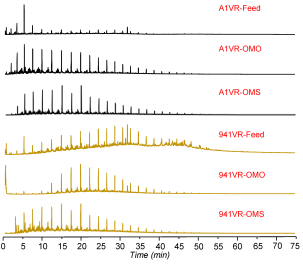
Figure 1. GC-MS chromatograms of saturated hydrocarbons in A1VR and 941VR and the related hydrogenation products.
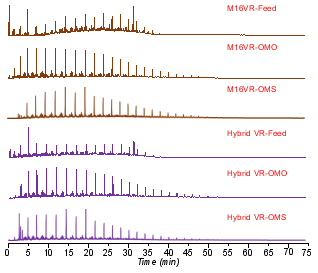
Figure 2. GC-MS total ion chromatograms of saturated hydrocarbons in M16VR and HybridVR and the related hydrogenation products.
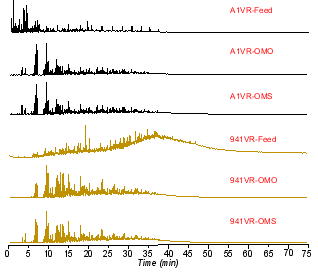
Figure 3. GC-MS chromatograms of aromatic hydrocarbons in A1VR and 941VR and the related hydrogenation products.
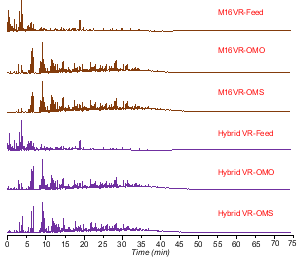
Figure 4. GC-MS chromatograms of aromatic hydrocarbons in M16VR and HybridVR and the related hydrogenation products.
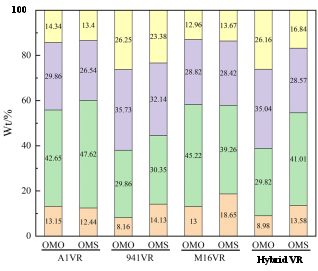
Figure 5. Boiling-range distribution of hydrogenation products from four typical residues with different catalysts.

Information


 Share This Article
 Twitter
 Linked In
 Facebook

 Copy
 Download