Abstract
Formative feedback is central to assessment for learning because it can help learners understand expectations, identify gaps in understanding, and improve subsequent learning. However, less is known about how formative feedback is understood and enacted in resource-constrained primary-school contexts. This study explored how Ethiopian primary-school teachers understand and enact formative feedback and how teacher, student, and contextual conditions shape feedback practices. Guided by Social Cognitive Theory (SCT), the study employed a qualitative instrumental case-study design at a government primary school in Asella, Oromia Regional State, Ethiopia. Data were collected through semi-structured interviews with five teachers and the school principal, classroom observations, and a focus group discussion involving five students and three Parent–Teacher Association representatives. Data were analyzed using reflexive thematic analysis, with SCT applied as an interpretive lens. Four themes emerged: teachers’ understanding and enactment of feedback; feedback, student engagement, and learning experiences; contextual conditions supporting feedback; and challenges and tensions affecting implementation. Teachers generally understood feedback as supporting learning, motivation, confidence, and participation. However, observations revealed a gap between formative intentions and enacted practices, with whole-class oral correction more common than sustained dialogue, individualized feedback, and opportunities for revision. Large classes, limited instructional time, assessment pressures, resource constraints, and differences in student engagement shaped implementation. The findings indicate that strengthening formative feedback requires teacher and student feedback literacy, relevant professional learning, and school conditions that enable dialogue, reflection, and revision.
Keywords
Formative Assessment, Formative Feedback, Feedback Practices, Social Cognitive Theory, Teacher Feedback Literacy,
Student Engagement, Primary Education, Ethiopia
1. Introduction
Feedback is a fundamental component of teaching and learning because it enables learners to understand expectations, identify gaps in understanding, and regulate subsequent learning. Contemporary assessment scholarship increasingly views feedback not as information transmitted from teachers to students but as an interactive and socially mediated process in which learners interpret, engage with, and act on feedback
| [6] | Carless, D., & Winstone, N. (2023). Teacher feedback literacy and its interplay with student feedback literacy. Teaching in Higher Education, 28(1), 150–163.
https://doi.org/10.1080/13562517.2020.1782372 |
| [26] | Winstone, N. E., & Boud, D. (2022). The need to disentangle assessment and feedback in higher education. Studies in Higher Education, 47(3), 656–667.
https://doi.org/10.1080/03075079.2020.1779687 |
[6, 26]
. Effective feedback therefore depends not only on the information provided by teachers but also on classroom relationships, student participation, opportunities for reflection, and conditions that enable learners to use feedback productively
.
Despite extensive research on feedback, much evidence comes from relatively well-resourced educational systems. Less is known about how teachers conceptualize and enact feedback where instructional conditions include large classes, limited resources, assessment pressures, and restricted professional-learning opportunities. Feedback practices are shaped by teacher beliefs, workload, assessment cultures, school leadership, resources, and professional learning rather than being applied uniformly as technical strategies
.
This issue is particularly relevant in educational systems where reforms promote learner-centered pedagogy and formative assessment. In low- and middle-income contexts, such reforms may be difficult to enact because of overcrowding, limited instructional materials, examination-oriented traditions, insufficient teacher preparation, and restricted professional development
| [21] | Power, T. (2019). Approaches to teacher professional development in low-to-middle-income countries. In Sustainable English language teacher development at scale: Lessons from Bangladesh (pp. 47–65). |
[21]
. Understanding feedback in such settings therefore requires attention to the relationship between policy expectations and classroom realities.
In Ethiopia, educational reforms increasingly emphasize competency development, learner-centered approaches, and assessment for learning
| [18] | Ministry of Education [MoE]. (2023). Education Sector Development Program VI (ESDP VI) and competency-based curriculum framework. Federal Democratic Republic of Ethiopia. |
[18]
. Nevertheless, teachers continue to work under conditions that may include large classes, limited resources, assessment pressures, and uneven professional support. Limited evidence exists on the relationship between teachers’ intended formative feedback practices and their actual enactment under resource-constrained conditions in Ethiopian primary schools.
Social Cognitive Theory (SCT) provides a useful framework for examining this issue because it conceptualizes human functioning through reciprocal interactions among personal factors, behavior, and environmental conditions
| [2] | Bandura, A., Caprara, G. V., Barbaranelli, C., Pastorelli, C., & Regalia, C. (2001). Sociocognitive self-regulatory mechanisms governing transgressive behavior. Journal of Personality and Social Psychology, 80(1), 125–135.
https://doi.org/10.1037/0022-3514.80.1.125 |
[2]
. Applied to feedback, SCT directs attention to teachers’ beliefs and self-efficacy, their observable feedback practices, student responses, and institutional conditions. This perspective is especially relevant to resource-constrained settings because environmental conditions can expand or restrict the instructional possibilities available to teachers.
This study therefore explored how primary-school teachers understand and enact formative feedback and how teacher, student, and contextual conditions shape those practices in a resource-constrained Ethiopian primary school. It contributes qualitative evidence from an underrepresented context, applies SCT to feedback enactment, and identifies implications for teacher and student feedback literacy and school-level support.
The study addressed three research questions:
1) How do primary-school teachers understand and enact formative feedback practices?
2) What contextual factors enable or constrain formative feedback practices in the resource-constrained primary-school context?
3) How do teacher and student responses interact with contextual conditions to shape formative feedback practices?
2. Literature Review2.1. Feedback as a Learning Process
Feedback is a cornerstone of formative assessment because it helps learners evaluate current understanding, identify gaps, and improve subsequent performance
. Earlier approaches often emphasized feedback as information transmitted by teachers to reduce discrepancies between current and desired performance. Contemporary scholarship argues that this transmission model is incomplete because learners actively interpret and use feedback within particular social and educational contexts
.
Feedback is increasingly conceptualized as dialogic and interactive. Teachers provide guidance, learners interpret and respond to it, and both engage in reflection that can inform subsequent learning. Its effectiveness therefore depends on learners’ capacity to understand and act on feedback
| [12] | Istencioglu, T., Yang, L., Dawson, P., & Boud, D. (2026). How do teachers design and do feedback? Development and validation of the teacher feedback literacy scale. Assessment & Evaluation in Higher Education, 1–21.
https://doi.org/10.1080/02602938.2026.2661361 |
| [16] | Malecka, B., Boud, D., Tai, J., & Ajjawi, R. (2022). Navigating feedback practices across learning contexts: Implications for feedback literacy. Assessment & Evaluation in Higher Education, 47(8), 1330–1344.
https://doi.org/10.1080/02602938.2022.2041544 |
[12, 16]
. This has led to greater attention to feedback literacy. Teacher feedback literacy involves designing meaningful opportunities, providing actionable guidance, and supporting dialogue and revision, while student feedback literacy involves interpreting feedback, managing responses to it, and applying it to future learning
.
Feedback can operate through cognitive, motivational, and behavioral pathways. Explanatory feedback may help learners identify misconceptions and refine strategies; constructive feedback may strengthen confidence and persistence; and opportunities to respond to feedback may support self-regulated learning
| [7] | Chong, S. W. (2021). Reconsidering student feedback literacy from an ecological perspective. Assessment & Evaluation in Higher Education, 46(1), 92–104.
https://doi.org/10.1080/02602938.2020.1730765 |
| [13] | Kutasi, R. (2023). Feedback: Unveiling its impact and enhancing its effectiveness in education. Revista de Pedagogie, 71(2), 7–32. https://doi.org/10.26755/RevPed/2023.2/7 |
| [29] | Yoon, M., Hill, J., & Kim, D. (2021). Designing supports for promoting self-regulated learning in the flipped classroom. Journal of Computing in Higher Education, 33(2), 398–418. https://doi.org/10.1007/s12528-021-09269-z |
[7, 13, 29]
. However, large classes, limited time, workload, and accountability pressures can lead teachers to use brief corrective or grade-oriented feedback instead of dialogic and developmental approaches
| [22] | Rabbani, L. M., & Husain, S. H. (2024). Fostering student engagement with criticism feedback: Importance, contrasting perspectives and key provisions. Frontiers in Education. |
| [24] | Smith, J. K., Lipnevich, A. A., & Guskey, T. R. (2023). Instructional feedback: The power, the promise, the practice. Corwin Press. |
[22, 24]
.
2.2. Contextual Influences on Feedback Practices
Feedback is embedded in educational environments involving teachers, learners, classroom relationships, school leadership, institutional policies, and wider sociocultural conditions
. Teacher–student relationships influence whether learners seek clarification, reflect on feedback, and revise their work. Trust and respect can make feedback more acceptable, whereas fear of failure may reduce students’ willingness to engage with it
| [15] | Little, T., Dawson, P., Boud, D., & Tai, J. (2024). Can students’ feedback literacy be improved? A scoping review of interventions. Assessment & Evaluation in Higher Education, 49(1), 39–52. https://doi.org/10.1080/02602938.2023.2177613 |
[15]
.
Students are also active participants in feedback processes. Their feedback literacy and motivation influence whether they interpret feedback as a resource for improvement or mainly as judgment and grading
. Institutional conditions also matter. Supportive leadership, professional collaboration, and professional learning can strengthen assessment practices, while large classes, limited time, inadequate resources, heavy workloads, and examination pressures can restrict individualized feedback and dialogue
| [9] | Ghamrawi, N., Shal, T., & Ghamrawi, N. A. (2024). Cultivating teacher leadership: Evidence from a transformative professional development model. School Leadership & Management, 44(4), 413–441.
https://doi.org/10.1080/13632434.2024.2328056 |
| [10] | Hill, J., & West, H. (2022). Dialogic feed-forward in assessment: Pivotal to learning but not unproblematic. Teaching and Learning Inquiry: The ISSOTL Journal, 10, 1–19. https://doi.org/10.20343/teachlearninqu.10.20 |
| [27] | Yan, Z., & Pastore, S. (2022). Assessing teachers’ strategies in formative assessment: The teacher formative assessment practice scale. Journal of Psychoeducational Assessment, 40(5), 592–604. https://doi.org/10.1177/07342829221075121 |
[9, 10, 27]
.
In low- and middle-income contexts, these constraints may be particularly significant. Shortages of instructional materials, overcrowded classrooms, limited professional development, and examination pressures can constrain the implementation of dialogic feedback
| [5] | Buabeng, I., & Amo-Darko, B. (2025). Curriculum reforms without foundation: The effects of inadequate preparation in curriculum reforms on Ghanaian teachers and the education system. Curriculum Perspectives, 45(2), 133–147.
https://doi.org/10.1007/s41297-025-00309-7 |
[5]
. From an SCT perspective, such conditions are not merely external barriers; they interact with teachers’ agency and students’ responses to shape feedback practices
| [2] | Bandura, A., Caprara, G. V., Barbaranelli, C., Pastorelli, C., & Regalia, C. (2001). Sociocognitive self-regulatory mechanisms governing transgressive behavior. Journal of Personality and Social Psychology, 80(1), 125–135.
https://doi.org/10.1037/0022-3514.80.1.125 |
[2]
.
2.3. Social Cognitive Theory and Conceptual Framework
Social Cognitive Theory conceptualizes human functioning through reciprocal interactions among personal factors, behavior, and environment
| [2] | Bandura, A., Caprara, G. V., Barbaranelli, C., Pastorelli, C., & Regalia, C. (2001). Sociocognitive self-regulatory mechanisms governing transgressive behavior. Journal of Personality and Social Psychology, 80(1), 125–135.
https://doi.org/10.1037/0022-3514.80.1.125 |
[2]
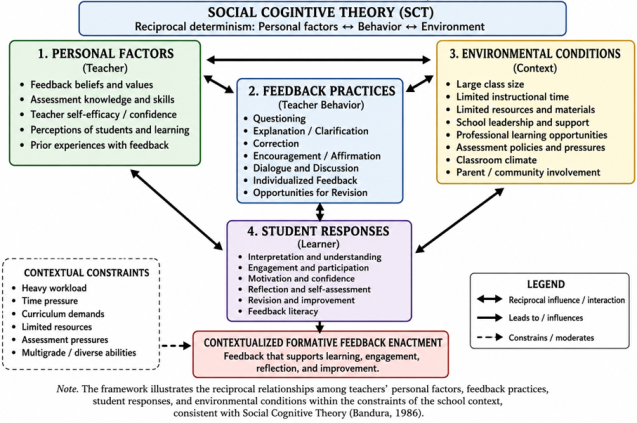
. In this study, personal factors include teachers’ feedback beliefs, assessment knowledge, confidence, and perceptions. Behavioral factors include questioning, explanation, correction, encouragement, dialogue, and opportunities for students to respond and revise. Environmental factors include class size, instructional resources, school leadership, professional learning, assessment policies, classroom climate, and parental involvement.
The framework assumes those teachers’ beliefs influence feedback behavior, but that student responses and environmental conditions also influence subsequent teacher decisions. Feedback is therefore treated as a socially situated practice rather than an isolated instructional technique. SCT guided the research questions, data collection, and interpretation, but it was not tested causally. Its role was interpretive, particularly in explaining reciprocal interactions among teacher agency, learner engagement, and environmental conditions.
Figure 1. Social Cognitive Theory–informed framework of formative feedback enactment in a resource-constrained primary school.
3. Materials and Methods
3.1. Research Design and Study Context
The study adopted a qualitative instrumental case-study design within a constructivist paradigm. The design was selected to explore participants’ experiences and interactions in their natural educational setting rather than to test causal relationships
. An instrumental case study was appropriate because the school served as a case through which the broader phenomenon of formative feedback could be examined
| [25] | Stake, R. E. (2005). Qualitative case studies. In N. K. Denzin & Y. S. Lincoln (Eds.), The Sage handbook of qualitative research (3rd ed., pp. 443–466). SAGE. |
[25]
.
The study was conducted at Asella Primary School, a government primary school in Asella Town, Arsi Zone, and Oromia Regional State, Ethiopia. The school was purposively selected because it reflected characteristics relevant to the study, including continuous-assessment implementation, relatively large classes, diverse learners, and limited instructional resources. The case was selected for information richness rather than statistical representativeness. The findings are therefore analytically transferable rather than statistically generalizable
| [28] | Yin, R. K. (2018). Case study research and applications: Design and methods. SAGE. |
[28]
.
3.2. Participants and Sampling
Purposive sampling was used to identify participants with direct experience of classroom feedback
| [20] | Patton, M. Q. (2015). Qualitative research & evaluation methods: Integrating theory and practice. SAGE. |
[20]
. Four stakeholder groups were included: classroom teachers, students, and the school principal, and Parent–Teacher Association (PTA) representatives. The final sample comprised 14 participants: five teachers, five students, one principal, and three PTA representatives.
The teachers had at least ten years of teaching experience, taught Grades 1–8, and were willing to reflect on assessment and feedback practices. Students were selected from different grade levels based on their experience of receiving feedback and their ability to describe their learning experiences. The principal was included because of the role of instructional leadership and assessment implementation. PTA representatives were selected because of their involvement in school governance and support for student learning.
Sample adequacy was considered in relation to information power, given the focused research questions, specific case, participants’ direct experience, and use of multiple data sources
| [17] | Malterud, K., Siersma, V. D., & Guassora, A. D. (2016). Sample size in qualitative interview studies: Guided by information power. Qualitative Health Research, 26(13), 1753–1760. https://doi.org/10.1177/1049732315617444 |
[17]
. Data collection continued until additional data generated limited new insights relevant to the research questions.
Table 1. Participant characteristics.
Participant group | n | Selection basis |
Teachers | 5 | ≥10 years’ experience; Grades 1–8 |
Students | 5 | Different grades; experience receiving feedback |
Principal | 1 | Instructional leadership role |
PTA representatives | 3 | School governance/support role |
3.3. Data Collection
Data were collected through semi-structured interviews, classroom observations, and a focus group discussion. Interviews explored participants’ understanding of formative feedback, strategies used, perceived effects, and contextual opportunities and challenges. Individual interviews were conducted with five teachers and the principal, lasted approximately 45–60 minutes, and were audio-recorded with consent. Field notes were also maintained.
Classroom observations were used to examine enacted feedback rather than relying solely on self-reported practice. A non-participant observation approach focused on feedback timing and specificity, teacher questioning, opportunities for dialogue and revision, student participation and responses, and contextual conditions such as class size, resources, classroom climate, and time management. Detailed field notes were expanded after observations and compared with interview and focus-group evidence.
A focus group discussion with the five students and three PTA representatives explored experiences of feedback, student engagement, parental support, and contextual influences. The discussion lasted approximately 90 minutes, was audio-recorded with consent, and was supplemented by field notes.
Using multiple methods enabled methodological and data-source triangulation. Interviews provided accounts of beliefs and experiences, observations documented enacted practices, and the focus group provided collective perspectives.
3.4. Data Analysis
Data were analyzed using reflexive thematic analysis following Braun and Clarke’s approach
| [4] | Braun, V., & Clarke, V. (2023). Toward good practice in thematic analysis: Avoiding common problems and becoming a knowing researcher. International Journal of Transgender Health, 24(1), 1–6.
https://doi.org/10.1080/26895269.2022.2129597 |
[4]
. Interviews and the focus group were transcribed verbatim, observation notes were expanded, and the researcher repeatedly reviewed the dataset while maintaining analytical memos.
The analysis followed six recursive phases: familiarization; coding; development of candidate themes; review of themes; definition and naming of themes; and production of the analytic narrative. Coding was primarily inductive but remained sensitized to SCT concepts such as teacher agency, self-efficacy, learner engagement, and environmental influence. Themes were reviewed against the dataset, and divergent cases were retained.
Evidence was compared across teachers, students, the principal, PTA representatives, and classroom observations. SCT was applied after theme development as an interpretive lens rather than as a predetermined coding framework. This approach kept participants’ accounts central while enabling interpretation of reciprocal interactions among personal, behavioral, and environmental factors.
3.5. Trustworthiness and Reflexivity
Trustworthiness was addressed through credibility, transferability, dependability, and conformability. Credibility was supported by methodological and data-source triangulation and member checking with selected teacher participants. Transferability was supported through description of the context, participants, and procedures. Dependability was strengthened through an audit trail documenting sampling, data collection, coding, theme development, and analytical decisions. Conformability was supported through reflexive memos, comparison of multiple sources, and attention to divergent perspectives.
The researcher’s experience in teacher education and curriculum studies provided contextual understanding of Ethiopian classroom and assessment practices but also required attention to possible preconceptions. Reflexive memos were maintained throughout data collection and analysis, and non-participant observation and open-ended questioning were used to minimize undue influence.
3.6. Ethical Considerations
The study was reviewed by the Departmental Research Ethics Committee of the School of Teacher Education, Hawassa University, and was assigned reference number HU-STE-1-01/25. The study was conducted in accordance with the ethical requirements of Hawassa University and applicable national research ethics guidelines. Participation was voluntary, and adult participants provided written informed consent before data collection. For student participants, parental or guardian consent and student assent were obtained before participation. Participants were informed about the purpose and procedures of the study, their right to decline participation or withdraw without penalty, and the measures taken to protect confidentiality.
Participant names and other identifying information were removed from research records and replaced with codes. Audio recordings, transcripts, observation notes, and other research materials were securely stored and were accessible only to the researcher. Permission to conduct the study was also obtained from the relevant education authorities and the participating school.
4. Findings
Four interrelated themes emerged: (1) teachers’ understanding and enactment of feedback practices; (2) feedback, student engagement, and learning experiences; (3) contextual conditions supporting feedback practices; and (4) challenges and tensions affecting implementation.
Table 2. Themes and Subthemes.
Main theme | Subthemes |
Teachers’ understanding and enactment of feedback practices | Understanding of feedback purposes; forms, quality, and enactment of feedback |
Contribution of feedback to student learning and engagement | Learning improvement; motivation, confidence, and learner participation |
Contextual conditions supporting feedback practices | Leadership support; teacher–student relationships; professional collaboration; parent and community support |
Challenges and tensions affecting feedback implementation | Workload and class size; limited feedback literacy; resource limitations; assessment pressures |
4.1. Teachers’ Understanding and Enactment of Feedback
Participants generally understood feedback as a process for supporting learning rather than simply evaluating performance. A teacher explained, “Feedback is not only telling students whether their answer is correct or wrong. It helps them understand their weaknesses and know how they can improve” (Teacher 5). A student similarly stated, “When teachers explain our mistakes, we know what we need to practice more and improve our work” (Student 2).
However, observations showed a gap between teachers’ conceptual understanding and enacted practice. Teachers reported using questioning, oral explanations, written comments, and assignment corrections, but whole-class oral feedback was common. Teachers frequently addressed incorrect answers by explaining the correct response to the class. This efficiently addressed common errors but provided fewer opportunities for individual dialogue, explanation of reasoning, and revision.
Feedback quality also varied. In some lessons, teachers asked why an answer was incorrect and guided students toward improvement. In others, feedback consisted mainly of brief comments such as “good,” “correct,” or “try again.” One student observed, “Sometimes the teacher says our work is good, but we do not always know what made it good or what we should improve” (Student 4). Thus, students valued specific guidance more than general evaluation.
Participants also differed in how they understood feedback. Some teachers emphasized improvement, whereas others associated it more strongly with identifying errors and confirming answers. A teacher noted, “Most students want to know their marks first. They are less interested in explanations unless they have made mistakes” (Teacher 2). Overall, feedback practices reflected a tension between formative principles and classroom realities such as limited time, class size, and students’ orientations toward grades.
4.2. Feedback, Student Engagement, and Learning Experiences
Participants associated feedback with understanding, motivation, confidence, and participation. The evidence does not establish causal effects on academic achievement; rather, it indicates that feedback was experienced as more useful when it included explanation, guidance, opportunities for response, and revision.
Teachers also used students’ responses as evidence about their own teaching. One teacher stated, “When I give feedback, I can understand which parts students have not understood, and then I can support them better” (Teacher 3). This illustrates feedback as reciprocal: teachers respond to students’ learning evidence and adjust instruction.
Students reported that explanatory feedback helped them understand mistakes. One student explained, “Before, I only knew my answer was wrong. After the teacher explained, I understood the reason and could correct it” (Student 1). Observations supported this account. Where teachers explained errors, asked follow-up questions, and encouraged reconsideration, students appeared more engaged: they asked questions, attempted corrections, and discussed answers. Where teachers moved quickly to the next activity, opportunities for reflection and revision were more limited.
The emotional tone of feedback also mattered. Teachers reported that supportive feedback encouraged hesitant students. A teacher said, “Some students do not answer because they are afraid of being wrong. When we encourage them and show them how to improve, they become more willing to participate” (Teacher 1). A student similarly stated, “When teachers correct us kindly, we feel comfortable asking questions and trying again” (Student 3).
Student engagement was not uniform. Some learners used feedback to improve, while others focused primarily on scores and correct answers. This variation suggests that feedback effectiveness depends partly on students’ feedback literacy and opportunities to act on feedback.
4.3. Contextual Conditions Supporting Feedback
Participants identified supportive leadership, professional collaboration, positive teacher–student relationships, parental involvement, and teacher commitment as conditions supporting feedback.
Teachers viewed school leadership as important for encouraging reflection and monitoring student progress. One teacher explained, “When the school leaders encourage us to follow students’ progress and discuss teaching challenges, we become more interested in improving our assessment practices” (Teacher 2). The principal emphasized that teachers needed guidance and discussion about how assessment can support learning. However, participants indicated that structured professional learning specifically focused on formative feedback remained limited.
Informal teacher collaboration also supported learning. A teacher noted, “When we discuss with other teachers, we learn different ways of helping students and giving better feedback” (Teacher 5). Participants nevertheless reported that professional activities often emphasized curriculum coverage and examination preparation rather than feedback literacy.
Teacher–student relationships influenced students’ willingness to engage. Encouraging language and patient responses appeared to support participation, while teacher-dominated interactions provided fewer opportunities for clarification. Parental involvement could reinforce feedback beyond the classroom, although PTA representatives reported variation in families’ capacity to support learning. A PTA representative stated, “When parents ask children about their schoolwork and support improvement, students take teachers’ comments more seriously” (PTA Representative 1).
Teachers also exercised professional agency by adapting feedback to conditions. When individualized written feedback was difficult, they used oral explanations, questioning, and encouragement. Their agency was therefore real but bounded by class size, time, workload, and available resources.
4.4. Challenges and Tensions
The major challenges were large classes and limited instructional time, examination-oriented assessment expectations, limited feedback-specific professional learning, resource constraints, and unequal student engagement.
Teachers reported that individualized feedback was difficult in large classes. One teacher explained, “We know that individual feedback helps students, but when there are many students in one classroom, it is difficult to give enough attention to everyone” (Teacher 3). Observations showed teachers using whole-class explanations and brief oral corrections to reach many learners. These strategies represented contextual adaptations but reduced opportunities for extended dialogue.
Assessment culture also shaped feedback. Teachers reported that students and parents often prioritized marks. One teacher stated, “Students usually ask about their scores first. They want to know whether they passed rather than how they can improve” (Teacher 2). Nevertheless, some students actively sought explanations and revised their work, showing that the influence of grades was not uniform.
Participants also reported limited opportunities for professional learning specifically focused on feedback. Teachers developed practices through experience and informal collaboration, but several believed more structured learning was needed. Resource constraints and workload further encouraged reliance on oral rather than written feedback.
Finally, students differed in their willingness and ability to engage with feedback. Some asked questions and corrected responses, while others waited for the correct answer. This indicates that feedback does not automatically become learning: students need opportunities and capabilities to interpret, discuss, and apply it.
Across these findings, a central tension emerged between teacher agency and contextual constraints. Teachers actively negotiated limitations rather than simply accepting them, but teacher commitment alone could not overcome large classes, limited time, insufficient resources, and weak feedback literacy. Sustainable improvement therefore requires both pedagogical and organizational support.
5. Discussion
The findings indicate that formative feedback in this case was a socially situated practice rather than one-way information transmission. Teachers valued feedback for learning, yet its enacted form was shaped by class size, time, assessment expectations, resources, and student responses. Thus, the quality of feedback cannot be understood solely from teachers’ stated beliefs.
5.1. Feedback as an Interactive Process
The findings are consistent with contemporary feedback scholarship emphasizing that feedback becomes meaningful when learners can interpret and act on it
. Students in this study valued explanations and opportunities to correct their work. However, the case adds an important contextual qualification: even when teachers understand dialogic feedback, structural conditions can push practice toward brief whole-class correction. The issue is therefore not simply teacher knowledge but the feasibility of enacting desired practices.
5.2. Feedback through Social Cognitive Theory
SCT helps explain the reciprocal pattern observed in the case. Teachers’ beliefs and commitment influenced the strategies they attempted, while students’ responses and environmental conditions influenced subsequent decisions
| [2] | Bandura, A., Caprara, G. V., Barbaranelli, C., Pastorelli, C., & Regalia, C. (2001). Sociocognitive self-regulatory mechanisms governing transgressive behavior. Journal of Personality and Social Psychology, 80(1), 125–135.
https://doi.org/10.1037/0022-3514.80.1.125 |
[2]
. Teachers adapted by using whole-class explanations when individualized feedback was difficult and oral guidance when written comments were impractical. The study therefore illustrates reciprocal determinism as an interpretive lens for feedback enactment in a resource-constrained setting. It does not establish causal relationships among SCT constructs.
5.3. Institutional Support and Teacher Learning
The findings challenge explanations that locate weak feedback primarily in teacher competence. Teachers demonstrated awareness of formative feedback, but large classes, limited time, resource constraints, and limited feedback-specific professional learning constrained implementation. Professional development should therefore be accompanied by organizational conditions that make intended practices feasible. Teacher learning and institutional support should be treated as complementary.
5.4. Student Feedback Literacy
The study also highlights student feedback literacy. Some students interpreted explanations and revised their work, while others focused mainly on marks or correct answers. This supports the view that feedback uptake depends on learners’ capacity to interpret and use feedback
. Strengthening formative feedback should therefore address both sides of the process: teachers need to create usable feedback opportunities, while students need support to interpret, discuss, and act on feedback.
6. Conclusion
This study found that formative feedback in an Ethiopian primary school was shaped by interactions among teachers, students, and contextual conditions. Although teachers valued feedback for supporting learning, observations revealed a gap between formative intentions and enacted practices. Large classes, limited time, assessment pressures, resource constraints, and differences in student engagement constrained the depth of feedback, despite teachers’ efforts to adapt.
From an SCT perspective, the findings highlight how teacher agency, feedback practices, student responses, and environmental conditions interact. Strengthening formative feedback therefore requires teacher and student feedback literacy, relevant professional learning, and school conditions that support dialogue, reflection, and revision. Although based on one school, the findings offer analytically transferable insights for similar resource-constrained contexts.
7. Limitations
The study was conducted in one primary school with 14 purposively selected participants, limiting statistical generalization. Its value lies instead in the depth of contextual understanding and analytical transferability. The observations were conducted over a relatively short period and may not represent differences across all subjects, grades, assessment periods, or the school year. Participants may also have presented socially desirable accounts of their practices. Triangulation across interviews, observations, and focus-group data helped address this concern, but some accounts may still reflect perceptions rather than practice in every situation. Future multi-school and longer-term research could provide a broader account of how feedback practices vary and develop.
8. Recommendations for Future Research
Future studies should examine feedback practices across multiple Ethiopian schools and regions to explore how resources, leadership, culture, and policy implementation influence formative assessment. Longitudinal research could investigate changes following professional development designed to strengthen teacher and student feedback literacy. Further research should examine students’ interpretations and use of feedback and compare resource-constrained and better-resourced schools. Mixed-method studies could also examine how teacher self-efficacy, feedback literacy, institutional support, classroom interaction, and student engagement interact over time.
Abbreviations
PTA | Parent–Teacher Association |
SCT | Social Cognitive Theory |
Acknowledgments
The author sincerely thanks the Arsi and East Shewa Zone Education Offices, school administrators, and all participating teachers, students, and Parent–Teacher Association representatives for their cooperation and support during the data collection process.
Author Contributions
Seboka Geleta Tonkolu: Conceptualization, Data curation, Formal Analysis, Investigation, Methodology, Visualization, Writing – original draft, Writing – review & editing
Data Availability Statement
The datasets generated and/or analyzed during the current study are not publicly available due to ethical restrictions related to participant confidentiality. De-identified data may be made available from the corresponding author upon reasonable request and subject to institutional approval.
References
| [1] |
Asyifa, D. F. (2024). Understanding feedback literacy in higher education: Concepts, practices, and future directions. Nusantara Education Studies, 2(1), 72–92.
https://doi.org/10.54518/nes.2.1.2024.1263
|
| [2] |
Bandura, A., Caprara, G. V., Barbaranelli, C., Pastorelli, C., & Regalia, C. (2001). Sociocognitive self-regulatory mechanisms governing transgressive behavior. Journal of Personality and Social Psychology, 80(1), 125–135.
https://doi.org/10.1037/0022-3514.80.1.125
|
| [3] |
Brandmo, C., & Gamlem, S. M. (2025). Students’ perceptions and outcome of teacher feedback: A systematic review. Frontiers in Education.
https://doi.org/10.3389/feduc.2025.1572950
|
| [4] |
Braun, V., & Clarke, V. (2023). Toward good practice in thematic analysis: Avoiding common problems and becoming a knowing researcher. International Journal of Transgender Health, 24(1), 1–6.
https://doi.org/10.1080/26895269.2022.2129597
|
| [5] |
Buabeng, I., & Amo-Darko, B. (2025). Curriculum reforms without foundation: The effects of inadequate preparation in curriculum reforms on Ghanaian teachers and the education system. Curriculum Perspectives, 45(2), 133–147.
https://doi.org/10.1007/s41297-025-00309-7
|
| [6] |
Carless, D., & Winstone, N. (2023). Teacher feedback literacy and its interplay with student feedback literacy. Teaching in Higher Education, 28(1), 150–163.
https://doi.org/10.1080/13562517.2020.1782372
|
| [7] |
Chong, S. W. (2021). Reconsidering student feedback literacy from an ecological perspective. Assessment & Evaluation in Higher Education, 46(1), 92–104.
https://doi.org/10.1080/02602938.2020.1730765
|
| [8] |
Christie, P., & Lingard, B. (2020). Teachers and schooling making a difference: Productive pedagogies, assessment and performance. Routledge.
https://doi.org/10.4324/9781003117643
|
| [9] |
Ghamrawi, N., Shal, T., & Ghamrawi, N. A. (2024). Cultivating teacher leadership: Evidence from a transformative professional development model. School Leadership & Management, 44(4), 413–441.
https://doi.org/10.1080/13632434.2024.2328056
|
| [10] |
Hill, J., & West, H. (2022). Dialogic feed-forward in assessment: Pivotal to learning but not unproblematic. Teaching and Learning Inquiry: The ISSOTL Journal, 10, 1–19.
https://doi.org/10.20343/teachlearninqu.10.20
|
| [11] |
Irons, A., & Elkington, S. (2021). Enhancing learning through formative assessment and feedback. Routledge.
https://doi.org/10.4324/9781138610514
|
| [12] |
Istencioglu, T., Yang, L., Dawson, P., & Boud, D. (2026). How do teachers design and do feedback? Development and validation of the teacher feedback literacy scale. Assessment & Evaluation in Higher Education, 1–21.
https://doi.org/10.1080/02602938.2026.2661361
|
| [13] |
Kutasi, R. (2023). Feedback: Unveiling its impact and enhancing its effectiveness in education. Revista de Pedagogie, 71(2), 7–32.
https://doi.org/10.26755/RevPed/2023.2/7
|
| [14] |
Lipnevich, A. A., & Smith, J. K. (2022). Student–feedback interaction model: Revised. Studies in Educational Evaluation, 75, 101208.
https://doi.org/10.1016/j.stueduc.2022.101208
|
| [15] |
Little, T., Dawson, P., Boud, D., & Tai, J. (2024). Can students’ feedback literacy be improved? A scoping review of interventions. Assessment & Evaluation in Higher Education, 49(1), 39–52.
https://doi.org/10.1080/02602938.2023.2177613
|
| [16] |
Malecka, B., Boud, D., Tai, J., & Ajjawi, R. (2022). Navigating feedback practices across learning contexts: Implications for feedback literacy. Assessment & Evaluation in Higher Education, 47(8), 1330–1344.
https://doi.org/10.1080/02602938.2022.2041544
|
| [17] |
Malterud, K., Siersma, V. D., & Guassora, A. D. (2016). Sample size in qualitative interview studies: Guided by information power. Qualitative Health Research, 26(13), 1753–1760.
https://doi.org/10.1177/1049732315617444
|
| [18] |
Ministry of Education [MoE]. (2023). Education Sector Development Program VI (ESDP VI) and competency-based curriculum framework. Federal Democratic Republic of Ethiopia.
|
| [19] |
Nieminen, J. H., & Carless, D. (2023). Feedback literacy: A critical review of an emerging concept. Higher Education, 85(6), 1381–1400.
https://doi.org/10.1007/s10734-022-00895-9
|
| [20] |
Patton, M. Q. (2015). Qualitative research & evaluation methods: Integrating theory and practice. SAGE.
|
| [21] |
Power, T. (2019). Approaches to teacher professional development in low-to-middle-income countries. In Sustainable English language teacher development at scale: Lessons from Bangladesh (pp. 47–65).
|
| [22] |
Rabbani, L. M., & Husain, S. H. (2024). Fostering student engagement with criticism feedback: Importance, contrasting perspectives and key provisions. Frontiers in Education.
|
| [23] |
Regmi, B. P. (2024). Qualitative research design: A discussion on its types. Research Journal, 9(1), 37–45.
https://doi.org/10.3126/rj.v9i1.74415
|
| [24] |
Smith, J. K., Lipnevich, A. A., & Guskey, T. R. (2023). Instructional feedback: The power, the promise, the practice. Corwin Press.
|
| [25] |
Stake, R. E. (2005). Qualitative case studies. In N. K. Denzin & Y. S. Lincoln (Eds.), The Sage handbook of qualitative research (3rd ed., pp. 443–466). SAGE.
|
| [26] |
Winstone, N. E., & Boud, D. (2022). The need to disentangle assessment and feedback in higher education. Studies in Higher Education, 47(3), 656–667.
https://doi.org/10.1080/03075079.2020.1779687
|
| [27] |
Yan, Z., & Pastore, S. (2022). Assessing teachers’ strategies in formative assessment: The teacher formative assessment practice scale. Journal of Psychoeducational Assessment, 40(5), 592–604.
https://doi.org/10.1177/07342829221075121
|
| [28] |
Yin, R. K. (2018). Case study research and applications: Design and methods. SAGE.
|
| [29] |
Yoon, M., Hill, J., & Kim, D. (2021). Designing supports for promoting self-regulated learning in the flipped classroom. Journal of Computing in Higher Education, 33(2), 398–418.
https://doi.org/10.1007/s12528-021-09269-z
|
Cite This Article
-
ACS Style
Tonkolu, S. G. Formative Feedback in a Resource-Constrained Ethiopian Primary School: Teacher Practice, Student Engagement, and Context. Int. J. Elem. Educ. 2026, 15(2), 34-42. doi: 10.11648/j.ijeedu.20261502.12
 Copy
|
Copy
|
 Download
-
@article{10.11648/j.ijeedu.20261502.12,
  author = {Seboka Geleta Tonkolu},
  title = {Formative Feedback in a Resource-Constrained Ethiopian Primary School: Teacher Practice, Student Engagement, and Context},
  journal = {International Journal of Elementary Education},
  volume = {15},
  number = {2},
  pages = {34-42},
  doi = {10.11648/j.ijeedu.20261502.12},
  url = {https://doi.org/10.11648/j.ijeedu.20261502.12},
  eprint = {https://article.sciencepublishinggroup.com/pdf/10.11648.j.ijeedu.20261502.12},
  abstract = {Formative feedback is central to assessment for learning because it can help learners understand expectations, identify gaps in understanding, and improve subsequent learning. However, less is known about how formative feedback is understood and enacted in resource-constrained primary-school contexts. This study explored how Ethiopian primary-school teachers understand and enact formative feedback and how teacher, student, and contextual conditions shape feedback practices. Guided by Social Cognitive Theory (SCT), the study employed a qualitative instrumental case-study design at a government primary school in Asella, Oromia Regional State, Ethiopia. Data were collected through semi-structured interviews with five teachers and the school principal, classroom observations, and a focus group discussion involving five students and three Parent–Teacher Association representatives. Data were analyzed using reflexive thematic analysis, with SCT applied as an interpretive lens. Four themes emerged: teachers’ understanding and enactment of feedback; feedback, student engagement, and learning experiences; contextual conditions supporting feedback; and challenges and tensions affecting implementation. Teachers generally understood feedback as supporting learning, motivation, confidence, and participation. However, observations revealed a gap between formative intentions and enacted practices, with whole-class oral correction more common than sustained dialogue, individualized feedback, and opportunities for revision. Large classes, limited instructional time, assessment pressures, resource constraints, and differences in student engagement shaped implementation. The findings indicate that strengthening formative feedback requires teacher and student feedback literacy, relevant professional learning, and school conditions that enable dialogue, reflection, and revision.},
 year = {2026}
}
Copy
|
Download
-
TY  - JOUR
T1  - Formative Feedback in a Resource-Constrained Ethiopian Primary School: Teacher Practice, Student Engagement, and Context
AU  - Seboka Geleta Tonkolu
Y1  - 2026/09/24
PY  - 2026
N1  - https://doi.org/10.11648/j.ijeedu.20261502.12
DO  - 10.11648/j.ijeedu.20261502.12
T2  - International Journal of Elementary Education
JF  - International Journal of Elementary Education
JO  - International Journal of Elementary Education
SP  - 34
EP  - 42
PB  - Science Publishing Group
SN  - 2328-7640
UR  - https://doi.org/10.11648/j.ijeedu.20261502.12
AB  - Formative feedback is central to assessment for learning because it can help learners understand expectations, identify gaps in understanding, and improve subsequent learning. However, less is known about how formative feedback is understood and enacted in resource-constrained primary-school contexts. This study explored how Ethiopian primary-school teachers understand and enact formative feedback and how teacher, student, and contextual conditions shape feedback practices. Guided by Social Cognitive Theory (SCT), the study employed a qualitative instrumental case-study design at a government primary school in Asella, Oromia Regional State, Ethiopia. Data were collected through semi-structured interviews with five teachers and the school principal, classroom observations, and a focus group discussion involving five students and three Parent–Teacher Association representatives. Data were analyzed using reflexive thematic analysis, with SCT applied as an interpretive lens. Four themes emerged: teachers’ understanding and enactment of feedback; feedback, student engagement, and learning experiences; contextual conditions supporting feedback; and challenges and tensions affecting implementation. Teachers generally understood feedback as supporting learning, motivation, confidence, and participation. However, observations revealed a gap between formative intentions and enacted practices, with whole-class oral correction more common than sustained dialogue, individualized feedback, and opportunities for revision. Large classes, limited instructional time, assessment pressures, resource constraints, and differences in student engagement shaped implementation. The findings indicate that strengthening formative feedback requires teacher and student feedback literacy, relevant professional learning, and school conditions that enable dialogue, reflection, and revision.
VL  - 15
IS  - 2
ER  -
Copy
|
Download





 Share This Article
 Twitter
 Linked In
 Facebook