
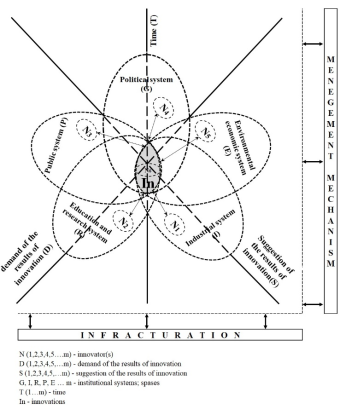
The purpose of this article is to develop a model of innovation development, the "open innovator," with the definition of framework conditions, the role, and the place of the "open innovator" in this model, based on a combination of linear and nonlinear models of innovation development. The author's model of innovation development, the "open innovator," is based on the "triple helix" model with the addition of the "fifth helix." The formation of measures to implement mechanisms ensuring the advanced development of the scientific and technical potential of Russia's manufacturing industries, based on the principles of the concept of "smart specialization," is carried out within the "open innovator" model of innovation development. The methodological basis of the study is the "open innovator" model of innovation development, based on a combination of linear and non-linear models of innovation development, with the definition of framework conditions, the role, and the place of the "open innovator," and the concept of smart specialization. The methods used include analysis of scientific literature, the vector method for calculating the value and purposefulness of achieving management goals, and the systematization of activities based on the analysis of the national normative framework. Measures have been developed to implement mechanisms that ensure the accelerated development of the scientific and technical potential of Russia's manufacturing industries, both from the perspective of the industrial system and from the perspective of the innovator, within the framework of the "open innovator" model of innovation-driven development.
| Published in | International Journal of Economic Behavior and Organization (Volume 14, Issue 4) |
| DOI | 10.11648/j.ijebo.20261404.11 |
| Page(s) | 105-112 |
| Creative Commons |
This is an Open Access article, distributed under the terms of the Creative Commons Attribution 4.0 International License (http://creativecommons.org/licenses/by/4.0/), which permits unrestricted use, distribution and reproduction in any medium or format, provided the original work is properly cited. |
| Copyright |
Copyright © The Author(s), 2026. Published by Science Publishing Group |
Innovation Development Model, Innovation Model, Model of Innovation Development, Open Innovator, Manufacturing Industries, Manufacturing
Mechanisms for ensuring the leading-edge development of an "open innovator" in accordance with the provisions of the "smart specialization" concept | Which conditions of the «open innovator» model of innovation are implemented by the mechanisms listed in column 1 |
|---|---|
Mechanisms of government support for fostering collaboration among the public, industrial, scientific, civil society, environmental, and other sectors |
|
Mechanisms for developing and managing competitive advantages to identify a unique specialization and a competitive form of economic activity |
|
Economic mechanisms to support entrepreneurial innovation and help businesses identify new opportunities |
|
Mechanisms for interregional cooperation |
|
Organizational and economic mechanisms for stakeholder collaboration |
|
Legal and economic mechanisms for the development of new types of economic activities |
|
Forecast years | Forecast values of the STPt index |
|---|---|
2024* | 1,50 |
2025 | 1,49 |
2026 | 1,47 |
2027 | 1,45 |
2028 | 1,44 |
2029 | 1,42 |
2030 | 1,40 |
2031 | 1,38 |
2032 | 1,37 |
Components | Value of management goal achievement | Purposefulness of achieving management goal |
|---|---|---|
Group of internal components | 291,794 | 0,998 |
Block of personnel (labor) potential | 94,046 | 0,992 |
Share of the number of employed persons by level of education and qualification | 91,894 | 0,992 |
Share of personnel engaged in research and development | 2,152 | 0,991 |
Block of material and technical potential | 6,075 | 0,994 |
Material potential | 1,649 | 0,995 |
Technical potential | 4,426 | 0,991 |
Information capacity block | 2,443 | 0,988 |
Block of innovation potential | 15,350 | 0,979 |
Share of innovative goods, works, services | 12,434 | 0,970 |
Block of technological potential | 39,553 | 0,975 |
Intangible capacity block | 0,054 | 0,870 |
Organizational capacity block | 67,641 | 0,997 |
Legal capacity block | 1,682 | 0,991 |
Financial capacity block | 2,030 | 0,995 |
Investment potential block | 1,538 | 0,987 |
Tax potential block | 52,739 | 0,970 |
Fiscal capacity block | 0,443 | 0,945 |
Share of expenditures on technological innovations by sources of budget financing | 0,443 | 0,945 |
Block of entrepreneurial potential | 8,202 | 0,871 |
Group of input components | 0,537 | 0,983 |
Group of output components | 0,057 | 0,859 |
Mechanisms for ensuring the leading-edge develop-ment of an "open innova-tor" in accordance with the provisions of the "smart specialization" concept2 | Measures2 | |
|---|---|---|
STPt of Russian manufacturing industries in the «open innovator» model of innovation development as an industrial system () | STPt of Russian manufacturing industries in the «open innovator» model of innovation development as innovator(s) () | |
Mechanisms of government support for fostering collaboration among the public, industrial, scientific, civil society, environmental, and other sectors | Establishing the legal framework for a new organizational and legal structure: a research consortium | Providing legal protection for the integration of innovative R&D projects into existing production at newly established demonstration zones for R&D implementation |
Mechanisms for developing and managing competitive advantages to identify a unique specialization and a competitive form of economic activity | Establishing a legal framework for preferential innovative scientific and technical centers in specific territories and areas | Allowing innovators, startups, and fast-growing technology companies to apply experimental legal frameworks in specific sectors |
Economic mechanisms to support entrepreneurial in-novation and help businesses identify new opportunities | Regulatory framework for supporting innovative projects involving high-risk investments in technology companies | Providing legal protection and removing regulatory barriers to innovation and the intellectual property market in the interests of developers, entrepreneurs, and investors |
Mechanisms for interregional cooperation | Testing new organizational and legal structures in pilot areas established for the implementation of innovations and fundamentally new technologies | Development of uniform standards and guidelines for the operation of an interregional network of innovation and technology transfer centers |
Organizational and economic mechanisms for stakeholder collaboration | Establishing and implementing-preferably at the national level-transparent and stable regulatory standards governing the conduct and interaction of actors in innovation and technological development | Regulation of the legal relationship between an innovator (rights holder) and the state regarding R&D projects initiated by innovators and funded with their own resources, which are necessary for state needs |
Legal and economic mecha-nisms for the development of new types of economic activities | Providing legal protection for regarding R&D pro-jects that are being transformed into operational production facilities based on demonstration zones for the industrial development of regarding R&D | Providing legal protection for intellectual property rights of innovators, startups, and fast-growing technology companies |
| [1] | Batov G. H., Kumisheva Z. H., Tlisov A. B. Technological Aspect in the Concept of Advanced Development. MIR (Modernizatsiya. Innovatsii. Razvitiye). 2019, 10(2), 275–287. |
| [2] | Carayannis E. G., Barth T. D., Campbell D. F. The Quintuple Helix innovation model: global warming as a challenge and driver for innovation. J Innov Entrep. 2012, 1, 2 |
| [3] | Cassingena Harper J., Lubicka B., Lindqvist G. The role of clusters in smart specialisation strategies, Publications Office. 2013. |
| [4] | Chernova O. A., Klimuk V. V. Four-Link Spiral Concept in Strategies Smart Specialization of Industrial Development, Estestvenno-gumanitarnyye issledovaniya. 2019, 25(3), 179–184. |
| [5] | Cimolia M., Porcilec G. Sources of Learning Paths and Technological Capabilities: An Introductory Roadmap of Development Processes. Economics of Innovation and New Technology. 2009, 18(7), 675–694. |
| [6] | Etzkowitz H., Leydesdorff L. The dynamics of innovation: from National Systems and «Mode 2» to a Triple Helix of university–industry–government relations. Research Policy. 2000, 29, 109–123. |
| [7] | Foray D., Eichler M., Keller, M. Smart specialization strategies—insights gained from a unique European policy experiment on innovation and industrial policy design. Rev Evol Polit Econ. 2021, 2, 83–103. |
| [8] | Foray D. On the Policy Space of Smart Specialization Strategies. European Planning Studies. 2016, 24(8), 1428–1437. |
| [9] | Glazyev S. Y. On the Creation of Systems of Strategic Planning and Management of Scientific and Technological Development. Innovatsii. 2020, 2(256), 14–23. |
| [10] | Khudyakov V. V., Merzlov Y. I. Forecast-management model of assessing scientific and technical potential. Innovacionnaja dejatel'nost'. 2023, 2(65), 52-63. |
| [11] | Kotsemir M., Abroskin A., Meissner D. Innovation Concepts and Typology – An Evolutionary Discussion. Higher School of Economics Research Paper No. WP BRP 05/STI/2013, Available at SSRN: |
| [12] | Krasnyanskaya O. V. Analysis of the State of Organization of Scientific and Technological Development of Industry in Russia and Abroad. Innovatsionnoe razvitie ekonomiki. 2022, 3–4(69–70), 41–47. |
| [13] | Meissner D. Approaches for Developing National STI Strategies, STI Policy Review. 2014, 5(1), 34-56. |
| [14] | Midtkandal I., Sörvik J. What is smart specialisation. Nordregio News, 2012, 5, 3-6. |
| [15] | Miller A., Miller M. Study of the Problems of Technological Integration in the Manufacturing Industry in Russia, Strategic Management. 2019, 24(3), 33–42. |
| [16] | Naumova E. A., Sokolova E. V. Regional Aspects of the Application of the «Triple Helix» Model as a Factor in the Development of an Innovative Economy. Putevoditel’ predprinimatelya. 2022, 15(4), 45–51. |
| [17] | Nauwelaers C, Kleibrink A., Stancova K. The Role of Science Parks in Smart Specialisation Strategies S3 Policy Brief Series No. 08/2014. EUR 26701 EN. Luxembourg (Luxembourg): Publications Office of the European Union; JRC90719. |
| [18] | Pensky O. G. Mathematical Models for the Integral Assessment of the Attractiveness of Resort Facilities. 4th International Scientific-Practical Online Conference Formation of a Comfortable Mediterranean Environment, December 7–10, 2020, Netanya (Israel), Netanya: [online], 291–293. |
| [19] | Petrovsky A. B., Pronichkin S. V., Sternin M. Yu., Shepelev G. I. National innovation systems: structures, goals, functions, ways of development. Belgorod State University Scientific Bulletin. 2018, 45(1), 149-158. |
| [20] | Prosalova V. S., Loksha A. V., Petrova N. I. Analysis of Rating of Scientific and Technical Development of Territorial Subjects of the Russian Federation. Azimut nauchnykh issledovaniy: ekonomika i upravleniye. 2019, 1(26), 267–269. |
| [21] | Rumyantseva S. Yu, Korostyshevskaya E. M., Samylov I. O. Etapy stanovleniya i razvitiya ponyatiya «innovatsii». Innovatsii. 2018, 3(233), 36-46. |
| [22] | Shinkevich A. I., Kudryavtseva S. S., Chikisheva N. M., Korotun O. N., Fatikhova L. E., Gainullina R., Ostanina S. S. Scientific and Technical Potential of Russia as a Factor of Economic Growth in the Knowledge Economy. International Journal of Environmental and Science Education. 2017, 12(1), 47–56. |
| [23] | Shirokova E. A., Kurnikova M. V. The Development of the Innovative Potential of Regional Industrial Complex Based on «Smart Specialization». Problemy razvitiya predpriyatiy: teoriya i praktika. 2020, 1–2, 99–103. |
| [24] | Uskov V. S. Scientific and Technological Development of the Russian Economy in the Transition to a New Technological Order. Economic and Social Changes: Facts, Trends, Forecast. 2020, 13(1), 70–86. |
| [25] | Yun J. H. J., Liu Z. Micro- and Macro-Dynamics of Open Innovation with a Quadruple-Helix Model. Sustainability. 2019, 11 (12). |
APA Style
Khudyakov, V. (2026). The Role of the Concepts of «Smart Specialization» and «Open Innovation» in Stimulating the Advanced Development of the Manufacturing Sector in the Russian Federation. International Journal of Economic Behavior and Organization, 14(4), 105-112. https://doi.org/10.11648/j.ijebo.20261404.11
ACS Style
Khudyakov, V. The Role of the Concepts of «Smart Specialization» and «Open Innovation» in Stimulating the Advanced Development of the Manufacturing Sector in the Russian Federation. Int. J. Econ. Behav. Organ. 2026, 14(4), 105-112. doi: 10.11648/j.ijebo.20261404.11
AMA Style
Khudyakov V. The Role of the Concepts of «Smart Specialization» and «Open Innovation» in Stimulating the Advanced Development of the Manufacturing Sector in the Russian Federation. Int J Econ Behav Organ. 2026;14(4):105-112. doi: 10.11648/j.ijebo.20261404.11
@article{10.11648/j.ijebo.20261404.11,
  author = {Vladimir Khudyakov},
  title = {The Role of the Concepts of «Smart Specialization» and «Open Innovation» in Stimulating the Advanced Development of the Manufacturing Sector in the Russian Federation},
  journal = {International Journal of Economic Behavior and Organization},
  volume = {14},
  number = {4},
  pages = {105-112},
  doi = {10.11648/j.ijebo.20261404.11},
  url = {https://doi.org/10.11648/j.ijebo.20261404.11},
  eprint = {https://article.sciencepublishinggroup.com/pdf/10.11648.j.ijebo.20261404.11},
  abstract = {The purpose of this article is to develop a model of innovation development, the "open innovator," with the definition of framework conditions, the role, and the place of the "open innovator" in this model, based on a combination of linear and nonlinear models of innovation development. The author's model of innovation development, the "open innovator," is based on the "triple helix" model with the addition of the "fifth helix." The formation of measures to implement mechanisms ensuring the advanced development of the scientific and technical potential of Russia's manufacturing industries, based on the principles of the concept of "smart specialization," is carried out within the "open innovator" model of innovation development. The methodological basis of the study is the "open innovator" model of innovation development, based on a combination of linear and non-linear models of innovation development, with the definition of framework conditions, the role, and the place of the "open innovator," and the concept of smart specialization. The methods used include analysis of scientific literature, the vector method for calculating the value and purposefulness of achieving management goals, and the systematization of activities based on the analysis of the national normative framework. Measures have been developed to implement mechanisms that ensure the accelerated development of the scientific and technical potential of Russia's manufacturing industries, both from the perspective of the industrial system and from the perspective of the innovator, within the framework of the "open innovator" model of innovation-driven development.},
 year = {2026}
}
TY  - JOUR
T1  - The Role of the Concepts of «Smart Specialization» and «Open Innovation» in Stimulating the Advanced Development of the Manufacturing Sector in the Russian Federation
AU  - Vladimir Khudyakov
Y1  - 2026/10/09
PY  - 2026
N1  - https://doi.org/10.11648/j.ijebo.20261404.11
DO  - 10.11648/j.ijebo.20261404.11
T2  - International Journal of Economic Behavior and Organization
JF  - International Journal of Economic Behavior and Organization
JO  - International Journal of Economic Behavior and Organization
SP  - 105
EP  - 112
PB  - Science Publishing Group
SN  - 2328-7616
UR  - https://doi.org/10.11648/j.ijebo.20261404.11
AB  - The purpose of this article is to develop a model of innovation development, the "open innovator," with the definition of framework conditions, the role, and the place of the "open innovator" in this model, based on a combination of linear and nonlinear models of innovation development. The author's model of innovation development, the "open innovator," is based on the "triple helix" model with the addition of the "fifth helix." The formation of measures to implement mechanisms ensuring the advanced development of the scientific and technical potential of Russia's manufacturing industries, based on the principles of the concept of "smart specialization," is carried out within the "open innovator" model of innovation development. The methodological basis of the study is the "open innovator" model of innovation development, based on a combination of linear and non-linear models of innovation development, with the definition of framework conditions, the role, and the place of the "open innovator," and the concept of smart specialization. The methods used include analysis of scientific literature, the vector method for calculating the value and purposefulness of achieving management goals, and the systematization of activities based on the analysis of the national normative framework. Measures have been developed to implement mechanisms that ensure the accelerated development of the scientific and technical potential of Russia's manufacturing industries, both from the perspective of the industrial system and from the perspective of the innovator, within the framework of the "open innovator" model of innovation-driven development.
VL  - 14
IS  - 4
ER  -
Department of Management, Marketing and Commerce, Perm State University, Perm, Russia

Information


 Share This Article
 Twitter
 Linked In
 Facebook
 Copy
Copy Download