Background: Benign prostatic hyperplasia (BPH) commonly causes lower urinary tract symptoms (LUTS), with α1-blockers as first-line therapy. Silodosin, due to its high uroselectivity and favorable tolerability, is increasingly used; this survey assesses clinician preferences, usage patterns, tolerability, and combination therapy practices in clinical practice. Methods: This cross-sectional survey was conducted among 97 urologists in India and used a validated 23-item questionnaire to assess treatment preferences, silodosin use, switching patterns, adverse events, combination therapies, and outcomes. Data were analyzed descriptively as frequencies and percentages. Results: The survey included 97 participants. A majority of clinicians (76%) preferred silodosin as the first-line α1-blocker for BPH management. Approximately 44% recognized all listed reasons for its use, including receptor selectivity, safety profile, and clinical benefits. Switching from tamsulosin to silodosin in 21–30% of patients due to inadequate symptom relief was reported by around 43% of clinicians. Marked clinical improvement with silodosin was observed by nearly 77%, while 54% reported no associated adverse drug reactions. Reduction in the risk of BPH-related surgery was identified as the key advantage of combination therapy by around 47% of clinicians. Preference for the silodosin and dutasteride combination to prevent disease progression was noted by 85% of respondents, and approximately 53% reported adding mirabegron to silodosin in 11–20% of patients. Conclusion: This survey highlights silodosin as an effective, well-tolerated, and first-line treatment for BPH and LUTS in clinical practice. Its high uroselectivity, favorable safety profile, and strong symptomatic relief support its use both as monotherapy and in combination with dutasteride or mirabegron in more complex cases. These findings underscore the need for further long-term studies to strengthen its role in BPH management.
This is an Open Access article, distributed under the terms of the Creative Commons Attribution 4.0 International License (http://creativecommons.org/licenses/by/4.0/), which permits unrestricted use, distribution and reproduction in any medium or format, provided the original work is properly cited.
Benign prostatic hyperplasia (BPH) is a non-cancerous enlargement of the prostate and a common urological condition affecting men worldwide, particularly with advancing age. Its prevalence rises from approximately 50% at 60 years to nearly 90% in men older than 85 years, with nearly 70% of men affected by 70 years. About half of these individuals develop bladder outlet obstruction and lower urinary tract symptoms (LUTS), significantly impairing quality of life and increasing risks such as falls due to nocturia. Globally, BPH contributes substantially to disease burden, with high incidence, prevalence, and disability-adjusted life years reported
[1]
Putra SS. The Efficacy And Safety Of Silodosin For The Treatment Of Benign Hyperplasia Prostate: A Systematic Review. Journal of Advanced Research in Medical and Health Science. 2023; 9(10): 48–52.
Wei H, Zhu C, Huang Q, Yang J, Li YT, Zhang YG, et al. Global, regional, and national burden of benign prostatic hyperplasia from 1990 to 2021 and projection to 2035. BMC Urol. 2025; 25: 34.
. In 2021, the global burden of BPH was considerable, with incident cases, prevalent cases, and disability-adjusted life years estimated at 137.88, 1125.02, and 22.36 per 100,000 population, respectively
[3]
Wei H, Zhu C, Huang Q, Yang J, Li YT, Zhang YG, et al. Global, regional, and national burden of benign prostatic hyperplasia from 1990 to 2021 and projection to 2035. BMC Urol. 2025; 25: 34.
Alpha 1-adrenoceptor blockers (α₁-blockers) are globally recommended as first-line therapy for patients with bothersome, moderate-to-severe LUTS associated with BPH, as endorsed by the European Association of Urology (EAU), the American Urological Association (AUA), and the Urological Society of India (USI)
[4]
Akhtar OS, Singh V, Bhojani KA, Dharmadhikari S, Bhargave C, Mane A, et al. A Comprehensive Review of the Clinical Evidence on the Efficacy, Effectiveness, and Safety of Silodosin for the Treatment of Benign Prostatic Hyperplasia. Cureus. 2025; 17(6): e85445.
. Compared with non-selective α₁-adrenoceptor blockers, agents with high α₁A-adrenoceptor selectivity are more prostate-specific and can effectively relieve symptoms of BPH while exerting minimal effects on blood pressure and causing fewer cardiovascular adverse events
[5]
Ding H, Du W, Hou ZZ, Wang HZ, Wang ZP. Silodosin is effective for treatment of LUTS in men with BPH: a systematic review. Asian J Androl. 2013; 15(1): 121–8.
. Silodosin is preferred over other α-blockers for the management of LUTS associated with BPH, owing to its high α₁A uroselectivity. It is a selective α₁-adrenergic receptor antagonist that primarily targets α₁A receptors in the prostate and urethra, leading to relaxation of smooth muscle in the lower urinary tract. Its greater affinity for α₁A receptors over α₁B receptors reduces the likelihood of blood pressure-related adverse effects typically associated with α₁B receptor blockade
[6]
Yoshida M, Kudoh J, Homma Y, Kawabe K. Safety and efficacy of silodosin for the treatment of benign prostatic hyperplasia. Clin Interv Aging. 2011; 6: 161–72.
Jindan L, Xiao W, Liping X. Evolving Role of Silodosin for the Treatment of Urological Disorders - A Narrative Review. Drug Des Devel Ther. 2022; 16: 2861–84.
Despite the growing body of evidence, data on clinician’s treatment behavior, switching patterns, and combination therapy preferences for silodosin in the Indian clinical settings remain limited. This survey aims to evaluate treatment patterns, preferences, and outcomes associated with silodosin in the management of BPH and LUTS among urologists in India, with particular emphasis on its use as monotherapy and in combination with dutasteride and mirabegron.
2. Materials and Methods
2.1. Study Settings
A cross-sectional questionnaire-based survey was conducted between June and December 2025 among urologists involved in the management of BPH across major cities in India. The study protocol was reviewed and approved by the Bangalore Ethics Independent Ethics Committee (ECR/355/Indt/KA/2022), which is recognized by the Drug Controller General of India (DCGI). All study procedures were carried out in accordance with the approved ethical requirements.
2.2. Study Participants
In March 2025, invitations to participate in the survey were extended to urologists involved in the management of benign prostatic hyperplasia (BPH) across India. A total of 97 clinicians from major cities representing diverse geographic regions and states consented to participate and provided the required survey data.
2.3. Study Procedure
Clinicians who agreed to participate received the SILO (A Comprehensive Overview of Silodosin Usage pattern) questionnaire booklet. The survey instrument consisted of 23 questions designed to obtain information on patient demographics and disease prevalence, clinical presentation and risk factors, preferred pharmacological therapies, silodosin selection, treatment-switching patterns, combination therapy practices, adverse drug reactions, and clinician-rated therapeutic outcomes using a 5-point Global Improvement Scale. The questionnaire demonstrated acceptable internal consistency based on split-half reliability (coefficient alpha), although further refinement may enhance its reliability in future iterations. Criterion validity was assessed by comparing clinicians' responses with independent evaluations performed by an external reviewer and a statistician. Potential sources of variation, including differences in clinical experience and familiarity with newer therapeutic agents, were recognized during the validation process. Participants were free to omit any question they did not wish to answer and were instructed to complete the questionnaire independently without consulting colleagues. Written informed consent was obtained from all respondents before enrollment in the survey.
2.4. Statistical Analysis
Survey responses were summarized using descriptive statistical methods. Categorical variables were expressed as frequencies and percentages to describe their distribution. The findings were presented using frequency tables as well as graphical representations, including bar charts and pie charts, prepared in Microsoft Excel 2013 (version 16.0.13901.20400) for clear visualization of the results.
3. Results
A total of 97 clinicians participated, contributing expert perspectives on various aspects of BPH management. Around 35% of experts reported that more than 50% of their patients present with LUTS. Equal proportions of clinicians (44.33% each) reported that 21–30% and more than 30% of their patients are diagnosed with BPH. A predominant proportion of clinicians (61.86%) strongly agreed that BPH affects 50% of men by the age of 60 years. Nearly 51% reported storage or overactive bladder symptoms, including frequency, nocturia, and urgency, as the most prevalent LUTS in patients with BPH. Approximately 69% of practitioners identified diabetes and the use of antidiabetic medications as the most common risk factor for BPH. Around 44% of clinicians reported that 11–20% of patients self-report having BPH. Around 65% of experts recommended fluid restriction before bedtime as the most common lifestyle modification.
Around 37% of respondents reported recommending Prostate-Specific Antigen testing very often to guide treatment decisions in patients with BPH. Approximately 74% preferred alpha-blockers as the first-line therapy for patients with BPH. Nearly 55% of experts considered sexually active males as the key patient-related factor when recommending alpha-blockers for LUTS/BPH treatment. Around 65% of clinicians reported that patients should be re-evaluated at 4 weeks after initiating therapy. Majority of clinicians (69%) reported tamsulosin as the most commonly preferred alpha-blocker for medical expulsive therapy in distal ureteral stones. Approximately 70% preferred alfuzosin in patients with BPH and erectile dysfunction who do not respond adequately to tadalafil monotherapy.
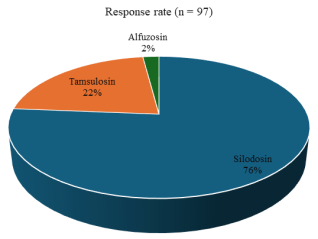
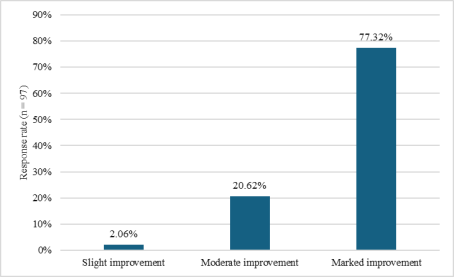
Approximately 76% of experts preferred silodosin as the first-line alpha-blocker for managing BPH (Figure 1). Around 44% of clinicians recognized all listed reasons for recommending silodosin, including receptor selectivity, safety profile, and clinical benefits (Table 1). According to 43% of experts, 21–30% of patients were switched from tamsulosin to silodosin due to inadequate symptomatic relief (Table 2). Nearly 77% of participants reported marked improvement in patients treated with silodosin (Figure 2), while around 54% of clinicians reported no associated adverse drug reactions. Approximately 77% identified retrograde ejaculation as the most common side effect associated with silodosin therapy.
Figure 2. Distribution of responses to clinician-rated outcomes with silodosin in BPH (Global improvement scale).
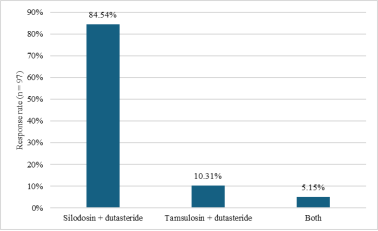
Around 47% of experts reported that reduction in the risk of BPH-related surgery is the key advantage of the 5-alpha reductase inhibitor and alpha-blocker combination therapy (Table 3). A predominant proportion of clinicians (85%) preferred the silodosin + dutasteride combination to prevent progression of LUTS/BPH (Figure 3). Around 53% favored the addition of mirabegron (25/50 mg) to silodosin 8 mg in 11–20% of patients with BPH (Table 4).
Table 3. Distribution of responses to perceived advantages of combination therapy with 5-alpha reductase inhibitors and alpha-blockers in BPH.
Advantage
Response rate (n = 97)
Reduction in the risk of BPH surgery
46 (47.42%)
Decrease in the risk of AUR
12 (12.37%)
Improved urinary flow rates and prostate volume reduction
Figure 3. Distribution of responses to preferred 5-alpha reductase inhibitor and alpha-blockers combination to prevent the progression of LUTS/BPH.
Table 4. Distribution of responses to estimated proportion of patients prescribed mirabegron (25/50 mg) with silodosin 8 mg in BPH.
Proportion of patients
Response rate (n = 97)
<10%
19 (19.59%)
11-20%
51 (52.58%)
21-30%
22 (22.68%)
31-40%
5 (5.15%)
4. Discussion
This survey provides valuable insights into contemporary clinical practices in the management of BPH and LUTS among clinicians in India. A substantial proportion of clinicians reported a high burden of LUTS in routine practice, with storage symptoms such as frequency, nocturia, and urgency being the most prevalent. These findings are clinically relevant, as storage symptoms are known to significantly impair quality of life and are often the primary drivers for seeking medical care. Furthermore, the observation that nearly two-thirds of clinicians identified diabetes as a major risk factor highlights the growing recognition of metabolic contributors to BPH progression. This underscores the importance of adopting a holistic, comorbidity-focused approach in the management of LUTS/BPH, integrating metabolic risk assessment into routine clinical evaluation.
The finding that approximately 76% of clinicians preferred silodosin as the first-line alpha-blocker for BPH is notable and reflects an evolving shift toward more uroselective agents in clinical practice. This preference is supported by robust clinical evidence. A systematic review and meta-analysis by Cui et al., involving 2,543 patients, demonstrated that silodosin is effective in the management of BPH, with significant improvement in the total International Prostate Symptom Score (IPSS) (standardized weighted difference: 2.92; 95% CI: 2.19–3.65), corresponding to a mean reduction ranging from 6.4 to 10.6 points. In addition to overall symptom improvement, silodosin showed benefits in both voiding and storage symptoms, as well as quality-of-life scores, indicating superior efficacy compared with placebo. The favorable safety profile observed in clinical studies, combined with its high α1A-adrenoceptor selectivity, further supports its widespread use in routine practice
[8]
Cui Y, Zong H, Zhang Y. The efficacy and safety of silodosin in treating BPH: a systematic review and meta-analysis. Int Urol Nephrol. 2012; 44(6): 1601–9.
The finding that majority of clinicians recognized receptor selectivity, safety profile, and clinical benefits collectively as reasons for recommending silodosin reflects a nuanced, evidence-based clinical appreciation of the drug's multifaceted advantages. A notable proportion of clinicians (43.3%) reported switching 21–30% of their patients from tamsulosin to silodosin due to inadequate symptomatic relief. This is further reinforced by the finding that 77% of clinicians reported marked clinical improvement in patients treated with silodosin, underscoring its therapeutic impact in routine clinical practice. With respect to tolerability, 54% of clinicians reported no adverse drug reactions with silodosin in their patient cohorts.
These survey observations are consistent with findings from clinical studies. A European phase IV study by Montorsi et al., involving 1,036 patients with BPH, showed that 77.1% achieved a ≥25% reduction in IPSS following silodosin treatment. The mean total IPSS decreased from 18.9 to 10.6, with improvements observed in both storage and voiding symptoms. Nocturia declined from 85.7% to 52.4%, and quality-of-life scores improved from 4.0 to 2.2, indicating a meaningful overall clinical benefit
[9]
Montorsi F, Gandaglia G, Chapple C, Cruz F, Desgrandchamps F, Llorente C. Effectiveness and safety of silodosin in the treatment of lower urinary tract symptoms in patients with benign prostatic hyperplasia: A European phase IV clinical study (SiRE study). Int J Urol. 2016; 23(7): 572–9.
. Similarly, a review by Akhtar et al. reported that silodosin is both effective and well tolerated in patients with BPH, including those with coexisting cardiovascular comorbidities
[4]
Akhtar OS, Singh V, Bhojani KA, Dharmadhikari S, Bhargave C, Mane A, et al. A Comprehensive Review of the Clinical Evidence on the Efficacy, Effectiveness, and Safety of Silodosin for the Treatment of Benign Prostatic Hyperplasia. Cureus. 2025; 17(6): e85445.
. A meta-analysis by Wu et al., including 2,595 patients, demonstrated that silodosin produced significant improvements compared with placebo in total IPSS, IPSS subscores, and maximum urinary flow rate (Qmax). It also showed greater efficacy in relieving voiding symptoms than tamsulosin. Silodosin treatment was associated with a similarly low incidence of dizziness and headache as observed with placebo and tamsulosin
[10]
Wu YJ, Dong Q, Liu LR, Wei Q. A meta-analysis of efficacy and safety of the new α1A-adrenoceptor-selective antagonist silodosin for treating lower urinary tract symptoms associated with BPH. Prostate Cancer Prostatic Dis. 2013; 16(1): 79–84.
Regarding combination pharmacotherapy, a majority of clinicians identified reduction in the risk of BPH-related surgery as the primary advantage of combining a 5-alpha reductase inhibitor (5-ARI) with an alpha-blocker. The strong preference for the silodosin plus dutasteride combination to prevent LUTS/BPH progression observed in this survey suggests that clinicians are increasingly applying an evidence-based rationale to silodosin-based combination regimens.
These findings are supported by existing clinical evidence. In a study by Ong et al., long-term combination therapy with an α₁-blocker and a 5α-reductase inhibitor resulted in sustained improvements in lower urinary tract symptoms, uroflowmetry parameters, and prostate-related variables, with benefits maintained over an extended follow-up period of up to 12 years
[11]
Ong HL, Liao CH, Kuo HC. Long-term Combination Therapy With α-Blockers and 5α-Reductase Inhibitors in Benign Prostatic Hyperplasia: Patient Adherence and Causes of Withdrawal from Medication. Int Neurourol J. 2016; 20(4): 356–62.
. Similarly, Hagiwara et al. demonstrated that treatment with silodosin 8 mg and dutasteride 0.5 mg daily achieved a Trial Without Catheter (TWOC) success rate of 88.8% at 12 weeks. Significant improvements in voided volume and maximum urinary flow rate were observed at 2, 4, 8, and 12 weeks compared with the time of acute urinary retention (AUR) (P < 0.001). In addition, IPSS and quality-of-life scores showed significant reductions at all follow-up time points, indicating consistent symptomatic relief
[12]
Hagiwara K, Koie T, Iwamura H, Imai A, Hatakeyama S, Yoneyama T, et al. Efficacy and Safety of Silodosin and Dutasteride Combination Therapy in Acute Urinary Retention due to Benign Prostatic Hyperplasia: A Single-Arm Prospective Study. Biomed Res Int. 2016; 2016: 4975851.
. Further supporting these observations, Rao et al. reported that combination therapy with silodosin 8 mg and dutasteride 0.5 mg led to significant reductions in prostate size and post-void residual volume, along with marked improvement in IPSS scores. These benefits were observed across patients with mild, moderate, and severe BPH, highlighting the broad applicability of this combination
[13]
Rao GS, Sudharani K, Sulthana SS, Kranthi KS and ML. Safety and efficacy of silodosin-dutasteride in the management of benignprostatic hyperplasia. International Journal of Advanced Research. 2022; 10(06): 601–4.
As per the survey findings, 52.58% of clinicians reported adding mirabegron (25/50 mg) to silodosin 8 mg in 11–20% of their BPH patients. In a study by Somarendra et al., the addition of mirabegron to silodosin resulted in statistically significant improvements in total IPSS, IPSS storage subscore, and quality-of-life measures. Mechanistically, mirabegron, a potent β3-adrenoceptor agonist, enhances bladder compliance by promoting relaxation of the detrusor smooth muscle, thereby effectively addressing storage symptoms. Overall, this add-on approach was more effective than monotherapy in improving quality of life and alleviating persistent symptoms
[14]
Somarendra K, Lodh B. Efficacy of mirabegron add-on therapy to silodosin for the treatment of persistent storage symptoms in patients with benign prostatic hyperplasia. J Popul Ther Clin Pharmacol. 2024; 31(2): 1981-1984.
. Further evidence supporting this combination comes from Abdel-Kader et al., who reported that silodosin combined with mirabegron was associated with higher stone expulsion rates and a shorter time to expulsion in patients with lower ureteric stones. In addition, the combination provided improved pain control and demonstrated a favorable safety profile without serious adverse effects. These findings suggest that silodosin–mirabegron combination therapy represents an effective and comprehensive strategy for improving patient outcomes across both LUTS/BPH and related urological conditions
[14]
Somarendra K, Lodh B. Efficacy of mirabegron add-on therapy to silodosin for the treatment of persistent storage symptoms in patients with benign prostatic hyperplasia. J Popul Ther Clin Pharmacol. 2024; 31(2): 1981-1984.
Abdel-Kader MS, Sayed AM, Sayed SM, AbdelRazek M. Evaluation of the efficacy and safety of either or both mirabegron and silodosin, as a medical expulsive therapy for distal ureteric stones. Int Urol Nephrol. 2024 May; 56(5): 1605–10.
This survey bridges the gap between clinical evidence and routine practice, reinforces silodosin’s role as a preferred first-line alpha-blocker, and highlights its increasing use in combination with dutasteride and mirabegron. The findings may support clinical decision-making, and identify areas for further research to optimize BPH and LUTS management. The use of a well-designed, validated questionnaire further strengthens the reliability of these evidence-based insights. This study is subject to several limitations inherent to its survey-based design, including potential responder bias, as clinicians who participated may not be fully representative of the broader urological community. The reliance on self-reported clinical observations rather than objective patient-level data limits the ability to draw definitive causal conclusions.
5. Conclusions
This survey demonstrates that silodosin is widely regarded by clinicians as an effective, well-tolerated, and evidence-based first-line treatment for BPH and LUTS in clinical settings. Its multifaceted advantages, encompassing high uroselective receptor specificity, a favorable adverse effect profile, and robust symptomatic improvement, support its preferential use both as monotherapy and in combination with dutasteride or mirabegron for patients with more complex or progressive disease. These findings reinforce the need for continued evidence and long-term studies to further consolidate silodosin's role across the spectrum of BPH management.
Krishna Kumar Manjunath: Data curation, Formal Analysis, Investigation, Visualization, Writing – original draft, Writing – review & editing
Conflicts of Interest
The authors declare no conflicts of interest.
References
[1]
Putra SS. The Efficacy And Safety Of Silodosin For The Treatment Of Benign Hyperplasia Prostate: A Systematic Review. Journal of Advanced Research in Medical and Health Science. 2023; 9(10): 48–52.
Wei H, Zhu C, Huang Q, Yang J, Li YT, Zhang YG, et al. Global, regional, and national burden of benign prostatic hyperplasia from 1990 to 2021 and projection to 2035. BMC Urol. 2025; 25: 34.
Akhtar OS, Singh V, Bhojani KA, Dharmadhikari S, Bhargave C, Mane A, et al. A Comprehensive Review of the Clinical Evidence on the Efficacy, Effectiveness, and Safety of Silodosin for the Treatment of Benign Prostatic Hyperplasia. Cureus. 2025; 17(6): e85445.
Ding H, Du W, Hou ZZ, Wang HZ, Wang ZP. Silodosin is effective for treatment of LUTS in men with BPH: a systematic review. Asian J Androl. 2013; 15(1): 121–8.
Yoshida M, Kudoh J, Homma Y, Kawabe K. Safety and efficacy of silodosin for the treatment of benign prostatic hyperplasia. Clin Interv Aging. 2011; 6: 161–72.
Jindan L, Xiao W, Liping X. Evolving Role of Silodosin for the Treatment of Urological Disorders - A Narrative Review. Drug Des Devel Ther. 2022; 16: 2861–84.
Cui Y, Zong H, Zhang Y. The efficacy and safety of silodosin in treating BPH: a systematic review and meta-analysis. Int Urol Nephrol. 2012; 44(6): 1601–9.
Montorsi F, Gandaglia G, Chapple C, Cruz F, Desgrandchamps F, Llorente C. Effectiveness and safety of silodosin in the treatment of lower urinary tract symptoms in patients with benign prostatic hyperplasia: A European phase IV clinical study (SiRE study). Int J Urol. 2016; 23(7): 572–9.
Wu YJ, Dong Q, Liu LR, Wei Q. A meta-analysis of efficacy and safety of the new α1A-adrenoceptor-selective antagonist silodosin for treating lower urinary tract symptoms associated with BPH. Prostate Cancer Prostatic Dis. 2013; 16(1): 79–84.
Ong HL, Liao CH, Kuo HC. Long-term Combination Therapy With α-Blockers and 5α-Reductase Inhibitors in Benign Prostatic Hyperplasia: Patient Adherence and Causes of Withdrawal from Medication. Int Neurourol J. 2016; 20(4): 356–62.
Hagiwara K, Koie T, Iwamura H, Imai A, Hatakeyama S, Yoneyama T, et al. Efficacy and Safety of Silodosin and Dutasteride Combination Therapy in Acute Urinary Retention due to Benign Prostatic Hyperplasia: A Single-Arm Prospective Study. Biomed Res Int. 2016; 2016: 4975851.
Rao GS, Sudharani K, Sulthana SS, Kranthi KS and ML. Safety and efficacy of silodosin-dutasteride in the management of benignprostatic hyperplasia. International Journal of Advanced Research. 2022; 10(06): 601–4.
Somarendra K, Lodh B. Efficacy of mirabegron add-on therapy to silodosin for the treatment of persistent storage symptoms in patients with benign prostatic hyperplasia. J Popul Ther Clin Pharmacol. 2024; 31(2): 1981-1984.
Abdel-Kader MS, Sayed AM, Sayed SM, AbdelRazek M. Evaluation of the efficacy and safety of either or both mirabegron and silodosin, as a medical expulsive therapy for distal ureteric stones. Int Urol Nephrol. 2024 May; 56(5): 1605–10.
Suresh, M., Manjunath, K. K. (2026). Silodosin in the Management of Benign Prostatic Hyperplasia and Lower Urinary Tract Symptoms:
An Experts Perspective Study. International Journal of Clinical Urology, 10(2), 119-125. https://doi.org/10.11648/j.ijcu.20261002.12
Suresh, M.; Manjunath, K. K. Silodosin in the Management of Benign Prostatic Hyperplasia and Lower Urinary Tract Symptoms:
An Experts Perspective Study. Int. J. Clin. Urol.2026, 10(2), 119-125. doi: 10.11648/j.ijcu.20261002.12
Suresh M, Manjunath KK. Silodosin in the Management of Benign Prostatic Hyperplasia and Lower Urinary Tract Symptoms:
An Experts Perspective Study. Int J Clin Urol. 2026;10(2):119-125. doi: 10.11648/j.ijcu.20261002.12
@article{10.11648/j.ijcu.20261002.12,
  author = {Manjula Suresh and Krishna Kumar Manjunath},
  title = {Silodosin in the Management of Benign Prostatic Hyperplasia and Lower Urinary Tract Symptoms:
An Experts Perspective Study},
  journal = {International Journal of Clinical Urology},
  volume = {10},
  number = {2},
  pages = {119-125},
  doi = {10.11648/j.ijcu.20261002.12},
  url = {https://doi.org/10.11648/j.ijcu.20261002.12},
  eprint = {https://article.sciencepublishinggroup.com/pdf/10.11648.j.ijcu.20261002.12},
  abstract = {Background: Benign prostatic hyperplasia (BPH) commonly causes lower urinary tract symptoms (LUTS), with α1-blockers as first-line therapy. Silodosin, due to its high uroselectivity and favorable tolerability, is increasingly used; this survey assesses clinician preferences, usage patterns, tolerability, and combination therapy practices in clinical practice. Methods: This cross-sectional survey was conducted among 97 urologists in India and used a validated 23-item questionnaire to assess treatment preferences, silodosin use, switching patterns, adverse events, combination therapies, and outcomes. Data were analyzed descriptively as frequencies and percentages. Results: The survey included 97 participants. A majority of clinicians (76%) preferred silodosin as the first-line α1-blocker for BPH management. Approximately 44% recognized all listed reasons for its use, including receptor selectivity, safety profile, and clinical benefits. Switching from tamsulosin to silodosin in 21–30% of patients due to inadequate symptom relief was reported by around 43% of clinicians. Marked clinical improvement with silodosin was observed by nearly 77%, while 54% reported no associated adverse drug reactions. Reduction in the risk of BPH-related surgery was identified as the key advantage of combination therapy by around 47% of clinicians. Preference for the silodosin and dutasteride combination to prevent disease progression was noted by 85% of respondents, and approximately 53% reported adding mirabegron to silodosin in 11–20% of patients. Conclusion: This survey highlights silodosin as an effective, well-tolerated, and first-line treatment for BPH and LUTS in clinical practice. Its high uroselectivity, favorable safety profile, and strong symptomatic relief support its use both as monotherapy and in combination with dutasteride or mirabegron in more complex cases. These findings underscore the need for further long-term studies to strengthen its role in BPH management.},
 year = {2026}
}
TY  - JOUR
T1  - Silodosin in the Management of Benign Prostatic Hyperplasia and Lower Urinary Tract Symptoms:
An Experts Perspective Study
AU  - Manjula Suresh
AU  - Krishna Kumar Manjunath
Y1  - 2026/08/10
PY  - 2026
N1  - https://doi.org/10.11648/j.ijcu.20261002.12
DO  - 10.11648/j.ijcu.20261002.12
T2  - International Journal of Clinical Urology
JF  - International Journal of Clinical Urology
JO  - International Journal of Clinical Urology
SP  - 119
EP  - 125
PB  - Science Publishing Group
SN  - 2640-1355
UR  - https://doi.org/10.11648/j.ijcu.20261002.12
AB  - Background: Benign prostatic hyperplasia (BPH) commonly causes lower urinary tract symptoms (LUTS), with α1-blockers as first-line therapy. Silodosin, due to its high uroselectivity and favorable tolerability, is increasingly used; this survey assesses clinician preferences, usage patterns, tolerability, and combination therapy practices in clinical practice. Methods: This cross-sectional survey was conducted among 97 urologists in India and used a validated 23-item questionnaire to assess treatment preferences, silodosin use, switching patterns, adverse events, combination therapies, and outcomes. Data were analyzed descriptively as frequencies and percentages. Results: The survey included 97 participants. A majority of clinicians (76%) preferred silodosin as the first-line α1-blocker for BPH management. Approximately 44% recognized all listed reasons for its use, including receptor selectivity, safety profile, and clinical benefits. Switching from tamsulosin to silodosin in 21–30% of patients due to inadequate symptom relief was reported by around 43% of clinicians. Marked clinical improvement with silodosin was observed by nearly 77%, while 54% reported no associated adverse drug reactions. Reduction in the risk of BPH-related surgery was identified as the key advantage of combination therapy by around 47% of clinicians. Preference for the silodosin and dutasteride combination to prevent disease progression was noted by 85% of respondents, and approximately 53% reported adding mirabegron to silodosin in 11–20% of patients. Conclusion: This survey highlights silodosin as an effective, well-tolerated, and first-line treatment for BPH and LUTS in clinical practice. Its high uroselectivity, favorable safety profile, and strong symptomatic relief support its use both as monotherapy and in combination with dutasteride or mirabegron in more complex cases. These findings underscore the need for further long-term studies to strengthen its role in BPH management.
VL  - 10
IS  - 2
ER  -
Suresh, M., Manjunath, K. K. (2026). Silodosin in the Management of Benign Prostatic Hyperplasia and Lower Urinary Tract Symptoms:
An Experts Perspective Study. International Journal of Clinical Urology, 10(2), 119-125. https://doi.org/10.11648/j.ijcu.20261002.12
Suresh, M.; Manjunath, K. K. Silodosin in the Management of Benign Prostatic Hyperplasia and Lower Urinary Tract Symptoms:
An Experts Perspective Study. Int. J. Clin. Urol.2026, 10(2), 119-125. doi: 10.11648/j.ijcu.20261002.12
Suresh M, Manjunath KK. Silodosin in the Management of Benign Prostatic Hyperplasia and Lower Urinary Tract Symptoms:
An Experts Perspective Study. Int J Clin Urol. 2026;10(2):119-125. doi: 10.11648/j.ijcu.20261002.12
@article{10.11648/j.ijcu.20261002.12,
  author = {Manjula Suresh and Krishna Kumar Manjunath},
  title = {Silodosin in the Management of Benign Prostatic Hyperplasia and Lower Urinary Tract Symptoms:
An Experts Perspective Study},
  journal = {International Journal of Clinical Urology},
  volume = {10},
  number = {2},
  pages = {119-125},
  doi = {10.11648/j.ijcu.20261002.12},
  url = {https://doi.org/10.11648/j.ijcu.20261002.12},
  eprint = {https://article.sciencepublishinggroup.com/pdf/10.11648.j.ijcu.20261002.12},
  abstract = {Background: Benign prostatic hyperplasia (BPH) commonly causes lower urinary tract symptoms (LUTS), with α1-blockers as first-line therapy. Silodosin, due to its high uroselectivity and favorable tolerability, is increasingly used; this survey assesses clinician preferences, usage patterns, tolerability, and combination therapy practices in clinical practice. Methods: This cross-sectional survey was conducted among 97 urologists in India and used a validated 23-item questionnaire to assess treatment preferences, silodosin use, switching patterns, adverse events, combination therapies, and outcomes. Data were analyzed descriptively as frequencies and percentages. Results: The survey included 97 participants. A majority of clinicians (76%) preferred silodosin as the first-line α1-blocker for BPH management. Approximately 44% recognized all listed reasons for its use, including receptor selectivity, safety profile, and clinical benefits. Switching from tamsulosin to silodosin in 21–30% of patients due to inadequate symptom relief was reported by around 43% of clinicians. Marked clinical improvement with silodosin was observed by nearly 77%, while 54% reported no associated adverse drug reactions. Reduction in the risk of BPH-related surgery was identified as the key advantage of combination therapy by around 47% of clinicians. Preference for the silodosin and dutasteride combination to prevent disease progression was noted by 85% of respondents, and approximately 53% reported adding mirabegron to silodosin in 11–20% of patients. Conclusion: This survey highlights silodosin as an effective, well-tolerated, and first-line treatment for BPH and LUTS in clinical practice. Its high uroselectivity, favorable safety profile, and strong symptomatic relief support its use both as monotherapy and in combination with dutasteride or mirabegron in more complex cases. These findings underscore the need for further long-term studies to strengthen its role in BPH management.},
 year = {2026}
}
TY  - JOUR
T1  - Silodosin in the Management of Benign Prostatic Hyperplasia and Lower Urinary Tract Symptoms:
An Experts Perspective Study
AU  - Manjula Suresh
AU  - Krishna Kumar Manjunath
Y1  - 2026/08/10
PY  - 2026
N1  - https://doi.org/10.11648/j.ijcu.20261002.12
DO  - 10.11648/j.ijcu.20261002.12
T2  - International Journal of Clinical Urology
JF  - International Journal of Clinical Urology
JO  - International Journal of Clinical Urology
SP  - 119
EP  - 125
PB  - Science Publishing Group
SN  - 2640-1355
UR  - https://doi.org/10.11648/j.ijcu.20261002.12
AB  - Background: Benign prostatic hyperplasia (BPH) commonly causes lower urinary tract symptoms (LUTS), with α1-blockers as first-line therapy. Silodosin, due to its high uroselectivity and favorable tolerability, is increasingly used; this survey assesses clinician preferences, usage patterns, tolerability, and combination therapy practices in clinical practice. Methods: This cross-sectional survey was conducted among 97 urologists in India and used a validated 23-item questionnaire to assess treatment preferences, silodosin use, switching patterns, adverse events, combination therapies, and outcomes. Data were analyzed descriptively as frequencies and percentages. Results: The survey included 97 participants. A majority of clinicians (76%) preferred silodosin as the first-line α1-blocker for BPH management. Approximately 44% recognized all listed reasons for its use, including receptor selectivity, safety profile, and clinical benefits. Switching from tamsulosin to silodosin in 21–30% of patients due to inadequate symptom relief was reported by around 43% of clinicians. Marked clinical improvement with silodosin was observed by nearly 77%, while 54% reported no associated adverse drug reactions. Reduction in the risk of BPH-related surgery was identified as the key advantage of combination therapy by around 47% of clinicians. Preference for the silodosin and dutasteride combination to prevent disease progression was noted by 85% of respondents, and approximately 53% reported adding mirabegron to silodosin in 11–20% of patients. Conclusion: This survey highlights silodosin as an effective, well-tolerated, and first-line treatment for BPH and LUTS in clinical practice. Its high uroselectivity, favorable safety profile, and strong symptomatic relief support its use both as monotherapy and in combination with dutasteride or mirabegron in more complex cases. These findings underscore the need for further long-term studies to strengthen its role in BPH management.
VL  - 10
IS  - 2
ER  -





 Share This Article
 Twitter
 Linked In
 Facebook
 Copy
Copy Download