
 ,
Emeka Edward Okocha,
Kingsley Chukwuka Amaihunwa,
Ikemefune Ochonogor,
Benson O Eyenubo,
Godwin O Avwioro
,
Emeka Edward Okocha,
Kingsley Chukwuka Amaihunwa,
Ikemefune Ochonogor,
Benson O Eyenubo,
Godwin O Avwioro
Background: Salvia officinalis is a medicinal plant used for the treatment of various disorders such as inflammation, rheumatism, ulcers, dizziness, high blood pressure and high blood sugar. Studies have associated its medicinal properties to its strong chemical constituents and various pharmacological effects. Objectives: The work was to evaluate the total contents of flavonoid, phenolic, saponins and tannin along with the antioxidant and anti-inflammatory properties of dechlorophyllized ethanol extract of Salvia officinalis leaf. Method: The Salvia officinalis leaves were macerated in ethanol and liquid-liquid extraction to obtain complete removal of the chlorophyll content. While the phytochemical constituents and the antioxidant, anti-inflammatory activities of dechlorophyllized extract of Salvia officinalis leaf were estimated by standard methods. Results: The flavonoid, phenolic, saponins and tannin contents of the Salvia officinalis dechlorophyllized leaves were 64.517mgQE/g, 91.433mgGAE/g, 185.666mgSE/g and 47.333mg/TAE/g extract respectively. The dechlorophylized extract had high antioxidant activity: ferric reducing antioxidant power (FRAP) of 14.157mg/l QE and IC50 of 16.28ppm with 2, 2-diphenyl-1-picrylhydrazyl (DPPH) radical scavenging activity. It had potent anti-inflammatory activity with IC50 value of 115.201ppm. Conclusion: The results demonstrated that Salvia officinalis leaf is a source of antioxidant and anti-inflammatory pharmacologic agents.
| Published in | International Journal of Biomedical Science and Engineering (Volume 14, Issue 2) |
| DOI | 10.11648/j.ijbse.20261402.11 |
| Page(s) | 42-50 |
| Creative Commons |
This is an Open Access article, distributed under the terms of the Creative Commons Attribution 4.0 International License (http://creativecommons.org/licenses/by/4.0/), which permits unrestricted use, distribution and reproduction in any medium or format, provided the original work is properly cited. |
| Copyright |
Copyright © The Author(s), 2026. Published by Science Publishing Group |
Dechlorophyllation, Salvia officinalis Leaf, Pharmacologic Agents
Sample | Weight of | Weight of Crude | Extraction | Percentage |
|---|---|---|---|---|
- | leaves (g)- | extract (g) - | yield (g)- | yield (%) |
Crude Extract | -100.06 - | - | 8.23 - | 8.23 |
Dechlorophyllized | ||||
Extract | - | 4.00 | 1.43 | 35.75 |
Riplicate | ABS. C | ABS. D | Percentage | Average |
|---|---|---|---|---|
Readings | Chlorophyll | Chlorophyll | ||
Removed (%) | Removed (%) | |||
1 | 0.501 | 0.216 | 56.67 | |
2 | 0.346 | 0.191 | 44.76 | 51.630 ± 7.76 |
3 | 0.432 | 0.201 | 53.47 |
Riplicate | Absorbance | Total Flavonoid | Average |
(mgQE/g extract) | (mgQE/g extract) | ||
1 | 0.54 | 58.602 | |
2 | 0.548 | 60.543 | 64.519 ± 8.55 |
3 | 0.586 | 74.414 | |
Riplicate | Absorbance | Total Phenolic | Average |
(mgGAG/g extract) | (mgGAG/g extract) | ||
1 | 0.336 | 76.67 | |
2 | 0.391 | 94. 160 | 91.433 ± 5.62 |
3 | 0.401 | 103.47 | |
Riplicate | Absorbance | Total Saponin | Average |
(mgSE/g extract) | (mgSE/g extract) | ||
1 | 0.421 | 178.517 | |
2 | 0.425 | 180.618 | 185.666 ± 13.07 |
3 | 0.468 | 197.014 | |
Riplicate | Absorbance | Total Tanin | Average |
(mgTAE/g extract) | (mgTAE/g extract) | ||
1. | 0.504 | 46.124 | |
2. | 0.508 | 47.348 | 47.333 ± 3.31 |
3. | 0.612 | 48.487 |
Replicate Reading | Absorbance | Antioxidant Activity (mg/LQE | Average Antioxidant Activity (mg/LQE |
|---|---|---|---|
1. | 0.574 | 13.138 | |
2. | 0.585 | 13.918 | 14.157 ± 1.02 |
3. | 0.601 | 15.101 |
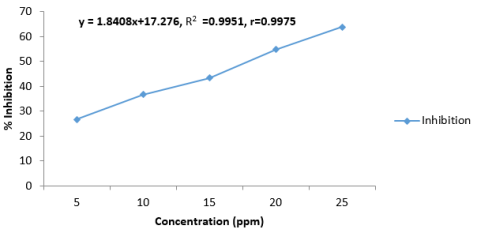
Concentration | Absorbance | Absorbance | Percentage (%) | IC50 |
|---|---|---|---|---|
(mg/L) | Extract | DPPH | Inhibition | (mg/L) |
5 | 0.523 | 0.716 | 26.955 | |
10 | 0.460 | 0.716 | 35.754 | |
15 | 0.407 | 0.716 | 43.156 | 16.28 |
20 | 0.328 | 0.716 | 54.166 | |
25 | 0.268 | 0.716 | 62.570 |
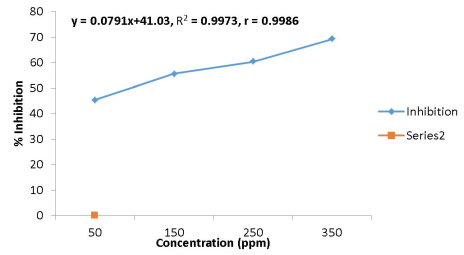
Concentration (mg/L) | Absorbance | % Inhibition | IC50 (ppm) |
|---|---|---|---|
Negative Control | 1.340 | - | |
50 | 0.731 | 45.69 | |
150 | 0.629 | 53.27 | 115.20 |
250 | 0.528 | 60.77 | |
350 | 0.412 | 69.39 |
ABC | Absorbance |
BSA | Bovine Serum Albumin |
DPPH | 2, 2-diphenyl-1-picrylhydrazyl |
FRAP | Ferric Reducing Oxidation Power |
| [1] | Abidin, Z., Aminah, Razak R., Pratama, M. Phytochemical Constituents, Antioxidant and Anti-inflammatory Potentials of Dechlorophyllized Extract of Kenikir Leaves (Cosmos caudatus Kunth). Trop J Nat Prod Res. 2025, 9(5), 1958 – 1963 |
| [2] | Mera, IFG., Falcon, DEG., Córdova, VM. Secondary Metabolites In Plants: Main Classes, Phytochemical Analysis and Pharmacological Activities. Bionatura Lat Am J Biotechnol Life Sci. 2019, 4(4), 1000-1009. |
| [3] | Zhang, M., Zhao, J., Li, XDaX. Extraction and Analysis of Chemical Compositions of Natural Products and Plants. Separations J. 2023, 10(598), 1-29. |
| [4] | Stuper-Szablewska, K., Szablewski, T., Przybylska-Balcerek, A., Szwajkowska-Michałek, L., Krzyżaniak, M., Świerk, D., Cegielska-Radziejewska, R., Krejpcio, Z. Antimicrobial Activities Evaluation and Phytochemical Screening of Some Selected Plant Materials Used in Traditional Medicine. Molecules. 2023, 28(1), 244. |
| [5] | Ayatollahi, A., Shojaii, A., Kobarfard, F., Mohammad, zadeh M., Choudhary, M. Two flavones from Salvia leriaefolia. Iran J Pharm Res 2010, 8, 179-84. |
| [6] | Mokogwu, ATH., Amaihunwa, KC., Adjekuko, CO., Ekene, EN., Okoro, EO., Adeosun, OG. In vivo Antimalarial and Liver function Profile of Salvia officinalis (Common Sage) Leaf in Plasmodium-berghei Infected Mice. Ethiop J Health Sci. 2024, 34(4), 290-300. |
| [7] | Lahlou, Y., Moujabbir, S., Aboukhalaf, A., El Amraoui, B., Toufiq, B. Antibacterial Activity Of Essential Oils Of Salvia Officinalis Growing In Morocco (National Institute of Public Health) Rocz Panstw Zakl Hig. 2023, 74(4), 459-468 |
| [8] | Mokogwu, ATH., Adjekuko, CO., Oshilonyah, UH., Ikpefan, JO., Eyenubo, OB., Avwioro, OG. Hypoglycaemic and Hypolipidemic Effects of Alcoholic Extract of Common Sage (Salvia Officinalis) In Streptozotocin-Induced Diabetic Rabbits. Afr J Biomed Res. 2020b, 25(6), 243-247. |
| [9] | Mokogwu, ATH., Adjekuko, CO., Oshilonyah, UH., Ikpefan, JO., Avwioro, GO. Antihypertensive and Cardioprotective Effects of Salvia officinalis (Sage) Leaf in NG-Nitro- L Arginine Methyl Ester (L-NAME) Induced Hypertensive Wistar Rats. Trop J Nat Prod Res. 2022a, 6(12), 2047-2050. |
| [10] | Harizia, A., Benguerai, A., Elouissi, A., Mahi, T., Bonal, R. Chemical composition and biological activity of Salvia officinalis L. essential oil against Aphis fabae Scopoli (Hemiptera: Aphididae). J Plant Diseases Protection. 2021, 128(6), 1547-1556. |
| [11] | Privitera, G., Luca, T., Castorina, S., Passanisi, R., Ruberto, G., Napoli, E. Anticancer activity of Salvia officinalis essential oil and its principal constituents against hormone-dependent tumour cells. Asian Pacific Journal of Tropical Biomedicine. 2019, 9(1), 24-28. 10.4103/2221- 1691.250266. |
| [12] | Marvic, M., Stefan, MB., Kindl, M., Blazekovic, B., Marijan, M., Vladimir-Knezvic, S. Conparative Antioxidant, Anti-Acetylcholinesterase and Anti-α-Glucosidase activity of Mediterranean Salvia Species. Plants 2022, 11, 625. |
| [13] | Boufadi, MY., Keddari, S., Moulai-Hacene, F., Chaa, S. Chemical Composition, Antioxidant and Anti-Infammatory Properties of Salvia Officinalis Extract from Algeria. Pharmacogn J. 2021, 13(2), 506-16. |
| [14] | El-Jery, A., Hasan, M., Rashidi, MM., Al Mesfer, MK., Danish, M., Rebah, FB. Phytochemical characterization and ant-microbial activity of essential oil from leaves of the common sage Salvia officinalis L. from Abha, Saudi Arabia. Asian Biomed. 2020, 14(6), 261-270 |
| [15] | Mokogwu, ATH., Adjekuko, CO., Oshilonyah, HU., Avwioro, OG. Studies of Salvia officinalis leaf extract on some biochemical parameters in rats induced with overdosed tramadol. Afr J Biotech. 2020a, 21(8), 353-360. |
| [16] | Stéphane, FFY., Jules, BKJ., Batiha, GES., Ali, I., Bruno, LN. Extraction of Bioactive Compounds from Medicinal Plants and Herbs. In Pharmacognosy - Medicinal Plants. Intech Open. 2021, 1-39 p. |
| [17] | Kouar, J., Lamsaddek, A., Benchekroun, R., Amrani, AE., Cherif, A., Bellahcen, TO., Kamil, N. Comparison Between Electrocoagulation and Solvent Extraction Method in the Process of the Dechlorophyllation of Alcoholic Extracts from Moroccan Medicinal Plants Petroselinum crispum, Thymus satureioides and Microalgae Spirulina platensis. SN Appl Sci. 2019, 1, 132 |
| [18] | Pebriana, RB., Lukitaningsih, E., Khasanah, SM. Dechlorophyllation of Cosmos caudatus Kunth., Morinda citrifolia, and Mangifera indica L. Leaves Methanolic Extract by Electrocoagulation Technique. Trad Med J. 2017, 22(3), 190-198. |
| [19] | Suppalak, P., Gorawit, Y., Attapon, S., Nattapon, T., Seiichi, S., Waraporn, P. A green and effective method using oils to remove chlorophyll from Chromolaena odorata (L.) R. M. King & H. Rob. Songklanakarin J Sci Technol. 2020, 42(5), 1084-1090. |
| [20] | Kusuma, AT., Adelah, A., Abidin, Z., Najib, A. Determination of Flavonoid Content of Ethyl Acetate Extract of Breadfruit Leaves (Artocarpus altilis). Ad-Dawaa’ J Pharmac Sci. 2018, 1(1), 25-31. |
| [21] | Mapoung, S., Semmarath, W., Arjsri, P., Umsumarng, S., Srisawad, K., Thippraphan, P., Yodkeeree, S., Limtrakul, P. Determination of Phenolic Content, Antioxidant Activity, and Tyrosinase Inhibitory Effects of Functional Cosmetic Creams Available on the Thailand Market. Plants J. 2021, 10(1383), 1-18. |
| [22] | Cheok, CY., Salman, HAK., Sulaiman, R. Extraction and Quantification of Saponins: A Review. Food Res Int. 2014, 59, 1640. |
| [23] | Ojha, S., Raj, A., Roy, A., Roy, S. Total Extraction of Phenolics, Flavonoids and Tannins from Paederia foetida L. Leaves and Their Relationship to Antioxidant Activity. Jur Farmakog 2018, 10(3), 541-547. |
| [24] | Ouriagli, T., Amnay, A., Raoui, SM., Errachidi, F., Chahdi, FO., Chabir, R. Alkaloids from Marrubium vulgar L.: Antioxidant and AntiInflammatory Activities as a Function of Extraction Methods. Trop J Nat Prod Res. 2023, 7(7), 3411-3420. |
| [25] | Faisal, H., Handayani, S. Comparison of Antioxidant Activity of Ethanol Extract of Fruit and Okra Leaves (Abelmoschus esculentus L. Moench) by DPPH and ABTS Methods. Indo J Pharm Clin Res. 2019, 02(2), 06-13. |
| [26] | Masri, AA., Bakar, FIA., Abidin, MZ., Malik, NH. Development of Antioxidant Jelly Using Tropical Fruits. Trop J Nat Prod Res. 2023, 7(7), 3433-3438. |
| [27] | Almira, D., Subaidah, WA., Ananto, AD., Deccati, RF., Muliasari, H. In Vitro Concentration Optimization of Ethanol Extract from Makasar Fruit Seeds (Brucea javanica L. Merr) as an Anti-Inflammatory Agent. J Pij MIPA. 2021, 16(5), 595-599. |
| [28] | Amin, A., Khairi, N., Hendrarti, W. Antioxidant Activity of Ethanol Extract of Stems, Leaves and Roots of Kopasanda (Chromolaena odorata L.) with FRAP (Ferric Reducing Antioxidant Power) Method. J Sains Kes. 2022, 4(5), 473-480. |
| [29] | Ganesan, MA. Phytochemical of Chromolaena Odorata. Universiti Putra Malaysia, Faculty of Forestry. 2018. |
| [30] | Aung, WW., Panich, K., Watthanophas, S., Naridsirikul, S., Ponphaiboon, J., Krongrawa, W., Kulpicheswanich, P., Limmatvapirat, S., Limmatvapirat, C. Preparation of Bioactive De-Chlorophyll Rhein-Rich Senna alata Extract. Antibiotics J. 2023, 12(181), 1-25. |
| [31] | Tagrida, M., Benjakul, S. Betel (Piper betle L.) Leaf Ethanolic Extracts Dechlorophyllized Using Different Methods: Antioxidant and Antibacterial Activities, and Application for Shelf-life Extension of Nile Tilapia (Oreochromis niloticus) Fillets. R Soc Chem Adv. 2021, 11, 17630-17641. |
| [32] | Abidin, Z., Putri, UA., Widiastuti, H. Potensi Anti-inflamasi Fraksi Etil Asetat Ranting Patah Tulang (Euphorbia tirucalli L.) dengan Uji Penghambatan Denaturasi Protein. J. Pharm Sciences (DJPS). 2019, 2(2), |
APA Style
Mokogwu, A. T. H., Okocha, E. E., Amaihunwa, K. C., Ochonogor, I., Ekene, E. N., et al. (2026). Chemical Constituents, Antioxidant and Anti-inflammatory Properties of De-chlorophyllized Extracts of Salvia officinalis Leaf. International Journal of Biomedical Science and Engineering, 14(2), 42-50. https://doi.org/10.11648/j.ijbse.20261402.11
ACS Style
Mokogwu, A. T. H.; Okocha, E. E.; Amaihunwa, K. C.; Ochonogor, I.; Ekene, E. N., et al. Chemical Constituents, Antioxidant and Anti-inflammatory Properties of De-chlorophyllized Extracts of Salvia officinalis Leaf. Int. J. Biomed. Sci. Eng. 2026, 14(2), 42-50. doi: 10.11648/j.ijbse.20261402.11
@article{10.11648/j.ijbse.20261402.11,
  author = {Azukaego Thomas Hughs Mokogwu and Emeka Edward Okocha and Kingsley Chukwuka Amaihunwa and Ikemefune Ochonogor and Enekabokom Nwoke Ekene and Benson O Eyenubo and Godwin O Avwioro},
  title = {Chemical Constituents, Antioxidant and Anti-inflammatory Properties of De-chlorophyllized Extracts of Salvia officinalis Leaf},
  journal = {International Journal of Biomedical Science and Engineering},
  volume = {14},
  number = {2},
  pages = {42-50},
  doi = {10.11648/j.ijbse.20261402.11},
  url = {https://doi.org/10.11648/j.ijbse.20261402.11},
  eprint = {https://article.sciencepublishinggroup.com/pdf/10.11648.j.ijbse.20261402.11},
  abstract = {Background: Salvia officinalis is a medicinal plant used for the treatment of various disorders such as inflammation, rheumatism, ulcers, dizziness, high blood pressure and high blood sugar. Studies have associated its medicinal properties to its strong chemical constituents and various pharmacological effects. Objectives: The work was to evaluate the total contents of flavonoid, phenolic, saponins and tannin along with the antioxidant and anti-inflammatory properties of dechlorophyllized ethanol extract of Salvia officinalis leaf. Method: The Salvia officinalis leaves were macerated in ethanol and liquid-liquid extraction to obtain complete removal of the chlorophyll content. While the phytochemical constituents and the antioxidant, anti-inflammatory activities of dechlorophyllized extract of Salvia officinalis leaf were estimated by standard methods. Results: The flavonoid, phenolic, saponins and tannin contents of the Salvia officinalis dechlorophyllized leaves were 64.517mgQE/g, 91.433mgGAE/g, 185.666mgSE/g and 47.333mg/TAE/g extract respectively. The dechlorophylized extract had high antioxidant activity: ferric reducing antioxidant power (FRAP) of 14.157mg/l QE and IC50 of 16.28ppm with 2, 2-diphenyl-1-picrylhydrazyl (DPPH) radical scavenging activity. It had potent anti-inflammatory activity with IC50 value of 115.201ppm. Conclusion: The results demonstrated that Salvia officinalis leaf is a source of antioxidant and anti-inflammatory pharmacologic agents.},
 year = {2026}
}
TY  - JOUR
T1  - Chemical Constituents, Antioxidant and Anti-inflammatory Properties of De-chlorophyllized Extracts of Salvia officinalis Leaf
AU  - Azukaego Thomas Hughs Mokogwu
AU  - Emeka Edward Okocha
AU  - Kingsley Chukwuka Amaihunwa
AU  - Ikemefune Ochonogor
AU  - Enekabokom Nwoke Ekene
AU  - Benson O Eyenubo
AU  - Godwin O Avwioro
Y1  - 2026/05/08
PY  - 2026
N1  - https://doi.org/10.11648/j.ijbse.20261402.11
DO  - 10.11648/j.ijbse.20261402.11
T2  - International Journal of Biomedical Science and Engineering
JF  - International Journal of Biomedical Science and Engineering
JO  - International Journal of Biomedical Science and Engineering
SP  - 42
EP  - 50
PB  - Science Publishing Group
SN  - 2376-7235
UR  - https://doi.org/10.11648/j.ijbse.20261402.11
AB  - Background: Salvia officinalis is a medicinal plant used for the treatment of various disorders such as inflammation, rheumatism, ulcers, dizziness, high blood pressure and high blood sugar. Studies have associated its medicinal properties to its strong chemical constituents and various pharmacological effects. Objectives: The work was to evaluate the total contents of flavonoid, phenolic, saponins and tannin along with the antioxidant and anti-inflammatory properties of dechlorophyllized ethanol extract of Salvia officinalis leaf. Method: The Salvia officinalis leaves were macerated in ethanol and liquid-liquid extraction to obtain complete removal of the chlorophyll content. While the phytochemical constituents and the antioxidant, anti-inflammatory activities of dechlorophyllized extract of Salvia officinalis leaf were estimated by standard methods. Results: The flavonoid, phenolic, saponins and tannin contents of the Salvia officinalis dechlorophyllized leaves were 64.517mgQE/g, 91.433mgGAE/g, 185.666mgSE/g and 47.333mg/TAE/g extract respectively. The dechlorophylized extract had high antioxidant activity: ferric reducing antioxidant power (FRAP) of 14.157mg/l QE and IC50 of 16.28ppm with 2, 2-diphenyl-1-picrylhydrazyl (DPPH) radical scavenging activity. It had potent anti-inflammatory activity with IC50 value of 115.201ppm. Conclusion: The results demonstrated that Salvia officinalis leaf is a source of antioxidant and anti-inflammatory pharmacologic agents.
VL  - 14
IS  - 2
ER  -
Department of Medical Laboratory Science, Delta State University, Abraka, Nigeria
Prince Abdul Mohsen Hospital, Alula, Saudi Arabia
Department of Medical Laboratory Science, Delta State University, Abraka, Nigeria
Department of Medical Laboratory Science, Delta State University, Abraka, Nigeria
Department of Science Laboratory Technology, Delta State University, Abraka, Nigeria
Department of Medical Laboratory Science, Delta State University, Abraka, Nigeria

Information


 Share This Article
 Twitter
 Linked In
 Facebook
 Copy
Copy Download